Impact of Periodontal Intervention on Local inflammation,
Periodontitis and HIV Outcomes
J. Valentine1, A E Sanders2, T Saladyanant2, K Ramsey4, J Blake2, T Morelli1, J
Southerland3, E B Quinlivan5, J Nelson3, K DeParis3, and J Webster-Cyriaque2,3,5
1Department of Periodontology, School of Dentistry, University of North Carolina at Chapel Hill,
Chapel Hill, North Carolina
2Department of Dental Ecology, School of Dentistry, University of North Carolina at Chapel Hill,
Chapel Hill, North Carolina
3Department of Microbiology and Immunology, School of Medicine, University of North Carolina at
Chapel Hill, Chapel Hill, North Carolina
4Department of Dental Research, School of Dentistry, University of North Carolina at Chapel Hill,
Chapel Hill, North Carolina
5Institute of Global Health and Infectious Diseases, School of Medicine, University of North
Carolina at Chapel Hill, Chapel Hill, North Carolina
Abstract
Objective—Periodontal disease resolution was hypothesized to impact systemic HIV measures.
Methods—In this longitudinal cohort study, 73 HIV-positive subjects received comprehensive dental care. AAP, CDC/AAP and biofilm gingival interface case definitions determined
periodontal classification. In a subset, IL-6 was measured. Multivariable binary logistic regression models estimated odds of periodontitis development for comparisons between HIV and NHANES (2009–12) groups.
Results—In both groups, moderate/severe periodontitis was positively associated with non-white race, smoking, male gender, low income and increased pro-inflammatory cytokines. Likelihood of HIV periodontitis was higher across demographic variables. Subjects with severe periodontitis on antiretroviral therapy demonstrated high plasma viral loads at baseline (median= 464 co/ml; mean 65,773 co/ml). Post intervention, HIV periodontitis distribution became similar to NHANES and IL-6 levels decreased 2-fold (p=0.07). Subjects with suppressed viral load at baseline
demonstrated increased CD4 counts at 12 months post intervention (P=0.027) (n=26).
Conclusions—Smoking, being non-white and low income were associated with periodontitis in HIV and NHANES. Higher Il-6, higher HIV VL and lower CD4 were associated with moderate/ severe periodontal disease. Periodontitis decreased significantly with treatment producing
periodontal profiles mirroring the national norm. In a subset of suppressed subjects, decreased oral inflammation, and associated microbial translocation, yielded improved CD4 counts.
HHS Public Access
Author manuscript
Oral Dis
. Author manuscript; available in PMC 2016 October 01.Published in final edited form as:
Oral Dis. 2016 April ; 22(Suppl 1): 87–97. doi:10.1111/odi.12419.
A
uthor Man
uscr
ipt
A
uthor Man
uscr
ipt
A
uthor Man
uscr
ipt
A
uthor Man
uscr
Keywords
Periodontal disease; HIV; inflammation; microbial translocation
Introduction
Oral lesions associated with human immunodeficiency virus (HIV) include oral candidiasis, Kaposi’s sarcoma, lymphoma and hairy leukoplakia (Greenspan & Greenspan, 2002). During the era of antiretroviral therapy (ART) oral human papilloma virus (HPV) and HIV associated salivary gland disease have been on the rise(Greenspan & Greenspan, 2002; Jeffers & Webster-Cyriaque, 2011). While HIV/AIDS associated periodontal lesions including linear gingival erythema, necrosing ulcerative periodontitis (NUP) and ulcerative gingivitis (NUG) are not as prevalent as pre-ART, chronic periodontitis remains an issue in the HIV/ AIDS population.
Along with many other systemic diseases, HIV/AIDS has been documented to impact the periodontium (Ryder, Nittayananta, Coogan, Greenspan, & Greenspan, 2012). Periodontitis is characterized by the interaction between the host immune reaction to periodontal pathogenic microorganisms. While largely identified as an inflammatory disease caused by bacteria and bacterial by-products detected in dental plaque, there is growing evidence that viral infections are involved in periodontal disease(Morris, Arnold, & Webster-Cyriaque, 2007; Slots, 2002). This inflammatory process is characterized by destruction of the attachment apparatus surrounding the teeth. The 2009–2012 National Health and Nutrition Examination Survey (NHANES), estimated that 46 percent (64.7 million) of the United States population has periodontitis, of which 8.9 and 37.1 percent suffer from severe and mild-moderate forms of the disease, respectively(Eke et al., 2015). Increasing evidence suggests that the chronic periodontal infection is implicated in the generation of a systemic inflammatory response, which represents a potential risk factor for worsening various systemic conditions including atherosclerosis, stroke, diabetes and others(Nibali et al., 2007; Williams & Offenbacher, 2000)
Chronic periodontal disease has been categorized using different classification systems. The most widely used classification system is based on clinical attachment levels, as described by Armitage and adopted by the American Academy of Periodontology (AAP)(Armitage, 1999). For the purposes of population surveillance, the Centers for Disease Control and Prevention developed a case classification in conjunction with the American Academy of Periodontology (CDC/AAP) based on periodontal probing depths and clinical attachment levels (Eke, Page, Wei, Thornton-Evans, & Genco, 2012). Lastly, the Biofilm Gingival Interface (BGI), a classification system based on bleeding on probing and probing depths, has been described by Offenbacher, et al(Offenbacher et al., 2007). The BGI classification reflects current periodontal status rather than historical levels of disease activity.
The systemic impact of HIV is multifaceted. Broad depletion of immune function allows susceptibility to opportunistic infections(Alarcón et al., 2012). Further, systemic immune activation occurs secondary to microbial translocation. The degree of immune activation is strongly correlated with disease progression, morbidity and mortality(Brenchley et al., 2006;
A
uthor Man
uscr
ipt
A
uthor Man
uscr
ipt
A
uthor Man
uscr
ipt
A
uthor Man
uscr
Hunt, 2012; Jiang et al., 2009; Klatt, Funderburg, & Brenchley, 2013; Sandler & Douek, 2012). Decreased production of protective interleukins (IL), such as IL17 and IL22, decreased IgA production, and decreased phagocytic function results in the compromise of epithelial tight junctions throughout the GI tract(Klatt et al., 2013). This allows for escape of immune-activating bacterial products into the systemic circulation. While immune activation related microbial translocation from the GI tract has been well documented, the oral cavity may also serve as an important a source of microbial translocation.
The mouth may harbor over 700 different bacterial species, billions of bacteria and a multitude of viruses and fungi. Teeth are transmucosal, with crowns exposed to the
contaminated oral cavity and root structures secured within maxillary and mandibular bone. The two environments are separated by a junctional epithelium that functions as a barrier to prevent the penetration of bacteria and bacterial products to underlying connective tissue and bone. During chronic periodontal disease, the junctional epithelial seal is widened, leading to the translocation of bacteria and bacterial by-products to the underlying connective tissue and bone(Bosshardt & Lang, 2005) Thus, chronic periodontal disease possesses the potential for oral microbial translocation as source of systemic inflammation. In this study, we aimed to compare our HIV cohort to a nationally representative sample in order to assess the effect of periodontal intervention on HIV population, locally and systemically.
Methods and Materials
Study Design
A cohort of 196 HIV positive subjects were followed longitudinally. This group was part of a multisite SPNS Oral Demonstration Project. Approval was obtained from the Institutional Review Boards of the University of North Carolina at Chapel Hill (UNC) and the Evaluation Center for HIV and Oral Health at Boston University. The multisite centers maintained human subjects’ approval for the overall and individual studies. Within this sub study, 48 adult HIV-positive participants who had not received dental care, with the exception of emergency care, in the previous 12 months were recruited and enrolled. Additionally, 25 HIV positive subjects who had received dental care within the past 12 months were recruited and enrolled. For all 73 subjects, data were collected every 6 months including periodontal metrics; probing depths, bleeding on probing, clinical attachment loss. Baseline, 12- and 24-month assessments were included in this analysis and at these time points saliva was collected. Comprehensive dental care for the 73 participants included dental prophylaxis at least every 6 months, scaling and root planing, oral hygiene instruction, extractions, restorative and prosthetic dentistry.
The baseline interview collected data on socio demographic characteristics; mode of HIV transmission; past substance use, tobacco use, and alcohol use; barriers to accessing oral health care since testing HIV-positive; and oral health-care habits. Interviews were conducted in both English and Spanish, and all participants gave informed consent to participate. Baseline data collection occurred from January 2008 to August 2009. Interviewers participated in a standardized training module. Data was entered into a web-based database hosted by the multisite coordinating center, where the data were merged into a single multisite database. Subjects were administered a questionnaire and received
A
uthor Man
uscr
ipt
A
uthor Man
uscr
ipt
A
uthor Man
uscr
ipt
A
uthor Man
uscr
comprehensive dental care as described above. Periodontal values were obtained, including probing depth, clinical attachment level, and bleeding on probing. All examiners were calibrated to a gold standard (kappa>0.9). Demographic values, smoking status, CD4 counts and HIV viral load were recorded. In a subset of 26 subjects, saliva samples were collected for measurement of pro-inflammatory cytokines.
Measures
The outcome of significance for the current analysis was periodontal status pre and post intervention. Using the American Academy of Periodontology (AAP) and Centers for Disease Control and Prevention/ American Academy of Periodontology (CDC/ AAP) and biofilm gingival interface (BGI) classifications, participants were classified based on periodontal disease severity at baseline and 12 months. Age-adjusted predicted probabilities for development of moderate/severe periodontal disease were determined using the
CDC/AAP case classification from multivariable binary logistic regression models for both the NHANES and HIV cohorts. Relationships to demographics, smoking, HIV viral load and concentration of pro-inflammatory cytokines were examined.
Enzyme-linked immunosorbent assay (ELISA) for pro-inflammatory cytokines
ELISA assays were used to measure IL-6 levels (Quantikine Kit; R&D systems). Saliva was assayed in duplicate following manufacturer’s instructions. Concentrations of the mediator was determined by optical density at the manufacturer’s recommend wavelength using a microplate reader (Epoch microplate spectrophotometer; Biotek). Duplicate readings were averaged and values were multiplied by the dilution factor.
Results
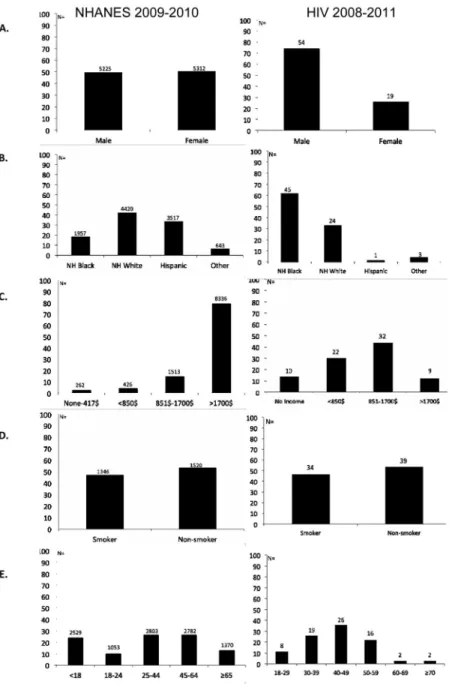
One hundred and ninety six participants enrolled in the UNC HIV Demonstration project from 2008 to 2011 and 73 met the criteria for inclusion in this 24 month analysis. There were 54 men and 19 women (Figure 1). Overall the mean age of participants was 36 years, 45 were Black non-Hispanic (NH), 24 were white non-Hispanic, 1 was Hispanic and 3 were of other ethnicities. At baseline, the overall CD4 mean was 517 cells/ml; median 490 cells/ml and HIV viral load was mean 72043 copies per ml; median 62 copies/ml. In this cohort, 53% were non-smokers. In the NHANES 2009–12 sample, 5225 men and 5312 women over age 30 were included, of these 1957 were Black non-Hispanic, 4420 were white non-Hispanic, 3517 were Hispanic and 643 were of other ethnicities (Figure 1). A subset of the HIV group were assessed for cytokines (n=26). Comprehensive care including oral examination and one on one and web based oral hygiene instruction were provided to all 73 individuals every 6 months. All subjects were seen at least 6 month intervals. For the 73 participants there were 293 dental prophylaxis/periodontal maintenance procedures, 19 scaling and root planing procedures, 33 underwent periodontal debridement, 127 dental extractions, and 325 restorations were placed.
A
uthor Man
uscr
ipt
A
uthor Man
uscr
ipt
A
uthor Man
uscr
ipt
A
uthor Man
uscr
Dental intervention in HIV positive participants resulted in periodontal disease distribution similar to that of a nationally representative sample
73 HIV positive subjects were classified according to AAP, CDC/AAP, and BGI periodontal disease classification systems at baseline and 12 months (Figure 2). With the AAP/ CDC classification, at baseline 37 of 73 subjects were classified as having moderate periodontitis, 7/73 were severe, 11 were classified as mild and 18 of 73 were classified as having a healthy periodontium. After the treatment intervention 29/73 were classified as having a healthy periodontium, 4/73 were severe, 5/73 were mild and 35/ 73 were classified as having moderate periodontitis. Post-treatment the HIV group more closely approximated the bimodal distribution of the nationally representative NHANES 2009–10 sample, with the majority of subjects in the healthy (n=1976) and moderate (n=1123) categories. The biologically based classification, BGI, determined that the majority of the subjects had severe disease at baseline 46/73. Post-treatment only 1 subject remained in the severe disease category and there were 44/73 subjects in the diseased moderate category. The AAP classification at both baseline and post-intervention categorized the majority of subjects as having mild periodontitis, with 64/73 and 68/73 in the mild category baseline and post intervention, respectively. Compared to the AAP classification, the BGI and the CDC/AAP classifications more accurately reflected active disease and periodontal disease resolution.
In HIV infected subjects, differences in age, smoking, and income were not associated with development of severe periodontal disease
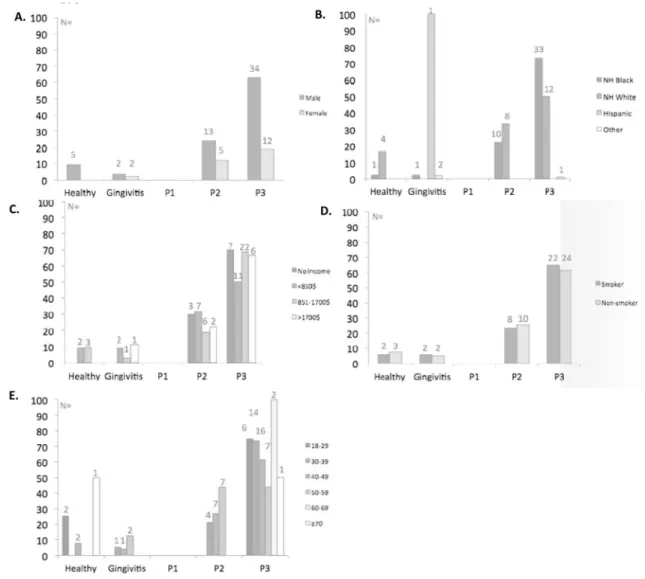
BGI case classifications were used to assess frequency of periodontal health, gingivitis and disease in the context of demographic variables. Severe periodontal disease in the HIV cohort was detected across all income levels and across all ages (Figure 3). An equivalent number of smokers and non-smokers had severe periodontal disease. Severe periodontal disease was detected in 70% of HIV positive non-Hispanic blacks and in 50% of HIV positive non-Hispanic whites. At baseline, severe periodontal disease was detected in 60% of men and in 20% of women with HIV infection. A higher percentage of men were detected in the moderate disease category.
In HIV infected subjects, the likelihood of developing moderate and severe periodontal disease was higher for all demographic risk factors compared to a nationally
representative sample
Age-adjusted predicted probabilities (95% CI) of moderate/severe periodontitis were determined using CDC/AAP case classifications derived from multivariable binary logistic regression models. Estimates for men and women demonstrate a clear increased risk for men compared to women in the NHANES sample. In the HIV cohort the risk of periodontal disease development was more equivalent between genders (Figure 4A). The likelihood of developing moderate/severe periodontal disease was associated with increasing age in the NHANES sample. However, in the HIV cohort, the likelihood of developing disease was similar throughout the lifespan (Figure 4B). Being non-Hispanic black and Hispanic were associated with a higher likelihood of moderate/severe disease than being white in both the NHANES and HIV groups (Figure 4C). While lower annual family income was associated with increased likelihood of moderate/severe periodontal disease in NHANES, the
A
uthor Man
uscr
ipt
A
uthor Man
uscr
ipt
A
uthor Man
uscr
ipt
A
uthor Man
uscr
likelihood of periodontal disease development was high across all income strata in the HIV group (Figure 4D). However, at $1700 per month, the highest income strata for HIV, the $20,400 annual income was roughly equivalent to the lowest income group for the NHANES at less than $25,000 annual income. While nonsmokers were least likely to develop mod/ severe periodontal disease in NHANES, in the HIV group the likelihood of disease was similar regardless of smoking status (Figure 4E). Importantly, while the likelihood of moderate/severe disease development across different risk factors was generally in the 0.2– 0.6 range for the NHANES sample, in the HIV cohort the probability across risk factors was at least 2 fold higher in the 0.4 to 0.8 range.
Pro-inflammatory Cytokines were associated with increased risk of developing moderate/ severe periodontal disease
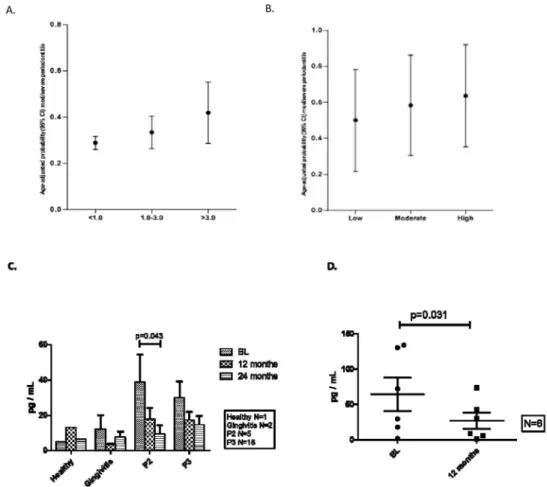
Age-adjusted predicted probabilities (95% CI) of moderate/severe periodontitis were determined for pro-inflammatory cytokines. C- reactive protein (CRP), an acute phase reactant and systemic marker of inflammation, was measured in NHANES. Those individuals with CRP levels in the highest tertile had the highest likelihood of periodontal disease (Figure 5A). The pro inflammatory cytokine IL-6 was measured in oral fluids from HIV positive individuals (n=26). Those individuals with highest IL-6 levels had the highest probability of moderate/severe periodontal disease at baseline (Figure 5B). Importantly, dental intervention resulted in overall decreased salivary IL-6 levels that approached statistical significance p=0.07. By 24 months the intervention resulted in a statistically significant decrease in in the moderate disease group (P=0.043) (Figure 5C). Post intervention IL-6 levels were also assessed in a virologically suppressed subgroup in the context of successful HIV therapy (Figure 5D). Mean IL-6 levels at baseline were 64.43 pg/ml in the suppressed group (n=6). At 12 months mean IL-6 levels in this group dropped to 26.96 pg/ml (p=0.031).
Severe periodontal disease was associated with high HIV VLs and lower CD4 counts
At the time of the 12 month assessment 61 subjects were on ART for at least one year. However, 7 of the 61 individuals were within one year of their HIV diagnosis at baseline. The overall HIV VL at baseline was median = 139 copies /ml; mean 81,755 co/ml (n=61). BGI classification at baseline determined that a detectable HIV VL was present in 15 of 39 HIV positive individuals in the severe periodontal disease group, mean 65,773 co/ml; median= 464 copies /ml) (N=39), and in 7 of 14 in the moderate disease group, mean= 170,334 copies /ml; median= 49.5 copies/ml. The high mean in the moderate group was largely due to one individual with a baseline HIV VL of 2,340,000 copies /ml. Four subjects with gingivitis had an HIV VL of mean =1043 copies/ml; median =80.5 copies/ml. The four healthy individuals were undetectable at baseline. Baseline group assignments were used throughout the analysis even though several individuals changed in actual disease status at the time of follow-up. At 12 months, HIV VL in the severe group was mean= 8680 copies /ml; median <49 copies /ml (undetectable), in the moderate group was mean<49 copies /ml; median <49 copies /ml, and in subjects with gingivitis was undetectable (n=61). A HIV VL of mean= 5393 copies/ml; median <49 copies/ml represented a one log decrease in the overall mean HIV VL at 12mo (n=61) (P=.0032) (Figure 6A). Declines in viral load were detected by 24 months with a mean HIV VL of 337 copies/ml (P=0.0063). At baseline
A
uthor Man
uscr
ipt
A
uthor Man
uscr
ipt
A
uthor Man
uscr
ipt
A
uthor Man
uscr
overall CD4 levels were mean=508 cells/ml; median=466 cells/ml and rose to mean=618 cells/ml; median=537 cells/ml at 12 months (P=0.033). At 24 months, CD4 levels rose to a mean= 751 cells/ml; median=730 cells/ml (P=0.0006). While CD4 increases in the moderate disease group were not statistically significant, CD4 cell increases the severe disease group were at 12 months (p=0.038) and at 24 months (p<0.01).
Improved HIV metrics could have been associated with effective ART as well as the dental intervention. Of the 39 subjects with severe periodontitis, there were 8 individuals in the severe periodontitis group who were within 1 year of their HIV diagnosis at baseline, thus had been on ART less than 1 year at baseline. Removal those individuals from the analysis demonstrated a mean HIV VL of 65,121 copies/ml; median 139 co/ml and mean CD4=546 cells/ml at baseline, a mean HIV VL= 10,905 co/ml; median <49co/ml and mean CD4 of 609 cells/ml at 12 months, and a mean HIV VL 441 co/ml; median <49 co/ml and mean CD4 of 778 cell/ml at 24 months (n=31) (Figure 6B). Overall, CD4 increases in this group were not statistically significant at 12 months (p=0.175), however significance was achieved by 24 months p=0.0003. Post intervention, CD4 changes were further assessed in the context of successful HIV therapy. There were 26 individuals in the moderate and severe disease groups at baseline with undetectable viral loads suggesting effective ART. These subjects had a mean CD4=517 cells/ml; median =490 cells/ml at baseline, and increased at 12 months to mean CD4 =642 cells/ml; median=490 cells/ml. The response was assessed at 24 months in 17 subjects who had a mean CD4= 619 cells/ml; median 500 cells/ml that increased at 24 months, to a mean CD4= 730 cells/ml; median 647 cells/ml. This reflected a sustained statistically significant increase in CD4 with the dental intervention in suppressed subjects (p=0.0277) (Figure 6C).
Discussion
Like the NHANES sample, smoking, being non-white and low income were associated with periodontal disease in HIV. Interestingly, in the HIV group, periodontal disease manifested across the age groups and severe disease was detected at the same rate in women and men. However, being HIV positive enhanced risk of having moderate/severe periodontal disease over and above the NHANES group for every demographic variable. Our findings were highly clinically relevant; dental treatment and aggressive oral hygiene in HIV resulted in a periodontal profile similar to that of the US healthy population. While the data do not remove the possibility that effective ART was responsible for viral load and CD4 count change, they do suggest that decreased oral infection and inflammation were associated with improved HIV metrics. This was confirmed in a group of twenty six subjects who were suppressed at baseline and demonstrated increased CD4 counts (p= 0.023) and decreased IL-6 (p=0.27) post intervention.
Use of a periodontal classification system that reflects the biology of disease is an important metric in those with a systemic inflammation-associated disorder. Distinct profiles of periodontal disease and disease resolution were detected comparing different periodontal classification systems in the HIV cohort. Inclusion of probing depths in the CDC/AAP classification facilitates biological relevance. At baseline, the majority of individuals were in the CDC/AAP severe group, treatment brought the HIV cohort to a distribution similar to
A
uthor Man
uscr
ipt
A
uthor Man
uscr
ipt
A
uthor Man
uscr
ipt
A
uthor Man
uscr
that of NHANES with most individuals in the CDC/AAP healthy and moderate groups. Inflammation is an important driver of both periodontal disease and HIV. BGI includes bleeding on probing as a metric, an important indicator of oral and periodontal
inflammation. Of all classification systems, BGI demonstrated the most significant shifts associated with the dental intervention moving virtually all of the severe category into the moderate disease group by 12 months. These findings demonstrate the importance of including inflammation as a disease indicator. The periodontal field has now recognized the importance of this indicator and a recent task force was convened to address the addition of bleeding on probing to the AAP classification to begin 2017.
Periodontal disease is associated with circulating microbial products. Bacterial translocation into systemic circulation from the periodontal pocket is a common event, as supported by detection of bacteremia subsequent to relatively minor periodontal events and procedures. The massive bacterial load of the gut is thought to drive microbial translocation causing HIV related systemic immune activation(Brenchley et al., 2006). We posit that the mouth
contributes to microbial translocation in HIV systemic immune activation. While periodontitis has been shown not to cause atherosclerotic vascular disease, periodontal interventions do result in reduction of systemic inflammation(Lockhart et al., 2012). In this study, following dental treatment, salivary levels of the systemic immune activation associated pro-inflammatory cytokine IL6, decreased from baseline to 12 months (p=0.07) reaching significance at 24 months (P=0.0115). We demonstrated in a small subset of six virally suppressed participants that decreased IL-6 from baseline to 12 months was not associated with being on ART (p=0.27). It has previously been established that while HIV stage was not associated with periodontal disease stage, oral hygiene was clearly associated with periodontal disease stage(John, Stephen, & Joyce Africa, 2013). In previous studies, bleeding on probing was twice as high in an antiretroviral untreated group compared to those on ART (P<0.001)(Fricke, Geurtsen, Staufenbiel, & Rahman, 2012) 69 of 73 individuals in our population were on ART and significant inflammation was detected that resolved with dental intervention and aggressive oral hygiene. A comprehensive care/oral hygiene
intervention in an ART naïve group may have even more impact. The presence of detectable viral loads, however, may signify ineffective ART. Given that there were individuals with detectable viral load, on ART, we cannot rule out that a portion of these results may have been related to more effective ART use. At baseline, 50% of individuals on long term ART in the severe disease group were undetectable and by 24 months two thirds of subjects in this group were undetectable. Further, there is the potential that improved HIV measures could lead to improved dental outcomes. It has previously been shown that achievement of undetectable HIV VL was associated with decreased risk of co-morbid events and strongly associated with increased CD4 cells(Moore & Chaisson, 1999)
In this study, high plasma HIV viral loads were associated with severe periodontal disease (P=0.0032). Detectable viral load has been associated with the presence of oral pathogens. A recent Brazilian study determined that detectable HIV VL was associated with elevated levels of known periodontal pathogens, such as P. nigrescens, T. forsythia, and E. corrodens (Pereira et al., 2013). There also is the potential for a direct pathogen- pathogen relationship as we and others have shown that periodontal bacterial end- products can increase HIV replication(Kantor, Ma, Webster-Cyriaque, Monahan, & Kafri, 2009). Importantly, oral
A
uthor Man
uscr
ipt
A
uthor Man
uscr
ipt
A
uthor Man
uscr
ipt
A
uthor Man
uscr
antigens have been shown to facilitate trafficking of activated oral antigen specific intestinal T cell responses through CD18(Marski, Ye, & Abraham, 2007). Hence, periodontal antigens may facilitate intestinal immune activation. Low CD4 counts have previously been
associated with chronic periodontitis in cross sectional studies(Pattrapornnan & Derouen, 2013). In this study, a mean sustained increase in CD4 count of over 100 cells/ml was detected with the dental intervention in a group of subjects who were suppressed at baseline (p=0.02). This suggests that over and above ART, dental interventions diminishing the oral microbial reservoir may provide significant benefit. A major limitation, however, is the small sample size of the study and of the suppressed group (n=26).
Periodontal interventions in HIV significantly reduced periodontal inflammation that could be associated with systemic inflammation. Additional studies of systemic immune activation markers and periodontal disease resolution are needed. Here we describe a simple and relatively inexpensive dental intervention that facilitated achievement of decreased IL-6 and increased CD4 counts in a small subset of individuals on effective ART.
Acknowledgments
Sources of Support:
NIH/NIDCR/NIAID U01 AI 68636, HRSA H97HA07511, UNC TRACS UL1TR000083
This work was supported by HRSA Special Projects of National Significance [grant number H97HA07511 to JWC], by the National Institute of Dental and Craniofacial Research at the National Institutes of Health [grant number OHARA 1U01AI068636 to JWC], and by UNC TRACS developmental award [UNC TRACS UL1TR000083 to KD and JWC]. The UNC CFAR Virology core was instrumental to the project [A1504410] as were Dr. Sally Mauriello, clinical calibrator, and Kevin Moss, for assistance with Dentry data collection.
References
Alarcón JO, Freimanis-Hance L, Krauss M, Reyes MF, Cardoso CAA, Mussi-Pinhata MM, … Hazra. for the NISDI Pediatric Stud R. Opportunistic and Other Infections in HIV-Infected Children in Latin America Compared to a Similar Cohort in the United States. AIDS Research and Human Retroviruses. 2012; 28(3):282–288. http://doi.org/10.1089/aid.2011.0057. [PubMed: 21902581] Armitage GC. Development of a classification system for periodontal diseases and conditions. Annals
of Periodontology / the American Academy of Periodontology. 1999; 4(1):1–6. http://doi.org/ 10.1902/annals.1999.4.1.1. [PubMed: 10863370]
Bosshardt DD, Lang NP. The junctional epithelium: from health to disease. Journal of Dental Research. 2005; 84(1):9–20. http://doi.org/10.1177/154405910508400102. [PubMed: 15615869] Brenchley JM, Price Da, Schacker TW, Asher TE, Silvestri G, Rao S, … Douek DC. Microbial
translocation is a cause of systemic immune activation in chronic HIV infection. Nature Medicine. 2006; 12(12):1365–1371. http://doi.org/10.1186/1742-4690-3-S1-S98.
Eke, PI.; Dye, Ba; Wei, L.; Slade, GD.; Thornton-Evans, GO.; Borgnakke, WS.; … Genco, RJ. Update on Prevalence of Periodontitis in Adults in the United States: NHANES 2009 – 2012; Journal of Periodontology. 2015. p. 1-18.http://doi.org/10.1902/jop.2015.140520
Eke, PI.; Page, RC.; Wei, L.; Thornton-Evans, G.; Genco, RJ. Update of the Case Definitions for Population-Based Surveillance of Periodontitis; Journal of Periodontology. 2012. p. 1-8.http:// doi.org/10.1902/jop.2012.110664
Fricke U, Geurtsen W, Staufenbiel I, Rahman A. Periodontal status of HIV-infected patients undergoing antiretroviral therapy compared to HIV-therapy naive patients: a case control study. European Journal of Medical Research. 2012; 17(1):2. http://doi.org/10.1186/2047-783X-17-2. [PubMed: 22472296]
A
uthor Man
uscr
ipt
A
uthor Man
uscr
ipt
A
uthor Man
uscr
ipt
A
uthor Man
uscr
Greenspan JS, Greenspan D. The epidemiology of the oral lesions of HIV infection in the developed world. Oral Diseases. 2002; 8(Suppl 2):34–39. http://doi.org/10.1034/j.1601-0825.2002.00009.x. [PubMed: 12164657]
Hunt PW. HIV and inflammation: Mechanisms and consequences. Current HIV/AIDS Reports. 2012; 9(2):139–147. http://doi.org/10.1007/s11904-012-0118-8. [PubMed: 22528766]
Jeffers L, Webster-Cyriaque JY. Viruses and salivary gland disease (SGD): lessons from HIV SGD. Advances in Dental Research. 2011; 23(1):79–83. http://doi.org/10.1177/0022034510396882. [PubMed: 21441486]
Jiang W, Lederman MM, Hunt P, Sieg SF, Haley K, Rodriguez B, … Brenchley JM. Plasma levels of bacterial DNA correlate with immune activation and the magnitude of immune restoration in persons with antiretroviral- treated HIV infection. The Journal of Infectious Diseases. 2009; 199(8):1177–1185. http://doi.org/10.1086/597476. [PubMed: 19265479]
John CN, Stephen LX, Joyce Africa CW. Is human immunodeficiency virus (HIV) stage an independent risk factor for altering the periodontal status of HIV-positive patients? A South African study. BMC Oral Health. 2013; 13:69. http://doi.org/10.1186/1472-6831-13-69. [PubMed: 24295071]
Kantor B, Ma H, Webster-Cyriaque J, Monahan PE, Kafri T. Epigenetic activation of unintegrated HIV-1 genomes by gut-associated short chain fatty acids and its implications for HIV infection. Proceedings of the National Academy of Sciences of the United States of America. 2009; 106(44): 18786–18791. http://doi.org/10.1073/pnas.0905859106. [PubMed: 19843699]
Klatt NR, Funderburg NT, Brenchley JM. Microbial translocation, immune activation, and HIV disease. Trends in Microbiology. 2013; 21(1):6–13. http://doi.org/10.1016/j.tim.2012.09.001. [PubMed: 23062765]
Lockhart PB, Bolger AF, Papapanou PN, Osinbowale O, Trevisan M, Levison ME, … Baddour LM. Periodontal disease and atherosclerotic vascular disease: Does the evidence support an
independent association?: A scientific statement from the American heart association. Circulation. 2012; 125(20):2520–2544. http://doi.org/10.1161/CIR.0b013e31825719f3. [PubMed: 22514251] Marski M, Ye AL, Abraham C. CD18 is required for intestinal T cell responses at multiple immune
checkpoints. Journal of Immunology (Baltimore, Md_: 1950). 2007; 178(4):2104–2112. http:// doi.org/10.4049/jimmunol.178.4.2104.
Moore RD, Chaisson RE. Natural history of HIV infection in the era of combination antiretroviral therapy. AIDS (London, England). 1999; 13(14):1933–1942.
Morris TL, Arnold RR, Webster-Cyriaque J. Signaling cascades triggered by bacterial metabolic end products during reactivation of Kaposi’s sarcoma- associated herpesvirus. Journal of Virology. 2007; 81(11):6032–6042. http://doi.org/10.1128/JVI.02504-06. [PubMed: 17376930]
Nibali L, D’Aiuto F, Griffiths G, Patel K, Suvan J, Tonetti MS. Severe periodontitis is associated with systemic inflammation and a dysmetabolic status: A case-control study. Journal of Clinical Periodontology. 2007; 34(11):931–937. http://doi.org/10.1111/j.1600-051X.2007.01133.x. [PubMed: 17877746]
Offenbacher S, Barros SP, Singer RE, Moss K, Williams RC, Beck JD. Periodontal disease at the biofilm-gingival interface. The Journal of Periodontology. 2007; 78(10):1911–1925. http://doi.org/ 10.1902/jop.2007.060465.
Pattrapornnan P, Derouen Ta. Associations of periodontitis and oral manifestations with CD4 counts in human immunodeficiency virus-pregnant women in Thailand. Oral Surgery, Oral Medicine, Oral Pathology and Oral Radiology. 2013; 116(3):306–312. http://doi.org/10.1016/j.oooo.2013.04.016. Pereira, VT.; Pavan, P.; Souza, RC.; Souto, R.; Vettore, MV.; Torres, SR.; … Gonçalves, LS. The
Association Between Detectable Plasmatic HIV Viral Load and Different Subgingival Microorganisms in HIV-Infected Brazilian Adults: A Multilevel Analysis; Journal of Periodontology. 2013. p. 1-14.http://doi.org/10.1902/jop.2013.130273
Sandler NG, Douek DC. Microbial translocation in HIV infection: causes, consequences and treatment opportunities. Nature Reviews Microbiology. 2012; 10(9):655–666. http://doi.org/10.1038/ nrmicro2848. [PubMed: 22886237]
Slots J. Selection of antimicrobial agents in periodontal therapy. Journal of Periodontal Research. 2002; 37(5):389–398. http://doi.org/0o004 [pii]. [PubMed: 12366863]
Williams RC, Offenbacher S. Periodontal medicine: the emergence of a new branch of periodontology. Periodontology 2000. 2000; 23(7):9–12. [PubMed: 11276770]
A
uthor Man
uscr
ipt
A
uthor Man
uscr
ipt
A
uthor Man
uscr
ipt
A
uthor Man
uscr
Fig 1. HIV infected subjects demonstrated a distinct demographic profile compared to a nationally representative sample
Summary of demographic data for both NHANES (2009–2012) and HIV (2008–2011) at baseline. Percent of each group are shown based on A) Gender B) Race/ethnicity C) Income D) Smoking status and E) Age distribution.
A
uthor Man
uscr
ipt
A
uthor Man
uscr
ipt
A
uthor Man
uscr
ipt
A
uthor Man
uscr
Fig 2. Biologically based indices, BGI and CDC/AAP, provided a more accurate reflection of periodontal disease and of disease resolution. Treatment brings HIV periodontal disease distribution similar to that of NHANES
Periodontal disease classification of UNC HIV Oral Demonstration population (n=73) at baseline and 12 mo using 3 periodontal classification systems: AAP, CDC/AAP, and BGI. Periodontal disease classification of NHANES 2009–10 using CDC/AAP.
A
uthor Man
uscr
ipt
A
uthor Man
uscr
ipt
A
uthor Man
uscr
ipt
A
uthor Man
uscr
Fig 3. Differences in age, smoking, and income were not associated with development of severe periodontal disease by BGI stratification in the context of HIV infection
Stratification of UNC HIV cohort demographic data a) gender, B) race/ethnicity, C) income, D) smoking status and E) age by BGI including periodontal health, gingivitis, mild
periodontitis (P1), moderate periodontitis (P2) and severe periodontitis (P3). Y axis reflects %.
A
uthor Man
uscr
ipt
A
uthor Man
uscr
ipt
A
uthor Man
uscr
ipt
A
uthor Man
uscr
Fig 4. The likelihood of developing moderate/severe periodontal disease was higher for the HIV group for all demographic risk factors
Age-adjusted predicted probabilities (95% CI) of moderate/severe periodontitis using CDC/AAP case classifications derived from multivariable binary logistic regression models. Estimates are for men and women [A]; four age groups [B]; major racial/ethnic groups (non-Hispanic white, non-(non-Hispanic black, (non-Hispanic, Other) [C]; categories of annual family income ($’000) [D]; and smoking status [E], NHANES (2009–2012) and HIV.
A
uthor Man
uscr
ipt
A
uthor Man
uscr
ipt
A
uthor Man
uscr
ipt
A
uthor Man
uscr
Fig 5. Pro-inflammatory Cytokines increase with increasing risk of developing moderate/severe periodontal disease
Age-adjusted predicted probabilities (95% CI) of moderate/severe periodontitis with inflammatory cytokine detection. A) Plasma CRP in NHANES, B) Salivary IL-6 in HIV positive individuals, C) IL-6 levels stratified by BGI (at o to 12 months overall IL-6 decline p=o.o7) and D) IL-6 levels in suppressed subjects at baseline and 12 months.
A
uthor Man
uscr
ipt
A
uthor Man
uscr
ipt
A
uthor Man
uscr
ipt
A
uthor Man
uscr
Fig 6. HIV VL and CD4 and plasma viral load on ART (A), on longer term ART (B) and in suppressed subjects (C)