A Reputation and Learning Model
for Electronic Commerce Agents
O. Roozmand
1, M.A. Nematbakhsh
and A. Baraani
1In this paper, reinforcement learning is used in order to model the reputation of buying and selling agents. Two important factors, quality and price, are considered in the proposed model. Each selling agent learns to evaluate the reputation of buying agents, based on their prots for that seller and uses this reputation to dedicate a discount for reputable buying agents. Also, selling agents learn to maximize their expected prots by using reinforcement learning to adjust the quality and price of the products, in order to satisfy the buying agents' preferences. In contrast, buying agents evaluate the reputation of selling agents based on two dierent factors: Reputation based on quality and price. Therefore, buying agents avoid interacting with disreputable selling agents. In addition, the fact that buying agents can have dierent priorities on the quality and price of their goods is taken into account. The proposed model has been implemented with Aglet and tested in a large-sized marketplace. The results show that selling/buying agents that use the proposed algorithms in this paper obtain more satisfaction than the other selling/buying agents.
INTRODUCTION
The problem of how to design personal, intelligent agents for e-commerce applications is a subject of increasing interest in both the academic and industrial research communities [1-3]. Since a multi-agent elec-tronic market environment is, by its very nature, open (agents can enter or leave the environment at will), dynamic (information such as prices, product quality etc. may be altered), and unpredictable (agents lack perfect knowledge of one another), it is very important that participant agents are equipped with eective and feasible learning algorithms to accomplish their delegated tasks or achieve their delegated goals. In this paper, a reinforcement learning and reputation model for buying and selling agents in electronic market environments is proposed. The agent environment is modeled as an open marketplace, which is populated with economic agents. The nature of an open market-place allows economic agents, which are classied as buyers and sellers, to freely enter or leave the market.
1. Department of Computer Engineering, University of Isfahan, Isfahan, I.R. Iran.
*. Corresponding Author, Department of Computer Engi-neering, University of Isfahan, Isfahan, I.R. Iran.
Buyers and sellers are self-interested agents whose goal is to maximize their own benet. Buying and selling prices are determined by individual buyers and sellers, respectively, based on their aggregate past experiences. It is assumed that the quality of goods oered by dierent sellers may not be the same and a seller may alter the quality of his goods. Also, each selling agent models the reputations of buying agents based on their prots for that seller and uses this reputation to consider discounts for reputable buying agents. It is assumed that a buyer can examine the quality of the item he purchases only after he receives that item from the selected seller. Each buyer has some way to evaluate the goods he purchases, based on the price and the quality of the goods received. Thus, in this market environment, a buyer tries to nd those sellers whose goods best meet his expected value of the goods, while a seller tries to maximize his expected prot by setting suitable prices for, and providing more customized value to, his goods, in order to satisfy the buyers' needs. In the proposed learning algorithm, which has been implemented using Aglet [4,5], buyers are de-signed to be reputation-oriented to avoid the risk of purchasing unsatisfactory quality goods. They each dynamically maintain a set of sellers with a good repu-tation and learn to maximize their expected product
values by selecting appropriate sellers among those reputable sellers. Sellers in the proposed approach learn to maximize their expected prots by, not only adjusting product prices, but also, optionally altering the quality of their products. As discussed in detail later, it is believed that the proposed algorithm will result in an improved performance for buyers, better satisfaction for both buyers and sellers, a reduced communication load and more robust systems.
The paper is organized as follows: The next sec-tion introduces the related work. Then, the proposed approach for e-commerce agents is described. After that, current experimental results are discussed and proposed future experimentation with the model is outlined. Finally, some future research directions and a conclusion to the paper are provided.
RELATED WORK
With the advent of mobile and intelligent agent tech-nology, e-commerce has entered a new era of its life [6]. Also, agent architecture provides a exible environment to model other elds of research [7-9]. The agent-based e-marketplace is one of the most important results of using agent technology rather than e-commerce. The electronic marketplace provides a single location for many buyers and sellers to congregate electronically and complete their own transactions. In recent years, extensive research has been focused on designing agent-based e-marketplaces [10-14]. Moreover, there is some research on personal intelligent agents for e-commerce applications [1-3,7,15]. But, the most important prob-lem mentioned in these works is the poor intelligence of trading agents.
In addition, reinforcement learning [16] has been studied for various multi-agent problems [17-20]. How-ever, these eorts are not directly modeled as economic agents and market environments. There is some research on reputation and trust modeling, which does not use reinforcement learning [21-25]. A number of agent models for electronic market environments have been proposed. Jango [2] is a shopping agent that as-sists customers in getting product information. Given a specic product by a customer, Jango simultaneously queries multiple online merchants (from a list main-tained by NetBot, Inc.) for the product availability, price and important product features. Jango then displays the query results to the customer. Although Jango provides customers with useful information for merchant comparison, at least three shortcomings may be identied:
(i) The task of analyzing the resultant information and selecting appropriate merchants is completely left to the customer;
(ii) The algorithm underlying its operation does not
consider product quality, which is of great impor-tance to the merchant selection task;
(iii) Jango is not equipped with any learning capa-bility to help customers choose more appropriate merchants.
Another interesting agent model is Kasbah [1], de-signed by the MIT Media Lab. Kasbah is a multi-agent electronic marketplace where selling and buying agents can negotiate with one another to nd the \best possible deal" for their users. The main advantage of Kasbah is that its agents are autonomous in making decisions, thus, freeing users from having to nd and negotiate with buyers and sellers. However, as admitted in [1], Kasbah's agents are not very smart, as they do not make use of any AI learning techniques.
Vidal and Durfee [26] address the problem of how buying and selling agents should behave in an information economy, such as the University of Michi-gan Digital Library. They divide agents into classes corresponding to the agents' capabilities of modeling other agents: Zero-level agents are the agents that learn from the observations they make about their environment and from any environmental rewards they receive; one-level agents are those agents that model agents as zero-level agents; two-level agents are those that model agents as one-level agents; higher-level agents are recursively dened in the same manner. It should be intuitive that the agents with more complete models of others will always do better. However, because of the computational costs associated with maintaining deeper (i.e., more complex) models, there should be a level at which the gains and costs of having deeper models balances out for each agent. The main problem addressed in this model is to answer the question of: When does an agent benet from having deeper models of others? Also, reinforcement learning has been applied in market environments for buying and selling agents, but reputation has not been used as a means to protect buyers from purchasing low quality goods. Moreover, selling agents do not consider altering the quality of their products, while learning to maximize their prots.
Tran and Cohen in [27-30] exploit reinforcement learning for buying agents to model the reputation of selling agents to protect buyers from communicating with non-reputable sellers. Nevertheless, buyers in this model should have xed priorities on the quality and price of their desired goods. In this way, they cannot change their preferences to buy an item in a sequence of purchases. That is, a buying agent cannot purchase goods in an auction with the priority on quality and willing to buy the same goods in another auction with priority on price. In addition, selling agents do not model the reputation of buyers to consider discount and only focus on the two factors of quality and price.
PROPOSED APPROACH TO MODEL
E-COMMERCE AGENTS
In this section, a marketplace model and learning algo-rithm for buying and selling agents is proposed, based on reinforcement learning and reputation modeling.
General Architecture for Agent-Based
e-Marketplace
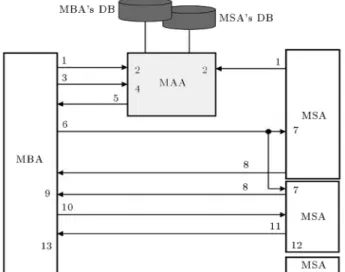
The proposed architecture of an e-marketplace is shown in Figure 1. There are three types of server in the proposed architecture for an e-marketplace, they are: (1) Marketplace, (2) Buying agent server and (3) Selling agent server. Each server includes sev-eral stationary agents and mobile agents and some important transactions between dierent agents in the marketplace. They are described, as follows.
Marketplace
A marketplace is a platform that supports transaction facilities for mobile agents of sellers and buyers. There is a static agent (MAA: Market Assistant Agent) and two kinds of mobile agent in the Marketplace:
1. MAA (Market Assistant Agent): The MAA is responsible for registering mobile buying and selling agents in the buyer and seller database of the mar-ketplace. The buyer database of the marketplace contains: Owner of the mobile buying agent, the buying agent server, a unique identier and the proxy address of the agent provided by the Aglet context and the time of registration. The seller database of the marketplace contains: Owner of the mobile selling agent, the selling agent server, a unique identier, proxy address of the selling agent, provided by the Aglet context, the goods which are available for the mobile selling agent to sell and the time of registration. Agent A can communicate with agent B through the proxy address of agent B
Figure1. The architecture of electronic commerce
environments.
and vice-versa. Also, the MAA answers the request of the mobile buying agent by retrieving the proxy address of the sellers from the seller database, who have goods to sell, and by sending the list to the mobile buying agent;
2. MBA (Mobile Buying Agent): Stands for the buyer, who moves to the marketplace and trades with mobile selling agents and learns, based on reinforcement learning, which sellers can satisfy his preferences. Also, the MBA measures the reputa-tion of each mobile selling agent by dierent factors, such as quality and price, focuses its business on reputable sellers and prevents interaction with non reputable ones;
3. MSA (Mobile Selling Agent): Stands for the seller, who moves to the marketplace and trades with mo-bile buying agents and learns how to adjust his bids, according to the preferences of the buying agents, while trying to maximize his expected prot. Also, he models the reputation of mobile buying agents to dedicate a discount for them, based on their reputation.
Buying Agent Server
The buying agent server provides the interface of the Buying Agent (BA) that lets users initialize and control their buying agent in order to carry out the e-commerce activation. The buying agent server stores the information of the buyer in the database and will produce the Mobile Buying Agent (MBA), according to the requirements of the user. It remains for the user to go to the marketplace to make and obtain bargains.
Selling Agent Server
Each seller that wants to join this e-marketplace should build a seller server. There are two main agents in a seller server, including:
1. Selling Agent (SA), which is provided by the selling agent server, which lets the seller initialize its selling agent and specify the goods, which are available for sale;
2. Mobile Selling Agent (MSA) that is created by the selling agent server and which migrates to the marketplace to try to sell goods with a maximum prot for its owner.
Transactions in the Marketplace
Figure 2 shows the process of trading using thirteen transactions:
1. BA submits registration request to MAA. Also, SA submits registration request to MAA;
2. MAA stores BAs and SAs registration information in Bs and Ss Databases;
Figure2. Transactions in agent-based e-marketplace.
3. BA requests from MAA a list of relevant sellers who sell specied product;
4. MAA retrieves relevant sellers for requested prod-uct;
5. MAA sends list of relevant sellers to BA;
6. BA multicasts its requests to relevant sellers for a specied product;
7. Each of those SAs prepares a bid for BA, based on his reputation and purchases;
8. Each of those SAs sends a bid to BA;
9. BA receives all bids, evaluates their value and selects the best bid;
10. BA announces the chosen bid owner and pays it; 11. Chosen SA delivers the product to BA;
12. Chosen SA updates the reputation of BA;
13. BA estimates the real value of the goods and updates the trust and reputation of this SA.
By considering some assumptions, the market is made more realistic and simpler. Therefore, it is assumed that:
1. The quality and price oered by dierent selling agents can be variable;
2. Each selling agent considers discounts for buying agents, based on their reputation;
3. There may be some dishonest selling agents in the market who lie about quality;
4. Buying agents in the market are not dishonest; 5. A buyer can purchase goods in dierent conditions
with variant priorities on quality and price instead of xed priorities;
6. Each buyer has his own preferences and priorities on quality and price;
7. Product delivery is done by transferring a message between the seller and buying agent;
8. The maximum quality of goods presented in the market is denite so that it is known by all selling and buying agents;
9. If a seller wants to deliver his product later, a buyer will expect more reduction in price from that seller, based on late time units;
10. A buyer can estimate the quality of the goods he purchases only after receiving the goods from the selected seller.
In the following sections, the seller and buyer algo-rithms are presented, respectively. Also, an example is described to show how the buyer and seller algorithms work.
Seller Algorithm
Let S be the set of sellers, G be the set of goods, B
be the set of buyers, Q be the set of qualities, P be
the set of prices and S;G;B;Q and P are nite sets
(it means that qmin 2 Q and qmax 2 Qrepresent the
minimum and maximum quality of goods that can be available in the market and all sellers and buyers know this). Assume that sellers2S has received a request
from buyerb2B on itemg2G. Sellershas to decide
on the quality and price of item g to be delivered to
buyerb. Assume thatRis the set of real numbers. Let
functione s:
GQPB!Restimate the expected
prot for seller s, if it sells item g with quality q at
pricepto buyerb. Letc s(
g;q;b) be the cost that seller sincurs to produce item g with qualityq for buyerb.
Sellersproduces dierent versions of itemg, based on
buyers requirements. The price that seller s chooses
to sell itemg to buyerb is greater than, or even equal
to c s(
g;q;b). Function e
s chooses a bid that has the
maximum prot for sellers. If sellersproduces itemg
with the cost ofc s(
g;q;b), the maximum price for seller sis calculated, as follows:
pmax=c s(
g;q;b) +c s(
g;q;b); (1)
in which,is the maximum percent of prot for sellers.
Moreover, sellers models the reputation of all buyers
in the market using function r s :
B ! (0;1) that is
called the reputation function of s. Initially, seller s
sets the reputation rating, r s(
b) = 0, for each buyer, b2B. The negative reputation for buyers is not used,
because it is assumed that all buyers are honest and no sellers are interested in losing their customers. The sellers want to satisfy the buyers' requirements so they compete with each other to increase the number of their own customers.
When seller ssends his bid to buyerb, there are
1. Seller s succeeds in selling item g with quality q
at price p to buyer. It means that seller s has
presented a better bid than the other sellers to buyerb. Therefore, seller s may be re-selected by
buyerb, if seller s repeats this bid for buyer b for
specied item g. Seller s delivers the product to
buyerband updates the reputation of buyerbusing
reinforcement learning:
r s(
b) =r s(
b) +(1 r s(
b)); (2)
where, is a positive factor called the cooperative
factor and is equal to:
= p c
s( g;q;b) pmax c
s( g;q;b)
: (3)
In which, pmax c s(
g;q;b) is the maximum prot
for sellers, if it could sell item gto b.
So, the new bid for buyerb, based on its new
reputation, is calculated by sellers, as follows: pnew=p
s ( r
s
new(b) r s
before(b))p s
: (4)
2. Seller s does not succeed in selling item g with
quality q at price p to buyer b. It means that
the bid of seller s has not satised the buyer b.
If seller srepeats the previous bid to buyer b, the
possibility of success in selling item g to buyer b
is low. Therefore, it is required to alter the price and maybe the quality of the item to be oered to buyerb. Letrp be a variable that species the
percent reduction in price, in order to satisfy the buyer. That is, he should reduce the price of his product according to this value. In addition, for preparing a new bid for buyerb, the reputation of
the buyer is also used to determine the new price. The quality remains as before, but a new price is updated with reinforcement learning, as follows:
pnew=p (rpp) r s(
b)p; (5)
in which (0 < < 1) is a variable that denotes
discount. It means that the seller who wants to consider a further discount for his customer sets
with a greater value and vice versa.
According to the fact that a seller does not sell his goods at a price lower than the production cost of the goods, if pnew < c
s(
g;q;b), then, seller s does
not suggest the same goods with the previous quality. So, he may optionally raise the value of quality by increasing its production cost, as follows:
c s(
g;q;b) = (1 +inc)c s(
g;q;b); (6)
where,incis a specic constant called quality
increas-ing factor of sellers.
Buyer Algorithm
Assume that buyer b wants to buy item g. Buyer b
broadcasts his request to all sellers who have item g
to sell. (According to that discussed earlier, a list of these sellers has been already retrieved from MAA.) Sellers answer the request by sending bids to buyer b.
Buyer b receives all bids and selects the suitable bid.
Buyerbmodels the reputation of all sellers and selects
a suitable bid from a reputable seller. Buyerb models
the reputation of each seller, based on two factors of quality and price, separately. To model the reputation of each seller, buyerb uses functionsr
b q :
S !( 1;1)
and r b p :
S ! ( 1;1), which are called reputation
functions of b, based on the factors of quality (q) and
price (p), respectively. For example, r b q(
s) represents
the reputation of seller son the quality computed by
buyer b. Initially, buyer b sets the reputation ratings r
b q(
s) = 0 andr b p(
s) = 0 for every sellers 2S. Seller s is reputable for buyer b on quality, i r
b q(
s) b q,
where b
q is buyer
b's reputable threshold on quality
(0 < b q
< 1). A seller s is considered disreputable
for buyer b on quality, i r b q(
s) b
q, where
b q is
buyerb's disreputable threshold on quality ( 1< b q
<
0). Similarly, buyer b's reputable and disreputable
thresholds are dened, based on price, by replacing q
withpin the above inequalities, respectively.
LetS b
r q be the set of sellers with a good
reputa-tion of quality to serve buyer b, that is S b
r q contains
the sellers that have servedbwith the expected quality
ofbin the past and are, therefore, reputable on quality
byb. Hence, S b rq
S and is initially empty, i.e.; S
b r q=
fs2Sjr b rq(
s) b q
gS: (7)
Also, let S b
rp be the set of sellers with a good
reputation of price. S b rp
S, S b
rp is initially empty
too, i.e.;
S b r p=
fs2Sjr b rp(
s) b p
gS: (8)
Assume that S b
nr q is the set of sellers with a bad
reputation of quality to serve buyer b, that is, S b nr q
contains the sellers that have served b with the not
expected quality of b and are known by b as
non-reputable sellers on quality. S b nr q
S and is initially
empty, i.e.;
S b nr q =
fs2Sjr b nr q(
s) b q
gS: (9)
Also, let S b
nrp be the set of sellers with a bad
reputation of price to serve buyerb. S b nr p
S,S b nr p
is initially empty, i.e.;
S b nr p=
fs2Sjr b nrp(
s) b p
Let w q and
w
p be the weight of the values of quality
and price for buyerb, so thatw q+
w
p = 1. Buyer b's
general reputable threshold is dened, as follows: b= w q b q+ w p b p ; (11)
while buyerb's general disreputable threshold is: b= w q b q+ w p b p : (12)
In the same way, the general reputation of seller s is
calculated, as follows:
r b(
s) =w q
r b q(
s) +w p
r b p(
s): (13)
LetS b rand
S b
drbe the sets of reputable and disreputable
sellers to serve buyerb, respectively, i.e.; S
b r=
fs2Sjr b(
s) b
gS; (14)
and:
S b dr=
fs2Sjr b(
s) b
gS; (15)
where b and
b are general reputable threshold and
general disreputable threshold respectively. Buyer b
will focus his business on the reputable sellers and stays away from disreputable ones.
Assume that each seller sends its bid in the form
bid(q s
;p
s) to buyer
b. Then, buyerbguesses the value
of bids oered by each seller by using this function:
G b( q s ;p s ;d s
;s) =w q q s qmax w p p s pmax ; (16)
where qmax is the maximum quality of item g in the
market andpmaxis the maximum price for goods with
quality qmax. Then, buyer b selects the seller, ^s, who
belongs to the set of reputable sellers for buyerb, whose
bid value for buyerbis more than the other sellers, i.e.;
^
s= argmaxG b(
q s
;p s
;s); s2S b r
; (17)
where, arg is an operator, such that argG b(
s) returnss.
In addition, if no sellers inS b
rsubmit bids for delivering g (i.e., S
b r =
), then, buyer b has to choose a seller,
^
s, from among sellers who are neither reputable nor
disreputable: ^
s= argmaxG b(
q s
;p s
;s); s2=(S b r [S b dr) : (18)
After paying seller ^s and receiving item g, buyer b
examines the quality, q 2 Q, of item g. Assume that
buyerb nds the quality ^q. Let the expected quality
and price for the buyer beq b and
p
b, respectively. The
updated reputation for the quality and price of seller ^s
is illustrated in the next sections, respectively.
In addition, with a probability, buyerbchooses
to explore (rather than exploit) the marketplace by randomly selecting a seller ^sfrom the set of all sellers.
Initially, the value of should be set to 1 and then
decreased over time to some xed minimum value determined by the buyer.
Updating Reputation of Quality
If ^qq
b, then, the reputation of seller ^
son quality is
updated using reinforcement learning, as follows:
r b q(
s) =
r b q(
s) + q(1
r b q(
s)) if r b q(
s)0 r
b q(
s) + q(1 +
r b q(
s)) if r b q(
s)<0
; (19)
where,
q is a positive factor called the cooperation
factor and
q is calculated, as follows:
q =
^
q q b qmax if
^
q q b qmax
>min q min
q otherwise
: (20)
That is, seller ^s oers item g with a quality greater
than, or equal to, the value that buyerb demands for
the quality of item g and, therefore, the reputation
of seller ^s on quality is increased by Equation 19,
accordingly. min
q is a positive factor, called the
minimum cooperation factor, for quality. If ^q<q
b, then, the reputation of seller ^
son quality
is updated, as follows:
r b q(
s) =
r b q(
s) + q(1
r b q(
s)) ifr b q(
s)0 r
b q(
s) + q(1 +
r b q(
s)) ifr b q(
s)<0
; (21)
where,
q is a negative factor, called the
non-cooperation factor and
q is calculated, as follows: q = q ^ q q b qmax : (22) In which, q( q
> 1) is called the penalty factor,
so that j q
j > j q
j, to implement the traditional
assumption that reputation is dicult to build up, but easy to tear down.
Updating Reputation of Price
1. Ifp b
p
s, then, the reputation of seller ^
son price
is updated using reinforcement learning, as follows:
r b p( s)= r b p(
s) + p(1
r b p(
s)) if r b p(
s)0 r
b p(
s) + p(1 +
r b p(
s)) if r b p(
s)<0
;
(23) where,
pis a positive factor, called the cooperation
factor and
pis calculated, as follows: q= p b p s pmax if
p b
p s pmax
>min p min
p otherwise
: (24)
That is, seller ^s oers item g with a price lower
than, or equal to, the value that buyerbdemanded
for the price of itemgand, therefore, the reputation
of seller ^s on price is increased by Equation 23,
accordingly. It implements the fact that buyer b
expects to buy goods at a low price. Therefore, sellers who oer goods at a lower price than the others, set more reputation on price for themselves to buyerb and have a positive reputation for price
when their price is lower than the expected price of buyer b. min
p is a positive factor, called the
2. Ifp b
<p
s, then, the reputation of seller ^
son price
is updated, as follows:
r b p(
s) =
r b p(
s) + p(1
r b p(
s)) ifr b p(
s)0 r
b p(
s) + p(1 +
r b p(
s)) ifr b p(
s)<0
;
(25) where,
p is a negative factor, called the
non-cooperation factor and
pis calculated, as follows:
p=
p p
b p
s pmax
: (26)
In which,( q
>1) is called the penalty factor, so
thatj p
j>j p
j.
EXPERIMENTAL RESULTS
The proposed model has been implemented with Aglets that are java based stationary and mobile agents built in the aglet environment. The results show that when a seller agent models the reputation of buyer agents and dedicates a discount to those that are reputable, he obtains greater satisfaction compared to the situation when he only alters the quality and price of his goods. Also, buyer agents that follow the proposed algorithms are more exible under dierent conditions for selecting goods. The proposed model, both for buyer and seller agents, has been tested by extensive experimentation. In the following sections, the seller agents satisfaction and the buyer agents satisfaction are presented.
Seller Satisfaction
In the test for evaluating the seller algorithm, there are 20 seller and 20 buyer agents in the simulated marketplace. Assume that buyers arrange, in total, 2000 auctions. Let g (quality, price) be the structure
of a good's specication. All buyer agents use the proposed algorithm in this paper for buyer and seller agents, which are divided into four groups:
1. Group A consists of ve sellers,s0;s1;, ands4.
These are dishonest sellers on quality who try to attract buyers with high quality goods and then cheat them using really low quality ones. They oer
g(48;50) and then deliver the item asg(38;50);
2. Group B consists of ve sellers, s5;s6;, and s9,
that do not cheat the buyers and use a xed bid for any buyer. They oer and deliver goods as
g(40;44). This group of sellers uses the algorithm
which is proposed by Vidal and Durfee [26]; 3. Group C consists of ve sellers,s10;s11;, ands14,
who alter the quality and price of their goods but do not model the reputation of the buyers. Moreover, they do not consider a discount for buyers. They start their bids asg(38;45:6) and, then, alter their
oers, based on buyers' requirements. This group of sellers uses the algorithm which is proposed by Thomas Tran [28];
4. Group D consists of ve sellers, s15;s16;, and s19, that, in addition to altering the quality and
price of their goods, model the reputation of the buyers and, also, consider a discount for them, based on their reputation. They start their bids as
g(38;45:6) and, then, use the proposed algorithms
to alter their bids. This group of sellers uses the algorithm which is proposed in this paper.
In addition, there are other parameters that are considered for sellers:
1. Quality is chosen equal to cost, to support the common assumption that it costs more to produce high quality goods. That is, an item with a quality of 38, costs just 38;
2. The maximum percent of prot is dened as =
0:2. Therefore, according to Equation 1, if an item
costs 38, then, the maximum price that sellerscan
dedicate to it is equal to 45.6;
3. It is assumed that the reduction percent of price (rp) and discount variable () in Equation 5 are
equal to 0.015 and 0.05, respectively;
4. Sellers increase the cost and quality of goods in Equation 6 with theincrate of 0.02;
5. A seller can produce goods at the maximum quality of 50.
All buyers use the buyer agents algorithm pro-posed in this paper and the parameters that are applied are, as follows:
1. For all buyers, reputable thresholds for quality and price are equal to 0.4, while their corresponding dis-reputable thresholds are -0.8 and -0.5, respectively; 2. Expected values for buyer b on quality and price
are 40 and 43, respectively, while weights w q,
w p
are 0.65 and 0.35, respectively; 3. If ^qq,min
q is dened in Equation 20 as equal
to 0.05. Also, it is supposed thatmin p= 0
:05;
4. If ^q <q, one gets q = 1
:5 in Equation 22. p is
also dened as being equal to 1.5.
The results of this experiment conrm that sellers who exploit the proposed algorithms (i.e., Group D), achieve better satisfaction than the other sellers. In addition, buyers learn to focus their business on sellers who have reached enough reputation and prevent inter-action with disreputable ones. The average and total number of sales made by each of these four groups of sellers are shown in Table 1.
Sellers of Group A are dishonest sellers that lie about quality. In real markets, it is expected that
Table1. Total and average number of sales made by ve
groups of seller agents.
Group A B C D
Total #ofSales 100 277 458 1165 Average# ofSales 20 55.4 91.6 233
when buyers purchase from a seller who tries to cheat them, they will not deal with him for future purchases. Table 1 conrms this matter, so that each buyer purchases from dishonest sellers no more than once. There are 20 buyers in the market and each of them was cheated once by a dishonest seller. Therefore, each dishonest seller can cheat each buyer one time and, in total, wins in 20 auctions. Buyers model the reputation of dishonest sellers and consider the reputation for the sellers lower than the disreputable threshold,
b, as
described in Equation 12. Actually, buyers learn to stay away from disreputable sellers.
Sellers of Group B oer goods with a xed quality and price. Although they may sell some of their goods in their rst deals, because of the existence of sellers of the other groups who alter their bids to oer goods at high quality, buyers will no longer purchase from sellers of this group, since they cannot visit the buyers'
requirements. Sellers of Group C alter their bids based on buyer requirements and achieve further sales, in comparison to sellers in Groups A and B.
In real markets, sellers pay tribute to buyers, in order to attract and keep them as their own customers for a long time. Discount is one of the most important factors that sellers can promote for their own reputable buyers. Sellers of Group D apply this marketing strategy to increase the number of their customers. The results shown in Table 1 conrm this hypothesis. Buyers gradually learn to purchase their required goods from sellers who oer goods at high quality, while giving discounts. In order to investigate the hypothesis mentioned above, in Figure 3, the number of sales are shown made by sellers s0 (from Group A), s5
(from Group B), s10 (from Group C) and s15 (from
Group D) during 2000 auctions at market. Curves numbered 1 through 4 belong to Groups A, B, C and D, respectively.
The results obtained from these four groups show the superiority of the presented model, so that sellers who exploit this model (Group D), made sales of an average number equal to 233, while the other groups (A, B, C and D) did 20, 55.4 and 91.6. The average prot of sellers who exploited the proposed model
Figure3. Comparison of sales made by sellerss 0,
s 5,
s 10 and
s
15with strategies 1 (Group A), 2 (Group B), 3 (Group C)
(Group D) was equal to 601.6, while the other groups (A, B and C) achieved the average prot 200, 211.5 and 263.4, respectively. Figure 3 shows that dishonest seller,s0, initially, does have good sales in the market.
However, the number of sales of honest sellers,s5 and s10, are smoothly increased over time. In the long term,
seller s15 ultimately outdistances the other sellers in
the market. Buyers have learned to buy from sellers who honestly oer goods at high quality, in addition to discount dedication, based on their reputation.
CONCLUSION AND FUTURE WORK
In this paper, a marketplace, based on reputation and reinforcement learning algorithms, is proposed for buying and selling agents. Selling agents learn to maximize their expected prots by adjusting product prices and altering the quality of their products and, more importantly, considering discounts for reputable buyers, based on their reputation. It is shown that sellers who exploit the proposed algorithms obtain better satisfaction compared to the others. Buyers also learn to purchase from sellers who reward them by dedicating discounts. The fact has been investigated that marketing and consumer relationship management are two important factors in business, so that sellers who obey this fact construct a better reputation for themselves among buyers and get greater prots in comparison to the others. This model is very exible for developing marketing purposes and for modeling a real market completely. However, the proposed model and algorithms can be improved so that both sellers and buyers who exploit the improved model can obtain the best results as fast as possible. For example, if buyers share their knowledge in cooperation with each other, they will quickly know honest sellers who present the best promotion and, accordingly, will stay away altogether from dishonest sellers. Therefore, the prots of those buyers and sellers will quickly increase. On the other hand, sellers can learn to oer suitable bids to new buyers, based on the similarity of their preferences, compared to the preferences and trading behaviors of previous buyers who have already purchased goods or services from the seller. Future research aims to provide a set of feasible learning algorithms, together with a clear characterization of dierent situations under which a particular algorithm is preferable. Also, for making eective economic agents and desirable market environments, it is attractive to model the reputation of buyers and sellers based on fuzzy logic.
REFERENCES
1. Chavez, A. and Maes, P. \Kasbah: An agent mar-ketplace for buying and selling goods", InProceedings of the First International Conference on the
Practi-cal Application of Intelligent Agents and Multi-Agent Technology, pp 75-90 (1996).
2. Doorenbos, R.B., Etzioni, O. and Weld, D. \A scalable comparison-shopping agent for the world wide web", In Proceedings of the First International Conference on Autonomous Agents, pp 39-48 (Feb. 1997). 3. Wurman, P.R., Wellman, M.P. and Wash, W.E.
\The Michigan internet auction bot: A congurable auction server for humans and software agents", In
Proceedings of the Second International Conference on Autonomous Agents, pp 301-308 (1998).
4. Aglet Research Group of NCKU [Online], Available: http://turtle.ee.ncku.edu.tw/.
5. IBM Aglet Home Page [Online], Available: http://www.trl.ibm.co.jp/aglets.
6. Weiss, G.,A Modern Approach to Distributed Articial Intelligence, The MIT Press Cambridge (1999). 7. Debenham, J.K. and Henderson-Sellers, B. \Designing
agent-based process systems; extending the OPEN process framework", inIntelligent Agent Software En-gineering, V. Plekhanova, Ed., (Idea Group), pp 160-190 (2003).
8. Hawryszkiewycz, I.T. \Agent architectures to support collaborative processes", Proceedings of the Fourth International Conference on Web Information Sys-tems Engineering (WISE'03)0-7695-1999-7/03 $17.00
c
IEEE(2003).
9. Sanchez, E., Lama, M., Amorim, R., Riera, A., Vila, J. and Barro, S. \A multi-tiered agent-based architecture for a cooperative learning environment",
Proceedings of the Eleventh Euromicro Conference on Parallel, Distributed and Network-Based Process-ing (Euro-PDP'03)0-7695-1875-3/03 $17.00 c IEEE
(2003).
10. Ajenstat, J. and Jones, P. \Virtual decision maker for stock market trading as a network of cooperating autonomous intelligent agents", inProceedings of the 37th Annual Hawaii International Conference on Sys-tem Sciences, pp 34-41 (5-8 Jan. 2004).
11. Cheng, T.W., Wang, W.L. and Chen, A. \E-marketplace using articial immune system as match-maker", Proceedings of e-Commerce Technology, pp 358-361 (6-9 July 2004).
12. Jong, Y.K. and Lee, J. \Evolution of intelligent agent in auction market,IEEE International Conference on Fuzzy Systems,1, pp 331-336 (25-29 July 2004).
13. Keller, P.W. and Duguay, F. \Red agent-2003: An autonomous, market-based supply-chain management agent", Proceedings of the Third International Joint Conference on Autonomous Agents and Multiagent Systems (AAMAS), pp 1182-1189 (19-23 July 2004). 14. Neri, F. \Agent based simulation of information
diusion in a virtual market place", Proceedings IEEE/WIC/ACM International Conference on Intelli-gent AIntelli-gent Technology, pp 333-336 (20-24 Sept. 2004).
15. Dasgupta, P., Narasimhan, N., Louise, E. and Melliar-Smith, P.M. \MagNet: Mobile agents for networked electronic trading", IEEE Transaction on Knowledge and Data Engineering, 11(4), pp 509-525
(July/August 1999).
16. Mitchell, T.M., Machine Learning, McGraw-Hill Sci-ence/Engineering/Math (1 March 1997).
17. Braga, S., Araujo, A.P. and Wyatt, A.F.R. \Incremen-tal topological reinforcement learning agent in non-structured environments", International Conference on Systems, Man and Cybernetics, pp 5567-5572 (10-13 Oct. 2004).
18. Littman, M.L. \Markov games as framework for multi-agent reinforcement learning", In Proceedings of the Eleventh International Conference on Machine Learn-ing, pp 157-163 (1994).
19. Sandholm, T.W. and Crites, R.H. \Multi-agent re-inforcement in the iterated prisoner's dilemma", In
Biosystems, pp 147-166 (1995).
20. Sen, S., Sekaran, M. and Hale, J. \Learning to coordinate without sharing information", In Proceed-ings of the Twelfth National Conference on Articial Intelligence, pp 426-431 (1994).
21. Bamasak, O. and Zhang, N. \A distributed reputa-tion management scheme for mobile agent-based e-commerce applications", e-Technology, e-Commerce and e-Service, 2005. EEE '05. Proceedings, The 2005 IEEE International Conference, pp 270-275 (29-01 Feb.-March 2005).
22. Derbas, G., Kayssi, A., Artail, H. and Chehab, A. \TRUMMAR - a trust model for mobile agent sys-tems based on reputation", ICPS 2004. Proceedings, The IEEE/ACS International Conference on Perva-sive Services, 19-23 July 2004, pp 113-120 (2004). 23. Esfandiari, B. and Chandrasekharan, S. \On how
agents make friends: Mechanisms for trust acquisi-tion", InProceedings of the Fifth International
Confer-ence on Autonomous Agents Workshop on Deception, Fraud and Trust in Agent Societies, pp 27-34 (2001). 24. Mui, L., Mohtashemi, M. and Halberstadt, A. \A
computational model of trust and reputation",System Sciences, Proceedings of the 35th Annual Hawaii Inter-national Conference on 7-10 Jan. 2002, pp 2431-2439 (2002).
25. Yu, B. and Singh, M.P. \A social mechanism of reputation management in electronic communities", In
Cooperative Information Agents IV, Lecture Notes in Articial Intelligence, M. Klusch and L. Kerschberg, Eds., pp 154-165 (2000).
26. Vidal, M. and Durfee, E.H. \The impact of nested agent models in an information economy", in Proceed-ings of the Second International Conference on Multi-Agent Systems, pp 377-384 (1996).
27. Tran, T. \A reliability modeling based strategy to avoid innite harm from dishonest sellers in electronic marketplaces", Journal of Business and Technology (JBT), Special Issue on Business Agents and the Semantic Web,1(1), pp 69-76 (2005).
28. Tran, T. and Cohen, R. \Improving user satisfac-tion in agent-based electronic marketplaces by rep-utation modeling and adjustable product quality",
Autonomous Agents and Multiagent Systems, pp 828-835 (19-23 July 2004).
29. Tran, T. and Cohen, R. \The stability of electronic marketplaces where buying agents use reliability mod-eling to select selling agents",Journal of Business and Technology (JBT), Special Issue on Business Agents and the Semantic Web,1(1), pp 62-68 (2005).
30. Tran, T. and Cohen, R. \Reputation-oriented re-inforcement learning strategies for economically-motivated agents in electronic market environments", PhD Thesis, School of Computer Science, University of Waterloo, Canada (2003).