Sharif University of Technology
Scientia IranicaTransactions B: Mechanical Engineering www.scientiairanica.com
Study on cloud-dust based intelligent maximum
performance analysis system for power generation with
solar energy
C.-C. Huang
Department of Automation and Control Engineering, Far East University, Tainan City, 744, Taiwan, ROC. Received 22 May 2014; accepted 15 September 2015
KEYWORDS Intelligent system; Cloud-dust based; Maximum performance analysis system; Solar energy.
Abstract. In the paper, a cloud-dust based intelligent maximum performance analysis system for power generation with solar energy is proposed. In order to resolve performance problems for power generation using solar energy, factors of the photovoltaic are integrated to the cloud-dust based intelligent maximum power analysis system for computing. This study concerns the development of a maximum performance analysis system for power generation using solar energy, in order to improve the eects of dierent regions on the solar panels and enable them to get maximum eciency of power generation. The design methodology of this study includes: (1) Records and surveillance module; (2) Prediction and assessment module; (3) Performance diagnosis module; and (4) Maintenance prescription module, with which we are able to nd the design and implementation of records, surveillance, prediction, assessment, diagnosis and prescription for power generation with solar energy. It has worked successfully. The advantages of the cloud-dust based intelligent, maximum performance analysis system for power generation with solar energy include an increase in the overall competitive performance of the products, and a reduction in the cost of the products and use of human resources.
© 2015 Sharif University of Technology. All rights reserved.
1. Introduction
Considering the management of solar power generation equipment, the choice of surrounding environments, control of weather conditions, surveillance, assessment, diagnosis and the maintenance of power generation, solar generator sets can produce maximum power generation eciency. The cloud-dust intelligent maxi-mum performance analysis system for power generation consists mainly of four parts:
1. The records and surveillance module;
2. The prediction and assessment module;
3. The performance diagnosis module;
4. The maintenance prescription module.
*. E-mail address: [email protected]
In 1995, Hussein [1] developed a new MPT algorithm based on the MPOP of a PV generator. It can be tracked accurately by comparing the incremental and instantaneous conductance of the PV array. By both simulation and experiment, the results show that the developed incremental conductance algorithm successfully tracked the MPOP. In 2006, Meng Xian Yao [2] optimized the BP neural network using genetic algorithms to diagnosis the faults of the main rotating device for ships. Considering 8 kinds of common fault as the network output, the signal is divided into 9 dierent frequency bands, and the peak value is the feature for the training samples. The experimental results demonstrate that optimization of the BP neural network using genetic algorithms can make the train-ing of BP neural networks such as to avoid falltrain-ing into the local minimum and quick convergence. It
predictive maintenance system to replace expensive motion-sensing technology. It is a new real-time neural network predictive maintenance system using o-line data, which uses Principal Component Analysis (PCA) for feature extraction. The predictive maintenance system uses the load and torque of a micro drill motor to reduce vibration and local thermal eects. In 2010, Kun and Gang [5] used the PCA method to build up principal component, and error monitoring models, design a human-machine-interface for on-line state monitoring, analyze abnormal conditions by the datum of the production process, and implement on-line state monitoring for the production process. By this, it is shown that the PCA method has good application prospects. In 2013, Saxena and Mishra [6] proposed that the maintenance of the solar system determined the life length of the system. Therefore, it is necessary to maintain a solar system for reducing the cost of the system. In 2010, Jiang et al. [7] studied a novel collection system of logistics management in which the data collection terminal RF-Information collection,
module. The output power from a PV module depends on environmental factors, such as irradiation and cell temperature. They chose irradiation, temperature and wind velocity as the input information for the neural network. The output is predicted maximum power gen-eration under conditions given by those environmental factors. The eciency of the proposed estimation scheme is evaluated using actual data on daily, monthly and yearly bases. Compared with the conventional multiple regression model, this method gives highly accurate predictions. In summary, it is necessary to develop a cloud-dust based intelligent maximum per-formance analysis system for power generation using solar energy.
2. Cloud-dust based intelligent maximum performance analysis system
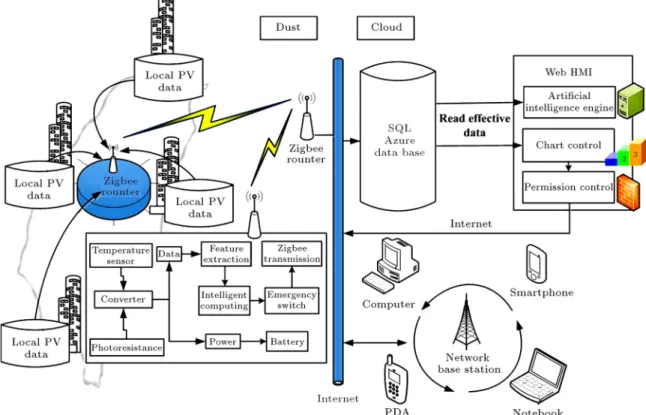
The architecture of the cloud-dust based intelligent maximum performance analysis system for power gen-eration with solar energy is shown in Figure 1. The
Figure 1. The architecture of the cloud-dust based intelligent maximum performance analysis system for power generation with solar energy.
Figure 2. The owchart of the cloud-dust based intelligent maximum performance analysis system for power generation with solar energy.
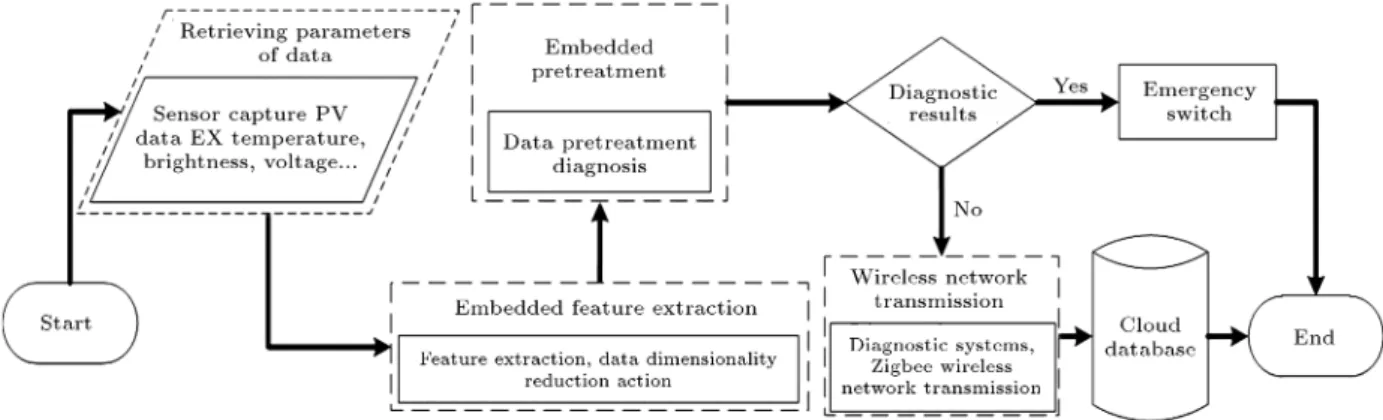
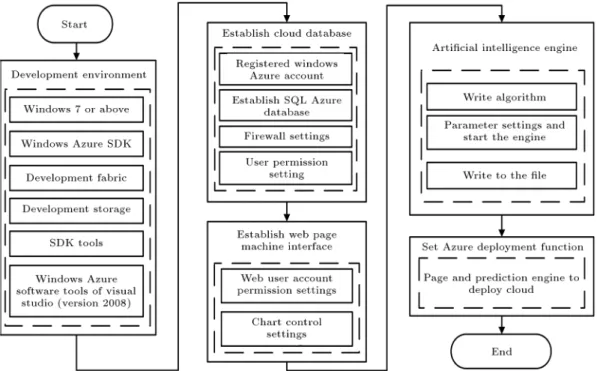
ow chart of the cloud-dust based intelligent maximum performance analysis system for power generation with solar energy is shown in Figure 2. The system is separated into the cloud part and the dust part. The dust part includes a wireless sensor network, feature extraction circuits, intelligent computing circuits and an embedded system. The architecture and owchart of the dust part are shown in Figures 3 and 4. It can preprocess very well. The cloud part includes the cloud database, an intelligent computing engine and a ubiquitous human-machine-interface. The architecture and owchart of the cloud part are shown in Figures 5 and 6. It can exibly use computing resources and integrate information from many dierent dust systems to improve the solar panel eects of dierent regions and enable them to get maximum eciency of power generation.
Figure 3. The architecture of the dust part for power generation with solar energy.
Figure 5. The architecture of the cloud part for power generation with solar energy.
3. Records and surveillance
Because it can real-time preprocess, the dust part can play the role of the monitoring and control of power generation with solar energy. The data of the surveil-lance can be stored in cloud databases for recording using the NET framework and the SQL Server. The owchart of surveillance for power generation with solar energy is shown in Figure 7.
4. Prediction and assessment
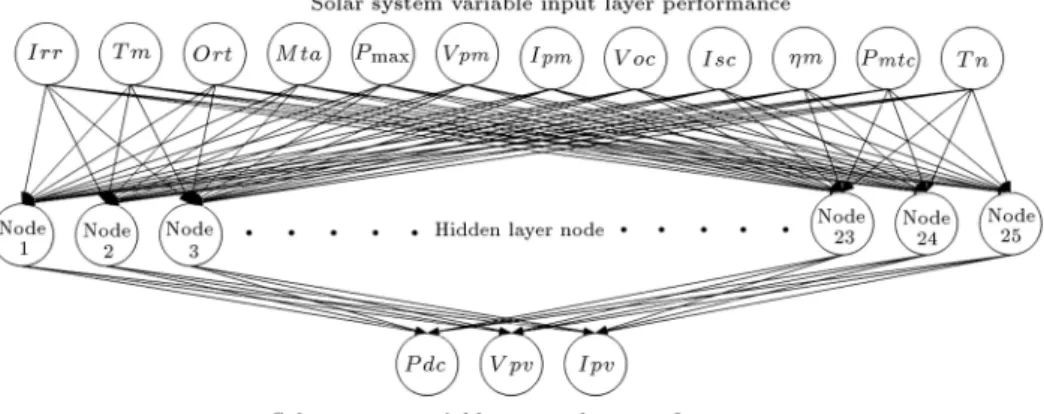
As shown in Table 1, we proposed 12 inuencing factors and 3 power outputs for prediction and assessment of power generation with solar energy, and we can predict and assess power output using the intelligent system.
Figure 6. The owchart of the dust part for power generation with solar energy.
Figure 7. The owchart of surveillance for power generation with solar energy.
Table 1. Inuence factors and power outputs for prediction and assessment of power generation with solar energy.
Input Output
Solar panel installation site as a measure of radiation measured value (Irr)
Solar panels output power instant (P dc) Solar panel module temperature value (T m)
Solar panel installation azimuth (Ort) Solar panel installation angle (Mta)
Solar panels instant output voltage (V pv) Solar panels standard operating temperature (T n)
Equipment
Specications maximum power output of solar panels (P max)
specications
Solar panels specications maximum power voltage (V pm) Solar panels specications maximum power current (Ipm) Solar panels specications open circuit voltage (V oc)
Solar panels immediate output current (Ipv) Solar panels specications short-circuit current (Isc)
Solar panels specications module conversion eciency (m) Solar panel specication peak power temperature coecient (P mtc)
The architecture of the articial neural network for prediction and assessment of power generation with solar energy is shown in Figure 8.
5. Performance diagnosis
We can assess the results of inuencing factors from power outputs through reverse mapping of the
neu-ral network model. The inuencing factors of the photovoltaic can be adjusted to achieve the desired photovoltaic results. The architecture of the articial neural network for performance diagnosis of power generation with solar energy is shown in Figure 9 and the owchart of the neural network model for performance diagnosis of power generation with solar energy is shown in Figure 10.
Figure 8. The architecture of articial neural network for prediction and assessment of power generation with solar energy.
Figure 9. The architecture of articial neural network for performance diagnosis of power generation with solar energy.
Figure 10. The owchart of the neural network model power generation with solar energy.
6. Maintenance prescription
The solar radiation data provided by the Central Weather Bureau in Taiwan was used as training sam-ples for prediction, and the maintenance prescrip-tion will be generated by the performance diagno-sis. The ow chart of the maintenance prescription for power generation with solar energy is shown in Figure 11, and the list of maintenance prescriptions for power generation with solar energy is shown in Table 2.
7. Results and discussion
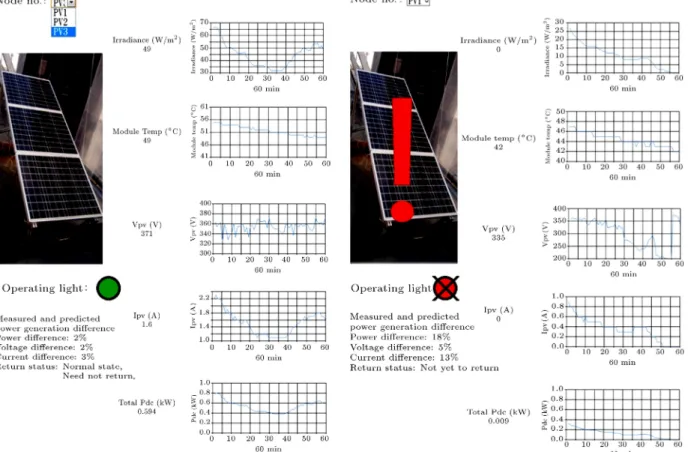
Predictions and assessments are shown in Figure 12. We input the inuence factors to the back-propagation neural network for system identication, and obtain the output results. The model is a 3-layer back propagation neural network. It contains 12 neurons in the input layer, 28 neurons in the hidden layer and 3 neurons in the output layer. The experimental results show that the correction of the diagnosis is over 99.93%. Surveillance is shown in Figure 13.
Figure 11. The owchart of maintenance prescription for power generation with solar energy.
Figure 12. Results of cloud-dust based intelligent prediction and assessment for power generation with solar energy.
Table 2. The list of maintenance prescription for power generation with solar energy.
Diagnose problems Maintenance time Aect the performance of solar power problem diagnosis
1 3 HR Excessive dust
2 3 HR Coverings
3 3 HR Excretions
4 3 HR Panel overheat
5 5 day Panel damage
6 3 day Cable connection problem 7 3 day Cable is damaged
8. Conclusions
This study is the development of a maximum perfor-mance analysis system for power generation with solar energy. It improves the solar panels eects of dierent regions and enables them to get maximum eciency of power generation.
The design and implementation of records, surveillance, prediction, assessment, diagnosis and pre-scription for power generation with solar energy was found and it worked very well. The advantages of a cloud-dust based intelligent maximum performance analysis system for power generation with solar energy include the increased overall competitive performance of products, and a reduction in the cost of products and user rates of human resources.
Acknowledgment
We would like to thank the Ministry of Science and Technology of Taiwan for nancial support of this research under grant No. MOST 103-2221-E-269-012-. Conict of interest statement
We declare that we have no conict of interest. Nomenclature
m Solar panel specication module conversion eciency
Irr Solar panel installation site as a measure of radiation measured value Ipm Solar panel specications maximum
power current
Isc Solar panel specications short-circuit current
Ipv Solar panel immediate output current
P max specications maximum power output of solar panels
P dc Solar panel output power instant P mtc Solar panel specication peak power
temperature coecient
T m Solar panel module temperature value Mta Solar panel installation angle
Ort Solar panel installation azimuth T n Solar panel standard operating
temperature
V pv Solar panel instant output voltage V pm Solar panel specications maximum
power voltage
V oc Solar panel specications open circuit voltage
References
1. Hussein, K.H., Muta, I., Hoshino, T. and Osakada, M. \Maximum photovoltaic power tracking an algorithm for rapidly changing atmospheric conditions", Gener-ation, Transmission and Distribution, 142, pp. 59-64 (1995).
2. Meng, X.Y., Han, X.J. and Meng, S. \BP network model optimized using the genetic algorithms and the application on fault diagnose of equipments", Proceedings of the 25th Chinese Control Conference, 7-11 August, Harbin, Heilongjiang (2006).
3. Hong, T., Zeng, J.G. and Zhi, H.X. \Real time embed-ded maintenance system of hydro generator excitation system", Condition Monitoring and Diagnosis, CMD, International Conference, pp. 402-406 (2008).
4. Bansal, D., Evans, D.J. and Jones, B. \A real-time pre-dictive maintenance system for machine systems - an alternative to expensive motion sensing technology", Sensors for Industry Conference, pp. 39-44 (2005). 5. Kun, I.Z. and Gang, R. \Improving monitoring
perfor-mance of on-line process based on PCA method", Con-trol and Decision Conference, pp. 4144-4148 (2010). 6. Saxena, A. and Mishra, S.K. \Review of system
main-tenance and troubleshooting of solar photovoltaic grid connected system", International Journal of Emerging Science and Engineering (IJESE), pp. 67-68 (2013). 7. Jiang, B., Ma, L.b. and Xu, J.W. \Research of the
collection system of logistics management based on RFID & ZigBee technology", Computer Application and System Modeling (ICCASM) International Con-ference, 6, pp. 526-529 (2010).
8. Hiyama, T. and Kitabayashi, K. \Neural network based estimation of maximum power generation from PV module using environmental information", IEEE Transactions on Energy Conversion, 12, pp. 241-247 (1997).