Electrical Engineering Vol. 17, No. 2, pp. 196{204
c
Sharif University of Technology, December 2010
Modied Active Constellation Extension
for PAPR Reduction of Space-Frequency
Block Coded OFDM Systems
M. Ferdosizadeh Naeiny
1;, A. Jafarnia Jahromi
1and F. Marvasti
1Abstract. In this paper, the Active Constellation Extension (ACE) technique is applied to Space Frequency Block Coded (SFBC) OFDM systems to reduce the Peak to Average Power Ratio (PAPR). For the extension of this technique to SFBC systems, it will be shown that the space frequency coded signals are the combination of several subframes and that the ACE method may be applied to these subframes. Using this model, an iterative ACE method, based on Projection Onto Convex Sets (POCS), is introduced. At each iteration, the time domain samples of the subframes are clipped based on their eect on the samples of all antennas. Then, the clipped subframes are ltered and the signals of the antennas are constructed from the modied subframes. The simulation results show that the performance of the proposed method is very close to the performance of the ACE method in the single antenna OFDM system.
Keywords: OFDM; PAPR; ACE; POCS; Spatial diversity; SFBC.
INTRODUCTION
OFDM is a well-known method for transmitting high data rate signals in the frequency selective channels. In OFDM systems, a wide frequency selective channel is divided into several narrow band frequency non-selective subchannels and, therefore, the equalization becomes much simpler [1-3]. However, one of the major drawbacks of multitone transmission systems, such as OFDM is higher PAPR compared to the single carrier transmission, which leads to the saturation of the high power ampliers. Thus, high dynamic range ampliers are needed, which is expensive. To solve this problem, many algorithms have been proposed. In these algorithms some modications are applied at the transmitter side to reduce the PAPR. In some of these algorithms, such as Partial Transmit Sequences [4,5] and Selective Mapping (SLM) [6-8], the receiver needs Side Information (SI) to be able to receive data without any performance degradation. In some other methods,
1. School of Electrical Engineering, Sharif University of Tech-nology, Tehran, P.O. Box 11155-9363, Iran.
*. Corresponding author. E-mail: [email protected] Received 25 January 2010; received in revised form 19 May 2010; accepted 25 June 2010
the receiver can receive data without SI; examples are clipping and ltering [9,10] using low PAPR codes [11], tone reservation [12,13] and ACE [14,15]. In the ACE method, the constellation points are moved such that the PAPR is reduced, but the minimum distance of the constellation points does not decrease. Thus, the BER at the receiver also does not increase in exchange for a slight increase in the average power. To nd proper movements of the constellation points, an iterative POCS-based method has been proposed in [14] for single antenna OFDM systems.
Space-time codes can achieve diversity by trans-mitting a signal from several antennas simultane-ously [16,17]. In these systems, the symbols are repeated across time and space to achieve diversity at the transmitter side. By combining the space diversity systems with the OFDM technique, SFBC systems were introduced in which the symbols are repeated in dierent subcarriers of OFDM symbols and dierent antennas simultaneously [18,19]. Spatially coded OFDM systems also have a high PAPR problem. In [20], the clipping and ltering technique introduced in [9] has been extended to time and space-frequency coded OFDM systems to reduce the PAPR. In this paper, it is shown that the space-frequency
coded signals can be represented as the combination of several subframes. Subsequently, the clipping and ltering may be applied to the subframes. Based on this idea, in this paper, the ACE method introduced in [14] will be extended to the SFBC case. In this method, a new clipping method based on the SFBC structure is proposed.
The rest of the paper is organized as follows. In the next section, the system model of a single transmission OFDM and PAPR problem is introduced. The original POCS method is also introduced in this section. Then, the system model of the space-frequency coded OFDM systems will be discussed and the extension of the original ACE method to this case is introduced. The computational complexity of the proposed method is analyzed and it is compared with the original ACE method in the single antenna case. Finally, the last section includes the simulation results for QPSK and 16-QAM modulations for the single antenna transmission (using the original ACE method) and the SFBC system with two antennas.
THE PAPR PROBLEM AND ACE METHOD In OFDM systems, the input bit stream is interleaved and encoded by a channel encoder. Then, the coded bits are mapped into complex symbols using QPSK or QAM modulation. The sequential symbols are converted to the blocks of Nc complex symbols where
Xm = [Xm(0); Xm(1); ; Xm(Nc 1)]T is the mth
block. Then, N Nc zeros are added at the end of
the frame and it is passed through an IFFT block to yield the oversampled time domain vector, xm =
[xm(0); xm(1); ; xm(N 1)]T, as follows:
xm(n) = p1
N
NXc 1
k=0
Xm(k)WNnk;
n=0; 1; ; N 1; (1)
where WN = e j2N. The PAPR of the mth OFDM
frame is dened as the ratio of the maximum to average power of the time domain samples:
PAPRm=maxnjxm(n)j 2
Efjxm(n)j2g : (2)
Based on Equation 1, the time domain samples are the sum of Nc independent terms. For a large Nc, the time
domain samples have a Gaussian distribution based on the central limit theorem, which may lead to large amplitudes. One of the proposed techniques to reduce the PAPR is the ACE method. In this method, the complex symbols, Xm(k), are changed such that the
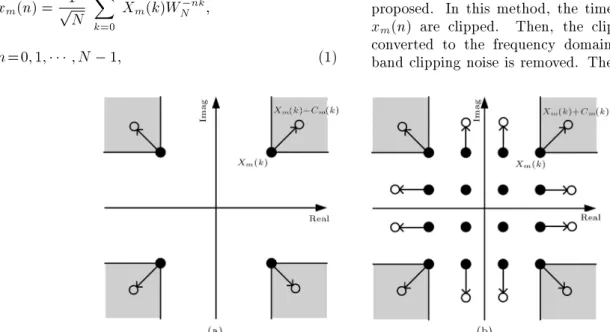
PAPR is reduced, but the minimum distance between the constellation points does not change (Figure 1). On the other hand, the frequency domain symbol, Xm(k),
is extended to the complex number, Xm(k) + Cm(k).
Therefore, the following optimization problem must be solved:
min
Cm(0);Cm(1); ;Cm(Nc)
max
0nN 1
jxm(n)
+p1 N
NXc 1
k=0
Cm(k)WNnkj ;
subject to:
8k Xm(k) + Cm(k)2 ; kCmk2 P: (3)
represents the acceptable regions shown in Figure 1 where the constellation points can be moved without BER degradation. The power increase is limited to P . In [14], a POCS method, which is the sub-optimum solution of the above problem, has been proposed. In this method, the time domain samples xm(n) are clipped. Then, the clipped samples are
converted to the frequency domain and the out-of-band clipping noise is removed. The in-out-of-band clipping
noise will move the constellation points. The removed constellation points are mapped to the acceptable region, , such that the minimum distance of the constellation points does not decrease. This procedure is performed iteratively to achieve the target PAPR or it will be stopped after a predetermined number of iterations. The convex sets in this method are the set of the signals with limited PAPR, the set of the band limited signals, and the set of signals in which the frequency domain samples have a min-imum distance. The projection to the rst set oc-curs via the clipping operation, to the second one via the ltering, and to the third one by means of mapping to the region . It is noteworthy that in the ACE method, the PAPR is reduced drasti-cally in exchange for a slight increase in the average power.
SFBC OFDM SYSTEM MODEL
In this section, the model for space-frequency block coded OFDM is introduced. Then, a modied ACE method will be proposed to reduce the PAPR in this system. In the SFBC-OFDM systems, the Xm block
is divided into subblocks where is the code block length. The ith subblock denoted by Xm;i is dened
by:
Xm;i=[Xm(i); Xm(i + ); ; Xm(i + Nc )]T;
i = 0; 1; ; 1: (4)
Then, the zero padded subblocks, Sm;i, are generated
as follows:
Sm;i= [X| m(i); 0; ; 0{z }; X|m(i + ); 0; ; 0{z }; ;
Xm(i + Nc ); 0; ; 0
| {z }]1Nc
= Xm;i [1; 0; ; 0| {z }]; (5)
where is the Kronecker product. If Z i is dened as
the ith right circular shift, then it is apparent that: Xm=
1
X
i=0
Z iS
m;i: (6)
In the SFBC encoder, the frequency domain vectors of dierent antennas are generated by a combination of subblocks Sm;i and their conjugates with dierent
shifts and scaling factors. If the frequency domain vector of the pth antenna is denoted by X(p)m , then it
can be written as: X(p)
m = 1
X
i=0
Z Di(p)
a(p)i Sm;i+ b(p)i Sm;i
;
p = 1; 2; ; Nt; (7)
where Di(p) is an integer, which shows the measure of the shift of the ith subblock at the pth antenna, and a(p)i and b(p)i are complex numbers. Afterward, the frequency domain vectors, X(p)m; p = 1; 2; ; Nt,
are passed through the IFFT operators to generate vectors x(p)m; p = 1; 2; ; Nt, which are the time
domain samples of dierent antennas. If subframes Sm;i; i = 0; 1; ; 1 are passed through the
IFFT blocks to yield time domain subblocks sm;i =
[sm;i(0); sm;i(1); ; sm;i(N 1)]T, then it can be seen
that: x(p)
m(n)= 1
X
i=0
W nD(p)i
N
h
a(p)i sm;i(n)+b(p)i sm;i(( n)N)
i ; (8) where (:)N is mod N operation. If the N= points
of the IFFT of the vector Xm;i are samples of the
vector, xm;i = [xm;i(0); xm;i(1); ; xm;i(N= 1)]T,
it is apparent that:
sm;i(n) = p x1 m;i((n)N): (9)
Therefore, Equation 8 can be written as: x(p)
m (n) = p1 1
X
i=0
W nD(p)i
N
a(p)i xm;i((n)N)
+ b(p)i x
m;i(( n)N)
: (10)
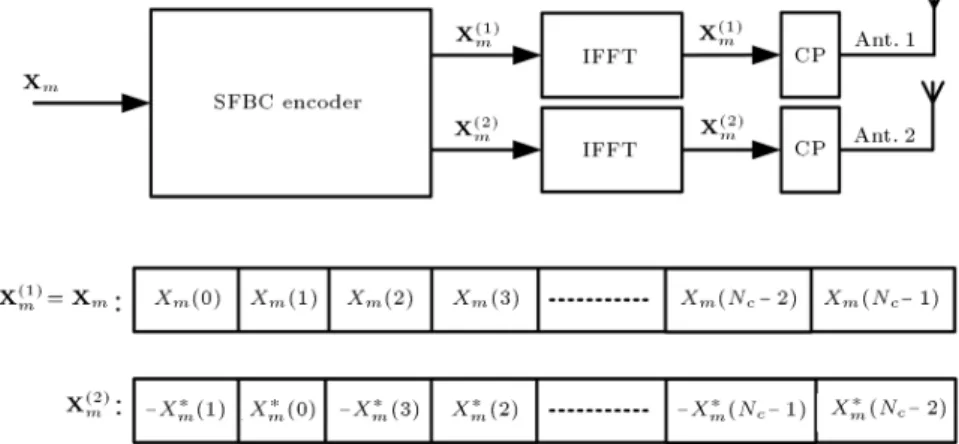
Figure 2 shows the block diagram and the frame structure of the Alomouti SFBC system with two transmitter antennas and a code block length of = 2 [18]. The frames, X(1)m and X(2)m, are generated from
Xm, as follows:
Xm(1)(2) Xm(1)(2 + 1)
Xm(2)(2) Xm(2)(2 + 1)
!
=
Xm(2) Xm(2 + 1)
X
m(2 + 1) Xm(2)
;
= 0; 1; ; Nc=2 1: (11)
In [18], it is shown that, assuming the same channel response at two adjacent OFDM subchannles, this SFBC scheme can reach full diversity. In this case,
Figure 2. The block diagram and the frame structure of SFBC-OFDM system with two transmitter antennas and the code block length of 2.
the original frame, Xm, is divided into the subblocks,
Sm;0and Sm;1, as shown below:
Sm;0= [Xm(0); 0; Xm(2); 0; ; Xm(Nc 2); 0]T;
Sm;1= [Xm(1); 0; Xm(3); 0; ; Xm(Nc 1); 0]T: (12)
Therefore, the vectors, X(1)m and X(2)m, can be written
in the form of Equation 7, i.e.: X(1)
m = Sm;0+ Z 1Sm;1;
X(2)
m = Z 1Sm;0 Sm;1: (13)
The PAPR of the mth frame at the pth antenna is dened by:
PAPR(p)
m =maxnfjx (p) m(n)j2g
Efjx(p)m(n)j2g
; (14)
and the overall PAPR at the mth transmission is dened by:
PAPRm= maxp PAPR(p)m: (15)
MODIFIED ACE FOR SFBC-OFDM
To reduce the PAPR using the ACE method, the symbols Xmare extended to Xm+Cm. If the extension
vector, Cm, is divided into subblocks, Cm;i, similar to
Equation 5, the time domain signal of the pth antenna becomes:
x(p)
m (n) = x(p)m(n)
+p1 N
1
X
i=0 NXc 1
k=0
W nDi(p)
N
a(p)i Cm;i(k)
+ b(p)i C m;i(k)
W nk
N : (16)
The main goal of the ACE technique in the SFBC sys-tems is the determination of the extension vector, Cm,
such that the maximum PAPR among the antennas is minimized. Thus, to minimize the maximum PAPR of the SFBC system, the following optimization problem must be solved:
min
Cm
max
n;p x (p) m(n)
+p1 N
1
X
i=0 NXc 1
k=0
W nD(p)i
N
a(p)i Cm;i(k)
+ b(p)i C m;i(k)
W nk
N
; Cm =
1
X
i=0
Z iC m;i:
Subject to:
Xm(k) + Cm(k)2 ; kCmk2 P: (17)
Based on Equation 10, the time domain samples of transmitted signals from dierent antennas are a com-bination of the time domain samples of the subframes. Equation 10 shows that the sample xm;i(n) contributes
to the generation of the antenna samples, x(p)m(n +
qN= ); q = 0; 1; ; 1, in the case that a(p)i 6= 0, and it also contributes to the generation of the samples, x(p)m( n + qN= ); q = 0; 1; ; 1, if b(p)i 6= 0. Thus,
ym;i(n) is dened by:
ym;i(n) = max
q 2 f0; 1; ; 1g p 2 f1; 2; s; Ntg
U(a(p)i )x(p) m
(qN= + n);U(b(p)
i )x(p)m (qN= n)
;
where n = 0; 1; 2; :;N 1 and function U(x) is
dened by: U(x) =
(
0 if jxj = 0
1 Otherwise (18)
ym;i(n) is a real positive number that shows the
largest amplitude of antenna samples in which sample xm;i(n) has a contribution. In the proposed method,
ym;i(n) is used as the clipping criterion of the subframe
sample, xm;i(n). Thus, if ym;i(n) is higher than a
predened threshold, A, then the amplitude of the sample, xm;i(n), must be clipped as shown below:
^xm;i(n) =
8 > < > :
Axm;i(n)
ym;i(n) if ym;i(n) > A
xm;i(n) Otherwise
(19) Based on this clipping method, the modied ACE method for the SFBC-OFDM systems can be summa-rized in the following steps of the proposed algorithm: 1. The subframes, Xm;i, are generated from the
orig-inal frame, Xm, using Equation 4.
2. The time domain subframes, xm;i, are generated
using N= points IFFT operation.
3. The signals of dierent antennas, x(p), are produced
from xm;i using Equation 10.
4. For each i 2 f0; 1; :; 1g and n 2
f0; 1; ; N= 1g the value of ym;i(n) is calculated
and xm;i(n) is clipped based on Equation 19 to yield
^xm;i(n).
5. The time domain subframes, ^xm;i, are transformed
to the frequency domain using N= points FFT operation ( ^Xm;i F F T f^xm;ig).
6. The out of band components, ^Xm;i(k); k =
Nc= ; Nc= + 1; ; N= 1, are removed and the
in-band components are mapped to the acceptable regions, .
7. Xm;i ^Xm;i and go to step 2.
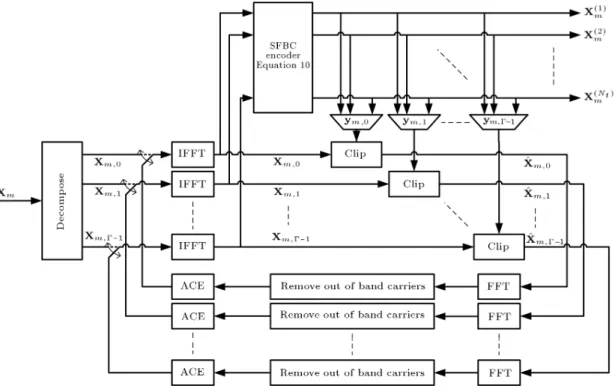
Figure 3 shows the block diagram of the proposed ACE method.
COMPUTATIONAL COMPLEXITY
In this section, the computational complexity of the proposed ACE method is derived based on the number of required Real Summations (RS) and Real Multi-plications (RM). It is assumed that the complexity of a Complex Summation (CS) is equivalent to the complexity of two RSs and that a Complex Multi-plication (CM) is equivalent to four RMs and two RSs. In step 2 (5) of the proposed algorithm, IFFT (FFT) with N= points must be calculated. The calculation of each IFFT (FFT) needs N= log(N= ) CMs and 2N= log(N= ) CSs. In step 3, the signals of antennas must be calculated from the subframes using Equation 10. If Knz is the number of nonzero
coecients, a(p)i and b(p)i , then this operation needs
Figure 3. Block diagram of the proposed ACE method for SFBC-OFDM system with Nt transmitter antennas and code
Knz NNtCMs and the same number of CSs. in step 4,
the value of y must be calculated N times and must be compared with the threshold. Equation 18 shows that for the calculation of ym;i, it is necessary to nd the
amplitude of the time domain samples of all antennas. The complexity of the calculation of the amplitude of a complex number is equivalent to the complexity of two RMs and one Rs. Thus, the complexity of amplitude calculation for all samples is equivalent to NNtCMs. It is assumed that the complexity of nding
the maximum among M positive numbers is equivalent to the complexity of M RSs. Thus, the complexity of the calculation of ym;i(n); n = 0; 1; ; N= ; i =
0; 1; ::; 1 is equal to NKnzNt RSs. Then the
values of ym;i(n) must be compared with threshold A
at which point the complexity of N RSs is added at this stage. In the 6th step, Nc points are mapped to
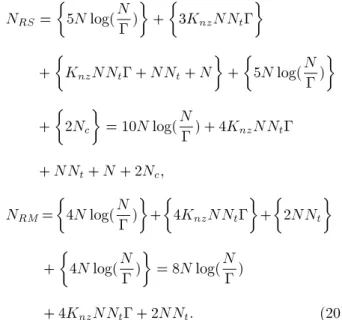
the acceptable regions. The complexity of mapping of a complex point to the acceptable regions is equivalent to the complexity of two RSs. With this brief discussion, it can be seen that the number of RSs and RMs at each iteration is:
NRS =
5N log(N)
+
3KnzNNt
+
KnzNNt + NNt+ N
+
5N log(N)
+
2Nc
= 10N log(N) + 4KnzNNt
+ NNt+ N + 2Nc;
NRM=
4N log(N)
+
4KnzNNt
+
2NNt
+
4N log(N)
= 8N log(N)
+ 4KnzNNt + 2NNt: (20)
For the case of a SFBC code with two transmitter antennas based on Equation 13, the parameters are = 2 and Knz = 4. For Nc = 256 and N =
1024, the modied ACE method needs 159232 RSs and 143360 RMs, while these numbers for the original ACE method in the single antenna case are 104960 and 83968, respectively. Thus, the complexity increase is approximately 60%.
SIMULATION RESULTS
To verify the performance of the proposed method, an OFDM system with 256 subcarriers was simulated. Two scenarios were considered: One was based on application of the original ACE method [14] on the
single antenna OFDM system, and the other based on application of the proposed method on a SFBC-OFDM system with two transmitter antennas and the code structure shown in Equation 11. The oversampling ratio is assumed to be 4, and 106 OFDM frames
are generated for a Monte-Carlo simulation. The performance of the PAPR reduction algorithms is evaluated in terms of the Complementary Cumulative Distribution Function (CCDF) of the PAPR, which is dened by:
CCDF (PAPR0) = PrfPAPR PAPR0g: (21)
The algorithms are applied to the frames with PAPR values higher than 6dB. The value of the clipping threshold, A, must be optimized. If Pave is dened
as the average power of the OFDM frame, then the clipping ratio, , is dened by:
= PA2
ave: (22)
Figure 4 shows the average PAPR versus for QPSK modulation after 7 iterations. As can be seen from this gure, the optimum measures for parameter are 4:7dB and 5:15dB for the single antenna and the SFBC cases, respectively. Figure 5 shows the CCDF of the PAPR after 1, 3 and 7 iterations. In the calculation of the PAPR, the ratio of the maximum power to the initial power (before constellation extension) has been considered; thus, the power increase of the PAPR reduction algorithm has been taken into account. As can be seen at the probability of 10 4, the value of
the PAPR reductions after 1, 3 and 7 iterations are 1dB, 2:2dB and 3:3dB for the single antenna scenario and 0:9dB, 1:9dB and 2:9dB for the SFBC case with the proposed ACE method. As expected, the original
Figure 4. Average PAPR (dB) versus clipping ratio () for the single antenna OFDM system (with 7 iterations of the original ACE) and the SFBC system with two transmitter antennas (with 7 iterations of the proposed ACE) using QPSK modulation.
Figure 5. CCDF of the PAPR for two transmitter antennas and QPSK modulation with SFBC using the proposed ACE method and its comparison to the Single Antenna (SA) case using the original ACE [14] (1, 3 and 7 iterations).
PAPR of the SFBC system was higher than the single antenna case, but the improvement of PAPR after each iteration of the modied ACE was approximately the same as the improvement in the single antenna ACE.
The simulations were repeated for 16-QAM mod-ulation. In Figure 6, it can be seen that the optimum value of is 5:2dB and 5:75dB for the single antenna scenario and the SFBC cases, respectively. Figure 7 shows the simulation results for 16-QAM modulation. In this case, the value of the PAPR reductions after 1, 3 and 7 iterations are 0:45dB, 1:05dB and 1:85dB for the single antenna and 0:4dB, 1dB and 1:7dB for the SFBC case with the proposed ACE method. For the case of 16-QAM modulation, the performance of the proposed method in the SFBC case is very close
Figure 6. Average PAPR (dB) versus the clipping ratio () for the single antenna OFDM system (with 7
iterations of the original ACE) and the SFBC system with two transmitter antennas (with 7 iterations of the
proposed ACE) using 16-QAM modulation.
Figure 7. CCDF of PAPR for two transmitter antennas and 16-QAM modulation with SFBC using the proposed ACE method and its comparison to the Single Antenna (SA) case using the original ACE [14] (1,3 and 7 iterations).
to the performance of the single antenna ACE. It is noticeable that both the original ACE method for a single antenna system and the proposed modied ACE for a SFBC case are less eective than the case of QPSK modulation, because the degree of freedom of the constellation extension is less than that in the QPSK modulation. On the other hand, in the QPSK modulation, all the constellation points can be moved while in the 16-QAM case, a quarter of the points (inner points of the constellation) remain unchanged. CONCLUSION
In this paper, an ACE-based PAPR reduction method is proposed to be used with transmitter diversity with a space-frequency scheme. In this method, the original frame is decomposed into subframes and suitable clip-ping is applied to the subframes at each iteration of the ACE. In the proposed clipping scheme, the eect of the time domain samples of the subframes on the samples of dierent antennas is taken into account. Then, the SFBC encoded frames of dierent antennas are constructed from the modied subframes. This proposed ACE guarantees that the SFBC relations hold after constellation extension. Simulation results show that the performance of the proposed method in PAPR reduction of the SFBC system with two transmitter antennas for QPSK and 16-QAM modulations is close to the performance of the original ACE with a single antenna based on POCS. This means that the full performance of the ACE method (dened by PAPR reduction in the single antenna case with the original ACE) is achieved and the SFBC constraints present no limitation on the performance of the proposed method.
REFERENCES
1. Wu, Y. and Zou, W.Y. \Orthogonal frequency division multiplexing: A multi-carrier modulation scheme", IEEE Trans. Consumer Electronics, 41(3), pp. 392-399 (1995).
2. Hwang, T., Yang, C., Wu, G., Li, S. and Lee, G.Y. \OFDM and its Wireless Application: A Survey", IEEE Trans. Vehicular Technology, 58(4), pp. 1673-1694 (March 2009).
3. Changiz Rezaei, S.S. and Pakravan, M.R. \Perfor-mance analysis of per tone equalization in DMT-based systems", Scientia Iranica, 13(4), pp. 355-363 (Oct. 2006).
4. Lu, G., Wu, P. and Carlemalm-Logothetis, C. \Peak-to-average power ratio reduction in OFDM based on transformation of partial transmit sequences", IEE Electronics Letters, 42(2), pp. 105-106 (2006). 5. Chen, J.C. \Partial transmit sequences for
peak-to-average power ratio reduction of OFDM signals with the cross-entropy method", IEEE Signal Processing Letters, 16(6), pp. 545-548 (June 2009).
6. Bauml, R.W., Fischer, R.F.H. and Huber, J.B. \Re-ducing the peak-to-average power ratio of multicarrier modulation by selected mapping," IEE Electronics Letters, 32(22), pp. 2056-2057 (1996).
7. Jie, Y., Lei, C. and De, C. \A modied selected map-ping technique to reduce the peak-to-average power ratio of an OFDM signal", IEEE Trans. Consumer Electronics, 53, pp. 846-851 (Aug. 2007).
8. Kasari, K. and Dehghani, M. \A Blind SLM scheme for reduction of PAPR in OFDM systems", Proceed-ings of World Academy of Science, Engineering and Technology, 38, pp. 403-406 (Feb. 2009).
9. Armstrong, J. \Peak-to-average power reduction for OFDM by repeated clipping and frequency domain ltering", IEE Electronics Letters, pp. 246-247 (Feb. 2002).
10. Chen, H. and Haimovich, A.M. \Iterative estimation and cancellation of clipping noise for OFDM signals", IEEE Comm. Letters, 7(7), pp. 305-307 (July 2003). 11. Davis, J.A. and Jedwab, J. \Peak-to-mean power
control in OFDM, Golay complementary sequences, and Reed-Muller codes", IEEE Trans. Inform. Theory, 45, pp. 2397-2417 (Nov. 1999).
12. Krongold, B.S. and Jones, D.L. \An active-set ap-proach for OFDM PAR reduction via tone reserva-tion", IEEE Trans. Signal Processing, pp. 495-509 (Feb. 2004).
13. Behravan, A. and Eriksson, T. \Tone reservation to reduce the envelope uctuations of multicarrier signals", IEEE Trans. Wireless Communications, 8(5), pp. 2417-2423 (May 2009).
14. Krongold, B.S. and Jones, D.L. \PAR reduction in OFDM via active constellation extension", IEEE Trans. Broadcasting, pp. 258-268 (Sept. 2003).
15. Bae, K., Andrews, J.G. and Powers, E.J. \Adaptive active constellation extension algorithm for peak-to-average ratio reduction in OFDM", IEEE Comm. Letters, 14(1), (Jan. 2010).
16. Alamouti, S.M. \A simple transmit diversity technique for wireless communications", IEEE J. Sel. Areas Commun., 16(8), pp. 1451-1458 (Oct. 1998).
17. Tarokh, V., Jafarkhani, H. and Calderbank, A.R. \Space-time block codes from orthogonal designs", IEEE Trans. Inform. Theory, 45, pp. 1456-1467 (July 1999).
18. Lee, K. and Williams, D. \A space-frequency transmit-ter diversity technique for OFDM systems", in Proc. IEEE Globecom, pp. 1473-1477 (2000).
19. Suto, K. and Ohtsuki, T. \Performance evaluation of space-time-frequency block codes over frequency selective fading channels", Vehicular Technology Con-ference, 3(24-28), pp. 1466-1470 (Sept. 2002).
20. Ui-Kun Kwon, Dongsik Kim, Kiho Kim, and Gi-Hong Im \Amplitude clipping and iterative reconstruction of STBC/SFBC-OFDM signals", IEEE Signal Processing Letters, 14(11), pp. 808-811 (Nov. 2007).
BIOGRAPHIES
Mahmoud Ferdosizadeh Naeiny was born in Iran in 1979. He received a B.S. (with highest honors) from Amirkabir University of Technology in 2002, and a M.S. from Sharif University of Technology (SUT) in 2004, where he is now a Ph.D. student in the Electrical Engineering Department under the supervision of Professor Farrokh Marvasti. He has also been a member of the Advance Communication Research Institute (ACRI) at SUT since 2006. His research interests are: Design and Implementation of OFDM Systems including Synchronization Issues, Software Dened Radio, MIMO Systems and the Ap-plication of Signal Processing Techniques in Communi-cations.
Ali Jafarnia Jahromi was born in 1981 in Iran. He received B.S. and M.S. degrees in Telecommu-nications Engineering from Amirkabir University of Technology Tehran, Iran, in 2006 and 2009, respec-tively. His M.S. dissertation title was \Multi-user Detection in CDMA based Cooperative Networks". His current research areas include: Cooperative Net-works, Design and Implementation of MIMO-OFDM Transceivers and the Application of Signal Process-ing in Wireless Communications. He is currently a member of the Advanced Communication Research Institute (ACRI) at Sharif University of Technol-ogy.
Farrokh Marvasti received his B.S., M.S. and Ph.D. degrees from Rensselaer Polytechnic Institute in 1970,
1971 and 1973, respectively. He has worked, consulted and taught in various industries and academic institu-tions since 1972 among which are Bell Labs, University of California Davis, Illinois Institute of Technology, and University of London, King's College. He was one of the editors and associate editors of the IEEE Trans. on Communications and Signal Processing from
1990-1997. He has about 50 journal publications and has written several reference books. His recent book is on Nonuniform Sampling: Theory and Practice, published by Kluwer in 2001. Dr. Marvasti is currently a Professor at Sharif University of Technology and the Chairman of the Advanced Communication Research Institute (ACRI) at this university.
![Figure 2 shows the block diagram and the frame structure of the Alomouti SFBC system with two transmitter antennas and a code block length of = 2 [18]](https://thumb-us.123doks.com/thumbv2/123dok_us/8394706.2230374/3.892.457.805.150.264/figure-shows-diagram-structure-alomouti-transmitter-antennas-length.webp)