Ms. Anurima Bhargava
Chief, Educational Opportunities Section Civil Rights Division
United States Department of Justice 601 D Street, N.W., Ste. 4300 Washington, DC 20004
Dear Educational Opportunities Section:
This complaint concerns a particularly harmful aspect of the “school-to-prison pipeline” in Texas – the use of adult criminal courts to prosecute youth for truancy, and the way that school districts’ violations of students’ civil and educational rights directly contribute to this problem. Specifically, this complaint focuses on the Dallas County truancy courts and the four school districts – Dallas, Garland, Mesquite, and Richardson Independent School Districts (“ISDs”) – that funnel students into this court system. The complaint alleges violations of rights guaranteed by the United States Constitution, the Equal Educational Opportunities Act of 1974, Title II of the Americans with Disabilities Act, and Title IV of the Civil Rights Act of 1964.
Texas Appleseed, Disability Rights Texas, and the National Center for Youth Law (“NCYL”) bring this complaint on behalf of seven students and all similarly situated students in Dallas, Garland, Mesquite, and Richardson ISDs. The students named in this complaint are representative of the many students who find themselves caught in this process in Dallas County:1
A.B., who was suspended for being tardy to class, received a truancy case in part because her school erroneously counted those days of suspension as unexcused absences for suspensions given for being tardy to class;
B.B., whose absences stemmed from the failure of the school to provide her necessary special education services;
J.D., whose absences were due to a chronic respiratory disability;
K.W., whose absences were caused by caring for her mother, who has congestive heart failure and chronic obstructive pulmonary disease;
S.M., whose absences were caused by medical complications after delivery of her child;
1
The information in this complaint comes from a year-long investigation of the Dallas County truancy courts conducted by Texas Appleseed, Disability Rights Texas and the National Center for Youth Law that included court observations, interviews with students, parents, and county and school officials, and data collection and analysis.
I.J., who was referred to truancy court for being late to class because she was using the restroom; and
L.P., whose truancy case was caused by absences due to illness, because her caregiver did not call the school on the day of her absence.
I. INTRODUCTION
In Texas, justice of the peace and municipal courts hold original jurisdiction over “Failure to Attend School” (“FTAS”) Class C Misdemeanors as a result of sweeping changes by the Texas Legislature to the state’s truancy laws in 2001.2
Prosecuting children through courts designed for adult low-level offenses has produced a host of harms to children and families. Students as young as twelve years old are subjected to an adult criminal court process despite being charged with a status offense, a “crime” only by virtue of the fact that it was committed by a child. Lacking access to an attorney, these children are almost guaranteed a criminal conviction and all the attendant consequences that follow.
Nowhere is the harm to students and families inflicted by this system more apparent than in Dallas County. Dallas County is one of two counties in the state that created specialized criminal courts solely dedicated to truancy cases in an effort to streamline prosecution.3 While criminal prosecution of truancy is prevalent statewide, the Dallas County truancy courts prosecute the highest number of students for FTAS in the state with more than 36,000 cases filed against students in Dallas County truancy courts in Fiscal Year (“FY”) 2012.
Once ensnared in the Dallas County truancy court process, children are subjected to a byzantine legal process resulting in increasingly punitive measures including arrest, handcuffing, and threats of jail time and detention. The harms of the system extend to students’ families, who get caught in a cycle of workdays missed due to court hearings and debt flowing from fines, costs, and fees. At no time during the Dallas County truancy court process—an adversarial process that includes restraints of students’ liberty and at times, incarceration—does the court provide counsel for the children. In the Dallas County truancy courts:
Cases are “e-filed” by schools with students’ attendance records triggering a system that electronically “pushes” cases to the courts once they have reached the designated filing date – leaving probable cause determinations to a computer.
2See S
ENATE RESEARCH CENTER,BILL ANALYSIS, S. 1432, 77th Leg., Reg. Sess. (Tex. 2001), available at
http://www.legis.state.tx.us/tlodocs/77R/analysis/html/SB01432F.htm. Stakeholders and legislators reasoned that while juvenile courts might be poorly positioned to handle the volume of truancy cases, justice and municipal courts could handle truancy with the same efficiency with which they process traffic tickets. See also ROBERT DAWSON,TEXAS JUVENILE LAW 589 (Christian A. Hubner et al. eds., 7th ed. 2008).
3Seeinfra section II(B). Fort Bend County, outside of Houston, has created a similar specialized truancy
Children are routinely criminalized for behavior as innocuous as being tardy to class.
Students—even those with disabilities—are required to represent themselves with no access to an attorney or advocate, and the court does not allow their parents to help them.
Youth are coerced and cajoled into pleading “guilty,” even when they have valid excuses for school absences.
Families already facing economic hardship are assessed high fines and court costs, with additional fees added each month that they are unable to pay in full.
Children who miss a truancy court hearing are arrested at school, put into a police car, brought into the courtroom in handcuffs, and then charged an additional $50 to cover the arrest warrant fee.
Youth who fail to fully comply with truancy court orders are arrested in court, handcuffed, and transferred without due process to the “Truancy Enforcement Center,” an arm of the county’s juvenile system, where they may face detention.
Youth may be jailed once they turn 17 if they have not paid their fines and costs in full.
Students are routinely threatened with jail time even before they are old enough under Texas law to be subjected to this punishment.
To sustain its specialized truancy court system, Dallas County uses the revenue from the fines paid by students and parents to pay the salaries of the truancy court judges and court staff.4
Opaque school attendance policies contribute to the Dallas County truancy court pipeline. Complex and confusing attendance policy structures exist in each of the four school districts that feed students to the truancy courts:
Broad school district attendance policies are included in the student handbook or code of conduct.
More specific school-level policies vary radically from school to school. They often include policies on the process for reporting an absence, how late a student can be to class before a tardy is counted as an absence, and the process for correcting errors on an attendance report.
Classroom policy—particularly related to tardy behavior—also exists at some schools, and may conflict with campus or district policies.
This trifurcated maze would be difficult for any parent and student to navigate, not to mention a parent with children in the same district at different schools with divergent attendance policies. Despite state law mandating truancy prevention and
4 D
ALLAS COUNTY,DALLAS COUNTY TRUANCY COURT SYSTEM, Appendix C ($2.9 million in revenue collected from fines in FY 2012); see also Annette Fuentes, The Truancy Trap, THE ATLANTIC, Sept. 5, 2012, available at http://www.theatlantic.com/national/archive/2012/09/the-truancy-trap/261937 (when a student in a Dallas County truancy court asked the judge why he had to pay a fine, the judge responded, “It costs $450,000 to run this courtroom. Who’s going to pay for it. . . . Do you think the taxpayers of Garland should pay for it?”).
intervention programs, no meaningful intervention systems exist at either the district or school level. A parent’s first warning of an attendance problem often arrives too late to be addressed outside of court.
In addition, despite the fact that Dallas County’s diverse school districts include a high percentage of “limited English proficient” (“LEP”) and English as a Second
Language (“ESL”) students, school and classroom-level policy is rarely, if ever, provided in any language other than English.
Additional civil and educational rights violations at the school and district level further serve to create a path to the truancy courts. Students who have disabilities are denied appropriate accommodations, placing them at high risk of disengagement from school resulting in attendance problems. Pregnant students are discriminated against for pregnancy-related absences.
These practices and systemic violations of students’ federally-protected rights make the truancy courts in Dallas County one of the largest and most efficient “school-to-prison” pipelines in the state, if not the nation.
II. THE DALLAS COUNTY TRUANCY COURT PROCESS
A. Texas Statutory Truancy Framework: “Failure to Attend School”
In Texas, youth are subject to compulsory school attendance laws that require children to attend school from age six until their eighteenth birthday.5 Texas’s
enforcement system for these compulsory attendance laws is perhaps unique among the states.
Enforcement provisions are included in both the Texas Education Code and Family Code: FTAS, a Class C misdemeanor, is located in the Education Code,6 and shares the same elements as “truancy,” a “Child in Need of Supervision” (“CINS”) offense found in the Family Code.7 A child may be charged with either the CINS offense of truancy or the Class C misdemeanor of FTAS if he or she misses three or more
unexcused days within a four-week period.8 The decision to file a FTAS complaint or refer the matter to juvenile court for CINS proceedings when a student misses three unexcused days within a four-week period is discretionary.9 After ten unexcused days within a six-month period, school districts must file a complaint against a student or refer the matter to juvenile court.
5 TEX.EDUC.CODE § 25.085. 6Id. § 25.094. 7 T EX.FAM.CODE § 51.03(b)(2). 8
TEX.EDUC.CODE § 25.094; TEX.FAM.CODE § 51.03(b)(2).
9 T
EX.EDUC.CODE § 25.0951. However, the school must issue a warning letter and request a conference with parents when a student misses three unexcused days within a four-week period. TEX.EDUC.CODE § 25.095.
Although the juvenile courts process the CINS offense of truancy, municipal and justice courts—adult criminal courts—have original jurisdiction over FTAS cases.10 Thus, children facing FTAS charges are not afforded many of the protections of juvenile court, including confidentiality provisions, appointment of counsel, and specific
protections related to waiver of rights.11 In most jurisdictions, no prosecutor reviews FTAS complaints for legal sufficiency until after a student pleads “not guilty.”
There is no mechanism to determine which FTAS cases may be dismissed or diverted without court involvement, as in Texas’s juvenile courts.12 Instead, the system automatically and mechanically prosecutes all cases, regardless of the circumstances. Not surprisingly, a high percentage of the statewide Class C cases prosecuted against juveniles in municipal or justice courts are FTAS cases. In FY 2012, 34% of the non-traffic juvenile cases filed in municipal and justice of the peace courts were FTAS cases, constituting the single largest cause of referral for non-traffic juvenile cases to these courts. The total number of non-traffic juvenile Class C misdemeanor cases filed in municipal and justice courts was 229,155.13 Of these, there were 76,878 FTAS cases: 64,997 filed in justice courts and 11,881 filed in municipal courts.14
Figure 1: Non-traffic Juvenile Cases Filed in Municipal and Justice Courts by Offense, FY 2012
10See T
EX.CODE CRIM.PROC. ch. 45.
11See Ryan Kellus Turner, Ticketing, Confidentiality, and Special Education Issues, J
UV.LAW SEC.’S
NEWSL.(Juvenile Law Section, State Bar of Tex., San Antonio, Tex.), Dec. 2012, at 5; Ryan Kellus Turner & Mark Goodner, Passing the Paddle: Nondisclosure of Children’s Criminal Cases, JUV.LAW SEC.’S
NEWSL.(Juvenile Law Section, State Bar of Tex., San Antonio, Tex.), Dec. 2010, at 13.
12See T
EX.FAM.CODE § 53.012 (prosecutor required to review case referred to juvenile system for legal sufficiency and “desirability of prosecution”).
13Id. 14 O
FFICE OF COURT ADMINISTRATION,ANNUAL STATISTICAL REPORT FOR THE TEXAS JUDICIARY:FISCAL
YEAR 2012, at 83, 90 (2013). These statistics do not represent the total number of FTAS filings in the state because they do not include FTAS cases filed in specialized truancy courts, as discussed in section II(B),
infra. 18% 3% 3% 34% 7% 4% 31% Non-driving alcohol Drug Paraphernalia Tobacco
Failure to Attend School Other Education Code Daytime Curfew All Other Non-traffic
Texas processes more truancy cases through its court systems than all other states in the nation combined.15
While districts may opt instead to file a case against a student’s parent(s), fewer cases are filed for “Parent Contributing to Nonattendance” (“PCNA”).16
In 2012, 57,360 PCNA cases were filed against parents: 53,048 in justice courts and 4,312 cases in municipal courts.17
The volume of juvenile cases filed in municipal and justice courts dwarfs that of the state’s juvenile courts. During FY 2012, the total number of cases on Texas juvenile court dockets was 55,720 and the total number of CINS cases on Texas juvenile court dockets was 2,098.18 Of those cases, only 23,138 total cases and 455 CINS cases were filed in FY 2012.19 The very high volume of juvenile cases heard by municipal and justice courts in Texas has led some to refer to them as the “shadow juvenile justice system.”20
B. Dallas County Truancy Courts
Until 2003, justice of the peace courts heard Dallas County FTAS cases, as they do in most other Texas counties.21 In 2003, Dallas County lobbied for and obtained a change in the law that allowed the creation of a specialized truancy court system as part of the constitutional county court system.22 Dallas County established its first three truancy courts in 2003 to hear cases filed by Dallas Independent School District (“DISD”).23
Since then, the truancy court system has grown to five courts accepting
15 The most recent available statistics show that in 2009, approximately 52,000 petitions alleging truancy
were filed in the nation’s juvenile courts. We are aware of only two other states that may process cases outside their juvenile court system, Wyoming and Pennsylvania. See NAT’L CENTER FOR JUVENILE JUSTICE, JUVENILE COURT STATISTICS 2009, at 72 (2012), available at
http://staging.ncjj.org/pdf/jcsreports/jcs2009.pdf.
16See T
EX.EDUC.CODE § 25.093. Again, these statistics do not represent the total number of PCNA filings in the state because they do not include PCNA cases filed in specialized truancy courts.
17
OFFICE OF COURT ADMINISTRATION, supra note 14, at 85, 90.
18Id. at 76-77. 19Id. at47, 77. 20 D
AWSON, supra note 2, at 589.
21
Letter from Bill Hill, Dist. Attorney, Civil Div., Dallas Cnty., to Greg Abbott, Attorney Gen., State of Tex. (Sept. 28, 2005), available at
https://www.oag.state.tx.us/opinions/opinions/50abbott/rq/2005/pdf/rq0400ga.pdf (discussing history of Dallas truancy courts and asking for guidance on legislation passed during the 2005 legislative session regarding timing of filing for FTAS complaints).
22 S
ENATE RESEARCH CENTER,BILL ANALYSIS, S. 358, 78th Leg., Reg. Sess. (Tex. 2003), available at
http://www.legis.state.tx.us/tlodocs/78R/analysis/pdf/SB00358F.pdf; JURISPRUDENCE COMMITTEE,SENATE
COMMITTEE REPORT,WITNESS LIST, S. 358, 78th Leg., Reg. Sess. (Tex. 2003), available at
http://www.legis.state.tx.us/tlodocs/78R/witlistbill/html/SB00358S.htm; JUVENILE JUSTICE &FAMILY
ISSUES COMMITTEE,HOUSE COMMITTEE REPORT,WITNESS LIST, S. 358, 78th Leg., Reg. Sess. (Tex. 2003),
available at http://www.legis.state.tx.us/tlodocs/78R/witlistbill/html/SB00358H.htm. Dallas had already created two specialized truancy courts within their municipal court system in 2002—the change in law allowed them to create additional courts within the county court structure under Texas Government Code Section 26.045. See BILL ANALYSIS, S. 358, supra; Letter from Bill Hill, supra note 21.
cases from three other school districts—Garland ISD (“GISD), Mesquite ISD (“MISD”), and Richardson ISD (“RISD”). The truancy court system plans to create a sixth court this year to accept cases from Grand Prairie ISD.24
Dallas County developed a “Truancy Information System” (“TIS”) which allows schools to “e-file” cases with the truancy courts.25
Student attendance automatically triggers the e-filing of an FTAS complaint.26 According to DISD, “[e]very thirty minutes the DISD system searches for queued cases that have reached the designated file date and electronically pushes them to TIS.”27
Electronic filing has supported the growth of the Dallas County system into the single largest court system handling truancy cases in Texas.
Remarkably, the statewide FTAS numbers, discussed in section II(A), supra, do not include data for Dallas County’s specialized truancy courts, because the Dallas courts are not part of the justice or municipal court systems.28 According to Dallas County data, 36,036 cases were referred to its four truancy courts in FY 2012.29 No other county in the state reports such a high volume of FTAS cases.30 While Harris County has a higher child population than Dallas County and includes Houston, the largest school district in the state,31 Harris County’s Justice of the Peace courts report only 12,541 FTAS cases in FY 2012, with Houston municipal courts reporting another 172 cases.32
24See Herb Booth, Grand Prairie Opens New Dallas County Government Center, D
ALLAS MORNING NEWS, May 4, 2013, available at
http://www.dallasnews.com/news/community-news/best-southwest/headlines/20130504-booth-grand-prairie-opens-new-dallas-county-government-center.ece (describing a government center that will house a new truancy court location to serve Grand Prairie ISD).
25 C
OMMISSIONER CANTRELL DISTRICT 2,TRUANCY INFORMATION SYSTEM (TIS), available at
http://www.dallascounty.org/department/comcrt/district2/pluggedin.html#tis.
26Id.; see also Appendix C (information provided to Texas Appleseed in response to its open records
request to Dallas ISD).
27Id. 28
Because the Dallas County truancy courts are Constitutional County Courts, the data is not reported to OCA for inclusion in the annual reports for justice and municipal courts. E-mail from Angela Garcia, Judicial Info. Manager, Tex. Office of Court Admin., to Deborah Fowler, Deputy Dir., Tex. Appleseed (Nov. 13, 2012) (on file with Texas Appleseed).
29
DALLAS COUNTY,DALLAS COUNTY TRUANCY COURT SYSTEM, Appendix C. This data was provided to Texas Appleseed during a meeting with Judge Clay Jenkins, Judge Boyd Richie, and truancy court staff on January 14, 2013. As is true statewide, Dallas County’s truancy courts handle a volume of cases that dwarfs its juvenile court dockets. At the end of FY 2012, Dallas County’s juvenile courts had only 7,407 cases pending on their dockets. OFFICE OF COURT ADMINISTRATION, supra note 14.
30 O
FFICE OF COURT ADMINISTRATION, supra note 14.
31See A
MERICAN SCHOOL &UNIVERSITY, LARGEST SCHOOL DISTRICTS IN TEXAS 2012-13,
http://asumag.com/top-10s/largest-school-districts-texas; ANNIE E.CASEY FOUNDATION,KIDS COUNT
DATA CENTER: PROFILES FOR DALLAS &HARRIS COUNTIES, http://datacenter.kidscount.org/data/bystate/Default.aspx?state=TX.
76,878
455
36,036 152,277
22,683
Justice or Municipal Courts Juvenile Courts Dallas County Truancy Courts
Figure 2: Juvenile Cases Filed by Court for FY 2012 Truancy Cases Other Cases
Because the Dallas County truancy courts are part of the County’s constitutional court system, County Judge Clay Jenkins oversees all the truancy courts.33 Five truancy court judges hear cases: Presiding Judge Chavez and Judges Rayford and Miller hear cases filed by DISD in Dallas, while Judges Sholden and Richie hear cases filed by GISD, MISD, and RISD in Garland.34 The truancy courts employ four case managers who are tasked with assigning some of the students who appear in court to community-based classes meant to address the problems that led to their truancy.35 However, the majority of youth do not receive case management through the truancy courts; during FY 2012, only about 22% of the youth who pleaded guilty or no contest received any case management services.36
A significant component of the FTAS enforcement system in Dallas County is the use of the “Truancy Enforcement Center” (“TEC”), an arm of the juvenile delinquency court managed by Dallas Challenge, Inc.37 Students who fail to abide by the terms of their Dallas County truancy court orders may be charged with contempt of court, arrested,
33See Dallas County Judge Clay Jenkins, Truancy Court,
http://www.dallascounty.org/department/comcrt/jenkins/truancy.php.
34See Dallas County Truancy Court, http://www.dallascounty.org/department/countyclerk/truancy.php. 35
DALLAS COUNTY,DALLAS COUNTY TRUANCY COURT SYSTEM, at 2, Appendix C.
36 This information was given to Texas Appleseed during a meeting with Judge Jenkins, Judge Richie, and
truancy court staff on January 14, 2013.
37 Letter from Bill Hill, supra note 21, at 2 (“Changing the culture of the local truancy community
necessitated implementing several major alterations in ideology and process. The first change involved developing a way in which the new ‘contempt’ cases could be processed without overtaxing an already overloaded juvenile justice system, while simultaneously assigning appropriate sanctions to a new category of juvenile offender. This goal was partially achieved by creating the Dallas Challenge Contempt
Enforcement Center . . . . It was brought on line in September of 1996 as a deferred prosecution program tasked with receiving contempt referrals from the JP system, stabilizing truant youth in an educational setting, and preventing their progression in the juvenile justice system. A critical agreement was reached with all concerned that gave increased credibility to the program: failures at the Contempt Center would be sent to the Dallas County Detention Center, and the District Attorney would file the contempt case in district court. This was a major step forward and lent credence to the idea that Dallas County was serious about truancy. It insured that truancy cases would not fall through any ‘cracks’ in the system.”).
and transported to the TEC by a constable.38 During FY 2012, 1,083 youth were sent to the TEC by the Dallas County truancy courts.39
Dallas County describes this transfer process as follows:
Once the presiding Judge decides to issue the contempt allegation, the offender is immediately taken into custody and transported to the TEC by a uniformed officer of the court. The youth’s parent or legal guardian is ordered to appear at the TEC within 90 minutes of the time the youth is transported. The TEC is not a 24-hour facility and is only authorized to hold the youth in custody a maximum of 6 hours before they must appear before the Magistrate....
Youth are booked into the TEC by a uniformed court bailiff. A background check is then conducted to find out if the youth is already active in the juvenile justice system for other, more serious offenses. If they are in the system on previous charges, the youth is transported to the juvenile detention center for further action. The next step is to use a screening instrument (MAYSI) with each eligible youth to determine if there are issues requiring immediate attention. The main thrust is to assess whether or not the youth appears suicidal or homicidal. If either risk is present, the youth is referred to a psychiatric facility or a detention center....
A case plan is developed from the assessment process.… Once the case plan is developed and agreed to by the participants, they appear before a Magistrate who explains their legal situation, reviews the conditions of participation, and makes sure they understand the necessity of
attending assigned programs. The Magistrate also allows parents and students to ask questions about the case, the process, and the court’s expectations. Participants are then assigned a report back date and time.40
At the TEC, the child appears before a Magistrate, a juvenile court referee, who enters another order requiring the youth to complete the developed service plan.41 If the youth does not successfully complete the case plan, the youth is detained.42
38Id.; see Appendix A for TEC forms. 39D
ALLAS COUNTY,DALLAS COUNTY TRUANCY COURT SYSTEM, at 5, Appendix C.
40 Letter from Bill Hill, supra note 21, at 4. This comports with the process described by TEC staff to both
Texas Appleseed and NCYL attorneys during meetings at the TEC. However, the letter refers to this as a “deferred prosecution” program and TEC staff indicate that they now think of this as a “diversion program” rather than a “deferred prosecution” program. It is not entirely clear what the distinction is between the two, as there are no provisions in the Family Code related to pre-adjudication judicial diversions aside from deferred prosecution. See TEX.FAM.CODE § 53.03.
41Id. 42Id.
Dallas County describes this process as an attempt to avoid detaining youth in the juvenile justice system for truancy-related charges.43 However, 2012 statewide data from the Texas Juvenile Justice Department (“TJJD”) shows that Dallas County detains almost as many youth (53) through the TEC process as are detained statewide for the CINS offense of truancy (70).44 In addition, TJJD data shows that 504 of the more than 1,000 youth referred to the Dallas County juvenile system on a contempt charge were placed in an Emergency Shelter, a non-secure facility licensed by the Texas Department of Family and Protective Services,45 and Dallas County notes that another 280 youth were
transferred from the truancy courts to detention for some other reason.46
Arrest warrants are commonly used within the Dallas County truancy court system. Warrants are used both to take youth into custody for transport to the TEC and when a youth fails to appear for an initial or review hearing. During FY 2012, the truancy courts issued 4,806 warrants and served 1,737 warrants.47 Many of the truancy court warrants are served on students while at school, leading to their arrest and transport from school to the truancy court in handcuffs.
C. Layered Attendance Policies—District, School and Classroom—in Districts Using Dallas County Truancy Courts
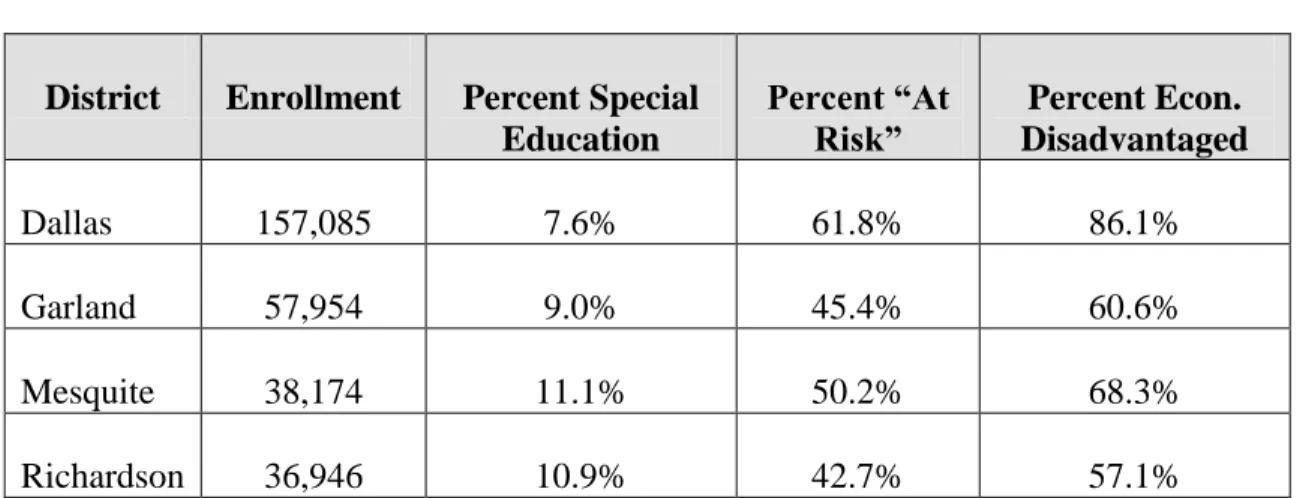
The four school districts currently using the Dallas County truancy courts differ in size and demographics. DISD is the second largest school district in Texas and the fifteenth largest district in the nation.48 GISD, MISD, and RISD are suburban Dallas districts that vary in their size and characteristics. All four districts share problems caused by an unnecessarily complex system of varying attendance policies.
43 During interviews with the Dallas County truancy court judges and with Judge Clay Jenkins, the County
officials expressed their opinion that the TEC process was a “diversion” from the juvenile system, and was therefore preferable to detention.
44 T
EXAS JUVENILE JUSTICE DEPARTMENT,STATEWIDE STATISTICAL REPORT, at 3 (2012), Appendix D (indicating 70 youth placed in secure detention as a result of a CINS truancy charge).
45 T
EXAS JUVENILE JUSTICE DEPARTMENT,STATISTICAL REPORT BY DEPARTMENT (DALLAS), at 2 (2012), Appendix D. While it is not entirely clear whether other youth may be referred to Dallas County’s juvenile department on a contempt charge, the numbers appear consistent with the number of youth referred to the TEC, according to Dallas County’s estimate. Furthermore, data compiled by the Texas Office of Court Administration for Dallas County justice courts and the Dallas municipal court show that only 96 youth were referred to the juvenile system during FY 2012 for contempt, leading to the conclusion that these courts were responsible for only a fraction of contempt charges that could have resulted in an emergency shelter placement. OFFICE OF COURT ADMINISTRATION, ANNUAL STATISTICAL REPORT FOR THE TEXAS
JUDICIARY:FISCAL YEAR 2012, MUNICIPAL COURTS JUVENILE/MINOR CASE ACTIVITY BY CITY (2012),
available at http://www.txcourts.gov/pubs/AR2012/toc.htm.
46 D
ALLAS COUNTY,DALLAS COUNTY TRUANCY COURT SYSTEM, at 1, Appendix C (“Number of Referrals to DCJD”).
47
DALLAS COUNTY,DALLAS COUNTY TRUANCY COURT SYSTEM, at 5, Appendix C.
48 A
MERICAN SCHOOL &UNIVERSITY, LARGEST SCHOOL DISTRICTS IN TEXAS 2012-13,
http://asumag.com/top-10s/largest-school-districts-texas;AMERICAN SCHOOL &UNIVERSITY, 2012 AS&U 100:LARGEST SCHOOL DISTRICTS BY ENROLLMENT, http://asumag.com/asu100/2012/enrollment.
Table 1: School District Demographics, 2011-1249
District Enrollment Percent Special Education Percent “At Risk” Percent Econ. Disadvantaged Dallas 157,085 7.6% 61.8% 86.1% Garland 57,954 9.0% 45.4% 60.6% Mesquite 38,174 11.1% 50.2% 68.3% Richardson 36,946 10.9% 42.7% 57.1%
DISD, GISD, MISD, and RISD (the “Districts”) all have broad district-wide attendance policies that allow each school to add specific school-wide policies. Further complicating matters, some schools allow teachers to implement their own classroom attendance policies.50 What results is a complex and confusing maze of policies that parents complain are unclear and divergent. These complaints were born out by our review of district and school attendance policies.
Policies related to tardy behavior and the process for getting absences excused vary between the districts but also between schools. Parents and students commonly described policies and practices such as:
Refusal to accept a note from a parent, doctor or other healthcare professional to excuse an absence if it is turned in to the office more than three days after the absence;
Refusal to accept an excuse note from a parent for any reason after the child had missed a certain number of days during the school year;51
49 Data taken from Texas Education Agency’s Academic Excellence Indicator System. T
EX.EDUC. AGENCY,2011-12ACADEMIC EXCELLENCE INDICATOR SYSTEM,
http://ritter.tea.state.tx.us/perfreport/aeis/2012/district.srch.html.
50
Classroom policies reported by parents usually focused on tardy behavior. For example, one parent (whose son was referred to truancy court for arriving to classes tardy) reported that one of her son’s teachers counted students tardy even if they were in the classroom, but they were not seated at their desk when the bell rang.
51
School-level policy expands on district-level policies by noting the number of handwritten excuses that would be accepted from a parent in a semester or school year, and the proper procedure for a parent to report a student’s absence. For example, on John D. Horn High School’s website (in Mesquite ISD), the parent information page indicates that any time a student is sick, a parent must “call in” to report the absence. It also notes that a parent may only excuse an absence by calling in three times—after the third call, “proper documentation” must be provided to excuse the absence. See JOHN D.HORN HIGH SCHOOL, http://www.mesquiteisd.org/jhhs/parents/. Similarly, in Garland ISD, Garland High School’s “policies and procedures” page notes that “an attendance form must be filled out and stapled to the absence note” that a student turns in after being out of school. Garland High School allows six notes for personal illness during the semester – after which, “an official doctor’s note” is required. See GARLAND HIGH SCHOOL,POLICIES AND PROCEDURES, http://www.garlandisdschools.net/page.cfm?p=54. Some schools specify that a student
Counting students absent if they arrive at class after the time has elapsed during which they may simply be considered “tardy;”
Counting a specified number of tardies as an unexcused absence; and
Lack of communication between the school nurse and the attendance office when the school nurse sends a student home for illness. As a result, parents were required to send an excuse note to school the following day to tell the attendance office that the school nurse sent their child home.
Frustrated parents indicated that the school did not adequately describe their policies before it was “too late” and students had already been referred to court. Students and parents agreed that there was little-to-no effort to clarify the school’s or district’s policies for turning in notes or getting an absence excused before it became a problem. One parent noted the most useful part of the truancy court process was attending a court-ordered class on district truancy policies; however, this class was only offered after her child was convicted for FTAS.
Many of the youth we met at court were absent due to extended illnesses and, in some cases, even hospitalizations. They often found that an FTAS complaint had been filed either due to the district’s mistake52
or the student’s failure to turn in excuse notes on time. While truancy court judges tell parents and students that the school “must” accept a doctor’s note at any time, families reported that schools refused doctor’s notes, telling students they would not accept the notes because too many days had passed after the absence. When parents reported this to the judge, they were often told that they needed to return to the attendance office with the doctor’s note and insist the school accept the note. However, judges often refused to allow students to present doctor’s notes directly to the court and told students that the court could not dismiss the FTAS charge unless the school corrected the student’s attendance record.53
needs a doctor’s note if they miss as few as three consecutive days of school—or, alternatively, that only three handwritten excuses from a parent will be accepted per semester. See WILMER-HUTCHINS HIGH
SCHOOL,ATTENDANCE (DISD), Appendix B; ZAN WESLEY HOLMES,JR.MIDDLE SCHOOL,STUDENT
ATTENDANCE POLICY 2012-2013 (DISD), Appendix B. Others allow five to ten absences before a doctor’s note is required.
52 We met a number of students and parents who complained that they were in court due to an error on the
part of their school or attendance office. In a couple of cases, an error in a student’s schedule led them to be marked absent for a class the student was never attending. Several parents complained about another type of error: the school counting a student’s absence for a suspension as unexcused. The information from one DISD high school, provided in response to Appleseed’s open records request, suggests these may not be isolated incidents. The Faculty and Staff Handbook for North Dallas High School includes “[n]o inaccurate court referrals due to attendance mistakes by teachers” as one of its attendance office goals for 2012-2013. NORTH DALLAS HIGH SCHOOL,2012-2013FACULTY AND STAFF HANDBOOK (DISD), Appendix B. Another DISD high school’s faculty handbook seems to either discourage correcting
attendance reports, or making mistakes (it isn’t clear which) – it states, “Correcting absences after a truancy case is filed may be considered as ‘filing false criminal charges.’ Offenders may be prosecuted by the district attorney’s office. Board Policy DF (LOCAL) #4 states that a teacher may be terminated for ‘failure or refusal to timely submit or account for all grades, reports, school equipment, or other required items.’ This does include attendance reporting.” W.T.WHITE HIGH SCHOOL,FACULTY/STAFF HANDBOOK (DISD), Appendix B.
53 One judge went so far as to tell students, during admonishments, that no judge “anywhere in the country”
All of the district and school policies received refer to the three-day limit for parental excuse notes, but none distinguish between notes from parents and those from doctors.54 Some of the school-wide policies indicate the three-day limit will be strictly enforced, noting “no exceptions” to this policy.55
Many of the school policies indicate that an unexcused absence is “automatically” entered if a note is not received within three days.56 Several schools define “truancy” to include the failure to turn in a note within three days.57 Some schools require parents to call the day the student is absent and follow up with a letter, others allow faxed or e-mailed excuses, but others will only accept a written letter.58 For example, a MISD high school requires the parent to call by 10:00 a.m. on the day of the absence or it is considered unexcused; the school does “not accept” parent notes.59
In the districts, school-level policies vary considerably from district-level policy. For example, while DISD policy notes that students may violate compulsory attendance
the school and Dallas County and made no mention of how a student could file a motion to request dismissal of an FTAS case.
54 As part of the research for this complaint, Texas Appleseed requested and received both district-level
policy related to attendance and school-level policy, where it deviated or expanded on district policy. One DISD school requires a specific form for class time missed due to a doctor or dentist appointment, which is kept by the school’s attendance office. W.W.SAMUELL HIGH SCHOOL,ATTENDANCE AND TARDY
PROCEDURES,CAMPUS LEVEL PROCEDURES 2012-2013(DISD), Appendix B. Another school requires students who have been absent due to “critical illness or emergency care” to see the nurse upon returning to school. JUSTIN FORD KIMBALL HIGH SCHOOL,STUDENT ATTENDANCE POLICY (DISD), Appendix B.
55
GEORGE BANNERMAN DEALEY MONTESSORI VANGUARD &INTERNATIONAL ACADEMY,ATTENDANCE
POLICY (DISD), Appendix B (“If a note is not received by the third day after the absence, an excused note cannot be accepted.”); ROSIE SORRELLS EDUCATION &SOCIAL SERVICES AT TOWNVIEW CENTER,ESSM ATTENDANCE (DISD), Appendix B (“Late notes are not accepted.”).
56
See J.J.PEARCE HIGH SCHOOL,2011-2012STUDENT HANDBOOK 17 (RISD), available at
http://www.edline.net/files/_WWBww_/e8d8dc38674c6a033745a49013852ec4/11_12_student_hdbk.pdf; MOISES E.MOLINA HIGH SCHOOL,2012-2013TARDY PROCEDURES 9 (DISD), Appendix B; HILLCREST
HIGH SCHOOL,ATTENDANCE POLICY (DISD), Appendix B. David Carter High School’s guidance on this
issue is the only guidance that appears to distinguish between a parent and doctor’s note, but it is extremely confusing, stating “Within three days of an absence, the student must give the Attendance Office clerk a written note from a parent/guardian stating the date and the reason for the absence. After three days, a note must come from the physician releasing the student back to school. Students not turning in a note within the three days will be counted as an unexcused absence.” DAVID W.CARTER HIGH SCHOOL,ATTENDANCE AND TARDY PROCEDURES 2012-2013(DISD), Appendix B. One DISD high school’s school level policy indicates, “[d]iscrepancies in attendance must be noted within the six weeks. (No changes will be made after the six weeks ends unless the absence was school related or a teacher error).” JUSTIN FORD KIMBALL
HIGH SCHOOL,STUDENT ATTENDANCE POLICY (DISD), Appendix B.
57 J
USTIN FORD KIMBALL HIGH SCHOOL,STUDENT ATTENDANCE POLICY (DISD), Appendix B; GARZA
EARLY COLLEGE HIGH SCHOOL,2012-2013GUIDELINES FOR STUDENT ATTENDANCE AND PUNCTUALITY 1-2(DISD), Appendix B.
58
For example, Garland High School requires an “attendance form” to be filled out and stapled to an absence note, and states that e-mails, faces, and phone calls” are not acceptable documentation. Garland High School, supra note 53.
59
NORTH MESQUITE HIGH SCHOOL,ATTENDANCE GUIDELINES FOR NORTH MESQUITE HIGH SCHOOL 2012-2013(MISD), available at http://www.mesquiteisd.org/nmhs/information/policies.html. John Horn High School, also in MISD, requires parents to call the day the student is absent and does not accept parent notes. JOHN D.HORN HIGH SCHOOL, http://www.mesquiteisd.org/jhhs/parents/.
laws if they are “absent from class” or “absent from school…for days or parts of days,”60 it does not establish when a student who is late to class will no longer be considered “tardy” and instead is marked absent.61
School-level policies determine this distinction and they vary considerably from school to school.62 Some schools mark a student who is more than five minutes late to class absent,63 while others give students a twenty-five minute window before marking them absent.64 This is also true for GISD, MISD, and RISD school policies. Because the FTAS statute allows prosecution for “parts of days” as well as whole days, many students find themselves in Dallas County truancy courts not for missing whole days—or even whole classes—but simply for being late to class.
To complicate matters, parents report that tardy policies can vary between classrooms, with one parent noting her son was counted “tardy” when he was in the classroom, but not seated at his desk, because his teacher adopted a classroom-specific rule.
60 D
ALLAS ISD,CODE OF CONDUCT ANDSTUDENT HANDBOOK 2012-2013, at 8 (2012), available at
http://www.dallasisd.org/cms/lib/TX01001475/Centricity/Domain/159//StudentHandbook/studenthandbook _English.pdf.
61Id. at 8-9.
62 It is not clear that these policies conform with either Texas Education Agency (“TEA”) guidance or a
1993 Attorney General (“AG”) opinion on this subject. Texas Attorney General Dan Morales opined that tardiness was not an unexcused absence because it signifies the youth is “present in the school building” and simply late getting to class, whereas the term “unexcused absence” signifies “a child is not present in the school building for a certain period of time.” Tex. Att'y Gen. Op. No. DM-200 (1993), available at
https://www.oag.state.tx.us/opinions/opinions/48morales/op/1993/htm/dm0200.htm. A 2001 TEA guidance letter citing this opinion states that “school districts should not routinely classify each instance of tardiness as an absence for purposes of truancy.” Letter from David A. Anderson, Gen. Counsel, Tex. Educ. Agency, to Administrators (Nov. 13, 2001), available at http://ritter.tea.state.tx.us/taa/legal011113.html. Both the AG Opinion and the 2001 TEA letter are cited in a 2012 TEA guidance letter noting, “Tardies are generally not considered absences for purposes of compulsory attendance enforcement.” Letter from David A. Anderson, Gen. Counsel, Tex. Educ. Agency, to Administrators (Aug. 2, 2012), available at
http://www.tea.state.tx.us/index4.aspx?id=2147508100. Texas school districts bypass this guidance by defining a window within which youth are “tardy” and another within which they are counted absent.
63
See ZAN WESLEY HOLMES,JR.MIDDLE SCHOOL,STUDENT ATTENDANCE POLICY 2012-2013 (DISD), Appendix B (“If a student is 5 minutes late to class without a pass, her or she may be marked absent. If the student has a pass, the teacher will submit an attendance correction form to the attendance office in order for it to be changed to a tardy.”). Wilmer-Hutchins High School in DISD indicates a student will be marked absent if they are more than eight minutes late to class. WILMER-HUTCHINS HIGH SCHOOL, ATTENDANCE (DISD), Appendix B.
64See N
ORTH MESQUITE HIGH SCHOOL,ATTENDANCE GUIDELINES FOR NORTH MESQUITE HIGH SCHOOL
2012-2013(MISD), (indicating twenty-five minutes is considered “excessively late” for first period classes and will be counted as an unexcused absence), available at
http://www.mesquiteisd.org/nmhs/information/policies.html. North Mesquite’s policy indicates,
incorrectly, that “The State of Texas does not distinguish between a student being tardy and being absent. It is a courtesy that NMHS does provide a tardy policy which provides some flexibility for the times that students are a few minutes late to class.” One DISD high school allows students to have an “absence” from a class changed to a “tardy” if they attend Saturday school. EMMETT J.CONRAD HIGH SCHOOL,
1. Policies Inaccessible to Non-English Speakers
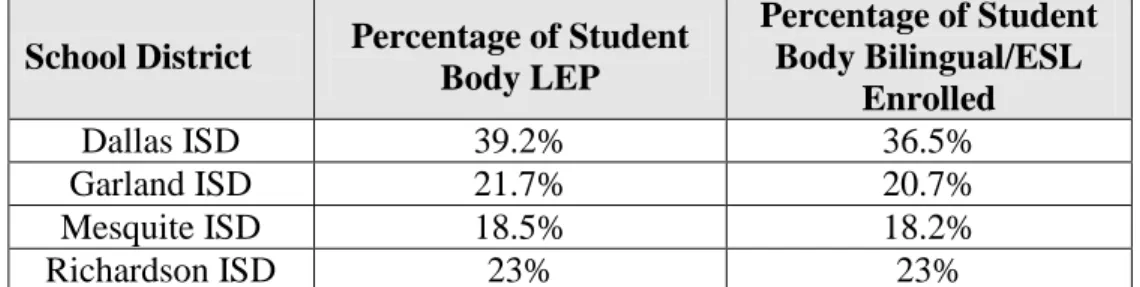
The complexity of the system of district, school-level, and classroom attendance policies is further exacerbated by schools’ failure to ensure policies are provided to students and parents in languages other than English. In each of these school districts, LEP students and those enrolled in Bilingual or ESL classes comprise a significant portion of the student body:65
Table 2: Students Who Are LEP or Bilingual/ESL Enrolled, 2011-2012
School District Percentage of Student Body LEP Percentage of Student Body Bilingual/ESL Enrolled Dallas ISD 39.2% 36.5% Garland ISD 21.7% 20.7% Mesquite ISD 18.5% 18.2% Richardson ISD 23% 23%
Despite this, while district-level policies are provided in English and Spanish, very few schools provide their school policies in any language other than English:66
In DISD, more than seventy middle and high schools provided school-level policy in response to our open records request,67 but only five schools provided them in any language other than English.68
In response to our open records request, RISD referred us to their website, which includes links to district policy as well as individual school sites. The District’s handbook is provided in English and Spanish; however, none of the school-level handbooks were available in any language other than English.
MISD provided its district-level policy in English and Spanish. While it also provided school-level policy for two high schools, those policies were not provided in any language other than English.69
65
Data in table taken from Texas Education Agency’s Academic Excellence Indicator System. TEX.EDUC. AGENCY,2011-12ACADEMIC EXCELLENCE INDICATOR SYSTEM, http://ritter.tea.state.tx.us/perfreport/aeis/.
66 As part of our research for this complaint, Texas Appleseed sent open records requests to Dallas, Garland,
Mesquite, and Richardson ISDs, asking for copies of their district and campus attendance policies in all languages in which they are made available to students and parents. See Texas Appleseed, Open Records Requests, Appendix B. Appleseed requested the district- and campus-level attendance policies in any language in which it was provided. The failure to provide a copy in any language other than English in response to the request is presumed to mean that it is provided only in English.
67
For purposes of this section, middle and high school policies were the only campus-level policies considered, since children under the age of twelve may not be prosecuted for “failure to attend school.” TEX.EDUC.CODE § 25.094.
68
The schools that included a Spanish version of their policy were W.H. Adamson High School, Thomas Jefferson High School, Lincoln High School, Gilliam Middle School, and Robert T. Hill Middle School.
See policies of the aforementioned schools in Appendix B.
The GISD student handbook is provided in English and Spanish on the District’s website. However, we were unable to find any GISD school-level policy in any language other than English and GISD did not respond to our open records request.
2. Minority Students Are Disproportionately Referred
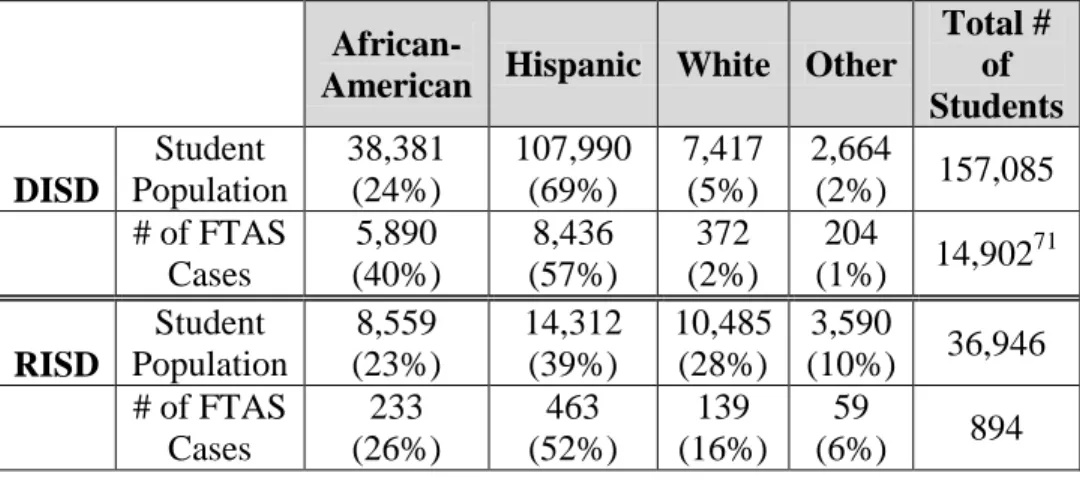
Data shows that African American students are over-represented in FTAS referrals in DISD and Hispanic students are over-represented in RISD referrals,
suggesting that these policies have a disparate impact on minority students.70 GISD and MISD did not respond to our requests for disaggregated FTAS data.
Table 3: Student Body and FTAS Cases by Race/Ethnicity, 2011-12
African-American Hispanic White Other
Total # of Students DISD Student Population 38,381 (24%) 107,990 (69%) 7,417 (5%) 2,664 (2%) 157,085 # of FTAS Cases 5,890 (40%) 8,436 (57%) 372 (2%) 204 (1%) 14,902 71 RISD Student Population 8,559 (23%) 14,312 (39%) 10,485 (28%) 3,590 (10%) 36,946 # of FTAS Cases 233 (26%) 463 (52%) 139 (16%) 59 (6%) 894 III. COMPLAINANTS
The following students have been or are currently involved in the Dallas County truancy court system. They respectfully request the U.S. Department of Justice to investigate the unlawful practices and processes to which they and other students in Dallas County have been subjected.
70 Data in table taken from Texas Education Agency’s Academic Excellence Indicator System. T
EX.EDUC. AGENCY,2011-12ACADEMIC EXCELLENCE INDICATOR SYSTEM:DISTRICT REPORTS,
http://ritter.tea.state.tx.us/perfreport/aeis/2012/district.srch.html. Data related to FTAS cases provided in response to open records request from Texas Appleseed. See DALLAS COUNTY,DALLAS COUNTY
TRUANCY COURT SYSTEM, Appendix C.
71
In its breakdown by race and ethnicity, DISD categorizes 3,952 students as “no ethnicity selected by parent/guardian on enrollment form,” even though other records from DISD suggest fewer than 10 students district-wide did not report their race/ethnicity. The numbers in the table do not include these students so as not to skew the results, but it should be noted that the total number of cases filed in 2011-12 by DISD is 18,854. See, e.g., DALLAS ISD,DATA PACK FOR 2012-2013PLANNING (2012) at 6, available at
https://mydata.dallasisd.org/docs/CILT2013/DP1000.pdf (“Dallas ISD 2011-12 Group Summary Statistics”).
A.B.
A.B. is a 16-year-old student who is finishing her sophomore year at South Oak Cliff High School (“SOC”) in DISD. A.B. has always excelled academically, and was salutatorian of her middle school. She has recently been chosen for a prestigious internship with a national corporation.
However, despite her academic success, A.B. has been unable to avoid truancy court. During the current school year, A.B. accumulated ten absences that the school inaccurately marked as unexcused:
A.B. was absent for four days after the death of her grandmother, whom she was very close to, and the school marked these absences as unexcused even though her mother turned in her grandmother’s obituary.
A.B. was suspended for three days and the school marked these absences as unexcused.
A.B. received another suspension for three days after she was tardy to one class period, and these absences were again marked as unexcused.
A.B. described SOC’s practice regarding tardy students: When the bell rings, SOC locks classroom doors. Students who cannot enter their classrooms have to go to the cafeteria and turn in their student badge. They are then sent to the disciplinary office where they receive a suspension. A.B. described that students sometimes receive in-school suspensions and sometimes receive out-of-in-school suspensions; she did not know what determined whether a student would receive an in-school or an out-of-school suspension. A.B. estimates that about ten to fifteen students are caught tardy every period at SOC and consequently receive suspensions for being tardy.
A.B. received an FTAS charge for these absences, including the suspensions, although suspensions are excused absences under Texas law. When her mother called the school to correct the attendance record, she was told that she had to go to the school in person to do so. She had to wait over one-and-a-half hours before she spoke to someone who could correct the record. During that time, she was passed from person to person with no one helping her. Finally, she spoke to the Assistant Principal who was able to excuse the absences.
Because A.B. had a corrected attendance record, her FTAS charge was dismissed. However, she acutely felt the injustice of receiving a criminal charge for mistaken record-keeping by the school, particularly the school’s failure to record a suspension given to her for being tardy to one class period as an excused absence. Moreover, A.B. had to miss school to go to truancy court before her charge was dismissed.
Additionally, A.B. reports that there are continually mistakes on her attendance record, which makes her feel like the teachers do not pay attention to the students. In one class, A.B. reports that her teacher marked her absent because another student with her last name was absent. In another class, she is the shortest student in the class, so the
teacher marked her absent because the teacher did not see her. After A.B. was referred to court, her mother has followed up on these mistakes immediately to ensure that A.B. does not receive another FTAS charge based on errors like these. However, her mother also points out that it is difficult to take the time to correct the school’s records given her other obligations.
B.B.
B.B. is an 18-year-old senior at Dallas CAN Academy, a charter school for youth who are at risk of dropping out. Before enrolling at Dallas CAN in May 2013, B.B. was a student at SOC High School in DISD. Her truancy cases are related to attendance at SOC.
B.B. was identified as having Attention Deficit Disorder (“ADD”) when she was in third grade. While her mother describes B.B. as “the most creative and naturally talented” member of the family, both B.B. and her mother acknowledge that her ADD made it difficult to learn without assistance through special education services. When she received appropriate help, B.B. was able to progress and enjoyed school.
B.B. started high school at A. Maceo Smith High School (“Maceo”), where she had “teachers that helped and encouraged her.” At Maceo, under her Individualized Education Program (“IEP”), B.B. received access to resource room support as well as push-in special education support. She had to transfer to SOC her junior year because DISD converted Maceo to a magnet program. B.B. immediately had problems at SOC – B.B. and her mother report that the school did not provide any special education services and failed to implement her IEP. B.B. reports that she had no one to help her at SOC, which led to academic problems for B.B.
She received her first truancy court referral when she was a junior at SOC. By her senior year, B.B.’s academic problems had led SOC to place her in “Reconnect” classes that offered a one-size-fits-all computer-based credit recovery program with insufficient teacher support for B.B. to learn. Moreover, B.B. reports that there were more students assigned to the “Reconnect” classroom than there were available computers so students regularly were unable to even work on the computer program in the classroom. B.B. reports that students who could not use one of the computers received no schoolwork to complete in the classroom.
In the absence of appropriate supports, B.B. finally gave up, became depressed, and stopped going to school regularly. Going to school seemed pointless to her because she was not learning. B.B.’s mother said that when she raised these problems in a meeting at SOC, school officials became defensive instead of working to appropriately improve and implement her IEP. The school completed no evaluations to consider the functional cause of the school attendance problem, and the school offered no additional academic or positive behavioral supports to improve her attendance.
As a result, during the 2012-13 school year, three truancy cases were filed against B.B.72 During her first hearing at court, B.B. and her mother tried to explain to the judge what happened—that B.B. was a special education student, her school was not providing the help she needed, and that she gave up hope when she was placed in the “Reconnect” classes because she could not understand the material and was not learning. Initially, the judge told her that he “would have DISD look into it,” but nothing happened.
At subsequent hearings, the judge was not interested in an explanation. Despite the repeated court filings, B.B.’s status as a special education student, and her
conversation with the judge about her disability, she never received assistance from the court’s case managers. Nor did the judge ever inquire into her capacity to represent herself, or her ability to understand the rights she waived or the pleas she entered. At one review hearing, the case manager who met with her said, “I don’t even want to see you – you are a senior who is not going to graduate. Get out of here.”
B.B. was convicted of “failure to attend” in all three cases, and has been ordered to pay fines in excess of $1300, which B.B. and her family have no way of paying. Since B.B. is eighteen, the court will not allow her mother to assist her during court
appearances, despite her disability. B.B.’s mother says she has “never felt more helpless as a parent because she knows that there’s nothing she can do to protect her.” She also said that students and parents at truancy court are like “sheep led to the slaughter” because the truancy courts are “making criminals” out of normal students.
Recently, B.B.’s mother persuaded her to enroll at Dallas CAN, a charter school. When she transferred to Dallas CAN, the school told B.B. that she could conceivably earn enough credits to finish her high school degree and graduate in June. B.B. loves Dallas CAN, and is excited about learning—she says she finally got the help she needs. Her mother reports that B.B. “came alive again…it is like a light came back on in her.” B.B had perfect attendance at Dallas CAN, and is scheduled to graduate on June 15, 2013. Nonetheless, the three truancy cases remain pending, with B.B. in court every month for a review hearing. Texas Appleseed was able to find pro bono representation for B.B., who was able to convince the judge to substitute community service for some of her fines and court costs. However, she still has other fines pending, and, since she is an adult, she risks arrest and jail until she can pay her fines.
J.D.
J.D. is a 15-year-old student, finishing her sophomore year at Richardson High School in RISD. J.D. has had chronic respiratory problems, including asthma and allergies, since she was a small child. J.D.’s mother, K.D., reports that when J.D. gets a cold or allergies, she often ends up with an infection that can keep her out of school for days, and sometimes even weeks, at a time.
72 After the first case was filed, DISD began to more aggressively pursue truancy charges against B.B.,
filing subsequent cases when she missed three days, or parts of days, rather than waiting until she reached the mandatory 10-day filing.
J.D. loves school, and gets upset and frustrated when her health prevents her from going. During one recent illness, J.D. insisted on going to school, but felt so badly that when she got there, she could not stay. J.D.’s mother reports that J.D. began crying out of frustration.
Despite J.D.’s chronic health problems and her repeated excused absences, RISD never provided J.D. with 504 services, accommodations or modifications to address her respiratory disability.
During the 2011-2012 school year, J.D. forgot to turn in two notes from K.D. for absences due to illness, and an FTAS case was filed. Because she was sick on the days that she missed school and believed that the absences should not be considered for truancy purposes, J.D. plead “not guilty.” From that point forward, the court and school engaged in an attempt to pressure J.D. into changing her plea.
At court, the RISD attendance officer gave them a form, “Understanding your Not Guilty Plea,” as soon as J.D. entered her plea (this form has since been amended, but still includes several misstatements of law). The form indicated that if they could not get RISD to correct J.D.’s attendance record, they would have to change her plea to “guilty." At the pre-trial, both K.D. and J.D. felt the prosecutor and court officers were very curt and abrupt. J.D. and K.D. described their demeanors as “bullying,” and “offensive, intimidating.” They started the pre-trial by shoving the attendance report in front of J.D. and asking her “if it looked correct.” J.D., who didn’t have time to look at it carefully before it was pulled away, said she “guessed it did.” K.D. felt that they were trying to get J.D. to admit that she was guilty, so she told the prosecutor that she planned to hire an attorney and did not want J.D. to answer any more questions. The prosecutor became very angry, his “face turned very red,” and he stormed out of the room.
After the pre-trial, K.D. received a call from the prosecutor asking “what they could do to get [J.D.’s] case resolved out of court.” K.D. responded by asking why the prosecutor called to ask her this question, noting the prosecutor was “the only one who [could] do anything.” J.D. was pulled into the office at school. Her principal asked her whether her mother “had any ideas about how [they] could get [the case] solved out of court” and “how [J.D.’s mother] was going to respond to the charges.” Despite this, when they were in court, the judge would not allow J.D.’s mother to speak on her behalf. Every time she tried to respond to a question or help J.D., the court instructed her that she was not allowed to do so.
Finally, when J.D.’s case was set for trial, the court failed to have prospective jurors available. J.D.’s principal, who had also appeared for court, was very upset at having to take time away from campus to be at court. The case was re-set, and when they appeared for the second trial date, the prosecutor’s witnesses were not in court. In the meantime, J.D. had missed multiple days of school for court. Her mother noticed that J.D. (who is very shy) was uncomfortable representing herself. J.D. changed her plea to
“guilty” on the day that the prosecutor's witnesses were not in court for trial, because at that point, she just wanted to move on and get the case over with.
J.D. reports that she was “overwhelmed” and “scared” by the whole process and felt she was “encouraged to say [she] was guilty.”
J.D. was convicted of “failure to attend school,” and ordered to pay a $100 fine and $77 in court costs. She asked to do community service but the judge did not allow it. She was also required to complete twenty-two hours of tutoring. J.D. has had trouble scheduling enough tutoring hours, between her illnesses and problems getting tutoring appointments with the appropriate teachers. Most of her teachers do not have tutoring hours in the morning, or their lunch is scheduled at a different time than J.D.’s
lunch. Though she only lacks five-and-a-half hours of tutoring before she is finished, until she completes all her hours, J.D. has to continue to appear in court for review hearings.
At this point, J.D. has missed almost as much school for court as she missed for the illness that brought her to court.
I.J.
I.J. is a 16-year-old student who is finishing her sophomore year at Namaan Forest High School in GISD. She has had a total of three FTAS cases since starting high school. The first case, filed when she was a freshman, was filed after she accrued
twenty-seven class period absences over the course of three days. I.J. acknowledges that when she started high school she “was hanging out with the wrong crowd” and “made bad choices.” For her first case, she was ordered to pay fines and court costs of $200, had to complete twenty hours of community service, and was ordered to attend a four-hour life skills course, which cost an additional $40.
This year, she has had two cases filed against her. The first case was filed as the result of fifteen absences that were entered as the result of a scheduling mix-up with her block schedule. The copy of the schedule she was given was different from the school’s attendance rolls. When I.J.’s mother received a call about the absences, I.J. went to talk to the school’s attendance clerk, but she was told it was too late to correct the errors for all but two of the absences.
I.J. pleaded “no contest” in court, was convicted of “failure to attend,” and was ordered to pay a $200 fine and $80 in court costs. She had to complete twenty hours of tutorials, and a truancy trivia quiz. I.J. and her mother were ordered to complete a 500-piece jigsaw puzzle together, and to bring proof of completion of the puzzle to court, along with pictures showing them working on the puzzle together.
Another case was filed against I.J. largely as the result of being tardy to class. I.J.’s mother reports that she was tardy because, after lunch, she always has to use the restroom. Her mother has a note from her doctor indicating that this is a medical issue that I.J. cannot control, however, the school still filed an FTAS case against I.J.
This case is still pending because I.J. pleaded “not guilty.” When the judge accepted her plea, he told her that it was her “lucky day” because, if she had pleaded guilty, she would have spent her summer in jail. He told her that, because she had pleaded not guilty, she would spend August and the first month of school in jail instead. I.J. recalled that this made her feel like it was inevitable that she would be convicted and locked up for truancy: “It’s like the court system and the judges are bullying the kids.” She does not think that the court system is designed to help students improve their attendance, because all it does is put additional stress on students who fear that they will go to jail because of truancy.
K.W.
K.W. is a 17-year-old student who just finished her junior year at Wilmer-Hutchins High School in DISD. K.W. likes school and wants to continue her education after she graduates next year, with hopes of someday attending Spelman College. K.W.’s sister, S.M., is also a complainant, infra.
K.W.’s mother, C.M., has congestive heart failure and chronic obstructive
pulmonary disease (“COPD”). C.M. has been very ill since K.W. was about ten years old, when C.M. had her first heart attack. C.M. had to quit working soon after due to her chronic health problems, and the family’s sole source of income is her Supplemental Security Income (“SSI”) check.
K.W. often helps care for her mother, who has been in and out of the hospital on a regular basis for about seven years. C.M.’s hospitalizations sometimes include long stays in intensive care—with the family noting that in 2011, she was in the hospital “every month.” Because C.M. had a good job before she fell ill, her SSI income puts the family above the threshold that would qualify her for Medicaid. Thus, her access to care and services is limited. While K.W. has an older sister who also helps to care for C.M., she has her own family and a job that restrict her ability to provide care for her mother. While her sister can help to give K.W.’s mother a ride home from the hospital sometimes, she is not in a position to stay home with her mother when she is sick.
K.W. sometimes stays home to care for her mother when she is ill – even though her mother tells her to go to school. K.W. is the only person in the household who can drive, and she has become familiar with her mother’s symptoms. K.W. reports that she knows when her mother’s symptoms indicate she needs to go to the hospital, and when she is so critically ill that she needs to call an ambulance. She assists in giving her mother her medications, and is proud of the role she plays in helping care for C.M.
K.W. also has asthma, and has had some hospitalizations and illnesses related to her respiratory problems. A first FTAS case was filed against K.W. during the 2011-2012 school year when K.W. missed school as the result of her own hospitalization; however, because the notice and summons was delivered to her school rather than her home, the family was not aware of it. The County did not pursue prosecution of that case.