TI-83
GRAPHING CALCULATOR
GUIDEBOOK
TI-GRAPH LINK, Calculator-Based Laboratory, CBL, CBL 2, Calculator-Based Ranger, CBR, Constant Memory, Automatic Power Down, APD, and EOS are trademarks of Texas Instruments Incorporated.
IBM is a registered trademark of International Business Machines Corporation. Macintosh is a registered trademark of Apple Computer, Inc.
Windows is a registered trademark of Microsoft Corporation. © 1996, 2000, 2001 Texas Instruments Incorporated.
8300INTR.DOC TI-83 Intl English, Title Page Bob Fedorisko Revised: 02/19/01 11:26 AM Printed: 02/19/01 1:46 PM Page iv of 8
Texas Instruments makes no warranty, either expressed or implied, including but not limited to any implied warranties of merchantability and fitness for a particular purpose, regarding any programs or book materials and makes such materials available solely on an “as-is” basis.
In no event shall Texas Instruments be liable to anyone for special, collateral, incidental, or consequential damages in connection with or arising out of the purchase or use of these materials, and the sole and exclusive liability of Texas Instruments, regardless of the form of action, shall not exceed the purchase price of this equipment. Moreover, Texas Instruments shall not be liable for any claim of any kind whatsoever against the use of these materials by any other party.
This equipment has been tested and found to comply with the limits for a Class B digital device, pursuant to Part 15 of the FCC rules. These limits are designed to provide reasonable protection against harmful interference in a residential installation. This equipment generates, uses, and can radiate radio frequency energy and, if not installed and used in accordance with the instructions, may cause harmful interference with radio communications. However, there is no guarantee that interference will not occur in a particular installation.
If this equipment does cause harmful interference to radio or television reception, which can be determined by turning the equipment off and on, you can try to correct the interference by one or more of the following measures:
• Reorient or relocate the receiving antenna.
• Increase the separation between the equipment and receiver. • Connect the equipment into an outlet on a circuit different
from that to which the receiver is connected. • Consult the dealer or an experienced radio/television
technician for help.
Caution: Any changes or modifications to this equipment not expressly approved by Texas Instruments may void your authority to operate the equipment.
Important US FCC Information Concerning Radio Frequency Interference
This manual describes how to use the TI.83 Graphing Calculator. Getting Started is an overview of TI.83 features. Chapter 1 describes how the TI.83 operates. Other chapters describe various interactive features. Chapter 17 shows how to combine these features to solve problems.
TI-83 Keyboard... 2
TI-83 Menus... 4
First Steps... 5
Entering a Calculation: The Quadratic Formula... 6
Converting to a Fraction: The Quadratic Formula... 7
Displaying Complex Results: The Quadratic Formula.... 8
Defining a Function: Box with Lid... 9
Defining a Table of Values: Box with Lid... 10
Zooming In on the Table: Box with Lid... 11
Setting the Viewing Window: Box with Lid... 12
Displaying and Tracing the Graph: Box with Lid... 13
Zooming In on the Graph: Box with Lid... 15
Finding the Calculated Maximum: Box with Lid... 16
Other TI-83 Features... 17 Turning On and Turning Off the TI-83... 1-2 Setting the Display Contrast... 1-3 The Display... 1-4 Entering Expressions and Instructions... 1-6 TI-83 Edit Keys... 1-8 Setting Modes ... 1-9 Using TI-83 Variable Names... 1-13 Storing Variable Values... 1-14 Recalling Variable Values... 1-15 ENTRY (Last Entry) Storage Area... 1-16 Ans (Last Answer) Storage Area... 1-18 TI-83 Menus... 1-19 VARS and VARS Y.VARS Menus... 1-21 Equation Operating System (EOSé)... 1-22 Error Conditions... 1-24
Table of Contents
Getting Started: Do This First! Chapter 1: Operating the TI-83iv Introduction
8300INTR.DOC TI-83 Intl English, Title Page Bob Fedorisko Revised: 02/19/01 11:26 AM Printed: 02/19/01 1:46 PM Page iv of 8
Getting Started: Coin Flip... 2-2 Keyboard Math Operations... 2-3 MATH Operations... 2-5 Using the Equation Solver... 2-8 MATH NUM (Number) Operations... 2-13 Entering and Using Complex Numbers... 2-16 MATH CPX (Complex) Operations... 2-18 MATH PRB (Probability) Operations... 2-20 ANGLE Operations... 2-23 TEST (Relational) Operations... 2-25 TEST LOGIC (Boolean) Operations... 2-26 Getting Started: Graphing a Circle... 3-2 Defining Graphs... 3-3 Setting the Graph Modes... 3-4 Defining Functions... 3-5 Selecting and Deselecting Functions... 3-7 Setting Graph Styles for Functions... 3-9 Setting the Viewing Window Variables... 3-11 Setting the Graph Format... 3-13 Displaying Graphs... 3-15 Exploring Graphs with the Free-Moving Cursor... 3-17 Exploring Graphs with TRACE... 3-18 Exploring Graphs with the ZOOM Instructions... 3-20 Using ZOOM MEMORY... 3-23 Using the CALC (Calculate) Operations... 3-25 Getting Started: Path of a Ball... 4-2 Defining and Displaying Parametric Graphs... 4-4 Exploring Parametric Graphs... 4-7 Getting Started: Polar Rose... 5-2 Defining and Displaying Polar Graphs... 5-3 Exploring Polar Graphs... 5-6 Chapter 2:
Math, Angle, and Test Operations Chapter 3: Function Graphing Chapter 4: Parametric Graphing Chapter 5: Polar Graphing
Getting Started: Forest and Trees... 6-2 Defining and Displaying Sequence Graphs... 6-3 Selecting Axes Combinations... 6-8 Exploring Sequence Graphs... 6-9 Graphing Web Plots... 6-11 Using Web Plots to Illustrate Convergence... 6-12 Graphing Phase Plots... 6-13 Comparing TI-83 and TI.82 Sequence Variables... 6-15 Keystroke Differences Between TI-83 and TI-82... 6-16 Getting Started: Roots of a Function... 7-2 Setting Up the Table... 7-3 Defining the Dependent Variables... 7-4 Displaying the Table... 7-5 Getting Started: Drawing a Tangent Line... 8-2 Using the DRAW Menu... 8-3 Clearing Drawings... 8-4 Drawing Line Segments... 8-5 Drawing Horizontal and Vertical Lines... 8-6 Drawing Tangent Lines... 8-8 Drawing Functions and Inverses... 8-9 Shading Areas on a Graph... 8-10 Drawing Circles... 8-11 Placing Text on a Graph... 8-12 Using Pen to Draw on a Graph... 8-13 Drawing Points on a Graph... 8-14 Drawing Pixels... 8-16 Storing Graph Pictures (Pic)... 8-17 Recalling Graph Pictures (Pic)... 8-18 Storing Graph Databases (GDB)... 8-19 Recalling Graph Databases (GDB)... 8-20 Getting Started: Exploring the Unit Circle... 9-2 Using Split Screen... 9-3 Horiz (Horizontal) Split Screen... 9-4 G-T (Graph-Table) Split Screen... 9-5 TI.83 Pixels in Horiz and G-T Modes... 9-6 Chapter 6: Sequence Graphing Chapter 7: Tables Chapter 8: DRAW Operations Chapter 9: Split Screen
vi Introduction
8300INTR.DOC TI-83 Intl English, Title Page Bob Fedorisko Revised: 02/19/01 11:26 AM Printed: 02/19/01 1:46 PM Page vi of 8
Getting Started: Systems of Linear Equations... 10-2 Defining a Matrix... 10-3 Viewing and Editing Matrix Elements... 10-4 Using Matrices with Expressions... 10-7 Displaying and Copying Matrices... 10-8 Using Math Functions with Matrices... 10-9 Using the MATRX MATH Operations...10-12 Getting Started: Generating a Sequence... 11-2 Naming Lists... 11-3 Storing and Displaying Lists... 11-4 Entering List Names... 11-6 Attaching Formulas to List Names... 11-7 Using Lists in Expressions... 11-9 LIST OPS Menu...11-10 LIST MATH Menu...11-17 Getting Started: Pendulum Lengths and Periods... 12-2 Setting up Statistical Analyses...12-10 Using the Stat List Editor...12-11 Attaching Formulas to List Names...12-14 Detaching Formulas from List Names...12-16 Switching Stat List Editor Contexts...12-17 Stat List Editor Contexts...12-18 STAT EDIT Menu...12-20 Regression Model Features...12-22 STAT CALC Menu...12-24 Statistical Variables...12-29 Statistical Analysis in a Program...12-30 Statistical Plotting...12-31 Statistical Plotting in a Program...12-37 Getting Started: Mean Height of a Population... 13-2 Inferential Stat Editors... 13-6 STAT TESTS Menu... 13-9 Inferential Statistics Input Descriptions...13-26 Test and Interval Output Variables...13-28 Distribution Functions...13-29 Distribution Shading...13-35 Chapter 10: Matrices Chapter 11: Lists Chapter 12: Statistics Chapter 13: Inferential Statistics and Distributions
Getting Started: Financing a Car... 14-2 Getting Started: Computing Compound Interest... 14-3 Using the TVM Solver... 14-4 Using the Financial Functions... 14-5 Calculating Time Value of Money (TVM)... 14-6 Calculating Cash Flows... 14-8 Calculating Amortization... 14-9 Calculating Interest Conversion...14-12 Finding Days between Dates/Defining Payment Method...14-13 Using the TVM Variables...14-14 Browsing the TI-83 CATALOG... 15-2 Entering and Using Strings... 15-3 Storing Strings to String Variables... 15-4 String Functions and Instructions in the CATALOG... 15-6 Hyperbolic Functions in the CATALOG...15-10 Getting Started: Volume of a Cylinder... 16-2 Creating and Deleting Programs... 16-4 Entering Command Lines and Executing Programs... 16-5 Editing Programs... 16-6 Copying and Renaming Programs... 16-7 PRGM CTL (Control) Instructions... 16-8 PRGM I/O (Input/Output) Instructions...16-16 Calling Other Programs as Subroutines...16-22 Comparing Test Results Using Box Plots ... 17-2 Graphing Piecewise Functions... 17-4 Graphing Inequalities... 17-5 Solving a System of Nonlinear Equations... 17-6 Using a Program to Create the Sierpinski Triangle... 17-7 Graphing Cobweb Attractors... 17-8 Using a Program to Guess the Coefficients... 17-9 Graphing the Unit Circle and Trigonometric Curves...17-10 Finding the Area between Curves...17-11 Using Parametric Equations: Ferris Wheel Problem...17-12 Demonstrating the Fundamental Theorem of Calculus...17-14 Computing Areas of Regular N-Sided Polygons...17-16 Computing and Graphing Mortgage Payments...17-18 Chapter 14: Financial Functions Chapter 15: CATALOG, Strings, Hyperbolic Functions Chapter 16: Programming Chapter 17: Applications
viii Introduction
8300INTR.DOC TI-83 Intl English, Title Page Bob Fedorisko Revised: 02/19/01 11:26 AM Printed: 02/19/01 1:46 PM Page viii of 8
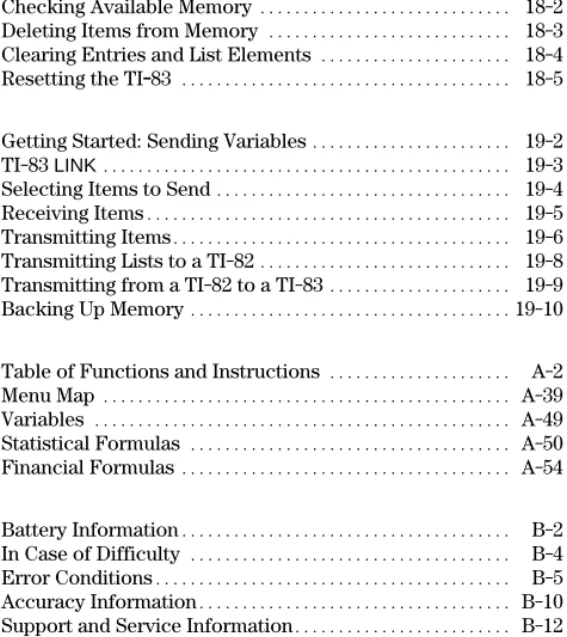
Checking Available Memory... 18-2 Deleting Items from Memory ... 18-3 Clearing Entries and List Elements... 18-4 Resetting the TI.83... 18-5 Getting Started: Sending Variables... 19-2 TI-83 LINK... 19-3 Selecting Items to Send... 19-4 Receiving Items... 19-5 Transmitting Items... 19-6 Transmitting Lists to a TI-82... 19-8 Transmitting from a TI-82 to a TI-83... 19-9 Backing Up Memory...19-10 Table of Functions and Instructions... A-2 Menu Map... A-39 Variables... A-49 Statistical Formulas ... A-50 Financial Formulas... A-54 Battery Information... B-2 In Case of Difficulty ... B-4 Error Conditions... B-5 Accuracy Information... B-10 Support and Service Information... B-12 Warranty Information... B-13 Chapter 18: Memory Management Chapter 19: Communication Link Appendix A: Tables and Reference Information Appendix B: General Information Index
Getting Started:
Do This First!
TI-83 Keyboard... 2
TI-83 Menus... 4
First Steps... 5
Entering a Calculation: The Quadratic Formula... 6
Converting to a Fraction: The Quadratic Formula... 7
Displaying Complex Results: The Quadratic Formula.... 8
Defining a Function: Box with Lid... 9
Defining a Table of Values: Box with Lid... 10
Zooming In on the Table: Box with Lid... 11
Setting the Viewing Window: Box with Lid... 12
Displaying and Tracing the Graph: Box with Lid... 13
Zooming In on the Graph: Box with Lid... 15
Finding the Calculated Maximum: Box with Lid... 16
Other TI.83 Features... 17 Contents
2 Getting Started
8300GETM.DOC TI-83 international English Bob Fedorisko Revised: 02/19/01 11:11 AM Printed: 02/19/01 11:14 AM Page 2 of 18
Generally, the keyboard is divided into these zones: graphing keys, editing keys, advanced function keys, and scientific calculator keys.
Graphing keys access the interactive graphing features. Editing keys allow you to edit expressions and values. Advanced function keys display menus that access the advanced functions.
Scientific calculator keys access the capabilities of a standard scientific calculator.
TI-83 Keyboard
Keyboard Zones Editing Keys Advanced Function Keys Scientific Calculator Keys Graphing KeysThe keys on the TI.83 are color-coded to help you easily locate the key you need.
The gray keys are the number keys. The blue keys along the right side of the keyboard are the common math functions. The blue keys across the top set up and display graphs. The primary function of each key is printed in white on the key. For example, when you press , the MATH menu is displayed.
The secondary function of each key is printed in yellow above the key. When you press the yellow y key, the character, abbreviation, or word printed in yellow above the other keys becomes active for the next keystroke. For example, when you press y and then , the TEST menu is displayed. This guidebook describes this keystroke combination as y [TEST].
The alpha function of each key is printed in green above the key. When you press the green ƒ key, the alpha character printed in green above the other keys becomes active for the next keystroke. For example, when you press ƒ and then , the letter A is entered. This
guidebook describes this keystroke combination as ƒ [A]. Using the Color-Coded Keyboard Using the y and ƒ Keys
The y key accesses the second function printed in yellow above each key.
The ƒ key accesses the alpha function printed in green above each key.
4 Getting Started
8300GETM.DOC TI-83 international English Bob Fedorisko Revised: 02/19/01 11:11 AM Printed: 02/19/01 11:15 AM Page 4 of 18
Displaying a Menu
While using your TI.83, you often will need to access items from its menus.
When you press a key that displays a menu, that menu temporarily replaces the screen where you are working. For example, when you press , the MATH menu is displayed as a full screen.
After you select an item from a menu, the screen where you are working usually is displayed again.
Moving from One Menu to Another
Some keys access more than one menu. When you press such a key, the names of all accessible menus are displayed on the top line. When you highlight a menu name, the items in that menu are displayed. Press ~ and | to highlight each menu name.
Selecting an Item from a Menu
The number or letter next to the current menu item is highlighted. If the menu continues beyond the screen, a down arrow ( $ ) replaces the colon ( : ) in the last displayed item. If you scroll beyond the last displayed item, an up arrow ( # ) replaces the colon in the first item displayed.You can select an item in either of two ways.
¦ Press † or } to move the cursor to the number or letter of the item; press Í. ¦ Press the key or key combination for the
number or letter next to the item.
Leaving a Menu without Making a Selection You can leave a menu without making a selection in any of three ways.
¦ Press ‘ to return to the screen where you were.
¦ Press y [QUIT] to return to the home screen.
¦ Press a key for another menu or screen.
TI-83 Menus
Before starting the sample problems in this chapter, follow the steps on this page to reset the TI.83 to its factory settings and clear all memory. This ensures that the keystrokes in this chapter will produce the illustrated results. To reset the TI.83, follow these steps.
1. Press É to turn on the calculator.
2. Press and release y, and then press [MEM] (above Ã).
When you press y, you access the operation printed in yellow above the next key that you press. [MEM] is the
y operation of the à key. The MEMORY menu is displayed. 3. Press 5 to select 5:Reset.
The RESET menu is displayed. 4. Press 1 to select 1:All Memory.
The RESET MEMORY menu is displayed.
5. Press 2 to select 2:Reset.
All memory is cleared, and the calculator is reset to the factory default settings. When you reset the TI.83, the display contrast is reset.
¦ If the screen is very light or blank, press and release y, and then press and hold } to darken the screen. ¦ If the screen is very dark, press and
release y, and then press and hold † to lighten the screen.
6 Getting Started
8300GETM.DOC TI-83 international English Bob Fedorisko Revised: 02/19/01 11:06 AM Printed: 02/19/01 11:06 AM Page 6 of 18
Use the quadratic formula to solve the quadratic equations 3X2 + 5X + 2 = 0 and 2X2 N X + 3 = 0. Begin with the equation 3X2 + 5X + 2 = 0.
1. Press 3¿ƒ [A] (above ) to store the coefficient of the X2 term. 2. Press ƒ [ : ] (above Ë). The colon
allows you to enter more than one instruction on a line.
3. Press 5¿ƒ [B] (above ) to store the coefficient of the Xterm. Press ƒ [ : ] to enter a new instruction on the same line. Press 2¿ƒ [C] (above ) to store the constant. 4. Press Í to store the values to the
variables A, B, and C.
The last value you stored is shown on the right side of the display. The cursor moves to the next line, ready for your next entry. 5. Press £Ìƒ [B] Ãy [‡] ƒ [B] ¡¹4ƒ [A] ƒ [C] ¤¤¥£2 ƒ [A] ¤ to enter the expression for one of the solutions for the quadratic formula,
− +b b − ac a 2 4 2
6. Press Í to find one solution for the equation 3X2 + 5X + 2 = 0.
The answer is shown on the right side of the display. The cursor moves to the next line, ready for you to enter the next expression.
You can show the solution as a fraction. 1. Press to display the MATH menu.
2. Press 1 to select 1:4Frac from the MATH menu.
When you press 1, Ans4Frac is displayed on the home screen. Ans is a variable that contains the last calculated answer.
3. Press Í to convert the result to a fraction.
To save keystrokes, you can recall the last expression you entered, and then edit it for a new calculation.
4. Press y [ENTRY] (above Í) to recall the fraction conversion entry, and then press y [ENTRY] again to recall the quadratic-formula expression,
− +b b − ac a 2 4 2
5. Press } to move the cursor onto the + sign in the formula. Press ¹ to edit the
quadratic-formula expression to become: − −b b − ac
a 2 4 2
6. Press Í to find the other solution for the quadratic equation 3X2 + 5X + 2 = 0.
8 Getting Started
8300GETM.DOC TI-83 international English Bob Fedorisko Revised: 02/19/01 11:06 AM Printed: 02/19/01 11:06 AM Page 8 of 18
Now solve the equation 2X2 N X + 3 = 0. When you set a+bi complex number mode, the TI.83 displays complex results.
1. Press z†††††† (6 times), and then press ~ to position the cursor over a+bi. Press Í to select a+bi complex-number mode.
2. Press y [QUIT] (above z) to return to the home screen, and then press ‘ to clear it.
3. Press 2¿ƒ [A] ƒ [ : ] Ì1 ¿ƒ [B] ƒ [ : ] 3¿ƒ [C] Í.
The coefficient of the X2 term, the coefficient of the X term, and the constant for the new equation are stored to A, B, and C, respectively.
4. Press y [ENTRY] to recall the store instruction, and then press y [ENTRY] again to recall the quadratic-formula expression,
− −b b − ac a 2 4 2
5. Press Í to find one solution for the equation 2X2 N X + 3 = 0.
6. Press y [ENTRY] repeatedly until this quadratic-formula expression is displayed:
− +b b − ac a 2 4 2
7. Press Í to find the other solution for the quadratic equation: 2X2 N X + 3 = 0.
Note: An alternative for solving equations for real numbers is to use the built-in Equation Solver (Chapter 2).
Take a 20 cm. × 25 cm. sheet of paper and cut X × X squares from two corners. Cut X × 12.5 cm. rectangles from the other two corners as shown in the diagram below. Fold the paper into a box with a lid. What value of X would give your box the maximum volume V? Use the table and graphs to determine the solution.
Begin by defining a function that describes the volume of the box.
From the diagram: 2X + A = 20 2X + 2B = 25 V = A B X
Substituting: V = (20 N 2X) (25à2 N X) X
1. Press o to display the Y= editor, which is where you define functions for tables and graphing.
2. Press £20¹2„¤£25¥2¹ „¤„Í to define the volume function as Y1 in terms of X. „ lets you enter X quickly, without having to press ƒ. The highlighted = sign indicates that Y1 is selected.
Defining a Function: Box with Lid
20 A X
X B X B 25
10 Getting Started
8300GETM.DOC TI-83 international English Bob Fedorisko Revised: 02/19/01 11:06 AM Printed: 02/19/01 11:06 AM Page 10 of 18
The table feature of the TI.83 displays numeric information about a function. You can use a table of values from the function defined on page 9 to estimate an answer to the problem.
1. Press y [TBLSET] (above p) to display the TABLE SETUP menu. 2. Press Í to accept TblStart=0.
3. Press 1Í to define the table increment @Tbl=1. Leave Indpnt: Auto and
Depend: Auto so that the table will be generated automatically.
4. Press y [TABLE] (above s) to display the table.
Notice that the maximum value for Y1 (box’s volume) occurs when X is about 4, between 3 and 5.
5. Press and hold † to scroll the table until a negative result for Y1 is displayed. Notice that the maximum length of X for this problem occurs where the sign of Y1 (box’s volume) changes from positive to negative, between 10 and 11.
6. Press y [TBLSET].
Notice that TblStart has changed to 6 to reflect the first line of the table as it was last displayed. (In step 5, the first value of X displayed in the table is 6.)
You can adjust the way a table is displayed to get more information about a defined function. With smaller values for @Tbl, you can zoom in on the table. 1. Press 3Í to set TblStart. Press Ë1
Í to set @Tbl.
This adjusts the table setup to get a more accurate estimate of X for maximum volume Y1.
2. Press y [TABLE].
3. Press † and } to scroll the table. Notice that the maximum value for Y1 is 410.26, which occurs at X=3.7. Therefore, the maximum occurs where 3.6<X<3.8. 4. Press y [TBLSET]. Press 3 Ë6Í to
set TblStart. Press Ë01Í to set @Tbl.
5. Press y [TABLE], and then press † and } to scroll the table.
Four equivalent maximum values are shown, 410.60 at X=3.67, 3.68, 3.69, and 3.70.
6. Press † and } to move the cursor to 3.67. Press ~ to move the cursor into the Y1 column.
The value of Y1 at X=3.67 is displayed on the bottom line in full precision as 410.261226.
7. Press † to display the other maximums. The value of Y1 at X=3.68 in full precision is 410.264064, at X=3.69 is 410.262318, and at X=3.7 is 410.256.
The maximum volume of the box would occur at 3.68 if you could measure and cut the paper at .01-cm. increments.
12 Getting Started
8300GETM.DOC TI-83 international English Bob Fedorisko Revised: 02/19/01 11:06 AM Printed: 02/19/01 11:06 AM Page 12 of 18
You also can use the graphing features of the TI.83 to find the maximum value of a previously defined function. When the graph is activated, the viewing window defines the displayed portion of the coordinate plane. The values of the window variables determine the size of the viewing window.
1. Press p to display the window editor, where you can view and edit the values of the window variables.
The standard window variables define the viewing window as shown. Xmin, Xmax, Ymin, and Ymax define the boundaries of the display. Xscl and Yscl define the distance between tick marks on the X and Y axes. Xres controls resolution.
Xmax Ymin Ymax Xscl Yscl Xmin
2. Press 0Í to define Xmin. 3. Press 20 ¥2 to define Xmax using an
expression.
4. Press Í. The expression is evaluated, and 10 is stored in Xmax. Press Í to accept Xscl as 1.
5. Press 0Í500Í100Í1 Í to define the remaining window variables.
Now that you have defined the function to be graphed and the window in which to graph it, you can display and explore the graph. You can trace along a function using the TRACE feature.
1. Press s to graph the selected function in the viewing window.
The graph of Y1=(20N2X)(25à2NX)X is displayed.
2. Press ~ to activate the free-moving graph cursor.
The X and Y coordinate values for the position of the graph cursor are displayed on the bottom line.
3. Press |, ~, }, and † to move the free-moving cursor to the apparent maximum of the function.
As you move the cursor, the X and Y coordinate values are updated continually.
14 Getting Started
8300GETM.DOC TI-83 international English Bob Fedorisko Revised: 02/19/01 11:06 AM Printed: 02/19/01 11:06 AM Page 14 of 18
4. Press r. The trace cursor is displayed on the Y1 function.
The function that you are tracing is displayed in the top-left corner.
5. Press | and ~ to trace along Y1, one X dot at a time, evaluating Y1 at each X.
You also can enter your estimate for the maximum value of X.
6. Press 3Ë8. When you press a number key while in TRACE, the X= prompt is displayed in the bottom-left corner.
7. Press Í.
The trace cursor jumps to the point on the Y1 function evaluated at X=3.8.
8. Press | and ~ until you are on the maximum Y value.
This is the maximum of Y1(X) for the X pixel values. The actual, precise maximum may lie between pixel values.
To help identify maximums, minimums, roots, and intersections of functions, you can magnify the viewing window at a specific location using the ZOOM instructions.
1. Press q to display the ZOOM menu. This menu is a typical TI.83 menu. To select an item, you can either press the number or letter next to the item, or you can press † until the item number or letter is highlighted, and then press Í. 2. Press 2 to select 2:Zoom In.
The graph is displayed again. The cursor has changed to indicate that you are using a ZOOM instruction.
3. With the cursor near the maximum value of the function (as in step 8 on page 14), press Í.
The new viewing window is displayed. Both XmaxNXmin and YmaxNYmin have been adjusted by factors of 4, the default values for the zoom factors.
4. Press p to display the new window settings.
16 Getting Started
8300GETM.DOC TI-83 international English Bob Fedorisko Revised: 02/19/01 11:06 AM Printed: 02/19/01 11:06 AM Page 16 of 18
You can use a CALCULATE menu operation to calculate a local maximum of a function.
1. Press y [CALC] (above r) to display the CALCULATE menu. Press 4 to select 4:maximum.
The graph is displayed again with a Left Bound? prompt.
2. Press | to trace along the curve to a point to the left of the maximum, and then press
Í.
A 4 at the top of the screen indicates the selected bound.
A Right Bound? prompt is displayed. 3. Press ~ to trace along the curve to a point
to the right of the maximum, and then press Í.
A 3 at the top of the screen indicates the selected bound.
A Guess? prompt is displayed. 4. Press | to trace to a point near the
maximum, and then press Í. Or, press 3Ë8, and then press Í to enter a guess for the maximum.
When you press a number key in TRACE, the X= prompt is displayed in the bottom-left corner.
Notice how the values for the calculated maximum compare with the maximums found with the free-moving cursor, the trace cursor, and the table.
Note: In steps 2 and 3 above, you can enter values directly for Left Bound and Right Bound, in the same way as described in step 4.
Getting Started has introduced you to basic TI.83 operation. This guidebook describes in detail the features you used in Getting Started. It also covers the other features and capabilities of the TI.83.
You can store, graph, and analyze up to 10 functions (Chapter 3), up to six parametric functions (Chapter 4), up to six polar functions (Chapter 5), and up to three
sequences (Chapter 6). You can use DRAW operations to annotate graphs (Chapter 8).
You can generate sequences and graph them over time. Or, you can graph them as web plots or as phase plots (Chapter 6).
You can create function evaluation tables to analyze many functions simultaneously (Chapter 7).
You can split the screen horizontally to display both a graph and a related editor (such as the Y= editor), the table, the stat list editor, or the home screen. Also, you can split the screen vertically to display a graph and its table simultaneously (Chapter 9).
You can enter and save up to 10 matrices and perform standard matrix operations on them (Chapter 10).
You can enter and save as many lists as memory allows for use in statistical analyses. You can attach formulas to lists for automatic computation. You can use lists to evaluate expressions at multiple values simultaneously and to graph a family of curves (Chapter 11).
You can perform one- and two-variable, list-based statistical analyses, including logistic and sine regression analysis. You can plot the data as a histogram, xyLine, scatter plot, modified or regular box-and-whisker plot, or normal probability plot. You can define and store up to three stat plot definitions (Chapter 12).
Other TI-83 Features
Graphing Sequences Tables Split Screen Matrices Lists Statistics
18 Getting Started
8300GETM.DOC TI-83 international English Bob Fedorisko Revised: 02/19/01 11:06 AM Printed: 02/19/01 11:06 AM Page 18 of 18
You can perform 16 hypothesis tests and confidence intervals and 15 distribution functions. You can display hypothesis test results graphically or numerically (Chapter 13).
You can use time-value-of-money (TVM) functions to analyze financial instruments such as annuities, loans, mortgages, leases, and savings. You can analyze the value of money over equal time periods using cash flow functions. You can amortize loans with the amortization functions (Chapter 14).
The CATALOG is a convenient, alphabetical list of all functions and instructions on the TI.83. You can paste any function or instruction from the CATALOG to the current cursor location (Chapter 15).
You can enter and store programs that include extensive control and input/output instructions (Chapter 16). The TI.83 has a port to connect and communicate with another TI.83, a TI.82, the Calculator-Based Laboratoryé (CBL 2é, CBLé) System, a Calculator-Based Rangeré (CBRé), or a personal computer. The unit-to-unit link cable is included with the TI.83 (Chapter 19).
Inferential Statistics Financial Functions CATALOG Programming Communication Link
1
Operating
the TI-83
Turning On and Turning Off the TI.83... 1-2 Setting the Display Contrast... 1-3 The Display... 1-4 Entering Expressions and Instructions... 1-6 TI.83 Edit Keys... 1-8 Setting Modes ... 1-9 Using TI.83 Variable Names... 1-13 Storing Variable Values... 1-14 Recalling Variable Values... 1-15 ENTRY (Last Entry) Storage Area... 1-16 Ans (Last Answer) Storage Area... 1-18 TI.83 Menus... 1-19 VARS and VARS Y.VARS Menus... 1-21 Equation Operating System (EOSé)... 1-22 Error Conditions... 1-24 Contents
1-2 Operating the TI-83
8301OPER.DOC TI-83 international English Bob Fedorisko Revised: 02/19/01 12:09 PM Printed: 02/19/01 1:34 PM Page 2 of 24
To turn on the TI.83, press É.
• If you previously had turned off the calculator by pressing y [OFF], the TI.83 displays the home screen as it was when you last used it and clears any error. • If Automatic Power Down™ (APDé) had previously
turned off the calculator, the TI.83 will return exactly as you left it, including the display, cursor, and any error. To prolong the life of the batteries, APD turns off the TI.83 automatically after about five minutes without any activity. To turn off the TI.83 manually, press y [OFF].
• All settings and memory contents are retained by Constant Memoryé.
• Any error condition is cleared.
The TI.83 uses four AAA alkaline batteries and has a user-replaceable backup lithium battery (CR1616 or CR1620). To replace batteries without losing any information stored in memory, follow the steps in Appendix B.
Turning On and Turning Off the TI-83
Turning On the Calculator
Turning Off the Calculator
You can adjust the display contrast to suit your viewing angle and lighting conditions. As you change the contrast setting, a number from 0 (lightest) to 9 (darkest) in the top-right corner indicates the current level. You may not be able to see the number if contrast is too light or too dark. Note: The TI.83 has 40 contrast settings, so each number 0 through 9 represents four settings.
The TI.83 retains the contrast setting in memory when it is turned off.
To adjust the contrast, follow these steps. 1. Press and release the y key.
2. Press and hold † or }, which are below and above the contrast symbol (yellow, half-shaded circle).
• † lightens the screen. • } darkens the screen.
Note: If you adjust the contrast setting to 0, the display may become completely blank. To restore the screen, press and release y, and then press and hold } until the display reappears.
When the batteries are low, a low-battery message is displayed when you turn on the calculator.
To replace the batteries without losing any information in memory, follow the steps in Appendix B.
Generally, the calculator will continue to operate for one or two weeks after the low-battery message is first displayed. After this period, the TI.83 will turn off
automatically and the unit will not operate. Batteries must be replaced. All memory is retained.
Note: The operating period following the first low-battery message could be longer than two weeks if you use the calculator infrequently.
Setting the Display Contrast
Adjusting the Display Contrast
When to Replace Batteries
1-4 Operating the TI-83
8301OPER.DOC TI-83 international English Bob Fedorisko Revised: 02/19/01 12:09 PM Printed: 02/19/01 1:34 PM Page 4 of 24
The TI.83 displays both text and graphs. Chapter 3 describes graphs. Chapter 9 describes how the TI.83 can display a horizontally or vertically split screen to show graphs and text simultaneously.
The home screen is the primary screen of the TI.83. On this screen, enter instructions to execute and expressions to evaluate. The answers are displayed on the same screen. When text is displayed, the TI.83 screen can display a maximum of eight lines with a maximum of 16 characters per line. If all lines of the display are full, text scrolls off the top of the display. If an expression on the home screen, the Y= editor (Chapter 3), or the program editor
(Chapter 16) is longer than one line, it wraps to the beginning of the next line. In numeric editors such as the window screen (Chapter 3), a long expression scrolls to the right and left.
When an entry is executed on the home screen, the answer is displayed on the right side of the next line.
Entry Answer
The mode settings control the way the TI.83 interprets expressions and displays answers (page 1.9).
If an answer, such as a list or matrix, is too long to display entirely on one line, an ellipsis (...) is displayed to the right or left. Press ~ and | to scroll the answer.
Entry Answer
To return to the home screen from any other screen, press y [QUIT].
When the TI.83 is calculating or graphing, a vertical moving line is displayed as a busy indicator in the top-right corner of the screen. When you pause a graph or a
program, the busy indicator becomes a vertical moving dotted line.
The Display
Types of Displays Home Screen Displaying Entries and Answers Returning to the Home Screen Busy IndicatorIn most cases, the appearance of the cursor indicates what will happen when you press the next key or select the next menu item to be pasted as a character.
Cursor Appearance Effect of Next Keystroke Entry Solid rectangle
$ A character is entered at thecursor; any existing character is overwritten
Insert Underline
__
A character is inserted in front ofthe cursor location Second Reverse arrowÞ A 2nd character (yellow on thekeyboard) is entered or a 2nd operation is executed
Alpha Reverse A
Ø An alpha character (green on thekeyboard) is entered or SOLVE is executed
Full Checkerboard rectangle #
No entry; the maximum characters are entered at a prompt or memory is full
If you press ƒ during an insertion, the cursor becomes an underlined A (A) If you press y during an insertion, the underline cursor becomes an underlined # ( # ).
Graphs and editors sometimes display additional cursors, which are described in other chapters.
1-6 Operating the TI-83
8301OPER.DOC TI-83 international English Bob Fedorisko Revised: 02/19/01 12:09 PM Printed: 02/19/01 1:34 PM Page 6 of 24
An expression is a group of numbers, variables, functions and their arguments, or a combination of these elements. An expression evaluates to a single answer. On the TI.83, you enter an expression in the same order as you would write it on paper. For example, pR2 is an expression. You can use an expression on the home screen to calculate an answer. In most places where a value is required, you can use an expression to enter a value.
To create an expression, you enter numbers, variables, and functions from the keyboard and menus. An expression is completed when you press Í, regardless of the cursor location. The entire expression is evaluated according to Equation Operating System (EOSé) rules (page 1.22), and the answer is displayed.
Most TI.83 functions and operations are symbols
comprising several characters. You must enter the symbol from the keyboard or a menu; do not spell it out. For example, to calculate the log of 45, you must press « 45. Do not enter the letters L, O, and G. If you enter LOG, the TI.83 interprets the entry as implied multiplication of the variables L, O, and G. Calculate 3.76 ÷ (L7.9 + ‡5) + 2 log 45. 3 Ë 76 ¥£Ì 7 Ë 9 à y [‡] 5 ¤¤ à 2 « 45 ¤ Í
To enter two or more expressions or instructions on a line, separate them with colons (ƒ [:]). All instructions are stored together in last entry (ENTRY; page 1.16).
Entering Expressions and Instructions
What Is an Expression? Entering an Expression Multiple Entries on a Line
To enter a number in scientific notation, follow these steps.
1. Enter the part of the number that precedes the exponent. This value can be an expression. 2. Press y [EE]. å is pasted to the cursor location. 3. If the exponent is negative, press Ì, and then enter the
exponent, which can be one or two digits.
When you enter a number in scientific notation, the TI.83 does not automatically display answers in scientific or engineering notation. The mode settings (page 1.9) and the size of the number determine the display format.
A function returns a value. For example, ÷, L, +, ‡(, and log( are the functions in the example on page 1.6. In general, the first letter of each function is lowercase on the TI.83. Most functions take at least one argument, as indicated by an open parenthesis ( ( ) following the name. For example, sin( requires one argument, sin(value).
An instruction initiates an action. For example, ClrDraw is an instruction that clears any drawn elements from a graph. Instructions cannot be used in expressions. In general, the first letter of each instruction name is uppercase. Some instructions take more than one argument, as indicated by an open parenthesis ( ( ) at the end of the name. For example, Circle( requires three arguments, Circle(X,Y,radius).
To interrupt a calculation or graph in progress, which would be indicated by the busy indicator, press É. When you interrupt a calculation, the menu is displayed. • To return to the home screen, select 1:Quit.
• To go to the location of the interruption, select 2:Goto. When you interrupt a graph, a partial graph is displayed. • To return to the home screen, press ‘ or any
nongraphing key.
• To restart graphing, press a graphing key or select a graphing instruction. Entering a Number in Scientific Notation Functions Instructions Interrupting a Calculation
1-8 Operating the TI-83
8301OPER.DOC TI-83 international English Bob Fedorisko Revised: 02/19/01 12:09 PM Printed: 02/19/01 1:34 PM Page 8 of 24
Keystrokes Result
~ or | Moves the cursor within an expression; these keys repeat. } or † Moves the cursor from line to line within an expression that
occupies more than one line; these keys repeat.
On the top line of an expression on the home screen, } moves the cursor to the beginning of the expression.
On the bottom line of an expression on the home screen, † moves the cursor to the end of the expression.
y| Moves the cursor to the beginning of an expression. y~ Moves the cursor to the end of an expression. Í Evaluates an expression or executes an instruction.
‘ On a line with text on the home screen, clears the current line. On a blank line on the home screen, clears everything on the home screen.
In an editor, clears the expression or value where the cursor is located; it does not store a zero.
{ Deletes a character at the cursor; this key repeats.
y [INS] Changes the cursor to
__
; inserts characters in front of the underline cursor; to end insertion, press y [INS] or press |, }, ~, or †.y Changes the cursor to Þ; the next keystroke performs a 2nd operation (an operation in yellow above a key and to the left); to cancel 2nd, press y again.
ƒ Changes the cursor to Ø; the next keystroke pastes an alpha character (a character in green above a key and to the right) or executes SOLVE (Chapters 10 and 11); to cancel ƒ, press ƒ or press |, }, ~, or †.
y [A.LOCK] Changes the cursor to Ø; sets alpha-lock; subsequent keystrokes (on an alpha key) paste alpha characters; to cancel alpha-lock, press ƒ; name prompts set alpha-lock automatically. „ Pastes an X in Func mode, a T in Par mode, a q in Pol mode, or an
n in Seq mode with one keystroke.
TI-83 Edit Keys
Mode settings control how the TI.83 displays and
interprets numbers and graphs. Mode settings are retained by the Constant Memory feature when the TI.83 is turned off. All numbers, including elements of matrices and lists, are displayed according to the current mode settings. To display the mode settings, press z. The current settings are highlighted. Defaults are highlighted below. The following pages describe the mode settings in detail. Normal Sci Eng Numeric notation
Float 0123456789 Number of decimal places Radian Degree Unit of angle measure Func Par Pol Seq Type of graphing
Connected Dot Whether to connect graph points Sequential Simul Whether to plot simultaneously Real a+bi re^qi Real, rectangular cplx, or polar cplx Full Horiz G-T Full screen, two split-screen modes To change mode settings, follow these steps.
1. Press † or } to move the cursor to the line of the setting that you want to change.
2. Press ~ or | to move the cursor to the setting you want.
3. Press Í.
You can set a mode from a program by entering the name of the mode as an instruction; for example, Func or Float. From a blank command line, select the mode setting from the mode screen; the instruction is pasted to the cursor location.
Setting Modes
Checking Mode Settings Changing Mode Settings Setting a Mode from a Program1-10 Operating the TI-83
8301OPER.DOC TI-83 international English Bob Fedorisko Revised: 02/19/01 12:09 PM Printed: 02/19/01 1:34 PM Page 10 of 24
Notation modes only affect the way an answer is displayed on the home screen. Numeric answers can be displayed with up to 10 digits and a two-digit exponent. You can enter a number in any format.
Normal notation mode is the usual way we express numbers, with digits to the left and right of the decimal, as in 12345.67.
Sci (scientific) notation mode expresses numbers in two parts. The significant digits display with one digit to the left of the decimal. The appropriate power of 10 displays to the right of E, as in 1.234567E4.
Eng (engineering) notation mode is similar to scientific notation. However, the number can have one, two, or three digits before the decimal; and the power-of-10 exponent is a multiple of three, as in 12.34567E3.
Note: If you select Normal notation, but the answer cannot display in 10 digits (or the absolute value is less than .001), the TI.83 expresses the answer in scientific notation.
Float (floating) decimal mode displays up to 10 digits, plus the sign and decimal.
0123456789 (fixed) decimal mode specifies the number of digits (0 through 9) to display to the right of the decimal. Place the cursor on the desired number of decimal digits, and then press Í.
The decimal setting applies to Normal, Sci, and Eng notation modes.
The decimal setting applies to these numbers: • An answer displayed on the home screen • Coordinates on a graph (Chapters 3, 4, 5, and 6) • The Tangent( DRAW instruction equation of the line, x,
and dy/dx values (Chapter 8)
• Results of CALCULATE operations (Chapters 3, 4, 5, and 6)
• The regression equation stored after the execution of a regression model (Chapter 12)
Normal, Sci, Eng
Float, 0123456789
Angle modes control how the TI.83 interprets angle values in trigonometric functions and polar/rectangular
conversions.
Radian mode interprets angle values as radians. Answers display in radians.
Degree mode interprets angle values as degrees. Answers display in degrees.
Graphing modes define the graphing parameters. Chapters 3, 4, 5, and 6 describe these modes in detail.
Func (function) graphing mode plots functions, where Y is a function of X (Chapter 3).
Par (parametric) graphing mode plots relations, where X and Y are functions of T (Chapter 4).
Pol (polar) graphing mode plots functions, where r is a function of q (Chapter 5).
Seq (sequence) graphing mode plots sequences (Chapter 6).
Connected plotting mode draws a line connecting each point calculated for the selected functions.
Dot plotting mode plots only the calculated points of the selected functions.
Radian, Degree
Func, Par, Pol, Seq
1-12 Operating the TI-83
8301OPER.DOC TI-83 international English Bob Fedorisko Revised: 02/19/01 12:09 PM Printed: 02/19/01 1:34 PM Page 12 of 24
Sequential graphing-order mode evaluates and plots one function completely before the next function is evaluated and plotted.
Simul (simultaneous) graphing-order mode evaluates and plots all selected functions for a single value of X and then evaluates and plots them for the next value of X.
Note: Regardless of which graphing mode is selected, the TI.83 will sequentially graph all stat plots before it graphs any functions. Real mode does not display complex results unless complex numbers are entered as input.
Two complex modes display complex results.
• a+bi (rectangular complex mode) displays complex numbers in the form a+bi.
• re^qi (polar complex mode) displays complex numbers in the form re^qi.
Full screen mode uses the entire screen to display a graph or edit screen.
Each split-screen mode displays two screens simultaneously.
• Horiz (horizontal) mode displays the current graph on the top half of the screen; it displays the home screen or an editor on the bottom half (Chapter 9).
• G.T (graph-table) mode displays the current graph on the left half of the screen; it displays the table screen on the right half (Chapter 9).
Sequential, Simul
Real, a+bi, re^qi
On the TI.83 you can enter and use several types of data, including real and complex numbers, matrices, lists, functions, stat plots, graph databases, graph pictures, and strings.
The TI.83 uses assigned names for variables and other items saved in memory. For lists, you also can create your own five-character names.
Variable Type Names
Real numbers A, B, . . . , Z, q
Complex numbers A, B, . . . , Z, q
Matrices ãAä, ãBä, ãCä, . . . , ãJä
Lists L1, L2, L3, L4, L5, L6, and user-defined names
Functions Y1, Y2, . . . , Y9, Y0
Parametric equations X1T and Y1T, . . . , X6T and Y6T Polar functions r1, r2, r3, r4, r5, r6
Sequence functions u, v, w
Stat plots Plot1, Plot2, Plot3
Graph databases GDB1, GDB2, . . . , GDB9, GDB0 Graph pictures Pic1, Pic2, . . . , Pic9, Pic0 Strings Str1, Str2, . . . , Str9, Str0 System variables Xmin, Xmax, and others
• You can create as many list names as memory will allow (Chapter 11).
• Programs have user-defined names and share memory with variables (Chapter 16).
• From the home screen or from a program, you can store to matrices (Chapter 10), lists (Chapter 11), strings (Chapter 15), system variables such as Xmax (Chapter 1), TblStart (Chapter 7), and all Y= functions (Chapters 3, 4, 5, and 6).
• From an editor, you can store to matrices, lists, and Y= functions (Chapter 3).
• From the home screen, a program, or an editor, you can store a value to a matrix element or a list element. • You can use DRAW STO menu items to store and recall
graph databases and pictures (Chapter 8).
Using TI-83 Variable Names
Variables and Defined Items
Notes about Variables
1-14 Operating the TI-83
8301OPER.DOC TI-83 international English Bob Fedorisko Revised: 02/19/01 12:09 PM Printed: 02/19/01 1:34 PM Page 14 of 24
Values are stored to and recalled from memory using variable names. When an expression containing the name of a variable is evaluated, the value of the variable at that time is used.
To store a value to a variable from the home screen or a program using the ¿ key, begin on a blank line and follow these steps.
1. Enter the value you want to store. The value can be an expression.
2. Press ¿. ! is copied to the cursor location.
3. Press ƒ and then the letter of the variable to which you want to store the value.
4. Press Í. If you entered an expression, it is evaluated. The value is stored to the variable.
To display the value of a variable, enter the name on a blank line on the home screen, and then press Í.
Storing Variable Values
Storing Values in a Variable
Displaying a Variable Value
To recall and copy variable contents to the current cursor location, follow these steps. To leave RCL, press ‘. 1. Press yãRCLä. Rcl and the edit cursor are displayed on
the bottom line of the screen.
2. Enter the name of the variable in any of five ways. • Press ƒ and then the letter of the variable. • Press yãLISTä, and then select the name of the list,
or press y [Ln].
• Press , and then select the name of the matrix. • Press to display the VARS menu or ~ to
display theVARS Y.VARS menu; then select the type and then the name of the variable or function. • Press |, and then select the name of the
program (in the program editor only).
The variable name you selected is displayed on the bottom line and the cursor disappears.
3. Press Í. The variable contents are inserted where the cursor was located before you began these steps.
Note: You can edit the characters pasted to the expression without affecting the value in memory.
Recalling Variable Values
Using Recall (RCL)
1-16 Operating the TI-83
8301OPER.DOC TI-83 international English Bob Fedorisko Revised: 02/19/01 12:09 PM Printed: 02/19/01 1:34 PM Page 16 of 24
When you press Í on the home screen to evaluate an expression or execute an instruction, the expression or instruction is placed in a storage area called ENTRY (last entry). When you turn off the TI.83, ENTRY is retained in memory.
To recall ENTRY, press y [ENTRY]. The last entry is pasted to the current cursor location, where you can edit and execute it. On the home screen or in an editor, the current line is cleared and the last entry is pasted to the line.
Because the TI.83 updates ENTRY only when you press Í, you can recall the previous entry even if you have begun to enter the next expression.
5 Ã 7 Í y [ENTRY]
The TI.83 retains as many previous entries as possible in ENTRY, up to a capacity of 128 bytes. To scroll those entries, press y [ENTRY] repeatedly. If a single entry is more than 128 bytes, it is retained for ENTRY, but it cannot be placed in the ENTRY storage area.
1 ¿ƒ A
Í
2 ¿ƒ B
Í y [ENTRY]
If you press y [ENTRY] after displaying the oldest stored entry, the newest stored entry is displayed again, then the next-newest entry, and so on.
y [ENTRY]
ENTRY (Last Entry) Storage Area
Using ENTRY (Last Entry)
Accessing a Previous Entry
After you have pasted the last entry to the home screen and edited it (if you chose to edit it), you can execute the entry. To execute the last entry, press Í.
To reexecute the displayed entry, press Í again. Each reexecution displays an answer on the right side of the next line; the entry itself is not redisplayed.
0 ¿ƒ N Í ƒ N à 1 ¿ƒ N ƒã:äƒ N ¡Í Í Í
To store to ENTRY two or more expressions or
instructions, separate each expression or instruction with a colon, then press Í. All expressions and instructions separated by colons are stored in ENTRY.
When you press y [ENTRY], all the expressions and instructions separated by colons are pasted to the current cursor location. You can edit any of the entries, and then execute all of them when you press Í.
For the equation A=pr2, use trial and error to find the radius of a circle that covers 200 square centimeters. Use 8 as your first guess. 8 ¿ƒ R ƒ [:] y [p] ƒ R ¡Í y [ENTRY] y| 7 y [INS] Ë 95 Í
Continue until the answer is as accurate as you want.
Clear Entries (Chapter 18) clears all data that the TI.83 is holding in the ENTRY storage area.
Reexecuting the Previous Entry
Multiple Entry Values on a Line
1-18 Operating the TI-83
8301OPER.DOC TI-83 international English Bob Fedorisko Revised: 02/19/01 12:09 PM Printed: 02/19/01 1:34 PM Page 18 of 24
When an expression is evaluated successfully from the home screen or from a program, the TI.83 stores the answer to a storage area called Ans (last answer). Ans may be a real or complex number, a list, a matrix, or a string. When you turn off the TI.83, the value in Ans is retained in memory.
You can use the variable Ans to represent the last answer in most places. Press y [ANS] to copy the variable name Ans to the cursor location. When the expression is evaluated, the TI.83 uses the value of Ans in the calculation.
Calculate the area of a garden plot 1.7 meters by 4.2 meters. Then calculate the yield per square meter if the plot produces a total of 147 tomatoes.
1 Ë 7 ¯ 4 Ë 2 Í
147 ¥y [ANS] Í
You can use Ans as the first entry in the next expression without entering the value again or pressing y [ANS]. On a blank line on the home screen, enter the function. The TI.83 pastes the variable name Ans to the screen, then the function.
5 ¥ 2 Í ¯ 9 Ë 9 Í
To store an answer, store Ans to a variable before you evaluate another expression.
Calculate the area of a circle of radius 5 meters. Next, calculate the volume of a cylinder of radius 5 meters and height 3.3 meters, and then store the result in the variable V.
y [p] 5 ¡ Í ¯ 3 Ë 3 Í ¿ƒ V Í
Ans (Last Answer) Storage Area
Using Ans in an Expression
Continuing an Expression
You can access most TI.83 operations using menus. When you press a key or key combination to display a menu, one or more menu names appear on the top line of the screen. • The menu name on the left side of the top line is
highlighted. Up to seven items in that menu are displayed, beginning with item 1, which also is highlighted.
• A number or letter identifies each menu item’s place in the menu. The order is 1 through 9, then 0, then A, B, C, and so on. The LIST NAMES, PRGM EXEC, and PRGM EDIT menus only label items 1 through 9 and 0.
• When the menu continues beyond the displayed items, a down arrow ( $ ) replaces the colon next to the last displayed item.
• When a menu item ends in an ellipsis, the item displays a secondary menu or editor when you select it. To display any other menu listed on the top line, press ~ or | until that menu name is highlighted. The cursor location within the initial menu is irrelevant. The menu is displayed with the cursor on the first item.
Note: The Menu Map in Appendix A shows each menu, each operation under each menu, and the key or key combination you press to display each menu.
To scroll down the menu items, press †. To scroll up the menu items, press }.
To page down six menu items at a time, press ƒ†. To page up six menu items at a time, press ƒ}. The green arrows on the calculator, between † and }, are the page-down and page-up symbols.
To wrap to the last menu item directly from the first menu item, press }. To wrap to the first menu item directly from the last menu item, press †.
TI-83 Menus
Using a TI-83 Menu
1-20 Operating the TI-83
8301OPER.DOC TI-83 international English Bob Fedorisko Revised: 02/19/01 12:09 PM Printed: 02/19/01 1:34 PM Page 20 of 24
You can select an item from a menu in either of two ways. • Press the number or letter of the item you want to
select. The cursor can be anywhere on the menu, and the item you select need not be displayed on the screen. • Press † or } to move the cursor to the item you want,
and then press Í.
After you select an item from a menu, the TI.83 typically displays the previous screen.
Note: On the LIST NAMES, PRGM EXEC, and PRGM EDIT menus, only items 1 through 9 and 0 are labeled in such a way that you can select them by pressing the appropriate number key. To move the cursor to the first item beginning with any alpha character or q, press the key combination for that alpha character or q. If no items begin with that character, then the cursor moves beyond it to the next item.
Calculate 3‡27.
†††Í
27 ¤Í
You can leave a menu without making a selection in any of four ways.
• Press y [QUIT] to return to the home screen. • Press ‘ to return to the previous screen. • Press a key or key combination for a different menu,
such as or y [LIST].
• Press a key or key combination for a different screen, such as o or y [TABLE]. Selecting an Item from a Menu Leaving a Menu without Making a Selection
You can enter the names of functions and system variables in an expression or store to them directly.
To display the VARS menu, press . All VARS menu items display secondary menus, which show the names of the system variables. 1:Window, 2:Zoom, and 5:Statistics each access more than one secondary menu.
VARS Y-VARS
1: Window... X/Y, T/q, and U/V/W variables 2: Zoom... ZX/ZY, ZT/Zq, and ZU variables 3: GDB... Graph database variables 4: Picture... Picture variables
5: Statistics... XY, G, EQ, TEST, and PTS variables 6: Table... TABLE variables
7: String... String variables
To display the VARS Y.VARS menu, press ~. 1:Function, 2:Parametric, and 3:Polar display secondary menus of the Y= function variables.
VARS Y-VARS
1: Function... Yn functions 2: Parametric... XnT, YnT functions 3: Polar... rn functions
4: On/Off... Lets you select/deselect functions Note: The sequence variables (u, v, w) are located on the keyboard as the second functions of ¬, −, and ®.
To select a variable from the VARS or VARS Y.VARS menu, follow these steps.
1. Display the VARS or VARS Y.VARS menu. • Press to display the VARS menu.
• Press ~ to display the VARS Y.VARS menu. 2. Select the type of variable, such as 2:Zoom from the
VARS menu or 3:Polar from the VARS Y.VARS menu. A secondary menu is displayed.
3. If you selected 1:Window, 2:Zoom, or 5:Statistics from the VARS menu, you can press ~ or | to display other secondary menus.
4. Select a variable name from the menu. It is pasted to the cursor location.
VARS and VARS Y-VARS Menus
VARS Menu
Selecting a Variable from the VARS Menu or VARS Y-VARS Menu
1-22 Operating the TI-83
8301OPER.DOC TI-83 international English Bob Fedorisko Revised: 02/19/01 12:09 PM Printed: 02/19/01 1:34 PM Page 22 of 24
The Equation Operating System (EOSé) defines the order in which functions in expressions are entered and evaluated on the TI.83. EOS lets you enter numbers and functions in a simple, straightforward sequence.
EOS evaluates the functions in an expression in this order: 1 Single-argument functions that precede the
argument, such as ‡(, sin(, or log(
2 Functions that are entered after the argument, such as 2, M1, !, ¡, r, and conversions
3 Powers and roots, such as 2^5 or 5x‡32 4 Permutations (nPr) and combinations (nCr) 5 Multiplication, implied multiplication, and
division
6 Addition and subtraction
7 Relational functions, such as > or
8 Logic operator and 9 Logic operators or and xor
Within a priority level, EOS evaluates functions from left to right.
Calculations within parentheses are evaluated first. Multiargument functions, such as nDeriv(A2,A,6), are evaluated as they are encountered.
Equation Operating System (EOS™)
Order of Evaluation
The TI.83 recognizes implied multiplication, so you need not press ¯ to express multiplication in all cases. For example, the TI.83 interprets 2p, 4sin(46), 5(1+2), and (2ä5)7 as implied multiplication.
Note: TI.83 implied multiplication rules differ from those of the TI.82. For example, the TI.83 evaluates 1à2X as (1à2)äX, while the TI.82 evaluates 1à2X as 1/(2äX) (Chapter 2).
All calculations inside a pair of parentheses are completed first. For example, in the expression 4(1+2), EOS first evaluates the portion inside the parentheses, 1+2, and then multiplies the answer, 3, by 4.
You can omit the close parenthesis ( ) ) at the end of an expression. All open parenthetical elements are closed automatically at the end of an expression. This is also true for open parenthetical elements that precede the store or display-conversion instructions.
Note: An open parenthesis following a list name, matrix name, or Y= function name does not indicate implied multiplication. It specifies elements in the list (Chapter 11) or matrix (Chapter 10) and specifies a value for which to solve the Y= function.
To enter a negative number, use the negation key. Press Ì and then enter the number. On the TI.83, negation is in the third level in the EOS hierarchy. Functions in the first level, such as squaring, are evaluated before negation. For example, MX2, evaluates to a negative number (or 0). Use parentheses to square a negative number.
Note: Use the ¹ key for subtraction and the Ì key for negation. If you press ¹ to enter a negative number, as in 9 ¯ ¹ 7, or if you press Ì to indicate subtraction, as in 9 Ì 7, an error occurs. If you press ƒ A Ì ƒ B, it is interpreted as implied multiplication (AäMB).
Implied Multiplication
Parentheses
1-24 Operating the TI-83
8301OPER.DOC TI-83 international English Bob Fedorisko Revised: 02/19/01 12:09 PM Printed: 02/19/01 1:34 PM Page 24 of 24
The TI.83 detects errors while performing these tasks. • Evaluating an expression
• Executing an instruction • Plotting a graph
• Storing a value
When the TI.83 detects an error, it returns an error message as a menu title, such as ERR:SYNTAX or ERR:DOMAIN. Appendix B describes each error type and possible reasons for the error.
• If you select 1:Quit (or press y [QUIT] or ‘), then the home screen is displayed.
• If you select 2:Goto, then the previous screen is displayed with the cursor at or near the error location. Note: If a syntax error occurs in the contents of a Y= function during program execution, then the Goto option returns to the Y= editor, not to the program.
To correct an error, follow these steps. 1. Note the error type (ERR:error type).
2. Select 2:Goto, if it is available. The previous screen is displayed with the cursor at or near the error location. 3. Determine the error. If you cannot recognize the error,
refer to Appendix B. 4. Correct the expression.
Error Conditions
Diagnosing an Error
Correcting an Error
2
Math, Angle, and Test
Operations
Getting Started: Coin Flip... 2-2 Keyboard Math Operations... 2-3 MATH Operations... 2-5 Using the Equation Solver... 2-8 MATH NUM (Number) Operations... 2-13 Entering and Using Complex Numbers... 2-16 MATH CPX (Complex) Operations... 2-18 MATH PRB (Probability) Operations... 2-20 ANGLE Operations... 2-23 TEST (Relational) Operations... 2-24 TEST LOGIC (Boolean) Operations... 2-26 Contents
2-2 Math, Angle, and Test Operations
8302MATH.DOC TI-83 international English Bob Fedorisko Revised: 02/19/01 12:12 PM Printed: 02/19/01 2:27 PM Page 2 of 26
Getting Started is a fast-paced introduction. Read the chapter for details. Suppose you want to model flipping a fair coin 10 times. You want to track how many of those 10 coin flips result in heads. You want to perform this simulation 40 times. With a fair coin, the probability of a coin flip resulting in heads is 0.5 and the probability of a coin flip resulting in tails is 0.5.
1. Begin on the home screen. Press | to display the MATH PRB menu. Press 7 to select 7:randBin( (random Binomial). randBin( is pasted to the home screen. Press 10 to enter the number of coin flips. Press ¢. Press Ë 5 to enter the probability of heads. Press ¢. Press 40 to enter the number of simulations. Press ¤.
2. Press Í to evaluate the expression. A list of 40 elements is displayed. The list contains the count of heads resulting from each set of 10 coin flips. The list has 40 elements because this simulation was performed 40 times. In this example, the coin came up heads five times in the first set of 10 coin flips, five times in the second set of 10 coin flips, and so on.
3. Press ¿y ãL1ä Í to store the data to the list name L1. You then can use the data for another activity, such as plotting a histogram (Chapter 12).
4. Press ~ or | to view the additional counts in the list. Ellipses (...) indicate that the list continues beyond the screen.
Note: Since randBin( generates random numbers, your list elements may differ from those in the example.