Credit management operations
PricewaterhouseCoopers LLP review presented to the BBC Governors’ Audit Committee,
March 2005, and a response to the review from the BBC
The BBC’s credit management operations have been subject to a value for money study to assess whether the function is achieving best value for licence fee payers and making the optimal contribution to the organisation’s overall effectiveness. This study by PricewaterhouseCoopers LLP (PwC) is part of a programme commissioned by the Governors’ Audit Committee that is assessing value for money across the BBC. A key constituent of the overall programme is the
appointment of external agencies to undertake independent reviews of selected topics.
PwC has evaluated the BBC’s in-house credit management operations, which are primarily responsible for the arrangements relating to the collection of the money that the BBC is owed.The study included an assessment of the BBC’s capabilities benchmarked against external best practice, as well as the identification of opportunities for improvement in both the short and long term. PwC carried out the fieldwork for this study between August and November 2004.
The Board of Governors thanks PwC for undertaking this study and accepts the report’s conclusions and recommendations. The Board welcomes the conclusion that the BBC has demonstrated continuous improvement in credit management operations over the past two years. However, Governors recognise that there are savings and improvements which can be made to the credit management process.
Although the average amount of outstanding debt at any one time is a small proportion of total revenues for the BBC, Governors are aware that an efficient credit management operation is an essential component of robust
As PwC has stated in the report, the BBC’s core source of income is generated from the licence fee, which in 2003/2004 amounted to £2,798million.The Board of Governors has made a commitment to keep the financial burden on licence fee payers as low as possible and to ensure that all income is used efficiently and effectively. Governors are therefore pleased that BBC management’s consideration of the report’s conclusions has found some scope for additional administrative efficiencies, which should ensure that credit management operations within the BBC are at least in line with industry best practice.
The Board has considered the changes to the credit management operations proposed by BBC management and has approved their implementation. We believe that the changes will help to achieve the BBC’s overall objective to increase the amount of money available to spend on the its public services. Governors will assess the implementation of the changes through the Board’s regular monitoring of value for money reforms. The attached statement from BBC management outlines what actions are being taken to address the report’s recommendations and responds to the specific conclusions made by PwC. Board of Governors
June 2005
Credit management operations
BBC response to the PricewaterhouseCoopers LLP Value for Money study
Overall, the BBC recognises that there are savings and improvements which can be made to the credit management process and therefore welcomes PwC’s
conclusions and recommendations. For the period reviewed by PwC, the BBC’s in-house collection teams managed £77million of debt and some 28% of this debt (£21million) was overdue.
In the period under review, the non-commercial activities of the BBC (referred to in the report and this response as BBC public service) performed less effectively than the BBC’s commercial operations, running with overdue debts of 47%. However, as at March 2005, the public service operation had made significant progress in the collection of overdue debt, with an average overdue debt of 21%. This improvement has been achieved by the actions taken by the BBC since the PwC review.
Response to the report’s
key findings
1. The BBC has clear standards in a significant part of its credit management operations but they are not consistent across the organisation.
The BBC recognises that the policies in its commercial operations are more developed than in its public service operations, where the value of external debt is far smaller.The BBC will ensure that these policies are reviewed and that a consistent standard is documented and published across all parts of the public service.
The differences in effectiveness noted by the PwC study, between the credit management operations in the BBC’s commercial and public service operations, are recognised and accepted by the BBC.These differences
operations, with the value of debt managed by the credit management teams across the commercial operations accounting for 92% of the total BBC debt.The variance in the scale of the operations and the differences in the operational requirements therefore drive the approach taken by the credit management teams within the BBC’s public service and commercial functions.
2. Current operations are reasonably effective. However, there are significant opportunities for the BBC to further enhance the value for money derived from its credit management operations.
The effectiveness of the BBC’s credit management function is included as part of the BBC’s internal efficiency reviews, which are looking to increase the value that the Corporation derives from this function.
3. The BBC has demonstrated continuous improvement over the past two years. However, this trend will be difficult to maintain without a step-change in working practices.
The BBC recognises that the improvements made over the past two years will only continue if a further review of the operations across the BBC is undertaken. New targets for cash collection and levels of outstanding debt are already being set for each division.
Continuing to improve
the BBC’s credit
management operations
As part of the BBC’s internal efficiency and value for money reviews – being undertaken throughout 2005 – the BBC is looking at the way in which it manages end-to-end sales and cash collection processes.The review aims to bring all processes in line with industry bestas its implementation across the organisation.The BBC will use the recommendations set out in the PwC report to underpin this work.
Responding to the
recommendations
and conclusions
PwC has made valuable observations and recommendations within the report which the BBC is actively taking steps to address. 1. Structure and accountability
PwC has recommended that refocusing operational accountability on one individual and establishing central control of credit management would benefit the BBC. In advance of BBC Finance’s value for money programme, which aims to achieve significant savings by restructuring the finance community across the BBC, we have formalised the Credit Control Forum, which currently shares information on an informal basis. This forum includes representatives from each of the credit control departments across the BBC and is chaired by the Group Credit Control Manager. It meets monthly to ensure that issues and information are shared. A further purpose of the forum is to raise the profile of the credit control departments across the BBC. 2. Credit policy and use of technology
PwC has recommended that a master credit policy be produced.This is currently being produced and will be reviewed across the BBC before implementation in July 2005.
PwC has also recommended that the BBC review the technology levers available to it and consider the use of the credit control system currently in use in BBC Worldwide in addition to the BBC’s standard system, SAP. Once the credit policy has been
Credit management operations
benefit analysis, to identify whether it would be efficient for the BBC to implement any further technology or system modules.
3. Knowledge sharing
The Credit Control Forum, as noted above, is now set up on a formal basis. This will encourage the sharing of good practice and credit intelligence across the BBC.
4. Performance monitoring and measurement PwC highlights that there are
opportunities to improve performance of the credit management functions. However, PwC does not think that this can be achieved unless the annual performance objectives (relating to business, teams and individuals) reflect this potential. PwC recommends that these objectives should include monthly cash collection and overdue debt targets. The BBC is addressing this
recommendation to improve reporting against key performance measures across the BBC, including the writing of additional reports within the current accounting systems.These will be in place for the second quarter of 2005/2006.
Specific performance measures and targets for levels of outstanding debtor days will be incorporated into the 2005/2006 annual objectives of the BBC’s divisional finance directors.
Review of the BBC Credit
Management Operations
PricewaterhouseCoopers LLP review presented to the
BBC Governors’ Audit Committee, March 2005
Contents
V
alue For Money
Review of the BBC’
s Cr
edit Management Operations
1 Preface 1
2 Summary and conclusion 2
3 Introduction and background 6
3.1 Background for this value for money study
3.2 Placing credit management in the context of the BBC's overall operations 3.3 Credit management organisation within the BBC
3.4 Scope of review
4 The BBC has clear standards in a significant part of its credit management operations but they are not consistent across
the organisation 10
4.1 A significant element of the BBC delivers credit management services to clear and consistent policies and relevant agreements are in place with third party service providers
4.2 Accountability and responsibility for credit management differs from business to business
4.3 Credit risk management processes are in place in each business but in certain instances are not being enforced
4.4 Target setting practices are inconsistent across the BBC
4.5 Whilst there is good credit management reporting in place in some businesses, there is no BBC-wide consolidation or overview 5 Current operations are reasonably effective however there are significant
opportunities for the BBC to further enhance the value for money derived
from its credit management operations 16
5.1 Whilst the BBC's collections performance is broadly in line with the median for the UK Services sector, there is still scope for improvement 5.2 There is an opportunity to improve overdue debt performance in the
range of £7 million to £15 million
5.3 Central control of credit management would further improve performance and could help reduce the overall cost of the service
5.4 Whilst good in parts of the BBC, there remain opportunities to improve existing credit policies
5.5 Standardising processes based on best practice, demonstrated in part by BBC Worldwide, will help to drive performance improvement across the corporation
5.6 BBC Worldwide demonstrates good practice by using a purpose built workflow management system to ensure that collections and query management adhere to predefined standards
Contents
V
alue For Money
Review of the BBC’
s Cr
edit Management Operations
6 The BBC has demonstrated continuous improvement over the past two years, however this trend will be difficult to maintain without a step
change in working practices and targets 28
6.1 The BBC has made significant reductions in overdue debt since July 2002
6.2 Continuing to improve BBC performance in credit management to levels in line with the best commercial organisations could reduce overdue debt by a further £7 million to £15 million
6.3 Continued performance improvement will require the BBC to set significantly more ambitious targets
7 Recommendations 34
7.1 Structure and accountability 7.2 Credit policy
7.3 Processes, work practices and technology
7.4 Sharing knowledge
7.5 Performance monitoring and measurement 7.6 Working with third party service providers
V
alue For Money
Review of the BBC’
s Cr
edit Management Operations
Preface
1
This report is one of a series of studies that assess value for money across the British Broadcasting Corporation (BBC). The programme of reviews was selected by the BBC Governors' Audit Committee in discussion with the Comptroller and Auditor General of the National Audit Office in the context of Parliament's consideration of the Communications Bill.
This report was prepared by
PricewaterhouseCoopers LLP ("PwC") for the Governors of the BBC. In the report we examine whether the BBC's credit
management operations are achieving best value for Licence Fee payers.
This report has been prepared for and only for the Governors of the BBC in accordance with the terms of our engagement letter dated 9 August 2004 and for no other purpose. We do not accept or assume any liability or duty of care for any other purpose or to any other person to whom this report is shown or into whose hands it may come, save where expressly agreed by our prior consent in writing. Whilst we have consented to allow this report to be made public by presentation to Parliament as part of / an appendix to a report presented by the Governors of the BBC, we have not in so doing agreed to extend any liability or duty of care that we may have beyond that referred to above.
We have not carried out an audit of the BBC's financial statements. Our work has been based primarily on internal
management information, collated during August and September 2004, which we have not verified or corroborated.
V
alue For Money
Review of the BBC’
s Cr
edit Management Operations
2
Summary
The BBC's primary function is public service broadcasting. In support of this activity, it sells goods and services to other
organisations. As a result, the BBC extends credit to its customers and is owed money by them.
In this review we have evaluated the BBC's credit management operations, which are primarily responsible for the arrangements relating to the management (i.e. collection) of the money that the BBC is owed. In line with this, the aim of this review was to:
• consider whether the BBC is achieving best value for Licence Fee payers from its credit management and debt collection process;
• benchmark the BBC's capabilities with external best practice;
• identify and quantify opportunities for improvement; and
• identify means to ensure continuous improvement in the short and long term.
Credit management teams across the BBC provide advice on setting credit limits for new customers, review credit limits where
required, pursue overdue debt, undertake query management, to the extent that it is undertaken, and escalate old debt to third party collection agencies. The teams are organised within BBC Worldwide, BBC Ventures (BBC Resources and BBC Broadcast) and BBC Public Service and comprise approximately 23.75 full time equivalent (FTE) staff across the BBC. The amount of outstanding debt at any one time needs to be placed in the overall financial context for the BBC.
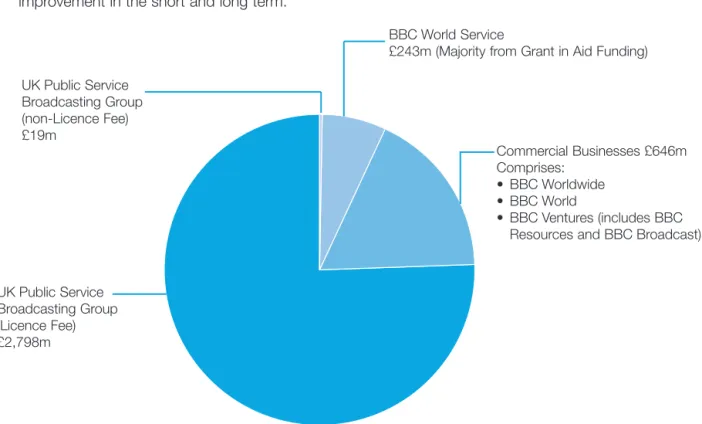
The majority of the BBC's income comes from the Licence Fee, which in 2003/04 generated £2,798 million of revenue for the corporation (See Figure 1).
Total BBC income for 2003/04 was £3,706m
Figure 1: Source BBC Annual Report and Accounts 2003/2004
BBC World Service
£243m (Majority from Grant in Aid Funding)
Commercial Businesses £646m Comprises:
• BBC Worldwide • BBC World
• BBC Ventures (includes BBC Resources and BBC Broadcast) UK Public Service
Broadcasting Group (non-Licence Fee) £19m
UK Public Service Broadcasting Group (Licence Fee) £2,798m
V
alue For Money
Review of the BBC’
s Cr
edit Management Operations
2
Summary
The average amount of debt which the BBC was owed for the periods of June, July and August 2004 was £116 million, representing a small fraction of total revenues. Whilst, prima facie, this would make a review of credit management at the BBC different to one in a wholly commercial organisation, where the proportionate amount of trade debt to revenue is much higher, the need to enhance cash generation is still very much a priority for the BBC. This can be evidenced in the BBC Governors having a stated objective in the 2003/04 annual report to: "Continue to increase the amount of money available to spend on the BBC's public services by enhancing the efficiency and effectiveness of the way the BBC operates." In this context, we have assessed the BBC's in-house credit management operations to see whether they make the optimal contribution to the BBC's effectiveness overall. We have adopted the BBC
Governors' own definition of value for money which means they require the BBC's credit management operations to:
• deliver services to clear standards (quality output);
• be the most effective, economic and efficient means available (cost effective); and
• demonstrate continuous improvement in the way in which functions are exercised.
Conclusion
Against the above criteria, our review noted the follow key findings:
The BBC's credit management operations have clear standards within the largest part of the organisation (i.e. BBC Worldwide), however they are not consistent across the corporation.
Indeed, the standards in some of the other businesses fell short of those employed within BBC Worldwide and when compared with external best practice.
Opportunities were identified for enhanced standards in terms of:
• clearer accountability and responsibility; • documented policies and procedures
which are aligned to overall BBC cash generation objectives;
• enhanced operational and management reporting including Key Performance Indicators;
• formal target setting; and
• enforcement of credit risk procedures. A key theme identified was the diversity of standards (i.e. organisation structure, policies, practices, target setting and reporting) employed across all the different credit management teams within the businesses. Consistency in standards provides a platform for improved
performance through sharing of practices and skills, internal benchmarking, and efficiencies derived from standardised processes.
The Governors' requirement to deliver against clear and consistent standards is supported by one of the BBC's core values:
"We are one BBC: great things happen when we work together."
The BBC's credit management operations are reasonable in terms of cost, efficiency and effectiveness when compared with "average" UK Service sector benchmarks, however there are significant opportunities for further improvement.
Of the £116 million that the BBC is owed, £77 million is managed by in-house collection teams. The receivables relating to third party service providers have been deemed to be out of scope for the purposes of this review. Of the £77 million, £21 million, some 28% was overdue. 28% is below the median performance level for the UK Services sector. These benchmarks and our experience of working with world-class organisations indicate that the best organisations are running with overdue debts of 10% or less,
V
alue For Money
Review of the BBC’
s Cr
edit Management Operations
2
Summary
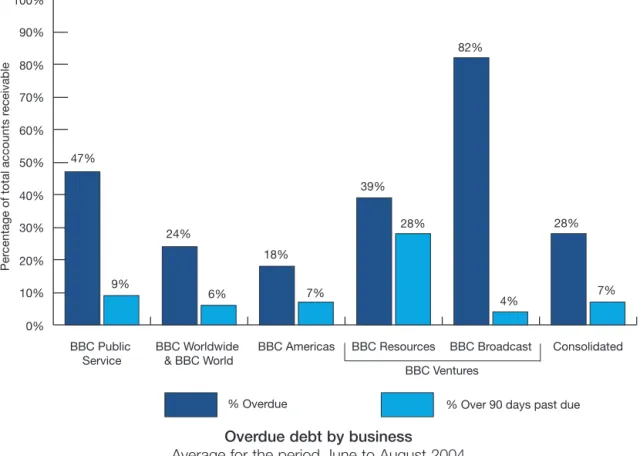
representing some scope for improvement for the corporation (see quantification in Section 5). Performance varies considerably amongst the BBC businesses with the commercial subsidiary, BBC Worldwide, both having the bulk of the debt and performing most effectively. BBC Public Service, on the other hand, performs less effectively, running with overdue debts of 47% (average for the periods June to August 2004).
We have compared the workload of the BBC's credit management teams with recent staff workload benchmarks relating to a sample of large UK based Service
organisations. These benchmarks indicate that, whilst the BBC is operating more economically than the sector median, it still has scope to reduce costs by increasing the number of accounts handled by each Credit Controller. Based on these benchmarks, we believe that a reduction in head count of between 3 to 4 staff is achievable by attaining a ratio in excess of 1 Credit Controller for every 350 accounts. This would equate to an annual cost saving of approximately £116,000 to £155,000. The above improvements in effectiveness and efficiency will be crystallised through the implementation of some of the
recommendations below, including: the standardisation of processes and the utilisation of technology, as currently employed by BBC Worldwide, across the organisation.
The BBC's in-house credit management operations have demonstrated continuous improvement over the last two years;
however, enhanced targets and practices will be required to maintain this trend.
We analysed the performance of the BBC's in-house credit management operation, excluding BBC Americas, over the last two years and found that it has improved from over £43 million overdue in January 2003 to the £20 million outstanding at the time of our fieldwork. We have found evidence of
management action to tackle overdue debt that has been effective. Lifting credit management performance to a level that compares with best practice could further reduce overdues to 10% of total accounts receivable. This represents an opportunity for the BBC to generate a potential one-off cash flow benefit of up to £15 million. However, we found that not all existing performance targets provide for continuous improvement. We also believe that new work practices, as noted below, in terms of
standardisation and improved efficiency, based on best practice processes and technology as employed in BBC Worldwide, will be required to achieve further
improvement.
Key Recommendations
The following key recommendations were made based on our review:
Structure and accountability
The BBC is most likely to realise the available benefits by refocusing operational
accountability on one individual and establishing central control over its credit management functions. There are three principal options to consider:
• Appoint a Group Credit Manager and establish a centre of excellence to provide credit management services to all BBC businesses. Given the BBC's devolved structure, we would envisage this operating along the lines of a shared service centre;
• Maintain a decentralised approach but establish reporting lines to a Group Credit Manager, with overall functional
responsibility for credit management. This approach would be unlikely to deliver the full extent of potential cost savings as it would not maximise economies of scale; and
• Focus responsibility for credit
management across the BBC on BBC Worldwide, the best performing business.
V
alue For Money
Review of the BBC’
s Cr
edit Management Operations
2
Summary
We understand that this would need to be conducted within the BBC's Fair Trading guidelines and Fair Trading advice should be sought.
As an alternative, the BBC may wish to consider outsourcing the collection of further elements of its receivables to a specialist third party service provider. The potential benefits of this approach may combine improved performance (in line with service level targets) together with reductions in operating costs in the longer term. This would require a detailed cost benefit analysis to establish whether this approach is viable. Credit policy
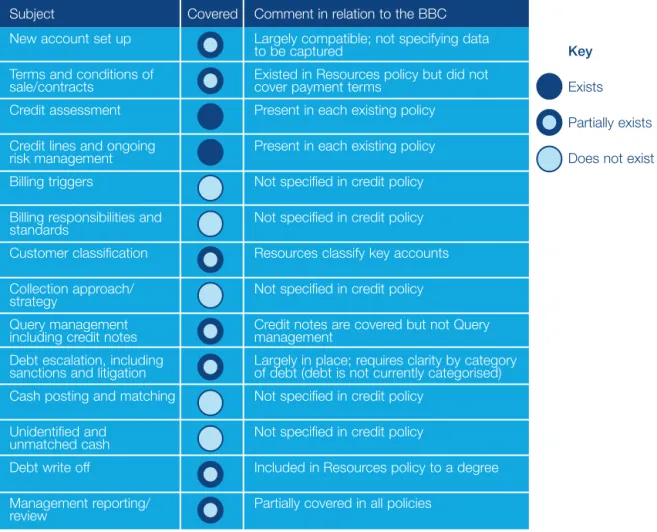
Whilst the BBC has credit policies at a business level, there is an opportunity to both extend their scope (to cover the broader sales-to-cash process) and publish a master credit policy, providing an overall credit framework and ensuring consistency with the BBC's broader cash generation objectives. Processes, work practices and technology Implementing best practice credit
management consistently across the BBC will help to maximise performance. The first step would be to define best practice as it relates to the BBC. Our experience has shown that, within an organisation as diverse as the BBC, processes may need to be adapted to the needs and dynamics of its various businesses.
A key element of standardising processes will involve an understanding of the extent to which technology can be best leveraged. The Credica system, currently used by BBC Worldwide, provides evidence that such technology can deliver tangible benefits. Accordingly, we consider that the BBC would derive considerable benefit from extending the use of such a system to BBC Public Service. Other future uses of technology could include the use of e-mail collection letters, automated credit risk score cards,
uploading third party customer information to SAP, electronic invoice presentation and payment, and document imaging. Sharing knowledge
We observed many good practices within the BBC and there is clearly a wealth of
knowledge and experience within the credit management teams. These teams should be actively encouraged to share both their knowledge of good practice but also the credit intelligence that they gather on
customers. We acknowledge that this would need to take place subject to the BBC's Fair Trading Guidelines.
Performance monitoring and measurement
As outlined in this report, there is a considerable opportunity to improve
performance. However, this is unlikely to be achieved unless the annual performance objectives (relating to businesses, teams and individuals) reflect this potential. These objectives should include monthly cash collection and overdue debt targets. Implementing a consistent set of key performance indicators across the BBC would provide greater control and also enable comparison of performance across the businesses.
V
alue For Money
Review of the BBC’
s Cr
edit Management Operations
3
Introduction and background
3.1 Background for this value for money study
The BBC's Royal Charter states that ensuring value for money is a core responsibility of the BBC Governors and that, for the BBC, this means:
• delivering services to clear standards (quality outputs);
• doing this in the most effective, economic and efficient means available (cost effective); and
• with continuous improvement in the way in which functions are exercised. In the context of the Communications Act 2003, the Government and the BBC agreed a development in the BBC Governors' oversight of value for money studies to ensure that there is sufficient scrutiny over Licence Fee expenditure. A key component of the programme was the appointment of external agencies, to include the National Audit Office ("NAO"), to undertake certain topics identified for review. The key objectives of the studies are to review whether the BBC is achieving best value for its Licence Fee payers. PwC was appointed in August 2004 to undertake a review of the BBC's credit management operations. Our fieldwork was carried out during August and September 2004.
The BBC has a strategic objective to improve its cash flow generation. This was evidenced by the BBC Governors' stated objective in the 2003/04 annual report to:
"Continue to increase the amount of money available to spend on the BBC's public services by enhancing the efficiency and effectiveness of the way the BBC operates." In line with this, the aim of this review is to: • evaluate whether the BBC is achieving
best value for Licence Fee payers from its credit management and debt collection process;
• benchmark the BBC's capabilities with external best practice;
• identify and scale opportunities for improvement; and
• identify means to ensure continuous improvement in the short and long term. 3.2 Placing credit management in the
context of BBC's overall operations The majority of the BBC's income comes from the Licence Fee, which in 2003/04 generated £2,798 million (see Figure 1 on page 2).
Whilst the Licence Fee represented 75% of total income, commercial activities, such as the sale of BBC programmes and
publications and the leasing of production facilities, generated £908 million.
The BBC's primary function is public service broadcasting. It operates around the world and has its main offices in White City and Central London. They are augmented by offices in other key locations, including New York for BBC Americas and regional capitals in the UK.
BBC Public Service fulfils the corporation's primary purpose of public service
broadcasting. In general, the BBC's commercial activities are undertaken by wholly owned subsidiaries set up for this specific purpose, they include:
• BBC Worldwide ("BBC Worldwide"); • BBC World ("BBC World"); and • BBC Ventures ("BBC Ventures (BBC
Resources and BBC Broadcast)"). BBC Ventures consists of four businesses, BBC Resources ("BBC Resources"), BBC Broadcast ("BBC Broadcast"), BBC Technology and BBC Vecta. At the time of the fieldwork for this review, the latter two were in the process of being sold and, consequently, were not covered by this review.
V
alue For Money
Review of the BBC’
s Cr
edit Management Operations
BBC Worldwide is the main commercial arm of the BBC and, as such, it is responsible for selling a large proportion of the BBC's products in the UK and around the world. BBC Worldwide is assisted in this in the UK by an outsourced credit management service provider which is responsible for magazine sales, distribution and associated credit management activities and an outsourced distributor that produces and distributes audio and visual media (e.g. CDs and DVDs). BBC Worldwide also has a significant business, BBC Worldwide Americas ("BBC Americas") based in New York, covering sales in North America, Canada and South America. It is supported by a credit management service provider that undertakes collections, in addition to advertising and affiliate sales, and an outsourced distributor that undertakes the manufacture and sale of videos and DVDs. 3.3 Credit management organisation
within the BBC
Credit management teams across the BBC provide advice on setting credit limits for new customers, review credit limits where
required, pursue overdue debt, undertake query management, to the extent that it is undertaken, and escalate old debt to third party collection agencies. All of the credit teams produce reports for review by management. The teams are organised within BBC Worldwide (including BBC World), BBC Americas, BBC Ventures (BBC
Resources and BBC Broadcast) and BBC Public Service and comprise 23.75 full time equivalent (FTE) staff including 17 in BBC Worldwide (excluding BBC Americas).
BBC Worldwide has a further 12 FTE in Accounts Receivable. The Accounts Receivable function for the other divisions is provided by a third party service provider. BBC Americas, part of BBC Worldwide, has its own credit management team responsible for the USA, Canada and Latin America. BBC Ventures (BBC Resources and BBC Broadcast) has a credit management
department of two, whilst BBC Public Service has a central credit management team of two and part of an FTE in both Scotland and the Sport International Unit.
BBC World Service is, effectively,
independent of the other businesses from a credit management perspective, as a result of its unique funding structure and remit. It does not have a credit management
department and uses other staff to undertake any such work.
V
alue For Money
Review of the BBC’
s Cr
edit Management Operations
The commercial divisions have the highest share of total debt, due to the fact that their income is predominantly from credit sales. BBC Public Service debt only makes up a small element, 8%, of total BBC receivables, its prime source of funding being the Licence Fee. The difference in funding between BBC Public Service and the commercial divisions influences their approach to credit
management.
Use of third party service providers BBC Public Service and BBC Ventures (BBC Resources and BBC Broadcast) have engaged an outsourced service provider to obtain credit risk reports from third party credit reference agencies, maintain customer master data, undertake cash application and
despatch invoices, statements and dunning letters. BBC Worldwide undertakes these tasks in-house.
Approximately 16% of BBC Worldwide's receivables relate either to an outsourced distributor or credit management service provider. Both are subject to formal distribution / service levels agreements and are managed directly by the business. As they do not involve the BBC's credit management teams, they have been excluded from the scope of this review. A similar situation exists for BBC Americas where 66% of its receivables relate to outsourced service providers. We have, however, undertaken a desktop review of recent performance of the credit
management service providers.
3
Introduction and background
The combined BBC accounts receivable ledger was an average of £116 million for the periods of June, July and August 2004.
Total debt £116m
Average for the period June to August 2004
Figure 3: Source BBC
BBC Public Service 8%
BBC Worldwide 89% BBC Broadcast
1%
BBC Resources 2%
BBC Ventures
BBC Worldwide in-house
credit management
50% Outsourced
distributors and credit management service providers
33%
BBC Americas
V
alue For Money
Review of the BBC’
s Cr
edit Management Operations
3
Introduction and background
3.4 Scope of review
As agreed with the BBC, the scope of this review covered the following business areas: • Central credit management for BBC
Public Service - this included separate teams within 2 areas of BBC Public Service:
• Sport International Unit; and • BBC Scotland;
• BBC World Service;
• Outsourced provider supporting credit management processes only;
• BBC Worldwide (including BBC Amercias);
• BBC World; and
• BBC Ventures: BBC Broadcast and BBC Resources (excluding BBC Technology and BBC Vecta).
It was agreed with BBC Management that the external service providers within BBC Worldwide and BBC Americas would not be subject to review. In addition, the sales order management and cash allocation processes were deemed to be out of scope. The operational scope of the review is illustrated in Figure 4.
In summary, the following areas were specifically not included within the scope of this review:
• collection of the Licence Fee; • outsourced distributors and credit
management service providers (other than a desktop review of recent performance of the latter);
• transactions between BBC Divisions and the commercial subsidiaries; • the sales order management; and • cash allocation process.
Scope of credit management process reviewed
V
alue For Money
Review of the BBC’
s Cr
edit Management Operations
This part of the review examines the standards in place at the BBC in relation to credit management. In particular, it covers: • the nature and level of the standards in
place; and
• the consistency with which the standards are applied.
4.1 A significant element of the BBC delivers credit management services to clear and consistent policies
4.1.1 BBC Worldwide and BBC Resources have well developed credit policies and documented processes
BBC Worldwide represents over 50% of the BBC's accounts receivable and has a significant focus on credit management. Our review established that both BBC Worldwide and BBC Resources operate to clear, visible and robust credit management standards. They have published credit policies comprising the areas that we would expect to see. They also have documented credit and collection processes, which complement the credit policies. We have not found any evidence to suggest that the staff in BBC Worldwide or BBC Resources do not work within the parameters set out in their policies and process documentation. 4.1.2 Other businesses have an
opportunity to better articulate their credit policy and work practices. This will make them more clearly aligned with the BBC's broader objective of improving cash flow generation
BBC Broadcast does not have the same level of sophistication as BBC Worldwide and BBC Resources, relying on a much smaller scale of operation and the experience of its Credit Managers, rather than a published credit policy and set of processes.
BBC Public Service has published a very brief credit policy document, lacking the detail of that prepared by BBC Worldwide. Furthermore, whilst it has a set of
documented credit and collection processes, these are not in wide circulation and do not tend to reflect day-to-day working practices. Currently, there are no credit policies or documented processes in place for BBC Broadcast or BBC World. However, management in both organisations did articulate a clear vision of what a credit policy should comprise.
4.1.3 The BBC does not have a consistent credit management policy framework across all of its businesses
We noted from our review that no overall credit management policy framework exists across the organisation. Our experience has shown that, even in the most diverse of organisations, there is a need for a master corporate credit policy from which divisional variations can be derived. The result is a series of interlinked polices that have shared values and objectives and, consequently, are able to sustain a greater profile and
consistency within the organisation.
We would recommend that the BBC develops a common policy framework upon which divisional variations can be developed, whilst sharing a common strategy and objectives. 4.1.4 Service level agreements are in
place with the BBC's principal outsourced distributors and credit management service providers The BBC has service level agreements in place with its main third party distributors and credit management service providers. We found that the service level agreements make provision for the services in question and the BBC regularly monitors performance against agreed standards.
4
The BBC has clear standards in a significant part
of its credit management operations but they are not
consistent across the organisation
V
alue For Money
Review of the BBC’
s Cr
edit Management Operations
4.2 Accountability and responsibility for credit management differs from business to business
4.2.1 The BBC has a devolved,
decentralised approach to credit management
Responsibility for credit management is devolved to each of the main businesses. Whilst a decentralised approach can be effective, it often means (as is the case with the BBC) that no one Credit Manager has overall responsibility for the BBC's credit and collections performance, organisation, policy, process or reporting. Our experience has shown that some measure of central coordination and accountability helps world-class organisations to improve performance, provide greater visibility of key issues, share knowledge, establish uniform policies and work practices, provide economies of scale and reduce costs. We recommend the BBC considers the following options:
• Appoint a Group Credit Manager and establish a centre of excellence to provide credit management services to all BBC businesses. Given the BBC's devolved structure, we would envisage this operating along the lines of a shared service centre;
• Maintain a decentralised approach but establish reporting lines to a Group Credit Manager, with overall functional
responsibility for credit management. This approach would, however, be unlikely to deliver the full extent of potential cost savings, as it would not maximise economies of scale; and
• Given the relative performance of the different businesses, the BBC may wish to consider the potential benefits of placing responsibility for all receivables with BBC Worldwide.
We understand that this would need to be conducted within the BBC's Fair Trading guidelines and Fair Trading advice should be sought.
As an alternative, the BBC may wish to consider outsourcing the collection of further elements of its receivables to a specialist third party service provider. The potential benefits of this approach may combine improved performance (in line with service level targets) together with reductions in operating costs in the longer term. This would require a detailed cost benefit analysis to establish whether this approach is viable. In order to engender cooperation and assistance from each of the divisions in support of implementing good credit management practice, we recommend that the BBC also considers levying an internal cost of capital charge proportionate to the level of receivables outstanding.
4.2.2 BBC Worldwide (including BBC Americas and BBC World), BBC Resources and BBC Broadcast have well defined organisational structures for credit management The credit management operations in BBC Worldwide, including BBC Americas, are driven by commercial imperative and strong local management. Receivables performance has, therefore, a high priority. There is a clear understanding of the importance of prompt payment, reinforced by published
procedures, targets and management review of performance. Credit management has a key role to play in BBC Worldwide's sales-to-cash process and this was clearly
understood by those interviewed. This is particularly important given the relative size of the organisation.
BBC Worldwide has a formal structure for its credit management team comprising 17 staff (excluding Accounts Receivable), with clearly defined responsibilities supported by a sophisticated performance measurement process (see section 4.5.1). Each member of staff has a set of personal objectives and is subject to a regular performance appraisal process.
4
The BBC has clear standards in a significant part
of its credit management operations but they are not
consistent across the organisation
V
alue For Money
Review of the BBC’
s Cr
edit Management Operations
Although BBC Worldwide's Finance Director is ultimately accountable for credit
management, day-to-day responsibility is delegated to an experienced Credit Manager. The Credit Manager, in turn, reports to the Head of Financial Accounting Services. In BBC Americas, the Vice President Finance is accountable for credit management and has a dedicated team of three staff. BBC Ventures (BBC Resources and BBC Broadcast) has a small team of two experienced Credit Controllers, with clear accountability, reporting to the Head of Purchasing for BBC Resources.
4.2.3 The credit management structure in BBC Public Service is more
complex and not as clear Currently, BBC Public Service has a decentralised approach to credit management with different lines of accountability.
For historical reasons only, Sport International Unit and BBC Scotland each have staff with part-time responsibility for credit
management. We do not consider that there is benefit in maintaining a decentralised approach within BBC Public Service and recommend that the BBC focuses responsibility on one central team. For the remainder of BBC Public Service a small dedicated team, comprising a Credit Manager and Credit Controller, was
appointed approximately two years ago. Our review highlighted that the role of this team is not yet fully understood by all of its divisional Financial Controllers, as a number noted that they still undertook some collections activities themselves because they were not aware that a central credit management team had this responsibility.
The Credit Manager is in the process of staging a series of "road shows" for individual divisions to introduce them to the principles
of good credit management and reinforce the availability of specialist resource. At the time of our review, a number of the Financial Controllers continued to take an active role in day-to-day credit and collection activities. We consider that there is an opportunity for these divisions to delegate responsibility to the specialist credit management team. 4.3 Credit risk management processes
are in place in each business but in certain instances are not being enforced
4.3.1 Credit management teams across the BBC understand the need for credit risk management
Processes for managing credit risk are in place across the BBC, although the extent to which these are fully documented is variable. Credit management staff in BBC Worldwide have been trained to assess the information provided to them from recognised third party credit reference agencies and evaluate the level of credit risk. BBC Americas staff are also trained to assess information provided via third party agencies. In line with best practice, other information (including trade references) is also used by these teams to determine customer credit limits. Other areas of the BBC obtain similar third party reports on potential new customers but tend to use the credit limits recommended by the credit reference agency. This may lead to the adoption of inappropriately high or low limits and could either restrict sales unnecessarily or expose the BBC to a high credit risk. 4.3.2 There is scope to improve credit
risk management in BBC Public Service
We found that the BBC Public Service divisions do not often follow their
documented credit risk process until after they have provided goods or services to the customer. It is only at this point that the credit management team receives a request
4
The BBC has clear standards in a significant part
of its credit management operations but they are not
consistent across the organisation
V
alue For Money
Review of the BBC’
s Cr
edit Management Operations
to undertake the normal credit risk
procedure, thereby significantly devaluing its purpose.
From our interviews, we understand that there are instances where BBC Public Service divisions raise both sales orders and invoices at period end after the customer's payment has been received. Furthermore, we found that BBC Public Service has no means of establishing the value of the services performed but not yet invoiced. We understand that uninvoiced amounts of this nature could be substantial, resulting in delays in cash collection. Whilst we have not found evidence of this risk materialising, the BBC should consider undertaking a review to quantify the impact of this and the need for changes in operating procedures.
4.3.3 There is currently no mechanism to aggregate credit limits across the BBC
The BBC currently runs two separate SAP accounting systems, one for BBC Worldwide and another for BBC Public Service, BBC World Service and BBC Ventures (BBC Resources and BBC Broadcast).
Accordingly, customer credit limits can only be aggregated for different accounts relating to the same customer if they are held on the same SAP system. In effect this means that cross-BBC credit risk management is difficult to achieve and, as a result, the BBC does not currently set limits or monitor total customer credit exposure for the whole corporation. Similarly there is no efficient means of sharing information relating to customer payment problems.
This may leave the BBC open to bad debt losses. However, we encountered no evidence that such losses have occurred to date.
4.3.4 In BBC Public Service, BBC World Service and BBC Ventures (BBC Resources and BBC Broadcast), the 'credit hold' feature within SAP does not automatically stop orders if a credit limit has been exceeded Some BBC Public Service, BBC World Service and BBC Ventures (BBC Resources and BBC Broadcast) customers are classified as "key" accounts within the SAP accounting system, whereas the remainder are flagged as "standard", or non-key accounts. SAP treats the two classes differently when applying credit limits. If a key customer exceeds its credit limit, the system provides only a warning and will allow the order to progress regardless. Alternatively, where credit limits are breached on standard accounts, the Credit Manager must specifically 'release' the order for it to progress. Whilst this is a standard feature of the SAP sales order processing module, it effectively places responsibility for credit risk management with the business rather than the credit management team. We
recommend that all breaches of credit limits should be referred to the Credit Management function.
4.4 Target setting practices are inconsistent across the BBC BBC Worldwide applies good practice and sets monthly cash collection targets for each team and, until recently, set targets for each individual. The use of individual targets has now been suspended to engender a more team focussed approach. Whilst we would normally expect targets to be set at individual level, the effectiveness of the team based targeting, as now adopted, should be evaluated over a period of time. BBC Worldwide also sets annual overdue debt targets for teams, and each individual is set objectives to improve the aged debt profile for which they are responsible.
4
The BBC has clear standards in a significant part
of its credit management operations but they are not
consistent across the organisation
V
alue For Money
Review of the BBC’
s Cr
edit Management Operations
BBC Ventures (BBC Resources and BBC Broadcast) does not set monthly cash collection targets and, furthermore, does not monitor the individual performance of their two Credit Controllers. Likewise, BBC Public Service and BBC Americas do not set monthly credit management targets. In 2003, however, BBC Public Service did set targets for a specific debt reduction exercise, which coincided with a reduction in overdue debt. We consider that the absence of monthly targets in these areas hinders the BBC's aspiration to achieve continuous improvement.
This lack of consistency means that the opportunity to share good practices that are already present within parts of the BBC is being missed and makes comparison of credit management performance across the organisation more difficult.
4.5 Whilst there is good credit
management reporting in place in some businesses, there is no BBC-wide consolidation or overview 4.5.1 BBC Worldwide (including BBC
World) and BBC Resources publish good quality management reports Each month BBC Worldwide and BBC Resources publish clear, one-page summary reports in respect of the previous period's performance. These reports comprise a number of meaningful key performance indicators and are supported by more detailed analysis. BBC Worldwide's reporting capability is enhanced through its use of Credica, a specialist credit
management workflow and reporting application. This system provides a good level of operational reporting, enabling the Credit Manager to monitor credit
management activity and make adjustments to daily priorities.
4.5.2 Reports prepared by other businesses are not as comprehensive
In contrast, the BBC Public Service report is not as comprehensive and does not provide a trend analysis or detailed set of
performance measurements. Certain divisions publish their own reports, typically monitoring the overdue debt profile and setting out details of the largest slow payers. Similarly, reports published by BBC Americas do not provide a full analysis of overdue receivables (distinguishing only between debts under and over 90 days past due), thus limiting the value of the information provided. In its one-page report, issued monthly to BBC Worldwide, it lists the top 12 debts and provides an aged ledger summary for the remainder. However, the lack of monitoring of the profile of debt less than 90 days overdue presents an opportunity for improvement.
We recommend that management reports prepared by the businesses should include reference to at least the following key performance indicators:
• Percentages of each overdue age band in relation to total accounts receivable; • Percentage overdue, with historic trends; • Debtor Days, also known as Days Sales
Outstanding ("DSO") and Best Possible DSO, with historic trends;
• Value and percentage of accounts receivable in dispute, with historic trends; • Value and percentage of disputes by
dispute type;
• Cash collected against cash target; and • Value of unbilled revenue.
4
The BBC has clear standards in a significant part
of its credit management operations but they are not
consistent across the organisation
V
alue For Money
Review of the BBC’
s Cr
edit Management Operations
4.5.3 The BBC businesses use different key performance indicators and the calculations underpinning some of these in certain businesses are inconsistent and inaccurate Each business uses a different set of key performance indicators. Furthermore, the source data used for calculating BBC Worldwide's DSO measurement is
inconsistent (with the other BBC businesses and external best practice), as accounts receivable figures include VAT, whilst sales figures do not. This results in DSO being generally overstated and subject to anomalous fluctuations in response to significant changes in the proportion of export sales. In addition, BBC Worldwide's calculation routinely overstates DSO by 30 days. Whilst this does not prevent internal trend analysis, it does preclude a valid comparison with external benchmarks. We understand that BBC Worldwide has since changed its method of calculating DSO in line with best practice. We also found that BBC Ventures (BBC Resources and BBC Broadcast) bases its DSO calculation on calendar days, whereas the source data relates to days within a BBC accounting period. Whilst the effect of this will vary, the consequence is that the data is inaccurately reported.
4.5.4 BBC Public Service reports include receivables for which the BBC is not responsible and others that are not true trade receivables
BBC Public Service receivables information, as reported via the Executive Committee report, includes non-trade receivables in the form of property transactions. The report also includes data in relation to the BBC World Service Trust. These receivables are the responsibility of the Trust, which is not part of the BBC. The value of Trust
receivables accounted for approximately 24% of the total BBC Public Service ledger, distorting its performance. For purposes of comparison in this report, we have adjusted the data provided to us by the BBC to remove receivables relating to either property transactions or the Trust.
4.5.5 The BBC does not publish an overview report providing a consolidated picture of credit management performance across its different businesses
We found that there is no consolidated reporting of receivables performance across the various BBC businesses, leading to a lack of visibility at top management level. In order to provide sufficient oversight of credit management issues across all the BBC's businesses, we recommend that a top-level management report is prepared and circulated to senior management on a monthly basis.
4
The BBC has clear standards in a significant part
of its credit management operations but they are not
consistent across the organisation
V
alue For Money
Review of the BBC’
s Cr
edit Management Operations
This section of the report examines whether credit management at the BBC is undertaken in the most efficient, effective and economic manner. It covers:
• Whether its credit and collection performance is effective;
• How the BBC's credit management operations compare with external best practice; and
• How the economies of the credit
management function compare with other world-class organisations.
5.1 Whilst the BBC's collections performance is broadly in line with the median for the UK Services sector, there is still scope for improvement
5.1.1 Of the £77 million of accounts receivable managed internally, £21 million was overdue
For the purposes of our review we have focused only on trade receivables generated from the BBC's core broadcasting and commercial activities. We have, therefore, excluded balances relating to the BBC World Service Trust and property transactions. Accordingly, the BBC's average trade receivables balance (excluding the BBC World Service Trust and property related transactions) over the three months to August 2004 totalled £116 million.
We have also excluded balances relating to outsourced service providers (which have been deemed out of scope) giving an adjusted total ledger balance of £77 million, of which, £21 million (or 28%) was overdue, with £5 million (or 7%) greater than 90 days past due.
5
Current operations are reasonably effective
however there are significant opportunities for the BBC
to further enhance the value for money derived from its
credit management operations
Total debt £116m
Average for the period June to August 2004
Figure 5: Source BBC
BBC Public Service 8%
Debt managed by in-house collection team £77m, 67% BBC Broadcast
1%
BBC Resources 2%
BBC Ventures
BBC Worldwide 50% Outsourced
distributors and credit management service providers
33%
BBC Americas
V
alue For Money
Review of the BBC’
s Cr
edit Management Operations
We have compared the BBC's performance with recently collated external benchmarks1.
The data provided to us related to a sample of large UK based organisations operating in the Services sector, including media,
broadcasting and publishing businesses.
With overdues of 28% and over 90 day past dues at 7%, the BBC's performance ranks between the sector median and the lower quartile. In our experience, world-class credit management teams (with a significant element of overseas debt in their portfolio) maintain overdues at below 10% of total accounts receivable.
BBC Worldwide has the highest level of receivables but the lowest percentage overdue
The chart below shows the overdue
performance of the BBC businesses that we reviewed.
Figure 6: Source Credit Management Research Centre
Upper quartile Median Lower quartile
Overdues as a % of total accounts receivable 13.0 22.0 38.7
Over 90 day overdues as a % of total accounts
receivable 0.1 1.4 11.6
Overdue debt by business
Average for the period June to August 2004
Figure 7: Source BBC
Note 1: Data provided by the Credit Management Research Centre at Leeds University Business School
5
Current operations are reasonably effective
however there are significant opportunities for the BBC
to further enhance the value for money derived from its
credit management operations
0% 20% 40% 60% 80% 100%
10% 30% 50% 70% 90%
47%
9%
6% 7%
28%
4% 7%
24%
18%
39%
82%
28%
% Overdue % Over 90 days past due
Per
centage of total accounts r
eceivable
BBC Ventures
Consolidated BBC Broadcast
BBC Resources BBC Americas
BBC Worldwide & BBC World BBC Public
V
alue For Money
Review of the BBC
’s Cr
edit Management Operations
BBC Worldwide is the most significant business in terms of annual sales and total accounts receivable. Furthermore, a material element of its receivables relates to overseas customers. In our experience, not only are payment terms for overseas accounts longer, but also payment is generally slower.
Relative to total receivables of £58 million, overdues of £14 million accounted for 24% and balances greater than 90 day past dues represented 6%.
The aged debtor information provided by the BBC in relation to the outsourced credit management service provider's collection performance does not allow a meaningful analysis of overdues. The average overdue figure for June 2004 to August 2004 was a credit balance and has been distorted by the following factors:
• The aged debt reports do not correctly classify invoices that fall due on the last day of the month as overdue; and • The ledger comprises a significant value
of credit notes raised as a result of billing errors or returned stock. Credit notes are classified as overdue with immediate effect and if left unmatched, significantly distort the overall aged profile.
BBC Resources overdues have been distorted by a £400,000 doubtful debt On face value, 39% of the BBC Resources ledger was overdue, with 28% more than 90 days past due. However, these figures were distorted by a large doubtful debt of
£400,000. We understand an agreement has been reached with this customer for the debt to be paid in instalments. If the balance were removed, BBC Resources overdues would represent 27% of its total accounts receivable.
BBC Broadcast overdues have also been distorted
BBC Broadcast's absolute level of overdues is relatively low at £934,000, of which 82% is overdue. On closer analysis, we found that BBC Broadcast often invoices its customers up to 50% of the contract value in advance. These invoices are due immediately and are, therefore, classified as overdue as soon as they are raised. In practice, customers take at least seven days to make payment. This, in turn, impacts the BBC Broadcast overdue position, which in recent months has averaged 82% of total accounts receivable. In this respect, although BBC Broadcast ledger is relatively small, the BBC may wish to consider applying more realistic payment terms to these invoices.
BBC Public Service has made good progress in reducing overdue balances, but still has significant scope for improving its collections performance Since early 2003, BBC Public Service has made progress in reducing its overdue balance. However, with overdues now averaging 47% of its total accounts receivable (and over 90 day past dues at 9%), there is still considerable scope for improvement when compared to industry sector average.
5
Current operations are reasonably effective
however there are significant opportunities for the BBC
to further enhance the value for money derived from its
credit management operations
V
alue For Money
Review of the BBC
’s Cr
edit Management Operations
BBC Americas' recent collection
performance is broadly in line with that of BBC Worldwide
BBC Americas' recent overdues have averaged £1 million, representing 18% of its accounts receivable balance, with over 90 day past dues at 7%.
The outsourced credit management service provider for BBC Americas shows an average overdue debt position of £4 million (57%).
Overdue debt profile
Average for the period June to August 2004
Figure 8: Source BBC
Note 1: At the time of our review, a full aged debt profile was not available for BBC Americas. As a result, its consolidated figures are shown above
5
Current operations are reasonably effective
however there are significant opportunities for the BBC
to further enhance the value for money derived from its
credit management operations
0 3 6 9 12 15
91 days plus 61-90 days
31-60 days 0-30 days
BBC Broadcast BBC Resources
BBC Americas BBC Worldwide &
BBC World BBC Public
Service
BBC
V
alue For Money
Review of the BBC
’s Cr
edit Management Operations
The BBC may wish to consider insourcing and outsourcing options
Given that BBC Worldwide performs better than the other businesses, the BBC may wish to consider giving it responsibility for all of the BBC's receivables.
We understand that this would need to be conducted within the BBC's Fair Trading guidelines and Fair Trading advice should be sought.
Furthermore, the BBC should also consider outsourcing the collection of further elements of its receivables to a third party service provider specialising in this area. This would require a detailed cost-benefit analysis to determine whether this approach is viable. 5.1.2 Collections Effectiveness Index
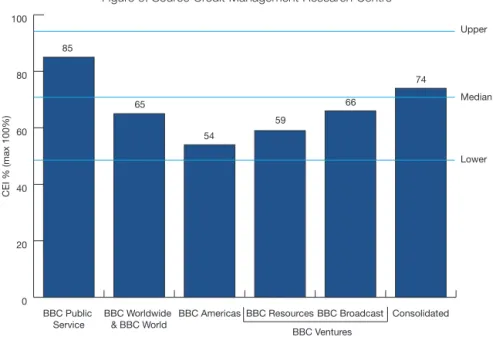
suggests an opportunity to improve The BBC's Collections Effectiveness Index (CEI), across all its businesses, for the 3
months to August 2004 has averaged 74%. Essentially, CEI assesses the proportion of accounts receivable collected in any one period as a percentage of the receivables available for collection (i.e. due for payment). The closer the CEI score is to 100% the better.
Comparing the BBC's CEI score with benchmarks for the UK Services sector demonstrates that all businesses are operating above the median level but below the upper quartile (See Figures 9 and 10). BBC Public Service and BBC Broadcast have higher than expected CEI values when considered in conjunction with their overdue debt. This suggests that a high value of debt is collected prior to due date. This is due to prepayments for BBC Broadcast and invoices being raised when cash is received, as part of normal trading, for elements of BBC Public Service.
5
Current operations are reasonably effective
however there are significant opportunities for the BBC
to further enhance the value for money derived from its
credit management operations
Upper quartile Median Lower quartile
Collections Effectiveness Index 93.4 70.8 49.1
0 20 40 60 80 100
Consolidated BBC Broadcast
BBC Resources BBC Americas
BBC Worldwide & BBC World BBC Public
Service
CEI % (max 100%)
BBC Ventures 85
65
54
59
66
74
Upper
Median Lower
Figure 9: Source Credit Management Research Centre
Collections Effectiveness Index by business
Average for the period June to August 2004
V
alue For Money
Review of the BBC
’s Cr
edit Management Operations
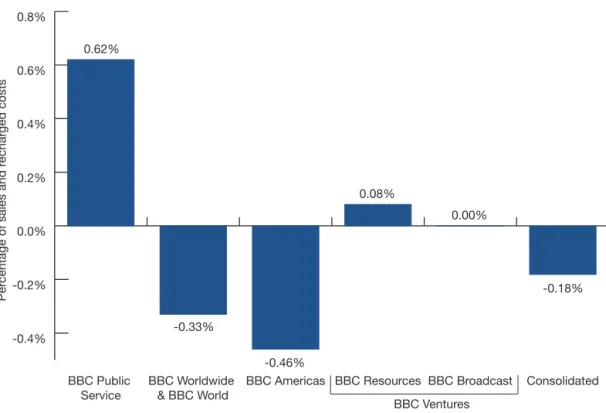
5.1.3 The combined bad debt position across all BBC businesses
represented a net write back of £0.9 million
During the financial year 2003/04, the BBC wrote back £0.9 million against bad debts incurred. This included a sum of £3.4 million recovered by BBC Worldwide in relation to debts previously provided for. Excluding this recovery, consolidated bad debts for the year totalled £2.7 million, representing 0.6% of sales and recharged costs (both including VAT). Given the scale of the BBC Worldwide write back, we do not consider that a comparison with the UK Service Sector benchmarks is meaningful in relation to the BBC as a whole. However, BBC Public Service incurred write-offs exceeding 0.6% of sales and recharged costs (both including VAT) which is well in excess of the sector median of 0.1%. This raises concerns in relation to the robustness of its credit risk processes.
5
Current operations are reasonably effective
however there are significant opportunities for the BBC
to further enhance the value for money derived from its
credit management operations
-0.4% -0.2% 0.0% 0.2% 0.4% 0.6% 0.8%
Consolidated BBC Broadcast
BBC Resources BBC Americas
BBC Worldwide & BBC World BBC Public
Service
Per
centage of sales and r
e
char
ged costs
BBC Ventures 0.62%
-0.33%
-0.46%
0.08%
-0.18% 0.00%
Bad debt as a percentage of sales and recharged costs
For the year 2003/04
V
alue For Money
Review of the BBC
’s Cr
edit Management Operations
5.2 There is an opportunity to improve overdue debt performance in the range of £7 million to £15 million If the BBC was to implement the
recommendations set out in this report, it would be well placed to realise a significant opportunity to improve collections
effectiveness. If overdues were reduced to the equivalent of 20% of total accounts receivable (2 percentage points better than the sector median), the BBC would generate approximately £7 million of additional cash receipts. Moreover, if overdues were to be reduced to 10% (in line with best practice), some £15 million could be released. This is explained more fully in section 6.2.
5.3 Central control of credit
management would further improve performance and could help to reduce the overall cost of the service
The BBC has four main dedicated credit management teams with a combined
operating budget for Financial Year 2004-5 of £920,000. This represents approximately 0.18% of the value of sales invoices handled by these teams. This falls between the median and the best performers in the UK services sector.
Of the total budget, salary related costs account for 90%, the remainder comprising general office costs and a contribution to central overheads.
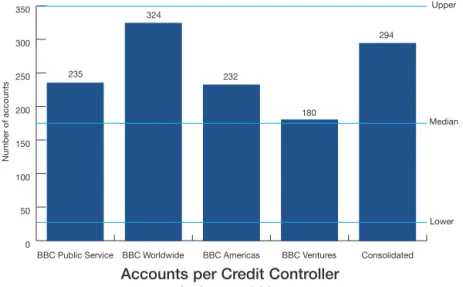
The credit management teams collectively employ a total of 23.75 FTEs managing approximately 7,000 active customer accounts. This represents a ratio of 1 Credit Controller for every 294 accounts.
An analysis of active accounts per FTE within each of the main credit management teams is set out below:
5
Current operations are reasonably effective
however there are significant opportunities for the BBC
to further enhance the value for money derived from its
credit management operations
Accounts per Credit Controller
At August 2004
Figure 13: Source BBC
BBC Ventures
(BBC Resources BBC Public BBC Worldwide BBC and BBC
£’000 Service & BBC World Americas Broadcast) Total
Salary costs 89.6 588.2 86.3 65.5 829.6
Office costs 15.1 43.2 22.3 9.7 90.3
Total budget 104.7 631.4 108.6 75.2 919.9
Figure 12: Source BBC
0 50 100 150 200 250 300 350
Consolidated Upper
Median
Lower 235
324
232
180
294
BBC Ventures BBC Americas
BBC Worldwide BBC Public Service