The Construction of Mental Models of Information-rich Web
Spaces: The Development Process and the Impact of Task
Complexity
Yan Zhang
A dissertation submitted to the faculty of the University of North Carolina at
Chapel Hill in partial fulfillment of the requirements for the degree of Doctor
of Philosophy in the School of Information and Library Science
Chapel Hill
2009
© 2009 Yan Zhang
Abstract
YAN ZHANG: The construction of mental models of information-rich web spaces: The development process and the impact of task complexity
(Under the direction of Barbara Wildemuth)
This study investigated the dynamic process of people constructing mental models of an information-rich web space during their interactions with the system and the impact of task complexity on model construction. In the study, subjects’ mental models of
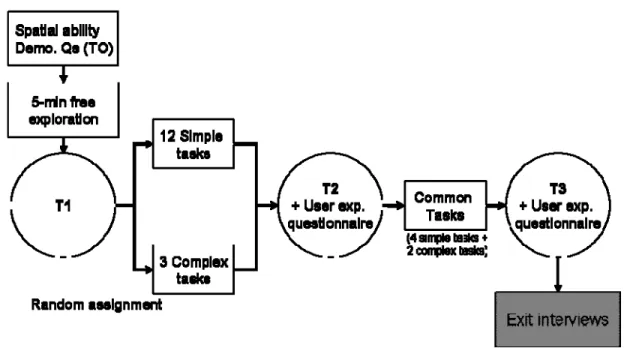
MedlinePlus were measured at three time points: after subjects freely explored the system for 5 minutes, after the first search session, and after the second search session. During the first search session, the 39 subjects were randomly divided into two groups; one group completed 12 simple search tasks and the other group completed 3 complex search tasks. During the second search session, all subjects completed a set of 4 simple tasks and 2 complex tasks. Measures of the subjects’ mental models included a concept listing protocol, a semi-structured interview, and a drawing task.
components each: system, content, information organization, and interface. The
construction of mental models was a process coordinated by people’s internal cognitive structure and the external sources (the system, system feedback, and tasks) and a process distributed through time, in the sense that earlier mental models impacted later ones. Task complexity also impacted the construction of mental models by influencing what objects in the system were perceived and represented by the user, the specificity of the representations, and the user’s feelings about the objects.
Acknowledgements
The writing of a dissertation could be a solitary journey. But many people made mine an enjoyable process. I want to first thank my advisor, Barbara Wildemuth, for being positive, encouraging, and inspiring. This work would not have been possible without her guidance. My genuine appreciations also go to other members of my dissertation
committee, Gary Marchionini, Paul Solomon, Diane Kelly, Javed Mostafa, and Peiling Wang for their input and support.
In shaping my research questions, I benefited a lot from the discussions with Dr. Peter Ornstein in the Department of Psychology at UNC, and John Schumacher at IBM Lotus Software Group. They helped me see the meaning and significance of this research from other perspectives.
I also want to express my appreciation to the SILS community, the faculty, staff, and students. My journey of pursuing a PhD would be less rewarding without your company. For many kinds of support that I have received for crafting my dissertation, I am
Cao.
Table of Contents
LIST OF TABLES ... XIV
LIST OF FIGURES ... XVIII
CHAPTER 1 INTRODUCTION ... 1
CHAPTER 2: LITERATURE REVIEW ... 5
2.1 Mental models in psychology ... 5
2.1.1 Mental models in logical reasoning and language comprehension ... 5
2.1.2 Mental models in representing domain knowledge ... 8
2.1.3 Schemata, Scripts, and Frames ... 10
2.1.4 Mental models and schemata ... 13
2.1.5 Mental imagery: the form of mental models ... 14
2.1.6 Situated cognition: alternative approaches to mental models ... 15
2.2 Mental models in HCI ... 16
2.2.1 Mental models defined in HCI ... 16
2.2.2 Types of mental models in HCI ... 18
2.2.3 Characteristics of mental models in HCI ... 21
2.2.4 Utility of mental models ... 24
2.3 Mental models in IR ... 31
2.3.2 Factors affecting mental models of IR systems ... 35
2.3.3 Construction of mental models of IR systems ... 37
2.3.4 Characteristics of mental models of IR systems ... 38
2.3.5 Mental models’ effects on information searching behavior ... 40
2.3.6 Mental models and IR system design ... 42
2.3.7 Summary ... 43
2.4 Methods for studying mental models ... 44
2.4.1 Mental models elicitation methods ... 44
2.4.2 Experimental studies of mental models ... 52
2.5 Task complexity and spatial ability ... 54
2.5.1 Task complexity ... 54
2.5.2 Spatial ability... 59
CHAPTER 3: THEORETICAL FRAMEWORK & RESEARCH QUESTIONS ... 63
3.1 Theoretical framework ... 63
3.1.1 Rationale for the framework ... 63
3.1.2 The research framework ... 65
3.1.3 Utility of the framework ... 68
3.2 Research questions and rationale ... 69
3.2.1 Construction of mental models of an information-rich web space ... 70
3.2.2 Effects of task complexity on mental model construction ... 72
CHAPTER 4: METHODS ... 74
4.1 Subjects ... 74
4.3 Tasks ... 77
4.4 Measurement of mental models ... 79
4.4.1 Concept listing... 80
4.4.2 Semi-structured interviews ... 82
4.4.3 Drawing ... 83
4.5 User experience when using the system ... 84
4.6 Research design and experimental procedures ... 85
4.7 Data analysis ... 88
4.7.1 Quantitative data analysis ... 89
4.7.2 Qualitative data analysis ... 90
4.7.3 Mental models construction ... 92
4.7.4 Evaluating the impact of task complexity ... 93
CHAPTER 5: RESULTS AND DISCUSSION: SUBJECTS, TASKS, AND USER PERCEPTIONS OF THE SYSTEM ... 95
5.1 Subjects ... 95
5.1.1 Demographic data ... 96
5.1.2 Spatial visualization ability ... 97
5.1.3 Experience with the web and medical information searching ... 98
5.2 Users’ assessments of tasks ... 101
5.3 Session length ... 104
5.4 Users’ perceptions of the system ... 105
5.5 Summary ... 107
CHAPTER 6: RESULTS AND DISCUSSION: CONSTRUCTION OF MENTAL
6.1 Mental models at T0: Initial models of information-rich web spaces ... 110
6.1.1 The structure dimension of mental models ... 111
6.1.2 The evaluation/emotion dimension of mental models ... 113
6.1.3 The (expected) behavior dimension of mental models ... 114
6.1.4 Characteristics of the initial (T0) model ... 116
6.2 Mental models at T1, T2, and T3 ... 117
6.2.1 Data used to create mental models at T1, T2, and T3 ... 117
6.2.2 Subjects’ mental models of MedlinePlus at T1 ... 121
6.2.3 Subjects’ mental models of MedlinePlus at T2 ... 126
6.2.4 Subjects’ mental models of MedlinePlus at T3 ... 130
6.3 The construction of the mental models’ three dimensions ... 134
6.3.1 The construction of the structure dimension of mental models ... 135
6.3.2. The construction of the evaluation/emotion dimension of mental models ... 139
6.3.3 The construction of the (expected) behavior dimension of mental models ... 143
6.3.4 Summary and discussion ... 147
6.4 The construction of the system component of the structure and evaluation/emotion dimensions ... 149
6.4.1 The construction of the system component of the structure dimension ... 150
6.4.2 The construction of the system component of the evaluation/emotion dimension ... 167
6.5 The construction of the content component of the structure and evaluation/emotion dimensions ... 179
6.5.1 The construction of the content component of the structure dimension ... 179
6.6 The construction of the information organization component of the structure
and evaluation/emotion dimensions ... 219
6.6.1 The construction of the information organization component of the structure dimension ... 220
6.6.2 The construction of the information organization component of the evaluation/emotion dimension... 223
6.6.3 Discussion of the construction of the information organization component of the structure and evaluation/emotion dimensions ... 227
6.7 The construction of the interface component of the structure and evaluation/emotion dimensions ... 230
6.7.1 The construction of the interface component of the structure dimension ... 230
6.7.2 The construction of the interface component of the evaluation/emotion dimension ... 243
6.8 Two additional components of the evaluation/emotion dimension of mental models: heuristics and self-reflection on the experience ... 258
6.8.1 Heuristics ... 259
6.8.2 Self-reflection on their experience with MedlinePlus ... 265
6.8.3 Summary ... 267
CHAPTER 7: CONCLUSIONS AND IMPLICATIONS ... 269
7.1 Conclusions: construction of and changes in mental models... 269
7.1.1 Users’ mental models of information-rich web spaces ... 270
7.1.2 Construction and changes of mental models over time: cognitive, emotional, and behavioral development ... 275
7.1.3 Characteristics of mental models and of model construction ... 282
7.2 Conclusions: the impact of task complexity on mental models construction ... 286
7.3 Limitations of the study ... 290
7.4.1 Mental models as a tool for system design, system evaluation, and user
modeling ... 293
7.4.2 Mental models as a tool for user training ... 299
7.5 Implications for research ... 302
7.5.1 An effective method for eliciting mental models: concept listing ... 302
7.5.2 Future research ... 305
APPENDIX A: DEMOGRAPHIC QUESTIONNAIRE ... 308
APPENDIX B: MENTAL MODELS MEASUREMENTS ... 311
APPENDIX C: TASKS ... 313
APPENDIX D: AFTER-EACH-TASK QUESTIONNAIRE ... 316
APPENDIX E: USER EXPERIENCE QUESTIONNAIRE ... 317
APPENDIX F: EXIT INTERVIEW ... 320
APPENDIX G: CODING SCHEMA FOR CONCEPT LISTING DATA ... 321
List of Tables
TABLE 1. DEMOGRAPHIC INFORMATION FOR THE SIMPLE AND
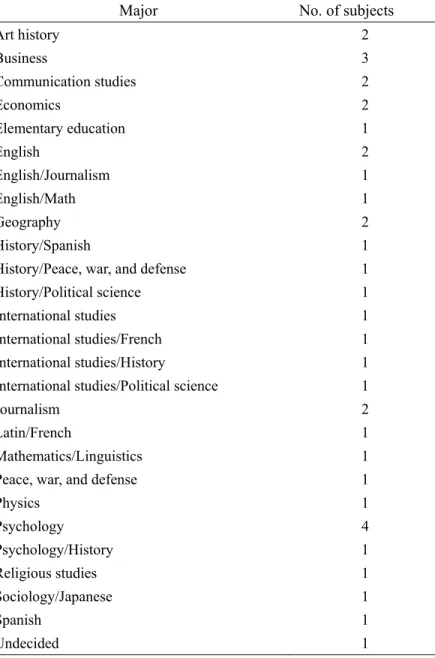
COMPLEX TASK GROUPS ... 96 TABLE 2. SUBJECTS’ MAJOR AREAS OF STUDY ... 97 TABLE 3. SUBJECTS’ SPATIAL VISUALIZATION ABILITY ... 98 TABLE 4. FREQUENCY OF SEARCHING FOR MEDICAL INFORMATION
ONLINE ... 99 TABLE 5. INFORMATION SOURCES FOR MEDICAL INFORMATION ... 99 TABLE 6. SUBJECTS’ ASSESSMENTS OF TASK DIFFICULTY, MENTAL
EFFORT, AND SATISFACTION WITH PERFORMANCE FOR TASK
SET 1 (MEAN RATINGS) ... 102 TABLE 7. SUBJECTS’ ASSESSMENTS OF TASK DIFFICULTY, MENTAL
EFFORT, AND SATISFACTION WITH PERFORMANCE FOR TASK
SET 2 ... 103 TABLE 8. TIME FOR COMPLETING TWO SETS OF TASKS ... 104 TABLE 9. USERS’ PERCEPTIONS OF THE SYSTEM AFTER SESSION 1 AND
AFTER SESSION 2 (MEANS AND STANDARD DEVIATIONS IN
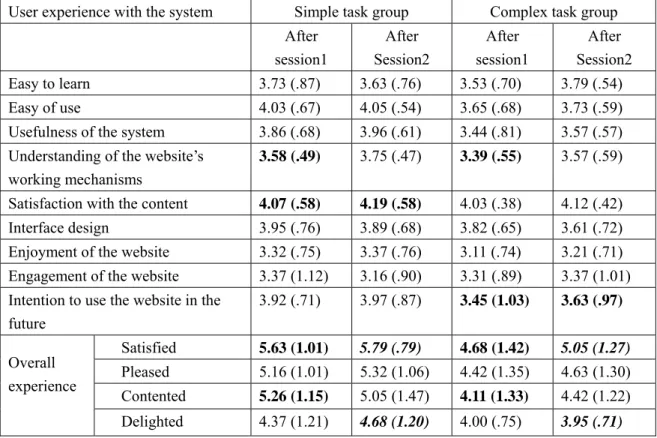
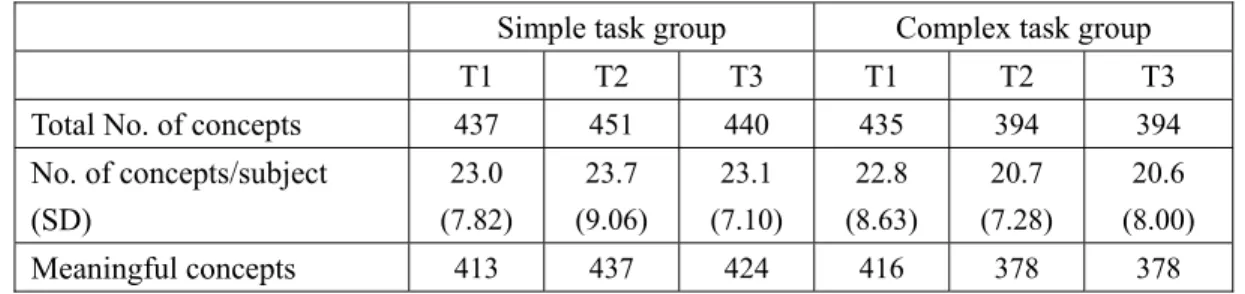
EACH COLUMN) ... 106 TABLE 10. DESCRIPTIVE STATISTICS FOR CONCEPT LISTING PROTOCOLS ... 118 TABLE 11. NUMBER OF CONCEPTS IN EACH COMPONENT OF THE
STRUCTURE DIMENSION OF SUBJECTS’ MENTAL MODELS OF
MEDLINEPLUS OVER TIME ... 136 TABLE 12. NUMBER OF CONCEPTS IN EACH COMPONENT OF THE
EVALUATION/EMOTION DIMENSION OF SUBJECTS’ MENTAL
MODELS OF MEDLINEPLUS OVER TIME ... 140 TABLE 13. SEARCH STRATEGIES TO BE USED FOR SOLVING THE
HYPOTHETICAL TASK FOR THE TWO GROUPS AT T1, T2, AND T3 ... 144 TABLE 14. EXPECTED USE OF SEARCH STRATEGIES A, B AND C FOR THE
TABLE 15. SUBJECTS’ REPRESENTATIONS OF MEDLINEPLUS AS AN
INTEGRATED SYSTEM AT T1 ... 151 TABLE 16. SUBJECTS’ REPRESENTATIONS OF MEDLINEPLUS AS AN
INTEGRATED SYSTEM AT T2 ... 155 TABLE 17. SUBJECTS’ REPRESENTATIONS OF MEDLINEPLUS AS AN
INTEGRATED SYSTEM AT T3 ... 158 TABLE 18. SUBJECTS’ REPRESENTATIONS OF THE SYSTEM COMPONENT
OF THE STRUCTURE DIMENSION AT T1, T2, AND T3 ... 161 TABLE 19. EVALUATIONS AND EMOTIONS ABOUT THE SYSTEM
COMPONENT OF SUBJECTS’ MENTAL MODELS OF
MEDLINEPLUS AT T1 ... 168 TABLE 20. EVALUATIONS AND EMOTIONS ABOUT THE SYSTEM
COMPONENT OF SUBJECTS’ MENTAL MODELS OF
MEDLINEPLUS AT T2 ... 171 TABLE 21. EVALUATIONS AND EMOTIONS ABOUT THE SYSTEM
COMPONENT OF SUBJECTS’ MENTAL MODELS OF
MEDLINEPLUS AT T3 ... 173 TABLE 22. SUBJECTS’ EVALUATIONS OF AND EMOTIONS ABOUT THE
SYSTEM COMPONENT AT T1, T2, AND T3 ... 174 TABLE 23. SUBJECTS’ REPRESENTATIONS OF INFORMATION TYPE,
FORMAT, AND PRESENTATION IN MEDLINEPLUS AT T1 ... 182 TABLE 24. SUBJECTS’ REPRESENTATIONS OF INFORMATION TYPE,
FORMAT, AND PRESENTATION IN MEDLINEPLUS AT T2 ... 187 TABLE 25. SUBJECTS’ REPRESENTATIONS OF INFORMATION TYPE,
FORMAT, AND PRESENTATION IN MEDLINEPLUS AT T3 ... 193 TABLE 26. SUBJECTS’ REPRESENTATIONS OF THE CONTENT COMPONENT
AT T1, T2, AND T3 ... 194 TABLE 27. SUBJECTS’ EVALUATIONS OF AND EMOTIONS ABOUT THE
CONTENT OF MEDLINEPLUS AT T1 ... 202 TABLE 28. SUBJECTS’ EVALUATIONS OF AND EMOTIONS ABOUT THE
TABLE 29. SUBJECTS’ EVALUATIONS OF AND EMOTIONS ABOUT THE
CONTENT OF MEDLINEPLUS AT T3 ... 211 TABLE 30. SUBJECTS’ EVALUATIONS OF AND EMOTIONS ABOUT THE
CONTENT COMPONENT AT T1, T2, AND T3 ... 214 TABLE 31. SUBJECTS’ REPRESENTATIONS OF INFORMATION
ORGANIZATION IN MEDLINEPLUS AT T1 ... 221 TABLE 32. SUBJECTS’ REPRESENTATIONS OF THE INFORMATION
ORGANIZATION IN MEDLINEPLUS AT T2 ... 222 TABLE 33. SUBJECTS’ REPRESENTATIONS OF THE INFORMATION
ORGANIZATION IN MEDLINEPLUS AT T3 ... 223 TABLE 34. SUBJECTS’ EVALUATIONS OF AND EMOTIONS ABOUT
INFORMATION ORGANIZATION AT T1 ... 224 TABLE 35. SUBJECTS’ EVALUATIONS OF AND EMOTIONS ABOUT
INFORMATION ORGANIZATION AT T2 ... 225 TABLE 36. SUBJECTS’ EVALUATIONS OF AND EMOTIONS ABOUT
INFORMATION ORGANIZATION AT T3 ... 226 TABLE 37. SUBJECTS’ REPRESENTATIONS OF THE INTERFACE OF
MEDLINEPLUS AT T1 ... 231 TABLE 38. SUBJECTS’ REPRESENTATIONS OF THE INTERFACE OF
MEDLINEPLUS AT T2 ... 233 TABLE 39. SUBJECTS’ REPRESENTATIONS OF THE INTERFACE OF
MEDLINEPLUS AT T3 ... 236 TABLE 40. SUBJECTS’ REPRESENTATIONS OF THE INTERFACE
COMPONENT AT T1, T2, AND T3 ... 238 TABLE 41. SUBJECTS’ EVALUATIONS OF AND EMOTIONS ABOUT THE
INTERFACE OF MEDLINEPLUS AT T1 ... 244 TABLE 42. SUBJECTS’ EVALUATIONS OF AND EMOTIONS ABOUT THE
INTERFACE OF MEDLINEPLUS AT T2 ... 246 TABLE 43. SUBJECTS’ EVALUATIONS OF AND EMOTIONS ABOUT THE
TABLE 44. SUBJECTS’ EVALUATIONS OF AND EMOTIONS ABOUT THE
INTERFACE COMPONENT AT T1, T2, AND T3 ... 253 TABLE 45. HEURISTICS FOR USING MEDLINEPLUS AT T2 ... 260 TABLE 46. HEURISTICS FOR USING MEDLINEPLUS AT T3 ... 263 TABLE 47. SUBJECTS’ SELF-REFLECTIONS ON THEIR EXPERIENCE OF
USING MEDLINEPLUS AT T2 ... 265 TABLE 48. SUBJECTS’ SELF-REFLECTIONS ON THEIR EXPERIENCE OF
USING MEDLINEPLUS AT T3 ... 266 TABLE 49. SUBJECTS’ REPRESENTATIONS OF THE COMPONENTS OF THE
STRUCTURE DIMENSION ... 273 TABLE 50. SUBJECTS’ REPRESENTATIONS OF THE COMPONENTS OF THE
EVALUATION/EMOTION DIMENSION ... 274 TABLE 51. MENTAL MODEL FRAMEWORK TO BE USED AS A TOOL FOR
List of Figures
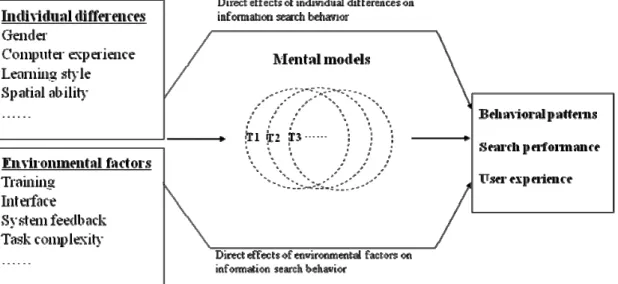
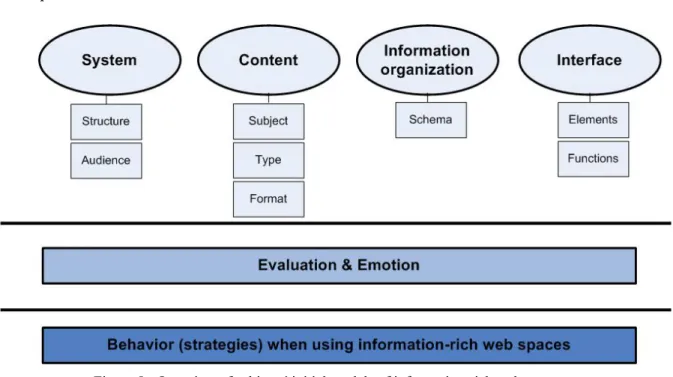
FIGURE 1. THEORETICAL FRAMEWORK ... 65
FIGURE 2. MEDLINEPLUS HOMEPAGE ... 77
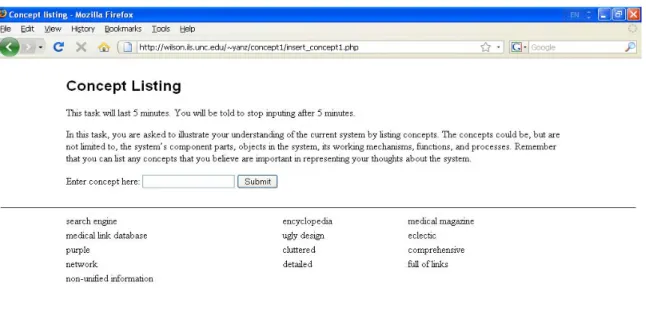
FIGURE 3. DATA COLLECTION PROGRAM FOR CONCEPT LISTINGS ... 82
FIGURE 4. RESEARCH PROCEDURE ... 86
FIGURE 5. OVERVIEW OF SUBJECTS’ INITIAL MODELS OF INFORMATION-RICH WEB SPACES ... 115
FIGURE 6. OVERVIEW OF SUBJECTS’ MENTAL MODELS OF MEDLINEPLUS AT T1 ... 123
FIGURE 7. OVERVIEW OF THE SIMPLE TASK GROUP’S MENTAL MODELS OF MEDLINEPLUS AFTER SESSION 1 (T2) ... 127
FIGURE 8. OVERVIEW OF THE COMPLEX TASK GROUP’S MENTAL MODELS OF MEDLINEPLUS AFTER SESSION 1 (T2) ... 128
FIGURE 9. OVERVIEW OF THE SIMPLE TASK GROUP’S MENTAL MODELS OF MEDLINEPLUS AFTER SESSION 2 (T3) ... 131
FIGURE 10. OVERVIEW OF THE COMPLEX TASK GROUP’S MENTAL MODELS OF MEDLINEPLUS AFTER SESSION 2 (T3) ... 132
FIGURE 11. THE CONTENT COMPONENT OF SUBJECTS’ MENTAL MODELS AT T1 ... 180
FIGURE 12. (A) THE CONTENT COMPONENT OF THE SIMPLE TASK GROUP’S MENTAL MODELS AT T2; (B) THE CONTENT COMPONENT OF THE COMPLEX TASK GROUP’S MENTAL MODELS AT T2 ... 184
Chapter 1 Introduction
Mental models theory is a psychological theory that has been widely employed to explore people’s cognitive processes involved in their use of mechanical or computer systems. It is generally accepted that mental models help people understand a system, navigate through the system, and predict the system’s behavior in future instances (Norman, 1983). Therefore, in the fields of human-computer interaction (HCI) and interactive
information retrieval (IIR), research on mental models is expected to inform the design of information systems that are easy to use, intelligent in supporting users to form an
appropriate understanding of the system, and effective in reducing unnecessary human errors.
Being dynamic is a feature that characterizes mental models. However, one common limitation of the existing studies is that they treat mental models as a static construct. Recognizing this problem, this study focused on exploring the dynamic processes of users constructing mental models of an IR system. Through this investigation, the usefulness of mental models as a theoretical construct and as a practical method or tool for system design was reexamined. To fulfill this purpose, this study investigated two themes: (1) the
dynamic process of users constructing mental models of an information-rich web space during a search session, and (2) the impact of a major contextual factor, task complexity, on the model construction.
Examining the construction process of mental models will reveal whether people’s mental models change over time and what types of changes they undergo, what aspects of the system can be easily represented and what aspects cannot. Such knowledge could be a particularly rich source for generating practical implications for system design, user modeling, and user instruction. The decision to focus on mental models construction in a short time period corresponds to the phenomenon that, in the web environment, people do not want to spend a long time figuring out the details about an IR system. If they cannot find the needed information quickly, they give up on the system. Therefore, knowledge about the development of people’s mental models during such a short time is valuable for web-based system design.
people’s information searching behavior. Examining the impact of task complexity on the construction of mental models of a system places the investigation of mental models construction in a context of specific tasks.
As noted above, an information-rich web space, a special type of IR system, was used as the platform for this study. Information-rich web spaces are websites that contain a large amount of information (often thousands or millions of web pages) in a particular domain or across domains, such as wikipedia, aclu.org, and the Internet Movie Database.
Information-rich web spaces are of interest because they are becoming more and more pervasive on the web. As the web keeps expanding, government agencies, military organizations, and companies are looking more and more to such hypermedia-based solutions for disseminating information (Farris, Jones, & Elgin, 2002). Meanwhile, this type of website has different structures and encourages different search strategies than traditional IR systems, and so requires additional investigation (Shneiderman, 1997).
Chapter 2: Literature review
This chapter reviews mental models from various aspects. It begins with a discussion of how mental models have been defined within psychology. Next, the application of mental models in HCI is discussed. Then, we focus on the research on mental models of IR systems, followed by a review of techniques that have been used to elicit users’ mental models and to explore the effects of mental models on people’s information search behavior. This chapter ends with a review of the roles of two variables, spatial ability and task
complexity, in people’s interactions with IR systems, which establishes the rationale for controlling subjects’ spatial ability and exploring the impacts of task complexity on their mental models in the current study.
2.1
Mental models in psychology
2.1.1 Mental models in logical reasoning and language comprehension
The term “mental model” was coined by Craik in his 1943 book, The Nature of
reasoning and fallacies that occurred in the reasoning.
Cognitive psychologists have traditionally argued that people employ formal inference
rules, such as:
If A then B
A
Therefore B
in their reasoning (e.g. Braine, 1978). When they fail to recover the correct logical form of the premises, or fail to construct a mental derivation of the conclusion, they make errors. However, this formal logic argument ignores the influence that the semantic meaning of premises has on people’s cognitive reasoning (Byrne, 1992). Research in decision making has consistently shown that, when the content of an abstract logical inference is substituted with real-life content, subjects’ decision accuracy rate increases (e.g., Stanovich, 1999).
To account for the influence of meaning in logical reasoning, Johnson-Laird (1983) proposed that, instead of employing formal logic, people construct mental models to understand and interact with the external world. A mental model is “a representation of the way the world would be if the premises were true” (Byrne, 1992: 12). Based on this
constructed of the premises; and they make errors when they fail to consider all the
possible models of the premises. This proposal is supported by the empirical evidence that the fewer models of the premises that need to be constructed, the fewer errors people make in an inference (Johnson-Laird, Byrne, & Schaeken, 1992).
An example extracted from Byrne (1992) illustrates the role of mental models in deductive reasoning. To make the inference:
If there is a triangle then there is a circle
There is not a circle
Therefore, there is not a triangle
Based on the mental model theory, the meaning of the conditional premise is represented by a set of models:
The first conditional premise is represented as: [∆] o The second conditional premise is represented as: ¬ o
To make the correct inference, the models must make explicit the alternative states of affairs. The fully fleshed-out models for the premise are:
∆ o ¬ ∆ o ¬ ∆ ¬ o
When the information from the second premise is added to this set of models, the models with a circle are eliminated, which leaves the third model:
¬ ∆ ¬ o
Mental model theory also helps explain the cognitive processes of language comprehension. Unlike other psychological approaches, which “emphasize the words themselves, as entries in a mental dictionary, as linked semantic entities, or rules for specifying relations between words” (Ehrlich, 1996: 224), mental models theory
emphasizes the content of the words, and asserts that people construct mental models based on the content (Wason & Johnson-Laird, 1972). Meanwhile, mental models share a similar relation-structure to that of the reality they imitate (Johnson-Laird, 1983). Both the
semantic and structural similarity of mental models to reality enables people to derive meanings from mental models. Johnson-Laird (1981: 117) has stated that:
The psychological theory of meaning that I wish to advance assumes that the mental representation of a sentence can take the form of an internal model of the state of affairs characterized by the sentence.
2.1.2 Mental models in representing domain knowledge
phenomena, while another argues that people possess only fragmented knowledge which by nature is a set of loosely connected ideas (Roger, 1992).
Unlike Johnson-Laird’s concept of mental model, which has been addressed primarily as a temporary structure in short term memory in the process of carrying out an inference, Gentner and Steven’s concept of a mental model was mainly examined as a permanent knowledge structure stored in long-term memory (Byran, 1992).
In summary, the concept of mental models has been discussed at two levels in psychology: the knowledge representation level and the inference and decision making level. At the knowledge representation level, a mental model “mirrors” the perceived structure of the external system being modeled (Johnson-Laird, 1983), so that meaning can be derived from actual states of affairs as they exist in the world. At the inference and reasoning level, because mental models are simplified and incomplete versions of reality, running mental models is less cognitively demanding. As a result, people can make inferences about the world efficiently.
2.1.3 Schemata, Scripts, and Frames
2.1.3.1 Schemata
Schemata are regarded as building blocks of cognition and fundamental elements upon which all information processing, such as perception, comprehension, remembering, learning, and problem solving, depends (Rumelhart, 1980). Rumelhart and Ortony (1977:101) defined schemata (the singular is schema) as:
data structures for representing the generic concepts stored in memory. They exist for generalized concepts underlying objects, situations, events, sequences of events, actions, and sequences of actions. Schemata are not atomic. A schema contains, as part of its specification, the network of
interrelationships that is believed to generally hold among the constituents of the concept in question. Schemata, in some sense, represent stereotypes of these concepts.
A schema has a set of prescribed variables and relationships between the variables. For example, the buy schema involves five variables: purchaser, seller, money, merchandise, and bargaining and the relationships between the five variables. The variables in a schema could have different values in different instances, but the structure of the schema is stable. Schemata could be organized in hierarchical structures or in network structures (Rumelhart, 1980).
When people apply an inappropriate schema to the current situation, the schemata might distort information (Grunig, Ramsey, & Schneider, 1985).
2.1.3.2 Scripts
The concept of scripts was proposed in Artificial Intelligence (AI) for computer simulation of human beings’ intellectual activities, such as comprehending semantic meanings of texts, or making decisions in a specific situation. In a script, tasks of understanding are often broken into discrete and serially executed components that are suitable for computer modeling and processing (Schank, 1999). Schank and Abelson (1977) defined that:
A script is a structure that describes appropriate sequences of events in a particular context. A script is made up of slots and requirements about what can fill those slots. The structure is an interconnected whole, and what is in one slot affects what can be in another. Scripts handle stylized everyday situations. They are not subject to much change, nor do they provide the apparatus for handling totally novel situations. Thus, a script is a predetermined, stereotyped sequence of actions that defines a well-known situation.
restaurants. In some script applications, plans and goals are used in parallel with scripts as high-level structures to control understanding (Carbonell, 1979; Wilensky, 1978).
Similar to computers retrieving information from hard disks, people retrieve a script through indexes. A script is called into play by triggering script headers. In the restaurant example, the headers for the restaurant script are concepts related to hunger, restaurants, and so on in the context of planning actions for getting fed (Schank & Abelson, 1977).
2.1.3.3 Frames
A frame is also a data structure that has been proposed for computer simulation of human beings’ intellectual activities. Minsky (1975) proposed that, to account for the effectiveness of common sense thoughts, the “chunks” of reasoning, language, memory, and perception must be very structured. Within these chunks, the factual and procedural contents must be “intimately connected in order to explain the power and speed of mental activities” (Minsky, 1975: 211). He proposed the concept of a frame to represent these mental “chunks”:
A frame is a data structure for representing a stereotyped situation, like being in a certain kind of living room, or going to a child’s birthday party. Attached to each frame are several kinds of information. Some of this information is about how to use the frame. Some is about what one can expect to happen next. Some is about what to do if these expectations are not confirmed.
things that are always true about an entity or a situation; whereas the lower level nodes represent features that are less essential. Each node has one or more default values. With these default values, frames are able to fill in additional information that is not explicitly encoded in the current situation to help people generate expectations for the situation (Wilson & Rutherford, 1989). Once a frame is selected to represent a situation, a matching process is initiated to assign values to the nodes of the frame. When the selected frame cannot fit the reality (or the current goal), a replacement frame will be initiated.
In the literature, no clear lines have been drawn between the three concepts: schemata, scripts, and frames. They were used in an interchangeable manner. Rumelhart (1980) pointed out that the three concepts are so closely related that a discussion of any of one of them will serve as an introduction to the others. Also, historically, the terms were closely related. Minsky (1975) has partially credited the idea of frame to Bartlett (1932), and Rumelhart (1975) has attributed the term schema to Bartlett, as well. Although Schank and Abelson (1977) used the term “scripts”, they pointed out simultaneously that such
structures have been called “frames” and “schemata”.
2.1.4 Mental models and schemata
dynamically, thus giving mental models superior explanatory power over schemata, scripts, and frames, which only provide related background knowledge for the current situation.
Nevertheless, mental models are closely related to schemata. Most researchers believe that mental models arise from schemata and are the running mode of schemata. Rumelhart (1984) described a mental model as the total set of schemata instantiated at the time. Johnson-Laird (1983) suggested that schemata provide the procedures from which mental models are constructed. Norman and Bobrow (1979) contended that schemata are data structures in memory, whereas mental models are the utilization of such information in a computationally dynamic manner. Brewer (1987) held a similar view.
Despite the effort to differentiate mental models from schemata, it is hard to draw a clear line between them (Wilson & Rutherford, 1989). Johnson-Laird (1983) admitted that the issue of the distinction between mental models and schemata was not strictly resolvable, since the set of all possible schemata and the set of all possible mental models have not been specified.
2.1.5 Mental imagery: the form of mental models
There is a continuous debate, known as the “analogy-propositional” debate, about the nature and form of human beings’ mental experience. The analogy school argued that mental imagery is a distinct, pictorial, and non-language-like form of representation (e.g., Kosslyn, 1994). The propositional school argued that mental representations are
Later on, some researchers proposed that there are two separate cognitive subsystems, the imagery system specialized for the representation and processing of information
concerning nonverbal objects and events, and the verbal system specialized for dealing with language (Paivio, 1986).
Mental models are essentially one type of mental representation, and thus cannot escape the picture-description debate surrounding mental imagery. In mental models studies, some researchers have asserted that mental models may be non-verbal, pictorial, or image-like (Rouse & Morris, 1986); and mental models are spatially arrayed corresponding to their real-life counterparts (Doyle & Ford, 1998). Other researchers have argued that mental models might be propositional representations (Wilson & Rutherford, 1989). Consistent with the dual processing theory, Glenberg and Langston (1992) contended that the elements in mental models point to both propositional and spatial information in long-term memory.
2.1.6 Situated cognition: alternative approaches to mental models
As a form of mental representation, mental models are inevitably challenged by the difficulties associated with the fundamental question of cognitive science: how does the mind work? To use mental models theory as a paradigm for HCI and IR research, it must be assumed that the mind works by constructing a representation of the world, either in
Recently, alternative approaches to this symbolic computational theory of cognition, including “dynamical systems theory” and “situated” or “embodied” cognition, have emerged. These alternative approaches call into question the basic assumption of the computational cognitive theory that mental contents are represented in computational units (data structures), and manipulated in the cerebral computer (Pylyshyn, 1999; Thelen & Smith, 1994). Related work on both robotic and human vision also has suggested that perception is best understood as ongoing, directed exploratory activity, rather than as the processing of sensory input into a detailed inner representation (Landy et al., 1996; O’Regan & Noe, 2001).
2.2
Mental models in HCI
2.2.1 Mental models defined in HCI
In cognitive science, a mental model is a knowledge representation that supports cognitive reasoning and decision making. In HCI, the term, mental model, has been defined in the context of other models involved in HCI processes (Norman, 1983):
System conceptual model. A conceptual model provides an appropriate representation of the system. It is accurate, consistent, and complete.
System image. The system image is the look and feel of a system and is characterized by the display, the documentation, and system messages. System image is also called the
The users’ mental models of the system. Users’ mental models of the system represent how users understand the system and how they perceive the functions of the system.
Scientists’ conceptualizations of users’ mental models. How researchers perceive and represent users’ mental models of the system.
System’s model of the user. The system’s model of the user is the model constructed inside the system of the user as it runs through different sources of information such as profiles, user settings, logs, and even errors (Fischer, 1991).
Since Norman’s denotation, it has been widely accepted that mental models refer to mental representations that users employ to understand and further operate the system (Brehmer, 1987; Conant & Ashby, 1970; Halasz & Moran, 1983; Norman, 1986). Within this scope, mental models have been defined further from different perspectives with different focuses and degrees of specificity. Rouse and Morris (1986: 351) defined that:
Mental models are the mechanisms whereby humans are able to generate descriptions of system purpose and form, explanations of system functioning and observed system states, and predictions of future system states.
Another widely recognized definition of mental model was proposed by Carroll and Olson (1988: 51):
The user’s mental model of a system is a rich and elaborate structure, reflecting the user’s understanding of what the system contains, how it works, and why it works that way. It can be conceived as knowledge about the system sufficient to permit the user to mentally try out actions before choosing one to execute.
structure; whereas Carroll and Olson point out that the mental model is both a knowledge structure and a dynamic instrument that enables users to interact with a system. However, both definitions do not cover some important characteristics of mental models. For example, they do not define the structural features of mental models of computer systems. It has been widely agreed in cognitive psychology that the structure of a mental model “mirrors” the perceived structure of the external system being modeled (Doyle & Ford, 1997).
2.2.2 Types of mental models in HCI
Young (1983) proposed eight tentative views of a mental model of an interactive device: strong analogy, surrogate, mapping, coherence, vocabulary, problem space, psychological grammar, and commonality. The eight viewpoints are distributed on a continuum from assimilation to accommodation. Models at the assimilatory end (e.g., strong analogy models) tend to view the device in terms of its relationships to other systems that have been familiar to the user. At the accommodatory end, the emphasis is more on an understanding of the device in its own right.
Young (1983) elaborated on two kinds of mental models – surrogates and task-action mapping – based on his research on people’s use of pocket calculators. A surrogate model is defined as a simulator of the target device, accounting for the device’s working
task/action model encompasses a core set of corresponding relationships between tasks and actions. New tasks are expressed as variants of the core tasks. Sequences of actions
corresponding to the new tasks are derived from the core actions that correspond to the core tasks.
diSessa (1986) distinguished between structural and functional models in terms of contextual specificity. Structural models contain information about the internal structure of the system and the models are independent of specific tasks. There is only one structural model for the system and it is universally applicable. Functional models contain
information about how to use a selected set of functionality to perform a specific task. The functional models are task related and reflect the relationship between goals and means.
diSessa (1986) pointed out that his structural model is similar to Young’s surrogate model. Both models focus on representing the structure of the system without considering contextual variables, such as tasks. The isolation from context limits their power to direct users to accomplish certain tasks. diSessa’s functional models are similar to Young’s task/action model. Both are rule-based models that represent the mapping between tasks and actions to achieve the tasks. The dual structural and functional aspects of mental models are acknowledged by Nielsen (1990) and supported by Marchionini’s (1989a) empirical study on students’ use of print and electronic encyclopedias.
organized around a single, coordinating principle or metaphor but instead consists of a number of distinct facts or (causal) explanations about the object it describes. The facts or explanations are accumulated through experience (Nielsen, 1990). These partial or
fragmented models serve as foundations for users to rationalize variations of constructs that they encounter while using the system.
Carroll and Olson (1988) divided mental models into three separate categories: surrogate models, metaphors, and “glass box” machines (Duboulay, O’Shea, & Monk, 1981). A surrogate model is identical to the surrogate model proposed by Young (1983). A metaphor model is a direct comparison between the target system and some other systems already known to the user. It is very similar to Young’s strong analogy model. A typical example is “a text editor is a typewriter”. Glass box models lie in between surrogates and metaphors. They are mimics of the target system, offering a semantic basis for
understanding the system, as do metaphors.
Rasmussen (1979, 1986) developed a taxonomy of mental models of systems. His taxonomy includes five types of models, moving from concrete to abstract: physical form, physical function, functional structure, abstract function, and functional meaning or purpose. Based on Rasmussen’s taxonomy, Rouse and Morris (1986) proposed that mental models could represent a system purpose (why a system exists), function (how a system operates), state (what a system is doing), or form (what a system looks like).
of models people use to reason about systems, the limits on the complexity of the models, and the interplay of multiple models in users’ learning and performance (Riley, 1986). However, some researchers have pointed out that classifying an abstract concept like mental models could be artificial and misleading because the models represent the same reality (Johnson-Laird, 1989).
2.2.3 Characteristics of mental models in HCI
Incompleteness is an inherent feature of mental models (Norman, 1983). A mental model’s content is only a partial representation of the environment and its scope is limited (Sanderson, 1990). It is worth noting that incompleteness is not necessarily a shortcoming of mental models. Keeping the model to a manageable size grants mental models cognitive feasibility in people's information processing, because human beings’ memories and processing capabilities are limited. Many studies provide empirical evidence for the incompleteness of mental models. For example, Makri et al. (2007) found that students developed rudimentary mental models of the digital libraries that they access. Their understanding of the system was limited.
the speculated mechanisms. There is also a tendency for users to establish causal
relationships based on co-occurrence of events, even though the co-occurrence might be random and for reasons that differ from the ones believed by the user (Besnard, Greathead, & Baxter, 2004).
Mental models often involve misconceptions or errors (Young, 1983). For example, Bayman and Mayer (1983) found that, in learning a programming language, novice users tended to develop conceptions of the statements that either failed to include the main idea or that included misconceptions. Misconceptions have also been found in people’s mental models of the Internet (Papastergiou, 2005) and Web search engines’ query processing mechanisms (Muramatsu & Pratt, 2001).
It has been postulated that mental models allow users to predict the status and feedback of an interactive system, as well as to plan methods for novel tasks (Card & Moran, 1986). If this postulation is true, a mental model has to be dynamic, that is, to be able to “run” in response to environmental changes. “Running” a model is a dynamic process of building, trying out, and changing the mental model (Ehrlich, 1996). Being able to “run” is a key feature that distinguishes mental models from other static knowledge structures, such as schemata and scripts.
same operations even when the system behaves abnormally (Chen & Dhar, 1991). People’s limited ability to construct and run a model is also reflected in people’s inclination to trade off extra physical actions for less cognitive effort. Sasse (1997), for instance, found that subjects tended to specify their own formulae instead of using system built-ins when they use MS Excel.
Mental models do not have firm boundaries. People’s existing mental models of one domain may influence the construction of their mental models of another domain. Norman (1983) observed people who had experience with several different calculators and found that they tended to mix up the features of different calculators. They were often unsure which feature applied to which calculator and had various superstitions about the operation of the calculator. In some cases, the existing models can be easily transferred to a new domain. Marchionini (1989a) found that some students were able to adapt their mental models of the print encyclopedia and further developed distinct mental models for the electronic encyclopedia.
In most studies, mental models were discussed as if they were single entities (Staggers & Norico, 1993). Yet some authors have postulated the possible existence of multiple mental models (e.g., Borgman, 1984; deKleer & Brown, 1983; Moray, 1987). The use of multiple models is affected by the complexity of the task and the complexity of the
system/device itself. For example, Williams, Hollan, and Stevens (1983) found that
model. Neither model individually can fully explain the behavior of the device.
2.2.4 Utility of mental models
Research has demonstrated that mental models help people learn a new system and further use the system in a more productive way. Meanwhile, mental models are able to communicate system design parameters to help designers produce more usable and enjoyable computer systems and to facilitate user training (Wahlström, 1988).
2.2.4.1 Learning a new system
Mental models’ role in learning and using a new device has been demonstrated by some early experimental studies in HCI. In these studies, participants are usually divided into two groups. One group (model group) receives training that emphasizes the conceptual model of a system. Members in the group are then assumed to develop mental models of the system. The other group (procedure group) receives only procedural knowledge of how to use the system. Performance of the two groups is then compared to illustrate the impact of mental models. For instance, in a study investigating people’s use of calculators, Halasz and Moran (1983) found that, although there were no differences between the groups in their accuracy of solving routine or even some complex problems, the conceptual model group did outperform the procedural group when it came to solving problems that require the invention of new methods and more cognitively intense problem-solving.
model group learned the procedures more quickly, retained the knowledge more accurately, and used it more adaptively than the rote learners (who were only taught the procedures of operating the device). Furthermore, the model group was able to infer the procedures from the conceptual model of the device. To exclude the possibility that the model group
outperformed the procedure group because they were given more information, Kieras and Bovair conducted another experimental study, demonstrating that simply giving more information was not a sufficient condition for improving performance. Specific information about the device topology and functioning is essential to support direct inferences about the behavior of the device.
Fein, Olson, and Olson (1993) extended Kieras and Bovair’s effort to look at whether a mental model provides benefit to users learning and operating a complex device. They created three groups by imposing three training conditions: rote, explicit model, and full model. Test results showed that both the model groups outperformed the rote group on time spent on tasks, success rate on retrieval tasks, and success rate on transfer tasks.
mental model provides a stable and robust basis for such an understanding. Bibby (1992) echoed Brown’s argument by stating that knowledge of the deep structure of a system that a mental model encompasses enables users to reason about the functioning of a device. Thus, mental models serve as a basis for taking sensible actions during the interaction with a system.
2.2.4.2 Improving efficiency of problem solving
Mental models not only help users learn to use a new system, but also help users who have had experience with a system understand the system at a more abstract level and use the system in a more efficient manner. This utility is reflected in a large number of studies on strategic differences between novice and expert users of a system. In these studies, all subjects had experience with the target system, while some had more sophisticated mental models than the others. For example, by interviewing and observing five nursing PhD students using the SPSSX statistical package, Staggers and Norcio (1993) found that novice users have a limited knowledge repository and repertoire of problem solving strategies. They tended to depend on notes when performing tasks. Expert users, however, were well organized and confident. They used trial-and-error strategies to solve emerging problems.
To explore the effects of mental models on users’ behaviors when using Excel
whereas the other group (main group) gave a purely procedural introduction to the system. The two groups also showed different behaviors; subjects in the main group tended to trade off physical efforts against cognitive efforts by specifying their own formulae instead of using system built-ins.
Dimitroff (1992) conducted a study to examine the relationship between users’ mental models of an online library catalog and their success in using the system. She found that the completeness of mental models had a clear impact on users’ searching performance.
Students with more complete mental models made significantly fewer errors and found significantly more items. Observing public library users using the Web and/or a Web based library catalog, Slone (2002) found that users’ mental models affected their search
approaches, Web sites visited, and sources used. Users with immature mental models of the Internet relied more heavily on the online catalog and off-line sources.
2.2.4.3 Enhancing a system’s usability
Hammond et al. (1983) interviewed software designers and found that, in making certain decisions, designers rely on some “psychological theories” of the user and user performance. Providing them with some type of user model is a better way to improve interface design than context-free design guidelines or task-action analysis methods, such as GOMS, a design tool representing a set of tasks as Goals, Operators, Methods, and Selection rules of a particular system (Card, Moran, & Newell, 1983).
their study of game playing, Graham, Zheng, and Gonzalez (2006) demonstrated mental models’ potential in improving game playability and usability. In the study, they observed that, when playing a real-time strategy game, a player’s first experience is based on the available mental models of the surface characteristics of the environment. As experience increases, they tend to move away from these surface characteristics. Based on this phenomenon, the authors proposed that mental models are a good descriptor of users and mental model shifts might serve as a benchmark for designing game progression.
Weaknesses in users’ mental models can guide system developers in coming up with designs that are able to reduce unnecessary human errors. It is well documented that, when an error occurs, users often do not analytically explore the environment and accordingly update their mental models. Rather, they persistently try to fit data to their existing models and reject any information that is not consistent with their expectations (e.g., Norman, 1988). This phenomenon is termed “cognitive lockup” or “confirmation bias”. It has been suggested that intelligent display and decision aids can be designed to overcome this shortcoming so as to facilitate users’ recovery from errors (Besnard, Greathead, & Baxter, 2004; Moray, 1987).
Although taking users’ mental models into consideration during the software design process is theoretically appealing, completely relying on mental models could be
Wright and Bason (1982) constructed a data analysis software package based on users’ specifications of their problems. Meanwhile, they constructed the same system based on system designers’ reinterpretation of the problems. They found that bending the system to the preconceptions of the user is not necessarily the most viable approach. The design based on designers’ reinterpretation sometimes provided more expedient operational routes that turned out to be acceptable to end users.
2.2.4.4 Facilitating user training
It is very common for users to develop misconceptions about a system and it is often hard for users to jump out of fallacies (e.g., Norman, 1988). In their investigation of programmers’ misconceptions of BASIC programming, Bayman and Mayer (1983) concluded that explicit training, including the introduction of a concrete model of
computers and key transactions for each statement, is needed to encourage users to develop an appropriate mental model of the behavior of the programming language. For many complex systems, training is necessary for efficient operation, even when the system usability has been achieved. For example, Borgman (1996) proposed that current library online catalog systems can be made more effective through training that provides users with a conceptual framework rather than a set of procedures for searching.
design of better training or teaching materials. For example, in their investigation of the use of a phone system, Hanisch, Framer, and Hulin (1991) pointed out that instructional aids and training programs should stress features that are likely to be misperceived by users and take into consideration the discrepancies between novices’ and experts’ representations of the system.
2.2.4.5 User modeling
User models are a system’s representation of the characteristics of its users (Allen, 1997; Fischer, 2001). The process of creating and maintaining an up-to-date user model by a system is known as user modeling (Brusilovsky & Millan, 2007). User modeling allows a system to be adaptive to users’ current status in knowledge or preferences so as to create a friendlier computing environment for the user. Different information sources could
contribute to user model construction: the user’s domain knowledge, interests, goals, background, individual traits (e.g., cognitive styles and learning styles), the user’s actions or action patterns (e.g., document reading, saving and printing), and the context of the work (e.g., computer platform and user location) (Kelly & Belkin, 2002; Kobsa, 2001).
subjects’ real-time mental models of the game and further used the mental models to direct the progression of the game.
A major challenge in developing effective adaptive systems is that the adaptive
behavior of a system empowered by user models may cause disruptions to the user’s mental models of the system, therefore causing difficulties for the user in performing certain tasks. Knowledge about mental models can be employed to reduce such disruptions. For example, Hui, Partridge, and Boutilier (2009) proposed a probabilistic model to assess the amount of disruption of an adaptive system that changing function locations (in order to make access more convenient) has on the user’s mental models of the location of those functions.
2.3
Mental models in IR
The purpose of studying mental models of IR systems is twofold: (1) to understand the underlying cognitive processes of people’s behaviors while using IR systems, and (2) to use this understanding to design more usable systems and more effective instructional materials. Thus, mental models are usually not studied as an isolated concept in the ILS field. Their influence on people’s information searching behavior and performance is of particular interest to researchers (e.g., Borgman, 1984). In this section, what we know about mental models of IR systems will be reviewed from various aspects.
2.3.1 Content and structure of mental models
A mental model is an unobservable mental construct, which dynamically changes with the environment. This inherent feature of mental models prevents researchers from
illustrating them in a tangible fashion. Thus, the content and structures of mental models are often inferred from subjects’ verbal accounts, drawings, ratings on related concepts, or behaviors. The validity of these approaches is not conclusive; nevertheless, they provide useful insights to enhance our understanding of this fundamental issue in mental model research.
In a study of undergraduate students’ mental models of the web as an IR system, Zhang (2008b) identified that the mental models have four components: building elements
include elements like computers, modem, servers, webpages, various information subjects (e.g, psychology and biology), various functions supported by the Internet or the Web (e.g., shopping and entertainment), types of information (e.g., news, maps, and movies), end users, search engines, and so on. The structures of mental models often appeared as linear communications between computers or users, hierarchical organization of computers or information resources, or networked connections among servers, computers, users, and information sources. In some cases, mental models only included a collection of functions or information sources, without any structural organization.
In studying subjects’ use of an experiment IR system, Savage-Knepshield (2001) observed that subjects’ mental models of information retrieval is an integration of schemata and scripts. Schemata included task specific and system specific variables, such as ranked results, information seeking strategies, and goals. Also included were fixed IR components, such as a computer, search engine, query box, and retrieved results list. For example, one subject exhibited use of the following schema: search topic (Alzheimer’s disease), results (relevant), data (new, bad terms, good terms), and the ability to reformulate a query. When schemata are organized into “a temporally organized, well-structured sequence of events”, they form an instantiation of a script (Savage-Knepshield, 2001: 130).
system documentation and her own experience: contents of the database, interactive nature of the system, multiple files, multiple fields within each record, multiple indexes and/or inverted indexes, Boolean search capability, keyword search capability, and use of controlled vocabulary. The completeness of users’ mental models of the system was measured against the scale. Zhang (1997) arrived at nine essential concepts and three attributes of IR systems by consulting a group of experts. The nine concepts -- browsing, classification, data structure, document content, feedback, information need, interface, query, and search -- cover important components of an IR system. The three attributes: format/process, targeted/untargeted, and specific to IRs/applicable to all information systems, are three dimensions on which the concepts were judged. Subjects’ mental models of the testing system were then represented by their ratings on the concepts and attributes.
Efthimiadis and Hendry (2005) created a conceptual model for search as a benchmark for analyzing subjects’ mental models of web search engines. The model divided search into three phases with various processing components embedded in each phase:
Indexing (Components: content, spidering/crawling, parsing, inverted index creation, link analysis, and storage)
Searching (Components: user, user needs, query, and results)
Matching (Components: query processing, matching, accessing inverted file, and ranking).
this predefined scheme.
The assumption underlying this indirect approach is that users’ mental models of the IR system share both content and structure with the conceptual model. It is worth noting that this assumption is not necessarily correct. End users’ mental models might contain content that is not included or reflected in the predefined “normative” model. Users’ mental models may also exhibit different structures from the “normative” model. Evaluating users’ mental models against the predefined norms might miss some unique content or structures in subjects’ mental models.
2.3.2 Factors affecting mental models of IR systems
2.3.2.1 Individual differences
Users come to a particular system with different mental models and assumptions (Cooper, 1995; Marchionini, 1995; Tognazzini, 1992). These preexisting knowledge structures have significant effects on their mental models of an IR system. In their study of lostness in a hypertext system, Otter and Johnson (2000) identified a significant correlation between the accuracy of subjects’ mental models and their level of familiarity with
users. Nevertheless, it is worth pointing out that frequent use of a system is a necessary rather than a sufficient condition for detailed and complete models.
Other individual differences have effects on mental models, as well. Zhang (1997) found that users’ educational status and academic background were related to users’ mental models of an IR system. In studying users’ mental models of the web, Zhang (2008a) found that male subjects were more likely to have a technical view than female subjects, and conversely, female subjects were more likely to develop a process view of the web than male subjects. More research is needed to explore the effects of individual differences, such as age, learning style, and spatial ability, on users’ mental models of IR systems.
2.3.2.2 Environmental factors
Empirical studies showed that providing users with an explicit conceptual model of an IR system would enhance their ability to construct mental models of the system. For example, Savage-Knepshield (2001) found that subjects who were exposed to explanations of how the experimental IR system’s features operated were more likely to create
not able to develop an adequate mental model for interacting with an experimental IR system (Savage-Knepshield, 2001).
2.3.2.3 System images
Clear system feedback sometimes is more crucial than providing users with a conceptual model of the system (Norman, 1983; Savage-Knepshield, 2001). Muramatsu and Pratt (2001) reported that when subjects are provided with visible feedback about the opaque query transformation process of web search engines, it was easier for them to construct mental models of search engines in terms of query processing.
Savage-Knepshield (2001) observed that sometimes subjects’ mental models degrade over time when they are using a system. She attributed this mental models degradation to the unintuitive feedback that the system provides in response to the user’s actions.
2.3.3 Construction of mental models of IR systems
Savage-Knepshield (2001) described the formation of mental models based on previous knowledge as a top-down process: users come to the system with preexisting knowledge about IR. When using the system to conduct a specific task, their preexisting mental model for comparable tasks was elicited for modification. During the interaction with the system, they gradually added task-specific information and specific system features to their mental models of IR.
of new system features and tried to apply routine search behaviors in the new environment. The second pattern was combining old and new models of systems. Users with this pattern made partial use of the new system features, representing an incomplete model of the new system. The third pattern was effectively using new features provided by the new system. Users with this pattern were able to interact with the new system in ways supporting the formation of an accurate model of the system. This type of user tended to adapt to the new system environment more quickly (Cool et al., 1996; Marchionini, 1989a).
Katzeff (1990) provided an account of mental models construction process by analyzing subjects’ think-aloud protocols during their interactions with a commercial database. Three phrases/states of the mental model construction process were identified: construction, testing, and running. The three states do not necessarily occur sequentially. In the construction phase, the system’s feedback in response to the user’s input is interpreted by the user and then incorporated into his/her mental model of the system. The mental model formed by the user is then tested in the user’s further interactions with the system. If the model cannot explain the system feedback satisfactorily, the model will be rejected. At the running phase, the model is used to predict system feedback. Meanwhile, the model becomes sticky and users tend to interpret outcomes to suit the model.
2.3.4 Characteristics of mental models of IR systems
of an IR system (e.g., Dimitroff, 1991). Mental models are often simple, sometimes rudimentary (e.g., Papastergiou, 2005; Makri, et al., 2007). Mental models are not necessarily correct. They sometimes include misunderstandings of system relations or system functioning (e.g., Brandt & Uden, 2003). Even so, mental models are important mechanisms that help people navigate through IR systems, predict system behavior, and complete information searching tasks (Ehrlich, 1996).
Savage-Knepshield (2001) observed that subjects relied on their mental models to decide what their next steps would be, given a set of possible system responses. This observation confirmed Johnson-Laird’s conjecture that mental models resulting from perception and comprehension are the basis of thinking and reasoning. She also pointed out that mental models are neither inherently metaphorical nor do they include mental imagery (i.e., mental models are not visualizations of the system), based on the analysis of subjects’ verbal accounts of how the experimental IR system operated. Her observations also did not provide evidence for the existence of multiple mental models, a notion suggesting that people might need multiple different mental models to fully understand a complex device (deKleer & Brown, 1984; Johnson-Laird, 1983; Moray, 1987; Williams, Holand, & Stevens, 1983).
models were able to reflect users’ satisfaction with using the Internet: a conceptualization of the Internet as an information store or library was more likely to arouse higher levels of satisfaction with the Internet than the conceptualization of the Internet as connectivity and interconnectedness. More empirical studies are needed to explore the affective dimension of mental models.
2.3.5 Mental models’ effects on information searching behavior
Mental models have significant effects on users’ information searching behavior and performance. Better mental models often lead to better task performance. Kerr (1990) assessed 99 students using system cues (textual, graphic, color) to navigate through a videotext information system and concluded that the presence or absence of physical cues was less important to successful searching than the user’s ability to represent internally the structure of the information. In this study, users with more detailed and complete
impressions of the database searched faster. Dimitroff (1992) found that students with more complete mental models of an OPAC system made significantly fewer errors and found significantly more items.
However, the evidence for mental models’ positive effect on users’ performance is not conclusive. Savage-Knepshield (2001) found that, although subjects who possessed higher congruency in their mental models achieved better performance in recall, precision, and number of documents saved than those who possessed mental models with lower
find statistically significant differences between groups with different mental models of the web (i.e., technical, functional, process, and connection view) on starting an interaction, navigation, query construction, and search patterns.
Borgman (1986) reported an interaction between mental models (imposed by training conditions) and the type of task performed. The model-based training led to improved performance on complex tasks that required some problem solving and creativity; whereas on routine or simple tasks, model-trained subjects’ performance was equal or inferior to non-model-trained subjects. She speculated that it may not be necessary to invoke the model for simple tasks and the model-based training provides no advantage for simple tasks. The same interactive effect between mental models and task complexity was found in people’s use of calculators (Halazs & Moran, 1983).