Cover Page
The handle http://hdl.handle.net/1887/81818 holds various files of this Leiden University dissertation.
Author: Azadbakht, K.
Title: Asynchronous Programming in the Abstract Behavioural Specification Language
Asynchronous Programming in
the Abstract Behavioural
Specification Language
Asynchronous Programming in
the Abstract Behavioural
Specification Language
Proefschrift
ter verkrijging van
de graad van doctor aan de Universiteit Leiden
op gezag van de Rector Magnificus prof. mr. C.J.J.M. Stolker
volgens besluit van het College voor Promoties
te verdedigen op woensdag 11 december 2019
klokke 11:15 uur
door
Keyvan Azadbakht
Promotor:
Prof. dr. F.S. de Boer Co-promotor:
Dr. E.P. de Vink Eindhoven University of Technology other members:
Prof. dr. ir. F. Arbab Dr. M.M. Bonsangue
Dr. L. Henrio CNRS, Paris
Prof. dr. A. Plaat
Prof. dr. M. Sirjani Malardalen University, Sweden
The work in this thesis has been carried out at the Center for Mathematics and Computer Science (CWI) in Amsterdam and Leiden Institute of Advanced Com-puter Science (LIACS) at Leiden University. This research was supported by the European project FP7-612985 UpScale (From Inherent Concurrency to Massive Parallelism through Type-based Optimizations).
Contents
Prologue
1
I
Background:
Abstract Behavioural Specification
3
1 The ABS Language 5
1.1 Introduction . . . 5
1.2 ABS and Other Languages . . . 7
1.3 Model of Concurrency . . . 7
1.4 Language Definition . . . 8
1.5 Distributed ABS . . . 10
1.6 Example . . . 11
II
Case Study:
Preferential Attachment in ABS
13
2 Preferential Attachment on Multicore Systems 15 2.1 Introduction . . . 152.2 The Modeling Framework . . . 16
2.3 Parallel Model of the PA . . . 17
2.4 Related Work . . . 22
2.5 Conclusion and Future Work . . . 23
3 Preferential Attachment on Distributed Systems 25 3.1 Introduction . . . 25
3.2 Distributed PA . . . 26
3.3 Implementation . . . 30
3.4 Conclusion and Future Work . . . 32
III
Enhancing Parallelism
35
4 Futures for Streaming Data 37
4.1 Introduction . . . 37
4.2 Future-Based Data Streams . . . 39
4.3 Subject Reduction for the Extended ABS . . . 58
4.4 Data Streams in Distributed Systems . . . 60
4.5 Implementation . . . 61
4.6 Case Study . . . 67
4.7 Related Work . . . 68
4.8 Future work . . . 70
5 Multi-Threaded Actors 71 5.1 Introduction . . . 71
5.2 Motivating Example . . . 73
5.3 Syntax of MAC . . . 74
5.4 Operational Semantics . . . 77
5.5 Experimental Methodology and Implementation . . . 82
5.6 Conclusion and Future Work . . . 87
IV
Deadlock Analysis
91
6 Deadlock Detection for Actor-Based Coroutines 93 6.1 Introduction . . . 936.2 The Programming Language . . . 95
6.3 The Concrete System . . . 97
6.4 The Abstract System . . . 100
6.5 Correctness of Predicate Abstraction . . . 103
6.6 Example . . . 104
6.7 Decidability of Deadlock Detection . . . 105
6.8 Conclusion . . . 109
Epilogue 111
Acknowledgements 113
Summary 115
Prologue
This manuscript studies the Abstract Behavioural Specification (ABS), a formal language for designing executable models of parallel and distributed object-oriented systems [48]. ABS is defined in terms of a formal operational semantics which enables a variety of static and dynamic analysis techniques for ABS models, e.g., deadlock detection [14, 39], verification [30] and resource analysis [5].
The overall goal of this thesis is to extend the asynchronous programming model and the corresponding analysis techniques in ABS. Based on the different results, the thesis is structured as follows: Part I gives a preliminary overview of the ABS. In part II, we apply an extension of ABS with a notion of shared memory which preserves encapsulation to a case study, where we provide a parallel and distributed model of preferential attachment which is used to simulate large-scale social networks with certain mathematical properties. Encapsulation is preserved by a single-write policy. In Part III, we formally extend ABS to enhance both asynchronous programming by data streaming between processes, and parallelism by multi-threading within an actor. Finally in part IV, a new technique based on predicate abstraction is introduced to analyze the ABS models for the absence of deadlock within an actor.
Validation. This work has been carried out in the context of the UpScale Project, an EU-funded project where the vision was:
to provide programming language support to efficiently develop applica-tions that seamlessly scale to the available parallelism of manycore chips without abandoning the object-oriented paradigm and the associated software engineering methodologies.
In particular, the above extension of ABS concerning streaming of data has been validated by the case study on preferential attachment for the efficient multicore and distributed simulation of large-scale social networks. The results of this thesis have been separately validated by the peer-reviewed scientific publications listed in Table 1.
Table 1: List of publications used in the thesis.
Publication Chapter
Azadbakht, Keyvan, et al. “A high-level and scalable approach for generating scale-free graphs using active objects.” Proceedings of the 31st Annual ACM Symposium on Applied Computing. ACM, 2016.
2
Azadbakht, Keyvan, Nikolaos Bezirgiannis, and Frank S. de Boer. “Distributed network generation based on preferential attachment in ABS.” International Conference on Current Trends in Theory and Practice of Informatics. Springer, Cham, 2017.
3
Azadbakht, Keyvan, Nikolaos Bezirgiannis, and Frank S. de Boer. ”On Futures for Streaming Data in ABS.” International Conference on Formal Techniques for Distributed Objects, Components, and Systems. Springer, Cham, 2017.
4
Azadbakht, Keyvan, Frank S. de Boer, Nikolaos Bezirgiannis, and Erik de Vink. “A formal actor-based model for streaming the fu-ture.” Science of Computer Programming 186 (2019): 102341.
4
Azadbakht, K., Frank S. de Boer, Vlad Serbanescu. “Multi-threaded actors.” In: Proceedings 9th Interaction and Concurrency Experience, ICE 2016, Heraklion, Greece, volume 223 of EPTCS, pp. 51–66 2016.
5
Azadbakht, Keyvan, Frank S. de Boer, and Erik de Vink. “Dead-lock Detection for Actor-Based Coroutines.” International Sympo-sium on Formal Methods. Springer, Cham, 2018.
Part I
Background:
Abstract Behavioural Specification
This part consists of the following chapter:
Chapter 1 Abstract Behavioural Specification (ABS) is a language for designing executable models of parallel and distributed object-oriented systems [48], and is defined in terms of a formal operational semantics which enables a variety of static and dynamic analysis techniques for the ABS models. In this chapter, we give a brief overview of ABS with the main focus on syntax, semantics, and the model of concurrency. Finally, a simple example that represents a model of thread pool in ABS is given.
Chapter 1
The ABS Language
1.1
Introduction
Over decades, execution of software has shifted from local computer programs with low processing power to execution of many computationally-intensive programs with massive data processing and transferring, which are physically distributed and inter-connected. Execution of such programs demands efficient, rigorous software design and implementation, and powerful underlying computing and communication re-sources.
According to the Moore’s law for decades, hardware manufacturers could double the number of transistors on a chip roughly every two years, which has been leading to proportional speed-up in the processing of a sequence of instructions for aunicore chip. Also in order to achieve the above speed-up, hardware manufacturers have been trying for long to reduce the sizes of transistors and the distance between them. However, the feasibility of such proportional speed-up has reached to its limit, mainly because of physical restrictions. In [8], three main obstacles are discussed that prevent the hardware manufacturers from sustaining the growing speed-up expected by Moore’s law: first, the linear increase in clock frequency of a unicore chip gives rise to quadratic energy consumption. Second, such a higher-frequency processor generates more heat than the current cooling technologies can dissipate. Third, the fine-granular parallelism gained from instruction-level parallelism (ILP) in the streams of a single instruction seems to have reached its limit. A more fundamental obstacle is, however, that the flow of information in a computer system with a single computational core is ultimately limited to the speed of light. Therefore, the continuous effort has reached to a threshold that the production of faster unicore processors is no longer economically-viable.
Because of the above obstacles, the hardware manufacturers started prototyping and producingmulticore (and manycore) processors as a new computer architecture around 2005 [71]. On these processors, there are multiple computational cores with dedicated and shared caches that operate on a shared memory and can process
multiple program instructions in parallel. However, a sequential program can be executed on a unicore processor with a specific frequency as fast as on a multicore processor with the same frequency, disregarding the number of cores.
The underlying idea of using a multicore processor is to improve performance by harnessing the processing power of its constituent cores. To this aim, by parallel programming, the workload is divided evenly in form of tasks which are assigned to the cores. A common parallel program (beside, e.g., data-parallelism and graphics processing) involvescommunicationamong the tasks (e.g.,synchronization on a data provided by another task). With the advent of chips with higher number of cores, however, the programming means of parallelism and communication also needs to scale. As an example, the multi-threading in Java can be applied to programs with a few number of threads executed on the current multicore processors. However, reasoning about the correctness of multi-threaded programs is notoriously difficult in general [67], especially in the presence of a shared mutable memory which can result in software errors due to data race and atomicity violations. The problem escalates when the future multicore processors come into the picture, and thus the need for a modeling language that enables scalable parallel and distributed programming still persists.
Abstract Behavioural Specification (ABS) is a language for designing executable models of parallel and distributed object-oriented systems [48], and is defined in terms of a formal operational semantics which enables a variety of static and dynamic analysis techniques for the ABS models, e.g., deadlock detection [14,39], verification [30] and resource analysis [5]. Moreover, the ABS language is executable which means the user can generate executable code and integrate it to production — currently backends have been written to target Java, Erlang, Haskell [20] languages and ProActive [46] library.
The ABS language originated from the Creol modeling language which is in-turn influenced by SIMULA, the first object oriented language. The language is generally regarded as a modeling language rather than a programming language with the aim of software production. The main purpose of ABS is thus to construct a (usually abstract) model of the system-to-be, whose different properties can be reasoned about based on different techniques on the underlying formalism. Nevertheless, the before-mentioned ABS backends provide libraries of data structures for the language, and considering the executable nature of the ABS models (and the similarity to Java), these models can be re-used as a starting point for the software production.
ABS and Other Languages 7
Therefore the language is comprised of two layers: 1) theconcurrent object layer, an imperative object oriented language that captures the concurrency model, com-munication, and synchronization mechanisms of the ABS, and 2) the functional layer, a functional language which is used for modeling data.
From another perspective, ABS adheres to the Globally Asynchronous Locally Sequential model of computation. A cog forms a local computational entity, which is based on synchronous internal method activations. All objects inside a cog, which share a thread of control, can synchronously call the methods of objects inside the same group. However communication between the objects of different cogs is, in principle, asynchronous. The behavior of a cog is thus based on cooperative multi-tasking of external requests sent to the constituent objects.
1.2
ABS and Other Languages
The actor model has gained attention as a concurrency concept since, in contrast to thread-based concurrency, it encapsulates control flow and data. Prominent exam-ples are Erlang [6] based on a functional programming paradigm and Akka actors 1
integrated into a modern object oriented language.
ABS, unlike the general notion of actors as in, e.g., Erlang and Akka Actors, is statically typed and supports a programming to interface discipline. Therefore a message, which represents an asynchronous method invocation, is statically checked if the called method on an object is supported by the interface that is implemented by the corresponding class, which gives rise to a type safe communication mechanism that is compatible with standard method calls. This also forces the fields of an object to be private, thus avoiding the incidents of reference aliasing. Unlike Java, objects in ABS are typed exclusively by interface with the usual nominal subtyping relations — ABS does not provide any means for class (code) inheritance.
In contrast to the run-to-completion mode of method execution, e.g., in Re-beca [69] and Akka Actors, ABS further provides the powerful feature ofcooperative scheduling which allows an object to suspend in a controlled manner the current ex-ecuting method invocation (also known as process) and schedule another invocation of one of its methods. This novel mechanism enables combining active and reactive behaviors within an object, and avoiding a common scenario where waiting for the resolution of certain messages requires the actor to be completely blocked for other activities, thus enhancing the potential concurrency and parallelism.
1.3
Model of Concurrency
The model of execution in ABS is based on the actor model [47] which is a model of concurrency with the following characterization: 1) an actor has an identity
1
and encapsulates its constituent data and a single thread of control, and 2) the communication between actors are via asynchronous message passing. The receiving messages are queued in the mailbox of the actor. The thread activates messages from the mailbox, i.e., dequeues the message and executes an internal computation correspondingly.
The identity of an actor is shared either with its creator upon creation , or it is explicitly sent as a parameter of a message. Also, there is no pre-defined global ordering where a sending actor can prioritize its message over the ones of other actors.
Active objects [55,78] are descendants of actors where messages are asynchronous method invocations and the operations of an object are defined in terms of methods that are encapsulated and exposed via interfaces. The notion of active object is an alternative to the traditional object’s built-in mechanisms for multi-threaded and distributed programming, where support for structuring and encapsulation of the state space, higher-level communication mechanisms and a common model for local and distributed concurrency is missing [63].
In addition to the above, ABS active objects feature synchronization on futures and cooperative scheduling of internal processes, which are elaborated as follows:
Synchronization on futures A future of a specific type is used as a unique reference to the return value of an asynchronous method call with the same return type. The future isunresolved if the corresponding return value is not yet available. It is resolved otherwise and stores the value. The query to retrieve the value of a future (via get operation) synchronizes the active object on the resolution of the future, namely, the active object is blocked until the future is resolved. The value is then retrieved.
Cooperative scheduling ABS also features cooperative scheduling, where the active process of an object can deliberately yield control such that a process from the set of suspended processes of the object can be activated, i.e., explicit coopera-tion in contrast to the common mechanisms of thread preempcoopera-tion. The “release of control” happens in explicit places of the ABS model, where the potential concurrent interleavings of different processes are defined. These places are specified byawait
and suspend statements, for conditional and unconditional release, respectively.
1.4
Language Definition
Language Definition 9
Syntactic categories
C, I, minNames ginGuard sinStatement
Definitions
P ::= Dd F IF CL {T x;s}
IF ::= interface I{Sg}
CL ::= classC[(T x)] [implementsI]{T x;M} Sg ::= T m (T x)
M ::= Sg{T x;s} g ::= b|e?|g∧g
s ::= s;s|x=rhs|suspend|await g|skip
| if b{s}[else{s}]|whileb{s} |return e rhs ::= e|new[local] C[(e)]|e!m(e)|e.m(e)|x.get
Figure 1.1: Core ABS syntax for the concurrent object level [48]
The Concurrent Object Layer of Core ABS is given in Figure 1.1. In this grammar, an overlined entity v denotes a list of v. The IF denotes an interface. Each interface has a name I and a list of method signatures Sg. A class CL has a name C, interfaces I, formal parameters and state variables x of types T, and methods M. (Thefields of the class are both its parameters and state variables).
When the class is instantiated, the number, order and type of actual parameters must match those of formal parameters. This also applies to the synchronous and asynchronous method invocations. In ABS the object references are typed only with interfaces (i.e., programming to interfaces). A reference variable with typeI, where
I is an interface name, can hold a reference to an instance of a class C, provided that C implements I.
A method signature Sg declares the return type T of a method with name m
and formal parameters x of types T. M defines a method with signature Sg, local variable declarationsxof typesT, and a statements. Statements can have access to the fields of the current class, local variables, and the method’s formal parameters. The state of a method is its local variables and the fields of the class it belongs to. A program’s main block is a method body {T x;s}.
Right-hand side expressions rhs include object creation within the same cog (written “new local C(e)”) and in a fresh cog (written “new C(e)”), method invocations, and expressions e. Statements are standard for sequential composition, assignment, skip, if, while, and return constructs. The statement suspend unconditionally releases the processor, suspending the active process. In await g, the guard g controls processor release and consists of Boolean conditions b and return testsx? (see below). If g evaluates to false, the processor is released and the processsuspended. When the processor is idle, any enabled process from the object’s pool of suspended processes may be scheduled. Consequently, explicit signaling is redundant in ABS.
fu-tures. An asynchronous method invocation is of the form of x = e!m(e), where e
is an object expression (i.e., an expression typed by an interface), and xis a future variable used as a reference to the return value of the asynchronous method call m, and thus the caller can proceed without blocking on the call. The method invoca-tion itself will generate a process which is stored in the mailbox (process queue) of the object e. Futures can be passed around and can be queried for the value they contain.
There are two operations on a future expressionefor synchronization on external processes in ABS. The operationx=e.getblocks the execution of the active object until the future expression e is resolved, where its value is assigned to x. On the other hand, the statement await e? results in releasing control by the process, where the future expression e is unresolved. This allows for scheduling another process of the same active object and as such gives rise to the notion of cooperative scheduling: releasing the control cooperatively so another enabled process can be (re)activated. ABS provides two other forms of releasing control: the await b
statement which will only re-activate the process when the given boolean condition
b becomes true (e.g. await this.x== 3), and thesuspend statement which will unconditionally release control to the active object. Note that the ABS language specification does not fix a particular scheduling strategy for the process queue of active objects as the ABS analysis and verification tools will explore many (if all) schedulability options; however, ABS backends commonly implement such process queues with FIFO ordering.
When executed between objects in different cogs, then the statement sequence
x=o!m(e); v =x.get amounts to a blocking,synchronous call and is abbreviated
v =o.m(e). In contrast, synchronous callsv =o.m(e)insidea cog have the reentrant semantics known from, e.g., Java method invocation. The statement sequence x=
o!m(e); await x?; v =x.get codes a non-blocking, preemptable call, abbreviated
awaitv =o.m(e). In many cases, these method calls withimplicit futures provide
sufficiently flexible concurrency control to the modeler.
1.5
Distributed ABS
Example 11
while freeing its resources, and load to query the utilization of the DC machine (e.g. UNIX load). Concrete class implementations to the DC interface are (cloud) machine provider specific and thus may define further specification (CPU, memory, or network type) or behaviour.
Initially, the Deployment Component will remain idle until some ABS code is assigned to it by creating a new object inside using the expressiono = [DC: dc1]
new Class(...), where o is a so-called remote object reference. Such references are indistinguishable to local object references and can be normally passed around or called for their methods. The ABS language specification and its cloud extension do not dictate a particular Garbage Collection policy, but we assume that holding a reference to a remote object or future means that the object is alive, if its DC is alive as well.
1.6
Example
In Figure 1.2 we show a model of a thread pool in ABS with a given interface and a fixed number of threads. The thread pool retrieves and executes tasks (asynchronous method invocations) that are stored in its queue and returns their corresponding futures. Once a thread terminates the execution of a task, it is assigned another task from the queue if the queue is not empty, or remains idle otherwise.
The thread pool consists of a set of active objects (i.e., instances of Member) that represent the threads, and one manager (i.e., an instance of Threadpool) that manages the thread pool. Both the manager and the members provide the same interface Service, which denotes the methods that can be executed by the thread pool. In this example, Service provides two method signatures m1 and
m2. The intended behaviour of these methods is implemented in Member. The implementation of the methods with the same signatures inThreadpool, however, involves relegating the call to an available member’s corresponding method. It also consistently updates the list of available members. For instance,m1inThreadpool
module threadpool; interface Service { T1 m1(...); T2 m2(...); ... }
class Member implements Service {
T1 m1(...) {
// implementation of m1
}
T2 m2(...) {
// implementation of m2
} ...
}
class Threadpool(Int count) implements Service{
List<Service> available = Nil;
{
Int i = 1; while(i<=count) {
Service thread = new Member();
available = cons(thread, available); i = i + 1;
} }
T1 m1(...)
{
Service thread = this.getThread();
Future<T1> f = thread!m1(p1);
// p1 is a list of arguments received by m1
await f?;
available = cons(thread, available); return f.get;
}
T2 m2(...) {
Service thread = this.getThread();
Future<T2> f = thread!m2(p2);
// p2 is a list of arguments received by m2
await f?;
available = cons(thread, available);
return f.get; }
...
Service getThread() {
await available != Nil;
Service thread = head(available); available = tail(available);
return thread; }
}
{ // main block
Service threadpool = new Threadpool(numberOfThreads);
Future<T1> f = threadpool!m1(...); ...
}
Part II
Case Study:
Preferential Attachment in ABS
This part consists of the following chapters:
Chapter 2 The Barabasi-Albert model (BA) is designed to generate scale-free networks using the preferential attachment mechanism. In the preferential attach-ment (PA) model, new nodes are sequentially introduced to the network and they attach preferentially to existing nodes. PA is a classical model with a natural intu-ition, great explanatory power and interesting mathematical properties. Therefore, PA is widely-used for network generation. However the sequential mechanism used in the PA model makes it an inefficient algorithm. The existing parallel approaches, on the other hand, suffer from either changing the original model or explicit complex low-level synchronization mechanisms. In this chapter we investigate a high-level Actor-based model of the parallel algorithm of network generation and its scalable mult-core implementation in the ABS language.
Chapter 3 Generation of social networks using Preferential Attachment (PA) mechanism introduced in previous chapter features interesting mathematical prop-erties which only appear in large-scale networks. However generation of such extra-large networks can be challenging due to memory limitations. In this chapter, we investigate a distributed-memory approach for PA-based network generation which is scalable and which avoids low-level synchronization mechanisms thanks to uti-lizing the powerful programming model and proper programming constructs of the ABS language.
Chapter 2
Preferential Attachment on
Multicore Systems
2.1
Introduction
Social networks in the real world appear in various domains such as, among others, friendship, communication, collaboration and citation networks. Social networks demonstrate nontrivial structural features, such as power-law degree distributions, that distinguish them from random graphs. There exist various network generation models that synthesize artificial graphs that capture properties of real-world so-cial networks. Some existing network generative models are the Erdos-Renyi (ER) [33] model of random graphs, the Watts-Strogatz (WS) [75] model of Small-world networks, and the Barabasi-Albert model of scale-free networks. Among these mod-els, Barabasi-Albert model, which is based on Preferential Attachment [18], is one of the most commonly used models to produce artificial networks, because of its explanatory power, conceptual simplicity, and interesting mathematical properties [73]. The need for efficient and scalable methods of network generation is frequently mentioned in the literature, particularly for the preferential attachment process [4, 9, 19, 23, 41, 58–60, 73, 79]. Scalable implementations are essential since massive networks are important; there are fundamental differences between the structure of small and massive networks even if they are generated according to the same model, and there are many patterns that emerge only in massive networks [56]. Analysis of the large-scale networks is of importance in many areas, e.g. data-mining, network sciences, physics, and social sciences [16]. The property that we have focused on in this chapter is the degree of the nodes and by preferential attachment (PA) we mean degree-based preferential attachment. In PA-based generation of the networks, each node is introduced to the existing graph preferentially based on the degrees of the ex-isting nodes, i.e., the more the degree of an exex-isting node, the higher the probability of choosing it as the target of a new connection.
The PA-based parallel and distributed versions of generating the scale-free graphs
are based on a partitioning of the nodes and a parallel process for each partition which adds edges to its nodes. The edges are generated by random selection of target nodes. The data structure prescribed in theCopy Model [54] guarantees that the selection of the target is done consistently, e.g., the probability distribution of selecting the target nodes in the parallel version should remain the same as the distribution in the sequential one. However, from the point of view of the control flow, the following main problem arises: random selection of the target node requires synchronization between the parallel processes. The process that hosts the randomly selected target node has possibly not determined the node yet. However the process hosting the source node must be informed about the target node in the future once it is determined.
random selection requires synchronization between the parallel processes, i.e., the target nodes are not resolved yet. and the need for conflict resolution, namely, the selection of a node which has already been selected as a target of the given source node.
The main contribution of this chapter is a high-level Actor-based model for the PA-based generation of networks which avoids the use of low-level intricate synchronization mechanisms. A key feature of the Actor-based model itself, so-called cooperative scheduling, however, poses a major challenge to its implementation. In this chapter, we discuss the scalability of a multicore implementation based on Haskell which manages cooperative scheduling by exploiting the high-level and first-class concept of continuations [62]. Continuations provide the means to “pause” (part of) the program’s execution, and programmatically switch to another execution context; the paused computation can be later resumed. Thus, continuations can faithfully implement cooperative scheduling in a high-level, language-builtin manner. The rest of the chapter is organized as follows. The description of the Actor-based modeling framework which is used to model the PA-based generation of massive networks is given in section 2.2. Section 2.3 elaborates on parallelizing the PA model. Section 2.4 mentions the related works. Finally we conclude in section 2.5.
2.2
The Modeling Framework
Parallel Model of the PA 17
languages like Haskell and Scala1), to avoid race conditions. In this chapter, and
chapter 3 and 4 the initial value 0 denotes the unresolved state of a slot.
2.3
Parallel Model of the PA
In this section we present the solution for the PA problem utilizing the idea of active objects cooperating in a multicore setting. For the solution we adopt the copy model, introduced in [54]. We first introduce the main data structure of the proposed approach which is based on the graph representation in copy model. Next we present the basic synchronization and communication mechanism underlying our solution and its advantages over existing solutions.
2.3.1
The Graph Representation
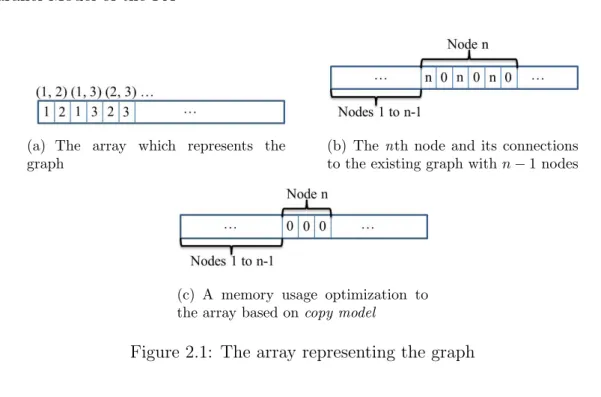
We introduce one shared array, arr, as the main data structure that holds the representation of the graph. The array consists of the edges of the graph. Each (i, j) where i, j > 0 and j = i+ 1, and j mod 2 = 0 shows an edge in the graph between arr[i] and arr[j] (Figure 2.1(a)).
According to the PA, each node is added to the existing graph via a constant number of edges (referred to as m) targetingdistinct nodes. There is also an initial clique, a complete graph with the size of m0 where (m0 > m), which is stored at the beginning of the array. Therefore the size of the array is calculated based on the number of nodes,num, and the number of edges that connect each new node to the existing distinct nodes, m. The connections of a new node are established via a probability distribution of the degrees of the nodes in the existing graph, that is, the more the degree of the existing node, the more the probability of choosing it as the target. For instance, if the node n is the new node to be added to the graph with the existing graph with [1..n−1] nodes then, according to equation 2.1, the probability distribution of choosing the existing nodes is [p1..pn−1]. (deg(i) gives the
degree of the node i in the existing graph)
pi =
deg(i) Pn−1
j=1 deg(j)
n−1
X
i=1
pi = 1 (2.1)
As mentioned, the connections for the new node should be distinct. Therefore if a duplicate happens the approach retries to make a new connection until all the connections are distinct. This graph representation provides the above mentioned probability distribution since the number of occurrences of each node in the array is equal to its degree. Figure 2.1(b) represents the position of node n in the graph array, where m = 3. In order to add node n to the existing graph containing n−1 nodes, with the assumption thatm= 3, targets are selected randomly from the slots
1
that are located previous to the noden (with the principle shown in Figure 2.2). It is obvious that self-loop cannot happen, i.e., an edge whose source and target are the same. Figure 2.1(c) illustrates an optimization on the array so that the array only contains the targets of the edges since the sources for each node are calculable. The array is half size as the one in Figure 2.1(b). Each slot in the array can have one of two states: resolved or unresolved. In the former case it contains the node number which is greater than zero, and in the latter it contains zero.
A sequential solution for the generation of such graphs consists of processing the array from left to right to resolve all the slots. The parallel alternative, on the other hand, is to have multiple active objects processing partitions of the array in parallel. As shown in the following equations, we distinguish between the following uses of indices. At the lowest level we have the indices of the slots. The next level is the id of the nodes. Each node contains a sequence of slots. Finally at the top level we have the id of the partitions. Each partition contains nodes and consequently slots. In the proposed approach the partitions satisfy the following equations which express that the sets of indices of the partitions are mutually disjoint (equation 2.3); that their union is equal to the whole array (equation 2.2); furthermore, the sequence of slots of each node must be placed in one partition (equation 2.4) so that one active object resolves the new node and race conditions are avoided for the checking duplicates:
w
[
i=1
pari =G (2.2)
∀(1≤(i6=j)≤w).pari∩parj =∅ (2.3)
∀i, j ∈G.(node(i) =node(j))→(par(i) = par(j)) (2.4)
where G is the global set containing all the indices of the shared array, w holds the number of partitions, pari is the set which holds the indices of the ith partition of
the array, node(i) is a function that returns the node id to which the slot of the array with index i belongs, and par(i) is a function that returns the partition id to which the index i belongs. Note that indices that belong to a specific node differ from the occurrences of that specific node in the array. The former indices are the slots that represents the edges that are created during introducing the new node to the graph, which its size is constant (denoted bym), while the latter changes during the graph generation.
Parallel Model of the PA 19
(a) The array which represents the graph
(b) The nth node and its connections to the existing graph withn−1 nodes
(c) A memory usage optimization to the array based oncopy model
Figure 2.1: The array representing the graph
2.3.2
Synchronization of Chains of Unresolved
Dependen-cies
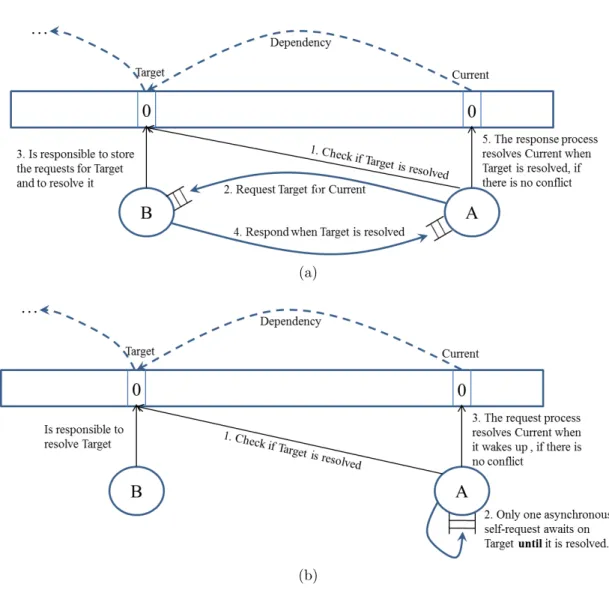
Each active object only resolves (i.e. writes to) the slots which belong to its own partition . Nevertheless it can read all the slots throughout the array. In the parallel solution, an active object may select a slot as the target which is not resolved yet since either the other active object responsible for the target slot has not yet processed it or the target slot may wait for another target itself (see dependency chains in figure 2.2). The way waiting for unresolved slots is managed is crucial for the complexity of the model and its scalability. Next we describe the two main approaches to deal with unresolved dependencies (Figure 2.3):
Synchronization by communication: Active object A processes its own partition of the array and for each randomly selected, unresolved slot it sends a request to the object B responsible for the target. When object B processes the request, it checks whether the slot is resolved. If it is not then it stores the information of the request (e.g. the sender id, the slot requiring the value of the target) in a corresponding data structure. BecauseB is the only object which writes to the target slot when it
(a)
(b)
Figure 2.3: Two different solutions for the PA problem (the second one is the pro-posed approach)
is resolved, it suffices thatB answers all the stored requests waiting for the resolved target by broadcasting the value of the slot. As such this approach exploits the wait-notify pattern rather than busy-wait polling, and it can be efficient depending on how the programmer implements the data structure. However, this approach involves a low-level user-defined management of the requests through the explicit user-defined implementation of the storage and retrieval of the requests. Note that in this approach there are exactly two messages that have to be passed for each request for an unresolved slot (Figure 2.3(a)).
Parallel Model of the PA 21
that the request process is suspended. It is notified when the boolean condition evaluates to true and stored back in the object’s queue of active processes (Figure 2.3(b)). This approach also avoids busy-waiting and follows the wait-notify pattern. However, the key feature in this approach is the use of cooperative scheduling in which the executing process of an active object can release conditionally the control cooperatively so that another process from the queue of the object can be executed. The continuation of the process which has conditionally released the control will be stored into a separate queue of suspended processes. These processes are stored again in the object’s queue for execution when they are notified. The Haskell im-plementation of this mechanism takes care of the low-level storage, execution and suspension of the processes generated by asynchronous messages. The ABS code itself, see below, remains high-level by means of its programming abstractions de-scribing asynchronous messaging and conditional release of control.
2.3.3
The Actor-based Model of PA
The main part of the encoding of our proposed approach is depicted as a pseudo-code in Figure 2.4. The full implementation of the model is provided online2. The worker
objects are active objects which resolve their corresponding partitions. To this aim, each worker goes through its own partition and it checks a randomly selected target for each of its slots (note that m denotes the number of connections, or slots in the array, per node). Since we use the optimized array representation (shown in Figure 2.1(c)), half of the array that corresponds to sources of the edges are not part of the array and the values (i.e., node numbers) are calculable from the index. However those indices can be targeted. The auxiliary function result(arr, target) checks the target index. If it is calculable, then it calculates and returns the value without referring to the array. Otherwise, the value of the index should be retrieved from the array. In such case, if the target slot is already resolved then the worker takes the value and resolves the slot of thecurrent index in case there is no conflict. If it is not resolved yet then it calls the request method asynchronously. The request method awaits on the target until it is resolved. Then it uses the value of the resolved target to resolve the current slot, if there is no duplicate. In case of a duplicate, the algorithm selects another target randomly in the same range as the previous one.
Note that the calls to the request method in lines 8 and 22 are asynchronous (de-noted by exclamation mark) and synchronous (de(de-noted by dot) respectively. The asynchronous call is introduced so as to spawn one process per each unresolved dependency. In the synchronous call, however, there is no need to spawn a new process since the current process is already introduced for the corresponding unre-solved dependency. Note that suspension of such a process thus involves in general an entire call stack, which poses one of the major challenges to the implementation of ABS, but which is dealt with in Haskell by the high-level and first-class concept
2
of continuations (described in more detail below).
1: Each active objectO executes the following in parallel
2: run(...) :void
3: for each Node iin the partition do
4: for j = 1 to m do
5: target← random[1..(i−1)2m]
6: current= (i−1)m+j
7: if result(arr,target) = 0 then
8: this! request(current,target)
9: else if duplicate(result(arr,target),current) then
10: j =j−1 . Repeat for the current slot j
11: else
12: arr[current] =result(arr,target) .Resolved
13: 14:
15: request(target:Int,current :Int) :void
16: await(result(arr,target)6= 0)
17: .At this point the target is resolved
18: value=result(arr,target)
19: if duplicate(value,current) then
20: target = random[1..(target/m)2m]
21: . Calculate the target for the current again
22: this.request(target,current)
23: else
24: arr[current] =value .Resolved
25: 26:
27: duplicate(target:Int,current :Int) :Boolean
28: for each i in (indices of the node to which current belongs)do
29: if arr[i] ==value then
30: returnTrue
31: return False
Figure 2.4: The sketch of the proposed approach
2.4
Related Work
Conclusion and Future Work 23
model [4, 59, 79], among which some methods [59, 79] are based on a version of the PA model which does not satisfy its basic criteria (i.e., consistency with the original model). The approach in [4] requires complex synchronization and communication management and generates considerable overhead of message passing. This stems from that this latter approach is not developed for a multicore setting but for a dis-tributed one. However our focus is to have a high-level parallel implementation of the original PA model utilizing the computational power of multicore architectures [12].
2.5
Conclusion and Future Work
We showed that the PA-based generation of networks allows a high-level multicore implementation using the ABS language and its Haskell backend that supports coop-erative multitasking via continuations and multicore parallelism via its lightweight threads. An experimental validation of a scalable distributed implementation of our model based on Haskell is presented in [12].
Chapter 3
Preferential Attachment on
Distributed Systems
3.1
Introduction
Massive social networks are structurally different from small networks synthesized by the same algorithm. Furthermore there are many patterns that emerge only in massive networks [56]. Analysis of such networks is also of importance in many areas, e.g. data-mining, network sciences, physics, and social sciences [16]. Nevertheless, generation of such extra-large networks necessitates an extra-large memory in a single server in the centralized algorithms.
The major challenge is generating large-scale social networks utilizing distributed-memory approaches where the graph, generated by multiple processes, is distributed among multiple corresponding memories. Few existing methods are based on a distributed implementation of the Preferential Attachment model (PA, chapter 2) among which some methods are based on a version of the PA model which does not fully capture its main characteristics. In contrast, we aim for a distributed solution which follows the original PA model, i.e., preserving the same probability distribu-tion as the sequential one. The main challenge of a faithful distributed version of PA is to manage the complexity of the communication and synchronization involved.
In a distributed version, finding a target node in order for the new node to make connection with may cause an unresolved dependency, i.e., the target itself is not yet resolved. However this kind of dependencies must be preserved and the to-be-resolved target will be utilized when it is resolved. How to preserve these dependencies and their utilization give rise to low-level explicit management of the dependencies or, by means of powerful programming constructs, high-level implicit management of them.
The main contribution of this chapter is a new distributed implementation of an ABS model of PA. In this chapter, we show that ABS can be used as a pow-erful programming language for efficient implementation of cloud-based distributed
applications.
This chapter is organized as follows: Section 3.2 elaborates on the high-level pro-posed distributed algorithm using the notion of cooperative scheduling and futures. In Section 3.3, implementation-specific details of the model are presented. Finally, Section 3.4 concludes the chapter.
Related Work. In chapter 2 (section 2.4) the existing related work for sequential and parallel implementations of PA is presented. The work in this chapter is inspired by the work in [4] where a low-level distributed implementation of PA is given in MPI: the implementation code remains closed source (even after contacting the authors) and, as such, we cannot validate their presented results (e.g, there are certain glitches in their weak scaling demonstration), nor compare them to our own implementation.
Since efficient implementation of PA is an important and challenging topic, fur-ther research is called for. Moreover, our experimental data are based on a high-level model of the PA which abstracts from low-level management of process queues and corresponding synchronization mechanism as used in [4].
In [68], a high-level distributed model of the PA in ABS has been presented together with a high-level description of its possible implementation in Java. How-ever, as we argue in Section 3, certain features of ABS pose serious problems to an efficient distributed implementation in Java. In this chapter, we show that these problems can be solved by a run-time system for ABS in Haskell and a corresponding source-to-source translation. An experimental validation of a scalable distributed implementation based on Haskell is presented in [10].
3.2
Distributed PA
In this section, we present a high-level distributed solution for PA which is similar to the ones proposed for multicore architectures in [12] (chapter 2) and distributed architectures in [4, 68], in a sense that they adopt copy model introduced in [54] to represent the graph. The main data structure used to model the graph which represents the social network is given in section 2.3.1. We use the same data structure for distributed PA as well.
Distributed PA 27
to deal with the unresolved dependencies is the main focus of this chapter. Next we present the basic synchronization and communication mechanism underlying our distributed approach and its advantages over existing solutions.
3.2.1
The Distributed ABS Model of PA
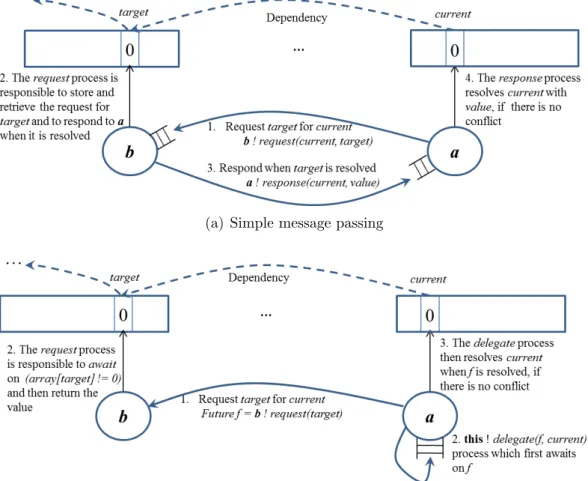
Two approaches are represented in Figure 3.1 which illustrate two different schemes of dealing with the unresolved dependencies in a distributed setting. In order to remain consistent with the original PA, both schemes must keep the unresolved dependencies and use the value of the target when it is resolved. Scheme A (used in [4]) utilizes message passing. If the target is not resolved yet, actor b explicitly stores the request in a data structure until the corresponding slot is resolved. Then it communicates the value with actor a. Actor b must also make sure the data structure remains consistent (e.g., it does not contain a request for a slot which is already responded).
In addition to message passing, scheme B utilizes the notion of cooperative scheduling. Instead of having an explicit data structure, scheme B simply uses the await statement on (target 6= 0). It suspends the request process until the target is resolved. The value is then communicated through the return value to actora. Also await f? is skipped if the future f is resolved, and suspends the current process otherwise. This statement is used to synchronize on the return value of a called method. The above-mentioned await constructs eliminates the need for an explicit user-defined data structure for storing and retrieval of the requests. The following section describes an ABS implementation of the scheme B.
An ABS-like pseudo code which represents scheme B in the above section is given in Figure 3.2. The full implementation of the model is provided online1. The main body of the program, which is not mentioned in the figure, is responsible to set up the actors by determining their partitions, and sending them other parameters of the problem, e.g.,n andm. Each actor then processes its own partition viarun method. The functionwhichActor calculates and returns the index of the actor containing the target slot, based on n, m and the partitioning method. The request for the slot is then sent asynchronously to the actor and the future variable is sent as a parameter to thedelegate function where the future value is obtained and checked for conflict. If there is no conflict, i.e., the new target is not previously taken by the source, then the slot is written with the target value. Recall that the one global array is divided into multiple local arrays, one per actor. Based on the partitioning method,nandm
there is a mapping from the global indices to the local ones. The function whichSlot maps an index of the global array to the index of a local array. The request method is responsible to map the global index of the target to the local index function (via whichSlot) and awaits on it and returns the value once the slot is resolved. Note that, based on the same optimization of the array size discussed in chapter 2, the
1
(a) Simple message passing
(b) Message passing with futures and cooperative scheduling
Distributed PA 29
method result(arr, target) checks if the value for the indextarget is calculable then it returns the calculated value. Otherwise it checks the corresponding array index in the array and returns the value.
1: Each actorO executes the following in parallel
2: Unit run(...)
3: for each node i in the partition do
4: for j = 1 to m do step
5: target← random[1..(i−1)2m]
6: current= (i−1)m+j
7: x=whichActor(target)
8: Fut<Int> f =actor[x] ! request(target)
9: this! delegate(f,current)
10: 11:
12: Int request(Int target)
13: localTarget=whichSlot(target)
14: await(result(arr,localTarget)6= 0)
15: .At this point the target is resolved
16: return result(arr,localTarget)
17: 18:
19: Unit delegate(Fut<Int> f,Int current)
20: awaitf?
21: value=f.get
22: localCurrent=whichSlot(current)
23: if duplicate(value, localCurrent) then
24: target= random[1..(current/m)2m]
25: . Calculate the target for the current again
26: x=whichActor(target)
27: Fut <Int > f =actor[x] ! request(target)
28: this.delegate(f,current)
29: else
30: arr[localCurrent] =value .Resolved
31: 32:
33: Boolean duplicate(Int value,Int localCurrent)
34: for each i in (indices of the node to which localCurrent belongs) do
35: if arr[i] ==value then
36: returnTrue
37: return False
3.3
Implementation
The distributed algorithm of Figure 3.2 is implemented directly in ABS, which is sub-sequently translated to Haskell code [10], by utilizing the ABS-Haskell [20] transcom-piler (source-to-source comtranscom-piler). The translated Haskell code is then linked against a Haskell-written parallel and distributed runtime API. Finally, the linked code is compiled by a Haskell compiler (normally, GHC) down to native code and executed directly.
The performance results of an experimental validation of the proposed approach in ABS-Haskell transcompiler is presented in [10]. The parallel runtime treats ABS active objects as Haskell’s lightweight threads (also known as green threads), each listening to its own concurrently-modifiable process queue: a method activation pushes a new continuation to the end of the callee’s process queue. Processes await-ing on futures are lightweight threads that will push back their continuation when the future is resolved; processes awaiting on boolean conditions are continuations which will be put back to the queue when their condition is met. The parallel run-time strives to avoid busy-wait polling both for futures by employing the underlying OS asynchronous event notification system (e.g. epoll, kqueue), and for booleans by retrying the continuations that have part of its condition modified (by mutating fields) since the last release point.
For the distributed runtime we rely on Cloud Haskell [32], a library framework that tries to port Erlang’s distribution model to the Haskell language while adding type-safety to messages. Cloud Haskell code is employed for remote method acti-vation and future resolution: the library provides us means to serialize a remote method call to its arguments plus a static (known at compile time) pointer to the method code. No actual code is ever transferred; the active objects are serialized to unique among the whole network identifiers and futures to unique identifiers to the caller object (simply a counter). The serialized data, together with their types, are then transferred through a network transport layer (TCP,CCI,ZeroMQ); we opted for TCP/IP, since it is well-established and easier to debug. The data are de-serialized on the other end: a de-serialized method call corresponds to a contin-uation which will be pushed to the end of the process queue of the callee object, whereas a de-serialized future value will wake up all processes of the object awaiting on that particular future.
The creation of Deployment Components is done under the hood by contacting the corresponding (cloud) platform provider to allocate a new machine, usually done through a REST API. The executable is compiled once and placed on each created machine which is automatically started as the 1st user process after kernel initialization of the VM has completed.
Implementation 31
Haskell is also a high-level, statically-typed, purely functional language. Secondly, compared to the distributed implementation sketched in Java [68], the ABS-Haskell runtime utilizes the support of Haskell’s lightweight threads and first-class continu-ations to efficiently implement multicore-enabled cooperative scheduling; Java does not have built-in language support for algebraic datatypes, continuations and its system OS threads (heavyweight) makes it a less ideal candidate to implement co-operative scheduling in a straightforward manner. On the distributed side, layering our solution on top of Java RMI (Remote Method Invocation) framework was de-cided against for lack of built-in support for asynchronous remote method calls and superfluous features to our needs, such as code-transfer and fully-distributed garbage collection.
3.3.1
Implementing Delegation
The distributed algorithm described in Section 3 uses the concept of a delegate for asynchronicity: when the worker actor demands a particular slot of the graph array, it will spawn asynchronously an extra delegate process (line 9) that will only execute when the requested slot becomes available. This execution scheme may be sufficient for preemptive scheduling concurrency (with some safe locking on the active object’s fields), since every delegate process gets a fair time slice to execute; however, in cooperative scheduling concurrency, the described scheme yields sub-optimal results for sufficient large graph arrays. Specifically, the worker actor traverses its partition from left to right (line 3), spawning continuously a new delegate in every step; all these delegates cannot execute until the worker actor has released control, which happens upon reaching the end of its run method (finished traversing the partition). Although at first it may seem that the worker actors do operate in parallel to each other, the accumulating delegates are a space leak that puts pressure on the Garbage Collector and, most importantly, delays execution by traversing the partitioned arrays “twice”, one for the creation of delegates and one for “consuming them”.
1: Unit run(...)
2: for each node i in the partition do
3: for j = 1 to m do step
4: target← random[1..(i−1)2m]
5: current= (i−1)m+j
6: x=whichActor(target)
7: Fut<Int> f =actor[x]!request(target)
8: aliveDelegates=aliveDelegates+ 1
9: this! delegate(f, current)
10: if aliveDelegates=maxBoundWindow then
11: awaitaliveDelegates<=minBoundWindow
Figure 3.3: The modified run method with window of delegates.
We opted instead for a middle-ground, where we allow a window size of dele-gate processes: the worker process continues to create deledele-gate processes until their number reaches the upper bound of the window size; thereafter the worker process releases control so the delegates have a chance to execute. When only the number of alive delegate processes falls under the window’s lower bound, the worker process is allowed to resume execution. This algorithmic description can be straightforwardly implemented in ABS with boolean awaiting and a integer counter field (named
this.aliveDelegates). The modification of therun is shown in Figure 3.3; Similarly the delegate method must be modified to decrease the aliveDelegates counter when the method exits.
Interestingly, the size of the window is dependent on the CPU/Network speed ratio, and the Preferential Attachment model parameters: nodes (n) and degree (d). In [10], the performance results of the PA model presented in this chapter in the Haskell backend are given. We empirically tested and used a fixed window size of [500,2000]. Finding the optimal window size that keeps the CPUs busy while not leaking memory by keeping too much delegates alive for a specific setup (cpu,network,n,d) is planned for future work.
3.4
Conclusion and Future Work
Conclusion and Future Work 33
Part III
Enhancing Parallelism
This part consists of the following chapters:
Chapter 4 Asynchronous Actor-based software programming has gained increas-ing attention as a model of concurrency and distribution. Many modern distributed software applications require a form of continuous interaction between their compo-nents which consists of streaming data from a server to its clients. In this chapter, we extend the basic model of asynchronous method invocation and return in order to support the streaming of data [13]. We introduce the notion of “future-based data streams” by augmenting the syntax, type system, and operational semantics of ABS. The application involving future-based data streams is illustrated by a case study on social network simulation.
Chapter 5 In this chapter we introduce a new programming model of multi-threaded actors which feature the parallel processing of their messages [15]. In this model an actor consists of a group of active objects which share a message queue. We provide a formal operational semantics, and a description of a Java-based implementation for the basic programming abstractions describing multi-threaded actors. Finally, we evaluate our proposal by means of an example application.
Chapter 4
Futures for Streaming Data
4.1
Introduction
Since the rapid growth in big data, data streaming is widely used in many distributed applications, e.g., telecommunications, event-monitoring and detection, and sensor networks. Data streaming is a client/server pattern which, in essence, consists of a continuous generation of data by the server and a sequential and incremental processing of the data by the client. Data streams are naturally processed differently from batch data. Functions cannot operate on data streams as a whole, as the produced data can be unlimited. Hence, new programming abstractions are required for the continuous generation and consumption of data in the streams.
Data streaming is highly relevant in modern distributed systems. Actor-based languages are specifically designed for describing such systems [1]. They provide an event-driven model of concurrency where messages are communicated asyn-chronously and processed by pattern matching mechanism [7]. Concurrent objects generalize this model to programming to interface discipline by modeling messages as asynchronous method invocations. The main contribution of this chapter is to integrate data streaming mechanism with concurrent object systems.
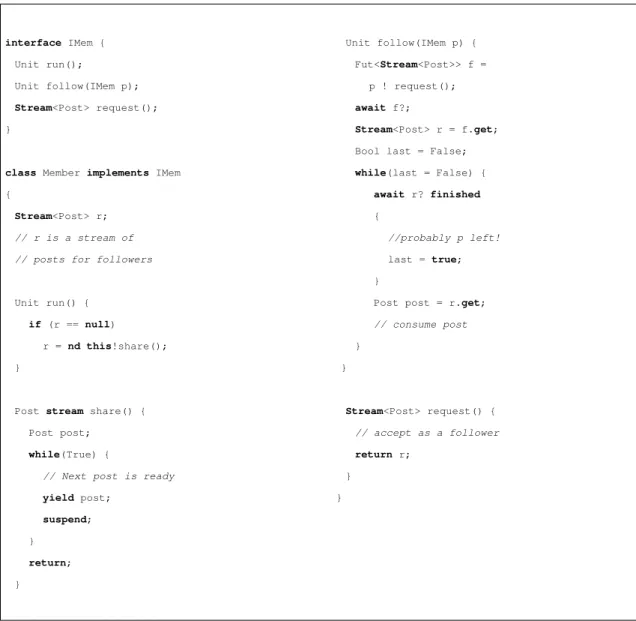
In this chapter, we extend the ABS language in order to support the streaming of data between a server and its clients. We introduce “future-based data streams” which integrates futures and data streams, and which specifies the return type of so-called streaming methods. Upon invocation of such a method a new future is created which holds a reference to the generated stream of data. Data items are added to the stream by the execution of a yield statement. Such a statement takes as parameter an expression the value of which is added to the stream, without terminating the execution of the method. The return statement terminates the execution of a streaming method, and is used to signal the end of data streaming. Even though no new data is produced, the existing data values in the stream buffer can be retrieved by the consumers.
The values generated by the server (the streaming method) can be obtained
incrementally and sequentially by a client by querying the future corresponding to this method invocation. By the nature of data streaming, it is natural to restrict the streaming to the asynchronous method calls. Therefore there is no support for synchronous invocation of streaming methods.
In this chapter, we introduce two different implementations of streams tailored to different forms of parallel processing of data streams. Obtaining data from a destructive stream involves the removal of the data, whereas in a non-destructive stream the data persists. Which of the implementation is used is determined by the caller of the streaming method (the creator of the stream) which is not necessarily the consumer of the data stream. The creator can then provide the consumers with a reference to the stream. Both the streaming method (producer) and the consumers which hold a reference to the data stream are not exposed to the underlying imple-mentation of the stream, i.e., these different impleimple-mentations are not represented by different types of data streams. This allows for a separation of concerns between the generation and processing of data streams, on the one hand, and their orchestration, on the other hand. This also enables reusability of the implementation of producers and consumers for both consumption approaches.
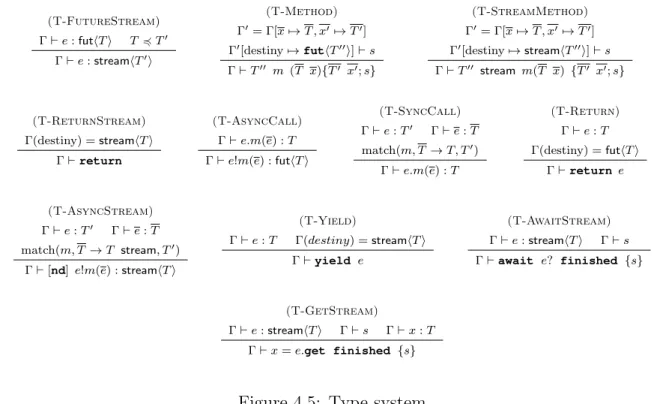
A preliminary discussion of the overall idea underlying this chapter is given in [11]. As an extension, in this chapter we introduce the different implementations of data streams, an operational semantics for both implementations of streams, a new type system which formalizes the integration of futures and data streams, and a proof of type-safety. Further, we show how the basic mechanism in ABS of cooperative scheduling of asynchronously generated method invocations itself can be used to implement data streams and the cooperative scheduling of streaming methods.
As a proof of concept, exploiting a prototype implementation for supporting future-based data streams on top of ABS, we present the usage of the above-mentioned feature in the implementation of a distributed application for the gener-ation of distributed PA (chapter 2 and 3). The notion of data streaming abstracts from the specific implementation of ABS. In our case, we make use of the distributed Haskell backend of ABS [20] for the case study on future-based data streams reported in this chapter.
Future-Based Data Streams 39
Plan of the chapter This chapter is organized as follows: the notion of a future-based data stream is specified as an extension of ABS in Section 4.2. In section 4.3, it is shown that the well-typedness of a program in the extended ABS is preserved. Section 4.4 discusses the usage of streams in a distributed setting. In section 4.5, an implementation of data streams is given as an API written in ABS. In Section 4.6, a case study on social network simulation is discussed, which uses the proposed notion of streams. Related works are discussed in section 4.7. Finally we conclude in section 4.8.
4.2
Future-Based Data Streams
In this section, we define future-based data streaming in the context of the ABS language. A streaming method is statically typed, namely, the return type of the method is followed by the keyword stream, specifying that the method streams values of that type. As mentioned before, ABS features a programming to inter-faces discipline. Therefore the caller can asynchronously call a streaming method, provided that the interface of the callee includes the method definition.
Data streaming is defined as a stream of return values from a callee to the data consumers of the stream in an asynchronous fashion. An invocation of a streaming method creates a stream. The callee first create an empty stream, and then produces and stores data to the stream buffer via the yield statement. The caller assigns the invocation to a variable of type Stream<T> for the return type T stream of the callee. The stream variable can be passed around. Therefore different variables in multiple processes (a process is the execution of an asynchronous method call) may refer to the same stream and retrieve data from it.
for its asynchronous parallel processing.
Abstracting from the typing information, to be discussed in more detail below, the syntax of our proposed extension of ABS, i.e., that of future-based data streams, is specified in Figure 4.1, where e denotes an expression (i.e., a variable name, etc),
e denotes a sequence of expressions,xis a variable name, mis a method name, and
s denotes a sequence of statements.
s::= s;s | x= [nd] e!m(e) | yield e | return| suspend |
await e? finished {s} | x=e.get finished {s}
Figure 4.1: Syntax
In the asynchronous invocation x = [nd] e!m(e) of a streaming method, the optional keyword ndindicates the creation of a new non-destructive stream.
Execution of the yield statement, which can only be used in the body of a streaming method, consist of queuing the value of the specified expression.
Execution of the returnstatement by a streaming method indicates termina-tion of the data generatermina-tion which is signaled to the consumers of the stream by queuing the special value η.
The active process unconditionally releases control by suspend. The object is then idle and can activate a suspended process. The await-finishedstatement allows to check the buffer of the stream denoted by the expressionein the following manner: if there is at least one proper value, different from the signalη, in the buffer, the statement is skipped. In case the buffer is empty, the current process suspends such that the object can activate another process. The statement s is executed in case the buffer only contains the signal η.
The get-finishedstatement allows to actually retrieve (in case of a
destruc-tive stream) or read (in case of a non-destrucdestruc-tive stream) a next data value. It however blocks the whole object when the buffer is empty. As above, statements is executed when the buffer only contains the signal η.
In await-finished and get-finished, the keyword finished and its
following block can be omitted if the block is empty.
We next illustrate the difference in the behaviour of destructive and non-destructive access to a stream by the following simple toy example. Consider the streaming method m():
Int stream m() {
yield 1;yield 2; return;
}
![Figure 1.1: Core ABS syntax for the concurrent object level [48]](https://thumb-us.123doks.com/thumbv2/123dok_us/8118592.2153027/16.892.252.658.160.351/figure-core-abs-syntax-concurrent-object-level.webp)