Journal of Language and Linguistic Studies Vol.3, No.2, October 2007
An Overall Analysis of Teaching Compulsory Foreign Language at Turkish State Universities
İsmail ÇAKIR [email protected]
Abstract
The aims of teaching compulsory foreign language are: teaching students the basic rules of the language in question, improving their vocabulary in that foreign language, enabling students to express themselves and understand the text relevant to their field. Theoretically, these objectives specified by Higher Education Council (YÖK) are quite rational in terms of foreign language teaching, but in practice to attain them adequately is unfortunately not always possible at Turkish state universities due to many factors which will be handled throughout this study. Bearing this issue in mind, the aim of this article has been to present some alternative suggestions to those in charge after revealing the current situation.
Key Words: Compulsory Foreign Language Teaching, Learners, Teaching Materials, Needs Analysis.
Özet
önerilerde bulunmaktır.
Anahtar Sözcükler: Zorunlu Yabancı Dil Öğretimi, Öğrenciler, Ders Araç ve Gereçleri, İhtiyaç Analizi
1.0INTRODUCTION
Having unsatisfactory results from teaching a foreign language despite a long and tiring education process of students is one of the important points that should be focused on. The reasons for this unintended result can be various and a long list of excuses can be made. Taking this issue into account, throughout this study, it is aimed at presenting the existing situation of foreign language teaching at Turkish state universities with specific reference to Kırıkkale University. It is naturally believed that language teaching is supposed to be taught perfectly with the help of the supplied materials and the syllabus, but the result is not so because of the foreign language teaching policy pursued at state universities, excluding those having preparatory schools.
The aims of teaching compulsory foreign language teaching have been clarified by the Higher Education Council (YÖK) in Turkey, and students at Turkish state universities must acquire these objectives throughout their education. To start with it would be better what the objectives to be attained are. According to the Article 4: The aims of teaching compulsory foreign language are: teaching students the basic rules of the language in question, improving their vocabulary in that foreign language, enabling students to express themselves and understand the text relevant to their field. (Resmi Gazete Sayı: 22074.07 Ekim 1994-3). Educationally speaking, it is undoubtedly true that these objectives are absolutely rational for any one learning a foreign language teaching. On the other hand, it is not quite possible to attain these objectives efficiently at Turkish state universities due to many factors which will be handled throughout this study.
points in Turkey even though a lot of money and time have been spent on it for years without having any reasonable solutions. In most of the universities in Turkey, even in the state high schools -excluding the private colleges and Anatolian High Schools- it is unfortunately not possible to be able to say that foreign language teaching is performed perfectly and students graduated from these schools are able to perform the objectives specified by either the National Ministry of Education or Higher Education Council (YÖK).
2.0 FOREIGN LANGUAGE TEACHING AT STATE UNIVERSITIES
As a matter of fact, foreign language teaching is compulsory at the state universities, which must be taught at least in 60 hours at any department. Although each university has an option to expand the length of teaching more than 60 hours, most of them are reluctant to do it. In two-hour weekly programme, students are expected to achieve the abilities mentioned in the article 4 above. That is to say, according to the expectations determined by YÖK, in 60 hours the students must be able to;
a) Learn the basic rules of the related language, b) Improve their vocabulary in that foreign language,
c) Express themselves and understand the text relevant to their field.
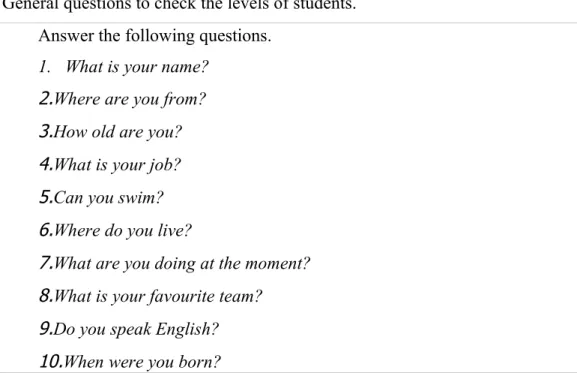
As is seen clearly above, in 60 hour- annual program students are expected to achieve a lot of things that require at least more than 24 hour-weekly program, as in the prep-classes of many schools. On the other hand, the current situation reveals that foreign language teaching do not match the objectives determined by the authorities in charge. To prove this fact, the questions in Appendix 1 have been administered to the first-year students at the beginning of the first term when they have started their education at Kırıkkale University.
When analyzing the results it is sad to say that only a few of the questions are answered correctly whereas more than half of them remain untouched. This case is also valid for any student at any state university, which shows us their levels they have had at their previous education.
foreign language teaching at State Universities. Needless to say, foreign language teachers confront a few important problems during the teaching process such as learners’ motivation towards the course, language levels of students, large classes, lack of audio-visual materials etc. Particularly three important components in foreign language teaching- institution, learners and teaching materials- are crucial elements that need to be kept in mind while analyzing the case.
2.1 Institution
It is true that institution is one of the important parts influencing an adequate foreign language teaching. At a quite number of the state universities, as most of the administrators are not familiar with foreign language teaching, it is not always possible to keep contact with them easily. They usually believe that it is just a compulsory course to be performed without putting so much care. On the other hand, to be able to attain the objectives and teach a foreign language effectively in a given period, the teacher needs to know a lot about the institution in so far as it’s involved with his teaching. Therefore, five areas of knowledge given below are key points for they are supposedly specified by the related institutions and each item will be analyzed in terms of foreign language teaching revealing the existing conditions.
b) Physical Conditions: The teacher needs to know what physical conditions exist in the place that he is going to teach. It is no good taking in an electrically powered tape recorder if there is no socket for a plug in the classroom. The condition of chairs, brightness of the lighting, blackboard, the location of the place are the crucial points that should be taken into consideration by the related institutions in order to have a successful foreign language teaching.
c) Syllabus: Planning a successful programme involves consideration factors that go beyond mere content and presentation of teaching material (Richards et al, 1985:11). The syllabus of the institution needs to be determined before starting to teach. The syllabi may vary according to the needs of the institutions and learners. It is clearly important to be familiar with the syllabus the institution has for the levels that are being taught. The teacher will have to be sure in general terms that he can cover the majority of the syllabus where possible. Although the objectives have been determined by YÖK, the syllabus for English course at state universities is not clearly specified. To achieve the objectives, an intensified syllabus, which is impossible to manage in 60 hour-annual programme, need to be designed. However, at most of the state universities, the syllabus is designed by the related course teachers considering the length of the course, need of the students, and usually the textbook elected to be followed.
2.2 Learners
through various techniques such as needs analysis (see 3.1).
With respect to learners at the state universities, they already study a specific subject such as Mathematics, Physics, History or Law, and a foreign language course called as a “service course” does not convey so much importance for them. Therefore, they lose their motivation to learn a foreign language at the beginning of the course, which results in poor teaching and learning in the classroom automatically. Needless to say, motivation is very strongly related to achievement in language learning. Most good teachers seem to accept that it is their responsibility to motivate learners, and invest quite a lot of effort in doing so (Ur, 1996:277). According to Brown (1994:155) there are two important factors affecting motivation of the students to learn, which are extrinsic and intrinsic affecting learners directly and indirectly such as families, teachers, materials etc., and they should be taken into consideration.
2.3 Teaching Materials
The third important element in language teaching and learning is of course teaching materials, mostly textbooks, used in classrooms such as video, tape recorder, visual aids, charts, flashcards, overhead projector and the like. It is widely accepted that a textbook is the crucial one that should be present in language teaching as it provides, psychologically speaking, and the learner with something concrete that gives a measure of progress and achievement as lessons are completed. Furthermore, textbook in a sense is useful for teachers as they help them bring the real world into the essentially artificial classroom situation so that they can relate the language items they are teaching to actual usage and teachers need a textbook to make the best use of the time in the classroom and to avoid unintended repetition or neglect of essential language patterns. What is more, students are also used to following textbooks in their own languages for other subjects. For this reason, they have the desire to have one for the language learning, thus they can measure the rate of the progress. Taking this issue into consideration it can be stated that both teachers and students would like to have a textbook as the main teaching and learning aid.
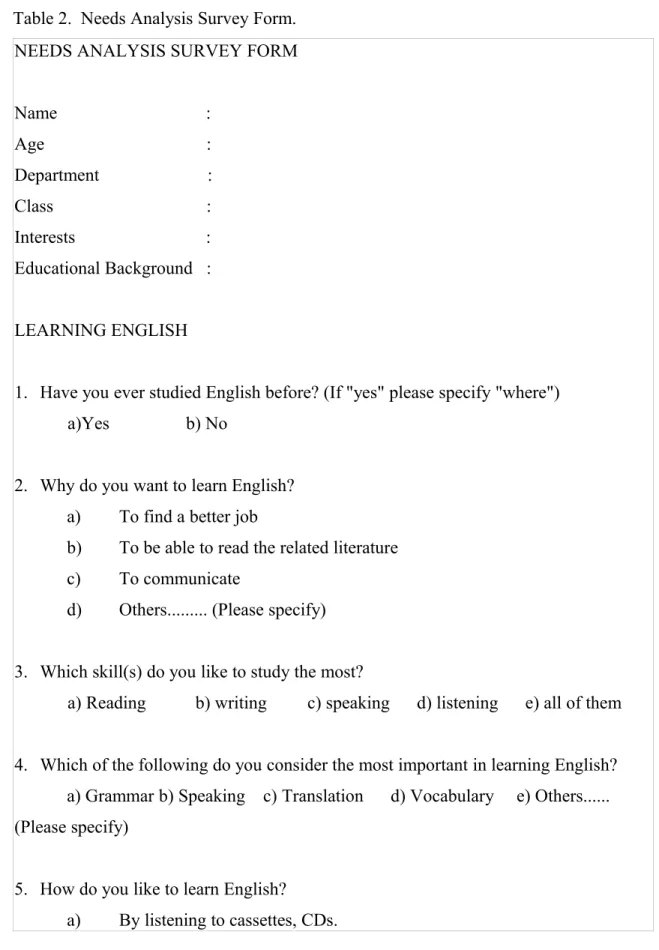
university has an option to decide on which teaching materials to be used in line with the syllabus specified by YÖK. However, having no unity among the universities and being flexible in choosing course materials do not enable learners to learn efficiently. Some of the course books are not suitable for the length of the course as well as the contents they include. While deciding on the course book learners’ needs and interests are usually disregarded. However, Breen and Candlin (1987) suggest that learner needs and interests, their approaches to language teaching, the teaching/learning process in the classroom should be taken into consideration in determining the course syllabus and electing the textbooks to be followed. That is why, to figure out the learners’ interests and needs what should be done before starting a teaching and learning process is to prepare a needs analysis survey form and ask the students to fill it in as mentioned earlier.
To sum up at the state universities the factors that discourage the students to learn a foreign language can be listed as follows:
1.Foreign language learning is not regarded as important as the courses of the related department.
2.The students are located in the mixed ability classes.
3.Curriculum to teach a foreign language is not suitable for the expected goals. 4.Students are not motivated to learn a foreign language.
5.Students are not well-educated in their previous education. 6.They are not provided with the necessary teaching materials.
7.The textbook chosen to be followed does not fit their needs, ages, cultural backgrounds, and interests.
8.Having a right not to attend the course for 30% of the period leads the students not to come to school, which creates a gap among themselves, particularly for the beginners or false beginners.
9.Some textbooks are loaded with unnecessary teaching activities which are likely to be omitted.
10.Foreign language courses are not located at the fruitful hours in weekly course schedules.
suitable as the teachers dream because students usually follow the foreign language courses reluctantly as the must of attendance forces them to. These factors need to be taken into consideration one by one if we want them to learn a foreign language to fit their needs.
3.0 SUGGESTIONS
The situation in terms of a foreign language teaching at Kırıkkale University doesn't seem beneficial for the learners and satisfactory for the teachers and
administrators. The current system of language teaching doesn’t provide so many things for the learners and it can unfortunately be said that most of the students, after they finish the first year of their education, tend to forget what they have been taught since they have no more chance to deal with and not to forget and improve. Considering these unsatisfactory factors we need to evaluate the situation and suggest some new ideas so that the students learn a foreign language at least to be able to read the related
literature. Having the present limitations at hand we can make them more creative, productive and enjoyable for the learners. The following part involves the suggestions that can be done to have a successful solution.
3.1 Needs analysis: Before starting a new curriculum needs analysis should be done. A needs analysis survey form can be applied to the new beginners at the beginning of the term at Turkish state universities (Appendix 2). Through the answers of the needs analysis we can have a conclusion about the learner's needs, interests, educational backgrounds and some other important data leading to set our objectives.
develop their reading comprehension. It shouldn’t be forgotten that most of the students at the third year will have "Mesleki İngilizce" which requires both the knowledge of grammar and ability in comprehension of the related texts. So, the objectives should be set keeping these issues in mind.
3.3 Syllabus Design: The syllabus should be designed in accordance with the time, length and frequency of the lesson. The type of the syllabus design to be offered cannot be so certain. However, the syllabi that can be suggested for the students at Turkish state universities might be either "skill based syllabus design” or “structural syllabus design." We need to know that syllabus designs may vary according to the level of the students. That is to say, to teach the grammar of the language at the first term structural syllabus design would be beneficial owing to the time limitation. After students learn the structure of the language they may go on to the activities of skill based syllabus design so that they can be ready for the following years.
3.4 Selecting Materials: The materials to be utilized in foreign language teaching for two-hour weekly program at state universities should be chosen carefully. It should be borne in mind that having only a textbook might be monotonous for the learners and bore the students with the routine activities. So, the materials might be varied depending on the departments and needs of learners.
3.5 Teaching and Testing: Teaching and testing parts, of course, need to be performed appropriately. Teaching conditions, students’ background, their departments, and levels should be taken into account while testing. Teachers should strive to make the objectives true in language teaching, and also test what has been presented. It is widely accepted that every item taught requires to be tested and testing should be done in the way it is taught.
curriculum. It is pity that at most of the state universities this point has been avoided. However, teachers are the ones who are at the center of teaching and can realize the weak and strong points of the syllabus or coursebook throughout the year. In a word, we can claim that every syllabus should be observed to check whether it works or not.
4. CONCLUSION
The aim of this study has been to present the current situation of foreign language teaching at Turkish state universities with a specific reference to Kırıkkale University, which is usually neglected and regarded as a compulsory duty. The conditions for language teaching are not satisfactory as required and intended owing to the lack of motivation, teaching materials and atmosphere, attitudes of the lecturers and administrators, towards foreign language teaching. Particularly, learners’ motivation and interest in this issue is quite important since they mostly believe that it is the secondary stress for them keeping them busy apart from the courses of their own departments.
In order to make compulsory foreign language teaching courses at state universities more attractive lecturers and administrators in charge have great responsibilities. First of all, what should be done as a lecturer at state universities, however, is to refresh his course without regarding the situation and facilities. There are always some issues that he or she should consider to make use of the given raw materials from which he can develop lots of activities techniques. After all, he should start with planning his lesson for the whole year or in the devoted period. Most importantly, before he can start to consider planning his classes he needs to know a considerable amount about three main areas: the profession, the institution and the students. In short, taking the profession into consideration the teacher should be familiar with the following six major areas of necessary knowledge to determine the objectives of the course:
a)the language for the level b)the skills for the level
e)a repertoire of activities f)classroom management skills
These are all important factors for any teacher of foreign language and they all imply a lot of work particularly where a level is being taught for the first time. It can be stated that without these areas of knowledge a teacher is in poor position to make decisions about to determine the objective of the lesson and designing a syllabus.
Clearly, a well-prepared teacher needs to know a lot about his job before he can start to make successful plan. He or she needs to know who the students are, what the students bring to the class and what the students need. Along with the students the institution he works in is also an important factor for the teacher to keep in mind so that he can evaluate his teaching before and after the terms. Physical conditions of the
school, facilities it provides, attitudes of the administrators constitute the other important elements for compulsory foreign language teaching.
Needless to say, the amount of money, effort and time to be able to learn English is countless. Keeping this issue in mind, the conditions at hand should be made use of by the learners and teachers effectively. In order to teach a foreign language as much as needed, the factors mentioned in this paper should be scrutinized, and the problems given should be solved by the people in question. Otherwise, it wouldn't be wrong to say that, we will go on spending time, money, effort and kill ourselves to teach in vain, and without any purpose. We have to state that teaching anything doesn't make any sense if it doesn't convey any purpose and planning.
References
Birdal, A. 2005, Türkiye’de Yabancı Dil Öğretimi Üzerine Yazılmış İki Makalenin Değerlendirilmesi :1)“Yabancı Dil Öğretiminde Yeni Yönelimler” 2) “Üniversitelerde Yabancı Dil Öğretimi Üzerine Saptamalar” by Prof. Dr. Ahmet Kocaman http:/www.inglish.com/makale-karsılastirma.html (24.12.05).
Brown, H.D.1994, T Principles of Language Learning and Teaching. The USA, Prentice Hall Regents.
Çakır, İ. 1995. Textbook Analysis in terms of Writing Skills with Reference to “ Developing Strategies”, Ankara: MA Thesis.
Köksal, D., 1997, ESP and Syllabus Design in the School of Tourism and Hotel Management. İstanbul, Teaching English , Issue 6. 23-29
Resmi Gazete Sayı: 22074.07 Ekim 1994-3
Richards et al, 1985. Longman Dictionary of Applied Linguistics. Essex: Longman Ur, P. 1996. A Course in Language Teaching, Great Britain: Cambridge University
Press.
Wilkins, D. 1976 Notional Syllabuses, Oxford: OUP.
Yalden, J. 1987 Principles of Course Design for Language Teaching, Cambridge. CUP.
Appendix 1.
Table 1. General questions to check the levels of students.
Answer the following questions. 1. What is your name?
2.Where are you from?
3.How old are you?
4.What is your job?
5.Can you swim?
6.Where do you live?
7.What are you doing at the moment?
8.What is your favourite team?
9.Do you speak English?
Appendix 2.
Table 2. Needs Analysis Survey Form. NEEDS ANALYSIS SURVEY FORM
Name : Age : Department : Class : Interests : Educational Background :
LEARNING ENGLISH
1. Have you ever studied English before? (If "yes" please specify "where") a)Yes b) No
2. Why do you want to learn English? a) To find a better job
b) To be able to read the related literature c) To communicate
d) Others... (Please specify)
3. Which skill(s) do you like to study the most?
a) Reading b) writing c) speaking d) listening e) all of them
4. Which of the following do you consider the most important in learning English? a) Grammar b) Speaking c) Translation d) Vocabulary e) Others... (Please specify)
5. How do you like to learn English?
b) By the help of the teacher c) By games, pictures, video d) By talking to English speakers e) Others... (Please specify)
6. How do find learning English?
YES NO
a) Enjoyable ... ... b) Easy ... ... c) Difficult ... ...
d) Boring ... ... e) Others ... ...
7. Do you think you can learn English? a) Yes b) No
8. Do you think you will need English after you finish the school? a) Yes b) No c) Pprobably
9. I think English is taught best by... a) a native speaker because ... b) a Turkish teacher because ...
10 How much time is necessary to study to learn English well? (Please write below) a) Per day...
b) Per week... c) Per month...
11. How do you learn best? Please put a tick.
In pairs ... ... ... ...
In group ……… ... ... ...
In class ... ... ... ...
Outside class ... ... ... ...
Private tutoring ... ... ... ...
Through technological devices.
... ... ... ...
12. Where do you want to study? a) At home
b) At school c) In a library d) Others...
13. Do you need supervision while you are studying? a) Yes b) No