R E S E A R C H
Open Access
Preference corrections: capturing student
and instructor perceptions in educational
recommendations
Yong Zheng
Correspondence:[email protected]
Department of Information Technology and Management, School of Applied Technology, Illinois Institute of Technology, Chicago, IL, USA
Abstract
Recommender systems (RS) have been applied in the area of educations to recommend formal and informal learning materials, after-school programs or online courses. In the traditional RS, the receiver of the recommendations is the only stakeholder, but other stakeholders may be involved in the environment. Take educations for example, not only the preference of the student, but also the perspective of other stakeholders (e.g., instructors, parents, publishers, etc) may be important in the process of recommendations. Multi-stakeholder recommender systems (MSRS) were recently proposed to balance the needs of multiple
stakeholders in the recommender systems. We use course project recommendations as a case study, and the perspectives of both students and instructors will be considered in our work. However, students and instructors may have different perceptions on the technical difficulty of the projects. In this paper, we particularly focus on the solution of preference corrections which can be used to capture different perceptions of students and instructors in the multi-stakeholder educational recommendations.
Keywords:Recommender systems, Educational recommendation, Multi-stakeholder,
Preference correction
Introductions
Recommender systems (RS) produce item recommendations tailored to user prefer-ences. The end user is the only stakeholder in the traditional RS. Recently, researchers
claimed that it’s necessary to balance the needs of multiple stakeholders in the process
of recommendations (Burke, Abdollahpouri, Mobasher, & Gupta, 2016). Take
recom-mending books to the students for example, not only the student’s preferences, but
also the perspectives of instructors, parents and even publishers may also be important. Maximizing the preference of the end users may hurt the utility of the item from the perspective of other stakeholders. Multi-stakeholder recommender systems (MSRS), therefore, suggest to produce recommendations by considering the perspective of mul-tiple stakeholders, and balance their needs in the environment.
We believe that MSRS is necessary in the area of educations for at least two major reasons. On one hand, the suggestions by other stakeholders are useful or helpful for
learners. For example, researchers (Ekstrand, Azpiazu, Wright, & Pera, 2018) pointed
out that the views of parents or instructors on the educational learning materials (e.g., books, textbooks) could be useful to help students select the appropriate learning re-sources. On the other hand, there could be conflicting interests in the process of teach-ing and learnteach-ing. For example, students may prefer to work on easier projects, while the instructors may encourage them to try more challenging ones (Zheng, Ghane, &
Sabouri,2019). In this case, a balance between these stakeholders may be required. The
situation could be more complicated, since students and instructors may have different
perceptions on the technical difficulty of the projects (Zheng, 2019a). For example, a
project seems to be easy from the perspective of instructors, while students may still believe it is difficult for them.
In this paper, we build our MSRS to adapt to the case of course project recommenda-tions. In addition, we propose preference correction as a solution to capture these dif-ference perceptions in the multi-stakeholder educational recommendations.
The major contributions in this paper can be summarized as follows:
We examine two types of the multi-stakeholder recommendations.
We additionally evaluate the performance of different multi-objective learning algo-rithms for multi-stakeholder educational recommendations.
We deliver more insights about the process of preference corrections by using the extended experimental results.
Related work and problem statements
Educational recommender systems
Educational recommender systems emerged as one of the technology-enhanced
learn-ing (Drachsler, Verbert, Santos, & Manouselis,2015) methods. They have been
success-fully applied to suggest books for K12 users (Pera & Ng, 2013), recommend
after-school programs in informal learning (Burke, Zheng, & Riley, 2011), or suggest
appro-priate citations (He, Pei, Kifer, Mitra, & Giles,2010) in paper writings.
Multi-stakeholder recommender systems
Multi-stakeholder recommender systems (MSRS) (Burke et al.,2016) were proposed in
2016, in order to balance the needs of multiple stakeholders. The idea of
“multi-stakeholder” is not new, while we can find the earliest research in the category of
reciprocal recommendations, such as the applications in dating (Pizzato, Rej,
Chung, Koprinska, & Kay, 2010) and recruitment (Yu, Liu, & Zhang, 2011). The
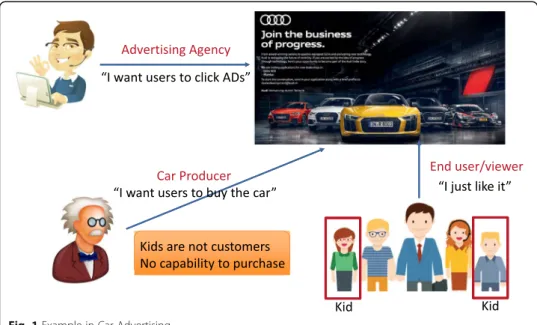
idea behind MSRS is that the perspectives of other stakeholders may also be im-portant in the process of recommendations. Take the car advertising as shown by
Fig. 1 for example, the advertising agency would like to present the car
advertise-ment to any viewers who may click it. The receiver of the Ads may just want to
view any Ads they are interested in. However, the Ads should be delivered to
po-tential customers from the perspective of car producers or sellers. Teenagers may
like cars but they may not have the capability to make purchases, which decreases the utility of the Ads in view of the producers or sellers.
Researchers have extended the notion of MSRS to several domains, including movies
Dines, & Krasnodebski,2017), dating (Zheng & Pu,2018a), educations (Burke &
Abdol-lahpouri, 2016; Ekstrand et al.,2018), and so forth. There are two existing work which
point out the potential usefulness of MSRS in the area of educations. Ekstrand et al.
(2018) believe that the suggestions by parents or instructors are useful to help students
select the appropriate learning materials. Burke and Abdollahpouri (2016) discuss the
possibility of applying MSRS in after-school programs. For example, an organizer may propose an educational event (e.g., robotics tutorial) and they may predefine some
con-straints (e.g., it is targeted to 9thgrade student only, and they hope to achieve a gender
equity in the event). In this case, the recommendations of the after-school programs should be produced by not only matching the student preferences, but also considering the constraints by the organizers. Unfortunately, these two work just discussed the po-tential applications of MSRS in educations, but no technical solutions were proposed or built. We made the first attempt to build the solution of multi-stakeholder
recom-mendations for the area of educations [Zheng, 2019a; Zheng, Ghane, & Sabouri,2019].
The major characteristics of MSRS can be summarized as follows:
There are at least two stakeholders in the system, and these stakeholders must have underlying interactions or connections. Take the dating application for example, the relationship between the target user and the partners to be recommended is reciprocal or bilateral. The target user can select any partners, while he or she can be selected by others as well.
There may be conflicts of interests among different stakeholders. As a result, maximizing the preference of one stakeholder may hurt the utility of the item from the perspective of other stakeholders.
Problem statements
How can we find a real-world education context in which we need MSRS? and how can we obtain the appropriate data?
How can we develop the technical MSRS solutions which balance the needs of
students and instructors.
Are there any particular issues or concerns we need to address in an educational MSRS? In our case, we identify the issue of different perceptions of the students and instructors, and propose our solutions.
Educational setting and data
In this section, we introduce our educational case study and the data set we have. We will discuss how we build the models and produce multi-stakeholder recommendations in the next sections.
We use the data collected by ourselves in the process of academic teaching and
learn-ing (Zheng, 2018b). We collected the data from a Web-based learning portal that
im-proves the process of teaching and learning for instructors and students. One of the components in our portal is the project recommendations. Students are required to complete a project for the data analytics courses. They need to find a data set from
Kaggle.com, define research problems (e.g., hypothesis testing, regressions, classifica-tions, etc), and utilize their skills to solve the proposed problems. We design a ques-tionnaire in which we provide a list of potential Kaggle data sets and collect student preferences on them. In the questionnaire, each student should select at least three liked and disliked data sets or projects, and give an overall rating to them. In addition, they were asked to rate each selected project on three criteria: how interesting the
ap-plication area is (App), how convenient the data processing will be (Data), how easy
the whole project is (Ease) by using this data set. The rating scale for all ratings is 1 to
5. The dimension “Data”and“Ease”indicate the degree of ease of the project from
dif-ferent perspectives. Table1presents an example of our data.
We assign this questionnaire to the students in the data analytics class every semes-ter, and we have collected the data for 2 years. There is a total of 3306 rating entries given by 269 students on 70 Kaggle data sets. Each rating entry is composed of an over-all rating and multi-criteria ratings by a student on a selected item.
The course project is used to let students have hands-on practice, and it is better for them to have practical experience in multiple aspects of data analytics. However, some Kaggle entries may provide a preprocessed data, which decreases the difficulty in data processing. Or, they may provide examples of research ideas or problems, which re-duces the burdens of brainstorming or critical thinking. Therefore, we also ask
instruc-tors to give ratings in the two criteria “Data” and “Ease” for all of the 70 items. These
ratings basically reflect the degree of difficulty of the projects from the perspective of
Table 1Example of The Educational Data
Student Item Overall Rating App Data Ease
10 41 4 4 4 4
10 60 2 2 2 2
the instructors. And these ratings can be used to estimate the utility of the projects from the perspective of the instructors. We currently only have one instructor who tea-ches the data analytics class. We are planning to extend the questionnaire to other
courses and instructors in the future. Note the “App” refers to how students like the
application or the domain of the data, while instructors have no limitations on it –
that’s the reason why we did not collected the instructor’s rating on“App”.
Apparently, students and instructors are the two stakeholders in this case study.
On one hand, the instructors respect students’ choices and encourage them to look
for any data sets they are interested in. They have no limitations on the criterion “App”. However, the instructors encourage students to take advantage of this chance and select more challenging projects. The ease of the project is also taken into account in the final grading. This is similar to the diving competition in Olympics games. More specifically, an athlete can select a diving style or action
with higher or lower degree of difficulty (Burke et al., 2016). And the final score
depends on the degree of difficulty and their performance in the final projects. On the other hand, from the perspective of the students, some of them may prefer to select easier topics since they would like to save time and efforts so that can complete the projects easily and quickly. Some others may prefer to choose more challenging topics so that they can learn more by these hands-on practice. There-fore, a multi-stakeholder recommender system is necessary to recommend appro-priate projects to the students by balancing the needs of both students and instructors.
Utility-based multi-stakeholder recommendations
In this section, we introduce the utility-based multi-stakeholder recommendation models.
Utility-based multi-stakeholder framework
Utility-based recommendation is one of the recommendation models, according to the
classification of recommender systems by Burke (2002). A utility function is necessary
to be built to capture the value of the item from the perspective of the end users. The utility score associated with an item and a user can be used to rank the candidate items and produce the top-N recommendations to the end user.
The utility-based multi-stakeholder framework was first proposed in (Zheng, Dave,
Mishra, & Kumar, 2018) in 2018, and extended to the area of educations [Zheng,
Ghane, & Sabouri, 2019]. It is general enough for the multi-stakeholder
recommenda-tions. The workflow can be described as follows:
First of all, we need to figure out the stakeholders in a system. The utility function should be defined in order to capture the value of the item from the perspective of each stakeholder. The utility function may be the same or different for several stakeholders. Each utility function can produce a utility score associated with an item in view of a stakeholder.
The ranking score which will be used to produce the top-N recommendations
most straightforward approach is a linear aggregation of these utility scores, where the weights are the parameters to be learned in the recommendation process.
Meantime, we need to define the objectives to balance the needs of multiple stakeholders, and usually there are multiple objectives involved. The weights in the linear aggregations finally can be learned by the multi-objective optimization process.
Utility functions and educational recommendations
The utility-based multi-stakeholder recommendation models were first proposed for
speed dating (Zheng & Pu, 2018a). In this section, we introduce our practice for the
educational case study [Zheng, Ghane, & Sabouri, 2019]. More specifically, the key
components in the utility-based multi-stakeholder educational recommendations can be described as follows.
Utility of the items from the perspective of students and instructors
Given a studentsand a candidate item t, we first predict hows will ratetin the three
criteria, “App”,“Data”and“Ease”, respectively by using the biased matrix factorization
(Koren, Bell, & Volinsky, 2009) which is a standard benchmark in traditional
recom-mender systems. These predicted multi-criteria ratings are used to create a rating
vec-tor Rs,t. For each student, we assume there are student expectations in the same three
criteria. These expectations are the latent standard to select the appropriate Kaggle data from the perspective of students. And we represent them as the student expectation
vectorEs. Namely, inEs, we have a student’s expectations on“App”,“Data” and“Ease”
respectively for the projects he or she likes.
Note that the expectations are not always the“full-stack”. The rating in each criterion
is not the full or optimal one. Take the hotel reviews on the TripAdvisor.com for
ex-ample, there may be several criteria, such as location, room size, cleanliness, and so forth. The ideal situation is that we would like to book a hotel with all fivestar in these criteria. However, there are always some factors which may persuade us to lower our expectations, such as the budget in the example of hotel bookings. Similarly, there are also factors in the case of educations, such as the capability of the students which result in the situation that not everyone would like to select more challenging projects in the class.
The instructors encourage students to select more challenging course projects. However, there are always underperformed and outperformed students in the class, and instructors cannot require every student to select more challenging data sets. In other words, the problem in this case study cannot be simply solved by a filter-based or constraint-filter-based recommendation models. To simplify the problem, in-structors or professors set up a minimal expectation or requirement which can be
described by the vector Ep associated with the criteria “Data” and “Ease” only, since
students can select the projects or data sets in any domains or applications (i.e.,
the criterion “App”). Recall that we have already collected the instructor’s rating
on each item in our data, and we use the Rp,t to represent the rating vector.
Therefore, the dissimilarity between Ep and Rp,t can be used to denote the utility
represents the minimal requirements, instead of the maximal expectations. The in-structors do not have a limit on the more challenging projects, but the inin-structors would like the students to avoid much easier ones at least.
In terms of the similarity measures, we figured out that Pearson correlations and co-sine similarity may not be reliable when the number of multiple criteria in the data is limited. As a result, we calculate the Euclidean distance between the vector of expecta-tions and ratings, normalize it to the scale [0, 1], and use 1 minus the normalized Eu-clidean distance as the similarity measure in our experiments.
Multi-stakeholder recommendations by multi-objective learning
For each item to be recommended, we can calculate the utility of the item from the
perspective of the student and instructor respectively, as denoted byUs,tand Up,t. The
utility score is a linear aggregation,φ×Us,t+ (1−φ) ×Up,t, whileφis the weight factor
in scale [0, 1]. This utility score is used to rank items to produce the top-N
recommen-dations. Note that 0.5 may not be the best choice for φ, since Us,t and Up,tmay be in
different distributions. The optimal value of φ can be learned through a process of
multi-objective learning by using the open-source library MOEA (
http://moeaframe-work.org). The multiple objectives can be set up as follows:
Us,Lrefers to the utility of student by given the top-Nrecommendation listL. It is the average of theUs,tover all items inL, whiletis an item in the listL.
Up,Lrefers to the utility of instructor by given the top-Nrecommendation listL. It is the average of theUp,tinL.
The difference betweenUs,LandUp,L, and we want to minimize this difference for the purpose of balance.
The recommendation performance, such as precision, recall, NDCG. These metrics
can be viewed as another representative of the student utilities. They may be decreased when we additionally consider the utility of instructors.
The multi-objective learning will minimize the difference between Us,Land Up,L, and
maximize other objectives. The optimal solution is expected to balance the needs of students and professors. It may decrease the recommendation performance since these performance can be viewed as a representation of matching the preferences of the end users, but we expect it is still acceptable. It could be better if the recommendation per-formance can be improved.
Student and instructor expectations
Due to the fact that there is only one instructor in our data, we acquire the Epfrom
the instructor. It is 4 and 4 for the criteria “Data” and” Ease” respectively. In other
words, a project with rating 5 in “Data” and” Ease” may not be suggested as the
Two-Stage Learning. We can learn student expectations in advance, and finally learn the parameterφin the multi-objective learning process. To learn these stu-dent expectations, we used the utility-based multi-criteria recommender (UBRec) (Zheng,2019b). More specifically, the similarity between the expectation vectorEs
and rating vector on an itemRs,tcan be used as the score to rank items for the
top-Nrecommendations. We can learn these student expectations by listwise ranking which maximizes the ranking metric normalized discounted cumulative gain (NDCG) (Valizadegan, Jin, Zhang, & Mao,2009).
One-Stage Learning. Alternatively, we can learn both the student expectations and the parameterφin the multi-objective learning process.
Preference corrections
In this case study, the instructors encourage students to select more challenging pro-jects, while some students may prefer to choose easier ones. We propose the multi-stakeholder recommendation approaches above to balance the needs of these two stakeholders. The degree of difficulty of the projects is the key concern in this.
topic. However, students and instructors may have difference perceptions on the
technical difficulty (i.e., the criteria“Data” and “Ease”) of the items. For example, from
the perspective of the instructor, he or she may find out that students overestimate or
underestimate the difficulty of the Kaggle data in terms of the ratings in the“Data”and
“Ease”. Assume a student’s expectation on “App”, “Data” and “Ease” is <4, 4, 3>, we may recommend wrong items to the student if he or she overestimate or underestimate
the ratings associated with“Data”and“Ease”on the items. Therefore, the correction of
student ratings may be required. From the perspective of students, a similar thing may happen. Students may find out that instructors are too critical on the degree of diffi-culty, and instructors may overestimate or underestimate the difficulty in the ratings on “Data” and “Ease”. In this case, the correction of instructor ratings may be required.
Our previous work [Zheng,2019a]pointed out preference corrections as one of the
pos-sible solutions, and we examine these solutions in both one-stage and two-stage learn-ing in this paper. Morespecifically, we can derive three solutions as a process of preference corrections:
Student Corrections.We adjust students’predicted ratings on the itemsRs,tby aggregating known ratings by instructorsRp,t. As a result,
Rs;t ¼β1Rs;tþ ð1−β1Þ Rp;t
Instructor Corrections.It is a similar process applied to instructor’s ratings.
Rp;t¼β2Rp;tþ ð1−β2Þ Rs;t
β1and β2are two weight factors that lie in [0, 1]. Note thatRs,tis composed of three
dimensions, while there are only two dimensions (“Data”and“Ease”) inRp,t. Therefore,
the corrections above only adjust ratings in the criteria“Data”and“Ease”. Students’
rat-ing on “App”will not be affected. After corrections, the adjusted ratings will be used to
further calculate student and professor utilities. We expect the process of preference corrections can work as a communication between students and instructors, and we may produce better solutions for the multistakeholder recommendations.
Experiments and results
Setting and evaluations
We use a 5-fold cross validation for evaluation purpose since the data is relatively
small. We evaluate the recommendations by using top-Nrecommendations. We
exam-ine the results by usingNas 5 and 10. We only present the results in top-5
recommen-dations since they present same patterns. We define the relevant items as the items which were given a rating no less than 3 in the test sets. We use F1-Measure (FM) and
NDCG as the evaluation metrics for the top-Nrecommendations. Precision is defined
as the ratio of relevant items selected to number of items recommended, and recall pre-sents the probability that a relevant item will be selected. FM is a metric which
com-bines precision and recall, as shown by Eq.1.
FM¼2 precisionrecall
precisionþrecall ð1Þ
NDCG is a ranking measure from information retrieval, where positions are dis-counted logarithmically. It is used to evaluate the quality of the ranks in the list of
top-Nrecommendations. Assuming each useruhas a“gain”Gui from being recommended
an item i, the average Discounted Cumulative Gain (DCG) for a list of J items is
de-fined as shown in Eq.2.
DCG¼ 1 N
XN
u¼1
XJ
j¼1
Guij
max 1 ; logbjÞ ð2Þ
NDCG is the normalized version of DCG given by Eq. 3, where DCG∗ is the
max-imum possible DCG.
NDCG¼ DCG
DCG ð3Þ
We use the following approaches as the baselines which are the recommendation methods without considering multiple stakeholders.
MFrefers to the biased matrix factorization technique (Koren et al., 2009) which produces the recommendations by using user, item, and overall ratings in the data.
SVRis a linear-aggregation based multi-criteria recommendation method
UBRecis the utility-based multi-criteria recommendation approach (Zheng,2019b) we used to learn user expectations.
Rankpis one recommendation method that only considers the utility of instructors or professors. We calculate the utility of instructors as the dissimilarity between instructor’s expectations and rating vectors. Afterwards, we rank and produce the top-Nrecommendations based on instructor utilities only.
In terms of the multi-objective learning, we use the MOEA library which is a Java-based open source framework for multi-objective optimization. It defines the whole learning framework, implements the state-of-the-art multi-objective optimization algo-rithms, and suggests empirical settings for quick experiments. We adopt six main-stream multi-objective learning techniques in the MOEA library:
NSGA-II (Deb, Pratap, Agarwal, & Meyarivan, 2002) is one of the most
popular multi-objective learning techniques. It is composed of two principal parts: a fast non-dominated sorting solution part and the preservation of the solution’s diversity.
NSGA-III (Deb & Sundar,2006) is an improved version of NSGA-II, in which adopts many new selection mechanisms and it can handle more than two objectives at the same time.
MSOPS (Hughes, 2003) is a multiple single objective which optimize single
objectives respectively and aggregate them together to produce the final solution.
e-MOEA (Deb,2003) is a steady-state algorithm, meaning only one individual in the population is evolved per step, and uses an -dominance archive to maintain a well-spread set of Pareto-optimal solutions.
SMPSO (Nebro et al.,2009) is a multi-objective learning approach based on the particle swarm optimizer (PSO).
OMOPSO (Sierra & Coello,2005) is an improved multi-objective PSO by using crowding, mutation and -dominance, and it was demonstrated as one of the top PSO methods to address the multi-objective issues.
We use the suggested empirical settings in the MOEA framework for these multi-objective learning approaches. MOEA setups these quick-run environments to avoid complicated parameter tuning in the experiments. We set the maximal number of function evaluations as 5000, so that it is able to find the best solution within an acceptable running time.
In addition, the multi-objective optimizers may produce multiple solutions. We need to select the best solution by using a pre-defined metric. We introduce the
utility loss as the metric for this purpose, as shown below. The “max” values, such
as maxUs,L, maxUp,L, maxFM and maxNDCG, are the best values for each metric from the baseline approaches. The loss is composed of the loss in three
compo-nents – the utility of the recommendation list from the perspective of students
stakeholder may hurt other stakeholders. Therefore, we expect a utility loss in comparison of the baseline methods.
UtilityLoss¼1
3
maxUs;L−Us;L maxUs;L þ
maxUp;L−Up;L maxUp;L þ
1 2
maxFM−FM
maxFM þ
maxNDCG−NDCG
maxNDCG
ð4Þ
Results and findings
First of all, we present the experimental results in Table2by using e-MOEA which was
demonstrated as the best multi-objective optimizer in our experiments. The numbers
in italic are the “max”values denoted in Eq.4. The numbers in bold are the best
per-forming results in the multi-stakeholder recommendations.
In terms of the baseline methods, UBRec is the best performing approach, since it
ob-tains the minimal utility loss in comparison with other baselines. Rankpobtains the largest
Up,Lsince it is baseline approach which considers the perspective of instructors only.
We build the multi-stakeholder recommendation models by using both two-stage and one-stage learning. In the process of two-stage learning, we learn the student
ex-pectations by using UBRec first, and learn other parameters (e.g., φ, β1, β2) in the
multi-objective learning. By contrast, we will learn all the parameters including the stu-dent expectations in the process of one-stage learning.
In two-stage learning, we can observe that by using preference corrections, we are able to reduce the utility loss in comparison with the method without corrections. Par-ticularly, we can obtain the minimal loss by using the combined corrections. In terms
of the βvalues, we can observe thatβ1is large and close to 1, whileβ2is smaller than
0.5. It tells that the degree of instructor corrections is much larger than the student corrections. Namely, the instructor may underestimate the technical difficulty of the projects from the perspective of the students. Another interesting finding is that the
optimal value of φwill be closer to 0.5 with preference corrections. As mentioned
be-fore, the optimal value of φis not always 0.5 since the distribution of the item utilities
from the perspective of students and instructors may be very different. With Table 2Experimental Results
Us,L Up,L FM NDCG UtilityLoss φ β1 β2
Baseline Methods MF 0.1590 0.1143 0.0787 0.1094 0.2804 N/A N/A N/A
SVR 0.1794 0.1272 0.0845 0.1156 0.2088 N/A N/A N/A
UBRec 0.1812 0.1338 0.0845 0.1264 0.1838 N/A N/A N/A
Rankp 0.0720 0.2982 0.0274 0.0390 0.4288 N/A N/A N/A
Two-Stage Learning
Without Correction 0.1611 0.2387 0.0622 0.0921 0.1925 0.8400 N/A N/A
Student Correction 0.2028 0.1348 0.0810 0.1232 0.1541 0.6100 0.9800 N/A
Instructor Correction 0.2021 0.1392 0.0826 0.1257 0.1439 0.5800 N/A 0.3000
Combined Correction
0.2029 0.1418 0.0838 0.1262 0.1366 0.5400 0.9800 0.4200
One-Stage Learning
Without Correction 0.1994 0.2506 0.0738 0.1069 0.0665 0.8000 N/A N/A
Student Correction 0.2079 0.1339 0.0832 0.1264 0.1371 0.9800 0.98 N/A
Instructor Correction 0.2079 0.1339 0.0832 0.1264 0.1371 0.9800 N/A 0.9800
Combined Correction
0.2079 0.1343 0.0832 0.1263 0.1368 0.98 0.98 0.73
appropriate preference corrections, these distributions will also be adjusted, and the op-timal value ofφwill be closer to 0.5.
The results in the one-stage learning are different from the ones in two-stage learn-ing, and more difficult to be interpreted. First of all, the approach without preference corrections obtains the lowest utility loss. However, a small loss may indicate that the adjustment is small and the needs of the multiple stakeholders are not well balanced. A further look at this solution reveals that the utility of the recommendation list from the view of the instructors dropped a little bit (0.2506 from 0.2982), which is the major rea-son why leads to a small utility loss. However, the recommendation performance in terms of FM and NDCG are close to the ones by MF. We believe this solution is not good enough, since the loss is too small and the balance is not well achieved. By using preference corrections, we can obtain similar utility loss as the ones by using the multi-stakeholder solutions in the two-stage learning process. It is still a question that how large or small the utility loss is acceptable. We believe it depends on the tolerance in view of the students and instructors, which requires user studies to learn more insights.
In addition, the optimal value of bothφandβparameters are increased in comparison
with the optimal ones in the two-stage learning process. Recall that we need to add-itionally learn the student expectations in the process of one-stage learning. The joint
effort of the student expectations and the optimal parameters (e.g., φ, β1, β2)
deter-mines the best performing solutions. In this case, the learned student expectations may
affect the optimal values of the φand βparameters, which makes it more difficult to
explain the patterns. More specifically, we believe that learning student expectations to-gether with these parameters may offset the issues that were raised by the different per-ceptions of the students and instructors. We can still observe that the optimal value of
β2 was reduced in the combined corrections, which infers that the perspective of
in-structors needs more corrections.
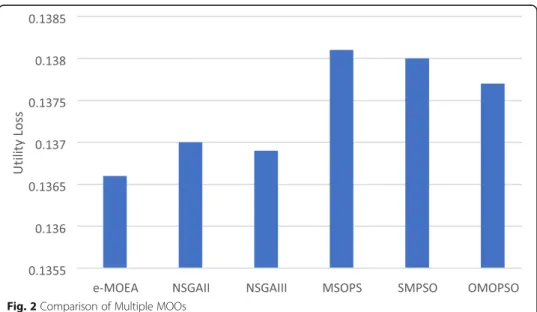
Finally, we compare different multi-objective optimizers (MOOs) by using the solu-tion with combined correcsolu-tions in the one-stage learning as an example. MOEA is se-lected as the best optimizer for two reasons. On one hand, it is able to produce the
solutions with less utility loss as shown in Fig. 2. On the other hand, each MOO can
produce multiple solutions, and the average quality of these solutions by using e-MOEA is the best.
Discussions
First of all, we discuss the validity threats (Wohlin et al., 2012), especially for the
reproduction of this study. There are potentially two major threats. One threat to exter-nal validity for this study involves the representativeness of our subjects and the educa-tional setting. Students and instructors may exhibit different behaviors, preferences or constraints, if the researchers want to reproduce the results by using a similar setting (i.e., course project recommendations). Another threat to external validity for the ex-perimental results come from the parameter tuning and evaluations by using the library MOEA. As mentioned previously, we use the default parameters in MOEA, and just change the number of function evaluations. However, there are several random initiali-zations in the optimizers, which may leads to different running results. It is suggested to run the optimizations for multiple times in order to identify the best solutions.
In this paper, we propose the MSRS for the course project recommendations. Note that our technical approaches rely on the multi-criteria ratings. The proposed methodologies can also be generalized to other educational settings, as long as the multi-criteria ratings are available. In addition, we can extract multi-criteria ratings or preferences based on the technology of review mining (Chelliah, Zheng, Sarkar, & Kakkar, 2019), if they are not available.
Take the book or learning material recommendations for example, Ekstrand et al.
(2018) believed that the suggestions by parents or instructors are useful to help
stu-dents select the appropriate learning materials. In this case, they can develop some cri-teria which are associated with the perspectives from students, parents and instructors, such as the content of the books, the storyline, the appropriateness in terms of age and
gender (Pera & Ng, 2012), the degree of compatibility with students’ major, and so
forth. It is worth mentioning that it is not necessary to let all stakeholders to rate the learning materials on all these criteria. Some criteria, such as the appropriateness in terms of age and gender, may be rated by parents, while other criteria may be rated by other stakeholders. In terms of the after-school program recommendations proposed
by Burke and Abdollahpouri (2016), the constraints from the perspective of the
nizers, such as age and gender, can be developed as the multiple criteria for the orga-nizers only.
Conclusions and future work
There are two major work we plan to do in the future. On one hand, we use utility loss as one of the metrics to select the optimal solution from the Pareto optimal set. However, it is still a challenge to select the optimal solution based on the loss without the information about the tolerance of the utility loss from the perspective of stake-holders. We plan to assign user studies to learn the tolerance of the utility loss in our future work. On the other hand, we believe user studies and user-centric evaluations are much more important than the offline evaluations. The user experience of each stakeholder, such as the tolerance of the utility loss or the preference of pairwise A/B tests, is the major factor to make a decision on the optimal solution. We will design ap-propriate user studies to perform user-centric evaluations, in order to better evaluate the proposed algorithms or solutions in our future work.
Acknowledgements Not applicable.
Author’s contributions
The paper and the research on which the paper is based on are of individual effort. The author read and approved the final manuscript.
Funding Not applicable.
Availability of data and materials
Main data and materials are provided upon request.
Competing interests
The author declares that he has no competing interests.
Received: 26 August 2019 Accepted: 22 October 2019
References
Abdollahpouri, H., Essinger, S.: Multiple stakeholders in music recommender systems. arXiv preprint arXiv:1708.00120 (2017). Adomavicius, G., & Kwon, Y. (2007). New recommendation techniques for multicriteria rating systems.IEEE Intell Syst,
22.3, 48–55.
Burke, R. (2002). Hybrid recommender systems: Survey and experiments.User Model. User-Adap. Inter., 12(4), 331–370. Burke, R., & Abdollahpouri, H. (2016). Educational recommendation with multiple stakeholders. In2016 IEEE/WIC/ACM
international conference on web intelligence workshops (WIW)(pp. 62–63). IEEE proceedings, Piscataway.
Burke, R., Zheng, Y., & Riley, S. (2011). Experience discovery: Hybrid recommendation of student activities using social network data. InProceedings of the 2nd international workshop on information heterogeneity and fusion in recommender systems
(pp. 49–52). ACM Proceedings, New York.
Burke, R. D., Abdollahpouri, H., Mobasher, B., & Gupta, T. (2016). Towards multi-stakeholder utility evaluation of recommender systems. InUMAP (Extended Proceedings).
Chelliah, M., Zheng, Y., Sarkar, S., & Kakkar, V. (2019). Recommendation for multi-stakeholders and through neural review mining. InProceedings of the 28th ACM international conference on information and knowledge management. ACM Proceedings, New York.
Deb, K.: A fast multi-objective evolutionary algorithm for finding well-spread pareto-optimal solutions. KanGAL Report No 2003002 (2003).
Deb, K., Pratap, A., Agarwal, S., & Meyarivan, T. (2002). A fast and elitist multiobjective genetic algorithm: Nsga-ii.IEEE Trans. Evol. Comput., 6(2), 182–197.
Deb, K., & Sundar, J. (2006). Reference point based multi-objective optimization using evolutionary algorithms. InProceedings of the 8th Conference on Genetic and Evolutionary Computation(pp. 635–642).
Drachsler, H., Verbert, K., Santos, O. C., & Manouselis, N. (2015). Panorama of recommender systems to support learning. In
Recommender Systems Handbook(pp. 421–451). Springer, US.
Ekstrand, M. D., Azpiazu, I. M., Wright, K. L., & Pera, M. S. (2018). Retrieving and recommending for the classroom.ComplexRec, 6(2018), 14.
He, Q., Pei, J., Kifer, D., Mitra, P., & Giles, L. (2010). Context-aware citation recommendation. InProceedings of the 19th international conference on world wide web(pp. 421–430). ACM.
Hughes, E. J. (2003). Multiple single objective pareto sampling. InEvolutionary Computation, 2003. CEC’03. The 2003 Congress on (Vol. 4, pp. 2678–2684). IEEE proceedings, Piscataway.
Koren, Y., Bell, R., & Volinsky, C. (2009). Matrix factorization techniques for recommender systems.Computer, 8, 30–37. Nebro, A. J., Durillo, J. J., Garcia-Nieto, J., Coello, C. C., Luna, F., & Alba, E. (2009). Smpso: A new pso-based metaheuristic for
multi-objective optimization. InComputational intelligence in Miulti-criteria decision-making, 2009. Mcdm’09. Ieee symposium on (pp. 66–73). IEEE proceedings, Piscataway.
Pera, M. S., & Ng, Y.-K. (2012). Personalized recommendations on books for k-12 readers. InProceedings of the fifth ACM workshop on research advances in large digital book repositories and complementary media(pp. 11–12). ACM Proceedings, New York.
Pera, M. S., & Ng, Y.-K. (2013). What to read next?: Making personalized book recommendations for k-12 users. InProceedings of the 7th ACM conference on recommender systems(pp. 113–120). ACM Proceedings, New York.
Pizzato, L., Rej, T., Chung, T., Koprinska, I., & Kay, J. (2010). Recon: A reciprocal recommender for online dating. InProceedings of the fourth ACM conference on recommender systems(pp. 207–214). ACM Proceedings, New York.
Sierra, M. R., & Coello, C. A. C. (2005). Improving pso-based multi-objective optimization using crowding, mutation and -dominance. InInternational conference on evolutionary multi-criterion optimization(pp. 505–519). Springer, Berlin, Heidelberg.
Valizadegan, H., Jin, R., Zhang, R., & Mao, J. (2009). Learning to rank by optimizing ndcg measure. InAdvances in Neural Information Processing Systems(pp. 1883–1891).
Wohlin, C., Runeson, P., H¨ost, M., Ohlsson, M. C., Regnell, B., & Wessl’en, A. (2012).Experimentation in Software Engineering. Springer, Berlin, Heidelberg.
Yu, H., Liu, C., & ZHANG, F. (2011). Reciprocal recommendation algorithm for the field of recruitment.J Inf Comput Sci, 8(16), 4061–4068.
Zheng, Y., Pu, A. (2018a). Utility-based multi-stakeholder recommendations by multi-objective optimization. InProceedings of the 2018 IEEE/WIC/ACM international conference on web intelligence. IEEE proceedings, Piscataway.
Zheng, Y. (2018b). Personality-aware decision making in educational learning. InProceedings of the 23rd international conference on intelligent user interfaces companion(p. 58). ACM Proceedings, New York.
Zheng, Y.(2019a). Multi-stakeholder personalized learning with preference corrections. In Proceedings of the 18th IEEE International Conference on Advanced Learning Technologies (ICALT). IEEE proceedings, Piscataway.
Zheng, Y. (2019b). Utility-based multi-criteria recommender systems. InProceedings of the ACM symposium on applied computing. ACM Proceedings, New York.
Zheng, Y., Dave, T., Mishra, N., & Kumar, H. (2018). Fairness in reciprocal recommendations: A speed-dating study. InAdjunct publication of the 26th conference on user modeling, adaptation and personalization(pp. 29–34). ACM Proceedings, New York.
Zheng, Y., Ghane, N., & Sabouri, M. (2019). Personalized educational learning with multi-stakeholder optimizations. InAdjunct Proceedings of the ACM Conference on User Modelling, Adaptation and Personalization. ACM.
Publisher’s Note