Background
The growing problem of overweight and obesity in European children has been widely recognised. The World Health Organization (WHO) states that one in five children in the WHO European Region is overweight and the prevalence is rising steadily. By 2010 it is estimated that 15 million children and adolescents will be obese [1].
Health education programmes targeting the prevention of obesity are focusing on all age groups [5]. The need for early intervention has become obvious and many programmes are hence targeted towards young children [6]. The effectiveness of these intervention programmes is difficult to measure [7,8].
Most intervention programmes are not successful with no or little impact on obesity [8]. Three main determinants however help in being more successful: using a whole kindergarten and
school approach, underpinning the intervention with a theoretical model and involving the school environment, families and the wider community.
There are several reasons for the non-effectiveness of interventions. One is the lack in understanding the precise factors that influence childhood obesity and how these are interacting. A summary of possible determinants of obesity has been listed by the WHO Regional Office for Europe as background material for the WHO
European Ministerial Conference on
Counteracting Obesity [4].
In Germany, a basic concept for education that includes the development of psychological and pedagogical facts, describing what children should learn in which part of their life, does not exist. Hence, dietary attitudes and behaviour, according to the child’s different needs, can not be directly influenced [3,9-12].
Parent involvement when developing health education programmes
Holger Hassel, Katharina M Keimer
Bremen Institute for Prevention Research and Social Medicine (BIPS), University of Bremen, Bremen, Germany
Correspondence to: Holger Hassel, Bremen Institute for Prevention Research and Social Medicine, University of Bremen, Linzer Strasse 10, D-28359 Bremen. E-mail: [email protected]
Abstract
Background: The problem of obesity in children and adults has been widely recognised and described in the literature [1]. There are several challenges leading to an augmentation of the problem. Firstly, the aetiology of overweight and obesity is not clear. Secondly, the long term effectiveness of prevention programmes is low. Only in some groups and for a short period of time an effect may be visible [2]. Thirdly, little is known about what children should learn when [3]. A proper concept of educating children in regard to healthy eating or physical activity does not exist.
As far as we know an essential pre-requisite for health education programmes is that they are lifestyle-oriented and easily transferable into daily family life [4]. For this, working together with the parents would be essential.
The main goal of this article will be
1) to get a better understanding of what parents and nurses/ teachers want
2) to strengthen the point that this method is one way to involve the target groups and thus it is likely to increase the acceptance of health education programmes
3) to describe that focus group discussions are a useful tool to identify the opinions of the target group.
Methods: In the frame of three projects, focus groups with nurses/ teachers and parents have been carried out.
Results and Conclusions: Results from different focus group discussions with pedagogues and parents will be discussed and conclusions for health education programmes relevant to all key players involved will be identified.
According to recommendations, in Germany children should cover 1/3 of their energy intake with breakfast [13]. However, more than 1/3 of the children do not eat breakfast at home or do not bring along any food for the kindergarten/ school breaks [14,15]. The heterogeneity lying within the aims of education, as well as in the contents and methods of health education in kindergartens and schools is causing difficulties. In intervention programmes, e.g. for the prevention and treatment of obesity in children, the choice and organisation of learning processes are only partially guided by theory. The bases for interventions are overwhelmingly social-cognitive and behavioral-therapeutically oriented [8,16,17]. The evaluated outcomes such as loss of weight, modification in diet or increase in physical activity could be stabilized only to a limited extent in the long run (more than 12 months) [2,8,12].
Other reasons for the non-effectiveness are the implementation of a programme only in one setting and the inability to reach children and parents from lower social backgrounds. Muller et al. [18] suggest that targeting children only through school intervention programmes leaves aside the influence of the family on overweight in children [19]. This seems to influence the acceptance of the programme and complicates through this the long-term modification of the child’s behaviour. The child’s modified behaviour can presumably not be placed in line with the lifestyle of parents and siblings [8,20]. In addition, it has been highlighted by several authors that intervention programmes are more successful in children from higher social classes than in those from lower ones and if parents were active partners in the intervention [2,16,21-25].
It is assumed that through the involvement of parents in health education it is more likely that the acceptance and motivation of children is improved. This again will lead to better long-term effects of the programme.
The aim of this paper is firstly to highlight and explain what parents and pedagogues want in terms of health education and what kind of support they need. And secondly to show how target groups could be more intensely involved in the development and implementation of health education. It is assumed that in this way the collaboration between kindergartens/ schools and the family can be increased. Lastly, the paper points out that focus groups are a useful tool to identify the opinions of the target group and to involve them in the development of the intervention.
Method
A focus group describes a group of individuals selected and assembled to discuss a topic of relevance. It is a qualitative research method that permits the development of concepts. This technique generates detailed and valid data that permit the formulation of new hypotheses and informs about further study or practice [26].
In a focus group, people with a similar background or experience are gathered to discuss a specific topic. Focus groups provide the possibility to qualitatively find out what target groups (e.g. parents, nurses and teachers) feel to be important in e.g. barriers and facilitating factors in health education [27-29].
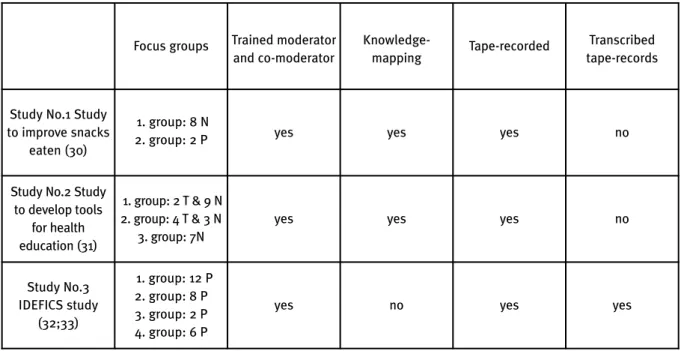
Focus groups have been undertaken in the frame of three different studies and built the basis for this article. These are (see also Table 1):
Study No.1) One focus group with parents and one focus group with nurses in the frame of an intervention to improve the snacks eaten during breaks by 4 to 5 year-olds in kindergartens in Bremen, Germany in January 2007 [30],
Study No.2) three focus groups with nurses and teachers were conducted in a study to develop tools for health education in five to six year-olds in kindergartens and primary schools in Berlin, Germany, in March 2006 [31] and
Study No.3) four focus groups, carried out in Delmenhorst, Germany, from February to April 2007, with parents of kindergarten and of primary school children as part of a European study named IDEFICS, will provide the necessary input and serve as examples here [32,33].
The focus groups were undertaken using different questioning routes, according to each of the three studies they were part of. All included comparable questions about healthy living. Thus they offered valuable information on the topic “Parent involvement when developing health education programmes”. The following topics were covered in all focus groups: information channels, the role of parents and pedagogues in the process of health education, the co-operation between parents and nurses/ teachers and the possibilities of parents to be involved in health education processes.
All focus groups have been undertaken in an environment familiar to the participants and were offered at different times of the day to increase participation. The settings were schools or kindergartens, where the pedagogues work and where the parents send their children.
views, engage in discussions or shape the view of the outcome. A co-moderator, trained in a two-day workshop as well as the moderator, was also present during all focus groups [29]. The co-moderator stayed in the background and did not participate in the discussion.
For the focus groups undertaken in study No.1 and study No.2, knowledge-mapping was employed to summarise and analyse the focus group results. Knowledge-mapping is a technique that helps visualising and structuring complex topics. This method describes the process of creating a knowledge map [29]. Using this technique, the co-moderator groups the comments of participants and pins them on a black board according to main topics previously identified using the questioning route as a basis. The grouped comments are visible at all times to the focus group participants, thus allowing to easily identify missing comments and to summarise the session at the end.
In addition, all focus groups were audio-taped, thus ensuring that no data were lost. The focus groups in study No.3 was transcribed using the audio-taped session. For details which methods were used in which of the three studies, see Table 1. The results concerning what pedagogues want in relation to health education will be presented first. Following are the results of focus groups being held with parents.
Results
What do pedagogues want?
The collaboration with parents is considered as important by the nurses and teachers [30,31].
However, the practical experience looks different. Generally, information evenings are offered in order to enlighten parents about a healthy nutrition for school breaks. This offer is used only by a fraction of the parents mainly by those with a high or middle socio-economic background. Precise figures are not available [30].
Direct involvemente of the parents:
What are the possibilities seen by nurses/ teachers in kindergartens and primary schools to involve parents in the daily teaching experience? Within Study No. 1, the snacks eaten during breaks, especially those of children from families with a low socio-economic background, were discussed with nurses as well as further possibilities of a participation of parents [30]:
Nurses realized that they are dealing with different types of parents, who, for example, have different resources of time at their disposal (employees, manual workers, single parents and others). Based on the findings, tailor made interventions were developed for the different kindergartens. Nurses could choose beside the basic programme, from further modules for the intervention. Nurses expressed their content of being able to discuss in a group and choose from different modules. As activities for the parents, a “parent café”, preparing meals with parents or an afternoon for tasting food for parents and their children were offered. The study was running until summer 2007. Precise results concerning the participation of parents have yet to be compiled [30].
Table 1. Focus groups and methods of data collection employed in the three studies
T = Teachers; N = Nurses; P = Parents
Focus groups Trained moderator and co-moderator
Knowledge-mapping
Tape-recorded Transcribed tape-records
Study No.1 Study
to improve snacks
eaten (30)
1. group: 8 N
2. group: 2 P yes yes yes no
Study No.2 Study
to develop tools
for health
education (31)
1. group: 2 T & 9 N
2. group: 4 T & 3 N
3. group: 7N
yes yes yes no
Study No.3
IDEFICS study
(32;33)
1. group: 12 P
2. group: 8 P
3. group: 2 P
4. group: 6 P
Transfer:
Transfer exercises have been described to pedagogues during focus group discussions as practice of healthy behaviour, which children can train in daily life situations. Which are the possibilities seen by nurses/ teachers in kindergartens and primary schools to assist children to use the knowledge in daily life? In the context of focus group discussions concerning the development of media, nurses/ teachers describe the importance to teach children nutrition knowledge but they reject undertaking transfer exercises [31]. What are the reasons for rejecting transfer exercises?
To find out about this, the following case study was discussed with nurses/ teachers during focus groups:
Based on nutrition habits in Germany, breakfast and also snacks eaten during breaks at kindergartens and schools are considered an essential meal. A group of children, aged five to six, has undertaken the following steps on health education in the past weeks:
1.Learning about the composition of healthy ingredients of a food box for breaks,
2.Introducing the nutrition pyramid [34]. What possibilities do pedagogues see as further step for intervention?
As a goal it was defined that children had to apply what they had learnt to their own snacks for breaks. Nurses and teachers describe five possibilities for further steps based on their practical experience. These can be summarized as follows:
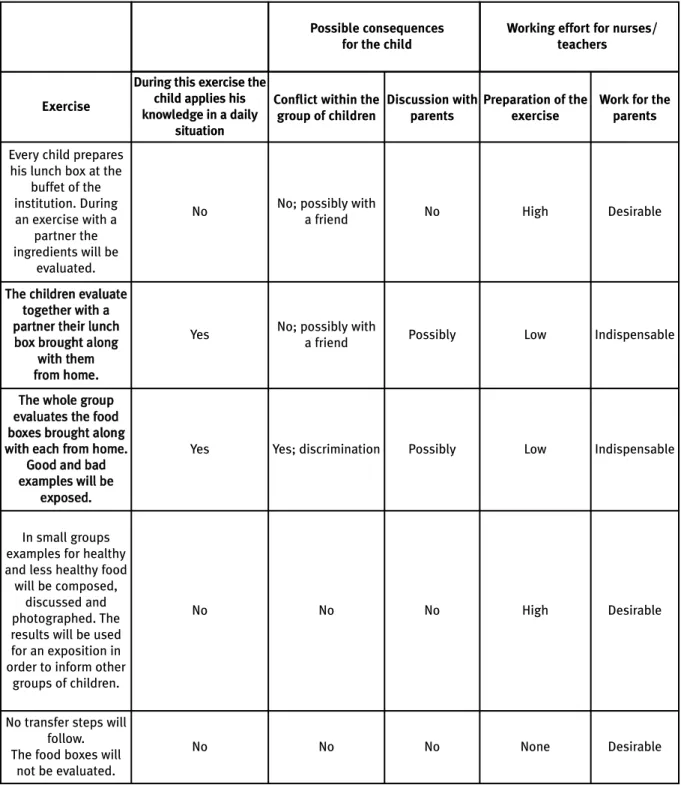
1.Every child prepares his lunch box at the buffet of the institution. During an exercise with a partner the ingredients will be evaluated. 2.The children evaluate together with a partner
their lunch box brought along with them from home.
3.The whole group evaluates the food boxes brought along with each from home. Good and bad examples will be exposed.
4.In small groups examples for healthy and less healthy food will be composed, discussed and photographed. The results will be used for an exposition in order to inform other groups of children.
5.No transfer steps will follow. The food boxes of children will not be evaluated.
In the focus groups, most nurses/ teachers disagreed with implementing exercises 2 and 3 in order to avoid disputes with the parents. In particular, teachers themselves describe that they are not perceived as experts acting as a role model and to practice healthy eating with the children.
What do parents want?
According to parents’ views, what role do diet and physical activity play in the health of their children? What role do parents play in the promotion of health? And what is the role of nurses and teachers, according to the parents? Where do parents see a potential for improvement and possibilities to be involved?
As a result of analysing focus groups [30;32;33] (Study No.1 and Study No.3) parents see a great responsibility in offering a balanced diet at home. A balanced diet was understood in the sense that healthy foods (vegetables, fruits) should always be available but that also unhealthy foods (sweets, chocolate) were not forbidden. All parents also stated that common meals (at least once per day) were very important for the wellbeing of their child.
When it comes to offering a balanced diet, the kindergarten, on one side, is perceived as playing a greater role than the school. Parents of younger children agree that the kindergarten by providing a different environment can motivate children to try out new foods. Rules and regulations set by the kindergarten, like bringing vegetables or fruits to kindergarten, eating together and sharing dishes, is perceived as very important in keeping a healthy diet. However, common breakfast in the setting are often only realized as individual projects in kindergartens. The nurse in her/ his function as a role model is perceived by all parents as very important.
The school, on the other side, is not perceived as important in providing a healthy diet. When children are of school-age, parents see the responsibility of taking care of healthy eating to be theirs.
In relation to physical activity, parents agreed that it is mainly their responsibility in motivating the child to do more sports. However, most parents also stated that in their opinion their child had a natural drive for being active. Simply the parent’s own laziness sometimes stopped their child from being active; for example at the weekend when a family activity could be planned. Additionally, a lot of parents stop their child from being physically active in the house or flat.
motivator for the children to be more physically active.
As a general theme worked out, parents describe their own responsibility in relation to their children’s health. Hence, they wish to be included in health education. Some parents for example described initiatives like breakfast buffet where they are or would like to be involved. The role of nurses is seen as important and working together at the kindergarten level would be less of a problem than at the school level because nurses are seen as a role model. The role of the teacher is predominantly understood as transferring knowledge to the child but not as an expert in giving advice in health related topics. Parents appreciate working more closely together with nurses and teachers.
Discussion
For the development and long-lasting realisation of intervention programmes, the communication between pedagogues and parents is essential but has been researched relatively little. For this reason it was helpful to analyse the focus group discussions at hand in terms of claims and wishes of the parents and pedagogues. However, it should not be ignored that the discussions were held on the basis of different questioning routes. The qualitative results described in this article can be used for further, deeper analysis of opinions and attitudes of the target groups.
In order to develop effective health education programmes it is essential to involve the family (especially the parents) in the work carried out by pedagogues. The idea behind is three-fold.
(1) The acceptance of the programme is enhanced through involving the parents/ family. (2) And it increases the motivation for sticking to the programme and thus also the likelihood of the programme being transferred into daily-living routines. (3) Involving the parents would also increase the likelihood of reaching more children, also those from lower social backgrounds.
Through summarizing the results of focus groups with key players, we have worked out that a greater co-operation between target groups is both perceived as essential and generally wanted. The results of what children want have also been collected through focus groups in Study No.3 but are not available yet. These may be part of a forthcoming publication.
Participation
The focus groups have shown that the target group is enthusiastic about being “interviewed”. It should however be mentioned at this point that
conducting focus groups especially with teachers have been proven to be difficult. These difficulties shall not be discussed further at this point, will however be part of another publication. For the planning and development of an intervention a wide participatory quality development is to be hoped for [35,36]. Otherwise the danger that well-meant and inevitable orientations as well as formal, functionally sensible curricula can not be transferred adequately into practice remains. Additionally, most programmes for the prevention of obesity would only work insufficiently in the long-term, as already indicated above [16,37]. The access to e.g. the family and also the school setting remains closed (low acceptance of parents and of pedagogues) and/ or the intervention does not have the longed for effect, as it is the case in obesity prevention [2,18,20]. In one of the studies [30], it could be implied that by offering the possibility to choose from additional tailored intervention modules, the acceptance of these measures by the nurses could be increased.
What do pedagogues need?
How difficult it is to develop programmes with a theoretical background concerning health education, to interpret transfer exercises and to co-operate with the parents was made transparent by giving an example about healthy nutrition during school breaks.
An accompanying, intensive work with the parents is described as vital from the side of the pedagogues. However, in practice the co-operation with the parents is often only realised in the form of informational talks, which are less directed towards a pedagogical discussion. Parents, especially single parents, in difficult social circumstances often do not even participate in those parent-teacher conferences.
It is, among other goals, the aim that the children do not only get to know healthy eating during breaks but that they also take it from home and finish eating it. Part of the nutrition education should be not to discriminate children who are provided with insufficient snacks.
Depending on the transfer exercise and based on the case study mentioned above, different social consequences arose for the child, who did not bring along healthy food for breaks, as well as for the nurses/teachers, who were dealing with a different work effort (compare with Table 2).
The various examples show different
The forth example of the exercise makes the collaboration with the parents unnecessary. However, it means a bigger transfer step (with more effort for teachers) than the first exercise. Here the children are the experts who present their knowledge to others and explain it. This way of learning enables a strong transfer [31].
If the children evaluate the lunch box brought along with them (second example), this exercise will generally be executed together with a friend from the group. Even giving a critical reaction, the
discussion will be kept under control and remain friendly. Theory and practice merge in the real situation of having breakfast during the break. In case of some children bringing along with them no or deficient food boxes, the evaluation by the group could create a source of discrimination (third exercise).
In examples two and three (highlighted in light), the child (and therefore also indirectly the parents) receives specific information about the food they bring along. For this reason such an
Table 2. Examples of exercises for transfer “healthy lunch box”
Exercise
During this exercise the child applies his knowledge in a daily
situation
Conflict within the group of children
Discussion with parents
Preparation of the exercise
Work for the parents
Every child prepares
his lunch box at the buffet of the institution. During an exercise with a
partner the
ingredients will be evaluated.
No No; possibly with
a friend No High Desirable
T
Thhee cchhiillddrreenn eevvaalluuaattee ttooggeetthheerr wwiitthh aa p
paarrttnneerr tthheeiirr lluunncchh b
booxx bbrroouugghhtt aalloonngg
w
wiitthh tthheemm ffrroomm hhoommee..
Yes No; possibly with
a friend Possibly Low Indispensable
T
Thhee wwhhoollee ggrroouupp e
evvaalluuaatteess tthhee ffoooodd b
booxxeess bbrroouugghhtt aalloonngg
w
wiitthh eeaacchh ffrroomm hhoommee.. G
Goooodd aanndd bbaadd e
exxaammpplleess wwiillll bbee e
exxppoosseedd..
Yes Yes; discrimination Possibly Low Indispensable
In small groups examples for healthy
and less healthy food will be composed,
discussed and photographed. The results will be used
for an exposition in order to inform other
groups of children.
No No No High Desirable
No transfer steps will follow.
The food boxes will not be evaluated.
No No No None Desirable
Working effort for nurses/ teachers Possible consequences
intervention requires a before and after preparation together with the parents. The pedagogue knows his/her group. He/ She knows who of the children brings along insufficient snacks. For this reason he/ she will prepare himself/ herself professionally for possible conflicts in the group (e.g. putting the partner exercise number two before number three) and intervene if necessary.
The teachers avoid a direct discussion with the parents regarding the specific nutrition behaviour and attitudes within the family. This is probably due to the fact that it means additional work for them and the parents. For these cases the pedagogues seem to need intensified support, like low-threshold, simple communication exercises between children and parents [38]. Health education only makes sense and serves a purpose if examples for daily living are given and if the learned behaviour can also be transferred. Pedagogues need greater support for a constructive co-operation that does not remain on the surface.
What do parents need?
In general, most parents want to be involved. Parents are ready to actively participate in the health education of their children and want to work together with the pedagogues.
It is essential to schedule the co-operation at an early stage. In the kindergarten the co-operation with the parents should begin and act as a preparation for the collaboration in school. The transfer from kindergarten to school has to be well prepared, so that the parents can rearrange their everyday family life as early as possible.
The co-operation, especially in the school needs to be improved. The roles of teachers and parents need to be clarified. Primary schools in Germany are usually not full-time schools. Hence, children in primary school bring their own snacks from home, for which parents see the responsibility to lie with themselves. Teachers are not expected to act as a role model for healthy eating. In addition, teachers themselves describe that they are not perceived as experts in relation to this topic. The role of teachers in relation to giving health education needs to be strengthened.
Similar to the way it is in kindergartens, in schools the pedagogue should be a partner of the parents and should be campaigning for a healthy lifestyle. In essence, questions of education need to be agreed upon by teachers and parents. This way, the parents would more easily accept advice. Parents need to be encouraged to be more physically active, since at the moment they do not assume responsibility. Parents principally expect
that their child is encouraged to be physically active in/ by the school or kindergarten. Pedagogues could offer support when working with parents in relation to physical activity education - more active leisure activities could be strived for.
According to the experiences of pedagogues, there are various types of parents that also need different kinds of advice. The main differentiating factor lies in the time resources available. There are those parents who have time to set up own initiatives, like „parent cafés”. Other parents can only be won for a short informal informational talk, e.g. when picking up their child.
Conclusions
The co-operation with parents is assumed to be one way to lead to a stabilisation of the newly learned behaviour. To achieve this, a comprehensive psychologically oriented health education programme, in which the collaboration with parents is integrated as an essential column, needs to be developed. Through the analysis of focus groups results, we are able to line out that the co-operation between pedagogues and parents is possible on four levels:
1.through developing an intervention in co-operation with the parents
2.through pedagogical work with children (as an example the teachers/ nurses give the task to prepare a sandwich at home with their parents; for this a discussion with parents will be necessary; action-oriented and transfer ensured) 3.through information and advice (nurses/ teachers inform and discuss with the parents; improvement of collaboration; an example are parent-teacher conferences where a topic such as motivation of less television viewing is discussed)
4.through direct involvement of the parents into the kindergarten/ school setting (e.g. parents organise a healthy breakfast buffet once a week at school/ in the kindergarten).
Differential models that are described on the four levels of parent collaboration need to be worked out and evaluated by pedagogues and parents.
Pedagogues need help on how to communicate and motivate parents with the goal to actively involve parents in the pedagogical work.
Acknowledgements
This work was done as part of the IDEFICS
Study (www.idefics.eu). We gratefully
Framework Programme Contract No. 016181 (FOOD). The information in this document reflects the author’s view and is provided as is. No guarantee or warranty is given that the information is fit for any particular purpose. The user thereof uses the information at its sole risk and liability.
References
1) Wang Y, Lobstein T. Worldwide trends in childhood overweight and obesity. International Journal of Pediatric Obesity 2006; 1:11-25. 2) Stice E, Shaw H, Marti CN. A meta-analytic review of obesity prevention programs for children and adolescents: the skinny on interventions that work. Psychol Bull 2006; 132(5):667-91. 3) Birch L, Fisher J. Development of eating behaviours among children and adolescents. Pediatrics 1998; 101,539-49.
4) World Health Organization. The challenge of obesity in the WHO European Region and the strategies for response. WHO European Ministerial Conference on Counteracting Obesity, Istanbul, Turkey 2006;1-76.
5) World Health Organization. Nutrition, physical activity and prevention of obesity: recent policy developments in the WHO European region. WHO European Ministerial Conference on Counteracting Obesity, Istanbul, Turkey 2006;1-59.
6) Dietz WH. Health consequences of obesity in youth: childhood predictors of adult disease. Pediatrics 1998; 101(3 Pt 2):518-25. 7) Campbell K, Waters E, O'Meara S, Kelly S, Summerbell C. Interventions for preventing obesity in children. Cochrane Database Syst Rev 2002;(2).
8) Summerbell CD, Waters E, Edmunds LD, Kelly S, Brown T, Campbell KJ. Interventions for preventing obesity in children (review). The Cochrane Collaboration 2005; 3(4):1-71.
9) Bayerisches Staatsministerium für Arbeit und Sozialordnung, Familien und Frauen (Hrsg.). Der Bayerische Bildungs- und Erziehungsplan für Kinder in Tageseinrichtungen bis zur Einschulung. München 2006.
10) Sächsisches Staatsministerium für Soziales (Hrsg.). Der sächsische Bildungsplan - ein Leitfaden für pädagogische Fachkräfte in Kinderkrippen und Kindergärten. Netz Verlag, 2006; Weimar, Berlin.
11) Universität Padeborn (Hrsg.). Reform der Ernährungs-und Verbraucherbildung in Schulen 2003-2005. (REVIS). Schlussbericht für das Bundesministerium für Verbraucherschutz, Ernährung und Landwirtschaft, Paderborn 2005.
12) Contento I, Balch G, Bronner Y. The effectiveness of nutrition education and implications for nutrition education policy, programs and research. Journal of nutrition education 1995; 27:279-418.
13) aid-Nachschlagewerk. Essen und Trinken in Schulen. Bonn, 2006; Bestell-Nr. 3839.
14) WHO Regional Office for Europe (Hrsg.). Food and nutrition policy for schools. A tool for the development of school nutrition programmes in the European Region. Programme for Nutrition and Food Security. Copenhagen 2006.
15) World Health Organization (Hrsg). Young people's health in context. Health Behavior in School Aged Children (HBSC) study: International report from the 2001/2002 survey. Health Policy for children and Adolescents No 4 2004.
16) Epstein LH, Myers MD, Raynor HA, Saelens BE. Treatment of pediatric obesity. Pediatrics 1998; 101(3 Pt 2):554-570. 17) Caballero B. Obesity prevention in children: opportunities and challenges. Int J Obes Relat Metab Disord 2004; 28 Suppl 3:S90-S95.
18) Muller MJ, Danielzik S, Pust S. School- and family-based interventions to prevent overweight in children. Proc Nutr Soc 2005; 64(2):249-54.
19) Golan M, Crow S. Parents are key players in the prevention and treatment of weight-related problems. Nutr Rev 2004;
62(1):39-50.
20) Müller MJ, Reinehr T, Hebebramd J. Prävention und Therapie von Übergewicht im Kindes- und Jugendalter. Deutsches Ärzteblatt 2006; Heft 6:334-340.
21) Blättner B, Mueller KK, Grewe A. Adipositasprogramme für Kinder und Jugendliche- Weshalb sind sie nur bei manchen Kindern erfolgreich? Prävention Gesundheitsförderung 2006; 1:121-127.
22) Pott E, Lehmann F. Intervention zur Gesundheitsförderung bei Kindern und Jugendlichen aus sozial benachteiligten Gruppen. Bundesgesundheitsblatt Gesundheitsforschung Gesundheitsschutz 2002; 45:976-983.
23) Epstein LH, Wing RR, Woodall K, Penner BC, Kress MJ, Koeske R. Effects of family-based behavioural treatment on obese 5-to-8-year-old children. Behav Ther 16, 1985; 205-12.
24) Epstein LH, Valoski A, Wing RR, McCurley J. Ten-year follow-up of behavioural, family-based treatment for obese children. JAMA 1990; 264(19):2519-523.
25) Caballero B. Obesity prevention in children: opportunities and challenges. Int J Obes Relat Metab Disord 2004; 28 Suppl 3:S90-S95.
26) Powell RA, Single HM. Focus groups. Int J Qual Health Care 1996; 8(5):499-504.
27) Freeman T. 'Best practice' in focus group research: making sense of different views. J Adv Nurs 2006; 56(5):491-97. 28) University of Ghent. Study manual for qualitative research and documentation sheets for qualitative research. Internal Document 2006.
29) Pelz C, Schmitt A, Meis M. Knowledge Mapping als Methode zur Auswertung und Ergebnispräsentation von Fokusgruppen in der Markt- und Evaluationsforschung. Forum: Qualitative Social Research 2004; 5(2).
30) Hassel H, von Atens-Kahlenberg W, Bosche H. Optimierung der mitgebrachten Pausenverpflegung in Kindertagesstätten. Teilprojekt im Rahmen von Evaluationstools, Abschlussbericht. Bremen 2007; im Druck.
31) Hassel H. Ernährungserziehung in Kita und Schule. Fokusgruppengespräche zur Bedarfsermittlung von Beratungsmaterialien. Auswertungsbericht. aid, unveröffentlichter Bericht, Bonn 2006.
32) Ahrens W, Bammann K, de Henauw S, Halford J, Palou A, Pigeot I et al. Understanding and preventing childhood obesity and related disorders--IDEFICS: a European multilevel epidemiological approach. Nutr Metab Cardiovasc Dis 2006; 16(4):302-8.
33) University of Bremen. Summary report on results of qualitative research (focus groups) as supportive material for development of intervention modules for UNIHB (Germany). Unpublished Report 2007.
34) aid Infodienst (Hrsg.). Glever essen und trinken mit der aid-Kinderpyramide. Baustein für erlebnisorientiertes Lernen in der Grundschule. Ernährung im Fokus 6-08, 2006.
35) Kolip P. Evalution, Evidenzbasierung und Qualitätsentwicklung. Zentrale Herausforderungen für Prävention und Gesundheitsförderung. Prävention und Gesundheitsförderung 4, 2006; Springer Medizin Verlag.
36) Wright M. Partizipative Qualitätssicherung und Evaluation für Präventionsangebote im Setting. In: Rosenbrock R, Bellwinkel M, Schröer A (Hrsg.): Primärprävention im Kontext sozialer Ungleichheit. Bremerhaven 2004;297-346.
37) Summerbell CD, Ashton V, Campbell KJ, Edmunds L, Kelly S, Waters E. Interventions for treating obesity in children. The Cochrane Collaboration 2005; 4.