PORT OF PLYMOUTH
CATTEWATER HARBOUR
COMMISSIONERS
2 The Barbican, Plymouth, PL1 2LRTel: 01752 665934 Fax: 01752 253624 e-mail: [email protected]
PLYMOUTH PILOTAGE
SERVICE
2 The Barbican, Plymouth, PL1 2LR
Tel: 01752 662708 Fax: 01752 669691
e-mail: [email protected] www.plymouthport.org.uk
CODES OF CONDUCT
FOR VESSELS AND CRAFT USING THE CATTEWATER
Reference: Dockyard Port of Plymouth Order 1999
GENERAL
1.
2.
3.
The following Codes of Conduct for the users of the congested water of Cattewater are in amplification of the reference and the international Regulations for the prevention of Collision at Sea.
The codes are in agreement between the representatives of those who use the Cattewater, the City Boat Master and the Cattewater Harbour Master.
Additional copies may be obtained from the: Cattewater Harbour Commissioners, 2 The Barbican, Plymouth. PL1 2LR.
DEFINITIONS
4. MAIN CHANNEL: is an area 200 feet on either side of the lines indicated by the channel beacons on QAB Breakwater; above Sparrow's Quay and on Turnchapel Heights.
SUTTON CHANNEL: is that area north of Fisher’s Nose leading to the entrance to Sutton Harbour and bounded to the east by Queen Anne's Battery Marina.
ORESTON CHANNEL: the marked channel between the mooring trots off Oreston and the Cocklebank.
CODES OF CONDUCT
5. COMMUNICATIONS
All craft fitted with VHF are required to maintain watch on Channel 14 VHF. 6. ALL CRAFT a. b. c. d. e.
Will keep the starboard side of the Channel (See para 18 re canoes). Will give Fisher’s Nose a wide berth.
Will keep a good look-out.
Will clear the channels as required by the Harbour Master, Pilots or Merchant Vessels making the appropriate sound signals.
Are required to keep clear of any yacht mooring areas unless the constraints of navigation require them to enter such areas. Caution should be exercised in such circumstances.
7. PASSENGER VESSELS AND FERRIES a. b. c. d. e. f. g.
Will secure in loading and waiting with a minimum of two berthing ropes. Will not use engines alongside unless required by the safety of the vessel or its passengers.
Will not move off the berth unless certain that their intended route is clear.
Will make the said sound signals which are appropriate to their intended movement. Will not pass through any moorings.
Will not normally use Baltic Wharf as a waiting berth.
Will normally berth at The Barbican Landing Stage under the direction of the Plymouth City Boat Master.
8. SPEED LIMITS a.
b. c.
No vessel will proceed at a speed in excess of 4 knots in Sutton Channel or 8 knots elsewhere in the Cattewater.
All vessels and craft must keep their wash to a minimum, especially on passing loading berths, marinas or mooring areas.
See current Dockyard Port Order for speed limits in Plymouth Sound. 9. BARBICAN LANDING STAGE
Only craft licenced by Plymouth City Council or Cattewater Harbour Commissioners are allowed to use this facility. Use by private craft is not allowed.
10. MOUNT BATTEN PASSENGER LANDING STAGE
All craft passing this area are to keep well clear and reduce their wash.
Craft in transit to and from other areas in the Cattewater are encouraged to use the main channel.
11. JET SKIS/WATER SKI CRAFT & OTHER HIGH SPEED CRAFT a.
a.
Will not exceed 8 knots (soon to be reduced to 6 knots) through the water anywhere in the Cattewater or exceed 4 knots in the Sutton channel. In the interest of safety, Jet Skis and Water Ski craft may not be used for
b. c.
Will not take part in water skiing, towing of inflatable craft, parascending or any other similar type of activity in the Cattewater.
Jet Skis/Water Ski craft may be launched into the Cattewater and driven at slow speed (keeping wash to a minimum) to the designated areas for use, which are in the Jennycliff Bay area of Plymouth Sound and north of Laira Bridge, near Chelson Meadow.
12. SAILING CRAFT - GENERAL
a. Will give way to all vessels over 20 metres in length using the Main, Sutton or Oreston Channels.
b. Will proceed direct from their berths or launching slips to seaward and return direct to berth or slip and not linger in the Channels.
c. Will, if fitted with motor, proceed under power when North of the line joining Fisher’s Nose to the southern extremity of QAB Breakwater.
d. Will not race, linger or free sail in the Sutton Channel. 13. SAILING RACING
a. Racing marks will not be laid in the Main, Sutton or Oreston Channels. b. Will not race through any fore and aft moorings.
c. Notwithstanding any rules in this Code, local clubs’ sailing instructions should be adhered to. Disqualification may result from any deviation.
14. SAIL BOARDS
a. Board sailing will not take place East of a line joining the Yacht Haven Hoist and Victoria Wharves.
b. Will clear the channels on hearing the sound signal D (-..), made by a vessel over 20 metres in length.
15. CRAFT USING QUEEN ANNE'S BATTERY MARINA
a. Craft leaving the marina will give way to traffic navigating through the Sutton Channel.
b. Craft entering the marina will give way to those leaving. 16. DIVING CRAFT AND DIVING OPERATIONS
a. Diving craft will keep well clear of Mount Batten passenger landing stage and reduce wash to a minimum.
b. Diving will not take place in the Cattewater except with the written consent of the Harbour Master.
17. CANOES
a. Will clear the launching slip area immediately after launching. b. Will rendezvous and brief at a point clear of the slips.
c. Local training in Sutton Channel will only take place in an area approved by the Harbour Master
d. Will keep close to Baltic Wharf when leaving and entering Sutton Channel. e. Will cross all channels at right angles.
18. MERCHANT AND OTHER LARGE VESSELS WHEN REQUIRING A CLEAR CHANNEL
a. Will, if requiring the Main or Oreston Channels to be cleared, make the sound signal D (-..).
b. Will, if requiring Sutton Channel to be cleared, make the sound signal D D (-.. -.. ).
RIVER PLYM - ABOVE LAIRA BRIDGE
CODES OF CONDUCT
The following codes of conduct have been agreed between representatives of the water sports involved, the City Boat Master and the Queen’s Harbour Master.
a. b. c. d. e. f. g.
Waterskiing / Jetskiing. Small craft may exceed
the speed limit for the purpose of
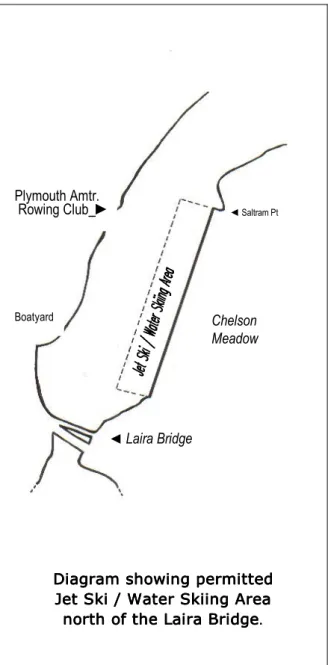
waterskiing/jetskiing in the area off Chelson Meadow marked by yellow buoys and shown on the diagram by a broken line.
Sailboards should launch from the East Beach at Saltram and proceed up river to keep clear of the water/jet ski area and return by the same route. All craft not waterskiing should, for their own safety, keep clear of the water/jet ski area,
although the above notice does not give exclusive
use to water/jetskiers.
All craft should give a wide berth to rowing shells
and avoid creating a wash in their vicinity. Rowing shells are very fragile, have a low freeboard and are most un-manoeuvrable.
All craft are to keep clear of existing moorings and avoid passing through them unless proceeding to or from these moorings.
All craft are reminded that, notwithstanding the above code, in the final event, the provisions of the Rule of the Road for Prevention of Collision at Sea are overriding.
Reports of accidents or near misses should be made to Long Room Port Control, by telephone (01752 836528 or VHF Channel 14) if immediate action is required and should be followed up by forwarding a written report to the Cattewater Harbour Master or the Plymouth City Boat Master.
Diagram showing permitted Diagram showing permitted Diagram showing permitted Diagram showing permitted
Jet Ski / Water Jet Ski / Water Jet Ski / Water
Jet Ski / Water Skiing Area Skiing Area Skiing Area Skiing Area north of the Laira Bridge north of the Laira Bridgenorth of the Laira Bridge north of the Laira Bridge....
◄ Saltram Pt Chelson Meadow Boatyard Plymouth Amtr. Rowing Club ► ◄ Laira Bridge