THE ULTIMATE GUIDE TO
INTRODUCTION
The importance of communicating information in a visual way that people can truly understand is as old as we are. From cave paintings to the earliest maps and graphs, visualizing information has changed the world as we know it.
Today, information and data are everywhere. And yet the skills to present all that data are often lacking
in the modern business professional. We are visual creatures by nature. And in order to succeed in our careers, we need the ability to tell visual stories that excite, inspire and persuade skeptical audiences.
Your business has more data, from more sources, than ever before. But the information being presented, from the boardroom all the way down to the most junior employees, is often scraped together at the last minute and presented in the form of complicated spreadsheets, and over-used powerpoint charts that miss the key insights that can make or break your business.
The most successful managers and executives know how to take vast amounts of often contradicting data and boil it down to the key insights that anyone can understand. To help them, data insights need to be streamlined so that it can get analyzed quickly and presented in the simplest and most powerful way.
Data visualization has emerged as one of the most powerful tools because it can take all the data available, from many sources and convert it into meaningful stories with visual appeal.
We’ve compiled this Ultimate Guide To Data Visualization to help you understand the power of Data Visualization, how visual stories can impact any business, examples of impactful data visualizations, and how you can get started down the path of visualizing the most important insights for your business.
This paper will cover:
What Is Data Visualization?
Why the Human Brain Loves Pictures Streamline the Clutter
What is the Business Impact of Data Visualization?
How to Turn Numbers Into Magic
Examples of Powerful Data Visualization How to Make Data Visualization Work for You What’s Next?
Simple can be harder than complex: You have to work
hard to get your thinking clean to make it simple. But
it’s worth it in the end because once you get there, you
can move mountains.”
WHAT IS DATA VISUALIZATION?
THE HUMAN BRAIN LOVES PICTURES
Data visualization takes data and transforms it into visual stories that have meaning and impact for the audience. According to TechTarget.com¹:
“Today’s data visualization tools go beyond the standard charts and graphs used in Excel spreadsheets, displaying data in more sophisticated ways such as infographics, dials and gauges, geographic maps, sparklines, heat maps, and detailed bar, pie and fever charts. The images may include interactive capabilities, enabling users to manipulate them or drill into the data for querying and analysis. Indicators designed to alert users when data has been updated or predefined conditions occur can also be included.”
We’re innately programmed to process information from images quickly. Concepts can be conveyed, results displayed and conversations held. This transcends into all forms of communication, including internal staff, business partners and customers.
Media theorist John Berger states:
They say “a picture is worth a thousand words.” Psychologist Albert Mehrabian has used scientific studies to prove this out. He has shown that 93% of communication between human beings is in the nonverbal area. Other studies show that language is decoded on a linear level, while images are deciphered on a simultaneous level.
This means that an image can be immediate, while language requires time to analyze.
Data visualization can cut-to-the-chase, saving that critical time and allowing the next step in
developing solutions.
Data visualization is a general term that describes
any effort to help people understand the significance
of data by placing it in a visual context. Patterns, trends
and correlations that might go undetected in text-based
data can be exposed and recognized easier with data
visualization software.”
...unless our words, concepts, ideas are hooked onto
an image, they will go in one ear, sail through the brain,
and go out the other ear. Words are processed by our
short-term memory where we can only retain about 7
bits of information (plus or minus 2).”
BREAKING THROUGH THE NOISE
We are all experiencing ‘information overload’. This condition exists in our personal and business lives and we are on an endless path to try to filter out what we don’t need, analyze what’s important and make the right decisions to act. Yet the process of plowing through everything doesn’t only take time. It takes a tremendous amount of effort.
According to Ted², every day the average internet user experiences:
Every day, there is literally more content uploaded than we could ever consume.
When we add this to the mix of business data we have available inside even the smallest company, it is easy to feel overwhelmed.
Data visualization allows you to break through the noise and puts you in control of the information so that you can craft stunning, relevant images that empowers you to make the best decision on how to drive your business forward.
204,166,667 email messages sent More than 2,000,000 Google searches
684,478 pieces of content added on Facebook $272,070 spent by consumers via online shopping More than 100,000 tweets on Twitter
47,000 app downloads from Apple
34,722 “likes” on Facebook for different brands and organizations
27,778 new posts on Tumblr blogs
3,600 new photos on Instagram 3,125 new photos on Flickr 2,083 check-ins on Foursquare 571 new websites created
347 new blog posts published on WordPress 217 new mobile web users
WHAT IS THE BUSINESS IMPACT OF DATA VISUALIZATION?
HOW TO TURN NUMBERS INTO MAGIC
With the increasing amount of data inside companies, many businesses turned to data warehousing technologies to efficiently manage and normalize data across the enterprise.
Next we looked to complex Business Intelligence software to help with creating reports and executive
dashboards to make sense of all that data. But even with the rise in adoption of Data Warehousing and Business Intelligence software, executives and managers continue to struggle with analyzing and reporting data.
Business Intelligence software requires complex installations, expert-level training, often to those who are the furthest removed from the decision makers in the business. This reliance on expensive software and technical experts makes the job of visualizing important insights challenging in even the most streamlined organizations. Data visualization brings clarity through Business Intelligence (BI), which elevates the existence of your industry through interactive analysis. Data Visualizations empower you to ask important ‘what-if’ questions so that you can see immediate results.
A baselinemag.com article indicates:
Today’s fast pace environment means that you need to endlessly unearth the crux of each message. This is not just a skill - it’s a superpower. But now you can plug information into software, turning stats into stunning images that capture the heart and soul of your customers. Visuals that adjust to varying needs allows information to get synthesized in a way that adds power to your presentations.
But the art of fusing your left and right brains shouldn’t be so complicated. You’re a mere human with one brain that needs to focus on other, more pressing issues. You want to focus on information that’s the most important. But how do you know what will hit the right tone?
These considerations reflect an important lesson
for organizations: While advances in analytics make
it possible to generate a valuable array of potentially
transformative business insights, there is no point
to the exercise if those insights cannot be seen and
understood by the people who are making
the decisions.”
Intuitive data seamlessly provides context to the questions your executives, managers, or customers ask. Your data can now meet art, allowing intuition and interactivity
A 2015 HorizonWatch report states³:
Good data visualization practices help not just to solve
issues but also to pose new questions, encouraging
the discovery and research process to go beyond just
common tasks to explore new patterns and trends
that can potentially boost business efficiency.”
Data visualization
provides your business
with vastly improved decision-making
because time-sensitive decisions can
now be made more easily.
WHAT IS THE
BUSINESS IMPACT OF
DATA VISUALIZATION?
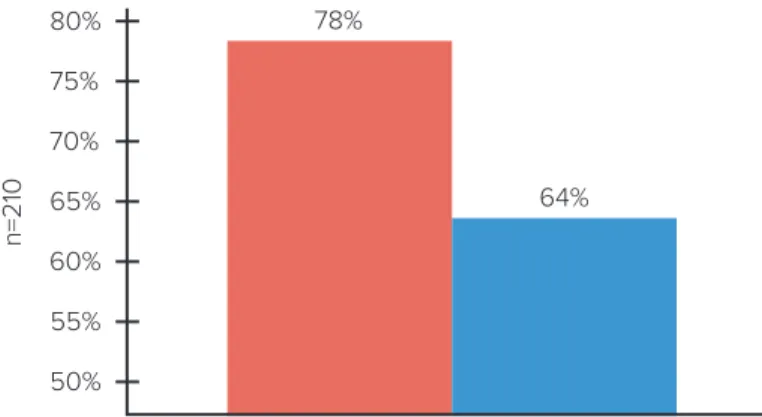
According to research conducted by Aberdeen⁴, organizations with real-time visualization can get
important information within the decision window 78% of the time, or 22% more often than organizations without real-time visualization.
This helps to:
Figure I: The Decision Window
Emphasize details
Allow for more interactivity with your teams Empower your customers to remember more of what you say
Frequency of access to timely information
n=210 78% 64% 80% 75% 70% 65% 60% 55% 50%
EXAMPLES OF POWERFUL DATA VISUALIZATION
BUSES BUNCH
Why Buses Bunch⁵ illustrates just how effective an interactive visual can be:
According to HubSpot⁶:
This interactive image illustrates the importance of time with an event that seems trivial in our day-to-day: Loading and unloading the passengers from a bus. This data visualization allows us to better understand how “buses bunch” in a way that words can’t do alone.
Telling this story in numbers alone would be pretty
difficult, but instead, they turn it into an interactive
game. While the buses rotate along a route, we can
click and hold a button to delay a bus. Then, all we
have to do is watch to see how even a short delay
causes the buses to bunch together after a time.
LANGUAGES IN THE WORLD
This interactive image by Density Design⁷ illustrates the 2,678 languages that are spoken throughout the world. It’s powerful visual storytelling because it takes in-depth subject and breaks it down in a way that’s
U.S. WIND MAP
In this stunning visual of a map of the United States, the visualization depicts something that’s not usually seen by the naked eye: wind. The image is compelling because it illustrates something that’s quite mysterious (the element wind) in a way where numbers aren’t necessary. The intuitive design reveals the speed of the wind immediately and it also allows the viewer to “click to zoom” into the city to get more in-depth detail.
According to the folks at Pew Research Center:
Usually, when a designer has a lot of text that can’t
be left out, they’ll usually organize that information
into a data table in order to make it more compact.”
But this leads to status quo interpretation.
The wind visualization in the above example lets viewers easily see where each data point exists on the map, without numbers that equate to clutter. The end result is a zen-like image that conveys a ton of information - minus any noise.
THE DAILY ROUTINES OF FAMOUS CREATIVE PEOPLE
This visualization showcases the daily schedules of famous creatives broken down by time and activity. Within seconds, you can easily see who likes to sleep, eat, and exercise - and what time they prefer to do it. Your eyes can easily scan down to a name, then scan over to see the activity and the time of day they preferred to do the activity. The color within the design adds to the simplicity of interpretation.
HOW TO MAKE DATA VISUALIZATION WORK FOR YOU
HERE ARE THREE SIMPLE STEPS TO MAKE DATA VISUALIZATION WORK FOR YOUR BUSINESS.
1. Understand the Basics of How Data Gets Interpreted
Get familiar with how the best data gets visualized and interpreted. This ability will allow you to be more effective at building compelling visuals. It empowers you to understand both the ‘inner and outer’ aspects of data flows so that you can understand what works and what doesn’t. The skill lies in pulling it all together.
2. Impact is More Important than Interesting
Data visualization allows you to create a whole new world of interesting images. But the most important element is whether that image can make an impact. The image needs to drive compelling conversations around your industry so that it drives business change. This creates a situation that’s practical and intuitive. Drive your ideas in a clear direction, know what you are seeking, and then work the thoughts through to create insights that get revealed in a compelling way.
3. Know Your Target Audience
This is an overused tagline but it’s still important. You’re endlessly asked to tailor your message so that it’s useful to your audience - so you’ll need to know your audience first. Understand them and think of their most important questions ahead of time so that you can get empowered to create, consider, and respond in a timely manner. Gain the ability to perform ad-hoc data analysis that speaks the same language as your target audience through powerful visuals.
WHAT’S NEXT?
REFERENCES
Data visualizations are crucial to today’s business. But a few questions still remain:
1. http://searchbusinessanalytics.techtarget.com/definition/data-visualization 2. https://www.ted.com/read/ted-studies/statistics/introductory-essay 3. http://www.slideshare.net/HorizonWatching/data-visualization-horizon-watch-2015-trend-report-client-version-28jan2015 4. http://www.aberdeen.com/research/8604/ra-business-intelligence-analytics/content.aspx 5. http://setosa.io/bus/ 6. http://blog.hubspot.com/marketing/great-data-visualization-examples 7. http://www.densitydesign.org/
You will first need to:
What’s next?
How do you use visualization during a real-life business situation?
What do you need to create highly effective interactive dashboards?
How can you produce content that is rich with visual explorations and tells the story of the embedded analytics?
CREATE A DATA VISUALIZATION STRATEGY. Create a data visualization strategy. This establishes real
business results for your data. It also involves changing old habits. Instead of simply looking at the weekly analytic reports, you can now drill-down with enhanced reporting, so that you can optimize the information.
USE BUSINESS INTELLIGENCE. Business Intelligence is predictive. It tells you the past and the present, but also the trends for the future. Work with your IT or Data Analytics team to understand which tools are available to you. And make sure your data visualization strategy meets your team’s capacity to deliver it.
USE BUILT-IN VISUALIZATION TOOLS.
These tools are included in most BI software packages and are
there to help you dazzle your peers and create images that can turn you into a leadership superstar.
USE DATA DEMOCRACY.