AUTOMATYKA 2010 Tom 14 Zeszyt 3/1
* Institute of Computer Science, Pope John Paul II University in Bia³a Podlaska, Poland ** Technical University of Lodz, Poland
547 Marta Chodyka*, W³odzimierz Mosorow**
Identification of TV Programs
Based on Providers Logo Analysis
1. Introduction
The problem of an easy access of underage persons to the multimedia video content with inappropriate themes and its consequences are well known [2, 8]. The source of infor-mation enabling the access to such video programs is widely available in Internet TV. There are methods [10–13], which purpose is to control the content of television programs trans-mitted via the Internet. The operation of the tools and applications [14–20] implementing these methods consist in the fact of blocking video materials at certain hours, or filtering web pages with selected IP addresses and keywords. There are also available parental con-trol modules [21–24] in the antivirus software, web browsers and operating systems. The mentioned above solutions have, however, crucial limitations. In the event of a temporary access block to Internet TV, parents must be involved in the process of assessment and selection of programs. With regard to IP address filtering, the problem concerns a rapidly growing resource of keywords used for filtering and the ease of making changes to IP ad-dresses by Internet Service Providers.
Another solution to the stated problem is to analyze the content of images transmitted from the video stream. In order to achieve it, well-known algorithms [1, 3, 5, 7, 9] use procedures for the identification of objects or learning models/sets. But the problem is the selection of adequate model/set, a significant danger of over fitting models/sets and time-consumption of the methods.
This article presents a method involving the automatic identification of the Internet TV program provider by examining the logo sign of the program provider, broadcasted along with the Internet TV program. Such identification of the provider’s logo will allow to block access to video programs of the specific providers, irregardless of their transmission time, IP address, or keywords used to find the required website. In contrast to many algorithms
548 Marta Chodyka, W³odzimierz Mosorow
enabling object recognition in the image, the presented approach does not require the pre-paration of a learning model/set – neural networks and advanced image processing me-thods, what simplifies its application for the logo recognition in real time.
2. Description of algorithm
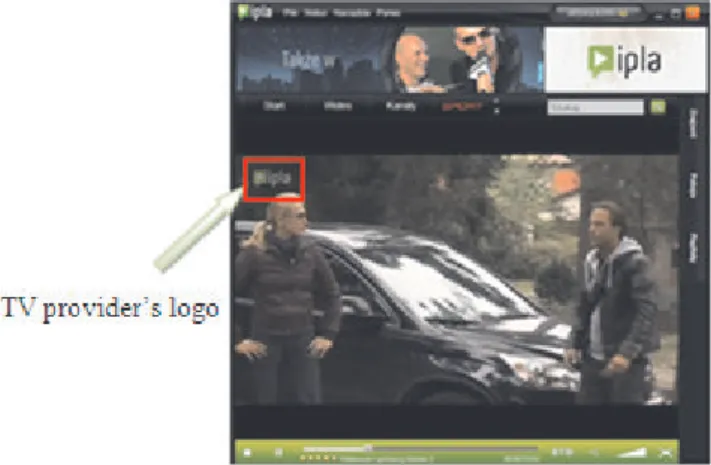
Images transmitted from the video stream Internet TV program contain the logo of the provider (see Fig. 1). A single image of the logo consists of the objects’ areas belonging to the logo and background. It can be assumed that the contours of the logo are solid whilst the background can vary during the program transmission.
In order to recognize the logo images, the pre-defined set of patterns of logo signs of different broadcasters of the selected Internet TV programs is required.
Fig. 1. Sample image taken during broadcasting of the Internet TV-IPLA with the selected area of the providers logo
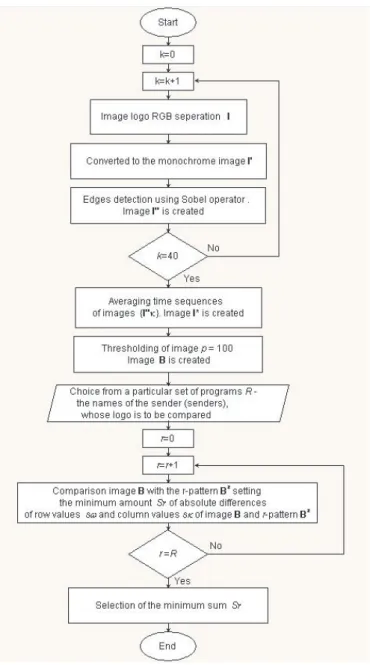
The logo identification procedure will consist of the cyclical online comparison of image logos separated from the video stream with the predefined patterns of logos (Fig. 2). Let mathematical model of the logo image will be a matrix I = I'(i, j), i = 1 ... m, j = 1 ... n, where m and n define the isolated logo image.
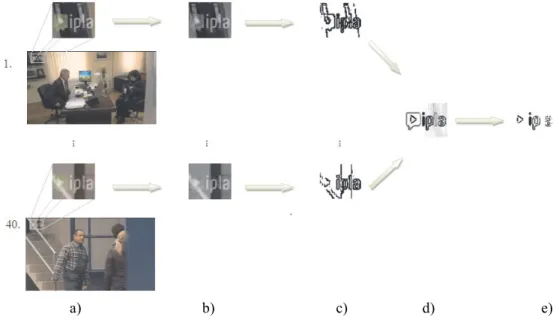
Initially, the colorful image I of the analyzed logo area (Fig. 3a) is converted to the monochrome image I'. This operation consists in calculation, for each pixel’s output image
I'(i, j), its brightness on the basis of the information about its constituent colors R, B, G. The obtained monochrome image I' (Fig. 3b) is then subjected to the next operation of edges detection by the use of Sobel operator device [4]. As a result of this operation a logo image contour I'' is created. The obtained image I''is not perfect (see Fig. 3c), due to the fact that the result of the detection considerably depends on the background, where the logo appears. In order to obtain the best quality of contours the averaging method is applied
IdentificationofTVProgramsBasedonProvider'sLogoAnalysis 549
during the sequence of images of logo’s contours {I''k}, k = 1 ... K. As a result of this
opera-tion the averaged image of logo’s contours is created I*.
Number of images in the sequence K was established for 40. This is experimentally adopted number, at which the procedure for identifying the logo is close to 100%.The image example I* is shown in Figure 3d.
550 MartaChodyka,W³odzimierzMosorow
In order to classify the image point to logo contour or background the method of image segmentation is used – thresholding [6]. A threshold value p = 100 was determined on the basis of statistical analysis of the obtained results. After the thresholding operation of the image of the logo’s contours a binary image of logo’s contours is created B = B(i, j), i = 1 ... m,
j = 1 ... n.The image example B is shown in Figure 3e.
In order to determine whether the received B image is a logo, or, for instance, TV commercials are emitted, the number of pixels on p image is analyzed. When the sum of pixels p is less than the experimentally determined number q = 100, then the algorithm identifies the image as a programe without a logo (eg. TV commercial)
Fig. 3.Stagesofimageprocessinginthealgorithmtorecognizethelogo: originalimage (a), compressionformonochromeimage (b),edgesdetectionusingSobeloperator (c),normalized
imageaftertheoperationofaccumulating40inputimages (d),thresholdingoperation (e)
Otherwise, the next stage of the algorithm is the comparison operation of the obtained binary image of the logo’s contours B with previously defined patterns {Bzr}, r = 1 ... R,
where Bzr is r-this logo pattern, and R is the number of patterns. Each pattern is obtained on
the basis of the hereabove described procedure for the case when the background is steady. The comparison operation is performed on the basis of analysis of a sum of pixels for each rows wi and columns kj of images B and Bzr.
1 ( , ) 1... , 1... m i j w B i j i m j n = =
∑
= = (1a) a) b) c) d) e)Identification of TV Programs Based on Provider's Logo Analysis 551 1 ( , ) 1... , 1... n j i k B i j i m j n = =
∑
= = (1b)Let wIi, kIj are the mean values calculated for each row and column of the image B, similarly wzi, kzj for each rows and columns of the r-of this pattern Bzr. In order to compare
the image B and pattern Bzr the sums are calculated srw i srk of absolute differences of rows
values wIi, wzi and columns kIj, kIj.
, 1 1... m r I z w i r i i s w w r R = =
∑
− = (2a) , 1 1... n r I z k j r j j s k k r R = =∑
− = (2b)The pattern corresponding to the analyzed image is recognized by setting the minimum amount according to the criterion:
min( wr kr) 1...
r s +s r= R (3)
3
.
Tests
results
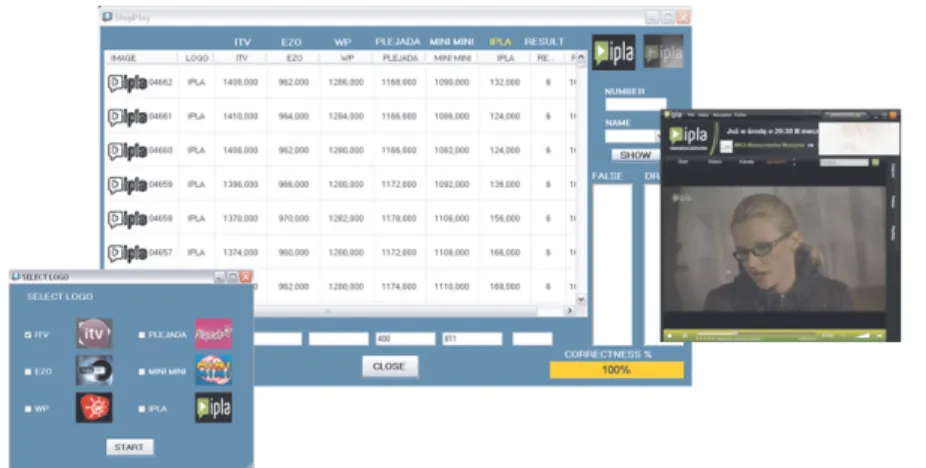
On the basis of the algorithm an application has been developed in the C# lan-guage. The application window is shown in Figure 4. Author’s application „StopPlay” works in real time in parallel with the selected Internet television programs. In order to verify the correctness of the algorithm to recognize the logo, a set of six patterns of the logo{Bzr}, r = 1 ... 6 (see Fig. 3) of popular Internet televisions was defined. Internet
addresses of Internet television programs used in the tests include inter alia: http:// www.itv.net.pl, http://www.ipla.pl.
Logo images of dimensions 60 to 50 pixels are extracted automatically from the indi-vidual frames in the video stream during transmission of Internet television program. The location of the logo transmission on the image must be predetermined.
The task of the user is only the choice from a particular set of programs – the names of the provider (providers), whose logo is to be recognized. Figure 4 presents an analysis of tested logos of television programs. Due to the limited broadcasting time of the Internet television programs in the tests the results for the three available TV sites: ITV, EZO, IPLA were only presented. The tests were performed for an average of 20 000 video frames in approximately three hours for each logo.
552 Marta Chodyka, W³odzimierz Mosorow
Fig. 4.The main algorithm application window with the logo and sample image of Internet TV-IPLA
The algorithm was tested during the TV program as well as during commercial breaks. The algorithm identifies the situation in the absence of a logo on a screen. The obtained results allow to conclude that the presented algorithm detects the logo with an accuracy above 98% (see Fig. 5).
Fig. 5.Percentage chart correctly recognized logos for selected television broadcasters
The lack of proper recognition is affected by cases where the logo and background are in the same colours, i.e. without visible logo’s contours, as well as the presence of per-manent objects in the logo. Additional objects when recording consecutive frames of video sequences are the areas identified in the algorithm as a logo. Table 1 presents the tested logo patterns {Bzr}, r = 1 ... 3 and sample images of logo contours I* recognized (a) and unrecognized (b).
IdentificationofTVProgramsBasedonProvider'sLogoAnalysis 553 Table1
SamplepatternsBzrandimagesoflogocontoursI*: recognized (a) andunrecognized (b)
4
.
C
onclusions
This article presented the object recognition algorithm that can be used in the applica-tion working in real time and enabling to recognize television programs.
Implemented algorithm is able to detect images of the logo with an accuracy of above 98%. It can also identify a situation in the absence of the logo on the image. The problem appears however, when the logo and background images are in the same colours as well as when permanent objects turn up in the logo area, which are identified by the algorithm as a logo. However, in contrast to many other object recognition algorithms, the proposed algorithm does not require the preparation of a learning set, or the application of advanced methods for image processing. This allows for its practical and easy use in the application of automatic identification of television programs. Further studies will include refinement of the algorithm and finding solutions to recognize the logos, which are not recognized or detected by the algorithm, also in case of image disruption.
554 MartaChodyka,W³odzimierzMosorow
References
[1] AcharyaT., RayA.K.,Image Processing: Principles and Applications. JohnWiley & SonsInc., 2005,428.
[2] BryantA.,The Childrens Television Community. Lawrence ErlbaumAssociates,Mahwah, New Jersey,2007.
[3] Chellappa R.,WilsonC.L.,Sirohej S., Human and machine recognition of faces: A survey. Proc. oftheIEEE,v. 83(5),1995,705741.
[4] Gonzalez R.C.,Woods R.E.,Digital Image Processing. Prentice Hall,UpperSaddle River, New Jersey,2001.
[5] Handbook of Pattern Recognition and Computer Vision.4th EditioneditedbyC H Chen ( Univer-sityofMassachusetts Dartmouth,USA),2009,796 p.
[6] JähneB.,Digital Image Processing. Springer,Berlin, Heidelberg, NewYork,2002.
[7] Kim H.,LohW.-Y.,Classification Trees With Unbiased Multiway Splits. JournaloftheAmerican StatisticalAssociation,2001,598604.
[8] KirshS.J., Children, adolescents, and media violence: a critical look at the research. Sage, Cali-fornia,2006.
[9] YoungI.T., GerbrandsJ.J.,vanVlietL.J., Fundamentals of Image Processing. The Netherlandsat the DelftUniversityofTechnology,1998.
[10] Patent: System and Method for Subscriber Controlled Signal BlockingnrCA2266982,1999. [11] Patent: MethodforchildlockinInternetTelevisionnrKR20010037415,2001.
[12] Patent: Method and apparatus for permitting a potential viewer to view a desired program nrUS2004015985,2004.
[13] Patent: ContentcontrolsystemnrUS2005028191,2005. [14] Beniamin www.beniamin.pl.
[15] Cenzor www.cenzor.pl.
[16] Motyl www.adalex.pl/motyl.
[17] Nadzorca www.nadzorca.pl.
[18] OpiekundzieckawInterneciewww.opiekun.com.
[19] OpiekunuczniawInterneciewww.opiekunucznia.pl.
[20] X-Guardwww.x-guard.pl.
[21] BitDefenderInternetSecurity,www.bitdefender.com.
[22] F-SecureInternetSecurity,www.f-secure.com.
[23] G DATAInternetSecurity,www.gdata.pl.