by the numbers: Accounting
Accounts Payable
APQC’s research indicates that there is a substantial
gap in AP costs between organizations that have
taken full advantage of centralization and electronic
processing options and those that have not.
Also, organizations that have made the effort to
Processes Process Accounts Payable Process Expense Reimbursements Activities • Maintain AP/PO vendor masterfile • Maintain/manage electronic commerce • Audit invoices and keydata into AP system • Approve payment • Process financial
accruals and reversals • Process taxes • Research/resolve exceptions • Process payments • Respond to inquiries • Retain records • Adjust accounting records • Generate manual or “special” check disbursements • Maintain/enhance AP systems • Manage procurement
card (P-card) program
• Establish and communicate expense reimbursement policies
and approval limits • Capture and report relevant tax data • Approve reimbursements and advances • Process reimbursements and advances • Manage personal accounts
by the numbers: Accounting
In the AP function, invoicing unit cost is a critical
performance benchmark. As depicted in Figure 8,
the average cost per invoice is $5.72, but there is a
fairly wide variance between the median and the top
and bottom quartiles. Organizations at the bottom
quartile have unit costs roughly three times
as high
as those in the top quartile.
There is a similar variance between highly productive
AP functions and less productive AP functions; top
quartile performers process almost three times as
many invoices per FTE as those in the bottom quartile
(Figure 8).
Figure 8 $5.72 $10.52 $3.21Cost
Top QuartileProductivity
11,143 6,277 16,273 Bottom Quartile Median Top Quartile Bottom Quartile MedianInvoices Processed
by the numbers: Accounting
Organizational Structure
Centralized AP operations have an average cost
per invoice of $5.00 compared to an average of
$7.77 among decentralized operations (Figure 10).
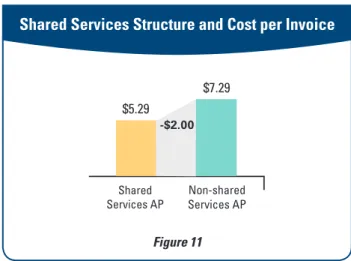
Meanwhile, shared service AP operations have an
average cost per invoice of $5.29 compared to an
To understand variations in cost, APQC has looked
further at business practices and outcomes.
Highlights of our fi ndings follow.
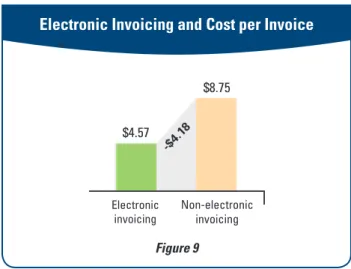
Organizations using electronic invoicing tend to
achieve markedly lower costs than organizations
that do not: Savings run more than $4.00 per invoice
(Figure 9). Dollar amounts displayed in Figure 9 are
median performance for each group.
Electronic Invoicing and Cost per Invoice
Figure 9 $4.57 $8.75 Electronic invoicing Non-electronic invoicing -$4.1 8
by the numbers: Accounting
Figure 10 $5.00 $7.77 Centralized AP Decentralized AP -$2.77A centralized structure is one that is concentrated into a single grouping of staff specializing in a specifi c function and/or process that serves the enterprise. This structure does not typically have a charge back/cost recovery mechanism in place. A decentralized structure is one in which like functions, processes, and/or activities are carried out across multiple areas.
A shared service structure is one that is created for the purpose of combining common or repetitive processes from multiple business units and centralizing them into one location, typically with service level agreements and charge back/cost recovery mechanisms in place.
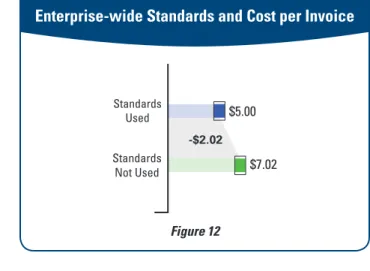
Enterprise-wide standards are systems and policies adopted by an organization to standardize functions.
Electronic invoicing involves the use of invoice processing by electronic data interchange (EDI), which is the linking of computer systems allowing vendors or payments to be transmitted between the organization’s and vendors’ systems.
K
EYT
ERMSby the numbers: Accounting
shared AP services tends to decrease unit costs, and
second, there is not much difference between shared
services and centralized accounts payable functions.
Structurally, they are very similar, so this result is not
surprising.
Centralized AP operations achieve a productivity
advantage over decentralized operations: They
process at the median 11,250 invoices per FTE
compared to 8,760 among decentralized operations.
Centralized AP operations at the median process
59 percent of their invoices manually compared
to a median of 95 percent among decentralized
operations (Figure 12). This may indicate that creating
or improving automated processing capabilities often
goes hand-in-hand with centralization efforts and cost
Figure 11 $5.29 $7.29 Shared Services AP Non-shared Services AP -$2.00
by the numbers: Accounting
Another outcome within a centralized structure is
cycle time reduction within error resolution.
Figure 12 $5.00 $7.02 Standards Used Standards Not Used -$2.02
Enterprise-wide Standards and Cost per Invoice
may be much less expensive to implement policy and
procedure changes than major systems changes, this
area is one in which organizations might fi nd quick
benefi ts without major investment.
Organizations adopting enterprise-wide standards
have an average cost per invoice of $5.00 compared
to an average of $7.02 among other organizations
(Figure 12). This practice focuses at least as much on
policies and procedures as it does on systems and
technology, yet it produces tangible benefi ts. Since it
Centralized
Decentralized
0.5 day 2 days