CDNs Content Outsourcing
via Generalized Communities
Dimitrios Katsaros, George Pallis, Konstantinos Stamos, Athena Vakali,
Antonis Sidiropoulos, and Yannis Manolopoulos
Abstract—Content distribution networks (CDNs) balance costs and quality in services related to content delivery. Devising an efficient content outsourcing policy is crucial since, based on such policies, CDN providers can provide client-tailored content, improve performance, and result in significant economical gains. Earlier content outsourcing approaches may often prove ineffective since they drive prefetching decisions by assuming knowledge of content popularity statistics, which are not always available and are extremely volatile. This work addresses this issue, by proposing a novel self-adaptive technique under a CDN framework on which outsourced content is identified with no a priori knowledge of (earlier) request statistics. This is employed by using a structure-based approach identifying coherent clusters of “correlated” Web server content objects, the so-called Web page communities. These communities are the core outsourcing unit, and in this paper, a detailed simulation experimentation has shown that the proposed technique is robust and effective in reducing user-perceived latency as compared with competing approaches, i.e., two communities-based approaches, Web caching, and non-CDN.
Index Terms—Caching, replication, Web communities, content distribution networks, social network analysis.
Ç
1
I
NTRODUCTIOND
ISTRIBUTINGinformation to Web users in an efficient andcost-effective manner is a challenging problem, espe-cially, under the increasing requirements emerging from a variety of modern applications, e.g., voice-over-IP and streaming media. Eager audiences embracing the “digital lifestyle” are requesting greater and greater volumes of content on a daily basis. For instance, the Internet video site YouTube hits more than 100 million videos per day.1
Estimations of YouTube’s bandwidth go from 25 TB/day to 200 TB/day. At the same time, more and more applications (such as e-commerce and e-learning) are relying on the Web but with high sensitivity to delays. A delay even of a few milliseconds in a Web server content may be intolerable. At first, solutions such as Web caching and replication were considered as the key to satisfy such growing demands and expectations. However, such solu-tions (e.g., Web caching) have become obsolete due to their inability to keep up with the growing demands and the unexpected Web-related phenomena such as the
flash-crowd events [17] occurring when numerous users access a Web server content simultaneously (now often occurring on the Web due to its globalization and wide adoption).
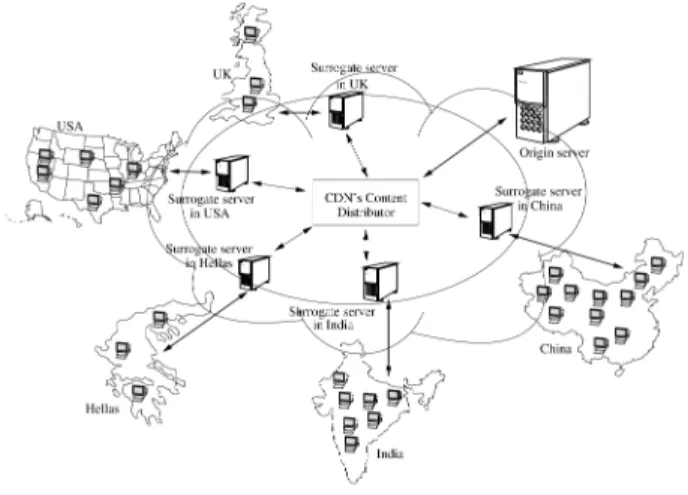
Content distribution networks (CDNs) have been pro-posed to meet such challenges by providing a scalable and cost-effective mechanism for accelerating the delivery of the Web content [7], [27]. A CDN2is an overlay network across Internet (Fig. 1), which consists of a set of surrogate servers (distributed around the world), routers, and network elements. Surrogate servers are the key elements in a CDN, acting as proxy caches that serve directly cached content to clients. They store copies of identical content, such that clients’ requests are satisfied by the most appropriate site. Once a client requests for content on an origin server (managed by a CDN), his request is directed to the appropriate CDN’s surrogate server. This results in an improvement to both the response time (the requested content is nearest to the client) and the system throughput (the workload is distributed to several servers).
As emphasized in [4] and [34], CDNs significantly reduce the bandwidth requirements for Web service providers, since the requested content is closer to user and there is no need to traverse all of the congested pipes and peering points. So, reducing bandwidth reduces cost for the Web service providers. CDNs provide also scalable Web application hosting techniques (such as edge comput-ing [10]) in order to accelerate the dynamic generation of Web pages; instead of replicating the dynamic pages generated by a Web server, they replicate the means of generating pages over multiple surrogate servers [34].
CDNs are expected to play a key role in the future of the Internet infrastructure since their high user performance . D. Katsaros is with the Department of Computer and Communication
Engineering, University of Thessaly, Volos, Greece. E-mail: [email protected].
. K. Stamos, A. Vakali, A. Sidiropoulos, and Y. Manolopoulos are with the Department of Informatics, Aristotle University of Thessaloniki, 54124, Thessaloniki, Greece.
E-mail: {kstamos, avakali, asidirop, manolopo}@csd.auth.gr.
. G. Pallis is with the Department of Computer Science, University of Cyprus, 20537, Nicosia, Cyprus. E-mail: [email protected].
Manuscript received 10 July 2007; revised 9 Feb. 2008; accepted 24 Apr. 2008; published online 6 May 2008.
For information on obtaining reprints of this article, please send e-mail to: [email protected], and reference IEEECS Log Number
TKDE-2007-07-0347.
Digital Object Identifier no. 10.1109/TKDE.2008.92. 1. http://www.youtube.com/.
2. A survey on the status and trends of CDNs is given in [36]. Detailed information about the CDNs’ mechanisms is presented in [30].
and cost savings have urged many Web entrepreneurs to make contracts with CDNs.3
1.1 Motivation and Paper’s Contributions
Currently, CDNs invest in large-scale infrastructure (surro-gate servers, network resources, etc.) to provide high data quality for their clients. To revenue their investment, CDNs charge their customers (i.e., Web server owners) based on two criteria: the amount of content (which has been outsourced) and their traffic records (measured by the content delivery from surrogate servers to clients). Accord-ing to a CDN market report,3 the average cost per GB of streaming video transferred in 2004 through a CDN was $1:75, while the average price to deliver a GB of Internet radio was $1. Given that the bandwidth usage of Web servers content may be huge (i.e., the bandwidth usage of YouTube is about 6 petabytes per month), it is evident that this cost may be extremely high.
Therefore, the proposal of a content outsourcing policy, which will reduce both the Internet traffic and the replicas maintenance costs, is a challenging research task due tothe huge-scale, the heterogeneity, the multilevels in the structure, the hyperlinks and interconnections, and the dynamic and evolving natureof Web content.
To the best of the authors’ knowledge, earlier approaches for content outsourcing on CDNs assume knowledge of content popularity statistics to drive the prefetching decisions [9], giving an indication of the popularity of Web resources (a detailed review of relevant work will be presented in Section 2). Such information though is not always available, or it is extremely volatile, turning such methods problematic. The use of popularity statistics has several drawbacks. First, it requires quite a long time to collect reliable request statistics for each object. Such a long interval though may not be available, when a new site is published to the Internet and should be protected from “flash crowds” [17]. Moreover, the popularity of each object varies considerably [4], [9]. In addition, the use of administratively tuned parameters to select the hot objects causes additional headaches, since there is no a priori knowledge about how to set these parameters. Realizing the limitations of such solutions, Rabinovich and Spatscheck
[30] implied the need for self-tuning content outsourcing policies. In [32], we initiated the study of this problem by outsourcing clusters of Web pages. The outsourced clusters are identified by naively exploring the structure of the Web site. Results showed that such an approach improves the CDN’s performance in terms of user-perceived latency and data redundancy.
The present work continues and improves upon the authors’ preliminary efforts in [32], focusing on devising a high-performance outsourcing policy under a CDN frame-work. In this context, we point out that the following challenges are involved:
. outsource objects that should be popular for long time periods,
. refrain from using (locally estimated or server-supplied) tunable parameters (e.g., number of clusters) and keywords, which do not adapt well to changing access distributions, and
. refrain from using popularity statistics which do not represent effectively the dynamic users’ navigation behavior. As observed in [9], only 40 percent of the “popular” objects for one day remain “popular” and the next day.
In accordance to the above challenges, we propose a novel self-adaptive technique under a CDN framework on which outsourced content is identified by exploring Web server content structure and with no a priori knowledge of (earlier) request statistics. This paper’s contribution is summarized as follows:
. Identifying content clusters,called Web page commu-nities, based on the adopted Web graph structure (where Web pages are nodes and hyperlinks are edges), such that these communities serve as the core outsourcing unit for replication. Typically, it can be considered as a dense subgraph where the number of edges within a community is larger than the number of edges between communities. Such struc-tures exist on the Web [1], [13], [20]—Web servers content designers (humans or applications) tend to organize sites into collections of Web pages related to a common interest—and affect users’ navigation behavior; a dense linkage implies a higher prob-ability of selecting a link. Here, we exploit a quantitative definition for Web page communities introduced in [32], which is considered to be suitable for CDNs content outsourcing problem. Our defini-tion is flexible, allowing overlaps among commu-nities (a Web page may belong to more than one community), since a Web page usually covers a wide range of topics (e.g., a news Web server content) and cannot be classified by a single community. The resulting communities are entirely being replicated by the CDN’s surrogate servers.
. Defining a parameter-free outsourcing policy,since our structure-based approach (unlike k-median, dense k-subgraphs, min-sum, or min-max clustering) does not require the number of communities as a pre-determined parameter, but instead, the optimal number of communities is any value between 1 and the number of nodes of the Web site graph, depend-ing on the node connectivity (captured by the Web
3. “Content Delivery Networks, Market Strategies and Forecasts (2001-2006),” AccuStream iMedia Research: http://www.marketresearch.com/.
server content structure). The proposed policy called Communities identification with Betweenness Cen-trality (CiBC) identifies overlapped Web page com-munities using the concept of Betweenness Centrality (BC) [5]. Specifically, Newman and Girvan [22] have used the concept of edge betweenness to select edges to be removed from the graph so as to devise a hierarchical agglomerative clustering procedure, which though is not capable of providing the final communities but requires intervening of adminis-trators. Contrary to this work [22], the BC is used, in this paper, to measure how central each node of the Web site graph is within a community.
. Experimenting on a detailed simulation testbed,since the experimentation carried out involves numerous experiments to evaluate the proposed scheme under regular traffic and under flash crowd events. Current usage of Web technologies and Web server content performance characteristics during a flash crowd event are highlighted, and from our experimentation, the proposed approach is shown to be robust and effective in minimizing both the average response time of users’ requests and the costs of CDNs’ providers.
1.2 Road Map
The rest of this paper is structured as follows: Section 2 discusses the related work. In Section 3, we formally define the problem addressed in this paper. Section 4 presents the proposed policy. Sections 5 and 6 present the simulation testbed, examined policies, and performance measures. Section 7 evaluates the proposed approach, and finally, Section 8 concludes this paper.
2
R
ELEVANTW
ORK2.1 Content Outsourcing Policies
As identified by earlier research efforts [9], [15], the choice of the outsourced content has a crucial impact in terms of CDN’s pricing [15] and CDN’s performance [9], and it is quite complex and challenging, if we consider the dynamic nature of the Web. A naive solution to this problem is to outsource all the objects of the Web server content (full mirroring) to all the surrogate servers. The latter may seem feasible, since the technological advances in storage media and networking support have greatly improved. However, the respective demand from the market greatly surpasses these advantages. For instance, after the recent agreement between Limelight Networks4and YouTube, under which the first company is adopted as the content delivery platform by YouTube, we can deduce, since this is proprietary information, the huge storage requirements of the surrogate servers. Moreover, the evolution toward completely perso-nalized TV (e.g., the stage6)5reveals that the full content of the origin servers cannot be completely outsourced as a whole. Finally, the problem of updating such a huge collection of Web objects is unmanageable. Thus, we have to resort to a more “selective” outsourcing policy.
A few such content outsourcing policies have been proposed in order to identify which objects to outsource for
replicating to CDNs’ surrogate servers. These can be categorized as follows:
. Empirical-based outsourcing.The Web server con-tent administrators decide empirically about which content will be outsourced [3].
. Popularity-based outsourcing. The most popular objects are replicated to surrogate servers [37].
. Object-based outsourcing.The content is replicated to surrogate servers in units of objects. Each object is replicated to the surrogate server (under the storage constraints) which gives the most performance gain (greedy approach) [9], [37].
. Cluster-based outsourcing.The content is replicated to surrogate servers in units of clusters [9], [14]. A cluster is defined as a group of Web pages which have some common characteristics with respect to their content, the time of references, the number of references, etc.
From the above content outsourcing policies, the object-based one achieves high performance [9], [37]. However, as pointed out by the authors of these policies, the huge amount of objects results in not being implemented on a real application. On the other hand, the popularity-based outsourcing policies do not select the most suitable objects for outsourcing, since the most popular objects remain popular for a short time period [9]. Moreover, they require quite a long time to collect reliable request statistics for each object. Such a long interval though may not be available, when a new Web server content is published to the Internet and should be protected from flash crowd events.
Thus, we resort to exploit action of cluster-based out-sourcing policies. The cluster-based one has also gained the most attraction in the research community [9]. In such an approach, the clusters may be identified by using conven-tional data clustering algorithms. However, due to the lack of a uniform schema for Web documents and dynamics of Web data, the efficiency of these approaches is unsatisfac-tory. Furthermore, most of them require administratively tuned parameters (maximum cluster diameter, maximum number of clusters) to decide the number of clusters, which causes additional problems, since there is no a priori knowledge about how many clusters of objects exist and of what shape these clusters are.
In disaccordance with the above approaches, we exploit the Web server content structure and consider each cluster as a Web page community, where its characteristics are that it reflects the dynamic and heterogeneity nature of the Web. Specifically, it considers each page as a whole object, rather than breaking down the Web page into information pieces and reveals mutual relationships among the concerned Web data.
2.2 Identifying Web Page Communities
In the literature there are several proposals for identifying Web page communities [13], [16]. One of the key distin-guishing properties of the algorithms that is usually considered has to do with the degree of locality which is used for assessing whether or not a page should be assigned in a community. Regarding this feature, the methods for identifying the communities can be summarized as follows:
4. http://www.limelightnetworks.com. 5. http://stage6.divx.com.
. Local-based methods. These methods (also known as bibliographic methods) attempt to identify com-munities by searching for similarity between pairs of nodes. Thus, their object is to answer the question “Are these two nodes similar?” In this context, the bibliographic approaches use two similarity metrics: the cocitation and the bibliographic coupling. These techniques, although well established, fail to find large-scale Web page communities of the Web site graph because the localized structures are too small. More details on their application can be found in [8].
. Global-based methods.These methods (also known as spectral methods) consider all the links in the Web graph (or subgraph). Specifically, spectral methods identify the communities by removing an approximately minimal set of links from the graph. In this context, the Kleinberg’s HITS [19] algorithm (stands for Hyperlink-Induced Topic Search) and the PageRank [6] are used to identifying some key nodes of the graph which are related to some community and work well as seed sets [1]. However, without auxiliary text information, both PageRank and HITS have limited success in identifying Web page communities [13]. A well-known global-based approach is the maximum flow one [12]. Given two vertices of a graph G, sand t, the maximum flow problem is to find the maximum flow that can be routed from s to t while obeying all capacity constraints with respect to G. A feature of the flow-based algorithms is that they allow a node to be in at most one community. However, this is a severe limitation in CDNs content outsourcing, since some nodes may be left outside of every community. Another algorithm is the Clique Percolation Method (CPM) [24] which is based on the concept of k-clique community. Specifically, a k-clique community is a complete subgraph of size k, allowing overlaps between the communities. CPM has been widely used in bioinformatics [24] and in social network analysis [25] and is considered as the state-of-the-art overlapping community finding method.
3
O
UTSOURCEDC
ONTENTS
ELECTIONIn this paper, we study the problem:Which content should be outsourced by the origin server to CDN’s surrogate servers so as to reduce the load on the origin server and the traffic on the Internet, and ultimately improve response time to users as well as reduce the data redundancy to the surrogate servers? Next, we formally define the problem; this paper’s notation is summarized in Table 1.
3.1 Primary Problem Statement
CDNs are overlay networks on top of the Internet that deliver content to users from the network edges, thus reducing response time compared to obtaining content directly from the origin server.
Problem 1: Content outsourcing. Let there be a network topology Xconsisting of jXj network nodes, and a set N of
jNjsurrogate servers, whose locations are appropriately [29] selected upon the network topology. Also, let there be a setOof
jOj unique objects of the Web server content, which has an
outsourcing contract with the CDN provider, whereNodenotes
the set of locations where objectohas been replicated andloðjÞ denotes that the objectois located at thejthsurrogate. It has to be noticed here, thatNoincludes also the origin Web server. For
a setW ofjWjusers, where Ow represents the set of objects
requested by client w, we will denote the response time experienced by user iði2WÞ, when s/he retrieves object o
from the surrogatejðj2NÞ, asTi;jo. Therefore, CDNs should
adapt anoutsourcing policyin order to select the content to be outsourced ðOoutsourcingP olicyoutsourced OÞ in such a way that is minimizes the following equation:
response time¼X i2W X o2Oi min j2No Ti;looðjÞ ! ð1Þ
subject to the constraint that the total replication cost is bounded byOSCðNÞ, whereOS is the total size of all the replicated objects to surrogate servers, andCðNÞ is the cache capacity of the surrogate servers.
Regarding where to replicate the outsourced content, we propose a heuristic6replica placement policy [26]. Accord-ing to this policy, the outsourced content is replicated to surrogate servers with respect to the total network’s latency from the origin Web server to the surrogate servers, making a conservative assumption that the clients’ request patterns
TABLE 1
Paper’s Notation Overview
are homogeneous. Specifically, for each outsourced object, we find which is the best surrogate server in order to place it (produces the minimum network latency). Then, we select from all the pairs of outsourced object-surrogate server that have been occurred previously, the one which produces the largest network latency and, thus, place this object to that surrogate server. The above process is iterated until all the surrogate servers become full.
3.2 Web Page Communities Identification
The outsourced content is replicated to CDN’s surrogate servers in the form of Web page communities. As it has been described in Section 2, several approaches have been proposed in the literature [12], [13], [20] in order to identify Web page communities. However, all these approaches require heavy parameterization to work in CDNs’ environ-ment and present some important weaknesses, since we could end up either with a huge number of very small communities or with a single community comprised by the entire Web server content. On the other hand, max-flow communities [12] seem more appropriate, but they suffer from their strict definition (in the sequel, we provide detailed explanation of this).
Formally, we consider a graphG¼ ðV ; EÞ, where V is a set of nodes andEis a set of edges. LetdiðGÞbe the degree
of a generic node i of the considered graph G, which, in terms of the adjacency matrix M of the graph, is
di¼Pj;i6¼jMi;jþPj;i6¼jMj;i. If we consider a subgraph UG, to which node i belongs, we can split the total degree di in two quantities: diðUÞ ¼diinðUÞ þdouti ðUÞ. The
first term of the summation denotes the number of edges connecting node i to other nodes belonging to U, i.e.,
din i ðUÞ ¼
P
j2U;i6¼jMi;j. The second term of the summation
formula denotes the number of connections of node i
toward nodes in the rest of the graph (G\U0, whereU0 is the complement of graph U), i.e., dout
i ðUÞ ¼ P
j=2U;i6¼jMj;i.
Specifically, a Web page community has been defined in [12] as follows:
Definition 1: The hard Web page community. A subgraph
UðVu; EuÞ of a Web site graph G constitutes a Web page
community, if every node vðv2VuÞ satisfies the following
criterion:
dinvðUÞ> doutv ðUÞ: ð2Þ
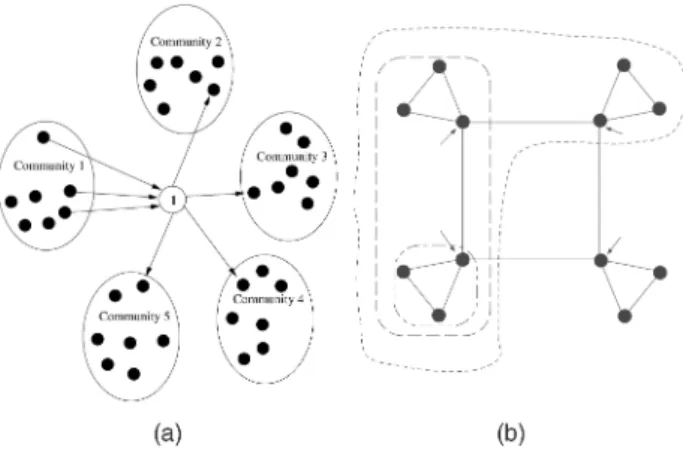
This definition is quite restrictive for the CDNs’ content outsourcing problem since it allows a node to be in, at most, one community or in no community at all. For instance, according to Definition 1, node 1 in Fig. 2a will not be assigned to any community; also no community will be discovered for the graph shown in Fig. 2b, although at a first glance, we could recognize four communities based on our human perception, i.e., the four triangles; a careful look would puzzle us whether the four nodes (pointed to by arrows) at the corners of the square really belong to any community.
Thus, a new and more flexible definition of the community is needed, that 1) will allow for overlapping communities, 2) will be based only on the hyperlink information, assuming that two pages are “similar”/ “correlated” iff there exists a link between them, 3) will not make use of artificial “weights” on the edges of the Web
site graph, and 4) will not make use of the direction of links in the Web site graph (the user browses the Web using both hyperlinks and the “back button”).
Definition 2: The generalized Web page community [32].
A subgraphUof a Web site graph Gconstitutes a Web page community, if it satisfies the following condition:
X v2U
dinvðUÞ>X v2U
doutv ðUÞ; ð3Þ
i.e., the sum of all degrees within the communityU is larger than the sum of all degrees toward the rest of graphG. Obviously, every hard Web page community may also be a generalized Web page community, but the opposite is not always true. Thus, our definition overcomes the limitation explained in Fig. 2 by implying more generic communities. Thus, rather than focusing on each individual member of the community, like Definition 1, which is an extremely local consideration, we consider relative connectivity between the nodes. Certainly, this definition does not lead to unique communities, since by adding or deleting “selected” nodes the property may still hold. Based on the above definition, we regard the identification of generalized Web page communities as follows:
Problem 2: Correlation clustering problem.Given a graph with V vertices, find the (maximum number of) possibly overlapping groups of vertices (i.e., a noncrisp clustering [11]), such that the number of edges within clusters is maximized and the number of edges between clusters is minimized, such that Definition 2 holds for each group.
Finding the optimal correlated clusters is unfeasible, since this clustering problem is NP-hard [2]. To deal with this problem, we propose a heuristic algorithm, namely CiBC, which identifies generalized Web page communities.
4
T
HEC
IBC A
LGORITHMCiBC is a heuristic CDN’s outsourcing policy which identifies generalized Web page communities from a Web server content. CiBC is ahybridapproach, since the identified communities are based on both local and global graph’s properties (discussed in Section 2.2). The Web server content is represented by a Web site graph G¼ ðV ; EÞ, where its nodes are the Web pages and the edges depict the hyperlinks Fig. 2. Sample communities where “hard Web page community” approach is not appropriate for content outsourcing in CDNs.
among Web pages. Given the Web site graph (Web server content structure), CiBC outputs a set of Web page communities. These communities constitute the set of objects
ðOCiBC
outsourcedÞwhich are outsourced to the surrogate servers.
CiBC consists of two phases. In the first phase, we compute the BC of the nodes of the Web site graph. In the second phase, the nodes of the Web site graph are accumulated around the nodes which have the lowest BC, called pole-nodes. Then, the resulted groups are processed
and a set of Web page communities is produced. The algorithm is given in Fig. 3.
4.1 Phase I: Computation of Betweenness Centrality
Initially, the BC of nodes is computed [5] (line 2), providing information about how central a node is within the Web graph. Formally, the BC of a node can be defined in terms of a probability as follows:
Definition 3. Betweenness centrality. Given a Web graph
G¼ ðV ; EÞ,spstðvÞis the number of the shortest paths from a
nodes2V tot2V that contains the nodev2V, andspstis
the number of shortest paths from s to t. The betweenness value of nodev for pairs s,tðbstðvÞÞ is the probability that
nodevfalls on a randomly selected shortest path connectings
witht. The overall BC of a nodevis obtained by summing up its partial betweenness values for all unordered pairs of nodes
fðs; tÞjs; t2V ; s6¼t6¼vg: BCðvÞ ¼ X s6¼t6¼v2V spstðvÞ spst : ð4Þ
In our framework, the BC of a particular Web page captures the level of navigational relevance between this page and the other Web pages in the underlying Web server content. This relevance can be exploited to identify tightness and correlation between the Web pages, toward forming a community. In order to compute the BC, we use the algorithm described in [5], since to the best of our knowl-edge, it has the lowest computational complexity. Specifi-cally, according to [5], its computation approach isOðV EÞ, where V is the number of nodes andE is the number of edges. Then, the nodes of the graph G is sorted by the ascending order of BC values (line 4).
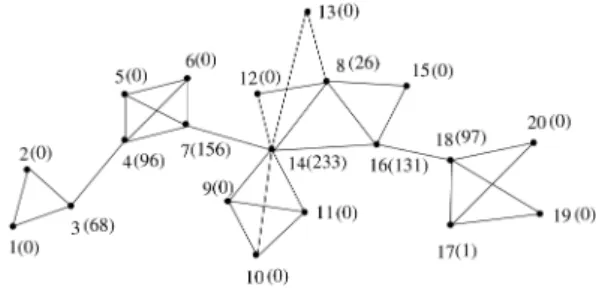
4.2 Phase II: Accumulation around Pole-Nodes The first step in this phase is to accumulate the nodes of the Web graph G around the pole-nodes. It is an iterative process where, in each iteration, we select the node with the lowest BC (called pole-node). Specifically, we start the formation of the communities from the pole-nodes since, as it is pointed in [22], the nodes with high BC have large fan-outs or are articulation points (nodes whose removal would increase the number of connected components in the graph) of the graph. For instance, consider Fig. 4, where the communities of the graph sample are well formed and intuitive. The numbers in parentheses denote the BC index for the respective node ID (the number left to the parentheses). We observe that, in some cases, the nodes with high BC are indeed central in the communities (e.g., Fig. 3. The CiBC algorithm.
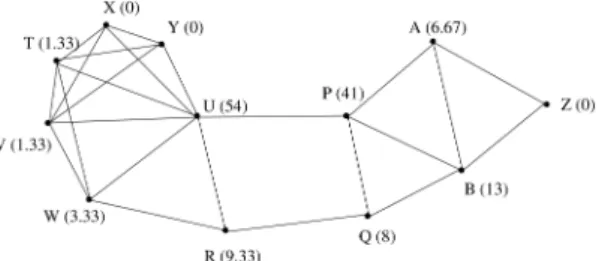
node 8), but there are also cases, where the nodes with high BC are the nodes which are in-between the communities (e.g., nodes: 3, 4, 14, and 18). Fig. 5 depicts another example, where the communities are not obvious at all. If we start the formation of communities from the node with the highest BC, i.e., node U, then it is possible that we will end up with a single community covering the whole graph. Therefore, we accumulate the nodes of the Web graph around the ones which have low BC. This process comes to an end when all the nodes of the graph have been assigned to a group.
In this context, the selected pole-node is checked if it belongs to any group (line 8). If not, it indicates a distinctive one (line 11) and then, it is expanded by the nodes which are directly connected with it (line 12). Afterward, the resulted group is expanded by the nodes which are traversed using the bounded-Breadth First Search (BFS) algorithm [33] (line 13). A nice feature of the bounded-BFS algorithm is that the resulted group is uniformly expanded until a specific depth of the graph. A typical value for the graph’s depth ispffiffiffiffiV [2]. Then, the above procedure is repeated by selecting as pole-node the one with the next lowest BC. At the end, a set of groups would have been created.
The next step is to minimize the number of these groups by merging the identified groups so as to produce general-ized Web page communities. Therefore, we define anll
matrix B (l denotes the number of groups), where each element B½i; j corresponds to the number of edges from group Ci to group Cj. The diagonal elements B½i; i
correspond to the number of internal edges of the group
CiðB½i; i ¼Pv2Cid
in
vðCiÞÞ. On the other hand, the sum of a
row of matrixBis not equal to the total number of edges. For instance, if a nodexbelongs to communitiesCiandCj, and
there is an edgex!y, then this edge counts once forB½i; i
(since it is an internal edge), but it also counts for B½i; j
(since y belongs also toCj). As far as the merging of the
groups is concerned, the CiBC consists of several iterations, where one merge per iteration takes place. The iterations come to an end (convergence criterion) when there is not any other pair to be merged. In each iteration, the pair of groups is selected for merging which has the maximum BB½½i;ji;i (line 24). We consider that a merge of the groups Ci, Cj
takes place when the following condition is true:
B½i; j B½i; i: ð5Þ
The above equation satisfies Definition 2, since the sum of the internal edges of the resulted communities would be larger than the sum of edges toward to the rest of the graph. Degenerate cases of communities (i.e., communities with only two or three nodes or communities which are larger than the cache size) are removed (line 30). The algorithm terminates when there is no change in the number of communities.
4.3 Time and Space Complexity
The CiBC’s first phase is an initialization process that calculates the BC of nodes. This computation can be done in time complexityOðV EÞfor a graphGðV ; EÞ[5]. Considering the sparse nature of the Web site graphs, i.e.,jEj ¼OðjVjÞ, it is obvious that this computation is very fast and it does not affect the performance of the algorithm. Therefore, even for the case of dynamic graphs where we have to execute it periodically, the overhead due to this computation is negligible.
The performance of the second phase of CiBC is highly dependent on the maximum number of iterations executed by CiBC, which is proportional to the initial number of the selected pole-nodes. Considering that a typical value of maximum number of nodes for each community ism¼pffiffiffiffiV
[2], the time complexity with respect to the number of nodes is OðVpffiffiffiffiVÞ, since in each iteration, all the pairs of the communities are checked. In particular, the time that is required is m2þ ðm1Þ2þ. . .¼X m n¼0 ðmnÞ2ffim3X m n¼0 1n m 2 ;
which means that the complexity is Oðm3Þ. As far as the memory space is concerned, the space complexity isOðVÞ
(i.e., anmmmatrix).
To sum up, the time and space computational require-ments of CiBC algorithm are mainly dependent on the number of graph’s nodes. On the other hand, its perfor-mance is only linearly affected by the number of edges.
5
S
IMULATIONT
ESTBEDThe CDNs’ providers are real-time applications and they are not used for research purposes. Therefore, for the evaluation purposes, it is crucial to have a simulation testbed [4] for the CDN’s functionalities and the Internet topology. Furthermore, we need a collection of Web users’ traces which access a Web server content through a CDN, as well as, the topology of this Web server content (in order to identify the Web page communities). Although we can find several users’ traces on the Web,7 real traces from CDN’s providers are not available. Thus, we are faced to use artificial data. Moreover, using artificial data enables us to validate extensively the proposed approach. In this frame-work, we have developed a full simulation environment, which includes the following:
1. a system model simulating the CDN infrastructure,
2. a Web server content generator, modeling file sizes, linkage, etc.,
Fig. 5. Calculation of BC for another sample graph. The numbers in parentheses denote the BC index for the respective node ID.
3. a client request stream generator capturing the main characteristics of Web users’ behavior, and
4. a network topology generator.
Table 2 presents the default parameters for the setup. 5.1 CDN Model
To evaluate the performance of the proposed algorithm, we used our complete simulation environment, called CDNsim, which simulates a main CDN infrastructure and is implemented in the C programming language. A demo can be found at http://oswinds.csd.auth.gr/~cdnsim/. It is based on the OMNeT++ library8 which provides a discrete event simulation environment. All CDN network-ing issues, like surrogate server selection, propagation, queueing, bottlenecks, and processing delays are com-puted dynamically via CDNsim, which provides a detailed implementation of the TCP/IP protocol (and HTTP 1.1), implementing packet switching, packet retransmission upon misses, objects’ freshness, etc.
By default, CDNsim simulates a cooperative push-based CDN infrastructure [31], where each surrogate server has knowledge about what content (which has been proactively pushed to surrogate servers) is cached to all the other surrogate servers. If a user’s request is missed on a surrogate server, then it is served by another surrogate server. In this framework, the CDNsim simulates a CDN with 100 surrogate servers which have been located all over the world. The default size of each surrogate server has been defined as the 40 percent of the total bytes of the Web server content. Each surrogate server in CDNsim is configured to support 1,000 simultaneous connections. Finally, the CDN’s surrogate servers do not apply any cache replacement policy. Thus, when a request cannot be served by the CDN’s infrastructure, it is served by the origin server without being replicated by any CDN’s surrogate server. The outsourced content has a priori been replicated to surrogate servers using the heuristic approach that has been described in Section 3.1. This heuristic policy is selected as the default replica placement one since it achieves the highest perfor-mance for all the outsourcing policies.
5.2 Web Server Content Generation
In order to generate the synthetic Web site graphs, we developed a tool, the so-called the FWGen.9 The FWGen
tool produces synthetic but realistic Web graphs since it encapsulates many of the patterns found in real-world graphs, including power-law and log-normal degree dis-tributions, small diameter, and communities “effects.” The parameters that are given to FWGen are
1. number of nodes,
2. number of edges or density related to the respective fully connected graph,
3. number of communities to generate,
4. skew, which reflects the relative sizes of the generated communities, and finally
5. the assortativity factor, which gives the percentage of the edges that are intracommunity edges. The higher the assortativity is, the stronger communities are produced. For instance, if the assortativity is 100 percent, then the generated communities are disconnected with each other. In general, research has shown that the assortativity factor of a Web site’s graph is usually high [22]. From a technical point of view, FWGen creates two files. The first one is the graph and the second one records the produced communities. Thus, we can compare the communities identified by the CiBC using a similarity distance measure. For our experiments, the produced Web graphs have 16,000 nodes and their sizes are 4.2 Gbytes. The number of edges slightly varies (about 121,000) with respect to the values of the assortativity factor.
5.3 Requests Generation and Network Topology As far as the requests’ stream generation is concerned, we used the generator described in [21], which reflects quite well the real users’ access patterns. Specifically, this generator, given a Web site graph, generates transactions as sequences of page traversals (random walks) upon the site graph, by modeling the Zipfian distribution to pages. In this work, we have generated 1 million users’ requests. Each request is for a single object, unless it contains “embedded” objects. We consider that the requests arrive according to a Poisson distribution with rate equal to 30. Then, the Web users’ requests are assigned to CDN’s surrogate servers taking into account the network proximity and the surrogate servers’ load, which is the typical way followed by CDNs’ providers (e.g., Akamai) [36]. Some more technical details about how CDNsim manages the users’ requests can be found in [32] and at http://oswinds.csd. auth.gr/~cdnsim/. Finally, concerning the network topology, we used an AS-level Internet topology with a total of 3,037 nodes. This topology captures a realistic Internet topology by using BGP routing data collected from a set of seven geographically dispersed BGP peers.
6
E
XPERIMENTATION 6.1 Examined PoliciesIn order to evaluate our proposed algorithm, we conducted extensive experiments comparing CiBC with another state-of-the-art policy. It should be noticed that although there are several approaches which deal with finding commu-nities (dense clusters) in a graph, the CPM algorithm has been preferred to be compared with CiBC. The reason is that CPM, in contrast to the most common approaches
TABLE 2 Simulation Testbed
8. http://www.omnetpp.org/article.php?story=20080208111358100. 9. FWGen Tool: http://delab.csd.auth.gr/~dimitris.
(flow-based, matrix-based such as SVD, distance-based, etc.), may produce, in an effective way, overlapped Web page communities which are in accordance with our target application. Furthermore, we investigate the performance of our earlier proposal, i.e., Correlation Clustering Com-munities identification (C3i) and of a Web caching scheme.
. CPM.The outsourced objects obtained by the CPM
ðOCP M
outsourcedÞ correspond to k-clique percolation
clus-ters in the network. The k-cliques are complete subgraphs of size k (in which each node is connected to every other nodes). Ak-clique percola-tion cluster is a subgraph containing k-cliques that can all reach each other through chains of k-clique adjacency, where two k-cliques are said to be adjacent if they share k1 nodes. Experiments have shown that this method is very efficient when it is applied on large graphs [28]. In this framework, the communities are extracted with the CPM using the CFinder package, which is freely available from http://www.cfinder.org.
. C3i. The outsourced communities obtained by the C3i are identified by naively exploring the structure of the Web site [32]. This results in requiring parameterization to identify communities. It is an algorithm that came out from our earlier preliminary efforts to develop a communities-based outsourcing policy for CDNs.
. Web caching scheme (LRU).The objects are stored reactively to proxy cache servers. We consider that each proxy cache server follows the Least Recently Used (LRU) replacement policy since it is the typical case for the popularity of proxy servers (e.g., Squid).
. No replication (W/O CDN). All the objects are
placed on the origin server and there is no CDN/no proxy servers. This policy represents the “worst-case” scenario.
. Full replication (FR). All the objects have been outsourced to all the CDN’s surrogate servers. This (unrealistic) policy does not take into account the cache size limitation. It is, simply, the optimal policy. 6.2 Evaluation Measures
We evaluate the performance of the above methods under a regular traffic and under a flash crowd event (a large amount of requests is served simultaneously). It should be noted that, for all the experiments, we have a warm-up phase for the surrogate servers’ caches. The purpose of the warm-up phase is to allow the surrogate servers’ caches to reach some level of stability and it is not evaluated. The measures used in the experiments are considered to be the most indicative ones for performance evaluation. Specifi-cally, the following measures are used:
. Mean response time (MRT).The expected time for a request to be satisfied. It is the summation of all requests’ times divided by their quantity. This measure expresses the users’ waiting time in order to serve their requests. The overall response time consists of many components, namely, DNS delay, TCP setup delay, network delay between the user and the server, object transmission delay, and so on. Our response time definition implies the total delay
due to all the aforementioned components. In the experiments for regular traffic, the results depict the total response time, since DNS and TCP setup delay are negligible, whereas the network delay dominates the object transmission delay. So, it makes no sense to present individual figures for these components, and we resort to the total response time as the measure of performance for regular traffic. In the experiments simulating a flash crowd, we provide more detailed results breaking down the response time to its components.
. Response time CDF. The Cumulative Distribution
Function (CDF) here denotes the probability of having response times lower or equal to a given response time. The goal of a CDN is to increase the probability of having response times around the lower bound of response times.
. Replica factor (RF).The percentage of the number of replica objects to the whole CDN infrastructure with respect to the total outsourced objects. It is an indication about the cost of maintaining the replicas “fresh.” High values of replica factor mean high data redundancy and waste of money for the CDNs’ providers.
. Byte hit ratio (BHR).It is defined as the fraction of the total number of bytes that were requested and existed in the cache of the closest to the clients surrogate server to the number of bytes that were requested. A high byte hit ratio improves the network performance (i.e., bandwidth savings and low congestion).
In general, replication and response time are interrelated and the pattern of dependence among them follows the rule that the increased replication results in reduced response times, because the popular data are outsourced closer to the final consumers. Specifically, the lowest MRT (upper limit), which can be achieved by an outsourcing policy, is observed when its replica factor is 1. In such a case, all the outsourced objects ðOoutsourcingP olicyoutsourced Þ of the underlying outsourcing policy have been replicated by all surrogate servers.
In addition, the performance of the examined outsourced policies is evaluated. Specifically, the CiBC approach is compared with CPM and C3i with respect to the following measures in order to assess their speed (how quickly do they provide a solution to the outsourcing problem?) as well as their quality (how well do they identify the communities?):
. CPU time.To measure the speed of the examining algorithms, since it is a value reported by using the system call time() of the Unix kernel and conveys the time that the process remained in the CPU.
. Similarity distance measure.To measure the degree of discrepancy between identified and real commu-nities (the produced commucommu-nities by the FWGen tool). For this purpose, a similarity distance measure is used, which measures the mean value of the difference of the objects’ correlation within two Web page communities sets (identified communities by an outsourcing policy and FWGen’s communities). Specifically, the distance between Ci and Ci0 is
DðCi; Ci0; GÞ ¼ P n12V P n22VjY Zj jVj jðVj 1Þ ; ð6Þ Y ¼ P c2Kðn1;CiÞNðn2;cÞ jKðn1;CiÞj ,Z¼ P c2Kðn1;C0 iÞ Nðn2;cÞ jKðn1;C0iÞj , andKðn; CÞ gives the set of communitiesð½1 . . .jCjÞthat the node n has been assigned to, and N(n, c) = 1 ifn2cand 0 otherwise. According to the above, ifCi andCi0are
equal thenD¼0.
Finally, we use the t-test to assess the reliability of the experiments. T-test is a significance test that can measure results effectiveness. In particular, the t-test would provide us an evidence whether the observed MRT is due to chance. In this framework, thetstatistic is used to test the following null hypothesisðH0Þ:
H0: The observed MRT and the expected MRT are
signifi-cantly different.
The t statistic is computed by the following formula:
t¼x
sx
; ð7Þ
where x and are the observed and expected MRTs, respectively. The variable sx is the standard error of the
mean. Specifically,sx¼s, where s¼ ffiffiffiffiffiffiffiffiffiffiffiffiffiffiffiffiffiffiffiffiffiffiffiffiffiffiffiffi P i¼1ðxixÞ 1 r ;
andis the number of observations in the sample. A small value of the t statistic shows that the expected and the actual values are not significantly different. In order to judge whethertstatistic is really small, we need to know a critical value ðtdf;Þ for the boundary of the area of
hypothesis’s rejection. For finding this critical value, we should define the level of significance (probability of erroneously rejecting the null hypothesis) and the degrees of freedom (df¼1). Thus, if the value of t statistic, computed from our data, is smaller thantdf;, we reject the
null hypothesis at the level of significance. In such a case, the probability that the observed MRT is due to chance is less than.
7
E
VALUATION7.1 Evaluation under Regular Traffic
7.1.1 Client-Side Evaluation
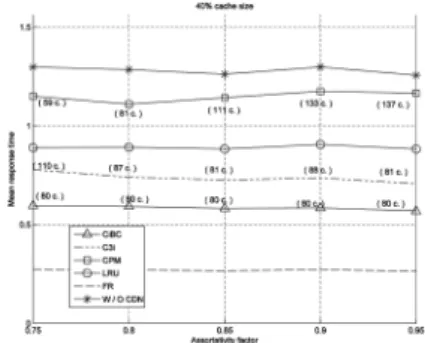
First, we tested the competing algorithms with respect to the average response time, with varying the assortativity factor. The results are reported in Fig. 6. The y-axis represents time units according to OMNeT++’s internal clock and not some physical time quantity, like seconds and minutes. So, the results should be interpreted by comparing the relative performance of the algorithms. This means that if one technique gets a response time 0.5 and some other gets 1.0, then, in the real world, the second one would be twice as slow as the first technique. The numbers which are included within the parentheses represent the number of communities identified by the underlying algorithm for different values of the assortativity factor.
We observe that the CiBC achieves the best performance compared to CPM, LRU, and C3i. Specifically, the CiBC improves the MRT at about 60 percent with respect to CPM,
about 38 percent with respect to LRU, and around 20 percent with respect to C3i for regular traffic conditions. In general, the communities-based outsourcing approach is advanta-geous when compared to LRU and W/O CDN, only under the premise that the community-identification algorithm does a good job in finding communities. Although it is impossible to check manually the output of each algorithm so as to have an accurate impression of all the identified communities, we observe that CPM achieves its lowest response time when the assortativity factor is equal to 0.8. In this case, it finds 81 communities, a number that is very close to the number of communities found by CiBC and C3i algorithms. Presumably, it does not discover exactly the same communities, and this is the reason for achieving higher response time than CiBC and C3i. In general, the low performance of CPM is attributed to the fact that it fails to identify large-scale communities, which makes this algo-rithm worse than LRU. This observation strengthens our motive to investigate efficient and effective algorithms for community discovery, because they have dramatic impact upon the response time.
As far as the performance of FR and W/O CDN is concerned, since these approaches represent the unfeasible lower-bound and impractical upper-bound of the MRT, respectively, their performance is practically constant; they are not affected by the assortativity factor. They do not present any visible up/down trend, and any observable variations are due to the graph and request generation procedure. This is a natural consequence, if we consider that they perform no clustering.
The general trend for the CiBC algorithm is that the response time is slightly decreasing with larger values of assortativity factor. The explanation for this decrease is that, due to the request stream generation method, which simulates a random surfer, as the value of assortativity factor grows (more dense communities are created), the random surfers browse mainly within the same commu-nities. Fig. 7 depicts the CDF for a Web graph with assortativity factor 0.75. They-axispresents the probability of having response times lower or equal to a given response time. From this figure, we see that the CiBC serves a large volume of requests in low response times. Quite similar results have been observed for the other values of assortativity factor.
Fig. 8 presents the BHR of the examined policies for different values of the assortativity factor. The CiBC has the highest BHR, around 40 percent. This is a remarkably significant improvement, if we consider that the BHR of a typical proxy cache server (e.g., Squid) is about 20 percent Fig. 6. MRT versus assortativity factor.
[35], and it is attributed to the cooperation among the surrogate servers. On the other hand, the CPM and LRU present low BHR, without exceeding 20 percent. The increase of the BHR is a very significant matter, and even the slightest increase can have very beneficial results to the network, since fewer bytes are travelling in the net, and thus, the network experiences lower congestion. In our case, we see that although CiBC is only 6 percent (on average) better than C3i in terms of BHR, this gain is translated into 20 percent reduction of the average response time (Fig. 6).
Overall, the experimentation results showed that the communities-based approach is a beneficial one for CDN’s outsourcing problem. Regarding the CiBC’s performance, we observed that the CiBC algorithm is suitable to our target application, since it takes into account the CDNs’ infrastructure and their challenges, reducing the users’ waiting time and improving the QoS of the Web servers content.
7.1.2 Server-Side Evaluation
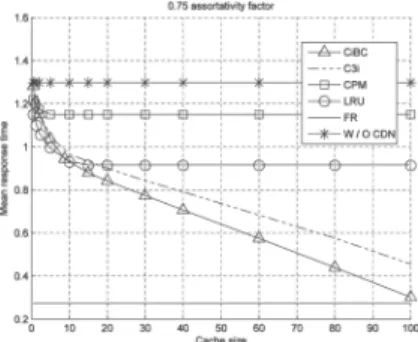
The results are reported in Figs. 9 and 10, where x-axis represents the different values of cache size as a percentage of the total size of distinct objects. A percentage of cache size equal to 100 percent may not imply that all objects are found in the cache due to the overlap among the outsourced communities. In general, an increase in cache size results in a linear (for caches larger than 15 percent) decrease in MRT and in a linear (for caches larger than 10 percent) increase in the replica factor. CiBC achieves low data redundancy as well as low MRT. For small cache sizes (<10percent of total objects’ volume), it is outperformed by LRU. This is due to the fact that there is a time penalty to bring the missing objects no matter how the cache size is increased. However, as the cache size increases, the CiBC outperforms LRU.
On the other hand, the CPM algorithm presents high data redundancy, without exhibiting the smooth behavior of CiBC. Its replica factor is increased almost instantly by increasing the cache size, with no significant improvement in MRT. Specifically, the CPM identifies Web page com-munities where each one has a small number of objects. Thus, the CPM reaches the maximum value of replica factor for small cache sizes. This drawback is not exhibited by C3i, which follows the CiBC’s pattern of performance, although it lags with respect to CiBC at a percentage which varies from 10 percent to 50 percent. Finally, the unfeasible FR approach, as expected, presents high data redundancy, since all the outsourced objects have been replicated to all the surrogate servers.
CiBC achieves low replica factor. This is very important for CDNs’ providers since a low replica factor reduces the computing and network resources required for the content to remain updated. Furthermore, a low replica factor reduces the bandwidth requirements for Web servers content, which is important economically for both indivi-dual Web servers content and for the CDN’s provider itself [4].
Fig. 11 depicts the performance of the examining algorithms with respect to runtimes for various values of the assortativity factor. The efficiency of the CiBC is obvious since it presents the lowest runtimes for all the values of the assortativity factor that have been examined. Specifically, CiBC is 6-16 times faster than CPM. Furthermore, we observe that the speed performance of CiBC is independent of the assortativity factor, whereas the CPU time for CPM depends on this factor at an exponential fashion. The behavior of C3i depends a lot on the assortativity factor; when the communities are “blurred” (i.e., low assortativity), its execution time is two times that of CPM, and only when the communities are more clearly present in the Web site Fig. 7. Response time CDF.
Fig. 8. BHR under regular traffic.
Fig. 9. MRT versus cache size.
graph, it becomes faster than CPM. Still, in the best case, C3i is three times slowest than CiBC, because the way it selects the kernel nodes [32] has a huge influence on the execution time. Even for high network assortativity, i.e., well-formed communities, an unfortunate selection of the kernel nodes might cause larger execution time when compared with the cases of networks with lower assortativity. Once again, this observation confirms the motive of this work to develop efficient and effective algorithms for community discovery in the context of content outsourcing.
7.1.3 Web Page Communities Validation
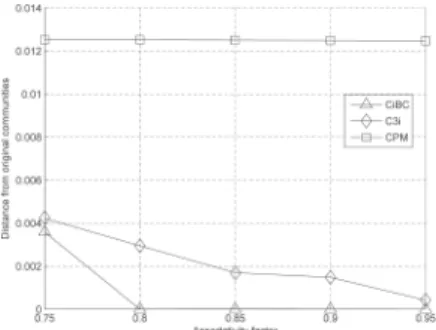
Fig. 12 presents the validity of the examined outsourcing algorithms by computing the similarity distance measure (6) between the resulted communities (identified by CiBC, C3i, and CPM) and the ones produced by the FWGen tool. The general observation is that when the communities are not “blurred” (i.e., assortativity factor larger than 0.75), CiBC manages to identify exactly the same number of communities (similarity distance ffi 0), although it is not guided by preset parameters used in other types of graph clustering algorithms. On the other hand, the communities identified by CPM are quite different than those produced. Finally, although C3i exhibits better performance than CPM, its performance approaches than of CiBC only for very large values of the network assortativity.
7.1.4 Statistical Test Analysis
When a simulation testbed is used for performance evaluation, it is critical to provide evidence that the observed difference in effectiveness is not due to chance. Here, we conducted a series of experiments, making random permutation of users (keeping the rest of the parameters unchanged). Based on (7), the value oftstatistic is t¼ 6:645. The critical value of t-test is tdf;¼3:29 for
level of significance ¼0:001 and degrees of freedom
df¼175. From the above, it occurs thatt175;0:001> t, which
means that the null hypothesisH0is rejected. Furthermore,
we computed thep-valueof the test, which is the probability of getting a value of the test statistic as extreme as or more extreme than that observed by chance alone, if the null hypothesisH0, is true. The smaller thep-valueis, the more
convincing is the rejection of the null hypothesis. Specifi-cally, we found that p-value <0:001, which provides a strong evidence that the observed MRT is not due to chance. 7.2 Evaluation under Flash Crowd Event
Flash crowd events occur quite often and present significant problems to Web server content owners [17]. For instance, in commercial Web servers content, a flash crowd can lead to severe financial losses, as clients often resign from purchasing the goods and search for another, more accessible Web server content. Here, we investigate the performance of the algorithms under a flash crowd event. Recall that each surrogate server is configured to support 1,000 simultaneous connections.
The experiments for the regular traffic measured the overall MRT without breaking it into its components, since the network delay dominated all other components. The situation during a flash crowd is quite different; TCP setup delay is expected to contribute significantly to the MRT, or even to dominate over the rest of the delay components.
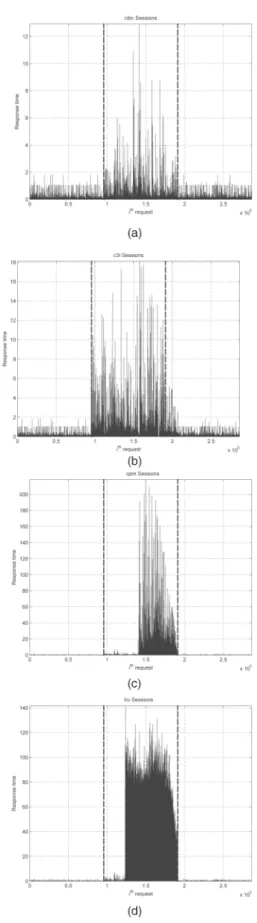
To understand the effect of a flash crowd on the performance of the algorithms, we simulated a situation where the users’ request streams are conceptually divided into three equi-sized epochs. The first epoch simulates a situation with regular traffic, where the requests arrive according to a Poisson distribution with rate equal to 30. The second epoch simulates the flash crowd (i.e., the request rate increases two orders of magnitude and bursts of users’ requests access a small number of Web pages), and finally, in the third epoch, the system returns again to the regular traffic conditions.
The dominant components of the response time are depicted in Table 3 (averages of values). DNS delay is excluded from this table because it was infinitesimal. The variance of these measurements was very large, which implied that the mean value would fail to represent the exact distribution of values. Thus, we plotted for each algorithm the total response time for each request in the course of the three epochs. The results are reported in the Fig. 12. Similarity distance measure.
Fig. 11. CPU time analysis.
TABLE 3
four graphs of Fig. 13. It has to be noticed here that we do not present results for the performance of the W/O CDN approach, because the Web server content collapsed quickly and did not serve any requests.
At a first glance, the results confirm the plain intuition that during a flash crowd event the response times increase dramatically; similar increase is observed in the variance of the response time. Looking at Table 3, we observe that during regular traffic conditions (epoch1) TCP setup delay is one order of magnitude smaller than network and transmission delay. But during the flash crowd, it becomes comparable or even exceeds the value of the other two components for the cases of CiBC and C3i. The flash crowd event has caused the other two algorithms to crash; their resources could cope with the surge of requests only for a small period during the flash crowd. This interval is very short for LRU; it is well known that the Web caching techniques cannot manage effectively the flash crowd events [17]. On the other hand, initially, CPM responds gracefully to the surge of requests (similar to the other two community-based outsourcing algorithms), but soon its lower quality decisions with respect to the identified communities make it also crash.
Turning to the two robust algorithms, namely, CiBC and C3i, we observe that they are able to deal with the flash crowd. There are still many requests that experience significant delay, but the majority is served in short times. Apparently, CiBC’s performance is superior than that of C3i. Moreover, as soon as the surge of requests disappears, the response times of CiBC are restored to the values it had before the flash crowd. C3i does not exhibit this nice behavior, which is attributed to its community-identifica-tion decisions.
In summary, the experiments showed that CiBC algo-rithm presents a beneficial performance under flash crowd events, fortifying the performance of Web servers content. Specifically, CiBC is suitable for a CDN’s provider, since it achieves low data redundancy, high BHR, and MRTs, and it is robust in flash crowd events.
7.3 Evaluation with Real Internet Content
To strengthen the credibility of the results obtained with the synthetic data, we evaluated the competing methods with real Internet content. The real Web site we used is the cs.princeton.edu. This Web site consists of 128,805 nodes and 585,055 edges. As far as the requests’ stream generation is concerned, we used the same generator that we used for the synthetic data. Then, we “fed” these requests into CDNsim in exactly the same way we did for synthetic data. The execution of CiBC revealed 291 communities, whereas the execution of C3i revealed 1,353 communities. As expected, due to its exponential time complexity, CPM did not run to completion and we terminated it after running for almost five days. The execution time for CiBC and C3i was 7,963 and 19,342 seconds, respectively, on a Pentium IV 3.2-GHz processor.
Table 4 presents the relative performance results for the competing algorithms for a particular setting (i.e., 40 percent Fig. 13. Response time for (a) CiBC, (b) C3i, (c) CPM, and (d) LRU.
TABLE 4
cache size), since the relative performance of the algorithms was identical to that obtained for the synthetic data. Notice that the replica factor is not measured for LRU, since it refers to static replication and not to “dynamic” replication. Similarly, BHR and RF have no meaning in the context of the W/O CDN approach. These results are in accordance with those obtained for the synthetic ones; indicatively, CiBC presents 27 percent higher BHR, 17 percent better response time, and 10 percent lower replication than C3i.
8
C
ONCLUSIONIn this paper, we dealt with the content selection problem —which content should be outsourced in CDN’s surrogate servers. Differently from all other relevant approaches, we refrained from using any request statistics in determining the outsourced content, since we cannot always gather them quite fast to address “flash crowds.” We exploited the plain assumption that Web page communities do exist within Web servers content, which act as attractors for the users, due to their dense linkage and the fact that they deal with coherent topics. We provided a new algorithm, called CiBC, to detect such communities; this algorithm is based on a new, quantitative definition of the community structure. We made them the basic outsourcing unit, thus providing the first “predictive” use of communities, which so far have been used for descriptive purposes. To gain a basic, though solid understanding of our proposed method’s strengths, we implemented a detailed simulation environment, which gives Web server content developers more insight into how their site performs and interacts with advanced content delivery mechanisms. The results are very promising and the CiBC’s behavior is in accordance with the central idea of the cooperative push-based architecture [31]. Using both synthetic and real data, we showed that CiBC provides significant latency savings, keeping the replication redun-dancy at very low levels. Finally, we observed that the CiBC fortifies the CDN’s performance under flash crowd events, providing significant latency savings.
A
CKNOWLEDGMENTSThe authors appreciate and thank the anonymous reviewers for their valuable comments and suggestions, which have considerably contributed in improving this paper’s content, organization, and readability.
R
EFERENCES[1] R. Andersen and K. Lang, “Communities from Seed Sets,”Proc. ACM Int’l Conf. World Wide Web (WWW ’06),pp. 223-232, 2006.
[2] N. Bansal, A. Blum, and S. Chawla, “Correlation Clustering,” Machine Learning,vol. 56, nos. 1-3, pp. 89-113, 2004.
[3] J. Fritz Barnes and R. Pandey, “CacheL: Language Support for Customizable Caching Policies,” Proc. Fourth Int’l Web Caching Workshop (WCW),1999.
[4] L. Bent, M. Rabinovich, G.M. Voelker, and Z. Xiao, “Characteriza-tion of a Large Web Site Popula“Characteriza-tion with Implica“Characteriza-tions for Content Delivery,”World Wide Web J.,vol. 9, no. 4, pp. 505-536, 2006.
[5] U. Brandes, “A Faster Algorithm for Betweenness Centrality,” J. Math. Sociology,vol. 25, no. 2, pp. 163-177, 2001.
[6] A.Z. Broder, R. Lempel, F. Maghoul, and J.O. Pedersen, “Efficient PageRank Approximation via Graph Aggregation,” Information Retrieval,vol. 9, no. 2, pp. 123-138, 2006.
[7] R. Buyya, A.K. Pathan, J. Broberg, and Z. Tari, “A Case for Peering of Content Delivery Networks,”IEEE Distributed Systems Online, vol. 7, no. 10, 2006.
[8] S. Chakrabarti, B.E. Dom, S.R. Kumar, P. Raghavan, S. Rajagopa-lan, A. Tomkins, D. Gibson, and J. Kleinberg, “Mining the Web’s Link Structure,”Computer,vol. 32, no. 8, pp. 60-67, 1999.
[9] Y. Chen, L. Qiu, W. Chen, L. Nguyen, and R.H. Katz, “Efficient and Adaptive Web Replication Using Content Clustering,”IEEE J. Selected Areas in Comm.,vol. 21, no. 6, pp. 979-994, 2003.
[10] A. Davis, J. Parikh, and W.E. Weihl, “Edgecomputing: Extending Enterprise Applications to the Edge of the Internet,”Proc. ACM Int’l Conf. World Wide Web (WWW ’04),pp. 180-187, 2004.
[11] V. Estivill-Castro and J. Yang, “Non-Crisp Clustering by Fast, Convergent, and Robust Algorithms,”Proc. Int’l Conf. Principles of Data Mining and Knowledge Discovery (PKDD ’01), pp. 103-114, 2001.
[12] G.W. Flake, S. Lawrence, C.L. Giles, and F.M. Coetzee, “Self-Organization and Identification of Web Communities,”Computer, vol. 35, no. 3, pp. 66-71, 2002.
[13] G.W. Flake, K. Tsioutsiouliklis, and L. Zhukov, “Methods for Mining Web Communities: Bibliometric, Spectral, and Flow,”Web Dynamics—Adapting to Change in Content, Size, Topology and Use,A. Poulovassilis and M. Levene, eds., pp. 45-68, Springer, 2004.
[14] N. Fujita, Y. Ishikawa, A. Iwata, and R. Izmailov, “Coarse-Grain Replica Management Strategies for Dynamic Replication of Web Contents,”Computer Networks,vol. 45, no. 1, pp. 19-34, 2004.
[15] K. Hosanagar, R. Krishnan, M. Smith, and J. Chuang, “Optimal Pricing of Content Delivery Network Services,”Proc. IEEE Hawaii Int’l Conf. System Sciences (HICSS ’04),vol. 7, 2004.
[16] H. Ino, M. Kudo, and A. Nakamura, “A Comparative Study of Algorithms for Finding Web Communities,”Proc. IEEE Int’l Conf. Data Eng. Workshops (ICDEW),2005.
[17] J. Jung, B. Krishnamurthy, and M. Rabinovich, “Flash Crowds and Denial of Service Attacks: Characterization and Implications for CDNs and Web Sites,” Proc. ACM Int’l Conf. World Wide Web (WWW ’02),pp. 293-304, 2002.
[18] J. Kangasharju, J. Roberts, and K.W. Ross, “Object Replication Strategies in Content Distribution Networks,” Computer Comm., vol. 25, no. 4, pp. 367-383, 2002.
[19] J.M. Kleinberg, “Authoritative Sources in a Hyperlinked Environ-ment,”J. ACM,vol. 46, no. 5, pp. 604-632, 1999.
[20] T. Masada, A. Takasu, and J. Adachi, “Web Page Grouping Based on Parameterized Connectivity,”Proc. Int’l Conf. Database Systems for Advanced Applications (DASFAA ’04),pp. 374-380, 2004.
[21] A. Nanopoulos, D. Katsaros, and Y. Manolopoulos, “A Data Mining Algorithm for Generalized Web Prefetching,”IEEE Trans. Knowledge and Data Eng.,vol. 15, no. 5, pp. 1155-1169, Sept./Oct. 2003.
[22] M.E.J. Newman and M. Girvan, “Finding and Evaluating Community Structure in Networks,” Physical Rev. E, vol. 69, no. 026113, 2004.
[23] V.N. Padmanabhan and L. Qiu, “The Content and Access Dynamics of a Busy Web Site: Findings and Implications,”Proc. ACM Conf. Applications, Technologies, Architectures, and Protocols for Computer Comm. (SIGCOMM ’00),pp. 111-123, 2000.
[24] G. Palla, I. Derenyi, I. Farkas, and T. Vicsek, “Uncovering the Overlapping Community Structure of Complex Networks in Nature and Society,”Nature,vol. 435, no. 7043, pp. 814-818, 2005.
[25] G. Palla, A.-L. Barabasi, and T. Vicsek, “Quantifying Social Group Evolution,”Nature,vol. 446, pp. 664-667, 2007.
[26] G. Pallis, K. Stamos, A. Vakali, D. Katsaros, A. Sidiropoulos, and Y. Manolopoulos, “Replication Based on Objects Load under a Content Distribution Network,”Proc. IEEE Int’l Workshop Chal-lenges in Web Information Retrieval and Integration (WIRI),2006.
[27] G. Pallis and A. Vakali, “Insight and Perspectives for Content Delivery Networks,”Comm. ACM,vol. 49, no. 1, pp. 101-106, 2006.
[28] P. Pollner, G. Palla, and T. Vicsek, “Preferential Attachment of Communities: The Same Principle, but a Higher Level,” Euro-physics Letters,vol. 73, no. 3, pp. 478-484, 2006.
[29] L. Qiu, V.N. Padmnanabhan, and G.M. Voelker, “On the Placement of Web Server Replicas,”Proc. IEEE INFOCOM ’01, vol. 3, pp. 1587-1596, 2001.
[30] M. Rabinovich and O. Spatscheck, Web Caching and Replication. Addison Wesley, 2002.