RETURN TO OFFICE
GUIDELINES:
Design Strategies for Workplace Safety
July 2020
Collin R. Barnes
IIDA, LEED AP ID+C, AIA PROFESSIONAL AFFILIATE MEMBER
Registered Interior Designer & Workplace Strategist Des Moines, IA
BFA Interior Design, Iowa State University
Collin leads RDG’s Corporate focus market, with dozens of corporate projects completed in the Des Moines metro area. She brings an exceptional design ability and acute analytical skills to her work.
Collin recognizes that a workplace needs to fit the unique needs of each organization —finding solutions to both technical issues and space planning challenges. As a forward-thinking designer, she works to educate her clients on the advantages of modern technology and how incorporating these features will help them respond to today’s ever-changing work force.
Alysia Radicia
NCIDQ Certificate No. 32448
Interior Designer Omaha, NE
BFA Interior Design, University of Nebraska Lincoln
Alysia Radicia is an experienced interior designer at RDG. She has spent her career planning and designing academic, health care, civic and office environments.
Building upon the knowledge gained in strategic planning and programming phases, she excels at translating client needs to thoughtful well-designed interiors. Alysia’s passion for design lies in creating spaces that allow for people to do their job better. Alysia is has been involved with Friends of Nebraska Children and Families Foundation, Joslyn Art Museum’s Young Art Patrons, Women’s Fund of Omaha, Junior League of Omaha, Leadership Omaha, Chi Omega and the International Interior Design Association.
We’re a Midwest design firm with a
national
and
international
presence.
Our Workplace team has completed
2,900
projects in
34
states. We love
what we do, and it shows in our work every day.
More than just a place to work.
More than ever it’s important to bring people together to do great work. In the last several months, we’ve
all adapted to working remotely, found success in utilizing technology and adjusted to new schedules. Still,
something’s been missing: each other.
People
are what make every office extraordinary and meaningful.
We’re thrilled to invite you back to the workplace! In the following pages, you’ll find strategies that will help
reconnect your teams, inspire a shared vision and most importantly, keep your employees safe and healthy.
Be well, friends.
A company’s ability to innovate has become
“the core driver of growth, performance, and valuation.”
WORK PLACE SAFETY >
Three Areas of Impact
EVERYTHING YOU REALLY NEED TO KNOW, YOU LEARNED IN KINDERGARTEN
Whether you hum “Happy Birthday” or wear a mask like your favorite superhero, each of us play a critical role in helping mitigate the risk of COVID-19 exposure. We’ve broken down the CDC’s strategies for staying well and stopping the spread.
PERSONAL
DO YOUR PART, STAY SIX FEET APART.
• Maintain 6’0” distance while in public settings. • Limit non-essential travel.
• Avoid physical contact, including handshakes —instead, say “hello,” wave or tip your hat.
• Limit in-person meetings. Utilize phones, video chats and other communication tools to stay connected.
• Stay home if you have any of the following symptoms: fever, cough, shortness of breath, sore throat, chills, muscle pain, headaches or a change in sense of taste or smell.
WASH YOUR HANDS. OFTEN.
• Use soap and warm water and wash for at least 20 seconds. • Wash your hands often —when entering a new space, before and
after food preparation, before eating, before and after caring for another, after using the restroom, after blowing your nose, coughing, or sneezing, after touching or feeding an animal and after touching garbage. • Use an alcohol-based hand sanitizer between washing. Be sure to
cover your entire hand, rubbing along fingertips and between fingers.
COVER YOUR SNEEZE, PLEASE.
• Practice good respiratory etiquette. Use a tissue or your sleeve (avoid coughing into your hands) to cover your cough.
• Wear a mask or other face covering in public spaces—or anywhere that physical distancing is difficult to maintain; be sure your mask covers both your nose and mouth.
• Replace and/or wash your mask often. Don’t wear a dirty or wet mask.
CLEAN UP AFTER YOURSELF.
• Disinfect surfaces before and after use.
• Use sanitizers and cleansers that contain at least 60 percent alcohol to disinfect surfaces.
• Use finishes that will help to mitigate the spread of contaminants. Walk-off mats are a great example; these products remove contaminants from visitors shoes to prohibit the spread through the building.
• Consider “touchless” entry sequences using voice/motion activation or foot pulls.
BE WELL.
Caring for your general wellbeing should not be missed in the list of personal health strategies. Your body, mind and spirit will thank you for it—worldwide pandemic or not.
• Maintain healthy sleeping habits.
• Uphold a well-balanced diet.
• Practice good ergonomics while working from home. Maintain proper posture and take frequent breaks to avoid prolonged strain. • Pay attention to your mental health. Talk with your friends, family
and medical professionals about your thoughts and feelings. • Exercise daily. Try walking outdoors—exposure to daylight can
positively impact sleep quality and overall well-being.
WE’RE ALL IN THIS TOGETHER.
As we return from the home office to the corporate office, the culture of our workplace will play an even more critical role in ensuring employees feel welcome, safe and invested in the work.
Iowa State University Economic Development Core Facility | Des Moines, Iowa
RDG Planning & Design | Des Moines, Iowa
THANKS, CAPTAIN OBVIOUS.
This is likely an obvious statement: your employees are your most valuable asset. Though it may seem obvious that the changes you’re making are for the benefit of employees’ health and well-be-ing, it’s still helpful to communicate the why behind these changes.
CONSIDERATIONS:
• Communicate often. Ensure that individuals have a clear understanding of policies and expectations.
• Know the demands of your team’s day-to-day. Understand that certain times of day may be more productive for individuals based on other responsibilities at home.
• Lead with empathy. Everyone has unique exposure risks and we’re all finding our own strategies to cope with the added stress. Offer grace and understanding as we all work to find a way forward. • Obtain feedback by facilitating sharing sessions or administering
surveys. Share the results and be ready to adjust to meet evolving needs of your teams.
WE’RE ALL ON THE SAME TEAM.
As people phase into the office at different rates, be mindful of any developing “us vs. them” mentalities. Constant communication and reminders about the importance of respecting individual decisions can help reduce any animosity between teammates.
CONSIDERATIONS:
• Encourage others to be respectful of everyone’s personal situation, and recognize employees who demonstrate this respect. • Support remote employees by ensuring they have the tools and
resources to successfully complete their work.
• Share mementos (e.g. a company branded calendar or souvenir) with those working from home to foster a connection to the workplace. • Identify ways to gather the team. Meet regularly to share ideas,
update progress and discuss challenges.
• Trust team members to produce high-quality work and recognize a job well done. Consider sharing recorded videos from the leadership team that express gratitude and celebrate the work.
FLEXIBILITY IS NOW THE NORM.
Get out the yoga mat because flexibility is here to stay. Everyone’s response to this new environment is unique, and now, more than ever, how we meet, work and communicate is all driven by the need to be nimble and adaptable.
CONSIDERATIONS:
• Provide employees with the choice of when they will return
to the office, empowering them to make the decision based on their individual comfort level.
• Instruct employees to communicate their schedules, both internally and externally. Whether at home, in the workplace or working outside of the traditional 9-to-5, doing so will help ensure operations continue to run smoothly.
• Prioritize communication as the hallmark of any positive work culture, and how it contributes to better employee engagement and improved productivity.
RÉPONDEZ S’IL VOUS PLAÎT.
We’re now living in an invite-only culture. This is helpful in our efforts to mitigate the spread of illness, but it’s also critical that we remember to invite others into conversations for learning purposes, to include all perspectives and increase collaboration.
CONSIDERATIONS:
• Implement communication tools that work best for your office. The methods you apply should work for both remote and in-office workers, ultimately becoming the norm for the entire team. • Embrace the informality of instant message systems—they
may become the equivalent of water cooler conversations. Consider the use of memes, GIFs, etc. in these casual interactions.
• Establish digital etiquette for video conferencing and encourage employees to keep their video on as often as possible. • Check in on team members regularly. Leverage existing internal
systems such as mentorship and advocacy programs.
• Bring the team to social events—or bring the event to them!
Scott Technology Center | Omaha, Nebraska
OPE, JUST GONNA SNEAK RIGHT PAST YA.
Do your part, stay six feet apart. Wear a mask. Sharing is not caring. Have policies and stick to them. It’s important to have a top-down leadership approach when enforcing these new norms.CONSIDERATIONS:
• Follow and implement CDC guidance to guide your team safely back into the workplace. Communicate clearly that the new guidelines are for the safety of the entire team.
• Leaders should model the new behaviors. This is not a time for “do as I say and not as I do.” Managers should act as an example of how to integrate new policies into daily routines.
• Add some levity when implementing policies and signage.
While public health is a serious matter, it can be more effective to communicate in a way that it is accessible and easily adopted.
BUT WAIT, THERE’S MORE.
Need more assistance in facilitating a culture change in your office? Our team of workplace experts are ready to help.
WALK THIS WAY.
The work environment is more than just a place to host meetings and conference calls—it’s a space where employees feel a sense of belonging and well-being. Re-engage your team safely with these simple improvements.
Scott Technology Center | Omaha, Nebraska
COME ON IN.
We all know the importance of first impressions. Start the experi-ence off right by providing an entry space that is informative and accommodating to new protocols and behaviors.
CONSIDERATIONS:
• Create an entry that communicates expectations and behaviors within the space. Signage is a great way to share these messages. • Offer clear direction for visitors queuing. You may consider a “no
lobby” approach, asking visitors to wait in a conference room. • Designate an area where visitors can sanitize hands, apply
a mask, conduct temperature checks, sign in or perform any other required entry protocols.
• Assign a guest entry that is separate from staff.
• Use finishes that will help mitigate spread of contaminants.
Specialized walk-off mats can remove contaminants from shoes. • Consider upgrading to a “touchless” entry sequence using
voice or motion activation and/or foot pulls to reduce the impact of high-touch surfaces.
GET INTO THE FLOW.
Strategic circulation paths throughout the office can help alleviate unwanted exposures. Position staff near frequently-used resources and exits to limit excessive travel through the building.
CONSIDERATIONS:
• Post signage for adjusted elevator capacity.
• Designate “wait zones” in high-traffic areas that allow users to stay at a safe distance from one another.
• Consider implementing one-way traffic throughout the floor plate and stairwells.
NO MORE SARDINE CANS.
Where once our desks might have been packed side-by-side in the office space, now we’re looking to widen the space between em-ployees. Accommodate physical distancing needs by adjusting desk layouts to ensure that employees remain six feet apart.
CONSIDERATIONS:
• Implement a phased re-entry approach that prioritizes “space-dependent” roles, allowing those that require use of resources and tools within the building to remain safe.
• Adjust desking layout and major circulation pathways to keep users at least six feet away from each other (see diagram, left).
SARDINE CANS, CONTINUED.
Accommodate physical distancing needs by adjusting desk layouts to ensure employees remain six feet apart.
CONSIDERATIONS:
• Limit configurations that require staff to sit face-to-face.
• Incorporate rigid panels between users to block transfer of respiratory droplets through the air.
• Implement a “single-daily use” policy in shared areas to limit the number of users and thereby the risk of germ spread.
• Use assigned seating locations when possible. This approach will aid in contact-tracing should contamination take place. • Consider limiting guests and visitors to the office.
• Establish and educate on any “DO NOT USE” areas that do not allow for proper distancing or require cleaning practices that make disinfecting difficult or cost-prohibitive.
WORKING TOGETHER, APART.
Group work is a large part of the daily process, but nowadays, this group work looks a little different. Adjust shared spaces to help reduce the risk of germ spread in these areas.
CONSIDERATIONS:
• Uphold an “open door” policy for meeting rooms.
• Limit meetings to 10 people or less and utilize virtual meeting software to allow larger group participation.
• Consider holding meetings of six people or more outdoors or in unenclosed areas.
• Reconfigure rooms to allow for proper distancing. Remove and store any unnecessary furniture.
Buffett Early Childhood Institute Office | Omaha, Nebraska
PHYSICALLY-DISTANCED SOCIAL NETWORKING.
Social spaces bring people together, foster socialization and help create a company’s culture. By implementing protocols to keep these areas clean for all users, social spaces and amenities can continue to play a role in today’s workplace.CONSIDERATIONS:
• Integrate touchless plumbing fixtures to reduce contact of high-touch surfaces.
• In restrooms, alternate use of stalls and sinks to allow for proper physical distancing.
• Reconfigure layouts in cafés, break areas and outdoor spaces
to allow for proper physical distancing. Remove and store any unnecessary furniture.
• Provide cleaning and sanitation products in shared locations
to encourage frequent, routine use.
EVERY BREATH YOU TAKE.
Clean air is critical to the health and well-being of occupants. Reduce airborne contaminants and the risk of germ spread by making adjustments to your building’s ventilation system and maintaining a thorough cleaning regimen.
CONSIDERATIONS:
• Have air ducts cleaned to eliminate existing contaminants. • Contact an engineer to discuss system upgrades and settings:
∙ Upgrade the building ventilation system to bring in more outside air.
∙ Maintain a balanced humidity level in the building to mitigate microbial growth.
∙ Improve air filtration with MERV 13 air filters in existing HVAC equipment to re-duce airborne contaminants, allergens and other volatile organic compounds.
• Implement centralized trash collection points, which removes individual receptacles and consolidates areas of microbial growth. • Check cleaning and maintenance guidelines on finishes
throughout your space to ensure that the products you’re using won’t damage the appearance or integrity of the finish.
IT’S A SIGN OF THE TIMES.
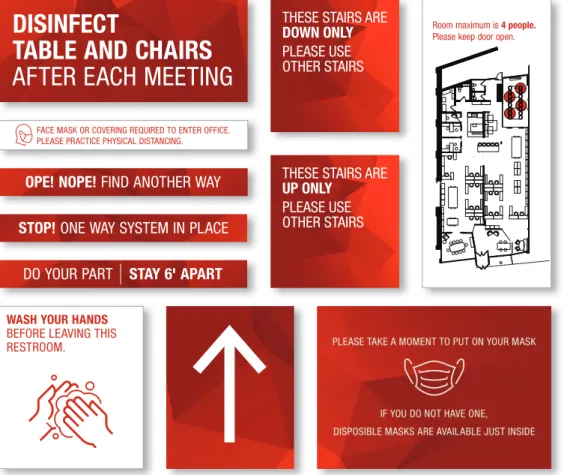
Help your team (and guests) uphold new office protocols by posting signage throughout the space. Signage is a quick, easy and economical solution to effectively communicate expectations in your space.
CONSIDERATIONS:
• Use signage to notify visitors and staff of your organization’s updated policies and expectations.
• Use colors, words and iconography that relate to your unique culture. • Key areas for signage include:
∙ Building entry
∙ Stairwells and elevators
∙ Restrooms and wellness facilities
∙ Kitchens and break rooms
∙ Restricted areas / discouraged use
∙ Circulation paths / one-way traffic
DISINFECT
TABLE AND CHAIRS
AFTER EACH MEETING
THESE STAIRS ARE
DOWN ONLY
PLEASE USE OTHER STAIRS
THESE STAIRS ARE
UP ONLY
PLEASE USE OTHER STAIRS
BUT WAIT, THERE’S MORE.
Interested in learning more about how to adapt your space? Our team of workplace design experts are ready to help.
QUESTIONS?
ANSWERS.
Learn more @
https://rdgusa.com/resilient-design
The COVID-19 virus is an ongoing, rapidly developing situation. While we are well-versed in planning and design, we would never consider ourselves to be public health experts. This information is intended to be a useful guide to help you deal with a variety of COVID-19 challenges, but you should still monitor and adhere to federal, state and local health organization guidance and mandates.