256
PP..ssuummaatthhii F FAACCTTOORRSSDDEESSIIGGNNIISSSSUUEESSIINNMMOOBBIILLEECCOOMMPPUUTTIINNGG P P..SSuummaatthhii J JaayyaarraajjAAnnnnaappaacckkiiyyaammCCoolllleeggeeffoorrWWoommeenn,,AAuuttoonnoommoouuss,,PPeerriiyyaakkuullaamm A ABBSSTTRRAACCTTOne of the most important and highly publicized recent developments in the PC world has been the introduction of the mobile gadgets. Mobile computers are turning thousands of computer illiterate people — especially those involved with field-based data collection — into computer users. The market potential and breadth of application requirements for mobile computing has prompted numerous hardware and software companies to focus their efforts in providing solutions to the vertical, form-oriented marketplace.
Mobile Computing has fast become an important new paradigm in today's world of networked computing systems. Ranging from wireless laptops to cellular phones and WiFi/Bluetooth-enabled PDAs to wireless sensor networks, mobile computing has become ubiquitous in its impact on our daily lives. The debut if iPhones and the proliferation of other handheld devices has spurred excitement and interest in this evolving field. In this paper we will study the state-of-the-art in both the research and commercial communities with respect to mobile computing and what are the design issues and technical issues we have to face it. We will investigate standard protocols and platforms, the capabilities of today's commercial devices, and proposed next-generation solutions. In the process, we will seek to gain an improved understanding about where the field is headed, and what is the importance in the mobile computing.
K KEEYYWWOORRDDSS::CCDDPPDD,,MMSSCC,,PPSSTTNN,,DDCCSS,,BBSS,,MMSS.. I INNTTRROODDUUCCTTIIOONN M MoobbiilleeCCoommppuuttiinngg
A technology that allows transmission of data, via a computer, without having to be connected to a fixed physical link. Mobile voice communication is widely established throughout the world and has had a very rapid increase in the number of subscribers to the various cellular networks over the across these cellular networks. This is the principle of mobile computing. Technology as it allows users to transmit data from remote locations to other remote or fixed locations. This proves to be the solution to the biggest problem of business people on the move – (mobility). In this article we give an overview of existing cellular networks and describe in detail the CDPD(Cellular Digital Packet Data) technology which allows data communications across these networks. Finally, we look at the applications of Mobile Computing in the real world.
E
EXXIISSTTIINNGGCCEELLLLUULLAARRNNEETTWWOORRKKAARRCCHHIITTEECCTTUURREE
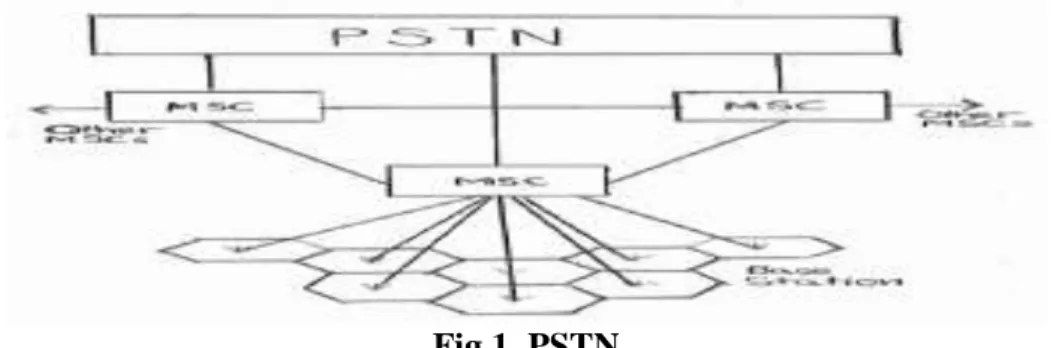
Mobile telephony took off with the introduction of cellular technology which allowed the efficient utilization of frequencies enabling the connection of a large number of users. During the 1980's analogue technology was used. A cellular network consists of mobile units linked together to switching equipment, which interconnect the different parts of the network and allow access to the fixed Public Switched Telephone Network (PSTN). The technology is hidden from view; it's incorporated in a number of transceivers called Base Stations (BS). Every BS is located at a strategically selected place and covers a given area or cell - hence the name cellular communications. A number of adjacent cells grouped together form an area and the corresponding BSs communicate through a so called Mobile Switching Centre (MSC). The MSC is the heart of a cellular radio
257
PP..ssuummaatthhiisystem. It is responsible for routing, or switching, calls from the originator to the designator. It can be thought of managing the cell, being responsible for set-up, routing control and termination of the call,
Fig 1. PSTN
for management inter MSC hand over and supplementary services, and for collecting charging and accounting information. The MSC may be connected to other MSCs on the same network or to the PSTN.
M
MOOBBIILLEESSWWIITTCCHHIINNGGCCEENNTTRREE
The frequencies used vary according to the cellular network technology implemented. For GSM, 890 - 915 MHz range is used for transmission and 935 -960 MHz for reception. The DCS(Digital Communication System) technology uses frequencies in the 1800MHz range while PCS in the 1900MHz range. Each cell has a number of channels associated with it. These are assigned to subscribers on demand. When a Mobile Station (MS) becomes 'active' it registers with the nearest BS. The corresponding MSC stores the information about that MS and its position. This information is used to direct incoming calls to the MS. If during a call the MS moves to an adjacent cell then a change of frequency will necessarily occur - since adjacent cells never use the same channels. This procedure is called hand over and is the key to Mobile communications. As the MS is approaching the edge of a cell, the BS monitors the decrease in signal power. The strength of the signal is compared with adjacent cells and the call is handed over to the cell with the strongest signal. During the switch, the line is lost for about 400ms. When the MS is going from one area to another it registers itself to the new MSC. Its location information is updated, thus allowing MSs to be used outside their 'home' areas.
D
DAATTAACCOOMMMMUUNNIICCAATTIIOONNSS
Data Communications is the exchange of data using existing communication networks. The term data covers a wide range of applications including File Transfer (FT), interconnection between Wide-Area-Networks (WAN), facsimile (fax), electronic mail, access to the internet and the World Wide Web (WWW).
Data Communications have been achieved using a variety of networks such as PSTN, leased-lines and more recently ISDN (Integrated Services Data Network) and ATM (Asynchronous Transfer Mode)/Frame Relay.
Circuit switching implies that data from one user (sender) to another (receiver) has to follow a pre specified path. If a link to be used is busy , message can not be redirected , a property which causes many delays.
Packet switching is an attempt to make better utilization of the existing network by splitting the message to be sent into packets. Each packet contains information about the sender, the receiver, the
258
PP..ssuummaatthhiiposition of the packet in the message as well as part of the actual message. There are many protocols defining the way packets can be send from the sender to the receiver. The most widely used are the Virtual Circuit-Switching system, which implies that packets have to be sent through the same path
Fig 2.Mobile Communications Overview
C
CDDPPDDTTEECCHHNNOOLLOOGGYY
Today, the mobile data communications market is becoming dominated by a technology called CDPD. There are other alternatives to this technology namely Circuit Switched Cellular, Specialized Mobile Radio and Wireless Data Networks. As can be seen from the table below the CDPD technology is much more advantageous than the others
Cellular Digital Packet Data (CDPD) Circuit Switched Cellular Specialized Mobile Radio (Extended) Proprietary Wireless Data Networks
Speed best best good good
Security best better good better
Ubiquity best best good better
Cost of Service best better better good
Cost of
Deployment
best best better good
Mobility best good better good
Interoperability best good good better
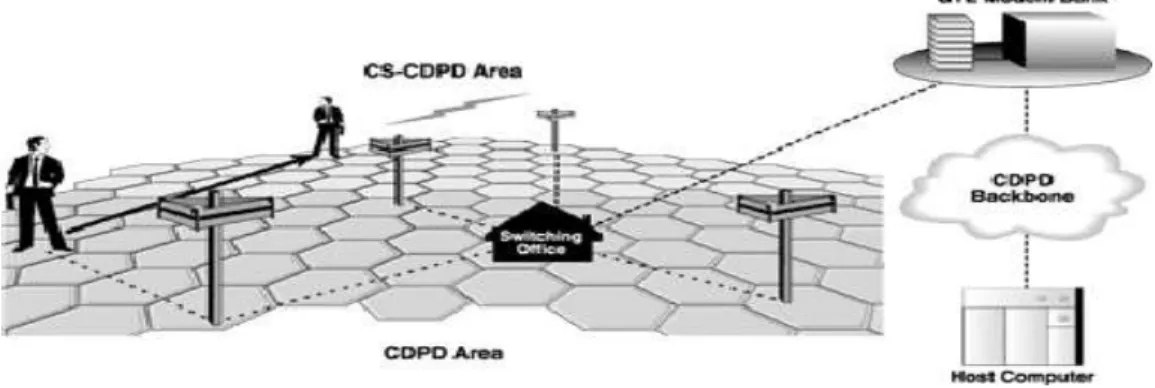
CDPD's principle lies in the usage of the idle time in between existing voice signals that are being sent across the cellular networks. The major advantage of this system is the fact that the idle time is not chargeable and so the cost of data transmission is very low. CDPD networks allow fixed or mobile users to connect to the network across a fixed link and a packet switched system respectively. In the case of a mobile end user, the user can, if CDPD network facilities are non-existent, connect to existing circuit switched networks and transmit data via these networks. This is known as Circuit Switched CDPD (CS-CDPD).
259
PP..ssuummaatthhiiService coverage is a fundamental element of providing effective wireless solutions to users and using this method achieves this objective. Where CDPD is available data is split into packets and a packet switched network protocol is used to transport the packets across the network. This may be of either Datagram or Virtual Circuit Switching form.
Fig 3.Circuit Switched CDPD
The data packets are inserted on momentarily unoccupied voice frequencies during the idle time on the voice signals. CDPD networks have a network hierarchy with each level of the hierarchy doing its own specified tasks.
C
CDDPPDDOOvveerrvviieeww
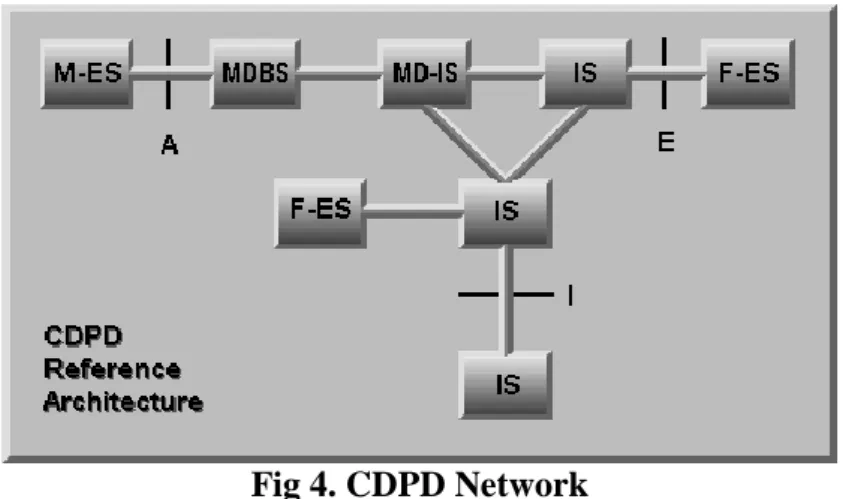
The hierarchy consists of the following levels 1) Mobile End User Interface
Using a single device such as a Personal Digital Assistant or personal computer which have been connected to a Radio Frequency (RF) Modem which is specially adapted with the antennae required to transmit data on the cellular network, the mobile end user can transmit both data and voice signals. Voice signals are transmitted via a mobile phone connected to the RF Modem Unit. RF Modems transfer data in both forward and reverse channels using Gaussian Minimum Shift Keying (MSK) modulation , a modified form of Frequency Shift Keying (FSK) at modulation index of 0.5 .
2) Mobile Data Base Station (MDBS)
In each cell of the cellular reception area, there is a Mobile Data Base Station (MDBS) which is responsible for detection of idle time in voice channels, for relaying data between the mobile units and the Mobile Data Intermediate Systems (MDIS), sending of packets of data onto the appropriate
260
PP..ssuummaatthhiiunoccupied frequencies as well as receiving data packets and passing them to the appropriate Mobile end user within its domain.
3) Mobile Data Intermediate Systems (MDIS)
Groups of MDBS that control each cell in the cellular network reception area are connected to a higher level entity in the network hierarchy, the Mobile Data Intermediate Systems. Connection is made via a wideband trunk cable. Data packets are then relayed by MDBS to and from mobile end users and MDIS. These MDIS use a Mobile Network Location Protocol (MNLP) to exchange location information about Mobile end users within their domain. The MDIS maintains a database for each of the M-ES in its serving area. Each mobile unit has a fixed home area but may be located in any area where reception is available.
4) Intermediate Systems (IS):
MDIS are interconnected to these IS which form the backbone of the CDPD system. These systems are unaware of mobility of end-users, as this is hidden by lower levels of the network hierarchy. The ISs are the systems that provide the CDPD interface to the various computer and phone networks. The IS's relay data between MDIS's and other IS's throughout the network. They can be connected to routers that support Internet and Open Systems Interconnection Connectionless Network Services (OSI-CLNS), to allow access to other cellular carriers and external land- based networks.
Fig 4. CDPD Network
C
CDDPPDDNNEETTWWOORRKKRREELLIIAABBIILLIITTYY
There are some actions that are necessary in order to obtain reliability over a network. 1) User Authentication
The procedure which checks if the identity of the subscriber transferred over the radio path corresponds with the details held in the network.
2) User Anonymity
Instead of the actual directory telephone number, the International Mobile Subscriber Identity (IMSI) number is used within the network to uniquely identify a mobile subscriber.
3) Fraud Prevention
Protection against impersonation of authorized users and fraudulent use of the network is required. 4) Protection of user data
All the signals within the network are encrypted and the identification key is never transmitted through the air. This ensures maximum network and data security.
The information needed for the above actions are stored in data bases. The Home Location Register (HLR) stores information relating the Mobile Station (MS) to its network. This includes information
261
PP..ssuummaatthhiifor each MS on subscription levels , supplementary services and the current or most recently used network and location area. The Authentication Centre (AUC) provides the information to authenticate MSs using the network , in order to guard against possible fraud , stolen subscriber cards , or unpaid bills. The Visitor Location Register (VLR) stores information about subscription levels , supplementary services and location for a subscriber who is currently in, or has very recently been ,in that area.
D
DeessiiggnnIIssssuueessIInnMMoobbiilleeCCoommppuuttiinngg
Usability Issues
‘Usability requirements specify the acceptable level of user performance and satisfaction with the system.’
Usability plays a very vital role in making an application user friendly and easy to use or vice versa. Due to the small size of mobile devices there are several changes that need to be accommodated according the need of applications used on it, for example a keyboard might become a touch screen or voice authentication, screen resolution and size will be smaller than a normal laptop screen. For some users it might be difficult to accept as there is a lot of deskilling in IT industry. But usability is one aspect which can make use of new devices very easy by considering its users and the targeted audiences. Usability can overcome several issues which might stop a potential user to get benefits from mobile computing or any new technology. Below are the important aspects needs considerations while designing a mobile computing device.
Form Factor of End User Device
Form factor deals with the size of hand held or mobile device, it is a very important design issue needs very much consideration before designing a new device or even providing an application on an existing device. Size makes a huge difference when it comes to usability as several applications only fail because of their bad design, for instance if the screen is too small to provide the full functionality of an application then alternate can be seek to provide same functionality but with less or simple usability.
Similar issues can thought when it comes to input method, before going into any kind of production or development of such applications it is always a good idea to consider the targeted users either they will accept it or not. People with partial or less vision mite need an alternative to hand help devices as they might not enjoy typing on a tiny keypad and get annoyed, alternatives can always be considered to overcome these issues. At this early stage where mobile computing is buzzing and several famous services like MSN Messenger, eBay, Yahoo and many other known services are showing a huge interest in mobile computing, this is the time to consider this critical issue of either user will be satisfied with the limited functionality or will accept full functionality on limited form factor.
Battery Life
The concept of being mobile means that anyplace anytime, but time can be an issue in this case. As the technology is advancing it also has some implications on the new technologies and battery life is one of them. Now days a simple phone with a built-in camera in it provide maximum of 6-8 hours of talk time or we can also say usage time. If same implies on the mobile or hand held devices how acceptable it will be for the user to rely on it. Below is list of talk time or use time of some famous mobile computing devices.
Looking at the figures in table 1 it can be seen that the maximum usage time for a device is 10 hours, will it be good enough for a regular user who is using computing in their business almost 24 hours a day, and once ran out of battery what will be the substitute for it, will user be carrying a spare battery every time, but this is not the solution if for some reason two batteries aren’t enough
262
PP..ssuummaatthhiithen what will be the possibility. Without the battery any electrical devices nothing more than a piece of stone, and the high tech application we are seeing in this modern era of computing for how long they can be lithium ion battery.
It needs consideration at design stage because at this applications can be designed to be able to run using minimum amount of battery
B
BaatttteerryyLLiiffeeCChhaarrtt
Name Talk / Usage
Time (Hours) RIM BlackBerry Curve 10
RIM BlackBerry 8800 9 Samsung UpStage 7 Motorola RAZR V3i 6
HTC Mogul 6
Nokia N95 6
Helio Ocean 5.5
RIM BlackBerry Pearl 5 Sony Ericsson W300i 5 Samsung SGH-i607 5 .
Input Methods
After form factor it is one of the most important aspects needs considering at design stage, as we are aware that every computing device from a notebook to a PDA needs to be provided with some input in order to perform a task. Inputting information or data into a computing device can be done in several ways like touch screen, small keypad, voice recognition etc. if a suitable input method is not considered at design time it can lead the service to a failure, depending on the type of application it should be decided what type of input method will be used. It is quite obvious that different applications has different input needs for instance an accounting software mostly need a numeric pad where as an email device like blackberry might need both, do there will be enough flexibility when deciding the input method. To overcome this issue flexible input types should be provided or a combination of most needed depending on the application and the user as well. (Kent Lyons, 2004) According to a research done at College of Computing and GVU Center Georgia Institute of Technology Atlanta, mobile input capabilities can be increased via two complementary methods: - By increasing a user’s data entry capability with the Twiddler chording keyboard which can be attached with the mobile device and work as a keyboard. This will provide the same feeling and comfort of using a keyboard.
- Through reusing conversational information with a dual purpose speech. Ruggedness
Just looking back a year when iPod nano first came out users ended up cracking them in their pockets because of its delicate design and volatile body people were so use to the typical iPod that they problems with the durability of iPod nano. Similarly when a mobile device is design the element of toughness will never be ignored for instance if a mobile device is so delicate that it cannot be used on the go then it lost its purpose. At design time it is very important to consider the environment where the device will be used and must comply with it. If device is very delicate and needs more than extra care then user will be more worried about the care and always have a fear of damage.
263
PP..ssuummaatthhiiThese devices must be design to tolerate minor drops and falls and must not be very sensitive to the weather.
Health & Safety Issues
Several health and safety issues are related with the use of mobile phones which need consideration at design time. First of all is the risk of using battery assisted power supply which can in very few cases has caused fire, the famous example is of Dell laptops where a whole batch of production had a manufacturing fault in batteries causing a serious explosion. The use of battery material in this case need a lot of consideration as it is usually a pocket device and can cause serious injuries to the user in case of explosion or short circuit. (Paul Hales, 2006)
Due to the small size of hand held mobile devices screen might give eye sight issues in long run plus some other factors like constant use of touch screen or keypad might have some side effects. All these exceptions need consideration at design level because there are many implications which can be imposed in case it does not meet the health and safety standards.
Portable or Fixed
The aspect of being fixed here means that services should only be limited by only allowing them at certain places or where there is big user demand, but as soon as we hear the word mobile, the concept of being fix at a place doesn’t fancy it much. The reason for enabling mobile services is to provide freedom of place and access to information from anywhere and anytime.
The charm of mobile will be lost if it is fixed by providing services only at certain places not flexibly everywhere. A good example is the GPRS services which provide hot spots where users can access there data, but as soon as they are away from the hot spot they are unable to connect.
Both device and network should be portable so that they can be taken anywhere without the fear of having any geographical restrictions at least in one or more neighbouring countries. Imagine if we can only use our mobile phones at certain places instead of every where, we definitely don’t want to limit the benefits we are receiving from it.
T
TeecchhnniiccaallDDeessiiggnnIIssssuueess
Technical aspects or issues are the backbone for any development especially in today’s world as there is a constant change which needs to be observed for any future changes to it. There should always be enough scope for future development or enhancement to the application, and is only possible when scope and industry of the application so that it fulfil the requirements of targeted audiences. In past this was neglected and due to lack of information gathering and less or none compatible usability issues has led to a disaster. Technical design covers a huge range of aspects like network infrastructure; hardware software and multimedia support etc. all these are discussed separately below.
1.1Wireless LAN (Local Area Network) Design Issues
This is the technical back bone of mobile computing because the whole idea of being mobile is based on wireless technology. First network design issue will be the correct number of users or at least a reasonable assumption considering the increase in near as well as far future. Moreover this also needs to be estimated that how many active users there will be at different times.
The reason for this estimate is because wireless networks are usually slower than wired networks although constant efforts are being made to minimise the data lose over the wireless network and is still under consideration. If the estimate is not accurate users can face severe delays during the data transfer process.
264
PP..ssuummaatthhiiend device can either be a laptop, a PDA, a mobile or a blackberry. Devices has a very important relationship with networks, to achieve the maximum compatibility device selection will also need to be justified during the design stage.
Access point range should also be considered to provide the full coverage; otherwise end user might face difficulties accessing the services on their mobile devices, this problem is still being faced by many mobile users where there is bad reception or coverage. This should be considered during the design stage that where there is more users there will also be sufficient coverage.
Wide Area Radio Network Design Issues
There are two possibilities (most of the times) when it comes to implementing the radio network design, should a private radio network be built or public shared network be used. Depending on the future scope this needs to be considered very carefully.
Capacity Planning & Response Time Calculations
Data flowing across the network goes through several mediums like wired hubs, wired/wireless networks, cables, satellites etc. and more than once in order to send and receive data across the network and end user. Due to this complexity of data flow it very difficult to come up with actual response time but an accurate estimate can be made keeping all the real situations in time. This will enable the services to be design according to the response time of data across the network and from user’s device to the server or vice versa.
Data Compression Consideration
Due to heavy flow of data across the network it is very likely that, services on a mobile device become very slow or inaccessible, the best technique used to over come this situation is to implement the concept of compression, which reduces the amount of traffic across the network. Data compression is usually done in modems but mobile devices can also be configured to interpret the short of common messages or applications/services using small codes. Compression helps to achieve the best service from the bandwidth. Moreover forms and screens can be stored on the mobile devices, so that minimal amount of traffic should flow across the network.
System Availability Design
System availability is about considering the backup devices in case of a major failure in hardware or software. Wireless networks usually have redundancies which can cause over load of data and might need backing up. There can be a possible down time for the server for which need of a replacement server or hardware should be considered, moreover estimated down time and uptime should also be considered to avoid any unwanted delays.
Security Issues
Securing information is one of the most important aspects need consideration while dealing with data over a network especially wireless network, and this is one reason which put down many potential users to use mobile devices for data sharing. Security should be considered by providing encryption and on-the-air encryption specifically in mobile communication or mobile computing. Since mobile computing takes place through the radio signals, which travels through the open air where they are intercepted by people who are on the move and are difficult to track down.
Common security breaches like criminal elements, interception of credit card authorizations over wireless network etc. should always be considered before implementing the network. This should also be considered at the design stage to allow necessary precautions and disaster planning.
A
265
PP..ssuummaatthhii1) For Estate Agents 2) Emergency Services 3) Credit Card Verification 4) Taxi/Truck Dispatch 5) Electronic Mail/Paging 1) For Estate Agents
Estate agents can work either at home or out in the field. With mobile computers they can be more productive. They can obtain current real estate information by accessing multiple listing services, which they can do from home, office or car when out with clients. They can provide clients with immediate feedback regarding specific homes or neighborhoods, and with faster loan approvals, since applications can be submitted on the spot. Therefore, mobile computers allow them to devote more time to clients.
2) Emergency Services
Ability to recieve information on the move is vital where the emergency services are involved. Information regarding the address, type and other details of an incident can be dispatched quickly, via a CDPD system using mobile computers, to one or several appropriate mobile units which are in the vicinity of the incident. Here the reliability and security implemented in the CDPD system would be of great advantage.
Fig 5 Police Incident Information Screen 3) Credit Card Verification
At Point of Sale (POS) terminals in shops and supermarkets, when customers use credit cards for transactions, the intercommunication required between the bank central computer and the POS terminal, in order to effect verification of the card usage, can take place quickly and securely over cellular channels using a mobile computer unit. This can speed up the transaction process and relieve congestion at the POS terminals.
4) Taxi/Truck Dispatch
Using the idea of a centrally controlled dispatcher with several mobile units (taxis), mobile computing allows the taxis to be given full details of the dispatched job as well as allowing the taxis to communicate information about their whereabouts back to the central dispatch office. This system is also extremely useful in secure deliveries ie: Securicor. This allows a central computer to be able to track and receive status information from all of its mobile secure delivery vans.
266
PP..ssuummaatthhii5) Electronic Mail/Paging
Usage of a mobile unit to send and read emails is a very useful asset for any business individual, as it allows him/her to keep in touch with any colleagues as well as any urgent developments that may affect their work. Access to the Internet, using mobile computing technology, allows the individual to have vast arrays of knowledge at his/her fingertips.
F
FUUTTUURREEPPRROOSSPPEECCTTSS
1) With the rapid technological advancements in Artificial Intelligence, Integrated
Circuitry and increases in Computer Processor speeds, the future of mobile computing looks increasingly exciting.
2) With the emphasis increasingly on compact, small mobile computers, it may also be possible to have all the practicality of a mobile computer in the size of a hand held organizer or even smaller. 3) Use of Artificial Intelligence may allow mobile units to be the ultimate in personal secretaries, which can receive emails and paging messages, understand what they are about, and change the individuals personal schedule according to the message. This can then be checked by the individual to plan his/her day.
4) The working lifestyle will change, with the majority of people working from home, rather than commuting. This may be beneficial to the environment as less transportation will be utilised. This mobility aspect may be carried further in that, even in social spheres, people will interact via mobile stations.
Fig 6 Major Trends in Computing
267
PP..ssuummaatthhiicertain degree of mobility in the home, ie. home shopping etc. The future of Mobile Computing is very promising indeed, although technology may go too far, causing detriment to society.
C
COONNCCLLUUSSIIOONN
According to my aims and objectives of this paper I have done the detailed research and get the knowledge about it and the factors that need to be consider carefully. At this stage we are facing different types of problems and threats to the mobile industry, the two major aspects are the security and the usability issue. Detailed analysis of security issues is very important at least for a mobile wireless device, there are numbers of ways that it can be compromised, but I would like to draw an attention on the usability issues as well. They both need to be carefully planned and designed that the mobile user or target audience get used to it easily, effectively and securely. I would like to draw attention of these issues while designing a mobile device or the device that going to be part of mobile computing domain. Without considering these issues we can face many problems as well as the fear of losing particular technology. In this decade people are more mobile now, they want to access their information and services anywhere, anytime regardless of their geographical location.
R
REEFFEERREENNCCEESS
1. Halsall, Fred “Network Switching Techniques-Circuit, Packet and Datagram”. Data Communications, Computer Networks and Open Systems. 4th edition 1996. pp 424-459. 2. Martin de Prycker “Asynchronous Tranfer Mode “Solution for Broadband ISDN, Third
edition 1993.
3. www.wikipedia.org.
4. Dr.N.N.Jani “Mobile computing Technologies and Applications”,.S.Chand & Company Ltd.New Delhi.