DRAFT NIST Big Data Interoperability
Framework:
Volume 6, Reference Architecture
NIST Big Data Public Working Group
Reference Architecture Subgroup
Draft Version 1
April 6, 2015
http://dx.doi.org/10.6028/NIST.SP.1500-6NIST Special Publication 1500-6
Information Technology Laboratory
DRAFT NIST Big Data Interoperability
Framework:
Volume 6, Reference Architecture
Draft Version 1
NIST Big Data Public Working Group (NBD-PWG)
Reference Architecture Subgroup
National Institute of Standards and Technology
Gaithersburg, MD 20899
April 2015
U. S. Department of Commerce
Penny Pritzker, Secretary
National Institute of Standards and Technology
Dr. Willie E. May, Under Secretary of Commerce for Standards and Technology and Director
National Institute of Standards and Technology Special Publication 1500-6 60 pages (April 6, 2015)
Certain commercial entities, equipment, or materials may be identified in this document in order to describe an experimental procedure or concept adequately. Such identification is not intended to imply recommendation or endorsement by NIST, nor is it intended to imply that the entities, materials, or equipment are necessarily the best available for the purpose.
There may be references in this publication to other publications currently under development by NIST in accordance with its assigned statutory responsibilities. The information in this publication, including concepts and methodologies, may be used by Federal agencies even before the completion of such companion publications. Thus, until each publication is completed, current requirements, guidelines, and procedures, where they exist, remain operative. For planning and transition purposes, Federal agencies may wish to closely follow the development of these new publications by NIST.
Organizations are encouraged to review all draft publications during public comment periods and provide feedback to NIST. All NIST Information Technology Laboratory publications, other than the ones noted above, are available at http://www.nist.gov/publication-portal.cfm.
Public comment period: April 6, 2015 through May 21, 2015 Comments on this publication may be submitted to Wo Chang
National Institute of Standards and Technology Attn: Wo Chang, Information Technology Laboratory 100 Bureau Drive (Mail Stop 8900) Gaithersburg, MD 20899-8930
iii
Reports on Computer Systems Technology
The Information Technology Laboratory (ITL) at NIST promotes the U.S. economy and public welfare by providing technical leadership for the Nation’s measurement and standards infrastructure. ITL develops tests, test methods, reference data, proof of concept implementations, and technical analyses to advance the development and productive use of information technology. ITL’s responsibilities include the development of management, administrative, technical, and physical standards and guidelines for the cost-effective security and privacy of other than national security-related information in Federal information systems. This document reports on ITL’s research, guidance, and outreach efforts in Information Technology and its collaborative activities with industry, government, and academic organizations.
Abstract
Big Data is a term used to describe the large amount of data in the networked, digitized, sensor-laden, information-driven world. While opportunities exist with Big Data, the data can overwhelm traditional technical approaches and the growth of data is outpacing scientific and technological advances in data analytics. To advance progress in Big Data, the NIST Big Data Public Working Group (NBD-PWG) is working to develop consensus on important, fundamental concepts related to Big Data. The results are reported in the NIST Big Data Interoperability Framework series of volumes. This volume, Volume 6, summarizes the work performed by the NBD-PWG to characterize Big Data from an architecture perspective, presents the NIST Big Data Reference Architecture (NBDRA) conceptual model, and discusses the components and fabrics of the NBDRA.
Keywords
Big Data, reference architecture, System Orchestrator, Data Provider, Application Provider, Framework Provider, Data Consumer, Security and Privacy Fabric, Management Fabric, use cases, Big Data characteristics
Acknowledgements
This document reflects the contributions and discussions by the membership of the NBD-PWG, co-chaired by Wo Chang of the NIST ITL, Robert Marcus of ET-Strategies, and Chaitanya Baru, University of California San Diego Supercomputer Center.
The document contains input from members of the NBD-PWG: Reference Architecture Subgroup, led by Orit Levin (Microsoft), Don Krapohl (Augmented Intelligence), and James Ketner (AT&T); Technology Roadmap Subgroup, led by Carl Buffington (Vistronix), David Boyd (InCadence Strategic Solutions), and Dan McClary (Oracle); Definitions and Taxonomies Subgroup, led by Nancy Grady (SAIC), Natasha Balac (SDSC), and Eugene Luster (R2AD); Use Cases and Requirements Subgroup, led by Geoffrey Fox (University of Indiana) and Tsegereda Beyene(Cisco); Security and Privacy Subgroup, led by Arnab Roy (Fujitsu) and Akhil Manchanda (GE).
NIST SP1500-6, Version 1 has been collaboratively authored by the NBD-PWG. As of the date of
publication, there are over six hundred NBD-PWG participants from industry, academia, and government. Federal agency participants include the National Archives and Records Administration (NARA), National Aeronautics and Space Administration (NASA), National Science Foundation (NSF), and the U.S. Departments of Agriculture, Commerce, Defense, Energy, Health and Human Services, Homeland Security, Transportation, Treasury, and Veterans Affairs.
NIST acknowledges the specific contributions to this volume by the following NBD-PWG members: Chaitan Baru
University of California, San Diego, Supercomputer Center
Janis Beach
Information Management Services, Inc.
David Boyd
InCadence Strategic Solutions Scott Brim Internet2 Gregg Brown Microsoft Carl Buffington Vistronix Yuri Demchenko University of Amsterdam Jill Gemmill Clemson University Nancy Grady SAIC Ronald Hale ISACA Keith Hare JCC Consulting, Inc. Richard Jones
The Joseki Group LLC
Pavithra Kenjige PK Technologies James Kobielus IBM Donald Krapohl Augmented Intelligence Orit Levin Microsoft Eugene Luster DISA/R2AD Serge Manning Huawei USA Robert Marcus ET-Strategies Gary Mazzaferro AlloyCloud, Inc. Shawn Miller
U.S. Department of Veterans Affairs Sanjay Mishra Verizon Vivek Navale NARA Quyen Nguyen NARA Felix Njeh
U.S. Department of the Army Gururaj Pandurangi
Avyan Consulting Corp. Linda Pelekoudas
Strategy and Design Solutions Dave Raddatz
Silicon Graphics International Corp. John Rogers HP Arnab Roy Fujitsu Michael Seablom NASA Rupinder Singh McAfee, Inc. Anil Srivastava
Open Health Systems Laboratory Glenn Wasson
SAIC
Timothy Zimmerlin
Automation Technologies Inc. Alicia Zuniga-Alvarado Consultant
v
The editors for this document were Orit Levin, David Boyd, and Wo Chang.
Notice to Readers
NIST is seeking feedback on the proposed working draft of the NIST Big Data Interoperability Framework: Volume 6, Reference Architecture. Once public comments are received, compiled, and addressed by the NBD-PWG, and reviewed and approved by NIST internal editorial board, Version 1 of this volume will be published as final. Three versions are planned for this volume, with versions 2 and 3 building on the first. Further explanation of the three planned versions and the information contained therein is included in Section 1.5 of this document.
Please be as specific as possible in any comments or edits to the text. Specific edits include, but are not limited to, changes in the current text, additional text further explaining a topic or explaining a new topic, additional references, or comments about the text, topics, or document organization. These specific edits can be recorded using one of the two following methods.
1. TRACK CHANGES: make edits to and comments on the text directly into this Word document using track changes
2. COMMENT TEMPLATE: capture specific edits using the Comment Template
(http://bigdatawg.nist.gov/_uploadfiles/SP1500-1-to-7_comment_template.docx), which includes space for Section number, page number, comment, and text edits
Submit the edited file from either method 1 or 2 to [email protected] with the volume number in the subject line (e.g., Edits for Volume 6.)
Please contact Wo Chang ([email protected])with any questions about the feedback submission process. Big Data professionals continue to be welcome to join the NBD-PWG to help craft the work contained in the volumes of the NIST Big Data Interoperability Framework. Additional information about the NBD-PWG can be found at http://bigdatawg.nist.gov.
Table of Contents
EXECUTIVE SUMMARY ... VII
1 INTRODUCTION ... 1
1.1 BACKGROUND ... 1
1.2 SCOPE AND OBJECTIVES OF THE REFERENCE ARCHITECTURES SUBGROUP ... 2
1.3 REPORT PRODUCTION ... 3
1.4 REPORT STRUCTURE ... 3
1.5 FUTURE WORK ON THIS VOLUME ... 4
2 HIGH LEVEL REFERENCE ARCHITECTURE REQUIREMENTS ... 5
2.1 USE CASES AND REQUIREMENTS ... 5
2.2 REFERENCE ARCHITECTURE SURVEY ... 7
2.3 TAXONOMY ... 7
3 NBDRA CONCEPTUAL MODEL... 10
4 FUNCTIONAL COMPONENTS OF THE NBDRA ... 12
4.1 SYSTEM ORCHESTRATOR ... 12
4.2 DATA PROVIDER ... 12
4.3 BIG DATA APPLICATION PROVIDER ... 14
4.3.1 Collection ... 15
4.3.2 Preparation ... 15
4.3.3 Analytics ... 15
4.3.4 Visualization ... 16
4.3.5 Access ... 16
4.4 BIG DATA FRAMEWORK PROVIDER ... 16
4.4.1 Infrastructure Frameworks ... 17
4.4.2 Data Platform Frameworks ... 19
4.4.3 Processing Frameworks ... 23
4.4.4 Messaging/Communications Frameworks ... 28
4.4.5 Resource Management Framework ... 28
4.5 DATA CONSUMER ... 29
5 MANAGEMENT FABRIC OF THE NBDRA ... 31
5.1 SYSTEM MANAGEMENT ... 31
5.2 BIG DATA LIFECYCLE MANAGEMENT ... 32
6 SECURITY AND PRIVACY FABRIC OF THE NBDRA ... 34
7 CONCLUSION ... 35
APPENDIX A: DEPLOYMENT CONSIDERATIONS ... A‐1
APPENDIX B: TERMS AND DEFINITIONS ... B‐1
APPENDIX C: EXAMPLES OF BIG DATA ORGANIZATION APPROACHES ... C‐1
APPENDIX D: ACRONYMS ... D‐1
vi
Figures
FIGURE 1: NBDRA TAXONOMY ... 8
FIGURE 2: NIST BIG DATA REFERENCE ARCHITECTURE (NBDRA) ... 10
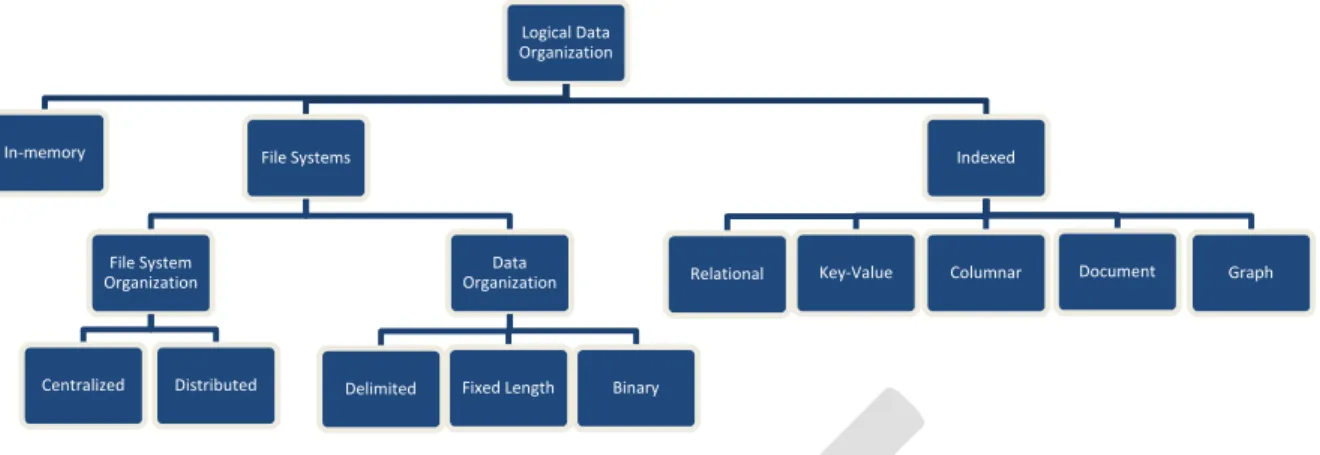
FIGURE 3: DATA ORGANIZATION APPROACHES ... 20
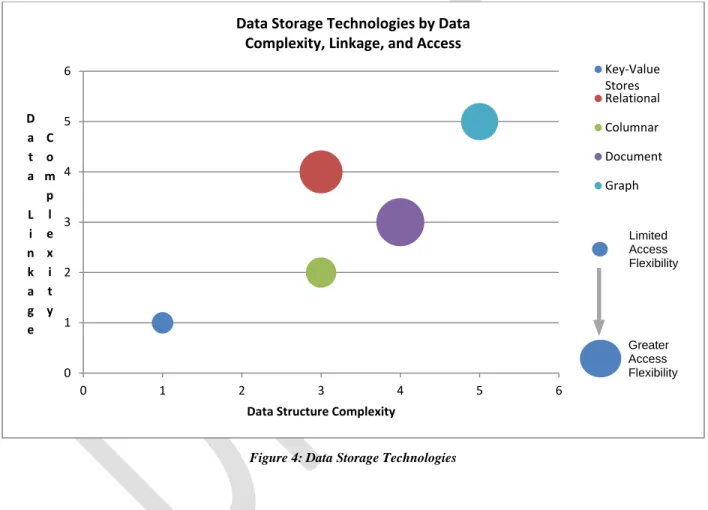
FIGURE 4: DATA STORAGE TECHNOLOGIES ... 23
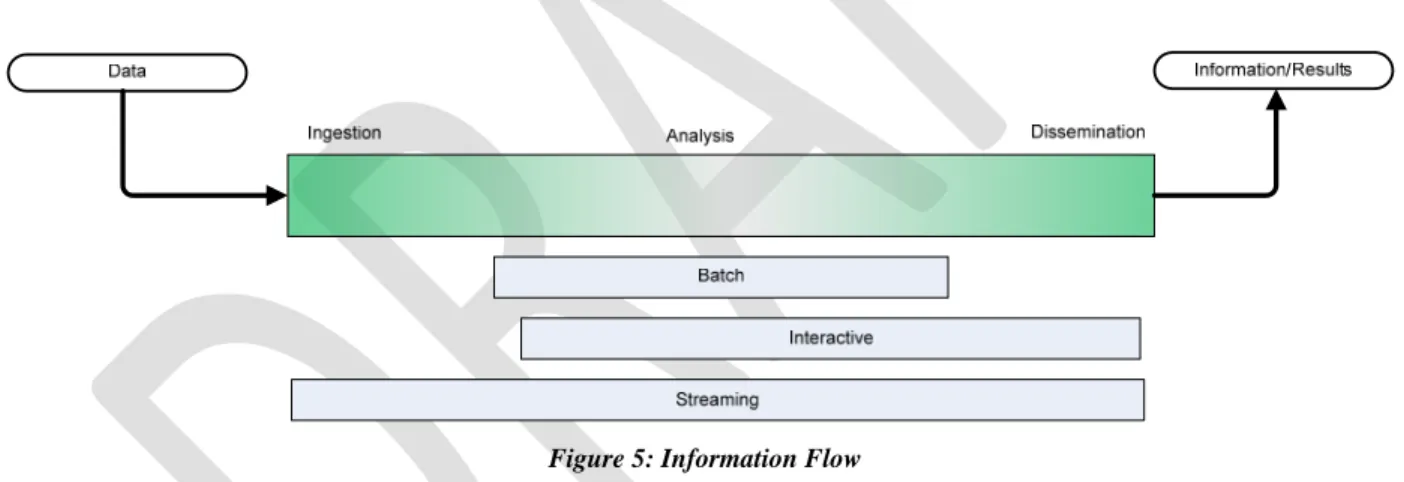
FIGURE 5: INFORMATION FLOW ... 24
FIGURE A‐1: BIG DATA FRAMEWORK DEPLOYMENT OPTIONS ... A‐1 FIGURE B‐1: DIFFERENCES BETWEEN ROW ORIENTED AND COLUMN ORIENTED STORES ... B‐3 FIGURE B‐2: COLUMN FAMILY SEGMENTATION OF THE COLUMNAR STORES MODEL ... B‐3 FIGURE B‐3: OBJECT NODES AND RELATIONSHIPS OF GRAPH DATABASES ... B‐6
Tables
TABLE 1: MAPPING USE CASE CHARACTERIZATION CATEGORIES TO REFERENCE ARCHITECTURE COMPONENTS AND FABRICS ... 5Executive Summary
1The NIST Big Data Public Working group (NBD-PWG) Reference Architecture Subgroup prepared this 2
NIST Big Data Interoperability Framework: Volume 6, Reference Architecture to provide a vendor-3
neutral, technology- and infrastructure-agnostic conceptual model and examine related issues. The 4
conceptual model, referred to as the NIST Big Data Reference Architecture (NBDRA), was crafted by 5
examining publicly available Big Data architectures representing various approaches and products. Inputs 6
from the other NBD-PWG subgroups were also incorporated into the creation of the NBDRA. It is 7
applicable to a variety of business environments, including tightly-integrated enterprise systems, as well 8
as loosely-coupled vertical industries that rely on cooperation among independent stakeholders. The 9
NBDRA captures the two known Big Data economic value chains: information, where value is created by 10
data collection, integration, analysis, and applying the results to data-driven services; and, the information 11
technology (IT), where value is created by providing networking, infrastructure, platforms, and tools in 12
support of vertical, data-based applications. 13
The NIST Big Data Interoperability Framework consists of seven volumes, each of which addresses a 14
specific key topic, resulting from the work of the NBD-PWG. The seven volumes are as follows: 15
Volume 1, Definitions 16
Volume 2, Taxonomies 17
Volume 3, Use Cases and General Requirements 18
Volume 4, Security and Privacy 19
Volume 5, Architectures White Paper Survey 20
Volume 6, Reference Architecture 21
Volume 7, Standards Roadmap 22
The NIST Big Data Interoperability Framework will be released in three versions, which correspond to 23
the three stages of the NBD-PWG work. The three stages aim to achieve the following with respect to the 24
NBDRA: 25
Stage 1: Identify the high-level Big Data reference architecture key components, which are 26
technology, infrastructure, and vendor agnostic 27
Stage 2: Define general interfaces between the NBDRA components 28
Stage 3: Validate the NBDRA by building Big Data general applications through the general interfaces 29
Potential areas of future work for the Subgroup during stage 2 are highlighted in Section 1.5 of this 30
volume. The current effort documented in this volume reflects concepts developed within the rapidly 31
evolving field of Big Data. 32
1
1 I
NTRODUCTION
34
1.1 B
ACKGROUND 35There is broad agreement among commercial, academic, and government leaders about the remarkable 36
potential of Big Data to spark innovation, fuel commerce, and drive progress. Big Data is the common 37
term used to describe the deluge of data in today’s networked, digitized, sensor-laden, and information-38
driven world. The availability of vast data resources carries the potential to answer questions previously 39
out of reach, including the following: 40
How can a potential pandemic reliably be detected early enough to intervene? 41
Can new materials with advanced properties be predicted before these materials have ever been 42
synthesized? 43
How can the current advantage of the attacker over the defender in guarding against cyber-44
security threats be reversed? 45
There is also broad agreement on the ability of Big Data to overwhelm traditional approaches. The growth 46
rates for data volumes, speeds, and complexity are outpacing scientific and technological advances in data 47
analytics, management, transport, and data user spheres. 48
Despite widespread agreement on the inherent opportunities and current limitations of Big Data, a lack of 49
consensus on some important, fundamental questions continues to confuse potential users and stymie 50
progress. These questions include the following: 51
What attributes define Big Data solutions? 52
How is Big Data different from traditional data environments and related applications? 53
What are the essential characteristics of Big Data environments? 54
How do these environments integrate with currently deployed architectures? 55
What are the central scientific, technological, and standardization challenges that need to be 56
addressed to accelerate the deployment of robust Big Data solutions? 57
Within this context, on March 29, 2012, the White House announced the Big Data Research and 58
Development Initiative.1 The initiative’s goals include helping to accelerate the pace of discovery in
59
science and engineering, strengthening national security, and transforming teaching and learning by 60
improving the ability to extract knowledge and insights from large and complex collections of digital 61
data. 62
Six federal departments and their agencies announced more than $200 million in commitments spread 63
across more than 80 projects, which aim to significantly improve the tools and techniques needed to 64
access, organize, and draw conclusions from huge volumes of digital data. The initiative also challenged 65
industry, research universities, and nonprofits to join with the federal government to make the most of the 66
opportunities created by Big Data. 67
Motivated by the White House initiative and public suggestions, the National Institute of Standards and 68
Technology (NIST) has accepted the challenge to stimulate collaboration among industry professionals to 69
further the secure and effective adoption of Big Data. As one result of NIST’s Cloud and Big Data Forum 70
held on January 15–17, 2013, there was strong encouragement for NIST to create a public working group 71
for the development of a Big Data Interoperability Framework. Forum participants noted that this 72
roadmap should define and prioritize Big Data requirements, including interoperability, portability, 73
reusability, extensibility, data usage, analytics, and technology infrastructure. In doing so, the roadmap 74
would accelerate the adoption of the most secure and effective Big Data techniques and technology. 75
On June 19, 2013, the NIST Big Data Public Working Group (NBD-PWG) was launched with extensive 76
participation by industry, academia, and government from across the nation. The scope of the NBD-PWG 77
involves forming a community of interests from all sectors—including industry, academia, and 78
government—with the goal of developing consensus on definitions, taxonomies, secure reference 79
architectures, security and privacy, andfrom thesea standards roadmap. Such a consensus would 80
create a vendor-neutral, technology- and infrastructure-independent framework that would enable Big 81
Data stakeholders to identify and use the best analytics tools for their processing and visualization 82
requirements on the most suitable computing platform and cluster, while also allowing value-added from 83
Big Data service providers. 84
The NIST Big Data Interoperability Framework consists of seven volumes, each of which addresses a 85
specific key topic, resulting from the work of the NBD-PWG. The seven volumes are as follows: 86
Volume 1, Definitions 87
Volume 2, Taxonomies 88
Volume 3, Use Cases and General Requirements 89
Volume 4, Security and Privacy 90
Volume 5, Architectures White Paper Survey 91
Volume 6, Reference Architecture 92
Volume 7, Standards Roadmap 93
The NIST Big Data Interoperability Framework will be released in three versions, which correspond to 94
the three stages of the NBD-PWG work. The three stages aim to achieve the following with respect to the 95
NBDRA: 96
Stage 1: Identify the high-level Big Data reference architecture key components, which are 97
technology, infrastructure, and vendor agnostic 98
Stage 2: Define general interfaces between the NBDRA components 99
Stage 3: Validate the NBDRA by building Big Data general applications through the general interfaces 100
Potential areas of future work for the Subgroup during stage 2 are highlighted in Section 1.5 of this 101
volume. The current effort documented in this volume reflects concepts developed within the rapidly 102
evolving field of Big Data. 103
1.2 S
COPE ANDO
BJECTIVES OF THER
EFERENCEA
RCHITECTURESS
UBGROUP 104Reference architectures provide “an authoritative source of information about a specific subject area that 105
guides and constrains the instantiations of multiple architectures and solutions.” 2 Reference architectures
106
generally serve as a foundation for solution architectures and may also be used for comparison and 107
alignment of instantiations of architectures and solutions. 108
The goal of the NBD-PWG Reference Architecture Subgroup is to develop an open reference architecture 109
for Big Data that achieves the following objectives: 110
Provides a common language for the various stakeholders 111
Encourages adherence to common standards, specifications, and patterns 112
Provides consistent methods for implementation of technology to solve similar problem sets 113
Illustrates and improves understanding of the various Big Data components, processes, and 114
systems, in the context of a vendor- and technology- agnostic Big Data conceptual model 115
Provides a technical reference for U.S. government departments, agencies, and other consumers 116
to understand, discuss, categorize, and compare Big Data solutions 117
Facilitates analysis of candidate standards for interoperability, portability, reusability, and 118
extendibility 119
3
The NIST Big Data Reference Architecture (NBDRA) is a high-level conceptual model crafted to serve 120
as a tool to facilitate open discussion of the requirements, design structures, and operations inherent in 121
Big Data. The NBDRA is intended to facilitate the understanding of the operational intricacies in Big 122
Data. It does not represent the system architecture of a specific Big Data system, but rather is a tool for 123
describing, discussing, and developing system-specific architectures using a common framework of 124
reference. The model is not tied to any specific vendor products, services, or reference implementation, 125
nor does it define prescriptive solutions that inhibit innovation. 126
The NBDRA does not address the following: 127
Detailed specifications for any organization’s operational systems 128
Detailed specifications of information exchanges or services 129
Recommendations or standards for integration of infrastructure products 130
1.3 R
EPORTP
RODUCTION 131A wide spectrum of Big Data architectures have been explored and developed as part of various industry, 132
academic, and government initiatives. The development of the NBDRA and material contained in this 133
volume involved the following steps: 134
1. Announce that the NBD-PWG Reference Architecture Subgroup is open to the public to attract 135
and solicit a wide array of subject matter experts and stakeholders in government, industry, and 136
academia 137
2. Gather publicly-available Big Data architectures and materials representing various stakeholders, 138
different data types, and diverse use cases a
139
3. Examine and analyze the Big Data material to better understand existing concepts, usage, goals, 140
objectives, characteristics, and key elements of Big Data, and then document the findings using 141
NIST’s Big Data taxonomies model (presented in NIST Big Data Interoperability Framework: 142
Volume 2, Taxonomies) 143
4. Develop a technology-independent, open reference architecture based on the analysis of Big Data 144
material and inputs received from other NBD-PWG subgroups 145
1.4 R
EPORTS
TRUCTURE 146The organization of this document roughly corresponds to the process used by the NBD-PWG to develop 147
the NBDRA. Following the introductory material presented in Section 1, the remainder of this document 148
is organized as follows: 149
Section 2 contains high-level, system requirements in support of Big Data relevant to the design 150
of the NBDRA and discusses the development of these requirements 151
Section 3 presents the generic, technology-independent NBDRA conceptual model 152
Section 4 discusses the five main functional components of the NBDRA 153
Section 5 describes the system and lifecycle management considerations related to the NBDRA 154
management fabric 155
Section 6 briefly introduces security and privacy topics related to the security and privacy fabric 156
of the NBDRA 157
Appendix A summarizes deployment considerations 158
Appendix B lists the terms and definitions in this document 159
Appendix C provides examples of Big Data logical data architecture options 160
a Many of the architecture use cases were originally collected by the NBD-PWG Use Case and Requirements
Appendix D defines the acronyms used in this document 161
Appendix E lists several general resources that provide additional information on topics covered 162
in this document and specific references in this document 163
1.5 F
UTUREW
ORK ON THISV
OLUME 164The NIST Big Data Interoperability Framework will be released in three versions, which correspond to 165
the three stages of the NBD-PWG work. The three stages aim to achieve the following with respect to the 166
NBDRA: 167
Stage 1:Identify the common reference architecture components of Big Data implementations and 168
formulate the technology-independent NBDRA 169
Stage 2:Define general interfaces between the NBDRA components 170
Stage 3:Validate the NBDRA by building Big Data general applications through the general interfaces 171
This document (Version 1) presents the overall NBDRA components and fabrics with high-level 172
description and functionalities. 173
Version 2 activities will focus on the definition of general interfaces between the NBDRA components by 174
performing the following: 175
Select use cases from the 62 (51 general and 11 security and privacy) submitted use cases or 176
other, to be identified, meaningful use cases 177
Work with domain experts to identify workflow and interactions among the NBDRA 178
components and fabrics 179
Explore and model these interactions within a small scale, manageable, and well-defined 180
confined environment 181
Aggregate the common data workflow and interactions between NBDRA components and 182
fabrics and package them into general interfaces 183
Version 3 activities will focus on validation of the NBDRA through the use of the defined NBDRA 184
general interfaces to build general Big Data applications. The validation strategy will include the 185
following: 186
Implement the same set of use cases used in Version 2 by using the defined general interfaces 187
Identify and implement a few new use cases outside the Version 2 scenarios 188
Enhance general NBDRA interfaces through lessons learned from the implementations in 189
Version 3 activities 190
The general interfaces developed during Version 2 activities will offer a starting point for further 191
refinement by any interested parties and is not intended to be a definitive solution to address all 192
implementation needs. 193
194 195
5
2 H
IGH
L
EVEL
R
EFERENCE
A
RCHITECTURE
R
EQUIREMENTS
196
The development of a Big Data reference architecture requires a thorough understanding of current 197
techniques, issues, and concerns. To this end, the NBD-PWG collected use cases to gain an understanding 198
of current applications of Big Data, conducted a survey of reference architectures to understand 199
commonalities within Big Data architectures in use, developed a taxonomy to understand and organize 200
the information collected, and reviewed existing technologies and trends relevant to Big Data. The results 201
of these NBD-PWG activities were used in the development of the NBDRA and are briefly described in 202
this section. 203
2.1 U
SEC
ASES ANDR
EQUIREMENTS 204To develop the use cases, publically available information was collected for various Big Data 205
architectures in nine broad areas, or application domains. Participants in the NBD-PWG Use Case and 206
Requirements Subgroup and other interested parties provided the use case details via a template, which 207
helped standardize the responses and facilitate subsequent analysis and comparison of the use cases. 208
However, submissions still varied in levels of detail, quantitative data, or qualitative information. The 209
NIST Big Data Interoperability Framework: Volume 3, Use Cases and General Requirements document 210
presents the original use cases, an analysis of the compiled information, and the requirements extracted 211
from the use cases. 212
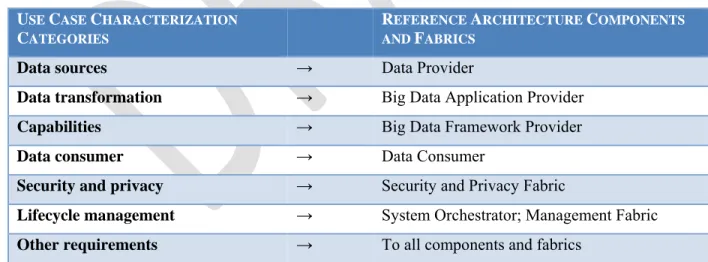
The extracted requirements represent challenges faced in seven characterization categories (Table 1) 213
developed by the Subgroup. Requirements specific to the use cases were aggregated into high level, 214
generalized requirements, which are vendor and technology neutral. 215
The use case characterization categories were used as input in the development of the NBDRA and map 216
directly to NBDRA components and fabrics as shown in Table 1. 217
Table 1: Mapping Use Case Characterization Categories to Reference Architecture Components and 218
Fabrics 219
USE CASE CHARACTERIZATION
CATEGORIES
REFERENCE ARCHITECTURE COMPONENTS AND FABRICS
Data sources → Data Provider
Data transformation → Big Data Application Provider
Capabilities → Big Data Framework Provider
Data consumer → Data Consumer
Security and privacy → Security and Privacy Fabric
Lifecycle management → System Orchestrator; Management Fabric
Other requirements → To all components and fabrics
220
The high-level, generalized requirements are presented below. The development of these generalized 221
requirements is presented in the NIST Big Data Interoperability Framework: Volume 3, Use Cases and 222
Requirements document. 223
DATA PROVIDER REQUIREMENTS
224
DSR-1: Reliable, real-time, asynchronous, streaming, and batch processing to collect data from 225
centralized, distributed, and cloud data sources, sensors, or instruments 226
DSR-2: Slow, bursty, and high throughput data transmission between data sources and 227
computing clusters 228
DSR-3: Diversified data content ranging from structured and unstructured text, documents, 229
graphs, web sites, geospatial, compressed, timed, spatial, multimedia, simulation, and 230
instrumental (i.e., system managements and monitoring) data 231
BIG DATA APPLICATION PROVIDER REQUIREMENTS
232
TPR-1: Diversified, compute-intensive, analytic processing and machine learning techniques 233
TPR-2: Batch and real time analytic processing 234
TPR-3: Processing large diversified data content and modeling 235
TPR-4: Processing data in motion (e.g., streaming, fetching new content, data tracking, 236
traceability, data change management, and data boundaries) 237
BIG DATA FRAMEWORK PROVIDER REQUIREMENTS
238
CPR-1: Legacy software and advanced software packages 239
CPR-2: Legacy and advanced computing platforms 240
CPR-3: Legacy and advanced distributed computing clusters, co-processors, input/output (I/O) 241
processing 242
CPR-4: Advanced networks (e.g., Software Defined Networks [SDN]) and elastic data 243
transmission, including fiber, cable, and wireless networks (e.g., local area network [LAN], wide 244
area network [WAN], metropolitan area network [MAN], Wi-Fi) 245
CPR-5: Legacy, large, virtual, and advanced distributed data storage 246
CPR-6: Legacy and advanced programming executables, applications, tools, utilities, and 247
libraries 248
DATA CONSUMER REQUIREMENTS
249
DCR-1: Fast searches (~0.1 seconds) from processed data with high relevancy, accuracy, and 250
recall 251
DCR-2: Diversified output file formats for visualization, rendering, and reporting 252
DCR-3: Visual layout for results presentation 253
DCR-4: Rich user interface for access using browser, visualization tools 254
DCR-5: High resolution, multi-dimension layer of data visualization 255
DCR-6: Streaming results to clients 256
SECURITY AND PRIVACY REQUIREMENTS
257
SPR-1: Protect and preserve security and privacy of sensitive data 258
SPR-2: Support sandbox, access control, and multi-tenant, multi-level, policy-driven 259
authentication on protected data and ensure these are in line with accepted governance, risk, and 260
compliance (GRC) and confidentiality, integrity, and availability (CIA) best practices 261
MANAGEMENT REQUIREMENTS
262
LMR-1: Data quality curation, including pre-processing, data clustering, classification, 263
reduction, and format transformation 264
LMR-2: Dynamic updates on data, user profiles, and links 265
LMR-3: Data lifecycle and long-term preservation policy, including data provenance 266
LMR-4: Data validation 267
7 LMR-5: Human annotation for data validation 268
LMR-6: Prevention of data loss or corruption 269
LMR-7: Multi-site (including cross-border, geographically dispersed) archives 270
LMR-8: Persistent identifier and data traceability 271
LMR-9: Standardization, aggregation, and normalization of data from disparate sources 272
OTHER REQUIREMENTS
273
OR-1: Rich user interface from mobile platforms to access processed results 274
OR-2: Performance monitoring on analytic processing from mobile platforms 275
OR-3: Rich visual content search and rendering from mobile platforms 276
OR-4: Mobile device data acquisition and management 277
OR-5: Security across mobile devices and other smart devices such as sensors 278
2.2 R
EFERENCEA
RCHITECTURES
URVEY 279The NBD-PWG Reference Architecture Subgroup conducted a survey of current reference architectures 280
to advance the understanding of the operational intricacies in Big Data and to serve as a tool for 281
developing system-specific architectures using a common reference framework. The Subgroup surveyed 282
currently published Big Data platforms by leading companies or individuals supporting the Big Data 283
framework and analyzed the collected material. This effort revealed a consistency between Big Data 284
architectures that served in the development of the NBDRA. Survey details, methodology, and 285
conclusions are reported in NIST Big Data Interoperability Framework: Volume 5, Architectures White 286
Paper Survey. 287
2.3 T
AXONOMY 288The NBD-PWG Definitions and Taxonomy Subgroup focused on identifying Big Data concepts, defining 289
terms needed to describe the new Big Data paradigm, and defining reference architecture terms. The 290
reference architecture taxonomy presented below provides a hierarchy of the components of the reference 291
architecture. Additional taxonomy details are presented in the NIST Big Data Interoperability 292
Framework: Volume 2, Taxonomy document. 293
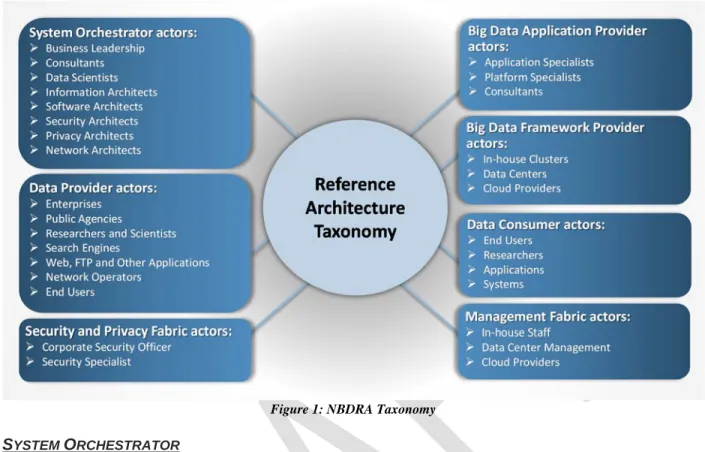
Figure 1 outlines potential actors for the seven roles developed by the NBD-PWG Definition and 294
Taxonomy Subgroup. The blue boxes contain the name of the role at the top with potential actors listed 295
directly below. 296
Figure 1: NBDRA Taxonomy
297
SYSTEM ORCHESTRATOR
298
The System Orchestrator provides the overarching requirements that the system must fulfill, including 299
policy, governance, architecture, resources, and business requirements, as well as monitoring or auditing 300
activities to ensure the system complies with those requirements. The System Orchestrator role provides 301
system requirements, high-level design, and monitoring for the data system. While the role pre-dates Big 302
Data systems, some related design activities have changed within the Big Data paradigm. 303
DATA PROVIDER
304
A Data Provider makes data available to itself or to others. In fulfilling its role, the Data Provider creates 305
an abstraction of various types of data sources (such as raw data or data previously transformed by 306
another system) and makes them available through different functional interfaces. The actor fulfilling this 307
role can be part of the Big Data system, internal to the organization in another system, or external to the 308
organization orchestrating the system. While the concept of a Data Provider is not new, the greater data 309
collection and analytics capabilities have opened up new possibilities for providing valuable data. 310
BIG DATA APPLICATION PROVIDER
311
The Big Data Application Provider executes the manipulations of the data lifecycle to meet requirements 312
established by the System Orchestrator. This is where the general capabilities within the Big Data 313
framework are combined to produce the specific data system. While the activities of an application 314
provider are the same whether the solution being built concerns Big Data or not, the methods and 315
techniques have changed because the data and data processing is parallelized across resources. 316
BIG DATA FRAMEWORK PROVIDER
317
The Big Data Framework Provider has general resources or services to be used by the Big Data 318
Application Provider in the creation of the specific application. There are many new components from 319
which the Big Data Application Provider can choose in using these resources and the network to build the 320
specific system. This is the role that has seen the most significant changes because of Big Data. The Big 321
Data Framework Provider consists of one or more instances of the three subcomponents: infrastructure 322
9
frameworks, data platforms, and processing frameworks. There is no requirement that all instances at a 323
given level in the hierarchy be of the same technology and, in fact, most Big Data implementations are 324
hybrids combining multiple technology approaches. These provide flexibility and can meet the complete 325
range of requirements that are driven from the Big Data Application Provider. Due to the rapid emergence 326
of new techniques, this is an area that will continue to need discussion. 327
DATA CONSUMER
328
The Data Consumer receives the value output of the Big Data system. In many respects, it is the recipient 329
of the same type of functional interfaces that the Data Provider exposes to the Big Data Application 330
Provider. After the system adds value to the original data sources, the Big Data Application Provider then 331
exposes that same type of functional interfaces to the Data Consumer. 332
SECURITY AND PRIVACY FABRIC
333
Security and privacy issues affect all other components of the NBDRA. The Security and Privacy Fabric 334
interacts with the System Orchestrator for policy, requirements, and auditing and also with both the Big 335
Data Application Provider and the Big Data Framework Provider for development, deployment, and 336
operation. The NIST Big Data Interoperability Framework: Volume 4, Security and Privacy document 337
discusses security and privacy topics. 338
MANAGEMENT FABRIC
339
The Big Data characteristics of volume, velocity, variety, and variability demand a versatile system and 340
software management platform for provisioning, software and package configuration and management, 341
along with resource and performance monitoring and management. Big Data management involves 342
system, data, security, and privacy considerations at scale, while maintaining a high level of data quality 343
and secure accessibility. 344
345 346
3 NBDRA
C
ONCEPTUAL
M
ODEL
347
As discussed in Section 2, the NBD-PWG Reference Architecture Subgroup used a variety of inputs from 348
other NBD-PWG subgroups in developing a vendor-neutral, technology- and infrastructure-agnostic, 349
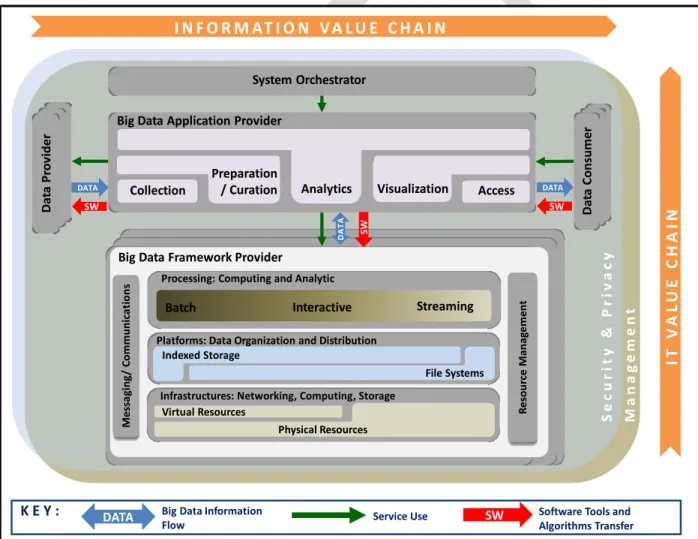
conceptual model of Big Data architecture. This conceptual model, the NBDRA, is shown in Figure 2 and 350
represents a Big Data system comprised of five logical functional components connected by 351
interoperability interfaces (i.e., services). Two fabrics envelop the components, representing the 352
interwoven nature of management and security and privacy with all five of the components. 353
The NBDRA is intended to enable system engineers, data scientists, software developers, data architects, 354
and senior decision makers to develop solutions to issues that require diverse approaches due to 355
convergence of Big Data characteristics within an interoperable Big Data ecosystem. It provides a 356
framework to support a variety of business environments, including tightly-integrated enterprise systems 357
and loosely-coupled vertical industries, by enhancing understanding of how Big Data complements and 358
differs from existing analytics, business intelligence, databases, and systems. 359
360
Figure 2: NIST Big Data Reference Architecture (NBDRA)
361
The NBDRA is organized around two axes representing the two Big Data value chains: the information 362
(horizontal axis) and the IT (vertical axis). Along the information axis, the value is created by data 363
K E Y : Big Data Information Service Use SW
Flow
Software Tools and
Algorithms Transfer
Big Data Application Provider
Visualization Access Analytics Collection System Orchestrator Sec u r ity & Pr iv ac y Ma n a g e men t DATA SW DATA SW I N F O R M AT I O N V A L U E C H A I N IT VA L U E CH AIN Da ta C o nsumer Da ta Pr o vider DATA Virtual Resources Physical Resources Indexed Storage File Systems
Big Data Framework Provider
Processing: Computing and Analytic
Platforms: Data Organization and Distribution
Infrastructures: Networking, Computing, Storage
DATA SW Preparation / Curation Messa gi n g / C o mmunic a ti o n s Streaming Re so u rc e Manag e me nt Interactive Batch
11
collection, integration, analysis, and applying the results following the value chain. Along the IT axis, the 364
value is created by providing networking, infrastructure, platforms, application tools, and other IT 365
services for hosting of and operating the Big Data in support of required data applications. At the 366
intersection of both axes is the Big Data Application Provider component, indicating that data analytics 367
and its implementation provide the value to Big Data stakeholders in both value chains. The names of the 368
Big Data Application Provider and Big Data Framework Provider components contain “providers” to 369
indicate that these components provide or implement a specific technical function within the system. 370
The five main NBDRA components, shown in Figure 2 and discussed in detail in Section 4, represent 371
different technical roles that exist in every Big Data system. These functional components are as follows: 372
System Orchestrator 373
Data Provider 374
Big Data Application Provider 375
Big Data Framework Provider 376
Data Consumer 377
The two fabrics shown in Figure 2 encompassing the five functional components are the following: 378
Management 379
Security and Privacy 380
These two fabrics provide services and functionality to the five functional components in the areas 381
specific to Big Data and are crucial to any Big Data solution. 382
The “DATA” arrows in Figure 2 show the flow of data between the system’s main components. Data 383
flows between the components either physically (i.e., by value) or by providing its location and the means 384
to access it (i.e., by reference). The “SW” arrows show transfer of software tools for processing of Big 385
Data in situ. The “Service Use” arrows represent software programmable interfaces. While the main focus 386
of the NBDRA is to represent the run-time environment, all three types of communications or transactions 387
can happen in the configuration phase as well. Manual agreements (e.g., service-level agreements 388
[SLAs]) and human interactions that may exist throughout the system are not shown in the NBDRA. 389
The components represent functional roles in the Big Data ecosystem. In system development, actors and 390
roles have the same relationship as in the movies, but system development actors can represent 391
individuals, organizations, software, or hardware. According to the Big Data taxonomy, a single actor can 392
play multiple roles, and multiple actors can play the same role. The NBDRA does not specify the business 393
boundaries between the participating actors or stakeholders, so the roles can either reside within the same 394
business entity or can be implemented by different business entities. Therefore, the NBDRA is applicable 395
to a variety of business environments, from tightly-integrated enterprise systems to loosely-coupled 396
vertical industries that rely on the cooperation of independent stakeholders. As a result, the notion of 397
internal versus external functional components or roles does not apply to the NBDRA. However, for a 398
specific use case, once the roles are associated with specific business stakeholders, the functional 399
components would be considered as internal or external—subject to the use case’s point of view. 400
The NBDRA does support the representation of stacking or chaining of Big Data systems. For example, a 401
Data Consumer of one system could serve as a Data Provider to the next system down the stack or chain. 402
4 F
UNCTIONAL
C
OMPONENTS OF THE
NBDRA
404
As outlined in Section 3, the five main functional components of the NBDRA represent the different 405
technical roles within a Big Data system. The functional components are listed below and discussed in 406
subsequent subsections. 407
System Orchestrator: Defines and integrates the required data application activities into an 408
operational vertical system 409
Data Provider: Introduces new data or information feeds into the Big Data system 410
Big Data Application Provider: Executes a data lifecycle to meet security and privacy 411
requirements as well as System Orchestrator-defined requirements 412
Big Data Framework Provider: Establishes a computing framework in which to execute 413
certain transformation applications while protecting the privacy and integrity of data 414
Data Consumer: Includes end users or other systems that use the results of the Big Data 415
Application Provider 416
4.1 S
YSTEMO
RCHESTRATOR 417The System Orchestrator role includes defining and integrating the required data application activities 418
into an operational vertical system. Typically, the System Orchestrator involves a collection of more 419
specific roles, performed by one or more actors, which manage and orchestrate the operation of the Big 420
Data system. These actors may be human components, software components, or some combination of the 421
two. The function of the System Orchestrator is to configure and manage the other components of the Big 422
Data architecture to implement one or more workloads that the architecture is designed to execute. The 423
workloads managed by the System Orchestrator may be assigning/provisioning framework components to 424
individual physical or virtual nodes at the lower level, or providing a graphical user interface that supports 425
the specification of workflows linking together multiple applications and components at the higher level. 426
The System Orchestrator may also, through the Management Fabric, monitor the workloads and system to 427
confirm that specific quality of service requirements are met for each workload, and may actually 428
elastically assign and provision additional physical or virtual resources to meet workload requirements 429
resulting from changes/surges in the data or number of users/transactions. 430
The NBDRA represents a broad range of Big Data systems, from tightly coupled enterprise solutions 431
(integrated by standard or proprietary interfaces) to loosely coupled vertical systems maintained by a 432
variety of stakeholders bounded by agreements and standard or standard-de-facto interfaces. 433
In an enterprise environment, the System Orchestrator role is typically centralized and can be mapped to 434
the traditional role of system governor that provides the overarching requirements and constraints, which 435
the system must fulfill, including policy, architecture, resources, or business requirements. A system 436
governor works with a collection of other roles (e.g., data manager, data security, and system manager) to 437
implement the requirements and the system’s functionality. 438
In a loosely coupled vertical system, the System Orchestrator role is typically decentralized. Each 439
independent stakeholder is responsible for its own system management, security, and integration, as well 440
as integration within the Big Data distributed system using the interfaces provided by other stakeholders. 441
4.2 D
ATAP
ROVIDER 442The Data Provider role introduces new data or information feeds into the Big Data system for discovery, 443
access, and transformation by the Big Data system. New data feeds are distinct from the data already in 444
use by the system and residing in the various system repositories. Similar technologies can be used to 445
13
access both new data feeds and existing data. The Data Provider actors can be anything from a sensor, to 446
a human inputting data manually, to another Big Data system. 447
One of the important characteristics of a Big Data system is the ability to import and use data from a 448
variety of data sources. Data sources can be internal or public records, tapes, images, audio, videos, 449
sensor data, web logs, system and audit logs, HTTP cookies, and other sources. Humans, machines, 450
sensors, online and offline applications, Internet technologies, and other actors can also produce data 451
sources. The roles of Data Provider and Big Data Application Provider often belong to different 452
organizations, unless the organization implementing the Big Data Application Provider owns the data 453
sources. Consequently, data from different sources may have different security and privacy 454
considerations. In fulfilling its role, the Data Provider creates an abstraction of the data sources. In the 455
case of raw data sources, the Data Provider can potentially cleanse, correct, and store the data in an 456
internal format that is accessible to the Big Data system that will ingest it. 457
The Data Provider can also provide an abstraction of data previously transformed by another system (i.e., 458
legacy system, another Big Data system.) In this case, the Data Provider would represent a Data 459
Consumer of the other system. For example, Data Provider 1 could generate a streaming data source from 460
the operations performed by Data Provider 2 on a dataset at rest. 461
Data Provider activities include the following, which are common to most systems that handle data: 462
Collecting the data 463
Persisting the data 464
Providing transformation functions for data scrubbing of sensitive information such as 465
Personally Identifiable Information (PII) 466
Creating the metadata describing the data source(s), usage policies/access rights, and other 467
relevant attributes 468
Enforcing access rights on data access 469
Establishing formal or informal contracts for data access authorizations 470
Making the data accessible through suitable programmable push or pull interfaces 471
Providing push or pull access mechanisms 472
Publishing the availability of the information and the means to access it 473
The Data Provider exposes a collection of interfaces (or services) for discovering and accessing the data. 474
These interfaces would typically include a registry so that applications can locate a Data Provider, 475
identify the data of interest it contains, understand the types of access allowed, understand the types of 476
analysis supported, locate the data source, determine data access methods, identify the data security 477
requirements, identify the data privacy requirements, and other pertinent information. Therefore, the 478
interface would provide the means to register the data source, query the registry, and identify a standard 479
set of data contained by the registry. 480
Subject to Big Data characteristics (i.e., volume, variety, velocity, and variability) and system design 481
considerations, interfaces for exposing and accessing data would vary in their complexity and can include 482
both push and pull software mechanisms. These mechanisms can include subscription to events, listening 483
to data feeds, querying for specific data properties or content, and the ability to submit a code for 484
execution to process the data in situ. Because the data can be too large to economically move across the 485
network, the interface could also allow the submission of analysis requests (e.g., software code 486
implementing a certain algorithm for execution), with the results returned to the requestor. Data access 487
may not always be automated, but might involve a human role logging into the system and providing 488
directions where new data should be transferred (e.g., establishing a subscription to an email based data 489
feed). 490
The interface between the Data Provider and Big Data Application Provider typically will go through 491
three phases: initiation, data transfer, and termination. The initiation phase is started by either party and 492
often includes some level of authentication/authorization. The phase may also include queries for 493
metadata about the source or consumer, such as the list of available topics in a publish/subscribe 494
(pub/sub) model and the transfer of any parameters (e.g., object count/size limits or target storage 495
locations). Alternatively, the phase may be as simple as one side opening a socket connection to a known 496
port on the other side. 497
The data transfer phase may be a push from the Data Provider or a pull by the Big Data Application 498
Provider. It may also be a singular transfer or involve multiple repeating transfers. In a repeating transfer 499
situation, the data may be a continuous stream of transactions/records/bytes. In a push scenario, the Big 500
Data Application Provider must be prepared to accept the data asynchronously but may also be required 501
to acknowledge (or negatively acknowledge) the receipt of each unit of data. In a pull scenario, the Big 502
Data Application Provider would specifically generate a request that defines through parameters of the 503
data to be returned. The returned data could itself be a stream or multiple records/units of data and the 504
data transfer phase may consist of multiple request/send transactions. 505
The termination phase could be as simple as one side simply dropping the connection or could include 506
checksums, counts, hashes, or other information about the completed transfer. 507
4.3 B
IGD
ATAA
PPLICATIONP
ROVIDER 508The Big Data Application Provider role executes a specific set of operations along the data lifecycle to 509
meet the requirements established by the System Orchestrator, as well as meeting security and privacy 510
requirements. The Big Data Application Provider is the architecture component that encapsulates the 511
business logic and functionality to be executed by the architecture. The Big Data Application Provider 512
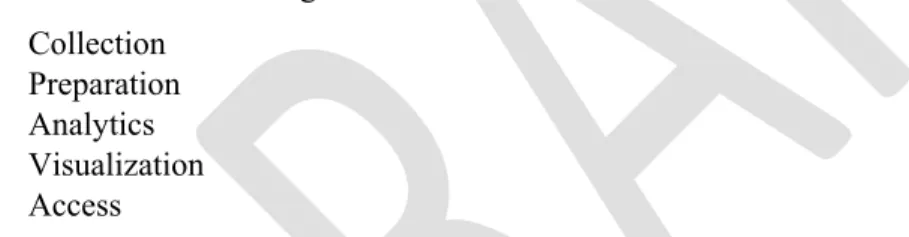
activities include the following 513 Collection 514 Preparation 515 Analytics 516 Visualization 517 Access 518
These activities are represented by the subcomponents of the Big Data Application Provider as shown in 519
Figure 2. The execution of these activities would typically be specific to the application and, therefore, 520
are not candidates for standardization. However, the metadata and the policies defined and exchanged 521
between the application’s subcomponents could be standardized when the application is specific to a 522
vertical industry. 523
While many of these activities exist in traditional data processing systems, the data volume, velocity, 524
variety, and variability present in Big Data systems radically change their implementation. Traditional 525
algorithms and mechanisms of traditional data processing implementations need to be adjusted and 526
optimized to create applications that are responsive and can grow to handle ever growing data collections. 527
As data propagates through the ecosystem, it is being processed and transformed in different ways in 528
order to extract the value from the information. Each activity of the Big Data Application Provider can be 529
implemented by independent stakeholders and deployed as stand-alone services. 530
The Big Data Application Provider can be a single instance or a collection of more granular Big Data 531
Application Providers, each implementing different steps in the data lifecycle. Each of the activities of the 532
Big Data Application Provider may be a general service invoked by the System Orchestrator, Data 533
Provider, or Data Consumer, such as a Web server, a file server, a collection of one or more application 534
programs, or a combination. There may be multiple and differing instances of each activity or a single 535
program may perform multiple activities. Each of the activities is able to interact with the underlying Big 536
Data Framework Providers as well as with the Data Providers and Data Consumers. In addition, these 537
15
activities may execute in parallel or in any number of sequences and will frequently communicate with 538
each other through the messaging/communications element of the Big Data Framework Provider. Also, 539
the functions of the Big Data Application Provider, specifically the collection and access activities, will 540
interact with the Security and Privacy Fabric to perform authentication/authorization and record/maintain 541
data provenance. 542
Each of the functions can run on a separate Big Data Framework Provider or all can use a common Big 543
Data Framework Provider. The considerations behind these different system approaches would depend on 544
potentially different technological needs, business and/or deployment constraints (including privacy), and 545
other policy considerations. The baseline NBDRA does not show the underlying technologies, business 546
considerations, and topological constraints, thus making it applicable to any kind of system approach and 547
deployment. 548
For example, the infrastructure of the Big Data Application Provider would be represented as one of the 549
Big Data Framework Providers. If the Big Data Application Provider uses external/outsourced 550
infrastructures as well, it or they will be represented as another or multiple Big Data Framework 551
Providers in the NBDRA. The multiple grey blocks behind the Big Data Framework Providers in Figure 2 552
indicate that multiple Big Data Framework Providers can support a single Big Data Application Provider. 553
4.3.1 C
OLLECTION554
In general, the collection activity of the Big Data Application Provider handles the interface with the Data 555
Provider. This may be a general service, such as a file server or web server configured by the System 556
Orchestrator to accept or perform specific collections of data, or it may be an application specific service 557
designed to pull data or receive pushes of data from the Data Provider. Since this activity is receiving data 558
at a minimum, it must store/buffer the received data until it is persisted through the Big Data Framework 559
Provider. This persistence need not be to physical media but may simply be to an in-memory queue or 560
other service provided by the processing frameworks of the Big Data Framework Provider. The collection 561
activity is likely where the extraction portion of the Extract, Transform, Load/Extract, Load, Transform 562
(ETL/ELT) cycle is performed. At the initial collection stage, sets of data (e.g., data records) of similar 563
structure are collected (and combined), resulting in uniform security, policy, and other considerations. 564
Initial metadata is created (e.g., subjects with keys are identified) to facilitate subsequent aggregation or 565
lookup methods. 566
4.3.2 P
REPARATION567
The preparation activity is where the transformation portion of the ETL/ELT cycle is likely performed, 568
although analytics activity will also likely perform advanced parts of the transformation. Tasks performed 569
by this activity could include data validation (e.g., checksums/hashes, format checks), cleansing (e.g., 570
eliminating bad records/fields), outlier removal, standardization, reformatting, or encapsulating. This 571
activity is also where source data will frequently be persisted to archive storage in the Big Data 572
Framework Provider and provenance data will be verified or attached/associated. Verification or 573
attachment may include optimization of data through manipulations (e.g., deduplication) and indexing to 574
optimize the analytics process. This activity may also aggregate data from different Data Providers, 575
leveraging metadata keys to create an expanded and enhanced data set. 576
4.3.3 A
NALYTICS577
The analytics activity of the Big Data Application Provider includes the encoding of the low-level 578
business logic of the Big Data system (with higher level business process logic being encoded by the 579
System Orchestrator). The activity implements the techniques to extract knowledge from the data based 580
on the requirements of the vertical application. The requirements specify the data processing algorithms 581
for processing the data to produce new insights that will address the technical goal. The analytics activity 582
will leverage the processing frameworks to implement the associated logic. This typically involves the 583
activity providing software that implements the analytic logic to the batch and/or streaming elements of 584
the processing framework for execution. The messaging/communication framework of the Big Data 585
Framework Provider may be used to pass data or control functions to the application logic running in the 586
processing frameworks. The analytic logic may be broken up into multiple modules to be executed by the 587
processing frameworks which communicate, through the messaging/communication framework, with 588
each other and other functions instantiated by the Big Data Application Provider. 589
4.3.4 V
ISUALIZATION590
The visualization activity of the Big Data Application Provider prepares elements of the processed data 591
and the output of the analytic activity for presentation to the Data Consumer. The objective of this activity 592
is to format and present data in such a way as to optimally communicate meaning and knowledge. The 593
visualization preparation may involve producing a text-based report or rendering the analytic results as 594
some form of graphic. The resulting output may be a static visualization and may simply be stored 595
through the Big Data Framework Provider for later access. However, the visualization activity frequently 596
interacts with the access activity, the analytics activity, and the Big Data Framework Provider (processing 597
and platform) to provide interactive visualization of the data to the Data Consumer based on parameters 598
provided to the access activity by the Data Consumer. The visualization activity may be completely 599
application implemented, leverage one or more application libraries, or may use specialized visualization 600
processing frameworks within the Big Data Framework Provider. 601
4.3.5 A
CCESS602
The access activity within the Big Data Application Provider is focused on the communication/interaction 603
with the Data Consumer. Similar to the collection activity, the access activity may be a generic service 604
such as a web server or application server that is configured by the System Orchestrator to handle specific 605
requests from the Data Consumer. This activity would interface with the visualization and analytic 606
activities to respond to requests from the Data Consumer (who may be a person) and uses the processing 607
and platform frameworks to retrieve data to respond to Data Consumer requests. In addition, the access 608
activity confirms that descriptive and administrative metadata and metadata schemes are captured and 609
maintained for access by the Data Consumer and as data is transferred to the Data Consumer. The 610
interface with the Data Consumer may be synchronous or asynchronous in nature and may use a pull or 611
push paradigm for data transfer. 612
4.4 B
IGD
ATAF
RAMEWORKP
ROVIDER 613The Big Data Framework Provider typically consists of one or more hierarchically organized instances of 614
the components in the NBDRA IT value chain (Figure 2). There is no requirement that all instances at a 615
given level in the hierarchy be of the same technology. In fact, most Big Data implementations are 616
hybrids that combine multiple technology approaches in order to provide flexibility or meet the complete 617
range of requirements, which are driven from the Big Data Application Provider. 618
Many of the recent advances related to Big Data have been in the area of frameworks designed to scale to 619
Big Data needs (e.g., addressing volume, variety, velocity, and variability) while maintaining linear or 620
near linear performance. These advances have generated much of the technology excitement in the Big 621
Data space. Accordingly, there is a great deal more information available in the frameworks area 622
compared to the other components and the additional detail provided for the Big Data Framework 623
Provider in this document reflects this imbalance. 624
The Big Data Framework Provider is comprised of the following three subcomponents (from the bottom 625
to the top): 626
Infrastructure Frameworks 627
Data Platform Frameworks 628
Processing Frameworks 629