Maternal
Child
Health
Nurses
and
First Time Parent Group Resource
and Facilitation Guide for
First-Time Parent Group
Resource and Facilitation Guide for
Project Consultants and Authors
Professor Gay Edgecombe, Clinical Chair, Community Child Health Nursing, RMIT Susanne White, Director, The Resolutions Group, Pty Ltd
Geraldine Marsh, Consultant, The Resolutions Group, Pty Ltd
Carol Jackson, Senior Lecturer, Child and Family Health Nursing, RMIT
Dr Barbara Hanna, Senior Lecturer, School of Nursing Deakin University
Sue Newman, Maternal and Child Health Nurse, City of Greater Geelong.
Acknowledgments
The Project Team wishes to thank those people consulted during the development of the Guide:
Patricia Glynn, Maternal and Child Health Nurse, Wyndham City.
Catriona Good, Maternal and Child Health Nurse, City of Darebin.
Raelene Howgate, Maternal and Child Health Nurse, Whitehorse City.
Sue Newman, Maternal and Child Health Nurse, City of Greater Geelong.
Katrina Pfarrer, Maternal and Child Health Nurse, City of Greater Geelong.
Hilary Robinson, Maternal and Child Health Nurse, City of Greater Geelong.
Faye Stanesby, Maternal and Child Health Nurse, City of Yarra.
Paula Walsh, Maternal and Child Health Nurse, City of Greater Geelong.
Sue Walsh, Maternal and Child Health Nurse, City of Darebin.
The 150 maternal and child health nurses who attended the eight One-Day First-Time Parent Group Workshops, gave the Project Team valuable feedback on the developing Guide. The maternal and child health nurses who gave feedback on the Guide after trialling it in their First-Time Parent Groups between October 1997 and February 1998.
Parent Group Resource Guide
Reference Group
A project Parent Group Resource Guide Reference Group was established to provide expert advice. The members of the Reference Group were:
Prue Ingram, Acting Manager, Family Services, Department of Human Services. Steve Ballard, Manager, Community Child Health, Department of Human Services. Miranda Adams, Program Adviser, Community Child Health, Department of Human Services.
Warren Cann, Senior Program Adviser, Parenting and Neighbourhood Services, Department of Human Services.
Vanessa Gati, Regional Parenting Resource Service, Western Metropolitan Region. Dr Dorothy Scott, Deputy Head, School of Social Work, The University of Melbourne. Marianne Mackay, Lecturer/Coordinator, Community, Child and Family Health
Nursing, School of Nursing, Faculty of Health Sciences, La Trobe University.
Nola Green, Maternal and Child Health Nurse, City of Yarra.
ISBN 0 7306 5078 2
Acknowledgements
Writen by G. Edgecombe, S. White, G. Marsh, C. Jackson, B. Hanna, S. Newman, D. Scott
Published by the Victorian Government Department of Human Services Melbourne, Victoria, April 2001.
© Department of Human Services (0140598)
iii CONTENTS
Section One
Introduction to First-Time Parent Group Resource and Facilitation
Guide for Maternal and Child Health Nurses
1.1 Introduction 3
1.2 Aims of the Guide 4
1.3 How Was the Guide Developed? 5
1.3.1 Background to the First-Time Parents’ Sessions 6
1.4 How to Use the Guide 7
1.5 Information about the Guide 8
1.6 References 9
Section Two
Social Interaction and Health
2.1 Introduction 11
2.2 Benefits of Social Support 12
2.3 Facilitator’s Role and Related Benefits 13
2.4 References 14
Section Three
Benefits of New Parents’ Support Groups
3.1 Introduction 17
3.2 Parents’ Perceptions of the Value of First-Time Parent Groups 17 3.3 Maternal and Child Health Nurses’ Perceptions of the Value of First-time 19
Parent Groups
3.4 Conclusion 20
Section Four
Tips for Organising and Facilitating First-Time Parent Groups
4.1 Introduction 21
4.2 Successful First-Time Parent Group Session Factors 21
4.3 Role of Facilitator 21
4.4 Encouraging Sustainable Connections Between Participants 22
4.5 Group Guidelines or Rules 22
4.6 Handling Difficult People in the Group Sessions 23
4.7 What to Do about ‘Drop Outs’ 24
4.8 Evaluating the Sessions 24
4.9 Debriefing the Facilitator 24
4.10 Engaging ‘Experts’ 24
4.11 Inviting Participants 24
4.12 Times, Days and Venues 25
4.13 Engaging Fathers 25
4.14 Maintaining and Continuing the Group 25 4.15 Developing and Improving Facilitation Skills 26
Section Five
About the First-Time Parent Group Sessions
5.1 Introduction 27
5.2 The Purpose of the Group Sessions 28 5.3 Maternal and Child Health Nurse as Group Facilitator 28
5.3.1 Accessing Resources for Parents and Maternal and Child Health Nurses 29
5.3.2 Accessing Resources for Culturally Specific Groups 29
5.4 The Session Designs 30
5.5 Choosing the Sessions for Parent Groups 31 5.6 Notes on the Strategies Used in Following Sessions 32
5.7 Promoting Discussion in Groups 34
v CONTENTS
Section Six
Suggested First-Time Parent Group Sessions
6.1 Getting to Know Each Other: Beginning Our Group 35
6.1.1 Planning the Session 35
6.1.2 Workshop Session 36
Conversation Starters 38
6.2 Being a Parent: Changes and Challenges 39
6.2.1 Planning the Session 39
6.2.2 Workshop Session 41
6.3 Getting to Know Your Baby 43
6.3.1 Planning the Session 43
6.3.2 Workshop Session 44
6.4 Looking After Yourself: Exploring Mother’s Health 47
6.4.1 Planning the Session 47
6.4.2 Workshop Session 49
Raindrops Massage Text 52
Script for Raindrops Massage 53
6.5 Baby’s Ages and Stages: What to Expect 55
6.5.1 Planning the Session 55
6.5.2 Workshop Session 57
6.6 Managing Childhood Illnesses 61
6.6.1 Planning the Session 61
6.6.2 Workshop Session 62
Visiting a Health Professional 65
6.7 What to do in an Emergency (1): Resuscitation 67
6.7.1 Planning the Session 67
6.7.2 Workshop Session 69
6.8 What to do in an Emergency (2): First Aid 71
6.8.1 Planning the Session 71
6.8.2 Workshop Session 73
6.9 Keeping Your Child Safe: Preventing Accidents 75
6.9.1 Planning the Session 75
6.9.2 Workshop Session 77
6.10 A Settled Baby: What Does it Mean? 81
6.10.1Planning the Session 81
6.11 Food: Your Baby and the Family 87
6.11.1 Planning the Session 87
6.11.2 Workshop Session 89
6.12 Teething and Looking After Baby’s Teeth for Life 91
6.12.1Planning the Session 91
6.12.2Workshop Session 93
6.13 Returning to Paid Work 95
6.1.1 Planning the Session 95
6.1.2 Workshop Session 96
6.14 Play: More than Fun and Games 99
6.14.1Planning the Session 99
6.14.2Workshop Session 100
6.15 Being a New Parent in Australia and Other Countries 103
6.15.1Planning the Session 103
6.15.2Workshop Session 104
6.16 Communicating With Your Baby Through Music and Books 107
6.16.1Planning the Session 107
6.16.2Workshop Session 108
Music and Your Baby 110
6.17 Where to From Here? 111
6.17.1Planning the Session 111
6.17.2Workshop Session 112
Section Seven
Resources for Nurses
7.1 Figure 1 – Model for Parent’s Perception of Core Benefits of
First Time parent Group 115
7.2 Invitation 116
7.3 Pre-Group Information 117
7.4 Group Session Outline and Roster 118
7.5 Evaluation 119
3 1. INTRODUCTION
1. Introduction to the First-Time Parent Group
Resource and Facilitation Guide for Maternal and
Child Health Nurses
1.1 Introduction
Welcome to the First-Time Parent Group Resource and Facilitation Guide for Maternal and Child
Health Nurses(The Guide). This Guide has been designed to assist maternal and child health
nurses in their facilitation of the first-time parent groups for which they are responsible.
First-Time Parent Groups are funded by the Department of Human Services in recognition of the challenges and stresses that may be associated with the transition to parenthood (Department of Human Services, 1997, p. 3). The purpose of groups for first-time parents is to:
• Enhance parental and emotional well-being. • Enhance parent–child interaction.
• Provide opportunities for first-time parents to establish informal networks and social supports.
• Increase parental confidence and independence in child rearing.
Parenting groups have been provided by maternal and child health nurses since the 1920s. However, it was not until 1994 that funding was formally allocated for first-time mothers’ groups by the then Department of Health and Community Services (now the Department of Human Services). The name of the groups was changed to First-Time Parent Groups in 1997– 8 in recognition of the role fathers play in parenting. The role of fathers as members of the First-Time Parent Groups is developing.
The Guide provides information about the theory and research which underpin the funding of First Time Parent Groups and the consequent emphasis within the Guide on promoting social interaction, both within the formal group sessions facilitated by the nurse and outside the sessions as well.
The primary focus of the Guide is the role of the maternal and child health nurse as a group facilitator. Most sections of the Guide are dedicated to the work of group facilitation. There are some tips for running effective groups and a series of sessions detailed. Nurses can select directly from these sessions for their groupwork or they can adapt them to suit the needs of their groups and their own facilitation styles. There are some materials which can be copied directly or again adapted for use by maternal and child health nurses. Throughout the Guide there are current references which have been provided for nurses and group participants to follow up.
Numbers of maternal and child health nurses have been successfully facilitating first-time parent groups for years. Many of the ideas within the Guide have been drawn from their experience and others have been developed to address the concerns which have been identified by nurses during the research and trialling phases conducted in preparation of this Guide.
1.2 Aims of the Guide
The specific aims of the Guide are to:
• Enhance maternal and child health nurses’ knowledge and skills in providing first-time parent groups.
• Provide information on the facilitation of groups. • Provide a range of group topic outlines.
• Provide a range of group models for increased flexibility. • Provide information on suitable resources for groups.
First-time parents require a range of information which supports the development of their parenting skills when they become a new parent. The provision of First-Time Parent Groups is one strategy used by Victoria’s Maternal and Child Health Service to provide parents with a range of information, while developing a supportive group environment for parents. The Department of Human Services, Victoria, has formally funded First-Time Parent Groups since January 1994. This new funding initiative was evaluated in 1995 by Deakin University (Clarke, Hanna, Rolls, Grant, Bethume, Horne and Ching, 1995, pp. 3–4). The areas of concern identified were:
• The groups should also include fathers and any other persons taking a major role in caring for the new baby.
• Consideration should be given to the flexibility of the timing of the groups, such as offering evening or weekend sessions.
• Greater involvement of participants in selecting the group topics may reduce the mismatch found between the parents (development of long-term friendships and informal social networks) and nurses’ needs (more interested in information provision and education). • All nurses should evaluate their groups.
• There is a need to have an interpreter present for some non-English speaking groups.
• There is a need to provide continuing education for some maternal and child health nurses in group facilitation.
Many Victorian maternal and child health nurses have the knowledge and skills needed for managing and facilitating First-Time Parent Groups and group work generally. This Guide is designed to capitalise on their expertise and provide new information and resources to assist them with this aspect of their practice.
While this Guide will be sufficient stimulus for many nurses in their group facilitation, others may find it advantageous to access some of the one or two day training programs in general group facilitation which are available at various educational organisations throughout Victoria. The Guide will then be useful for its suggestions in the specific application to the issues of first time parents.
5
1.3 How Was the Guide Developed?
Since 1994, maternal and child health nurses have requested assistance with the development of a package to assist them to provide high quality First-Time Parent Groups across Victoria. In 1997, a project team from RMIT University successfully tendered for a Department of Human Services Project Brief, Development of a First-Time Parent Group Resource and Facilitation Guide for Maternal and Child Health Nurses (April, 1997).
As it was several years since the evaluation of First-Time Parent Groups by Deakin University (1995) the project team undertook a series of focus groups with maternal and child health nurses and first-time parents in 1997, prior to commencing work on the design and layout of the
Resource and Facilitation Guide.
Key positive features of the groups identified by parents included: • The groups are fun.
• Parents value the informality of the groups.
• The information shared and discussed at the groups. • The new relationships developed with other parents. • Support received from the group.
• Support networks discovered through the groups.
• Parents also commented that they particularly liked the continuing use
of name tags for parents and babies within the groups and secondly, the opportunity to choose their content from a list of group topics.
• Parents discovered that their maternal and child health nurse had knowledge and skills on a wide range of topics.
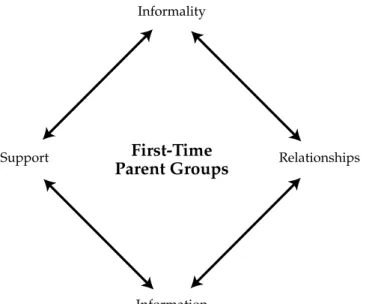
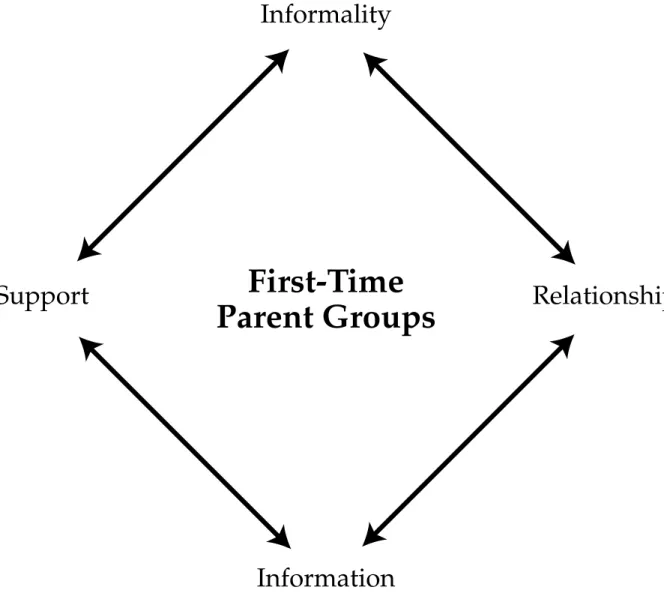
The above findings have been illustrated in Figure 1.
First-Time Parent Groups
Informality
Information
Support Relationships
Figure 1 Model of Parents' Perception of Core Benefits of First-Time Parent Groups
INTRODUCTION 1. INTRODUCTION
Key issues identified by maternal and child health nurses were: • Groups widely used.
• Not all maternal and child health nurses are providing First-Time Parent Groups.
• Maternal and child health nurses’ knowledge and skills in group facilitation appears to be at different levels.
• Quality of groups not known.
• ‘Nurses need to be more innovative in how they facilitate groups’. • ‘Parents don’t only attend for information’.
• ‘Getting discussion going and keeping on track is an issue for me’.
As the recommendations from the Deakin 1995 evaluation and the 1997 focus groups identified similar issues, the project team felt reasonably confident to begin designing the Resource and Facilitation Guide in August 1997, following the first meeting of the project’s Parent Group Resource Guide Reference Group on July 25, 1997.
The team recognised that nurses have varying experience in group facilitation, and work with new parents across all regions of Victoria, with a wide range of needs and issues. In order to design a practical and user-friendly document to address this range of requirements, a draft Guide was developed and distributed to 150 maternal and child health nurses, from all parts of Victoria, who attended one of a series of one-day workshops. During the workshops, the nurses reviewed the content and layout of the Guide and experienced some of the suggested strategies as group participants. Following these workshops, the nurses were invited to trial (some of) the strategies with the next groups they were facilitating. The feedback from the 150 nurses
provided during the workshops and after their own trials was taken into account and the issues were addressed in the final production of the Guide.
1.3.1 Background to the First-Time Parents’ Sessions
Maternal and child health nurses have had many years of experience in facilitating groups for new parents. The team which prepared this Guide observed numbers of nurses facilitating First-Time Parent Groups and have incorporated many of their ideas and activities in the sessions. Although nurses have this extensive experience, they requested the writing team make the group processes as simple to prepare as possible. The authors determined that the style chosen for the Guide would provide a step-by-step simplicity, and it is expected that nurses will adapt the sessions to their own situations, groups and time constrictions. For example, nurses working with groups with low literacy levels will focus more on discussions than print materials.
In addition, the Reference Group for the Project was of the view that the Guide needed to pay particular attention to the process of group facilitation. Maternal and child health nurses are well able to address the content for the Sessions presented in the guide, but have had less opportunities to develop other aspects of group work.
7 1. INTRODUCTION
The session titles themselves were agreed after extensive consideration. They are designed from the parent perspective. In fact, this perspective has been used throughout and the content of all sessions has been planned to be both parent and nurse user-friendly.
The sessions have been developed through:
• The experience of maternal and child health nurses who have been facilitating groups for mothers and/or fathers for many years.
• A process of consultation with a range of maternal and child health nurses and first-time parents currently participating in groups.
• Consideration of recommendations in recent literature which addressed the content and style of first-time parent groups, particularly Lawson and Callaghan (1991) and Moran and Martin (1997).
• Discussion with older parents about the sorts of issues they would have liked to discuss as well as what they had found valuable.
1.4 How to Use the Guide
Sections Two and Three of the Guide provide some theory and point to some research about the increasingly acknowledged value of social interation for first time parents. This material has been provided as the rationale for the focus of the Guide on promoting social interaction through and within the First Time Parent Groups. It has also been included to encourage maternal and child health nurses to place an emphasis on their group facilitation
responsibilities, since during the preparation of the Guide, nurses frequently commented on the difficulty of giving the time for planning and organising their group facilitation when there were many other competing priorities, especially for one-to-one consultations.
Sections Four to Seven of the Guide have been designed to assist maternal and child health nurses to meet two key objectives in their facilitation of first time parent groups. These objectives are:
• To develop a cohesive group with sustainable links between individual participants.
• To provide information and develop skills,where appropriate, which are critical to the role and tasks of new parents.
The Guide highlights the group and discussion facilitator roles, in which maternal and child health nurses need to become expert, rather than the presenter role that some nurses still use in order to ‘get through the information parents need to be aware of’. This facilitator role enables nurses to empower parents to play an active role in the group process and development of knowledge about parenting. In preparation of the session guides, the authors were very aware that nurses need to ‘switch hats’ quickly, from providing individual consultations to facilitating groups, and so a detailed step-by-step process was used throughout the seventeen session designs.
Seventeen different group session designs are provided in the Guide to enable selection according to the interests, information and skill needs of the groups. Most First-Time Parent Groups run for a period of eight weeks and so it assumed that while (a version of) the first and last sessions will be used in common, the other six sessions will be selected and mixed and matched for different groups. Most groups run for approximately two hours and each session has been designed to cover that time period, although it is possible to shorten each session if that is required. Each session has an introductory time to enable the group to re-form and a closure time. It is anticipated that some of the activities suggested for these times will be mixed and matched in different sessions.
The session titles have been designed to reflect the language used by parents, rather than the language maternal and child health nurses may traditionally use. However, the titles do reflect the issues, topics and / or information that parents have been asking maternal and child health nurses about for many years.
The sessions have been designed to include both parents, but at the time of writing it is acknowledged that the usual group participant is the mother. The time of day at which the group is conducted affects participation. Some sessions, such as What to do in an Emergency (1) Resuscitation and What to do in an Emergency (2) First Aid, lend themselves to promotion to both parents, perhaps in an evening session.
Finally, as there is a need for all nurses to evaluate their First-Time Parent Groups, some
examples of evaluation tools have been included in the final section. These may be used directly or adapted to meet the needs of the different users.
1.5 Information about the Guide
If you need information about the Resource and Facilitation Guide, contact Gay Edgecombe through the Office of Clinical Chair, Community Child Health Nursing.
Telephone: (03) 9925-4321 Business Hours Fax: (03) 9925-4398
Email: [email protected] Mailing Address
Professor Gay Edgecombe
Clinical Chair, Community Child Health Nursing RMIT
City Campus GPO Box 2476V Melbourne 3001 Victoria
AUSTRALIA
9 1. INTRODUCTION
1.6 References
Department of Human Services, 1997, Project Brief: Development of a First-Time Parents Resource
and Facilitation Guide for Maternal and Child Health Nurses,Department of Human Services
Publication, Melbourne.
Department of Human Services, 1997, Maternal and Child Health Program: Annual Report
1995–1996,Department of Human Services Publication, Melbourne.
Clarke, V., Hanna, B., Rolls, C., Grant, A., Bethume, E., Horne, R. and Ching, M., 1995, Evaluation
of Group Sessions for First-Time Mothers Provided by the Victorian Maternal and Child Health Service,
Deakin University, Melbourne.
Lawson, J.S. and Callaghan, A., 1991, ‘Recreating the village: the development of groups to improve social relationships among mothers of newborn infants in Australia’, Australian Journal
of Public Health,15(1) pp. 64–66.
Moran, C. and Martin, D., 1997, ‘What do Women Want to Know after Childbirth?’ in Birth, 24(1)27–34.
2. Social Interaction and Health
2.1 Introduction
It is well established that the transition to parenthood is a stressful time and the need for social support, paramount. Why is this? It is now known that integration into a social network protects health and promotes recovery (Bloom 1990). In addition, social support enhances health
outcomes and reduces mortality by fulfilling basic social needs and enhancing social integration, mediating the effects of stress on health and protecting individuals from harmful influences of acute stressful events (Quittner, Gleuckouf and Jackson 1990). The need for social support networks is recognised as an important feature of health-care delivery for parents as women are leaving hospital earlier than before following the birth of a child (Stewart and Tilden 1995). An Australian study by Rogan, Shmied, Barclay, Everitt and Wylie (1997) reports the hurdles new parents face as monumental, leaving many women initially feeling drained, alone and with a sense of loss. Research by Majewski (1987) and others suggests that partners provide new mothers with the greatest levels of support. They also identified a different type of support which is provided through parent groups. According to Majewski such groups offer parental guidance and a network of friends which is sustained over time. It is through social support that individuals gain information, see new role models and are encouraged by others (Bloom 1990). In a publication by the World Health Organisation (WHO) and the International Centre for Health and Society The Solid Facts: Social Determinants of Health (1998, p. 1-10) an attempt is made to examine research and present it in a useful format for policy makers, managers and health care providers. The ten social determinants of health referred to in this publication are: 1. The social gradient: People’s social and economic circumstances strongly affect their health
throughout life, so health policy must be linked to the social and economic determinants of health.
2. Stress: Stress harms health. Social and psychological circumstances can cause long-term stress.
3. Early life: The effects of early development last a life-time; a good start in life means supporting mothers and young children.
4. Social exclusion: Social exclusion creates misery and costs lives. 5. Work: Stress in the workplace increases the risk of disease.
6. Unemployment: Job security increases health, wellbeing and job satisfaction.
7. Social support: Friendship, good social relations and strong supportive networks improve health at home, at work and in the community.
8. Addiction: Individuals turn to alcohol, drugs and tobacco and suffer from their use, but use is influenced by the wider social setting.
12
10.Transport: Healthy transport means reducing driving and encouraging more walking and cycling, backed up by better public transport.
WHO states that (1998, p. 20-21):
Social support and good social relations make an important contribution to health. Social support helps give people the emotional and practical resources they need. Belonging to a social network of communication and mutual obligation makes people feel cared for, loved, esteemed and valued. This has a powerful protective effect on health.
Support operates on the levels of both the individual and the society. Social isolation and exclusion are associated with increased rates of premature death and poorer chances of survival after a heart attack. People who get less emotional social support from others experience less wellbeing, more depression, a greater risk of pregnancy complications and higher levels of disability from chronic diseases. In addition, the bad aspects of close relationships can lead to poor mental and physical health.
Access to emotional and practical social support varies by social and economic status. Poverty can contribute to social exclusion and isolation.
Social cohesion - the existence of mutual trust and respect in the community and wider society - helps to protect people and their health. Societies with high levels of income inequality tend to have less social cohesion, more violent crime and higher death rates.
Sir Donald Acheson (WHO, 1998, p. 5) states that "…scientific knowledge on the social
determinants of health is accumulating quickly. The need to direct our efforts there has become increasingly clear. This means ‘upstreaming’ public health, spreading awareness and promoting debate on social determinants."
2.2 Benefits of Social Support
Benjamin, Bessant and Watts (1997) are of the view that parents gain a range of benefits from support groups. These include:
• Therapeutic benefits.
• Understanding emotional problems. • Developing relationships.
• Shared reciprocity.
• Knowledge acquisition which leads to a greater sense of control. • Gaining a sense of who they are.
• Self determination. • Equality.
Empowerment, which is about encouraging participants to exercise more control over their lives is receiving more attention in the literature. For example, Neville, Beak and King (1995, p. 28), through their work with The Centre for Fun and Families in Great Britain, aim to empower parents who are experiencing behaviour and communication difficulties with their children. They have found that empowering parents results in a number of changes:
• Parents attain increased dignity and self respect.
• Decision-making about individual services is based on the best, most accurate, information. • Services are more appropriate to parents’ needs.
• Parents’ problem-solving skills are improved.
• Greater diversity and choice of services develop to meet parents’ needs more appropriately. • Forward planning of services is based upon the best information and therefore more
accurately reflects client’s needs.
Crittenden (1985) is of the view that social support has the ability to:
• Mediate environmental stress and personality deficits to enhance parent-child attachment. • Increase parental self-esteem and coping.
• Foster healthy child development and prevent family breakdown. • Provides a protective element in avoiding child abuse and neglect.
Abriola (1990) reported on a descriptive study of postpartum support groups which explored mothers’ perceptions of a support group which had been operating for many years. Specifically, the researcher investigated the reasons why the monthly support group continued and how it helped the twelve participants. The study found that the supportive nature of the groups was the most important aspect. Benefits included:
• Support and reassurance. • Knowledge.
• Needs were met.
• Information and support. • Networking.
• Help with transition to parenthood. • Interaction with children of similar ages.
2.3 Facilitator’s Role and Related Benefits
Gitterman (1989) offers advice to those who would be group facilitators regarding how to build support in groups. He claims that professionals can do much to assist group members in feeling supported while encouraging participants to be open with each other. The facilitating process, according to Gitterman, assists group members in the following ways by:
• Reducing isolation.
• ‘De-pathologising’ problems.
• Diminishing stigma when experiencing problems. • Helping each other learn skills.
14
• Managing their own anxieties.
• Improving their own problem solving skills. • Managing self-doubt’s and insecurities.
Facilitating adequate support networks promotes a positive state of health for individuals. However, when that support is not available or is inappropriate, then alternative ways of obtaining support need to be facilitated. Maternal and child health nurses are in a key position to facilitate the development of new social networks for new parents. This view is supported by the work of Lawson and Callaghan (1991) who examined whether an educational ‘mothers group’ facilitated by the early childhood nurses in New South Wales, encouraged social support and reduced isolation. They found that the early childhood nurse played an important role in helping parents to overcome reticence to become involved with strangers. The study
demonstrated a strong commitment to the group process through education, but at the same time it provided a subtle and socially acceptable way of facilitating interpersonal relationships. Facilitating supportive relationships within an interpersonal network has also been examined by Boyle (1989). Thus, it is increasingly being recognised in Australia and elsewhere that maternal and child health nurses have a central role to play in facilitating the development of supportive social networks during the transition to parenthood. They are often the "nucleus in the
neighbourhood" network and so are ideally located to create lasting linkages between families and so enhance the social well-being of all family members.
2.4 References
Abriola, D. (1990) Mothers’ perceptions of a postpartum support group, Maternal Child Nursing
Journal, Summer, pp. 113-134.
Benjamin, J. Bessant, J. and Watts. R. (1997) Making Groups Work: Rethinking Practice, Allen & Unwin, St Leonards, NSW.
Bloom, J.R. (1990) The relationship of social support and health, Social Science Medicine, 39(5), pp. 277-280.
Boyle, J.S. (1989) Constructs of health promotion and wellness in a Salvadoran population,
Public Health Nursing, 6(3) pp. 129-134.
Crittenden, P. (1985) Social networks, quality of child rearing and child development, Child
Development, 46, pp. 1299-1313.
Gitterman, A. (1994) Building mutual support in groups, Social Work with Groups, 12(2), pp.5-21. Lawson, J.S. and Callaghaan, A. (1991) Recreating the village: the development of groups to improve social relationships among mothers of newborn infants in Australia, Australian Journal
Majewski, J. (1987) Social support and the transition to the maternal role, Health Care For Women
International, 8, pp. 397-407.
Neville, D. Bleak, D. and King, L. (1995) Promoting Positive Parenting, Ashgate, Aldershot. Quittner, A. Glueckouff, R. and Jackson, D. (1990) Chronic parenting stress: moderating versus mediating effects of social support, Journal of Personal Social Psychology, 59(6) pp. 1266-1278. Stamp, G.E. Williams, A.S. and Crowther, C.A, (1995). Evaluation of antenatal and postnatal support to overcome postnatal depression: A randomized controlled trial, Birth, 22(3), pp. 138-143. Stewart, M.J. and Tilden, V.P. (1995) The contributions of nursing science to social support,
International Journal of Nursing Studies, 32(6), pp. 535-544.
Rogan, F. Schmeid, V. Barclay, L. Everitt, L. and Wyllie, A. (1997) ‘Becoming a mother’ — developing a new theory of early motherhood, Journal of Advanced Nursing, 25, pp. 866-885. World Health Organisation and International Centre Health and Society. (1998). The Solid Facts:
17
3. Benefits of New Parents’ Support Groups
3.1 Introduction
One of the ways of assessing the benefits of New Parents’ Support Groups is by evaluating the degree to which they evolve into self-sustaining supportive social networks. Maternal and child health nurses have long heard the anecdotal reports of how some of the groups they ran over a six to eight week period at the centre went on to have a long lasting life of its own, with strong bonds being forged between the children and the families.
This has recently been the subject of research undertaken by Associate Professor Dorothy Scott and Sue Bradey of the School of Social Work at the University of Melbourne in association with a La Trobe University research Masters student and maternal and child health nurse, Patricia Glynn, and her thesis supervisor Professor Judith Lumley.
The research involved doing a two year follow up of women who joined New Parent Groups in two outer urban municipalities of Melbourne in which the nurses had expressed an interest in new parent groups. A total of 243 women from 24 groups were interviewed and the study explored a number of issues in relation to consumer satisfaction with the maternal and child health nurse facilitated group sessions. The primary focus of the study however was on the extent to which the group members had maintained contact with one another after the formal phase of the group was finished. Maternal and child health nurses in both municipalities were also interviewed about the way in which they ran their groups and their attitudes to this aspect of their work.
3.2 Parents’ Perceptions of the Value of First-Time Parent
Groups
Some of the key findings of the study in relation to the first phase of the group were as follows: Most of the women (75%) reported positive feelings about the prospect of joining a group, with the remainder equally divided between those who were neutral, those who were negative and those who felt hesitant about doing so.
The most important things women hoped to gain from the group were: child health and development information, and the sharing of experiences and mutual support with other first time mothers.
The majority of women (76%) reported that the members of their group got along well. Those who had been in groups where this had not happened thought that the reasons included: group size (too large for the group to "click" or "gel" as they described it); too great a diversity of age and background; and differences in values and lifestyles, especially related to child rearing.
Most women (60%) were highly satisfied with the way their group was facilitated. Those who expressed dissatisfaction reported that the sessions were too didactic ("too much like a school class") or that the physical attributes of the centre itself were a problem (for example, too small, noisy, too hot in summer).
Some of the key findings in relation to the later phase of the group were as follows:
All but one of the 24 groups continued to meet informally after the sessions at the centre had ended with 5 ending by 12 months. At 12 months 18 groups (constituting two thirds of the women in the study) were still meeting, and 16 groups were still meeting at the time of follow up (18 months to 2 years).
Women returning to paid employment was related to some groups not continuing but other groups with members who returned to paid employment went to considerable lengths to change the group meeting times to accommodate this and these groups continued to flourish. Even among those groups which were not meeting 18 months later, there was considerable one-to-one contact between some members and significant friendships had been made through the groups.
One-to-one relationships were classified as mutual aid friendships, social activity based
friendships or acquaintance relationships. A large majority (80%) formed at least one mutual aid friendship through the group, and had frequent contact with the friend(s) outside of the group, often assisting each other with babysitting, as well as being a confidante.
Social activity based friendships did not involve the sharing of personal information but were characterised by participating in activities such as children’s birthday parties, clothes parties and occasional evenings spent together without the children. In some instances family to family contact developed which involved the fathers (for example, barbecues and picnics with the children).
A small number of women formed only acquaintance relationships, and would occasionally ’bump into‘ one another at the shops. This generally applied to women who had only attended the group for a short period of time or had returned to work and lost contact with the group. However, even this level of relationship was described by some women as giving them a sense of familiarity with others in their community.
Women gave multiple reasons for participating in the continuation of their group, with the main reasons being: that they enjoyed sharing their experiences of motherhood with one another (96%); that the groups provided support (95%) and that it was beneficial for their child to have contact with others (82%).
Most of the groups met in one another’s homes. As the children became increasingly mobile this presented problems and some of the groups evolved into playgroups which met at community
19 3. BENEFITS OF NEW PARENTS’ SUPPORT GROUPS
venues. A few women spoke of their discomfort at meeting in one another’s homes, particularly where there was a discrepancy in the level of affluence among members.
Overall there was a high level of homogeneity among those interviewed in relation to maternal age, occupation, ethnicity and marital status. While to some degree this reflects the demographic characteristics of the two municipalities involved in the study, it also raises concerns identified in earlier research as to whether young single mothers, and women from low income families and women from non-English speaking backgrounds are less likely to participate in such groups.
3.3 Maternal and Child Health Nurses Perceptions of the
Value of First-Time Parent Groups
A total of 17 maternal and child health nurses were interviewed about their experiences in facilitating groups. Most had facilitated a large number of groups (average 34 groups) over an average period of running groups of 10 years. Most of the nurses reported that they enjoyed running groups but that there was insufficient time allocated for the work which this entailed. A few expressed apprehension about facilitating groups and found the first group session rather anxiety provoking. Many mentioned the inadequacy of the facilities for running groups
(overcrowding, no space for prams, no air conditioning, parking problems).
All the nurses thought that the groups fulfilled a valuable function, but there were significant differences in the proportion of their first time mothers who joined their groups (ranging from one third to over 80%). Nearly all reported that it was more difficult to engage young single mothers, women from low income families and women from non-English speaking backgrounds in the groups, although some appeared to have had a lot more success than others in doing so. For example, some had successfully mixed women of very different ages in the same groups while others had run specific groups for young mothers in quite a different way from their other groups. Another nurse had run a highly successful group for women of very diverse cultural backgrounds and made the theme "mothering in a new land" a particular focus of discussion. Some nurses described how they introduced two mothers of the same non-English speaking background and that this had been more successful than trying to involve mothers with limited English in their groups. Others had linked such mothers to ethnic specific women’s associations or referred young single mothers to a specific program designed to meet their particular needs. Most of the nurses emphasised the importance of creating the right climate, particularly in the first group session, so that the group could develop a sense of cohesion and an informal
atmosphere. Most of the nurses had a set content which they followed but tried to be flexible in response to the needs and wishes of the particular group. They varied in the degree to which they balanced the provision of information with open discussion and social contact. Some commented that they had learned over time to become less preoccupied with getting through
their prepared material and more oriented to encouraging participation and social interaction as this is what mothers appeared to value most about the groups.
A few had successfully engaged men in their groups, some effectively using infant CPR sessions in the evening to draw in the fathers. Others were unsure about the participation of fathers and a few were opposed to it, believing that it inhibited women from discussing some issues and made the group less cohesive. One nurse had gone to great lengths to establish a group for at home fathers. The issue of paternal participation is obviously an area which requires more research and discussion.
3.4 Conclusion
In summary, this study has demonstrated that at least in two outer urban areas of Melbourne, a large majority of first time parent groups evolve into self-sustaining social networks and provide significant social support for women having their first child. Because so many of the groups in this study continued, it was not possible to identify the characteristics of those groups which were more likely to continue from those which were not. However, there is some evidence to suggest that continuation is more likely to occur if the group is facilitated in a way which creates an atmosphere of trust and builds a sense of group cohesion. If the nurse is overly focussed on didactic input, or if the group is too large or the backgrounds of the members too diverse, there may be insufficient group cohesion to sustain it. Future research is required, particularly on the participation of men in groups, how to make groups more accessible to parents of different backgrounds, and what alternative ways might exist for increasing the level of social support for families other than through groups.
21 4. TIPS FOR ORGANISING AND FACILITATING FIRST-TIME PARENT GROUPS
4. Tips for Organising and Facilitating First-Time
Parent Groups
4.1 Introduction
Many of the tips for organising and facilitating the First-Time Parent Sessions are incorporated into the Seventeen Suggested Sessions (Section 6). This section of the guide expands upon some of those tips and adds a few more to assist with the planning and facilitation of each session. There are numerous books available, too, which expand all the following ideas. One of these which many nurses have used is by Kerri Hamer, entitled Leading a Group: A Practical and
Comprehensive Handbook(1997) Published by Hamer, Maroubra, NSW (phone 02 9349 5170).
4.2 Successful First-Time Parent Group Session Factors
The success of the first-time parent sessions depends on a number of factors, including: • A definition and clear understanding of the purpose of the overall program and each of the
individual sessions.
• Pre-session planning to address the purpose and objectives. • Active marketing of the sessions.
• Articulation of group expectations and development of guidelines or rules.
• Consideration of the diverse needs of participants, for example, cultural background, rural or metropolitan setting.
• Opportunities for equal involvement by all participants. • Effective facilitation.
While collection of information resources for participants often dominates early planning time, this issue may be of less importance than the discussion in the sessions themselves. It is
important that nurses know their local services and resources well and prepare relevant
documentation to encourage their group participants to learn about and use them. Nurses need to remind themselves too, that the objectives of the group sessions are additional to individual one-to-one consultations. Nurses may occasionally need to remind themselves and parents that these consultations provide opportunities to address individual health concerns of the parents and babies, and the group time allows opportunities for shared issues and discussion.
4.3 Role of Facilitator
As the facilitator of the session the nurse acts as a catalyst. They bring together first-time parents, providing them with an environment which enables open communication and encourages the forming of networks and friendships.
An effective facilitator of First-Time Parent Groups: • Is a good listener.
• Utilises all opportunities to encourage participant involvement. • Acknowledges and builds on participants’ knowledge and skills. • Allows and encourages participants to explore ideas.
• Is the timekeeper.
• Summarises, or encourages the participants to summarise, the process, issues and decisions made in each session.
• Does not dominate the group.
While it is important for nurses to have done plenty of homework to ensure they are adequately informed about current parenting and health issues and local resources, they must take care not to be tempted to be the ‘fountain of all knowledge’. Participants will bring a great deal of knowledge to most issues, although this knowledge may not be as complete or as well
organised as the nurse’s. It is helpful to remember that most groups do not take in information after fifteen minutes of concentration.
It is likely that numbers of participants will not have had a group learning experience since school and for some participants that past experience may not have been a positive one. Nurse facilitators may have a powerful impact through their role in modeling group skills like active listening and encouraging resolution of differences as well as encouraging commitment to identification and achievement of group goals.
4.4 Encouraging Sustainable Connections Between
Participants
The group sessions are intended to create opportunities for socialisation within the formal group, but also to promote sustainable relationships and networks between participants after the formal sessions are completed. Mixing and matching participants in all sorts of varied combinations early in the group development will promote the cohesion of the group and the likelihood that all will be included in future. Groups are more likely to continue to meet beyond the structured sessions if the participants have not become dependent on the facilitator. This requires the nurse to be constantly alert to those situations and activities where participants will take the lead themselves. This may begin with the organisation of tea and coffee at the sessions, but will have even more lasting effect if people take responsibility to organise a trip to the library together, for example, with (or preferably without) the nurse’s participation. The circulation of names and contact address and phone numbers as early as the group is comfortable with this will enhance the opportunities for connections to continue after the sessions.
4.5 Group Guidelines or Rules
In the session ‘Getting to Know Each Other: Beginning Our Group’ it is recommended that the first-time parent group develop their own guidelines or rules. It is important that participants develop their group’s rules or guidelines and are not ‘given’ them, as they will be implementing the guidelines and need to ‘own’ them. This process also provides an excellent model for
23
A process has been included in the session notes to assist the nurse in facilitating the development of the group rules or guidelines.
Possible areas for discussion and inclusion in the guidelines or rules are: • Confidentiality (within and outside the group).
• Attendance at the group. • Listening to each other. • Positive communication.
• Acceptance of a diversity of ideas.
The group’s guidelines or rules could be written onto butcher’s paper and displayed on the wall for each session.
4.6 Handling Difficulties in the Group Sessions
The sessions in this guide have been designed to assist the facilitator manage any ‘difficult’ situations for example where some participants may talk too much. Working in small groups, utilising personal stories and developing group guidelines will capture the needs of the group and reduce the possibility of participants being ‘difficult’ for the facilitator.
Regular referral to, and if necessary, development of further group rules or guidelines are likely to be the best methods for handling issues like time keeping and participants who put down, talk over or contradict other parents.
While acknowledging that parenting is a value laden area, it will be important that the nurse encourages the group to discuss and explore a range of strategies for all situations and particularly for situations where inappropriate suggestions are made for handling some
parenting concerns, such as ‘giving a baby a smack to help them to settle’. On occasion, it will be appropriate for a nurse to express her concern about some strategies suggested by parents but it is critical that the group be assisted to explore and discuss the pros and cons of options rather than focus on the negatives of any inappropriate suggestion.
Occasionally, members of the group may be upset or distressed, perhaps because of personal issues outside the group, exhaustion from being a new parent or sensitivity to the issues being discussed. The nurse should be sensitive to personal needs within the group and can offer to spend time with the participant outside the group, but it is not the role of the nurse to be a therapist. The nurse could provide advice about where the participants could access help or resources.
4.7 What to Do about ‘Drop Outs’
If a participant attends a session and then drops out it would be appropriate to contact that parent to talk through reasons for non-attendance.
Maybe it was a bad day for them and they intend to continue or the group may not have met their needs. Find out how the group could meet their needs, and what they are wanting from the group sessions.
If the reason for non-attendance is the group composition it could be appropriate to refer or transfer the parent to another First-Time Parent Group.
4.8 Evaluating the Sessions
Session evaluation should be considered during the planning stage of the First Parent Sessions. The facilitator needs to determine the areas they will evaluate, the evaluation process and how the information collected from the evaluation will be used. Evaluation assists facilitators to improve and or refine their practice.
4.9 Debriefing the Facilitator
Facilitators often need to talk about the success and/or failure of facilitated sessions, this process is called debriefing. The nurse may elect to do this with a professional colleague or someone else within their professional group or agency. Talking through the highs and lows of a session can be a form of self evaluation and new ideas for future sessions may come to the surface or be shared with others for inclusion in their groups. Care needs to be taken not to talk about particular participants, but about the issues on which the facilitator needs to debrief.
4.10 Engaging ‘Experts’
For some sessions, nurses will choose to invite a person with specific expertise to contribute to the session. In these cases, it is important to clarify what the speaker is to address, and to brief the person accordingly. Nurses may wish to photocopy and distribute the objectives of the session and explain how the person’s information will be developed by group activities. It is important that the nurse is present at the session with the speaker so they can pick up on the issues for continuing the workshop process. The continuing role of session facilitation is critical to achieving the intended outcomes of the overall program.
4.11 Inviting Participants
Word of mouth from new parents about the value to new parents of First-Time Parent Groups is the most powerful marketing tool anyone can use. It will be important to encourage past
25 4. TIPS FOR ORGANISING AND FACILITATING FIRST-TIME PARENT GROUPS
participants to tell others about the value they gained, and, of course, in some areas, the nurses in the maternity units of local hospitals can assist in encouraging participation.
Personalised, written invitations, with dates, times, venue and perhaps the names of streets where other anticipated participants live will also provide interest in participation. Remember, people are more confident when they know what to expect from the sessions, so it may be useful to talk to new parents about the sorts of activities of past participants and some of the positive outcomes for those people.
If it is possible to put people who live near each other in touch prior to the first session or at least at the first session, they may be able to travel together which will have the dual benefit of promoting connections and providing a familiar face at the early sessions.
4.12 Times, Days and Venues
These will largely be determined by the demands of your organisation. However, some people cannot attend sessions because of transport access issues or work demands with the time of the sessions. It will be important to ask people about times, days and venues that suit them best and be prepared to be adaptable if at all possible. Participants will generally appreciate the nurse’s responsiveness to their needs. Obviously, if you wish to include working parents in the groups, then some special evening groups especially in daylight saving months, perhaps with a light meal included, will be more appropriate.
4.13 Engaging Fathers
Time of day (or evening) will affect the participation of many (new) fathers in groups. Inclusion of fathers will be promoted by providing at least one evening session. The content of the
planned session may affect some fathers’ interest too. However, if fathers are involved in the initial session when the topics are chosen, they will have an equal chance to express their interests. If mothers only are present at the initial session, then the nurse can encourage the group to consider a topic they would like to choose for a shared parent session. Sometimes women are reticent about including fathers in some of their sessions. It may be useful to discuss whether there are some groups people would like as mothers only, some fathers only and some combined.
4.14 Maintaining and Continuing the Group
Group dynamics change over the life of a group. Regular review of participants’ expectations and adaptation of group rules as required, will assist in maintaining a strong group. Continuing some mixing and matching of small groups within the larger group for different activities will promote cohesion among members and is a key strategy in addressing the issue of the ‘isolate’.
Dynamics will also change with the introduction of new participants into an established group. Some introductory icebreakers or introduction exercises, especially with numbers of pairings as are described in the introductory session in Section 6, will be useful to quickly establish a personal connection between participants.
As the group nears its formal ending, it will be important for the facilitator to invite participants to explore opportunities for continuing the group without the role of nurse as facilitator and in a new venue. Encouragement of options which will provide for inclusion of all group members, addressing participants’ concerns about appropriate venues, for example, will assist in
continuing the life of the group. In some cases, the group may decide to meet in a low cost community hall on an ongoing basis rather than individuals’ homes, for example. Whatever the decision, the nurse has responsibility for promoting and encouraging sustainable relationships among all participants.
4.15 Developing and Improving Facilitation Skills
In preparing this Guide, a number of highly experienced nurses asked permission of other nurses to watch them at work facilitating their groups. Without exception, the nurses reported learning a great deal about development of their own facilitation skills from this close
observation. It is probable that nurses can arrange such collaboration themselves, remembering always to ask permission of the group beforehand, and remembering too, the importance of providing positive feedback which can be built upon.
For nurses practicing as maternal and child health nurses for the first time or for those who wish to develop their skills in facilitation of diverse groups, observation of skilled maternal and child health nurses facilitating First-Time Parent Groups may assist. This diversity includes people from a wide range of ages, family support systems and life experiences, as well as people from a number of different cultural backgrounds.
Shared planning and co-facilitation also provides excellent opportunities for developing facilitation skills. However, it must be noted that to work well for both group participants and facilitators, the shared facilitation role requires a substantial time commitment to discuss personal facilitation styles, and to clarify and plan each person’s expectations and responsibilities.
Formal training in the process of group facilitation through tertiary education institutions and private education providers will also enable nurses to gain confidence in the facilitation role quickly. The nurses will then be free to use and adapt the content of the sessions provided in this Guide to suit their own facilitation style.
Some references have also been provided in this Guide for nurses for follow up reading about special facilitation issues.
27 5. ABOUT THE FIRST-TIME PARENT GROUP SESSIONS
5. About the First-Time Parent Group Sessions
5.1 Introduction
The workshop sessions are provided as a source of ideas and have been written as recipes for facilitation only. As with recipe books and cooking, those who are experienced in facilitation may note the desired outcomes, suggested ingredients and method and then immediately adapt the recipe (if required) to fit their own situation. Others will follow the recipe as detailed and may continue to do so because it provides an effective result, while still others will need to make changes along the way, perhaps because they prefer some slightly different outcome or perhaps because their ‘ingredients’ vary from those suggested. Feedback from the nurses who have trialled the sessions has shown that the designs have worked for some of their groups and they are already mixing and matching the strategies provided in the document with a range of strategies they were already using themselves. The following quotes taken from feedback on the use of this Guide illustrate this:
Feedback One
…Initially very time consuming getting resources and photocopying done and organising and planning
generally. Initially some sessions can be expensive, for example, Session 5.9 cost $35.00 for RCH Safety Book and for some appliances (not many). For 5.1 I have chosen to purchase an oil burner, oil, tape deck and tape – these, of course, will be used frequently, perhaps each week. I chose to combine 5.7 with my CPR training (Heart
Foundation) handbook and I think it went well.
Feedback Two
Congratulations on an excellent idea, presentation and resources. This is what we needed across the state to bring everyone into line with running professional parent groups. It is one thing we never had any training or
guidelines in and really is needed by us and by the parents who attend our groups. The resource will be even better when it is complete with lots of wonderful pamphlets introduced that the nurses have collected, updated and used as handouts or resources.
Feedback Three
I enjoyed the workshop – good introduction to manual. Gave great spurt to own conduct of groups. Enjoying them more, lots more ideas, from manual and from hearing of colleagues experiences. 75% of enrolments and birth notifications (at my centre) are first-time mothers therefore greatly increased workload, particularly groups. However, great way to disseminate knowledge, confidence, networking, etc. Great feedback from parents. Thank you to the team for putting together a useful, useable stimulating manual. I look forward to seeing the final product and hope it won’t be too long.
Feedback Four
My main comment is that I found it hard to keep the group attention for two hours and usually had to cut the content down even though I found it relevant. The mothers were often tired and were easily distracted by babies. They needed more time just to relax and chat. Even so, the group became very cohesive and the feedback was good. They are continuing to meet in own homes. Ages varied from 17 years to 34 years.
Group facilitation is challenging and requires quite different skills from one-to-one consultation and other practices well developed by maternal and child health nurses. Each group is different and success depends on the willingness of the facilitator to reflect on each group’s specific needs and interactions and to develop the group processes accordingly. Most groups and particularly very diverse ones, will be more effective if the nurse provides a structured process, especially at first. The structure will reduce as the sessions progress, especially as group members know each other and are keen to take the opportunity for discussions.
The workshop sessions described in Section Six have been developed for use by maternal and child health nurses as facilitators of the First-Time Parent Groups which they are responsible for organising for new parents in their municipality.
5.2 The Purpose of the Group Sessions
The workshop processes have been designed to enable the maternal and child health nurse, in her role as the group facilitator, to:
• Engage parents.
• Promote continuation of a group following the formal phase facilitated by the nurse. • Develop links between all individual participants of each First-Time Parent Group.
• Acknowledge and build on the knowledge and experience which first-time parents bring to their parenting role.
• Create formal opportunities for participants to share their concerns, joys and learning. • Provide relevant information about health and parenting issues and encourage use of local
resources.
5.3 The Maternal and Child Health Nurse as the Group Facilitator
As noted earlier, many nurses have been facilitating groups for many years, often well before these became an expected part of funding agreements. These groups were undertaken for a variety of reasons, not least of which was to save the time required if (health) information was provided by the nurse on an individual basis. Implementation of the following session designs may not provide as much opportunity for information provision by the nurse to the groups as previously, but is likely to encourage participation by all group members and optimise the chances of all individuals developing sustainable relationships with other group participants. We anticipate that much of the information provided and even some of the group processes detailed will not be new to nurses. What may be new are the combinations in which they are provided. We hope all nurses will test the session processes as they are described and adapt them as they develop strategies which are more effective in meeting the stated objectives of the individual sessions, while keeping the objectives of the group sessions in total in mind.
29
Traditionally, groups have very few fathers participating. In fact, they were usually called first-time mothers’ groups. The seventeen group sessions following have been designed to provide the facilitator with strategies to enable meaningful participation by either or both parents. If both parents are participating together in the group, the facilitator will need to be alert to concerns about group cohesion, as will also be required if there are two or three very close friends joining the group together. In these cases, the group will probably be best served by the facilitator treating the parents as individuals and, for example, inviting them to participate in separate small groups when small groups are formed.
Setting group guidelines provides an initial opportunity for the group to discuss expectations of each other. A review of these guidelines, and perhaps encouragement of additional ones at some time down the track can also be used to address any difficulties developing within the group around participation or future planning.
5.3.1 Accessing Resources for Parents and Maternal and Child Health
Nurses
It is important to make sure that any resources being used in conjunction with the Guide for parents and/or to guide maternal and child health nursing practice, meet copyright regulations. Copyright regulations include obtaining permission to use materials from the author(s) of the material, including permission to copy a percentage of the materials for teaching purposes. This permission must be written on the materials and include the year of publication, publisher etc. Most feedback from maternal and child health nurses on the Guide during 1997–1998 has been related to resources, such as ‘who is to pay for resources referred to in the Guide’ and the ‘need to include contact phone numbers for all resources cited in the Guide’. As most resources
referred to in this Guide are not provided with the Guide, an allocation will need to be included in annual budgets for resource purchase. This will be for both new resources and to update older ones already held.
The resources included in the outline of each session have been selected as the most appropriate at the time of the publication of this Guide and all were available.
5.3.2 Accessing Resources for Culturally Specific Groups
Some parents from culturally or linguistically diverse backgrounds may benefit from attending culturally specific groups instead of or as well as First-Time Parent Groups provided by
maternal and child health nurses. Maternal and child health nurses can find out where these groups are held by contacting the Centre for Culture Ethnicity and Health, 23 Lennox Street, Richmond, Victoria 3121 (telephone 03 9427 8766) or the local Community Health Centre.