This topic guide will give you some of the tools to be able to understand working relationships, develop them and then maintain them by
understanding the dynamics of teams and how they work together in an efficient, productive way. Some teams appear very similar on the surface, but spend any length of time with them and you will realise they can be significantly different below the surface. A solid working relationship with your team can make all the difference between success and failure when natural commercial pressures start to be applied.
Specifically you will look at:
• understanding how to develop working relationships • project priorities
• facing conflicts.
Understand how to
develop and maintain
working relationships
1 Understanding how to develop working
relationships
Once relationships are created between colleagues, business partnerships or customers it is important to grow and develop them in order to boost business or improve efficiency. If you have differences with someone at work, or with a customer or supplier, it is of benefit to all if both parties work on the relationship. Learn from more experienced and senior people in the organisation or simply take a moment to reflect on what is going on – it could just be due to a misunderstanding, lack of information or poor communication.
Open dialogue
Regular contact and discussion will always help maintain and develop a good working relationship. Relationships in all walks of life break down through people simply not talking. Routine discussion on projects or ongoing work will mean that:
• all the interested parties are informed of the latest situation • a team atmosphere is created
• weak links/single points of failure are prevented (because more than one person knows what is going on)
• an open and honest culture is nurtured for the time of the project and for any future joint projects
• feelings of trust, confidence and goodwill are created
• ultimately – effectiveness and efficiency are the order of the day.
Communicate shared targets
A job will often be made up of many component parts and will involve more than one interested party or stakeholder. This will generally mean that a
successful job will involve many different targets being completed, and some of these will be shared targets. If individuals share targets, good communication is essential to avoid conflict or failure. To avoid confusion or doubt, written notes can always help resolve issues.
Minutes of meetings are often prepared straight after a meeting and then sent to all the people involved. This may be the only chance for all interested parties to check what was agreed and give feedback if something needs clarification. Always read the minutes for the previous meeting, as you may have actions. Completing all your actions on time will help to avoid unnecessary conflict and embarrassment. If you have actions that you feel are unreasonable, or which you did not agree to, make sure this is also fed back because if you say nothing you may assume responsibility for the task.
Portfolio activity (1.1, 1.2, 2.1, 2.2)
You are going to analyse the communication that goes on in one of your current work projects. First, choose the main project that you want to analyse, then make a list of all the people involved directly and indirectly with this project. Write down what information they require and from whom. For each piece of information they communicate, use a table similar to the example below to record: • who is communicating
• the method used (i.e. email, formal report, word of mouth, telephone call, text message, etc.) • the frequency
• a rating of how effective each communication is based on the outcomes (successful or not). (The example below shows a rating out of ten.)
Communication between: Method Frequency Rating
Project manager Architect Meeting + phone call 2 x each per day 7 Write a plan to improve any weak points of communication.
Regular updates
Familiarity between people can develop the more time they spend with each other. This can cultivate a team spirit, especially if it is based on successful outcomes. A good way to keep a strong team and develop professional relationships is to hold regular meetings, briefings or update sessions (if
appropriate). If they are not appropriate they will actually have a negative effect on those that are made to attend, so make sure meetings are task-orientated and have purpose. Remember, there may be occasions when some form of socialising is called for. Maintain a professional approach at all times and be careful not to let your standards slip or to offend colleagues or customers.
Do everything you said you would
There is no better way to build up respect and regard among colleagues and customers than by completing all the targets and actions set for you. By agreeing to complete a piece of work by a set time you have set an expectation with the team that it will be completed. Targets and actions are given out and agreed for a reason. The overall success of a project is made up of a series of individual projects. Other individuals or teams will own these mini-projects. Each mini-project or target may be simple but, by not completing it, the overall outcome could be seriously delayed. In a very competitive commercial environment a delay will mean lost business so, if you agree an action, complete it, or at least keep other stakeholders aware of progress and any issues that arise.
Honesty is the best policy
When dealing in business, honesty will always be the best policy regardless of what anyone else advises you. Rules are there to be followed: they help you to stay within the law, to use best practice and to follow the operating principles of your company. It is possible to make short-term gains through dishonesty but it will always catch up with you, embarrass you and take you back to square one – it simply is not worth it. A dishonest approach to business will not win you any friends or influence people and it certainly will not help build relationships or maintain them. Find the rules and use them – they are there for a purpose, although it may not be instantly obvious why.
Links
The portfolio activity is also linked to NVQ Unit 36: AC 1.2, 2.1, 2.2, 3.1–3.3; HNC Unit 59: LO2.
Checklist
Have you identified the best and most efficient ways to communicate for your current project(s)?
Have you completed all of your actions from recent meetings?
2 Project priorities
It may be easy for you as a potential manager to understand the priorities within a project but your priorities may not be the same as the rest of your team’s. If success at work is based on completing a task within a set time, the workforce may take the view that the work needs to be finished with no regard for any other priority. Your target might be to complete to the highest standard possible within the timescales. Each scenario could have widely differing outcomes. Clarity is required at the beginning of all projects. Whatever the project priorities are, they will require careful communication so that everyone will succeed in what they set out to do.
Let’s get the job done!
Work projects can involve a large number of people from diverse backgrounds and with very different skills and expectations. What might be acceptable to them might not be acceptable to you. Managing these expectations can be tricky and requires careful negotiation and sensitivity about personal feelings and beliefs, to ensure a smooth running project. If you cause offence it may be very difficult to work together in the future – some people forget and move on, while others find it difficult to do so. If you are a team leader, or hold some managerial responsibilities, you will need to give out instructions and tasks from time to time. These tasks will need to be completed and you will need to manage the expectations of your project team. Ultimately, even though you have given out the tasks, it is your responsibility to ensure the job is done. You will need to check, support and help your direct team members to make sure that all that can be done is done.
Keep to corporate policy
All organisations evolve. This evolution or process of change will be due to market pressures, developments in the law, business practice, or simply customer demand. Corporate operations will change to reflect the market forces and these changes often happen in a structured way via some form of change management. If the company you work for does not operate effectively, then work with the change management process to help shape it – but remember the corporate policy is there for a reason and should be followed. If you work within a team it may be your responsibility to educate the team members about the procedures and policies they should follow. This could be via a presentation or briefing session. Corporate policies and procedures may also be communicated via an induction process that involves formal training, computer-based learning packages or an induction day.
Portfolio activity (1.2, 2.1)
Find your corporate induction on procedures and policies within your organisation. Demonstrate your knowledge by briefing another member of your peer team. If your company is small, design an induction process for new team members and discuss it with your manager or company directors.
Key term
Change management process – a formal process by which changes can be made to operational policy, procedures or documentation. The changes to the way something is done can then be communicated to all involved staff at the same time. Imagine a stampede on the African plains – all animals change direction at the same time – this is the ultimate change management!
Links
The portfolio activity is also linked to HNC Unit 59: LO1–LO3; HNC Unit 60: LO2, LO4.
Straightforward tasks
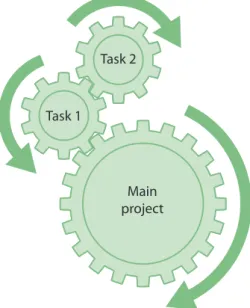
Projects are often made up of a whole series of individual tasks. A simple task may be a small cog in the machine but if it is not moving the whole machine stops. Managing this is a case of making sure all parties know exactly what it is they need to achieve and how they contribute to the whole project. A simple task (such as ordering a specific grade of cable with a long lead time) can hold up a much larger project if the team member responsible for the task has not been given the timescale. Routine tasks that need to be completed as components of a much larger project require solid project management techniques. Figure 7.1.1 demonstrates how tasks are linked.
Main project Task 1
Task 2
Delegation
You may be part of a team with a hierarchical structure or you might operate in a matrix-managed team where different people manage different functions (see Unit 36: Developing working relationships or use the internet to refresh your knowledge of management structures). Either way, delegation will form part of a work programme that is instigated by you or others in the team. Delegation can come naturally to some people but for others it is one of the most difficult life skills to achieve. Some people go through their entire work life and never manage to delegate. A guide for delegation to consider is this: if it is a reasonable request, and if someone is paid to do it, delegate it to them. People are employed to do a particular job so it is not unreasonable to ask them to do it. However, it is the way
in which you ask that makes the difference. You need to be sensitive to people’s individual circumstances and take their preferences into account. If someone will not do a task that is within their job description then there could be other issues and their manager may need to get involved. It may be that some training or personal development is needed. Whatever the solution, you should seek resolution and ensure that the delegated task is completed so that the project can move forward. Sometimes it might be a case of letting the person know how important their role is to the whole project, especially if the task seems mundane or tedious. Everyone has a role to play.
Figure 7.1.1: Interlinking tasks within a project.
Portfolio activity (1.2, 2.2)
Referring to a current project, look at the various components and analyse if any parts of the project can, and should, be delegated to someone in the team who can increase the success of the overall project. Consideration should be given to skill set, current workload and personal development. Discuss with the team and decide if this is an appropriate course of action.
Checks and balance
Once a task has been delegated you will need a method of ensuring it has been completed. All too often in the workplace, it is assumed that something has been done when in reality someone is waiting for one more piece of information before they even start. Two-way communication and open, honest questions are crucial aspects of a successful project. You will look at project management in more detail in later units.
Do not assume!
Never assume that others have exactly the same understanding of an issue or task as you do. This mistake can cause conflict or a breakdown in working relationships. A very simple way to remove this problem is to double-check that all involved understand the task by asking them open questions such as the following.
• Can I just check what it is you are going to do first?
• Just so we both know, can you summarise what we are trying to achieve as a team?
• How will we know we have succeeded in this project? • What, specifically, are your actions?
Have I got time?
It can be difficult to manage the timing of individual tasks. This is because circumstances change in a dynamic project. There could be a number of random elements that you have no control over that can extend a project or piece of work. A project meeting will often start by running through the minutes of the previous session. Generally this will involve going through the actions to check progress. The project manager will update the project plan and project programme based on the feedback. Larger projects may have a critical path analysis (CPA) that requires updating.
It is human nature for some people to agree to take on everything and for some people to avoid taking on responsibility for any actions at all – and to consider a meeting as a success if they come out with nothing to do. Either of these
circumstances is bad. If a team member is tempted to take on too many actions they simply will not have time to do them all. This will result in the project falling behind time and potentially failing. A team member not taking on tasks will obviously have a negative effect on the project, as the workload will move to others who may already have more than enough to do. This will cause unrest in the team and bad feeling that can eventually lead to mistrust, or ultimately an argument. It is your responsibility to make sure you volunteer for the actions that are appropriate for you but also for an amount you can manage. Ultimately, your manager or the project manager will monitor the workloads, but be mindful of others.
Links
The portfolio activity is also linked to NVQ Unit 36: AC 1.2, 1.3; NVQ Unit 19: AC 1.1–2.3; HNC Unit 5: LO2; HNC Unit 59: LO1–LO3; HNC Unit 60: LO4.
Key term
Critical path analysis – the management process used by a project manager to analyse the most efficient way to achieve project goals should an issue arise with a task.
Case study: Keep communicating
A large commercial site was moving across to green technology over a weekend. The project team was made up of several contributing companies, all project managed by a lead project director. The team initially had a regular update meeting where everyone reported on their progress and actions to date. One member of the team was responsible for moving over the communication systems to a UPS (uninterruptable power supply) as part of the programme. As the project become more and more complex due to the groundbreaking technology being installed, the ordering of a critical piece of equipment was not communicated to that person. The site went live but had no communication systems for one week after changeover and the company lost £20,000 of expected orders because customers could not call. The project manager, in part, caused this error. Not being fully aware of the limit of responsibilities of each person/team and not delegating this individual task led to something very important being forgotten.
Portfolio activity (1.1–1.4, 2.1–2.4)
What would you do to make sure this situation did not happen in one of your projects? Write down five main actions you would take as a project manager and discuss them with a peer. When you have decided on the best approach to prevent this mistake happening again, put the five actions in order of priority.
Difficult tasks – dealing with sensitivity
In all jobs there will always be something that someone really does not want to do. This may be due to fear, lack of training, being out of their comfort zone, dislike for someone or something, or simply, ‘I don’t want to do it’. If you experience this problem, you might be able to ‘feel the fear and do it anyway’ or you may need to seek help to explore the issues you are facing. If it is someone else, talk through the issues and try to find the reasons. You might need to practise your negotiation skills at this stage or simply put the importance of the task into perspective for the team member.
Portfolio activity (1.1–1.4, 2.1–2.4, 3.1–3.6)
From time to time you may be part of a large team or be a managing contractor who has to deal with sensitive situations. Discuss with a colleague or your line manager how you would approach the following scenario. Your task is to move some solar panel manufacturing machinery within a workshop and the move will involve splitting up two close friends who have worked next to each other for the past five years. The machines will need to be installed at different ends of the factory. The friends also go to daily prayers together and are distantly related. Your task is to implement this change without causing offence or conflict.
Case study: Handling sensitive issues
You are working in a team of six as the team leader for a particular project. You are approached by three of the team members who tell you that one member in particular has a terrible personal hygiene issue; it is becoming impossible to work in the same room as them. You are asked as the team leader to do something about this but you are worried because the individual concerned is very sensitive and is easily upset. The individual also plays a pivotal role in the success of the project. • Discuss with your manager or a colleague what you could do and agree the approach you
could take to address the problem.
Links
The portfolio activity is also linked to NVQ Unit 36: AC 1.1–3.6; HNC Unit 59: AC 4.1–4.3.
Links
The portfolio activity is also linked to NVQ Unit 2: AC 2.1–3.6; NVQ Unit 19: AC 1.1–1.4; NVQ Unit 36: AC 1.2–3.6; HNC Unit 59: AC 4.1–4.3.
Support and mentoring
If it is your responsibility to lead tasks through to completion, sometimes you may find that you will need to be extra supportive and possibly act as a mentor. Mentoring is a very good way to complete on-the-job training. The concept of leading by example is a great way to gain respect, improve personal development and build a team. But remember, you will not always have time to do this, so spend your time wisely; build it in to your personal development plan so the time can be allocated to do it to the best of your ability.
Activity
Take ten minutes to reflect on your own needs. Identify what it is you would ideally like from a mentor. When you have thought of a few key points, try to identify who might be a good mentor within your business (or outside of it) depending on your needs. Look at the Institution of Engineering and Technology website for more information on mentoring:
www.theiet.org/membership/career/mentoring/index.cfm
Do not be afraid to be wrong – get clarification!
No great achievements have ever happened without a few mistakes being made along the way. Some mistakes can be very expensive so the best approach is to plan. This will involve being prepared to ask questions – some of which may be very difficult or even seem trivial. You might not want to ask these types of questions but it is surprising how many people will be thinking the same as you in a project meeting and how grateful some of them will be that you asked for clarification.
Checklist
On a current project, are you sure that all actions have been allocated? Look at your projects. Have instructions been fully understood? Have all your current work tasks got firm timescales?
Are your work tasks prioritised correctly?
3 Facing conflicts
It is possible that one of your first tasks as a people manager could be to deal with the fallout arising from colleagues’ arguments. If a work matter leads to conflict, it could ultimately fall to you to find a solution in order to maintain the company’s professionalism and to deliver the project outcomes for the customer.
Conflicts at work
Conflict resolution will always be required in all walks of life. The ability to steer around conflict but still negotiate the desired result for your organisation is a highly desirable skill. Conflict can sometimes be unavoidable if both the interested parties’ ideas of an acceptable solution are poles apart.
Links
This section is linked to NVQ Unit 7: AC 1.4, 2.4; NVQ Unit 36: AC 1.4, 2.3, 3.4; HNC Unit 59: AC 3.1–3.3; HNC Unit 15: AC 2.2; HNC Unit 60: AC 4.1, 4.2.
Careful consideration and a reasoned approach will win out in the end but it may take time. Patience and careful planning will help resolve difficult situations. Remember, always stay calm and avoid raised voices.
Take it further
Go to the Chartered Institute of Personnel and Development (CIPD) link below and see if you can pick up any other tips or advice on conflict management:
www.cipd.co.uk/hr-resources/guides/managing-conflict-work-line-managers.aspx
NB: to view this resource, you will need to register for a free CIPD website account.
Conflicts will often flare up from what seems like nowhere or they may have been brewing for a while. Avoiding an issue will not make it go away – face it and be prepared to negotiate your points until an acceptable common ground can be found. Some issues will need to be resolved with extra assistance, for example from others within your organisation, outside neutral parties, or professionals such as lawyers, arbitrators or an ombudsman such as the Advisory, Conciliation and Arbitration Service (ACAS).
Take it further
Follow the link below to find out more about the work of ACAS.
www.acas.org.uk/index.aspx?articleid=1461
Disputes can escalate very quickly, so quick acknowledgement and action is required. Failure to resolve issues will lead to a lack of trust and respect, and will ultimately tarnish any future business or professional relationship. Disputes with suppliers can be particularly costly and inconvenient.
Conflicts due to company restructure
Conflicts are not always just between two people in the workplace; they could be between the company management and staff. Company mergers and takeovers are one source of unrest and conflict in the workplace. Two similar companies or departments can join and then remove whole layers of employees. There are rules and regulations covered by the UK labour law that protect staff whose business is being transferred to another business.
Portfolio activity (1.4, 2.4)
Go online and research Transfer of Undertakings (Protection of Employment) Regulations, or TUPE for short. Summarise your rights as a UK company employee.
Dealing with conflicts
There are many ways to deal with conflicts, ranging from ignoring them to full-on confrontation!
No one wants to be involved in intense conflict at the start of a promising career, so here are a few options to consider.
• Discuss the situation with a peer who is not directly involved and get some unbiased views or opinions on the dispute – consider them, do not simply dismiss them, as you may have missed a key piece of information.
Links
The portfolio activity is also linked to NVQ Unit 36: AC 1.4, 3.1, 3.4; HNC 59: AC 4.1, 4.2; HNC Unit 60: AC 4.1–4.3.
• Try to put yourself in the other person’s shoes – as far as possible, look at it from their perspective to see their reasoning.
• Write down some notes, for and against each point of view. • Ask for someone neutral to mediate.
• Ask a manager to get involved and sort out the dispute.
• Remember, this may not be personal, it may just be business, so keep it in perspective.
• Try to isolate the contentious point by discussing the issues calmly – and listening. • Always talk, never shout.
• If it looks like the situation is deteriorating beyond your control, you can always walk away, regroup, think about it and come back another time. Remember, most disputes can be resolved but not all parties can be completely happy all the time. These situations change and adapt, and relationships have to be worked on continuously.
Some rules for consideration are shown in Figure 7.1.2.
Keep calm Keep an Keep calm
open mind
Talk about it, do not shout
about it
Case study: Resolving conflict
A UK-based company has won a contract to supply a green solution for a new housing development in northern France. A local supplier is contracted to supply the main products and a deposit is negotiated to initiate the design and manufacture. The specialist installer changes the specification due to unforeseen local planning changes but the bespoke products have been designed and considerable money has been invested in setting up the manufacturing process and in the equipment. A lengthy and complex dispute is now a real possibility and mediation is sought to avoid further legal costs. Middle ground is negotiated on the contract and a suitable green solution is installed to the satisfaction of the stakeholders. The contract is able to complete within time, and trust and goodwill are maintained between both the parties involved.
Portfolio activity (1.4, 2.4)
Use the internet to research alternative dispute resolution and write a short report on your findings. The website below could be helpful:
www.adviceguide.org.uk
If your organisation is involved in European contracts with suppliers, find out what advice is available for alternative dispute resolution by visiting the UK European Consumer Centre website at:
www.ukecc.net
Activity
• What does TUPE say about your employment rights? • What is arbitration?
• What is conciliation? • What is mediation?
• What strategies can you use to stay calm when dealing with a workplace conflict? Figure 7.1.2: Even though it can be
difficult, try to keep the heat out of any discussions.
Links
The portfolio activity is also linked to NVQ Unit 36: AC 1.2–1.5, 2.1–2.3, 3.1, 3.2; HNC Unit 60: AC 4.1, 4.2; HNC Unit 59: AC 2.1, 3.2, 3.3, 4.1, 4.2.
Checklist
At the end of this topic guide you should be familiar with: developing your working relationships effectively dealing with work priorities
dealing with conflicts at work alternative dispute resolution.
Further reading and resources
www.acas.org.uk/index.aspx?articleid=1655
Acknowledgements
The publisher would like to thank the following for their kind permission to reproduce their photographs:
Veer/Corbis: Johan Swanepoel (1) All other images © Pearson Education
Every effort has been made to trace the copyright holders and we apologise in advance for any unintentional omissions. We would be pleased to insert the appropriate acknowledgement in any subsequent edition of this publication.