Solution Brief
Network Design
Considerations to Enable
the Benefits of Flash Storage
Flash memory has been used to transform consumer devices such as smartphones, tablets, and ultranote-books, and now it has the potential to also transform data centers. Gartner notes that flash memory is one of “the most important technologies in your data center future.” Data center administrators are generally aware of the benefits of flash storage in a data center environment, but they have struggled with deployment decisions. The fundamental question about imple-menting flash storage is whether the application performance gains can be supported by the network or whether an organization is simply moving the bottleneck from the storage to the network.
Data access speeds are becoming more critical as enterprises implement applications in dynamic virtualized environments that support real-time business requirements, including initiatives such as virtual desktop infra-structure environments, big data mining, and private cloud infrastructures. In a business environment in which data enables many customer solutions,
Fathom, a full-service digital marketing and analytics firm, suggests that by increasing data usability by just 10%, the average FORTUNE® 100 company
can expect an increase of $2 billion in revenue. The switch to flash memory for tier 1 storage has the potential to drive new revenue streams by enabling new IT services.
NetApp and Brocade deliver a data center storage infrastructure that offers the performance, scalability, and reli-ability that today’s dynamic data center environments demand. Several best practices and design considerations should be taken into account when implementing flash storage in a data center environment.
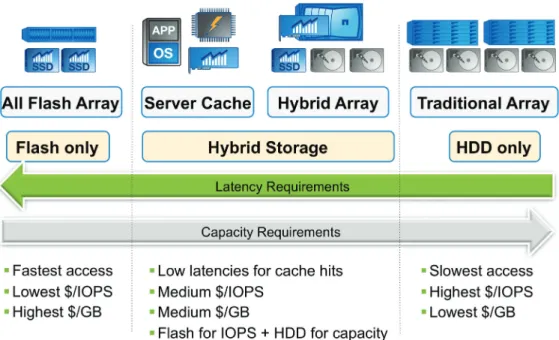
There are a number of options for deploy-ing flash in the data center (Figure 1).
• Hybrid storage solutions combine
the performance of flash with the capacity of HDD by targeting hot data to flash by using either migration or caching.
• Server flash solutions may provide
persistent solid-state storage or cache data from HDD storage onto
flash devices installed in servers, delivering extremely low latency for applications that access data from the cache.
• All-Flash arrays provide consistent,
predictable submillisecond response times for applications that require reliable, low-latency performance. NetApp provides a complete flash portfolio that enables customers to choose the solutions that deliver the performance and capacity they need, as well as tailor those solutions to the exact requirements of their applications. Because flash memory has a role to play across the entire infrastructure stack, NetApp’s portfolio includes hybrid storage, server flash, and all-flash array options.
• Hybrid flash options are available
for both NetApp® FAS and NetApp
E-Series platforms. NetApp Flash Cache™ and Flash Pool™
intelli-gent caching for FAS and V-Series systems and NetApp SANtricity®
SSD Cache for E-Series use flash resources to automatically cache hot data without complex configuration or ongoing management.
• NetApp server flash combines
NetApp Flash Accel™ software with
a choice of flash hardware on servers to provide a persistent cache for applications that require the lowest possible latency.
• NetApp flash arrays deliver
consis-tent submillisecond response times for latency-sensitive applications. The NetApp EF540 flash array is a field-proven platform with a stream-lined OS that offers low-latency performance, exceptional through-put, and scale-up capacity. NetApp FlashRay™ storage array is a
purpose-built, all-flash architecture that com-bines low-latency performance with robust data management, integrated data protection, and built-in storage efficiencies.
It is common for a single compute node to have many virtualized applications, all with different performance, data protection, and resiliency attributes. By reducing application wait time and enabling faster business opera-tion compleopera-tion time, companies can shorten run cycles, speed time to market, achieve more operations per second, and respond more quickly to customers. Flash memory is designed to support these benefits, but with the implementation of flash storage, organi-zations must also optimize the network
layer to support the flash storage so that the network does not become a bottleneck.
Brocade® Gen 5 Fibre Channel SAN
solutions are purpose-built for flash storage, enabling breakthrough application performance, scalability, and availability. The right network architecture can help prevent the improvements from flash memory implementation at the storage layer from creating new bottlenecks within the network layer. Gen 5 Fibre Channel (16Gbps) provides the reliability, scal-ability, and high-performance fabrics needed to support flash storage solu-tions. It offers advanced monitoring, network management, and diagnostics to provide reliable nonstop networking. Gen 5 Fibre Channel enables simple scale-out network infrastructures, with the highest available I/O to support virtualized applications. It is also optimized for SSD and flash storage. Extreme performance enables the deploy-ment of more servers, desktops, and OLTP workloads without sacrificing reli-ability in the software-defined data center. Following are some key considerations when designing the right network to support flash storage.
Design Considerations Does the network meet the bandwidth requirement?
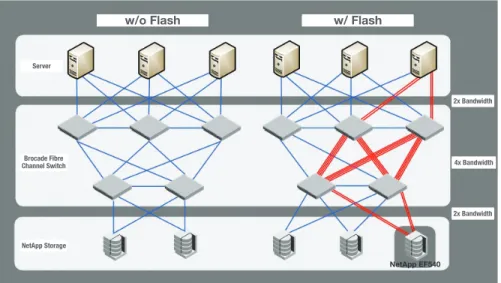
Existing infrastructures that run at 1 Gigabit Ethernet (GbE) or 10GbE, or 2Gbps, 4Gbps, or even 8Gbps Fibre Channel, may not have sufficient bandwidth to accommodate flash technology such as NetApp EF540, which is capable of 6Gbps of sustained throughput. In addition, the high I/O requirements of virtualized applications supported by flash storage become very important, as do the bandwidth and throughput requirements. Applica-tion traffic patterns and increased I/O continue to push bandwidth require-ments and are the primary reason that 10GbE and Gen 5 Fibre Channel (16Gbps) have become standard require-ments for data center infrastructures. Does the network have multipath capabilities to provide a robust and resilient interconnection?
A major benefit of Fibre Channel is that it is inherently a fabric architecture that features multipathing as its core capability. The best practices of Fibre Channel deployment typically provide at least two paths for traffic, both treated as active (referred to as active-active designs), and they enable the full utilization of links within a topology. In contrast, a standard IP topology has active and passive links, which results
in lower network utilization and also requires complex software configura-tion to provide redundancy and a plan for failover scenarios.
Can the network handle the dramatic increase in input/output operations per second (IOPS)?
I/O processing is another challenge to meet, and it differs from bandwidth. As an example, bandwidth can be under-stood as the number of lanes on the freeway. IOPS would then be under-stood as the number of cars, spacing and density, and average speed. Heavily virtualized environments become more IOPS-heavy. Fibre Channel networks complement flash storage, having low overhead and low latency, and flash storage arrays are designed to support maximizing IOPS throughput. Because IOPS can scale almost linearly with the expansion of storage capacity, the deterministic data delivery and cut-through architecture of the Fibre Channel Protocol (FCP) provide maxi-mum support for IOPS.
Will this infrastructure support future needs?
The necessity of an infrastructure that supports plans for future growth has become more critical than ever. The operational requirements to support a five- to seven-year product lifecycle are often at odds with the requirements of
an expanding and growing data center environment. Brocade and NetApp understand the balance of technical and business decisions, and provide solutions that meet today’s require-ments with the reliability, scalability, and higher performance to support tomorrow’s needs as well. New genera-tions of products are designed to work seamlessly with older products to help extend their usefulness.
Will the network be reliable and available for high-density and critical workloads?
Extreme performance enables the deployment of more servers, desktops, and OLTP workloads. This in turn increases the need for a highly reliable network that is available and minimizes the risks and business impact of down-time in virtualized and mission-critical environments. Gen 5 Fibre Channel increases availability for high-density and critical workloads through proac-tive monitoring tools that minimize disruptions and downtime by identifying problems before they affect operations and breakthrough diagnostic tools. Operational Considerations Latency:
Another benefit of using Fibre Channel for flash storage deployments is its inherent deterministic nature, and thus minimal latency. Having minimal and
consistent latency is essential to tier 1 storage and enterprise applications. With other protocols, the latency through the network can vary dramatically. Inconsistency requires administrators to design for a “worst-case” configuration that allows inefficiencies. FCP, which is Serial SCSI 3 over Fibre Channel, is noted as more deterministic than other protocols because most NFS/ CIFS platforms (or iSCSI, for that matter) are transported over TCP/IP. Fibre Channel writes individual blocks of data and uses a buffer-to-buffer credit mechanism to provide consistent data transmission, thereby executing far fewer retransmits and needing less overhead. The server then accesses the storage directly, instead of through the file system, which avoids the overhead of the IP-based file system.
Management:
The ability to monitor and manage an environment is crucial in deploying flash technology. The ability to track both the initial deployment and ongoing operations is critical in understanding whether the expected performance improvement levels are being met. Also, enabling easy configuration and day-to-day administration helps continuously maximize performance and value from a flash storage investment. This in turn helps maintain the lowest possible opex and increases the ROI for capex.
The EF540 flash array runs on the enterprise-proven SANtricity software platform. SANtricity allows storage administrators to achieve maximum performance and utilization of their EF540 through extensive configuration flexibility, custom performance tuning, and complete control over data place-ment. In addition to automated I/O path failover, online administration, and extensive diagnostic capabilities, SANtricity proactively monitors SSD-wear life and can advise when a drive is reaching the end of its useful life and should be replaced.
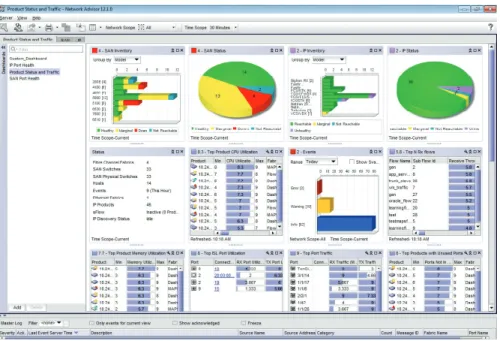
Brocade Fabric Vision technology, an extension of Gen 5 Fibre Channel, introduces a breakthrough hardware and software solution that maximizes uptime, simplifies SAN management, and provides unprecedented visibility and insight across the storage network. With innovative diagnostic, monitoring, and management capabilities, Fabric Vision technology helps administrators avoid problems, maximize application performance, and reduce operational costs.
Fabric Vision technology is integrated into the Brocade Network Advisor net-work management platform (Figure 2).
There, data is provided in customizable health and performance dashboard views to pinpoint problems faster, simplify SAN configuration and management, and reduce operational costs.
Network Options for Flash Optimization
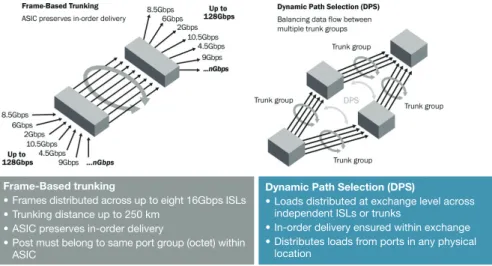
Many tier 1 applications are currently deployed by using FCP, which pro-vides a trusted path for customers to deploy flash technologies in their environments. A Fibre Channel–based network infrastructure also enables a fast rearchitecture of the network to accommodate the flash storage deploy-ment. When flash storage is connected to a Fibre Channel network, there are options that can enable the network to achieve the full utilization of the flash array. The first option, if the customer has Gen 5 Fibre Channel switches installed, is to implement 16Gbps SFPs. This move to 16Gbps doubles the throughput over 8Gbps SFPs. Another option is to use the trunking technology (Figure 3) from Brocade to create larger “pipes” in existing networks. By adding more interswitch links (ISLs) and enabling the trunking technology, the bandwidth between switches can be vastly improved (up to
128Gbps, or 8 links), thereby enhancing the overall performance of the network. The trunking technology treats the multiple links as one logical “pipe” that sprays traffic at the frame level for equal and optimal utilization. This technology can quickly and easily be added to an existing network infrastructure to increase bandwidth where required. A final option, which is considered a best practice, is to install new Gen 5 Fibre Channel (16Gbps) products at the aggregation or core of the network. The upgraded products can then be moved to edge connectivity to extend the useful life of the assets. With the introduction of new Gen 5 Fibre Chan-nel products at the core, 16Gbps Fibre Channel SFPs can be implemented to obtain the full bandwidth potential where the bulk of the data traffic tra-verses. Additionally, depending on the potential expected growth rate of a company’s architecture, modular Fibre Channel products such as Brocade backbones may be the better option compared with implementing fixed port switches. Modular devices such as backbones typically have a greater level of scalability and redundancy, and more granular options to execute a pay-as-you-grow environment.
Figure 3) Benefits of ISL trunking and dynamic path selection.
Frame-Based trunking
• Frames distributed across up to eight 16Gbps ISLs • Trunking distance up to 250 km
• ASIC preserves in-order delivery
• Post must belong to same port group (octet) within ASIC
Dynamic Path Selection (DPS)
• Loads distributed at exchange level across independent ISLs or trunks
• In-order delivery ensured within exchange • Distributes loads from ports in any physical
www.netapp.com
Follow us on: © 2014 NetApp, Inc. All rights reserved. No portions of this document
may be reproduced without prior written consent of NetApp, Inc. Specifications are subject to change without notice. NetApp, the NetApp logo, Go further, faster, Flash Accel, Flash Cache, Flash Pool, FlashRay, and SANtricity are trademarks or registered trademarks of NetApp, Inc. in the United States and/or other countries. Brocade is a registered trademark of Brocade Communications Systems, Inc., in the United States and/or in other countries. All other brands or products are trademarks or registered trademarks of their respective holders and should be treated as such.DS-3518-0414
Summary
Flash storage can be added to existing data center environments to optimize existing applications, or it can be designed in greenfield environments for new applications that demand the highest levels of performance. In either case, Fibre Channel is the network platform of choice, enabling the reli-able, scalreli-able, and high-performance fabrics needed to support flash storage solutions.
NetApp provides a complete flash portfolio so that customers can choose the solutions that deliver the necessary performance and capac-ity, and so that they can tailor those solutions to the exact requirements of their applications. NetApp’s portfolio includes hybrid storage, server flash, and all-flash array options, because flash memory has a role to play across the entire infrastructure stack. The Gen 5 Fibre Channel platform (provided by
Figure 4) Comparison of Fibre Channel topology with upgraded version that includes ISL trunked links or 8Gbps SFPs replaced by 16Gbps SFPs.
NetApp) in combination with NetApp flash solutions provide an optimal networking environment.
The right network architecture can prevent the improvements from flash memory implementation at the storage layer from creating new bottlenecks within the network layer. Gen 5 Fibre Channel provides the advanced monitoring, network management, and diagnostics needed to provide reliable, nonstop networking. About Brocade
Brocade networking solutions help organizations transition smoothly to a world where applications and informa-tion reside anywhere. Today, Brocade is extending its proven data center expertise across the entire network with open, virtual, and efficient solutions built for consolidation, virtualization, and cloud computing. Learn more at
www.brocade.com. w/ Flash w/o Flash
2x Bandwidth
4x Bandwidth
2x Bandwidth Server
Brocade Fibre Channel Switch
NetApp Storage
NetApp EF540
About NetApp
NetApp creates innovative storage and data management solutions that deliver outstanding cost efficiency and accelerate business breakthroughs. NetApp’s commitment to living its core values and consistently being recognized as a great place to work around the world are fundamental to the company’s long-term growth and success, as well as the success of its pathway partners and customers. Learn more at www.netapp.com.