ISSN: 2147-611X
www.ijemst.com
The Art of Teacher Talk: Examining
Intersections of the Strands of Scientific
Proficiencies and Inquiry
Jennifer K. LeBlanc1, Baki Cavlazoglu2, Stephen C. Scogin3, Carol L. Stuessy1
1Texas A&M University
2Karadeniz Technical University 3Hope College
To cite this article:
LeBlanc, J.K., Cavlazoglu, B., Scogin, S.C., & Stuessy, C.L. (2017). The art of teacher talk:
Examining intersections of the strands of scientific proficiencies and inquiry.
International
Journal of Education in Mathematics, Science and Technology (IJEMST), 5
(3), 171-186.
DOI:10.18404/ijemst.52368
This article may be used for research, teaching, and private study purposes.
Any substantial or systematic reproduction, redistribution, reselling, loan, sub-licensing,
systematic supply, or distribution in any form to anyone is expressly forbidden.
Authors alone are responsible for the contents of their articles. The journal owns the
copyright of the articles.
Volume 5, Number 3, 2017
DOI:10.18404/ijemst.52368
The Art of Teacher Talk: Examining Intersections of the Strands of
Scientific Proficiencies and Inquiry
Jennifer K. LeBlanc, Baki Cavlazoglu, Stephen C. Scogin, Carol L. Stuessy
Article Info
Abstract
Article History
Received: 27 April 2016
This research examined how a teacher’s discussion of the strands of scientific proficiencies changed over the course of an inquiry cycle as students engaged in a complex, technology-enhanced inquiry learning environment called PlantingScience (PS). Our research is descriptive in nature and attempts to deconstruct the complexity of teacher talk in the classroom as related to the strands of science proficiency. For this study, we used an exploratory sequential mixed methods design. First, the research team watched twenty recorded PS science lessons, transcribed the teacher’s comments about inquiry, and identified each class/lab’s phase of inquiry. Then, the research team coded the teacher’s transcribed inquiry comments. By using both the scientific proficiency and inquiry lenses to examine one teacher’s orchestration, our findings detail the art of teacher talk for promoting the four strands of scientific proficiencies through the phases of inquiry. As students transitioned through each phase of inquiry, the teacher emphasized the strands of scientific proficiency differently, but all strands were present. Since teachers play a vital role in developing students’ understanding of science as both content and practice, this research helps recognize and describe strategies promoting greater scientific proficiency in students.
Accepted: 22 June 2016
Keywords Inquiry Scientific proficiency Science practices Teacher discourse Mixed methods
Introduction
Facilitating discussions is an art… (Pimentel & McNeill, 2013, p. 386)
Research, policy and curriculum emphasizing what students need to do to learn science puts a focus on authentic science practices (Duschl, 2008). These are practices ―that are integral to the core work of science…core work is not intended to represent specific activities that all scientist engage in, rather it is conceptualized around an epistemology of scientific knowledge held by the scientific community‖ (Windschitl, Thompson, & Braaten, 2008, p. 943). In addition, the National Research Council (NRC; 2012) supports the idea that authentic science practices focus on a core of ideas that must be understood and ―acquiring skills in these practices supports a better understanding of how scientific knowledge is produced…[it] will help students become more critical consumers of scientific information‖ (NRC, 2012, p. 41). Due to new perspectives regarding authentic science practices, science education is currently undergoing a major transition toward incorporating the Next Generation Science Standards (NGSS; Achieve, 2013). Stakeholders in science education expect science teachers to incorporate these practices through appropriate strands of scientific profiencies in the complex science learning environments (Cavlazoglu & Stuessy, in press; NRC, 2014). The role of science teachers, therefore, has become more diffucult requiring successful orchestration of students learning process in these environments (LeBlanc, Cavlazoglu, Scogin, & Stuessy, 2015). However, research examining how teachers incorporate authentic science practices through the strands of scientific profiencies in complex science learning envrionments (e.g., PlantingScience [PS] inquiry learning platform) is limited.
teachers enact in orchestrating inquiry learning environments (Viilo, Seitamaa-Hakkarainen, & Hakkarainen, 2012).
To date, much of the research on teacher orchestration has focused on teacher questioning during inquiry (Louca, Zacharia, & Tzialli, 2012; Oliveira, 2010; Roth, 1996). However, if students are to participate in authentic scientific practices and become critical consumers of scientific information, teachers must scaffold the students’ development of scientific proficiencies in ways that go beyond simple questioning. Effective science teachers balance procedural knowledge, knowledge from the field of science, and content knowledge through orchestration of authentic science practices. This balancing act becomes a form of art – the art of teacher talk. Teacher talk requires practice and support as teachers learn to create balanced science discourse systems through prompts, questions, and encouragement.
Since inquiry is a specific science practice useful for conveying the scientific proficiencies (Achieve, 2013; NRC, 2012), our research seeks to examine how one teacher scaffolds the scientific proficiencies through a complete inquiry cycle. While some research has historically focused on the crucial importance of ―teacher structuring and questioning‖ to encourage students ―to be thoughtful about the substantive aspects of inquiry‖ (Krajcik et al., 1998, p. 313), we seek to examine the intersection of scientific proficiencies and inquiry in the classroom because ―in a society where science increasingly permeates the daily discourse, some understanding of its underlying epistemic values, methods, and institutional practices is essential if the citizen is to engage with the issues confronting contemporary society‖ (Osborne, Collins, Ratcliffe, Millar, & Duschl, 2003, p. 694).
Conceptual Framework
Our conceptual framework is based on two research themes prevalent in science education: the four strands of science proficiencies (Duschl, Schweingruber, & Shouse, 2007; Michaels, Shouse, & Schweingruber, 2008; NRC, 2012) and the phases of inquiry (Etheredge & Rudnitsky, 2003; Krajcik, Blumenfield, Marx, & Soloway, 1998; Chinn & Malhotra, 2002; Aulls & Shore, 2008). Both concepts are deeply connected to helping students’ understanding of authentic scientific practices. The strands of scientific proficiencies focus on ―what is learned during the study of science‖ (Michaels et al., 2008, p. 18) and ―inquiry instruction must emphasize the how of science‖ (Etheredge & Rudnitsky, 2003, p. 19). These themes, the what and how in authentic science learning, are interrelated concepts focusing on either epistemic or process knowledge. Both provide a framework for authentic science – describing how it can be enacted and describing the teachers’ role in enacting specific science practices. The scientific proficiency strands and the inquiry phases are intertwined, iterative and are not meant to be a linear set of processes. Looking at both scientific proficiencies and inquiry phases is useful because ―science is not just a body of knowledge that reflects current understanding of the world; it is also a set of practices used to establish, extend, and refine that knowledge. Both elements – knowledge and practice – are essential‖ (NRC, 2012, p. 26).
The Four Strands of Scientific Proficiencies
As students learn to engage in the process of doing science, their understanding of scientific knowledge is strengthened. What is learned in the study of science is framed by the strands of science proficiencies which include: (1) understanding scientific explanations, (2) generating scientific evidence, (3) reflecting on scientific knowledge, and (4) participating productively in science (Duschl et al., 2007; Michaels et al., 2008). The first strand, understanding scientific explanations, focuses on interconnections among content knowledge and constructions of scientific explanations through the relationships of the ideas. The second strand, generating scientific evidence, encompasses the knowledge and skills needed for designing and evaluating scientific evidence. This strand heavily emphasizes ―practices involved in carrying out a scientific investigation‖ (Michaels et al., 2008, p. 19). The third strand, reflecting on scientific knowledge, focuses on the nature of science. Specifically, it relates to understanding that scientific knowledge can be changed, restructured, or revised as new evidence arises. The fourth strand, participating productively in science, includes opportunities to partake in representing ideas and discussing representations of those ideas with others in the community. For more details regarding the strands of scientific profiencies and how they were used in our research, see the Science Proficiency Coding Rubric (Scogin, Ozturk, & Stuessy, 2013; Appendix A).
teacher orchestrates authentic science practices, naturally occurring opportunities for students to participate in the strands of scientific proficiency emerge. However, just as art transcends the ages, so does teacher talk in the classroom. Through the ―folk theory of inquiry,‖ teacher talk and reflection regarding authentic scientific practices tends to leave out ―references to the epistemological bases of inquiry—talk of arguments tying data to claims, alternative explanations, the development of theories of natural phenomena‖ (Windschitl, 2004, p. 503).
This epistemological absence is reflective of Strand 3 and the limited research explaining how teachers incorporate Strand 3. Much more research knowledge exists for how children perform in Strands 1 and 2 than exists for children’s performance in Strands 3 and 4 (Duschl, 2008). Other research on the strands supports these findings. For example, Minogue et al. (2010) discovered students spent ―the bulk of their science time working within the realm of Strand 2 - Generating Scientific Evidence‖ (p. 571). Teachers need to orchestrate authentic science practices to include all the strands because ―evidence suggests the development of proficiency is best supported when classrooms provide learning opportunities that interweave all four strands together in instruction‖ (Duschl et al., 2007, p. 37). Each strand is dependent on the other, and as students advance in one strand, it promotes the next strand (NRC, 2012). Similarly, as students advance in one phase of inquiry, it often guides them through the progressions of the other phases of inquiry.
Phases of Inquiry
For students to understand science, they must do science. Students ―cannot comprehend scientific practices, nor fully appreciate the nature of scientific knowledge itself, without directly experiencing those practices for themselves‖ (NRC, 2012, p. 30). Students participate in inquiry as an authentic scientific practice. Through participation, they experience what it feels like to do science, understand scientific explanations, generate evidence, and participate productively in science.
An inquiry cycle includes many different phases. Throughout the literature, the inquiry phases or scientific practices involved in authentic inquiry vary (for examples see Peterson, 2012). For the purpose of this paper, we focused on the phases of inquiry described by Peterson (2012). In her research, she defined eight phases of the inquiry cycle which included: a) Immersion, (b) Research Question, (c) Prediction, (d) Experimental Design and Procedures, (e) Observations, (f) Analysis and Results, (g) Conclusions and Explanations, and (h) Future Research and Implications of the Study (Peterson, 2012, p. 75; see Appendix B).
Inquiry is based on learners generating their own questions (Etheredge & Rudnitsky, 2003). During question development, it is important for teachers to provide adequate time for students to manipulate and explore the variables in the system under study. This exploration, called Immersion, is extremely important and ―set[s] the stage for framing researchable questions‖ (Etheredge & Rudnitsky, 2003, p. 39).
The process of asking questions is essential to developing scientific habits of mind (NRC, 2012). As students transition from the Immersion phase to the Research Question phase, scaffolding from the teacher is critical. Teachers must help students understand scientific explanations (Strand 1) and enable students to use that understanding to build arguments. It is important for teachers to support curiosity and questioning so students can create researchable questions. Viilo et al. (2012) noted that students often struggled generating researchable questions and needed more frequent scaffolding from teachers.
After students develop a researchable question, they proceed to make predictions about the phenomenon under study. The Prediction phase requires students to connect prior experiences to their knowledge of the target system (Krajcik et al., 1998). Throughout the Prediction phase, students must reflect on scientific knowledge (Strand 3) specifically as it relates to their understanding that predictions can be revised based on new evidence.
2012). At this point in the cycle, teachers should help students identify ―the relevant variables and [help students in] considering how they might be observed, measured, and controlled‖ (NRC, 2012, p. 59).
After students have engaged in creating their experimental design based on their question and prediction, they move on to the Observation, Analysis, Conclusions and Implication phases of the inquiry cycle. Before starting Observation, it is important for teachers to explicitly state the need for record-keeping and the importance of collecting data in detail through journaling, making tables, and charting results (Etheredge & Rudnitsky, 2003). This again highlights strand 2 because it emphasizes the students’ understanding relating to generating scientific evidence (Michaels et al., 2008).
Once students have collected data during the Observation phase, they use the data to develop explanations for their research question(s) in the Analysis phase. In order to analyze data, students must be able to recognize patterns or trends in their data, compare their data across other studies, and express any unexpected results if applicable (Peterson, 2012). The data must be presented in a form that will reveal patterns and relationships so that results can be communicated to others (NRC, 2012). The Analysis phase creates a clear transition to the Conclusion phase of inquiry.
Within the Conclusion phase, students provide evidence and explanations consistent with the collected data, discuss limitations, and mention alternative explanations for their results (Peterson, 2012). These last two phases, Analysis and Conclusion, highlight each strand of scientific proficiency and are possibly the most complex phases in the cycle. Students engaged in the Analysis and Conclusion phases are understanding scientific explanations (Strand 1), generating scientific evidence (Strand 2), reflecting on scientific knowledge (Strand 3), and participating productively in science (Strand 4). Finally, by reflecting on their conclusions, students are able to state Implications of their research, including limitations and future revisions of the process (Peterson, 2012). This phase tends to focus on Strand 3 – Reflecting on Scientific Knowledge – because it forces students to be reflective of their own work as well as the work of others.
For the sake of discussion, we have presented the scientific proficiencies and the phases of inquiry as a linear model, but we again emphasize the cyclical and interconnected nature of the strands and the phases. These complex interactions call for the teacher to scaffold students’ learning to increase ―student sophistication in the skills and knowledge needed to design and conduct experiments‖ (Etheredge & Rudnitsky, 2003, p. 45).
As the strands of scientific proficiency guide what students need to learn when doing science, the phases of inquiry progress students through the how-to processes of authentic scientific practices. Through this process, students depend on their teachers to skillfully scaffold their understanding and utilization of the science proficiencies as the students engage in the phases of inquiry. This intersection and skillful guidance is the art of ―teacher talk.‖ Even though ―a focus on the inquiry process is clearly evident in the prominent reform documents of the last decade… the practical application of full and complete science inquiry remains an elusive and daunting task for teachers‖ (Minogue et al., 2010, p. 562). Understanding how teachers orchestrate the intersection of the strands of scientific proficiencies through the art of teacher talk is critically important to advancing how future teachers enact inquiry instruction that promotes critical scientific understanding for students.
This research describes how a teacher’s discussion of the strands of scientific proficiencies changed over the course of an inquiry cycle as students engaged in PS projects. Specifically, we asked the guiding question, How does the teacher’s discussion of each scientific proficiency change over the course of the inquiry cycle? Few researchers have directly examined the characteristics of teachers enacting this mode of instruction in science classrooms (Minogue et al., 2010). Our research is descriptive in nature and attempts to deconstruct the complexity of teacher talk in the classroom as related to the strands of science proficiency.
Methods
Context of Study
Our research used the scientific proficiency strands as a lens to understand how a teacher orchestrated inquiry in a complex, technology-enhanced inquiry learning environment (i.e., PS) which is a blended curriculum developed by the Botanical Society of America (BSA). Used by over 11,000 students since 2005, PS mixes scientific inquiry, classroom instruction, and online mentoring by practicing scientists in an authentic classroom context. Students work in teams of 2-4 individuals and design, implement, and analyze their own inquiry-based experiments related to plants. While the PS program has used over 900 professional scientists and science graduate students worldwide as scientist-mentors, most of the orchestration falls on the shoulders of the classroom teacher.
The Participant
Amy (pseudonym), the teacher participant in this study, had 25 years teaching experience in science and taught middle school science using hands-on, inquiry-based teaching methods at a rural school in Texas, US. She participated in several PS summer professional development seminars and was familiar with the PS learning environment and how to implement it in the science classroom. After her second PS professional development, she volunteered to video record her inquiry module, The Wonder of Seeds. Her video recordings served as the data for the current analysis. Amy’s experience in the classroom, combined with her knowledge of PS implementation, was a leading reason for purposively selecting her classroom for the current study.
Research Design and Data Collection
This study used an exploratory sequential mixed methods design (Creswell & Plano-Clark, 2011). In the first phase of the study, the research team watched twenty recorded PS science lessons, transcribed the teacher’s comments about inquiry, and identified each class/lab’s phase of inquiry. This process helped us detect and identify the specific inquiry phases throughout the full inquiry sequence. In the second phase, the research team coded the teacher’s transcribed inquiry comments by using the Science Proficiency Rubric (Scogin et al., 2013; Appendix A). These codes were used to calculate Amy’s use of each scientific proficiency during the inquiry cycle. Figure 1 illustrates the research design, procedures, and products for each phase.
Analysis
Researchers used the Science Proficiency Rubric (Appendix A) to categorize the teacher’s talk into four scientific proficiency categories. These categories included: (a) understanding scientific explanations, (b) generating scientific evidence, (c) reflecting on scientific knowledge, and (d) participating productively in science. Doing so helped us develop a deeper understanding of the roles Amy enacted in scaffolding scientific proficiencies in this complex, collaborative, and technology-enhanced learning environment. Amy’s inquiry talk was independently coded by each researcher using the Science Proficiency Rubric. Percent agreement was used to calculate inter-rater reliability and between three coders inter-rater reliability was found 87%. Afterward, researchers discussed the codes and negotiated each code to reach full consensus.
Results
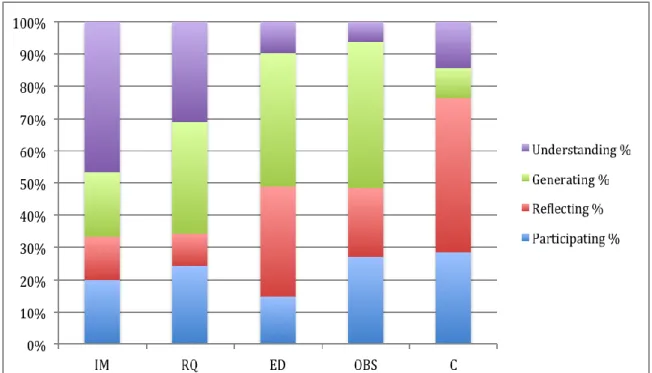
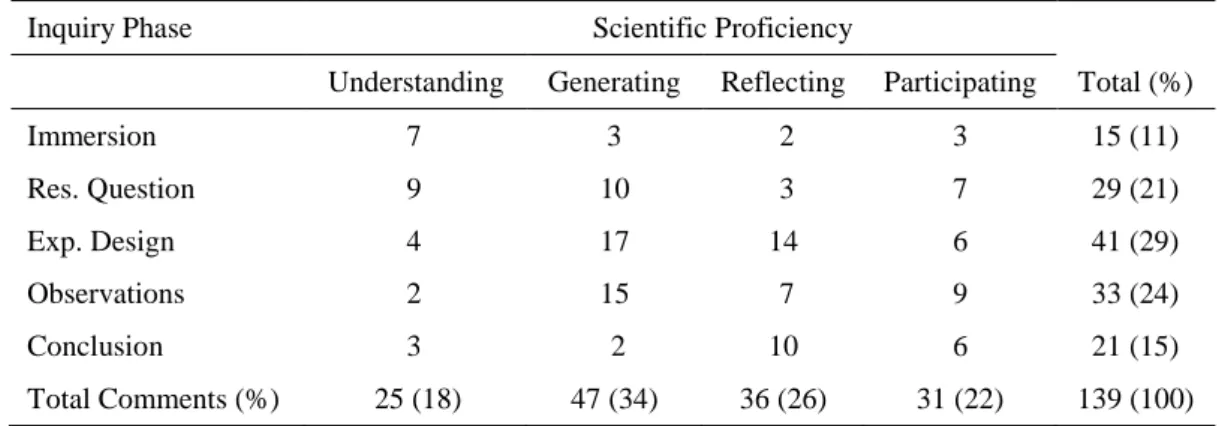
Amy’s references to scientific proficiencies during the inquiry cycle followed an iterative path. Throughout the inquiry cycle, Amy made references to all four scientific proficiencies. However, some proficiencies were emphasized more than others during certain phases of inquiry. Figure 2 illustrates how relative percentages of references to the four scientific proficiencies changed over the course of the inquiry cycle. During Immersion and Observation, one proficiency dominated the teacher’s discussions with the students. During Immersion, Amy focused on Understanding (Strand 1). In comparison, during the Observation phase, she referenced Generating (Strand 2) more often. Interestingly, during the Research Question, Experimental Design, and Conclusion phases, Amy emphasized two proficiencies almost equally; these were Understanding (Strand 1) and Generating (Strand 2) in the Research Question phase; Generating (Strand 2) and Reflecting (Strand 3) in the Experimental Design phase; and Reflecting (Stand 3) and Participating (Strand 4) in the Conclusion phase. These results indicate Amy altered her scaffolding of the scientific proficiencies as her students transitioned through the inquiry cycle. While these results indicate changes in Amy's scientific proficiency emphasis over the inquiry cycle, each of the four proficiencies was referenced at least 25 times over the course of the twenty observed days of class (Table 1). Overall, Amy made 139 references to scientific proficiencies. References to Understanding scientific explanations (Strand 1) were least common in her dialogue. The greatest number of comments related to Generating scientific evidence (Strand 2).
Figure 2. Percentages of each scientific proficiency in each inquiry phase within 100% stacked column format Phases of inquiry: IM = Immersion; RQ = Research Question; ED = Experimental Design and Procedures; OBS
= Observation; C = Conclusion and Explanations. Strands of Science Proficiency: Understanding = Strand 1 Understanding Scientific Explanations; Generating = Strand 2 Generating Scientific Evidence; Reflecting = Strand 3 Reflecting on Scientific Knowledge; Participating = Strand 4 Participating Productively in Science.
The data in Table 1 provide additional insight into how Amy’s references to the scientific proficiencies changed over the course of the inquiry cycle. During the Immersion phase, she made the least number of references to the scientific proficiencies. Amy’s comments about proficiencies almost doubled during the Research Question phase and continued to increase in the Experimental Design phase. References to the scientific proficiencies began to wane during Observations and were even less common in the Conclusion phase. Interestingly, the overall pattern of scientific proficiency references simulates a bell-shaped curve with most emphasis occurring during the middle stages of the inquiry cycle and less at the beginning and end stages.
during the Experimental Design and Conclusion phases. Dialogue about Participating productively in science (Strand 4) was slightly more common at the end of the inquiry cycle (i.e., Observations and Conclusion phases) but overall showed less variation than the other three proficiencies. The interactions of the four proficiencies changed over the course of inquiry, thus illustrating the iterative nature of inquiry in the classroom. Amy altered her conversations and scaffolding of the scientific proficiencies as students transitioned from phase to phase.
Table 1. Distribution of scientific proficiencies in each inquiry phase with total numbers and percentages
Inquiry Phase Scientific Proficiency
Understanding Generating Reflecting Participating Total (%)
Immersion 7 3 2 3 15 (11)
Res. Question 9 10 3 7 29 (21)
Exp. Design 4 17 14 6 41 (29)
Observations 2 15 7 9 33 (24)
Conclusion 3 2 10 6 21 (15)
Total Comments (%) 25 (18) 47 (34) 36 (26) 31 (22) 139 (100)
Discussion
This study investigated an increasingly important theme in science education research – the integration of scientific proficiencies in inquiry-based learning. We examined and explained, in an effort to make visible, the supportive practices used by one teacher in promoting scientific proficiencies while orchestrating a complex inquiry-based learning environment. By using both the scientific proficiency and inquiry lenses to examine Amy’s orchestration, our results detail the art of teacher talk for promoting the four strands of scientific proficiencies through the phases of inquiry and how the supports for the four strands change over time. As students transitioned from phase to phase in inquiry, each strand was emphasized differently, but all strands were present in Amy’s talk throughout the entire inquiry cycle. These findings support previous work stating the scientific proficiency strands and the inquiry phases are intertwined and connected (Duschl et al., 2007; Etheredge & Rudnitsky, 2003).
Strand 1 – Understanding Scientific Explanations
Figure 2 shows this proficiency was stressed at the beginning of the inquiry cycle during Immersion. When introducing scientific investigations, explicit understanding of scientific explanations is very important (McNeill & Krajcik, 2008). Amy included Understanding (Strand 1) in the Immersion phase by emphasizing the connection between students’ knowledge construction and creating a testable question. For example, Amy asked her students:
What are some questions we have about seeds that you would like to answer when you do your experiment?That’s what we’re getting to. What kind of questions do you have and how do you answer that with an experiment? (Day 1 – Immersion phase)
Additionally, Amy fostered increased understanding in her students by connecting their previous knowledge with the context of their upcoming inquiry study. For example, Amy had the following question/answer conversation with her students (Note: only Amy’s comments included):
We just studied photosynthesis. Why do plants do photosynthesis? To make sugar. To make sugar for energy. Why do they need to do that?...water… carbohydrate… and sun light….where do they get their food when they are inside the soil? (Day 3 – Immersion phase)
Based on our results, Strand 1 dialogue decreased and Strand 2 dialogue increased as students transitioned from Immersion to Research Question. The transition from the immersion experiences to asking general questions about the system ―is among the most important parts of the inquiry unit and calls for considerable perceptiveness‖ (Etheredge & Rudnitsky, 2003, p. 40). Amy noted, ―This was my students’ first time at starting with their own questions and coming up with a hypothesis so a lot of teacher-group discussion ensued as the groups worked through this process‖ (PS Teacher, 2012). This increased discussion to scaffold students could have been responsible for the steady increase in Strand 2 as students migrated to the Research Question and Experimental Design phases.
Strand 2 - Generating Scientific Evidence
Our results for Strand 2 mimic findings in Duschl (2008) and Minogue et al. (2010) that Strand 2 is the most heavily emphasized strand. Specifically, our results show that Amy emphasized this strand increasingly from Immersion to the Observation phase. Etheredge and Rudnitsky (2003) noted, ―Throughout the research step, teachers should look for opportunities to teach benchmark lessons, which are aimed at increasing student sophistication in the skills and knowledge needed to design and conduct experiments‖ (p. 45). Amy’s emphasis on Strand 2, as seen in the following quotes, therefore, seems quite natural.
When you get through getting your stuff together what is your job? …Make sure you have written down with details. You need to work on a data table or you need a place to record data, what you are going to measure. Think about what you’re going to collect as data. (Day 9 – Experimental Design phase)
I want to demonstrate to clarify for everybody what we mean when we say be specific... Here is the petri dish and here is the paper towel and I am going to put 30 seeds and then I put water in it. Did I follow the instructions? I put a paper towel in it, I put 30 seeds in it, I put water in it, did I do what they say? How can I do it right unless you tell me how to do it right? …You need to say that in your instructions because another person reading it doesn’t know all that unless you tell them…do you see why I am talking about detail?…give enough detail so someone can do it just like you are going to do it… this is not our usual way of writing, this is like a recipe… we’ve got to put every detail in there. (Day 9 – Experimental Design phase)
As your final set-up, you’re going to be collecting data.You’re going to be measuring seeds. You need to know what seeds you’re measuring each day, right? (Day 10 – transition from Experimental Design to Observation phase)
Even with an increased emphasis on Strand 2 as students transitioned from Experimental Design to Observations, Amy noted students still struggled with that particular aspect of their assessment. In her reflections, Amy noted:
The results of the open spiral tests were pretty good while the students struggled with the normal type assessment over how to design experiments and the related terminology. This is an issue I need to give some thought to this summer. I do not really understand why these particular terms are so much harder for the students to internalize.
Within the context of their own experiments, students seemed to do okay on the terms, but they could also consult their own journals. Without the journals as references, the terms did not transfer. Future research is needed to examine students-teacher response dialogues and determine methods to facilitate better transfer of terminology during inquiry experiments.
scaffolding to develop experiments but also need help transferring applicable ideas from the context of their own experiments to other contexts.
Strand 3 - Reflecting on Scientific Knowledge
The results showed this strand was mostly emphasized during the Experimental Design and Conclusion phases. It is important to note the Conclusion phase within our study included what literature often refers to as implications. In other words, teacher talk about implications was included as part of the Conclusion phase in this study. When addressing implications, teachers typically emphasize Strand 3 (Reflecting). Our results followed this trend. Amy felt the need to have students revisit their studies and reflected on the validity of their results. Additionally, she encouraged students to think about how they might change their experiment in the future.
While Strand 3 was emphasized more heavily during certain inquiry phases, Amy incorporated reflection throughout the inquiry cycle. She scaffolded students understanding of the ―game of science‖ and often emphasized that reflection and revision were necessary throughout the inquiry cycle. Some examples of Amy’s incoporation of this strand are found in the following examples:
So, if you came in tomorrow and you realize something is not the best, can you still change it? Yes! (Day 7 – Experimental Design phase)
So that is kind of an issue, I really don’t think the lack of oxygen is a problem. We have done that kind of experiment before without a problem. Maybe the seeds were too wet at the beginning. We are going to do it this time where we are not soaking them, so hopefully that will take care of the problem. (Day 14 – Observations phase)
Are we absolutely sure that is the cause? Not necessarily, but if we do it with a lot of them and it shows that or we repeat it again and it shows that, then we are getting more and more evidence that there is some connection between the two. (Day 19 – Review day)
Figure 2 reveals that Reflecting (Strand 3) was the most cyclical of the four strands discussed during teacher talk. Reflecting comments cycle up and down throughout the inquiry cycle. While based strictly on anecdotal evidence, this pattern suggests that Amy specifically emphasized reflection at various intervals during the inquiry cycle. As students proceeded through various phases, Amy had them reflect on their past experiences as they prepared to push to the next phase. Naturally, the greatest emphasis on Reflecting was at the end (i.e., Conclusion) as students considered the sum total of their inquiry experiences.
Strand 4 – Participating Productively in Science
This strand is often the most neglected by teachers (Michaels et al., 2008). While not the least emphasized in this study, our results indicated Strand 4 was minimally emphasized throughout the phases of inquiry (see Table 1). To incorporate Strand 4, Amy focused on emphasizing group work and appropriate ways to communicate scientific information. Examples from Amy’s teacher talk promoting this strand included:
In your groups, decide what question you want to address in your experiment. (Day 6 – Research Question phase)
In the other classes, we never looked at our computers and checked our responses. But today, I would like one person from each group to do computer after I’ve gone over the stuff. That way, you will have their [scientists’] input before you start actually getting your stuff together. (Day 7 – Experimental Design phase)
At this point your instruction should be clear enough and detailed enough so someone else can take your instructions and follow them and do it just like you did… (Day 8 – Experimental Design phase)
In addition to group work and shared discussions in the class, students were able to participate productively in science through online discussions with scientist-mentors through the PS platform. These discussions were not part of this study, but they represent students participating productively in science. Additionally, Amy often encouraged students to post on the platform. These references to the platform were used in a separate analysis of teacher orchestration (see Cavlazoglu et al., 2013), but they were not counted towards Participating productively (Strand 4). The decision to not count these references to the platform as representative of Strand 4 denote a limitation that could have altered the overall levels of Strand 4 teacher talk found in this study.
Participating productively includes ―the motivation and attitudes that provide a foundation for students to be actively and productively involved in science classrooms‖ (Michaels et al., 2008, p. 21). As seen in research completed by Scogin and Stuessy (2013), scientist-mentors may play a more significant role in motivating students in PS than do teachers. While teachers are involved in orchestration of the learning environment, assessment of student learning, and other day-to-day tasks in the classroom, scientists are free to simply engage students in conversations about science. Many students involved in PS tend to enjoy the interactions with scientists, thereby Participating productively in science.
In her reflections (PS Teacher, 2012), Amy recognized the need for scaffolding students to ―understand appropriate norms for presenting scientific information‖ (Michaels et al., 2008, p. 21). She acknowledged her struggles and stated she would like to incorporate more scaffolding for participating productively in science, noting that students struggled in recording their thoughts clearly. She wrote:
I was pleased to see she [a student] used some terminology – ―epicotyl‖ as she recorded observations. One thing we need to work on is putting more detail but also just putting thoughts and personal questions. I would like to see their journals as a running thought stream. I think I could show some samples of older students work or some examples from real scientists. (PS Teacher, 2012)
Conclusion
In this study, we ―made visible‖ (Viilo et al., 2012) the discourse practices promoting scientific proficiency by examining how one teacher talked about the strands of scientific proficiencies through the phases of an inquiry cycle. Amy, the teacher in our study, used the art of teacher talk to guide ―discussions by asking students to make their meanings clear, to explore various points of view in a neutral and respectful manner, and to monitor the discussion and their own thinking‖ (van Zee, Iwasyk, Kurose, Simpson, & Wild, 2001, p. 183). Since teachers play a vital role in developing students’ understanding of science as both content and process, this research helps us recognize and describe strategies promoting greater scientific proficiency in students.
Proficiency in the art of inquiry orchestration takes years of practice and concentrated professional development (PD) sessions. Even experienced teachers lack confidence in their abilities to orchestrate and scaffold student learning. In this study, Amy, a 25-year veteran teacher with extensive PD experience in PS, indicated she still needed support in how to encourage and help students understand scientific inquiry and scientific proficiencies (PS Teacher, 2012). All teachers, regardless of their experience and training, need continuous PD opportunities throughout their careers (Windschitl, 2004), especially in emerging technology-enhanced learning environments. These PD opportunities need to be connected to curriculum, tied to authentic research, integrated within the scientist community, and sensitive to students’ needs.
Acknowledgements
We wish to acknowledge the scientist mentors and the teacher volunteering her classes and portfolios for analysis in this study. We also acknowledge the National Science Foundation (NSF Award 07-33280) and the Department of Teaching, Learning and Culture at Texas A&M University. Any opinions, findings, or conclusions expressed in this report are those of the authors and do not necessarily reflect the views of the funding agency or Texas A&M University.
References
Achieve. (2013). Next generation science standards. Retrieved September 2, 2013, from http://www .nextgenscience.org/next-generation-science-standards.
Aulls, M. W., & Shore, B. M. (2008). Inquiry in education: The conceptual foundations for research as a curricular imperative (Vol. I). New York, NY: Taylor & Francis Group.
Cavlazoglu, B., LeBlanc, J., Peterson, C. A., & Stuessy, C. (2013, August). The role of teachers in orchestrating the PlantingScience learning environment. Final Report of the BSA Research Teams at Texas A&M University, College Station, TX.
Cavlazoglu, B., & Stuessy, C. L. (in press). Identifying and verifying earthquake engineering concepts to create a knowledge base in STEM education: A modified Delphi study. International Journal of Education in Mathematics, Science and Technology. DOI:10.18404/ijemst.60674
Chinn, C. A., & Malhotra, B. A. (2002). Epistemologically authentic inquiry in schools: A theoretical framework for evaluating inquiry tasks. Science Education, 86(2), 175-218.
Creswell, J. W., & Plano Clark, V. L. (2011). Designing and conducting mixed methods research (2nd ed.). Los Angeles, CA: Sage.
Duschl, R. (2008). Science education in three-part harmony: Balancing conceptual, epistemic, and social learning goals. Review of Research in Education, 32, 268-291. doi:DOI: 10.3102/0091732X07309371 Duschl, R. , Schweingruber, H. A., & Shouse, A. W. (2007). Taking science to school : Learning and teaching
science in grade K-8 . Washington, D.C.: The National Academies Press.
Etheredge, S., & Rudnitsky, A. (2003). Introducing students to scientific inquiry: How do we know what we know? Boston, MA: Pearson Education, Inc.
Krajcik, J., Blumenfeld, P. C., Marx, R. W., Bass, K. M., Fredricks, J., & Soloway, E. (1998). Inquiry in project-based science classrooms: Initial attempts by middle school students. The Journal of the Learning Sciences, 7(3 & 4), 313-350.
LeBlanc, J., Cavlazoglu, B., Scogin, S., & Stuessy, C. L. (April, 2015). The art of teacher talk: Examining the strands of scientific proficiency within inquiry phases. Paper presented at the annual meeting of American Education Researchers Association (AERA), Chicago, IL
Louca, L. T., Zacharia, Z. Z., & Tzialli, D. (2012). Identification, interpretation-evaluation, response: An alternative framework for analyzing teacher discourse in science. International Journal of Science Education, 34(12), 1823-1856.
McNeill, K. L., & Krajcik, J. (2008). Scientific explanations: characterizing and evaluating the effects of teachers' instructional practices on student learning. Journal of Research in Science Teaching, 45(1), 53-78.
Michaels, S., Shouse, A. W., & Schweingruber, H. A. (2008). Ready, set, science: Putting research to work in K-8 science classroom. Washington, D.C.: The National Academies Press.
Minogue, J., Madden, L., Bedward, J., Wiebe, E., & Carter, M. (2010). The cross-case analyses of elementary students' engagement in the strands of science proficiency. Journal of Science Teacher Education, 21, 559-587.
National Research Council. (2012). A framework for K-12 science education: Practices, crosscutting concepts, and core ideas. Washington, DC: The National Academies.
National Research Council. (2014). STEM integration in K-12 education: Status, prospects, and an agenda for research. Washington, DC: National Academy Press.
Oliveira, A. W. (2010). Improving teacher questioning in science inquiry discussions through professional development. Journal of Research in Science Teaching, 47(4), 422-453.
Osborne, J., Collins, S., Ratcliffe, M., Millar, R., & Duschl, R. (2003). What "Ideas-about-Science" should be taught in school science? A Delphi Study of the expert community. Journal of Research in Science Teaching, 40(7), 692-720.
Peterson, C. A. (2012). Mentored engagement of secondary science students, plant scientists, and
Pimentel, D. S., & McNeill, K. L. (2013). Conducting talk in secondary science classrooms: Investigating instructional moves and teachers' beliefs. Science Education, 97(3), 367-394.
PS Teacher. (2012). Teacher portfolio for Wonder of Seeds. [Personal Reflections Notebook]. Copy in possession of BSA Research Team, Texas A&M University, College Station, TX.
Roth, W. M. (1996). Teacher questioning in an open-inquiry learning environment: Interactions of context, content and student responses. Journal of Research in Science Teaching, 33(7), 709-736.
Scogin, S. C., Ozturk, G., & Stuessy, C. L. (2013, February). Online communication between mentors and students: An analysis of a model. Paper presented at the First International Teacher-Scientists Partnership Conference (American Association for the Advancement of Science), Boston, MA.
Scogin, S., & Stuessy, C. (2013). Scientist-mentors’ motivational support of student-teams in PlantingScience. Final Report of the BSA Research Teams at Texas A&M University, College Station, TX.
Talanquer, V., Tomanek, D., & Novodvorsky, I. (2013). Assessing students' understanding of inquiry: what do prospective science teachers notice. Journal of Research in Science Teaching, 50(2), 189-208.
van Zee, E. H., Iwasyk, M., Kurose, A., Simpson, D., & Wild, J. (2001). Student and teacher questioning during conversations about science. Journal of Research in Science Teaching, 38(2), 159-190.
Viilo, M., Seitemaa-Hakkarainen, P., & Hakkarainen, K. (2012). Infrastructures for technology
supported collective inquiry learning in science. In K. Littleton, E. Scanlon, & M. Sharples (Eds.), Orchestrating inquiry learning (pp. 128-145). New York, NY: Routledge.
Windschitl, M. (2004). Folk theories of inquiry: How preservice teachers reproduce the discourse practices of an atheoretical scientific method. Journal of Research in Science Teaching, 41(5), 481-512.
Windschitl, M., Thompson, J., & Braaten, M. (2008). Beyond the scientific method: Model-based inquiry as a new paradigm of preferences for school science investigations. Science Education, 92, 941-967.
Author Information
Jennifer K. LeBlanc Texas A&M University
Teaching, Learning, and Culture (TLAC) Department 4232 TAMU College Station, TX, United States 77843
Baki Cavlazoglu
Karadeniz Technical University Fatih Faculty of Education
Adnan Kahveci Blv. Akçaabat/Trabzon, Turkey 61080 Contact e-mail: [email protected]
Stephen C. Scogin Hope College
Departments of Biology and Education
Hope College, Holland, MI, United States 49423
Carol L. Stuessy Texas A&M University
Appendix A: Science Proficiency Coding Rubric
1E - By assisting students in UNDERSTANDING SCIENTIFIC EXPLANATIONS, e.g., 1. To know, use, and interpret scientific explanations
2. To understand interrelationships among concepts 3. To use interrelations to critique scientific arguments
4.
To learn the facts, concepts, principles, laws, theories and models of scienceG - By assisting students in GENERATING SCIENTIFIC EVIDENCE, e.g., 1. To generate evidence
2. To evaluate evidence
3. To build and/or refine models and explanations using generated evidence 4. To design and analyze investigations
5. To construct and defend arguments with evidence
6. To master the conceptual, mathematical, physical and computational tools to construct knowledge claims
7. To carry out scientific investigations
8.
To engage in the processes of science (i.e., to ask questions, develop measures, collect data, etc.)R - By encouraging and assisting students in REFLECTING ON SCIENTIFIC KNOWLEDGE, e.g., 1. To understand that scientific knowledge can be revised
2. To track and reflect on their own ideas as they change 3. To understand the nature of science
4. To understand how scientific knowledge is constructed
5. To understand that evidence and arguments are based on evidence as generated 6. To reflect on the status of their own knowledge
7. To experience what it feels like to do science 8. To understand what the game of science is all about
9. Understand that science is a search for core explanations and connections between them 10. To value explanations as they account for available evidence
11.
To value explanations in generating new and productive questions for researchP - By encouraging and engaging students to PARTICIPATE PRODUCTIVELY IN SCIENCE, e.g., 1. To skillfully participate in a scientific community in the classroom
2. To master productive ways to represent ideas 3. To master productive ways to use scientific tools 4. To interact with peers about science
5. To understand the appropriate norms for presenting scientific arguments
6. To practice productive social interactions with peers in the context of classroom investigations 7. To demonstrate motivation and attitudes to engage actively and productively in science classrooms 8. To emphasize doing science and doing it together in groups
9. To share ideas with peers
10. To build interpretive accounts of data