ISSN: 2147-611X
www.ijemst.com
Cognitive
Language
and
Content
Standards: Language Inventory of the
Common Core State Standards In
Mathematics and the Next Generation
Science Standards
Kathleen M. Winn, Kyong Mi Choi, Brian Hand University of Iowa
To cite this article:
Winn, K.M., Choi, K.M., & Hand, B. (2016). Cognitive language and content standards:
Language inventory of the common core state standards in mathematics and the next
generation science standards.
International Journal of Education in Mathematics, Science
and Technology, 4
(4), 319-339. DOI:10.18404/ijemst.26330
This article may be used for research, teaching, and private study purposes.
Any substantial or systematic reproduction, redistribution, reselling, loan, sub-licensing,
systematic supply, or distribution in any form to anyone is expressly forbidden.
Authors alone are responsible for the contents of their articles. The journal owns the
copyright of the articles.
Volume 4, Number 4, 2016
DOI:10.18404/ijemst.26330
Cognitive Language and Content Standards: Language Inventory of the
Common Core State Standards in Mathematics and the Next Generation
Science Standards
Kathleen M. Winn, Kyong Mi Choi, Brian Hand
Article Info
Abstract
Article History
Received: 09 February 2016
STEM education is a current focus of many educators and policymakers and the Next Generation Science Standards (NGSS) with the Common Core State Standards in Mathematics (CCSSM) are foundational documents driving curricular and instructional decision making for teachers and students in K-8 classrooms across the United States. Thus, practitioners and researchers need to possess a deep and working understanding of these standards. This study aims to examine how terms within the CCSSM and the NGSS are used and aligned by addressing the following research questions: (1) What common terminology is found across CCSSM and NGSS? (2) How does the terminology between the CCSSM and the NGSS compare to one another? (3) How do the cognitive terms found in CCSSM and NGSS change across grade bands? The findings indicate that there are numerous places where common terminology is aligned and used similarly both across grade bands and between the sets of standards. Conversely, many other terms are used with varying degrees of emphasis. Because STEM is presented as a holistic subject, these variable meanings and/or expectations reveal the potential for misguided expectations within the classroom as students, teachers, and principals use the same terminology in multiple, but distinct contexts.
Accepted: 10 April 2016
Keywords
Curriculum Education policy Mathematics education Science education
Introduction
In the advent of federal education policies like No Child Left Behind (2002) and Race to the Top (U.S. Department of Education, 2009), most states and/or school districts have adopted content standards; namely the Common Core State Standards (CCSS) and Next Generation Science Standards. Presently, 43 states and the District of Columbia have adopted the CCSS (Achieve, 2015) and 18 of these same states along with the District of Columbia have adopted the NGSS (Academic Benchmarks, 2015), while several other states have pending adoption decisions. In addition to the 18 states that have formally adopted the NGSS, numerous school districts have implemented the NGSS independent of their state policies (Heitin, 2015).
Thousands of educators and students in K-8 classrooms around the country are dependent on these documents. Thus, it is important for practitioners and researchers to possess a deep and working understanding of the standards as they serve as the educational expectations for instruction and learning. One way to help in this process is to examine and analyze the documents themselves. The language use and cognitive demands conveyed both between the standards and across the grade level progressions are a natural place to begin to develop this deep understanding. Accordingly, primary goal of our research is to begin to establish a coherent understanding of the interconnectedness of the terminology within and across the K-8 standards.
body that released the NGSS materials, write that these two sets of standards are aligned “to ensure a symbiotic pace of learning in all content areas… [and] offer an opportunity to give all students equitable access to learning standards” (Achieve, 2013).
Previous research tells us that teachers are heavily dependent on curricular and instructional materials (Brown, 2011), and the use of these curricular materials depends profoundly on teachers’ interpretation and orientation of them (Remillard & Bryans, 2004). Interpretation, understanding, and orientation hinges at least partially on the communicative message(s) (or the wording) to the stakeholders (Lunenberg & Ornstein, 2012) regarding the standards’ intended meaning. To date, no research has closely examined the specific terminology used across the CCSS and NGSS that communicate to educators what their leaners are supposed to do. This study aims to examine how the terms within the CCSS for mathematics (herein written as CCSSM) and the NGSS are used and aligned, and also aims to reveal the emergent patterns stemming from word use selection. This research also begins to answer questions related to transfer of learning as we present here a portion of the findings from a larger study focused on the transfer of student learning and cognition between science and mathematics at the elementary and middle school levels as evidenced by assessment data. Because there is burgeoning interest in transfer (Kiray, 2012; Mayer, Sodian, Koerber, & Schwippert, 2014; Royer, Mestre, & Dufresne, 2005), work such as this could help to explain the transfer of learning across disciplinary and grade contexts since elementary students are typically in the same classroom taught by the same teacher. This study is worthwhile as it holds potential to impact educators’ understanding of the documents and therefore, may impact the implementation of the content standards at the classroom level.
Not only does the states’ adoptions of the CCSSM and NGSS offer a timely context for this study, STEM education, which is the overarching categorization involving the disciplines of science, technology, engineering, and mathematics, is a current focus of many educators and policymakers. The attention to the STEM fields continues to increase since its emergence in the late 1980s (Assefa & Rorissa, 2013; Breiner, Harkness, Johnson, & Koehler, 2012) and STEM is actively promoted in the education policy arena where recent endorsements are found within the competitive Race to the Top education grant of 2009 (Johnson, 2013) and the dedication of billions of dollars by the U.S. federal government to this field (Breiner et al., 2013).
Review of the Literature
STEM Education
Despite its public promotion by policy makers, educators, and researchers alike, literature surrounding the STEM movement reveals that STEM education programs present an interesting and challenging endeavor for implementation in schools for two primary reasons. First, this field is extremely broad. For example, the singular domain of science has numerous sub-sections like biology, physics, chemistry, earth science, etc. Secondly, to many professionals who work in this arena, the title of “STEM” implies a coordinated curricular integration. The goal of blending the STEM disciplines together systematically and strategically helps drive its progression in educational programming (Breiner et al. 2012; Chiu, Price, & Ovrahim, 2015; Johnson, 2013). The concurrent adoptions of CCSSM and NGSS offer a platform for this integrated approach (Johnson, 2013) and the examination of these documents can help to highlight places of natural connections or places where the uniqueness of the disciplinary fields need to be recognized.
With the current efforts to converge the separate STEM disciplines into one area (Breiner et al., 2012), we argue that there is a potential for misinterpretation and miscommunication if inconsistent use of terms and/or definitions across the two sets of distinct standards exists. In other words, the “separate disciplines” within STEM although related, are distinctly separate; with unique, field-specific practices and expectations. Thus the amalgamation of the STEM fields under a singular umbrella poses a threat of failing to honor each discipline’s distinctness.
Connections and Cognitive Transfer between Mathematics and Science
This study focuses on the mathematics and science components of STEM. Mathematics and science have a long history of being linked in K-12 settings. Therefore, it is unsurprising that research exists which examines the connection between mathematics and science learning, offering implications for classroom instruction.
Integration of disciplines and the communication surrounding how to achieve integration may impact the epistemological transfer of knowledge and skills from one context to another (Hoban, Finlayson, & Nolan, 2013). Several empirical studies have examined this phenomenon across mathematics and science classrooms and the extant research describes the process of students transferring their skills. Unlike the present study, much of the evidence found is primarily situated in the high school or undergraduate mathematics and science contexts (e.g. Brogt, Soutter, Masters, & Lawson, 2014; Bassok & Holyoak, 1989; Hoban et al., 2013; Marrongelle, 2004; Potgieter, Harding, & Engelbrecht, 2008). Frykholm and Glasson (2005) recognize the natural connections, relationships, and overlap between these two areas in the classroom and from their work, they determined that necessary training is needed for teachers to make strategic and deliberate integration of these two subjects. It follows then, as more and more schools make strides to implement the CCSSM and NGSS, a cogent integrative approach may be applied if a deep understanding of the standards’ expectations is realized.
Cognition and Epistemology
The bridge between mathematics and science is strengthened by the research that exists on cognition and how cognitive processes are shared between these two disciplines. Students draw upon different “cognitive resources” when engaged in epistemological practices (Hammer, Elby, Scherr, & Redish, 2005). Because existing research offers evidence of connections between cognitive processes in mathematics and science, we can draw on the work of Glaser (1984) who argues that these cognitive connections should be “explicitly developed in the process of acquiring the knowledge and skills that we consider the objectives of education and training” (p. 93). Through an understanding of the cognitive processes with which students engage in the classroom, it is recognized that “students’ everyday thinking [involves] myriad cognitive resources, and we frame our questions in terms of when and how students activate those resources” (Hammer et al., 2005, p. 90) to provide evidence of learning. In these settings, language becomes the vehicle through which educators can guide their students and students can demonstrate their progress.
Domain-specific knowledge impacts cognitive thinking, and as knowledge structures widen into organized knowledge schema, these then influence learning across disciplines (Glaser, 1984; Lawson, 1985). For example, the disciplines of mathematics and science offer rich opportunities for problem solving and activation of knowledge constructs between domains. The standards articulate what students should be learning as they advance through school and also align with the implications from the existing research that stresses the need for classroom instruction to be grounded appropriately as students move from grade to grade. Theoretically, as students progress through school, their cognitive processes, skills, and resources will also progress. The recognition of age-appropriate subject-specific expectations could provide a rich opportunity for educators to collaborate across grade levels and subject areas in order to find places in the content standards where connections can be harnessed and developed more deeply for students.
Be it formal knowledge development in schools or in informal learning settings, “epistemological resources tend to become activated in locally coherent sets” (Hammer et al., 2005, p. 98). We then surmise that over time knowledge and skills become more nimble with increased utility within the cognitive practices and these epistemological practices are iterative, eventually becoming routine, ontological cognitive processes of knowledge transfer (Hammer et al, 2005).
Language
teachers will interpret the standards and the ways in which students can apply their learning from one subject to another (diSessa & Wagner, 2005; Hammer et al., 2005).
In this study, the word “language” is defined as the terms, vocabulary, or word choices directly found in the CCSSM and NGSS documents. This is especially relevant in the micro-educational setting of a classroom and the macro-educational setting of a state or federal policy. What is expected of students rests primarily on how the teacher in the everyday micro-educational setting makes instructional decisions (Cobb, Boufi, McClain, & Whitenack, 1997; Dufresne, Mestre, Thaden-Koch, Gerace, & Leonard, 2005) and with the policymakers and standards and assessment developers (Hickey & Pellegrino, 2005) within the larger, macro-educational environment.
Extant literature within mathematics and science education research emphasizes the importance of language. In science, it is recognized that “language plays a central role in scientific practice (and therefore scientific literacy) because it requires and develops abilities such as metacognition and critical reasoning” (Cavagnetto, 2010). In mathematics, language choice fills a prominent factor for development in this discipline (Truxaw & DeGranco, 2008). Language development is advanced through the word choices selected for dialogue in mathematics and science classes, and dialogue “is a useful construct in that it suggests possible relationships between classroom discourse and mathematical development” (Cobb et al., 1997, p. 274-275). Our project will offer a continuation of this line of research that uniquely examines the importance of language across the different disciplinary documents.
Cognitive Domain Language in STEM
The two well-known international studies in STEM include the Programme for International Student Assessment (PISA) which “measures 15-year-old students’ reading, mathematics, and science literacy every three years” (U.S. Department of Education, n.d.a) and the Trends in International Mathematics and Science Study (TIMSS) which “provides reliable and timely data on the mathematics and science achievement of U.S. students compared to that of students in other countries. TIMSS data have been collected from students at grade 4 and 8 since 1995 every 4 years” (U.S. Department of Education, n.d.b). Unlike PISA, TIMSS tests elementary and middle school students, and focuses solely on mathematics and science.
Different epistemological resources are connected to the TIMSS cognitive domain categories. The TIMSS International Study Center embarked on a project in 2002 to classify the assessment components into the three distinct cognitive domains: Knowing, Applying, and Reasoning (Thomson, 2006). The first:
covers what the student needs to know, while the second, applying knowledge and conceptual understanding, focuses on the ability of the student to apply what he or she knows to solve routine problems or answer questions. The third domain, reasoning, goes beyond the solution of routine problems and simple recall of facts to encompass unfamiliar situations, complex contexts, and multi-step problems (p. 2).
The cognitive domains, used in this well-known international assessment are utilized as an organizing framework for our study. More details outlining its use are described later in the methods section of this paper.
Inventory Studies
Previous inventory or inventory-like studies exist which examine terms or take record of educational elements like textbooks or curricula. Within the body of work on taking inventory, Assefa and Rorissa (2013) analyzed articles in STEM education using a bibliometric mapping approach and found that engineering data is not readily found in elementary contexts, but other, predictable terminology was frequently found along with subjects such as policy, curriculum, and professional development. Their research findings reveal a potential challenge that educators will face as the NGSS includes a strong engineering component.
Research Questions
The purpose of this study is to examine and highlight the commonalities and differences in word use emphasis across the CCSSM and the NGSS. The answers to our research questions may be especially relevant for stakeholders in states and school districts that adopt these standards especially as STEM education is promoted nationwide. The three research questions that drive this portion of the study are:
(1) What common terminology is found across CCSSM, and NGSS?
(2) How does the terminology between the CCSSM and the NGSS compare to one another? (3) How do the cognitive terms found in CCSSM and NGSS change across grade bands?
Methods
Several steps across two phases took place in order to address the three research questions. During both phases, a research team of two professors and three graduate students collaborated regularly to monitor progress on this project, make decisions about various components of the research, and discuss the data as they were collected. The first phase included decisions around the organization of the study’s procedures, the terms of which to take inventory, how to categorize the terms, and determine the total counts of each term within each set of standards (CCSSM and NGSS). During the second phase, additional data were gathered and organized. During this second phase, ratios of term use were determined and the frequencies of individual words were also recorded and analyzed by grade band. The frequencies of words were compared between and within standards. Each step is discussed in greater detail below.
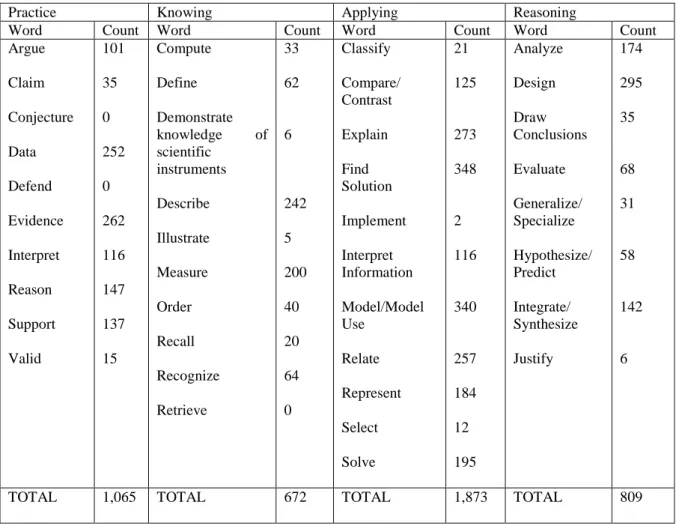
Table 1: Term Inventory across CCSSM and NGSS
Practice Knowing Applying Reasoning
Word Count Word Count Word Count Word Count
Argue Claim Conjecture Data Defend Evidence Interpret Reason Support Valid 101 35 0 252 0 262 116 147 137 15 Compute Define Demonstrate knowledge of scientific instruments Describe Illustrate Measure Order Recall Recognize Retrieve 33 62 6 242 5 200 40 20 64 0 Classify Compare/ Contrast Explain Find Solution Implement Interpret Information Model/Model Use Relate Represent Select Solve 21 125 273 348 2 116 340 257 184 12 195 Analyze Design Draw Conclusions Evaluate Generalize/ Specialize Hypothesize/ Predict Integrate/ Synthesize Justify 174 295 35 68 31 58 142 6
Phase 1
Over the course of several meetings, the research team involved with this larger study met to review and generate a list of terms selected for frequency analysis. The researchers began with brainstorming words associated with high-level cognitive demands. Following, the TIMSS cognitive domain categories and individual terms were considered for inclusion. Thirty-one terms originally associated with the TIMSS cognitive demands are categorized within the aforementioned themes of (1) Applying, (2) Reasoning, and (3) Knowing.
Additional words offered at team meetings, that were not already included in the established TIMSS categories, were placed in an fourth theme of epistemological Practice; and reasons for inclusion were based on existing literature and previous professional experience; and again, agreed upon by the members of the research team. The four themes (Applying, Reasoning, Knowing, and Practice) were then used as an organizing framework for the study. This taxonomy contained 43 total terms in the four themes. See Table 1 for a composite list of these terms.
One member of the research team utilized electronic versions of the CCSSM (National Governors Association Center for Best Practices & Council of Chief State School Officers, 2010), and the NGSS (NGSS Lead States, 2013) to take an inventory of the word counts. For each of the 43 terms, specific root word/terms were used as search items (e.g. “classif” was used for Classify to capture terms like classify, classified, classification). Once the initial counts were determined from each of the searches, efforts were made to only include terms that pertained to that requiring student action. For example, the term “support” is used in the context of a sentence like, “teachers provide support to students.” These types of occurrences were removed and not included in the word frequency inventory. These data were then organized and arranged in Microsoft Excel to help with the analysis, discussion, and interpretation of term frequencies.
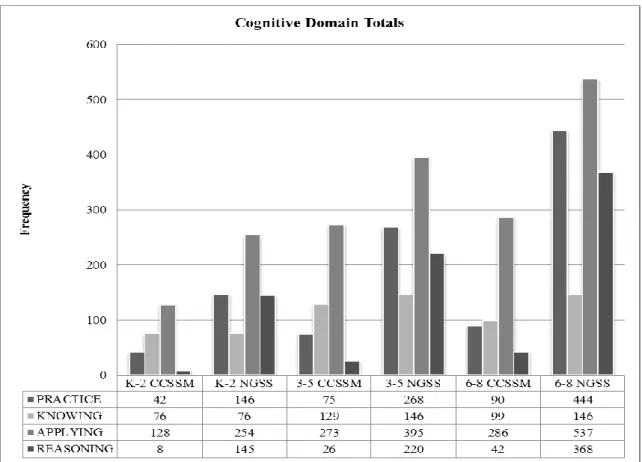
The word frequencies within each of the four themes were summed and they are reported in a table (See Table 1) and categorically depicted in a figure (see Figure 1). This table contains the total number of for each individual term across each of the three sets of standards and placed under its cognitive domain heading. Arranging the inventory this way gave the research team an indication of what types of cognitive demands are communicated as expectations, places of emphasis, and conveyed as valuable within these documents.
Phase 2
The next steps marked a second phase of the study: a phase that specifically answers the second and third research questions listed above. During this phase, some of the terms were adjusted from the original term from the TIMSS documents. For example, the term Draw Conclusions was expanded to include word counts of Draw Inferences and Draw Evidence. Where adjustments to the TIMSS’s terms were made, it was done with the consensus of the research team under the premise of working to more completely understand the intent of the standards’ expectations for student learning.
Word counts within grades were calculated and recorded during this step. The decision to break the inventory down by grade bands instead of individual grades stems from the NGSS documents. The NGSS is broadly organized in three grade bands: K-2, 3-5, 6-8. Following this arrangement, we decided to organize the data similarly. Counts were organized by cognitive domain/term/grade band in excel. Then, during a research team meeting, it was suggested that proportions of each term be calculated that compared the frequency number to the total word count (of the cognitive terms) of the specific set of standards (i.e. Synthesize count / total cognitive words in NGSS grade band K-2). The inventory of raw word counts and the count proportions were organized in Microsoft Excel tables and bar graphs. From these tables and graphs, the research team analyzed their use.
Findings
Cognitive Domain Word Frequencies across Standards
The evidence pertaining to the first research question displays a broad, overriding picture of the types of skills and language emphasized by the creators of the CCSSM and NGSS. From the term inventory (see Table 1 above), it is noted that the cognitive categories of Applying and Practice contain the highest counts of terms. There are 1,873 Applying words recorded and 1,065 Practice terms. Knowing and Reasoning have notably lower counts at 672 and 809 respectively.
From these data, it appears that the writers of the standards expect students to do more and use the content in order to produce or take action with their knowledge, rather than merely repeat, parrot, or report on their learning. For example, the frequency of terms like Model (340 times), Explain (273 times), and Evidence (262 times) show that content knowledge alone is not a sufficient level of understanding. Rather, expanding upon developing knowledge and using it appropriately are the goals in learning according to what is prevalent and emphasized in the CCSSM and NGSS.
Comparison across Standards and Grade Bands
Answering the second and third research questions required a more focused and targeted simultaneous look at the data across the standards and within the four cognitive domains. These data are displayed in the bar graphs in Figures 1-9. The CCSSM document contains nearly 1,300 of the key cognitive domain words across all grade bands (K-2 = 254; 3-5 = 503; 6-8 = 517). The NGSS document across all grade bands contains over 3,000 of these terms (K-2 = 621; 3-5 = 1,029; 6-8 = 1,495). This portion of the study provided an inventory and analyses of the 4,419 total words in mathematics and science using the TIMSS + Practice cognitive domains as the primary organizing framework. The raw counts and the proportions of each term are provided. Proportions were calculated by taking the raw count and dividing it by the total number of cognitive words per grade band in each standard set. The results from the TIMSS domains: Applying, Reasoning, and Knowing and the Practice
categories are described below.
recognize and generate equivalent fractions” (Number and Operations – Fractions 4.NF.1). Differences in expectations while using the same word to communicate meaning may pose a challenge to effective instruction, learning, and knowledge use as well as the potential for transfer.
The following portion will highlight the differences between the word choices in the CCSSM and NGSS by the four domain categories and the changes in word emphasis between and across grade bands. Due to space limitations, the findings will feature those places where there is evidence of inconsistent word counts, or notable patterns that emerged. We chose to focus our attention on those places of divergence, as they are the potential loci for misinterpretation, miscommunication, or misalignments by policy makers, assessment developers, educators, and students. The information summarizes the findings and adds specificity to the evidence provided above in order to more thoroughly address the second and third research questions. The numeric reporting provides the raw count with the proportion included in parenthesis next to the raw count number.
TIMSS Domain: Applying
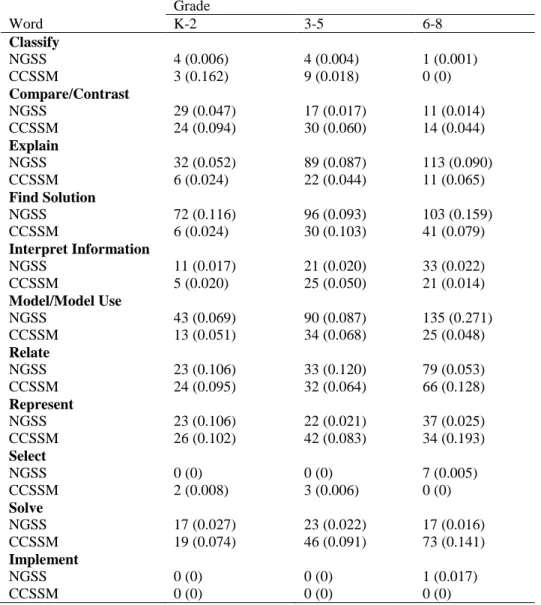
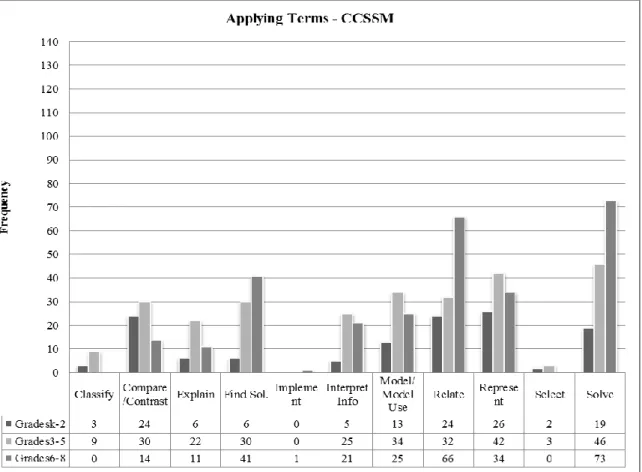
The numeric and proportional summaries of all the terms in this domain can be found in Table 2. An aggregated bar graph for the terms in this domain can be found in Figures 2 and 3. Three of the twelve Applying terms are consistently used in the standards across grade bands and are similarly emphasized in both the CCSSM and NGSS. These terms include: Classify, Select, and Implement.
Table 2: Applying Word Inventory-Raw (Proportion)
Grade
Word K-2 3-5 6-8
Classify
NGSS 4 (0.006) 4 (0.004) 1 (0.001)
CCSSM 3 (0.162) 9 (0.018) 0 (0)
Compare/Contrast
NGSS 29 (0.047) 17 (0.017) 11 (0.014)
CCSSM 24 (0.094) 30 (0.060) 14 (0.044)
Explain
NGSS 32 (0.052) 89 (0.087) 113 (0.090)
CCSSM 6 (0.024) 22 (0.044) 11 (0.065)
Find Solution
NGSS 72 (0.116) 96 (0.093) 103 (0.159)
CCSSM 6 (0.024) 30 (0.103) 41 (0.079)
Interpret Information
NGSS 11 (0.017) 21 (0.020) 33 (0.022)
CCSSM 5 (0.020) 25 (0.050) 21 (0.014)
Model/Model Use
NGSS 43 (0.069) 90 (0.087) 135 (0.271)
CCSSM 13 (0.051) 34 (0.068) 25 (0.048)
Relate
NGSS 23 (0.106) 33 (0.120) 79 (0.053)
CCSSM 24 (0.095) 32 (0.064) 66 (0.128)
Represent
NGSS 23 (0.106) 22 (0.021) 37 (0.025)
CCSSM 26 (0.102) 42 (0.083) 34 (0.193)
Select
NGSS 0 (0) 0 (0) 7 (0.005)
CCSSM 2 (0.008) 3 (0.006) 0 (0)
Solve
NGSS 17 (0.027) 23 (0.022) 17 (0.016)
CCSSM 19 (0.074) 46 (0.091) 73 (0.141)
Implement
NGSS 0 (0) 0 (0) 1 (0.017)
Figure 2. Terms in Applying Category of NGSS
Several terms (Explain, Interpret Information, Model/Model Use, Solve and Find Solution) generally increase as the grade bands increase. However, the term Compare/Contrast is actually mentioned less often in the 6-8 grade band than in the K-2 grade band both in the NGSS and the CCSSM. The use of the Compare/Contrast does increase in in the CCSSM from 24 mentions (9.4%) in the K-2 band, to 30 times (6%) grades 3-5 band but then drops back down in grades 6-8 with 14 mentions (4.4%).
Similarly, this pattern is also found with the word Explain in the CCSSM where the word counts start at 6 (2.4%), jump to 22 (4.4%), and then drop down to 11 (6.5%). The term is emphasized more often in the NGSS. The K-2 band contains 32 (5.2%) uses of the term, the 3-5 band contains 89 (8.7%) uses, and then in the 6-8 band students are asked to Explain 113 (9%) different times. Surprisingly, Find Solution is mentioned more often in the science standards than in the mathematics standards. In the CCSSM, this term is included 77 different times and 271 times in NGSS.
Students are expected to Interpret Information in both sets of content standards. The expectation for students to Interpret Information increases with the grade levels but is given greater priority in the CCSSM. The three grade bands in NGSS use this term 11 (4.3%) in the K-2 band, 21 (2%) in the 3-5 band, then 33 (2.2%) times in the 6-8 band. The term, in the CCSSM, was counted 5 (2%) times in the K-2 band, 25 (5%) times in the 3-5 band, then 21 (1.4%) times in the 6-8 band.
The terms Model and Model Use were both assigned the same word count. The reason behind this decision is that the definitions and expectations across disciplines seem to mean different things as described earlier and it was not in the scope of this particular paper to analyze and determine each definition of the term and compare its varying use within the two different sets of standards. Therefore, these terms are bundled and presented together. Model/Model Use is emphasized more so in NGSS than in CCSSM. At the K-2 level, the NGSS contains 43 (6.9%) references compared to the CCSSM’s count of 13 (5.1%). The 3-5 level also shows a disparity with 90 (8.7%) references in the NGSS and just 34 (6.8%) mentions in the CCSSM. The most advanced 6-8 grade level mentions Model/Model Use 135 (9%) times in the NGSS but only 25 (4.8%) times in the CCSSM.
The word Relate is referenced in CCSSM 24 (9.5%), 32 (6.4%), and 66 (5.5%) times in the K-2, 3-5, and 6-8 grade bands respectively. The NGSS has an initial count of 24 (9.5%) times in the K-2 band, increases to 32 (6.4%) in the 3-5 band, and then rises to 66 (12.8%) references in the 6-8 band. Represent shows some relative consistency between the two standards but they diverge in the middle, 3-5, grade band. Overall, the term Represent is mentioned 20 fewer times in NGSS with 82 mentions than in the CCSSM with 102 times. Lastly, the term Solve has a symmetrical curve of number of uses in NGSS with a progression of 17 (2.7%), 23 (2.2%), 17 (1.6%), but makes a steady rise in frequency in the CCSSM starting at 19 (7.4%) mentions in the K-2 band, increases to 46 (9.1%) mentions in the 3-5 band, then up to 73 (14.1%) times in grade band 6-8.
TIMSS Domain: Reasoning
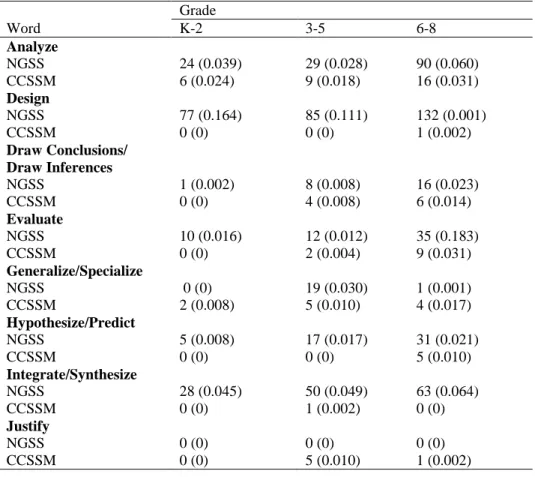
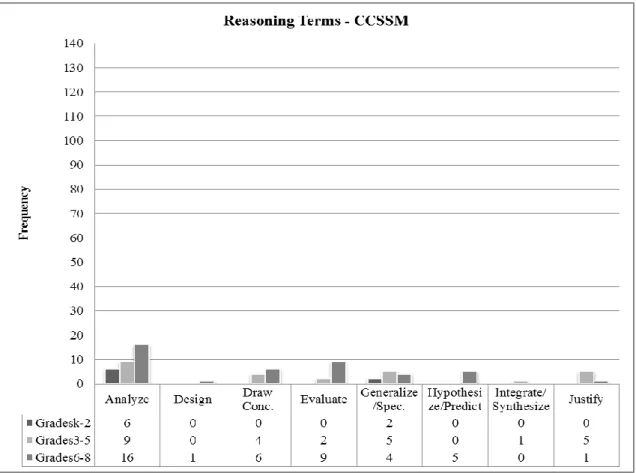
The numeric and proportional summaries of all the terms in the Reasoning domain can be found in Table 3. An aggregated bar graph for the terms in this domain can be found in Figures 4 and 5. Of the terms in the
Reasoning category, the terms Draw Inferences and Draw Conclusions were combined as they provided a more detailed depiction of how students use information in inductive and deductive ways in addition to Draw Conclusions. Two of the ten terms within this domain (Draw Conclusions and Justify) are consistently used in the standards across grade bands and are similarly emphasized in both NGSS and CCSSM.
Analyze is referenced in both NGSS and CCSSM but the emphasis lies more heavily in NGSS. The term is used 24 (3.9%) times in the K-2 band, 29 (2.8%) times in the 3-5 band, then spikes to 90 (6%) uses in the 6-8 grade band. The most prevalent use of Analyze in CCSSM is in the 6-8 grade band with 16 (3.1%) mentions. Analyze is used 6 (2.4%) and 9 (1.8%) times in the K-2 and 3-5 band respectively.
Table 3: Reasoning Word Inventory- Raw (Prop.)
Grade
Word K-2 3-5 6-8
Analyze
NGSS 24 (0.039) 29 (0.028) 90 (0.060)
CCSSM 6 (0.024) 9 (0.018) 16 (0.031)
Design
NGSS 77 (0.164) 85 (0.111) 132 (0.001)
CCSSM 0 (0) 0 (0) 1 (0.002)
Draw Conclusions/ Draw Inferences
NGSS 1 (0.002) 8 (0.008) 16 (0.023)
CCSSM 0 (0) 4 (0.008) 6 (0.014)
Evaluate
NGSS 10 (0.016) 12 (0.012) 35 (0.183)
CCSSM 0 (0) 2 (0.004) 9 (0.031)
Generalize/Specialize
NGSS 0 (0) 19 (0.030) 1 (0.001)
CCSSM 2 (0.008) 5 (0.010) 4 (0.017)
Hypothesize/Predict
NGSS 5 (0.008) 17 (0.017) 31 (0.021)
CCSSM 0 (0) 0 (0) 5 (0.010)
Integrate/Synthesize
NGSS 28 (0.045) 50 (0.049) 63 (0.064)
CCSSM 0 (0) 1 (0.002) 0 (0)
Justify
NGSS 0 (0) 0 (0) 0 (0)
CCSSM 0 (0) 5 (0.010) 1 (0.002)
Figure 5. Terms in Reasoning Category of CCSSM
Generalize/Specialize shows inconsistent emphasis between the two standards and across the NGSS. The term is used 0 times in K-2, 19 times (3%) in 3-5, and then only 1 time (0.1%) in 6-8. In the CCSS it is used 2 (0.8%), 5 (1%), then 4 (1.7%) times as the grade bands increase. The expectation that students will Draw Inferences, although not heavily underscored in either set of standards, increases differently between them. It is used in NGSS 1 (0.2%) time in the K-2 grade band, 8 (.8%) times in 3-5 band, and 16 (1.1%) times in the 6-8 band. In the CCSSM, the term is not used at all in K-2, 4 times (0.8%) in 3-5 and in grade band 6-8 the term appears 6 (1.4%) separate times.
Evaluate is more consistently found in the NGSS grade bands with counts 10 (1.6%) (K-2), 12 (1.2%) (3-5), and 35 (2.3%) (6-8), but in CCSSM Evaluate increases across the bands at 0 (K-2), 2 (0.03%) (3-5), then 9 (0.11%) (6-8). Next, the Hypothesize/Predict combination term is, perhaps unsurprisingly, only mentioned 5 times in the CCSSM but is used 53 total times across the grade bands in the NGSS. In the same way, there is 141 uses of the combination term Integrate/Synthesize in NGSS, but is only given a one-time mention in CCSSM.
TIMSS Domain: Knowing
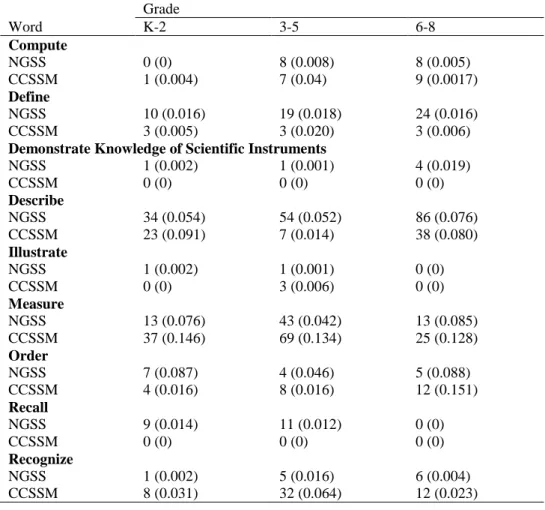
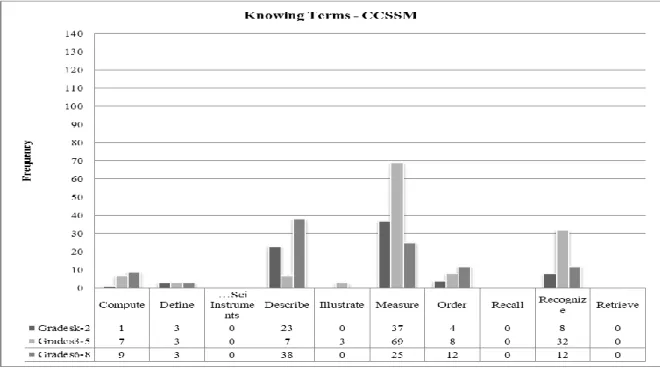
The numeric and proportional summaries of all the terms in the Knowing domain can be found in Table 4. An aggregated bar graph for the terms in this domain can be found in Figures 6 and 7. Four of the ten terms within this domain are consistently used in the standards across grade bands and are similarly emphasized in both NGSS and CCSSM. These terms include: Compute, Demonstrate Knowledge of Scientific Instruments, Illustrate, and Order. The data from the remaining terms’ word inventory reveal either inconsistencies or other notable patterns.
Table 4: Knowing Word Inventory-Raw (Proportion)
Grade
Word K-2 3-5 6-8
Compute
NGSS 0 (0) 8 (0.008) 8 (0.005)
CCSSM 1 (0.004) 7 (0.04) 9 (0.0017)
Define
NGSS 10 (0.016) 19 (0.018) 24 (0.016)
CCSSM 3 (0.005) 3 (0.020) 3 (0.006)
Demonstrate Knowledge of Scientific Instruments
NGSS 1 (0.002) 1 (0.001) 4 (0.019)
CCSSM 0 (0) 0 (0) 0 (0)
Describe
NGSS 34 (0.054) 54 (0.052) 86 (0.076)
CCSSM 23 (0.091) 7 (0.014) 38 (0.080)
Illustrate
NGSS 1 (0.002) 1 (0.001) 0 (0)
CCSSM 0 (0) 3 (0.006) 0 (0)
Measure
NGSS 13 (0.076) 43 (0.042) 13 (0.085)
CCSSM 37 (0.146) 69 (0.134) 25 (0.128)
Order
NGSS 7 (0.087) 4 (0.046) 5 (0.088)
CCSSM 4 (0.016) 8 (0.016) 12 (0.151)
Recall
NGSS 9 (0.014) 11 (0.012) 0 (0)
CCSSM 0 (0) 0 (0) 0 (0)
Recognize
NGSS 1 (0.002) 5 (0.016) 6 (0.004)
CCSSM 8 (0.031) 32 (0.064) 12 (0.023)
Figure 7. Terms in Knowing Category of CCSSM
The word Describe is one of the most commonly used terms in the Knowing domain. Within NGSS there is a steady increase as the grade bands progress with 34 (5.4%) mentions in K-2, 54 (5.2%) mentions in 3-5, and 86 (7.6%) mentions in the grades 6-8. Within the CCSSM, Describe is emphasized more so in the K-2 and 6-8 grade bands with 23 (9.1%) and 38 (8%) mentions respectively. A dip in the middle is observed where term is only referenced 7 (1.4%) times in the 3-5 grade band.
Table 5: Practice Word Inventory-Raw (Proportions)
Grade
Word K-2 3-5 6-8
Argue
NGSS 10 (0.016) 29 (0.028) 50 (0.033)
CCSSM 3 (0.012) 4 (0.008) 5 (0.010)
Claim
NGSS 2 (0.003) 5 (0.005) 28 (0.052)
CCSSM 0 (0) 0 (0) 0 (0)
Data
NGSS 41(0.006) 53 (0.052) 91 (0.06)
CCSSM 14 (0.055) 17 (0.034) 36 (0.079)
Evidence
NGSS 50 (0.081) 93 (0.090) 118 (0.079)
CCSSM 0 (0) 0 (0) 1 (0.002)
Interpret
NGSS 11 (0.098) 21 (0.020) 33 (0.022)
CCSSM 5 (0.020) 25 (0.050) 21 (0.0041)
Reason
NGSS 17 (0.126) 29 (0.028) 32 (0.014)
CCSSM 19 (0.075) 26 (0.051) 24 (0.046)
Support
NGSS 15 (0.150) 38 (0.065) 82 (0.076)
CCSSM 1 (0.004) 0 (0) 1 (0.002)
Valid
NGSS 0 (0) 0 (0) 10 (0.007)
CCSSM 0 (0) 3 (0.006) 2 (0.004)
CCSSM’s K-2 grade band 8 times (3.1%), but jumps to 32 (6.4%) mentions in the 3-5 band, and then drops down to only 12 (2.3%) references in the 6-8 grade band.
Additional Domain: Practice
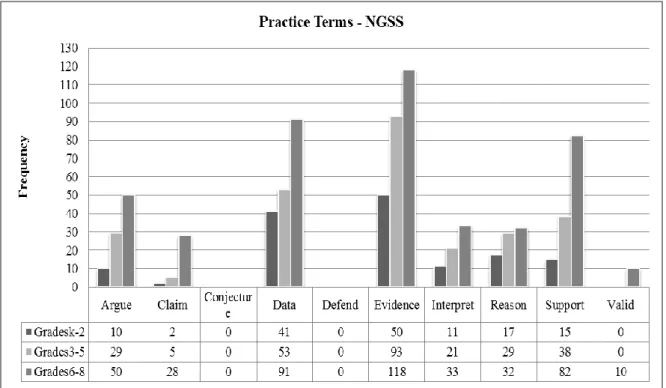
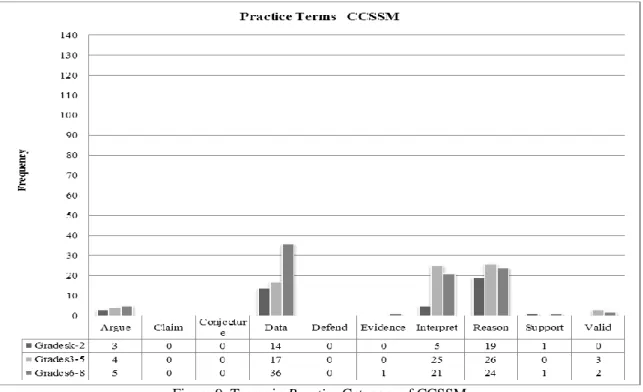
The numeric and proportional summaries of all the terms in the Practice domain can be found in Table 5. An aggregated bar graph for the terms in this domain can be found in Figures 8 and 9. The terms Interpret and Reason are emphasized consistently throughout the grade bands and between the standards.
Figure 8. Terms in Practice Category of NGSS
The term Argue is more noticeable in its increase across grade levels in the NGSS than in CCSSM. In NGSS, Argue is referenced 10 (1.6%) times in K-2, 29 (2.8%) times in 3-5, then 50 (3.3%) times in the 6-8 grade band. In CCSSM, this same word is mentioned 3 (1.2%), only 4 (0.8%), then 5 (1%) times as the grade bands increase indicating little emphasis on the term Argue in this document. Claim, not mentioned even once in CCSSM, is used 2 (0.3%) times in the earliest grade band, only 5 (0.5%) times in the middle grade band, and then is used 28 (5.2%) times in the oldest grade band.
The term Data by the raw counts increase in both NGSS and CCSSM as the grade levels increase but NGSS includes greater numbers of references. It is noted that the proportional comparison makes this pattern look curved rather than a linear increase for CCSSM. In NGSS, the K-2 band contains the term 41 (0.6%) times. The 3-5 band contains the term 53 (5.2%) times. The 6-8 band contains the term 91 (6%) times. The term, in CCSSM is used 14 (5.5%) times in the K-2 grade band, 17 (3.4%) in the 3-5 grade band, and 36 (7.9%) times in the 6-8 grade band. The next term, Evidence, is emphasized in dramatically different ways between the two sets of standards. It is mentioned 1 time total in the CCSSM 6-8 grade band. Whereas in NGSS, it is used 50 (8.1%) times in K-2, 93 (9%) times in 3-5, and 118 (7.9%) times in 6-8.
Figure 9. Terms in Practice Category of CCSSM
The last term in the Practice domain is Valid. Although there is relative consistency in emphasis given to this term both between standards and across grade bands, it is interesting that this term does not show up at all in NGSS until the 6-8 grade band where it is used 10 (0.7%) times. In the CCSSM, this same term is also not seen in the K-2 band but is used in the 3-5 band with 3 (0.6%) mentions, then 2 (0.4%) uses in the 6-8 grade band.
Discussion and Implications
In addition to the inventory work by Assefa and Rorissa (2013) and Adualrob and Daniel (2013), the current study contributes to the field as it presents a typology for term analysis and subsequent findings within a terminology inventory. The findings indicate that there are numerous places where common terminology is aligned and used similarly both across grade bands and between the sets of standards. Conversely, many other terms within the four categories are used with varying degrees of emphasis both across grade bands and/or between the standards.
The different TIMSS domains: Knowing, Applying, and Reasoning plus the additional Practice domain serves as the organizing framework to guide terminology inventory and analysis of content expectations across the CCSSM and the NGSS. The standards, because they are so widely used in schools, offer a platform from which to facilitate the practice and potential transfer of learning. The occasions where the terminology is consistent between the standards and across grade bands could be opportunities where the transfer of learning organically manifests and the epistemological practices are starting to become what Hammer and colleagues (2005) refer to as routine; whereas the places where the terminology is either inconsistent in emphasis or where the definitions and intentions vary may make transfer of learning more difficult simply because of the barriers created by the choice of particular words.
doing what one knows. That means demonstrating one’s learning in performance” (p. 362). For instance, within the counts for the eights terms in the Reasoning domain, the most emphasized word is Design.
Some of the words within the previously established TIMSS cognitive themes have weak or little representation in the CCSSM and NGSS. The TIMSS is regarded as a significant body of work and thus it is puzzling that key terms germane to the TIMSS are not given more attention in the CCSSM or the NGSS documents. More research examining the inconsistencies between the TIMSS and the content standards in the U.S. would help tease out and clarify this issue. The twelve terms in the Applying domain are seen more frequently than those words contained in the other three domains. A similar pattern to what was referenced above – that the overall emphasis in the standards is that students apply or utilize their learning in effective and appropriate contexts. The attention dedicated to the Applying domain may hold implications for the transfer of learning across the mathematics and science disciplines as the previous research in this area have already begun to show. Applying
students’ knowledge in various ways is expected in both the mathematics and science arenas.
The overall word counts in the Reasoning domain are emphasized less than those in the domain of Applying. A concern articulated earlier arises again, as what is emphasized in TIMSS versus what is emphasized in the
Reasoning category of terms in CCSSM and NGSS is inconsistent. The data from the terms under the Practice
domain indicate that the NGSS emphasizes the terms Argue, Data, Evidence, and Support more so than CCSSM. This is probably unsurprising given the nature of scientific practice and the field’s expectations of what students of science should be able to do. A similar emphasis on these terms may hold implications for practices that likely go together. For example, how are the terms Data and Evidence used differently? Are they actually referencing the same thing with simply a different word choice? Further examination in this area may offer additional insight.
Across grade bands, there are more places where the word counts are inconsistent. Only three of the twelve
Applying terms are consistently seen in the standards across grade bands and are similarly emphasized in both the NGSS and the CCSSM. Only three of the ten terms within this domain are both consistently used across grade bands and are also similarly emphasized in the CCSSM and NGSS. In addition, only four of the 10 terms within this domain are regularly used in the standards across grade bands and are similarly emphasized in both NGSS and CCSSM. Future research could examine these irregularities to determine if the changes in term emphasis are due to cognitive development or something else.
A critical finding from these data is that the difference in expectations while using the same term in CCSSM and NGSS hold the potential for confusion or misinterpretation. Although not within the scope of this study, similar meanings and expectations that are attached to different word choices may be present within the standards but not accounted for as those specific words were not included in the 4-themed typology of the TIMSS + Practice
used here. For the classroom teachers working to implement the standards with fidelity, we posit that most will or need to undergo a shift in the conceptual understanding and pedagogical approach to instruction and assessment of student progress in mathematics and science instruction. If students are invited to utilize their learning within a particular context, or discipline, and the classroom teacher deliberately creates a space to practice this application, might it then follow that the teacher could also design instruction in a way to facilitate transfer of learning to new contexts as previous research by Schwartz, Bransford, & Sears (2005) suggests? The transfer of skills and knowledge between disciplines is a viable goal of education. As educators, we want students to be able to use and apply their learning not only in the limited context of where they first encountered new information or skills, but also to be able to successfully employ them to appropriate contexts outside the original setting. Can this happen only if the documents are aligned with research in learning and cognitive development and aligned with each other?
Although Appendix A in the NGSS materials state that the science standards are aligned with the CCSSM, there are different places where the documents are asking students to engage in different cognitively demanding tasks. Should the standards, if they are aligned with each other and with what is developmentally appropriate, require students to meet similar objectives and engage in similar practices at the same stages of their schooling? In several places, they do not. For example, the CCSSM contains 8 Reasoning terms in K-2 but this same age group is asked to engage in the Reasoning domain 146 times in NGSS and 42 times in math in grades 6-8 but 368 times in science. We found these discrepancies interesting especially since existing research (e.g. Brogt et al., 2013; Frykholm & Glasson, 2005; Pang & Good, 2000) show the natural opportunities for and occurrences of transfer across mathematics and science learning.
us asking questions such as: What are those things educators and curriculum policy makers need to be mindful of in regards to learning, teaching, and the promotion of instructional approaches that effectively support these differences in terminology use? Or what are those things educators and curriculum policy makers need to be mindful of in regards to the variances in cognitive expectations within the three grade bands? These are especially pertinent since elementary students are typically in the same classroom and taught by the same teacher regardless of the subject.
It follows that a significant challenge remains, which begs further examination in this area. The CCSSM and NGSS do not provide meanings for the terms they ask students to be able to do. Therefore, there is an assumption, by the creators of all the standards, that all educators will interpret the words the same way. Elementary teachers are primarily generalists, and because the same terms are found both in the CCSSM and NGSS, it is likely that the same definition and expectation will be tied to both. As research in the areas of mathematics and science education show, there are specific ways of operating and communicating in these distinct disciplines. Without supplementary materials to accompany CCSSM and NGSS, a potential for misinterpretation and following, miscommunication is perpetuated. Research about field expectations of particular words in the standards would help address this disparity.
As principals, teachers, and other stakeholders deepen their understanding of the standards’ expectations and transfer of learning, in the current accountability era, the instructional changes and facilitation of these changes may more effectively serve as a tool for “new ways of thinking about transfer suggest new ways of thinking about assessments, and that working smart assessments are one example of a different paradigm that could have major effects on education and accountability” (Schwarts et al., 2005, p. 45). The inventory of words across the CCSSM and NGSS indicated that there are similar uses of language across the standards but notable differences in particular terms are also present and are thus in need of particular attention. These differences in specific use of terminology may stem from discipline, or field-specific, expectations for performance and learning. A problem arises if these differences are not recognized and adjusted for in pedagogy and practice. Because policy makers, school leaders, and other stakeholders promote and package the STEM fields as a holistic subject, these variable meanings and/or expectations reveal the potential for misguided expectations within the classroom as students, teachers, and principals use the same terminology in multiple, but distinct contexts.
As students navigate through the different disciplines, and classroom teachers adjust their instruction according to discipline, the recognition of the potential connections and places of diversion between science and mathematics can impact the decision making around instruction. Literature surrounding the CCSSM and the NGSS reveals that the adoption of the standards requires pedagogical understanding (Pratt, 2012; Pruitt, 2014; Wu, 2014) and capacity building (Darling-Hammond, Wilhoit, & Pittenger, 2014) for those educators charged with implementing them. Deepening the familiarity of the content standards may help teachers and school leaders make informed curricular and instructional decisions. Notably, “teachers should use practices true to the NGSS and diverse instructional strategies, drawing upon literacy and mathematical practices outlined in the Common Core State Standards (CCSSM) to reinforce the interconnected nature of science with other content areas” (Chiu et al., 2015, p. 11). An examination of the terminology is a worthwhile line of research since recognizing specific language connections across the standards could reveal relationships between and within disciplines.
The findings in this inventory and analysis may have particular relevance for those sites that adopt the CCSSM and NGSS and those that prioritize STEM education as the data reveal the emphasis of particular skills and expectations within student learning. Although this research prompts more questions for us in this line of research, we believe there are some notable takeaways from this work. From the data presented here, these findings hold implications for (1) future policy and curriculum analyses regarding the alignment of standards across disciplines; (2) future policy analysis regarding the alignment of assessments to these particular content expectation emphases; (3) the necessary capacity building for teachers and instructional leaders alike; (4) the exploration of the transfer of cognitive skills across disciplines; and (5) the evolution of epistemological to ontological practices and how this can be supported for students and how these practices will impact future curriculum policy decisions.
References
Curriculum. International Journal of Science Education, 35, 2538-2558. doi:10.1080/09500693.2011.610381
Academic Benchmarks. (2015). Next Generation Science Standards adoption map. Retrieved from http://academicbenchmarks.com/next-generation-science-standards-adoption-map/
Achieve. (2013). Science education in the 21st century: Why the K-12 science standards matter – and why the time is right to develop Next Generation Science Standards. Next Generation Science Standards.
Retrieved from www.nextgenscience.org
Achieve. (2015). Standards in your state. Common Core State Standards Initiative. Retrieved from www.corestandards.org
Assefa, S. G., & Rorissa, A. (2013). A bibliometric mapping of the structure of STEM education using co-word analysis. Journal of the American Society for Information Science and Technology, 64, 2513-2536. doi:10.1002/asi
Bassok, M., & Holyoak, K. J. (1989). Interdomain transfer between isomorphic topics in algebra and physics.
Journal of Experimental Psychology: Learning, Memory, and Cognition, 15, 153-166.
Breiner, J. M., Harkness, S. S., Johnson, C. C., & Koehler, C. M. (2012). What is STEM? A discussion about the conceptions of STEM in education and partnerships. School Science and Mathematics, 112, 3-11. doi:10.1111/j.1949-8594.2011.00109.x
Brogt, E., Soutter, A., Masters, S., & Lawson, W. (2014). Teaching for numeracy and mathematics transfer in tertiary science. AKI AOTEAROA. Retrieved from http://ir.canterbury.ac.nz/handle/10092/9502
Brown, M. W. (2011). The teacher–tool relationship: Theorizing the design and use of curriculum materials. In J. T. Remillard, B. A. Herbel-Eisenmann, & G. M. Llyod (Eds.), Mathematics teachers at work: Connecting curriculum materials and classroom instruction, 17-36. Retrieved from https://books-google-com.proxy.lib.uiowa.edu/books
Cavagnetto, A. R.(2010). Argument to foster scientific literacy: A review of argument interventions in K-12 science contexts. Review of Educational Research, 80, 336-371. doi:10.3102/0034654310376953 Chiu, A., Price, C. A., & Ovrahim, E. (2015). Supporting elementary and middle school STEM education at the
whole school level: A review of the literature. Paper presented at NARST 2015 Annual Conference. Retrieved from www.msichicago.org
Cobb, P., Boufi, A., McClain, K., & Whitenack, J. (1997). Reflective discourse and collective reflection.
Journal for Research in Mathematics Education, 28, 258-277. doi:10.2307/749781
Darling-Hammond, L., Wilhoit, G., & Pittenger, L. (2014). Accountability for college and career readiness: Developing a new paradigm. Education Policy Analysis Archives, 22(86), 1-38. doi: http://dx.doi.org/10.14507/epaa.v22n86.2014
diSessa A. A., & Wagner, J. F. (2005). What coordination has to say about transfer. In J. P. Mestre (Ed.),
Transfer of learning from a modern multidisciplinary perspective (pp. 121-154). Greenwich, CT: Information Age.
Dufresne, R., Mestre, J., Thaden-Koch, T., Gerace, W., & Leonard, W. (2005). Knowledge representation and coordination in the transfer process. In J. P. Mestre (Ed.), Transfer of learning from a modern multidisciplinary perspective (pp. 155-215). Greenwich, CT: Information Age.
Frykholm, J., & Glasson, G. (2005). Connecting science and mathematics instruction: Pedagogical context knowledge for teachers. School Science and Mathematics, 15 , 127-141. doi:10.1111/j.1949-8594.2005.tb18047.x
Glaser, R. (1984). Education and thinking: The role of knowledge. American Psychologist, 39, 93-104. doi:http://dx.doi.org/10.1037//0003-066X.39.2.93
Hakel, M. D., & Halpern, D. F. (2005). How far can transfer go? Making transfer happen across physical, temporal, and conceptual space. In J. P. Mestre (Ed.), Transfer of learning from a modern multidisciplinary perspective (vii-xxvi). Greenwich, CT: Information Age.
Hammer, D., Elby, A., Scherr, R. E., & Redish, E. F. (2005). Resources, framing, and transfer. In J. P. Mestre (Ed.), Transfer of learning from a modern multidisciplinary perspective (pp. 121-154). Greenwich, CT: Information Age.
Heitin, L. (2015). Districts out ahead of states in adopting science standards. Education Week, 34(29). Retrieved from http://www.edweek.org/ew/articles/2015/05/06/districts-out-ahead-of-states-in-adopting.html?qs=Districts+out+ahead+of+states+in+adopting+science+standards
Hickey, D., & Pellegrino, J. W. (2005). Theory, level, and function. In J. P. Mestre (Ed.), Transfer of learning from a modern multidisciplinary perspective (251-293). Greenwich, CT: Information Age.
Hoban, R. A., Finlayson, O. E., & Nolan, B. C. (2013). Transfer in chemistry: A study of students’ abilities in transferring mathematical knowledge to chemistry. International Journal of Mathematical Education in Science and Technology, 44, 14-35. doi:http://dx.doi/org/10.1080/0020739X.2012.69089
Kesidou, S., & Roseman, J. E. (2002). How well do middle school science programs measure up? Findings from Project 2061’s Curriculum Review. Journal of Research in Science Teaching, 39, 522-549. doi:10.1002/tea.10035
Kiray, S.A. (2012). A new model for the integration of science and mathematics: The balance model. Energy Education Science and Technology Part B: Social and Educational Studies, 4(3), 1181-1196.
Lawson, A. E. (1985). A review of research on formal reasoning and science teaching. Journal of Research in Science Teaching,22, 569-617. doi:http://dx.doi.org/10.1002/tea.3660220702
Lee, O., Quinn, H., & Valdés, G. (2013). Science and language for English language learners in relation to Next Generation Science Standards and with implications for Common Core State Standards for English language arts and mathematics. Educational Researcher, 42, 223-233.
Lunenberg, F. C., & Ornstein, A. C. (2012). Educational administration: Concepts and practices (6th ed.). Belmont, CA: Wadsworth.
Marrongelle, K.A. (2010). How students use physics to reason about calculus tasks. School Science and Mathematics, 104, 258-272. doi: 10.1111/j/1949-8594.2004.tb17997.x
Mayer, D., Sodian, B., Koeber, S., & Schwippert, K. (2014). Scientific reasoning in elementary school children: Assessment and relations with cognitive abilities. Learning and Instruction, 29, 43-55. doi:http://dx.doi.org/10.1016/j.learninstruc.2013.07.005
National Research Council. (1996). National Science Education Standards. Washington, D. C.: National Academic Press.
National Governors Association Center for Best Practices, & Council of Chief State School Officers. (2010).
Common Core State Standards for mathematics: Kindergarten introduction. Retrieved from www.corestandards.org
NGSS Lead States. (2013). Next Generation Science Standards: For States, By States. Washington, D.C.: The National Academies Press.
No Child Left Behind (NCLB). (2002). Act of 2001, Pub. L. No. 107-110, § 115, Stat. 1425.
Pang, J., & Good, R. (2000), A Review of the Integration of Science and Mathematics: Implications for Further Research. School Science and Mathematics, 100: 73–82. doi: 10.1111/j.1949-8594.2000.tb17239.x Phillips, V., & Wong, C. (2010). Tying together the common core of standards, instruction, and assessments.
Phi Delta Kappan, 91(5), 37-42. doi:http://dx.doi.org/10.1177/003172171009100511
Potgieter, M., Harding, A., Engelbrecht, J. (2008). Transfer of algebraic and graphical thinking between mathematics and chemistry. Journal of Research in Science Teaching, 45, 197-218. doi:10.1002/tea.20208
Pratt, H. (2012). The NSTA Reader’s Guide to a Framework for K-12 Science Education, Arlington, VA: NSTA Press.
Pruitt, S. L. (2014). The Next Generation Science Standards: The features and challenges. Journal of Science Teacher Education, 25, 145-156. doi:10.1007/s10972-014-9385-0
Remillard, J. T., & Bryans, M. B. (2004). Teacheres’ orientations toward mathematics curriculum materials: Implications for teacher learning. Journal for Research in Mathematics Education, 35, 352-388. doi:10.2307/30034820
Royer, J., M., Mestre, J. P., & Dufresne, R. J. (2005). Framing the transfer problem. In J. P. Mestre (Ed.),
Transfer of learning from a modern multidisciplinary perspective (vii-xxvi). Greenwich, CT: Information Age.
Schwartz, D. L., Bransford, J. D., & Sears, D. (2005). Efficiency and innovation in transfer. In J. P. Mestre (Ed.), Transfer of learning from a modern multidisciplinary perspective (1-51). Greenwich, CT: Information Age.
Thompson, S. (2006). Australian students achievement in the TIMSS 2002 mathematics cognitive domains. Australian Council for Educational Research. Retrieved from http://research.acer.edu.au/timss/monographs/2
Truxaw, M. P., & DeFranco, T. (2008). Mapping mathematics classroom discourse and its implications for models of teaching. Journal for Research in Mathematics Education, 39(5), 489-525.
U.S. Department of Education (n.d.a). Program for International Student Assessment (PISA). Institute of Education Sciences: National Center for Education Statistics. Retrieved from https://nces.ed.gov/surveys/pisa/
U.S. Department of Education (n.d.b). Trends in International Mathematics and Science Study (TIMSS).
Institute of Education Sciences: National Center for Education Statistics. Retrieved from https://nces.ed.gov/TIMSS/
Wu, H. (2014). Potential impact of the Common Core Mathematics State Standards on the American curriculum. In Li & Lappan (eds.), Mathematics Curriculum in School Education (pp. 119-142). Retrieved from https://math.berkeley.edu/~wu/Common_Core_on_Curriculum_1.pdf
Author Information
Kathleen M. Winn University of Iowa
N491 Lindquist Center Iowa City, IA 52242, U.S.A. Contact e-mail: [email protected]
Kyong Mi Choi Kyong Mi Choi University of Iowa
Lindquist Center Iowa City, IA 52242, U.S.A.
Brian Hand University of Iowa