ORIGINAL RESEARCH ARTICLE
A review study of photovoltaic array
maximum power tracking algorithms
Hala J. El‑Khozondar
1*, Rifa J. El‑Khozondar
2, Khaled Matter
1and Teuvo Suntio
3Abstract
There are numerous maximum power point tracking (MPPT) algorithms for improving the energy efficiency of solar
photovoltaic (PV) systems. The main differences between these algorithms are digital or analog implementation,
simplicity of the design, sensor requirements, convergence speed, range of effectiveness, as well as hardware costs.
Therefore, choosing the right algorithm is very important to the users, because it affects the electrical efficiency of PV
system and reduces the costs by decreasing the number of solar panels needed to get the desired power. This paper
provides the comparison of 62 different techniques used in tracking the maximum power based on literature survey.
This paper is intended to be a reference for PV systems users.
Keywords:
Maximum power point tracking system (MPPT), Photovoltaic (PV), System efficiency
© 2016 El‑Khozondar et al. This article is distributed under the terms of the Creative Commons Attribution 4.0 International License (http://creativecommons.org/licenses/by/4.0/), which permits unrestricted use, distribution, and reproduction in any medium, provided you give appropriate credit to the original author(s) and the source, provide a link to the Creative Commons license, and indicate if changes were made.
Background
Recently, renewable energy technology has been swiftly
developed where it has an important role in clean energy
application. An important type of renewable energy is
solar energy that produces electrical energy directly using
PV modules supported by MPPT algorithm to maximize
the output power. The objective of obtaining MPP in PV
systems is to regulate the actual operating voltage of PV
panels to the voltage at MPP, by adjusting the output
power of the inverter (Libo et al.
2007
).
In literature, there are plentiful MPPT methods as in
(Esram and Chapman
2007
; Ali et al.
2012
; Jusoh et al.
2014
; Kamarzaman and Tan
2014
; Liu et al.
2015
; Lyden
and Haque
2015
). Kamarzaman and Tan (
2014
) used four
categories to review MPPT algorithms as follows:
con-ventional MPPT algorithms (perturb and observation
P&O and incremental conductance IC); hill-climbing
(open circuit voltage and short circuit current); ripple
correlation current; and stochastic-based MPPT
algo-rithms (particle swarm optimization, fuzzy logic
control-ler, artificial neural network, and differential evolution).
Liu et al. (
2015
) gave a review of MPPT techniques for
use in partially shaded conditions. Lyden et al. (
2015
)
divided the tracking techniques to three types:
conven-tional MPPT techniques, global MPPT techniques, and
power electronics-based approaches.
This paper presents a brief comparison between
dif-ferent techniques to help the users to choose an MPPT
technique for a particular application. The comparison
between the MPPT methods includes cost, analog or
digital implementation, sensor dependence, convergence
speed, hardware complexity, and effectiveness.
Second section illustrates the statement of the
prob-lem. Comparison between different MPPT techniques is
given in third section. In fourth section, the methodology
is presented followed by the fifth section in which results
are introduced and three most popular algorithms are
presented. Finally, the conclusion is presented in the last
section.
Statement of the problem
In medium- and large-scale systems, sun tracking or
MPPT or both are used to obtain maximum power (Tse
et al.
2002
). MPPT systems are considered the most
pop-ular in all PV systems. MPPT systems are used to reach
MPP automatically from solar modules. That is the PV
system will work at its maximum efficiency. The amount
of energy gained by PV system depends on several
Open Access
*Correspondence: [email protected]
1 Electrical Engineering Department, Islamic University of Gaza, Gaza, Palestine
factors including level of irradiance, temperature, and
partial shading. Thus, these algorithms should consider
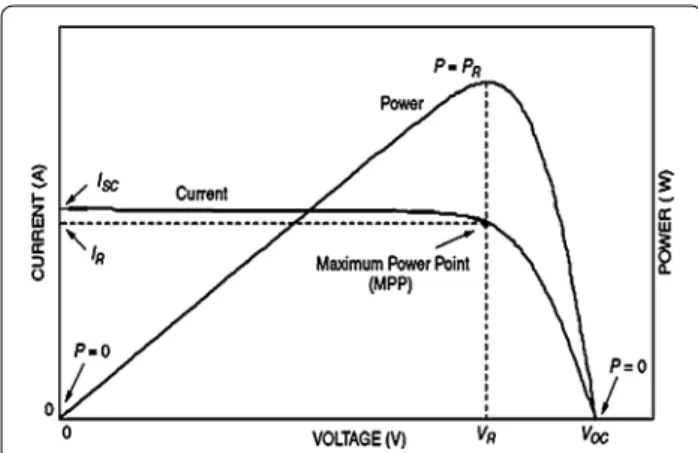
the changes in these factors. The characteristic current–
voltage curve and power–voltage curve are displayed in
Fig.
1
. These characteristic curves present the
param-eters that describe the operation of the PV cell such as
the open-circuit voltage
V
OC, short circuit current
I
SC,
and the cell voltage, current, and power at the maximum
power point,
V
MPP,
I
MPP, and
P
MPP, respectively.
In addition, the fill factor
FF
and efficiency
η
are
con-sidered.
FF
measures the quality of the PV array. It is the
ratio of the actual MPP (
P
MAX) to the product of
V
OCand
I
SCas in (
1
) (Chen
2011
).
While the efficiency,
η
, of a solar cell is defined as the
ratio of the output electric power over the input solar
radiation power under standard illumination conditions
at the maximum power point (Chen
2011
).
Comparison between MPPT techniques
The MPPT techniques vary in many aspects, which might
help the users to decide the system that suits their unique
applications. These parameters include hardware
imple-mentation, sensor, convergence speed, multiple local
maximum, cost, application, and dependency on array
parameter. Hardware implementation is simply the type
of circuit: analog or digital (Esram and Chapman
2007
).
Sensors and their numbers affect the decision makers
to decide which MPPT to use. The more precise MPPT
(1)
FF
=
P
MAXP
T=
I
MPV
MPI
SCV
OCrequires more sensors (Reported issued by National
Instruments
2009
). Usually, it is easier to sense voltage
than current. The irradiance or temperature sensors are
very expensive and uncommon (Faranda and Leva
2008
).
Convergence speed is the time taken to reach the MPP
(Walker et al.
2011
). For a high-performance MPPT
sys-tem, the time taken to converge to the required
operat-ing voltage or current should be low. The lower time and
periodic tuning taken to reach the
MPP
minimize power
losses and maximize efficiency.
The ability to detect multiple local maxima when the
system is under different irradiance levels is another
important parameter. The power loss can reach 70 %
under partial shading condition, if a local maximum
is tracked instead of the real MPP (Reported issued by
National Instruments
2009
; Ji et al.
2009
).
Performance cost is another parameter that concerns
the users. It is usually cheaper to use analog system than
digital system. Moreover, the number and type of
sen-sors, using other power or electronic components, add
extra cost to the system (Faranda and Leva
2008
).
Different MPPTs are suitable for various applications.
Depending on the application, different aspects may be
considered important when choosing the PV system. As
an example, in space satellites and orbital stations
appli-cations that involve a large amount of money, the costs
and complexity of the MPP tracker are not as important
as its performance and reliability. The tracker should be
able to continuously track the true MPP in minimum
amount of time and should not require periodic tuning
(Khatib et al
2010
).
The MPPT system might be independent (direct) or
dependent (indirect) on array parameters. The direct
methods use
PV
voltage and/or current measurements.
These direct methods have the advantage of being
inde-pendent from the prior knowledge of the
PV
array
configuration and parameter values for their
implemen-tation. Thus, the operating point is independent of
irra-diance, temperature, or degradation levels. The indirect
methods are based on the use of a database of parameters
that include data of typical
P
–
V
curves of PV systems for
different irradiances and temperatures, or on the use of
mathematical functions obtained from empirical data to
estimate the MPP (Khatib et al.
2010
; Jain and Agarwa
2007
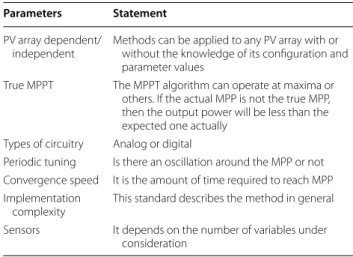
). Table
1
summarizes the most important
char-acteristics of MPPT algorithm that is used to compare
between different techniques.
Methodology
In this work, we conducted a literature review to what is
available in terms of MPP tracking algorithms. We
ana-lyzed theoretically the work presented in each paper and
fetch the parameters as indicated in Table
1
. We
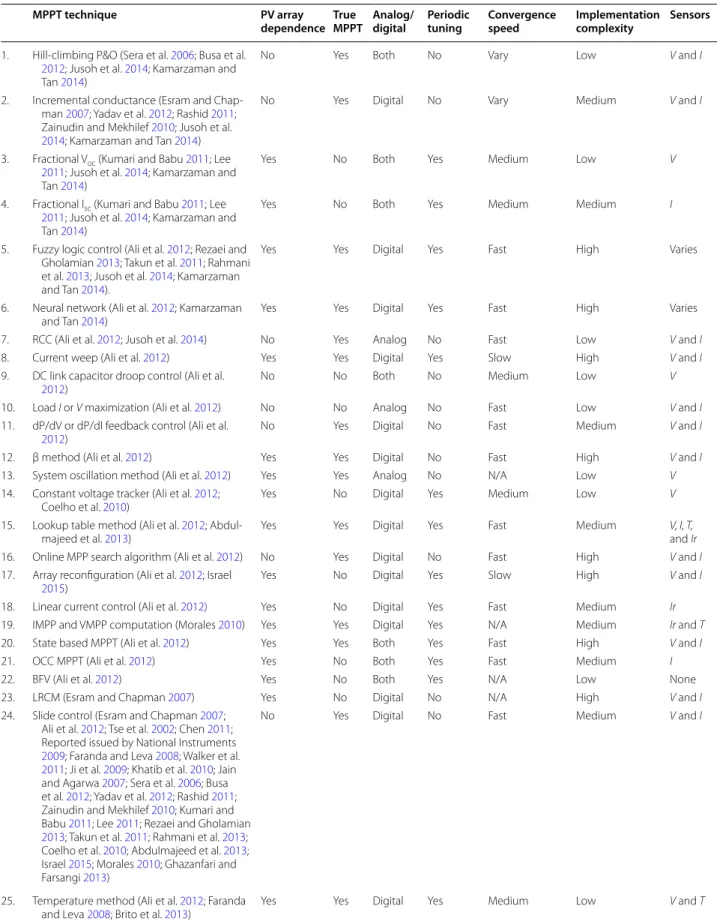
col-lected 45 different algorithms. The differences between
45 MPPT algorithms are listed in Table
2
. Table
2
is an
extended work to what have been presented in (Ali
et al.
2012
). Further, algorithms are collected from other
resources.
Results
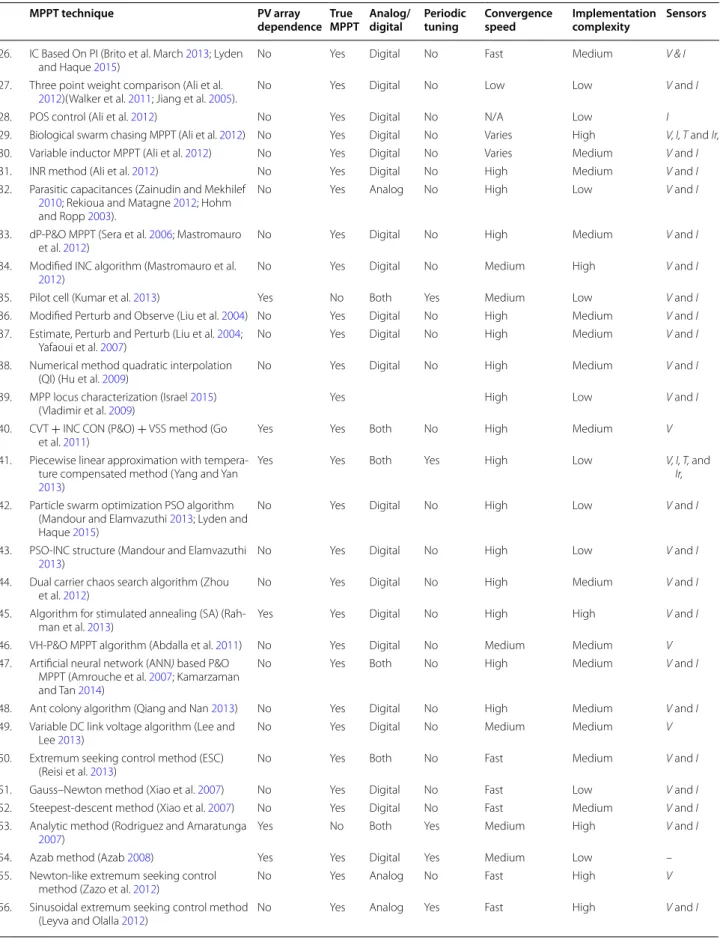
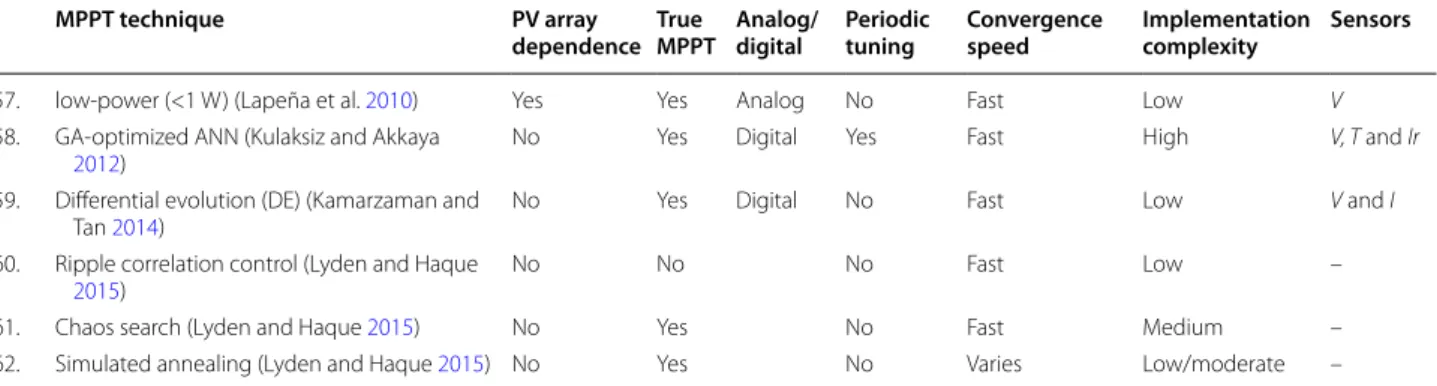
The comparison between 62 algorithms is shown in
Table
2
. According to the table, the most common
algo-rithms are perturb and observe (P&O)/”hill-climbing,”
incremental conductance algorithm, and fuzzy logic
con-troller (FLC).
Below is a quick review of these three well-known
algorithms.
Perturb and Observe (P&O)/”hill‑climbing”
The P&O is the most popular for its low cost, ease of
implantation, simple structure, and few measured
param-eters, which are required. It only measures the voltage
(
V
) and current (
I
) of the PV array. PV system controller
changes PV array output with a smaller step in each
con-trol cycle. The step size is generally fixed, while mode can
be increased or decreased. Both PV array output voltage
and output current can be the control object; this process
is called “perturbation.” It depends on the fact that the
derivative of power with respect to voltage is zero at MPP
point (Sera et al.
2006
; Busa et al.
2012
). This method fails
under rapidly changed atmospheric conditions and has
a slow response speed oscillation around the MPP (Sera
et al.
2006
).
Incremental conductance algorithm
The incremental conductance method is based on the
fact that the sum of the instantaneous conductance
(
I
/
V
) and the incremental conductance is zero at MPP.
Figure
2
shows the slope of the PV array power curve
compared to (
I
/
V
). Thus, incremental conductance can
determine that the MPPT has reached the MPP and
stop perturbing the operating point of the PV array as
explained in Fig.
2
.
Although incremental conductance is an improved
ver-sion of P&O, it can track rapidly increasing and
decreas-ing irradiance conditions with higher accuracy than P&O.
However, this algorithm is more complex than P&O. This
increases computational time and slows down the
sam-pling frequency of the array voltage and current (Esram
and Chapman
2007
; Chen
2011
; Yadav et al.
2012
; Rashid
2011
; Zainudin and Mekhilef
2010
).
Fuzzy logic controller (FLC)
FLC consists of four categories as fuzzification, inference
engine, rule base, and defuzzification. The numerical
input variables are converted into fuzzy variable known
as linguistic variable based on a membership function
similar to Fig.
3
. In this case, five fuzzy levels are used: NB
(negative big), NS (negative small), ZE (zero), PS (positive
small), and PB (positive big). For more accuracy seven
fuzzy levels are used. In Fig.
3,
a and b are based on the
range of values of the numerical variable. Conventional
fuzzy MPPT consists of two inputs and one output. The
two input variables are the error (
E
) and the error change
(Δ
E
), at sampled times
k
. The input
E
(
k
) shows if the
load operation point at the instant
k
is located on the left
or on the right of the maximum power point on the PV
characteristic, while the input Δ
E
(
k
) expresses the
mov-ing direction of this point (Esram and Chapman
2007
; Ali
et al.
2012
; Faranda and Leva
2008
; Brito et al.
2013
).
Conclusion
In this work, we presented a comparison of 62 MPPT
algorithms. In the comparison, we used several
param-eters including the complexity of the system, number of
sensors, kind of circuitry (digital or analog), tuning,
con-vergence speed, and the dependency of the parameters.
The results are shown in the table to serve the users to
Table 1 Parameters used to compare MPPT algorithms
Parameters Statement
PV array dependent/
independent Methods can be applied to any PV array with or without the knowledge of its configuration and parameter values
True MPPT The MPPT algorithm can operate at maxima or others. If the actual MPP is not the true MPP, then the output power will be less than the expected one actually
Types of circuitry Analog or digital
Periodic tuning Is there an oscillation around the MPP or not Convergence speed It is the amount of time required to reach MPP Implementation
complexity This standard describes the method in general Sensors It depends on the number of variables under
Table 2 Comparison between different MPPT algorithms (
V
voltage,
I
current,
Ir
irradiance)
MPPT technique PV arraydependence True MPPT Analog/ digital Periodic tuning Convergence speed Implementation complexity Sensors
1. Hill‑climbing P&O (Sera et al. 2006; Busa et al.
2012; Jusoh et al. 2014; Kamarzaman and Tan 2014)
No Yes Both No Vary Low V and I
2. Incremental conductance (Esram and Chap‑ man 2007; Yadav et al. 2012; Rashid 2011; Zainudin and Mekhilef 2010; Jusoh et al.
2014; Kamarzaman and Tan 2014)
No Yes Digital No Vary Medium V and I
3. Fractional Voc (Kumari and Babu 2011; Lee
2011; Jusoh et al. 2014; Kamarzaman and Tan 2014)
Yes No Both Yes Medium Low V
4. Fractional Isc (Kumari and Babu 2011; Lee
2011; Jusoh et al. 2014; Kamarzaman and Tan 2014)
Yes No Both Yes Medium Medium I
5. Fuzzy logic control (Ali et al. 2012; Rezaei and Gholamian 2013; Takun et al. 2011; Rahmani et al. 2013; Jusoh et al. 2014; Kamarzaman and Tan 2014).
Yes Yes Digital Yes Fast High Varies
6. Neural network (Ali et al. 2012; Kamarzaman
and Tan 2014) Yes Yes Digital Yes Fast High Varies
7. RCC (Ali et al. 2012; Jusoh et al. 2014) No Yes Analog No Fast Low V and I 8. Current weep (Ali et al. 2012) Yes Yes Digital Yes Slow High V and I 9. DC link capacitor droop control (Ali et al.
2012) No No Both No Medium Low V
10. Load I or V maximization (Ali et al. 2012) No No Analog No Fast Low V and I 11. dP/dV or dP/dI feedback control (Ali et al.
2012) No Yes Digital No Fast Medium V and I
12. β method (Ali et al. 2012) Yes Yes Digital No Fast High V and I 13. System oscillation method (Ali et al. 2012) Yes Yes Analog No N/A Low V 14. Constant voltage tracker (Ali et al. 2012;
Coelho et al. 2010) Yes No Digital Yes Medium Low V 15. Lookup table method (Ali et al. 2012; Abdul‑
majeed et al. 2013) Yes Yes Digital Yes Fast Medium V, I, T,and Ir 16. Online MPP search algorithm (Ali et al. 2012) No Yes Digital No Fast High V and I 17. Array reconfiguration (Ali et al. 2012; Israel
2015) Yes No Digital Yes Slow High V and I
18. Linear current control (Ali et al. 2012) Yes No Digital Yes Fast Medium Ir 19. IMPP and VMPP computation (Morales 2010) Yes Yes Digital Yes N/A Medium Ir and T 20. State based MPPT (Ali et al. 2012) Yes Yes Both Yes Fast High V and I 21. OCC MPPT (Ali et al. 2012) Yes No Both Yes Fast Medium I 22. BFV (Ali et al. 2012) Yes No Both Yes N/A Low None 23. LRCM (Esram and Chapman 2007) Yes No Digital No N/A High V and I 24. Slide control (Esram and Chapman 2007;
Ali et al. 2012; Tse et al. 2002; Chen 2011; Reported issued by National Instruments
2009; Faranda and Leva 2008; Walker et al.
2011; Ji et al. 2009; Khatib et al. 2010; Jain and Agarwa 2007; Sera et al. 2006; Busa et al. 2012; Yadav et al. 2012; Rashid 2011; Zainudin and Mekhilef 2010; Kumari and Babu 2011; Lee 2011; Rezaei and Gholamian
2013; Takun et al. 2011; Rahmani et al. 2013; Coelho et al. 2010; Abdulmajeed et al. 2013; Israel 2015; Morales 2010; Ghazanfari and Farsangi 2013)
No Yes Digital No Fast Medium V and I
25. Temperature method (Ali et al. 2012; Faranda
Table 2 continued
MPPT technique PV array
dependence True MPPT Analog/ digital Periodic tuning Convergence speed Implementation complexity Sensors
26. IC Based On PI (Brito et al. March 2013; Lyden
and Haque 2015) No Yes Digital No Fast Medium V & I 27. Three point weight comparison (Ali et al.
2012)(Walker et al. 2011; Jiang et al. 2005). No Yes Digital No Low Low V and I 28. POS control (Ali et al. 2012) No Yes Digital No N/A Low I
29. Biological swarm chasing MPPT (Ali et al. 2012) No Yes Digital No Varies High V, I, T and Ir, 30. Variable inductor MPPT (Ali et al. 2012) No Yes Digital No Varies Medium V and I 31. INR method (Ali et al. 2012) No Yes Digital No High Medium V and I 32. Parasitic capacitances (Zainudin and Mekhilef
2010; Rekioua and Matagne 2012; Hohm and Ropp 2003).
No Yes Analog No High Low V and I
33. dP‑P&O MPPT (Sera et al. 2006; Mastromauro
et al. 2012) No Yes Digital No High Medium V and I
34. Modified INC algorithm (Mastromauro et al.
2012) No Yes Digital No Medium High V and I
35. Pilot cell (Kumar et al. 2013) Yes No Both Yes Medium Low V and I 36. Modified Perturb and Observe (Liu et al. 2004) No Yes Digital No High Medium V and I 37. Estimate, Perturb and Perturb (Liu et al. 2004;
Yafaoui et al. 2007) No Yes Digital No High Medium V and I 38. Numerical method quadratic interpolation
(QI) (Hu et al. 2009) No Yes Digital No High Medium V and I 39. MPP locus characterization (Israel 2015)
(Vladimir et al. 2009) Yes High Low V and I
40. CVT + INC CON (P&O) + VSS method (Go
et al. 2011) Yes Yes Both No High Medium
V
41. Piecewise linear approximation with tempera‑ ture compensated method (Yang and Yan
2013)
Yes Yes Both Yes High Low V, I, T, and Ir,
42. Particle swarm optimization PSO algorithm (Mandour and Elamvazuthi 2013; Lyden and Haque 2015)
No Yes Digital No High Low V and I
43. PSO‑INC structure (Mandour and Elamvazuthi
2013) No Yes Digital No High Low V and I
44. Dual carrier chaos search algorithm (Zhou
et al. 2012) No Yes Digital No High Medium V and I
45. Algorithm for stimulated annealing (SA) (Rah‑
man et al. 2013) Yes Yes Digital No High High V and I 46. VH‑P&O MPPT algorithm (Abdalla et al. 2011) No Yes Digital No Medium Medium V 47. Artificial neural network (ANN) based P&O
MPPT (Amrouche et al. 2007; Kamarzaman and Tan 2014)
No Yes Both No High Medium V and I
48. Ant colony algorithm (Qiang and Nan 2013) No Yes Digital No High Medium V and I 49. Variable DC link voltage algorithm (Lee and
Lee 2013) No Yes Digital No Medium Medium V
50. Extremum seeking control method (ESC)
(Reisi et al. 2013) No Yes Both No Fast Medium V and I 51. Gauss–Newton method (Xiao et al. 2007) No Yes Digital No Fast Low V and I 52. Steepest‑descent method (Xiao et al. 2007) No Yes Digital No Fast Medium V and I 53. Analytic method (Rodriguez and Amaratunga
2007) Yes No Both Yes Medium High V and I
54. Azab method (Azab 2008) Yes Yes Digital Yes Medium Low – 55. Newton‑like extremum seeking control
method (Zazo et al. 2012) No Yes Analog No Fast High V 56. Sinusoidal extremum seeking control method
choose the suitable system that suits their specific
appli-cations. Moreover, we presented a summary of three
most common MPPT algorithms.
Authors’ contributions
HJE and TS originated the problem idea. KM collected and demonstrated the idea. RE contributed in writing and reviewing the paper. All authors read and approved the final manuscript.
Author details
1 Electrical Engineering Department, Islamic University of Gaza, Gaza, Palestine. 2 Physics Department, Al‑Aqsa University, Gaza, Palestine. 3 Dept of Electrical Engineering, Tampere University of Technology, Tampere, Finland.
Competing interests
The authors declare that they have no competing interests.
Received: 26 November 2015 Accepted: 18 January 2016
References
Abdalla, I., Zhang, L., & Corda, J. (2011). “Voltage‑Hold Perturbation & Observa‑ tion Maximum Power Point Tracking Algorithm (VH‑P&O MPPT) for Improved Tracking over the Transient Atmospheric Changes,” presented at Power Electronics and Applications (EPE 2011) of the 2011‑14th Euro‑ pean Conference, (pp.1–10).
Abdulmajeed, Q. M., Kazem, H. A., Mazin, H., Abd Malek, M. F., Maizana, D., Alwaeli, A. H. A., Albadi, M. H., Sopian, K., & Said Al Busaidi, A. (2013). “Pho‑ tovoltaic maximum tracking power point system: review and research challenges,” International Journal of Advanced Trends in Computer Sci‑ ence and Engineering (IJATCSE), Vol. 2, No. 5. (pp.16–21).
Ali, A., Saied, M., Mostafa, M., & Moneim, T. (2012). A survey of maximum PPT techniques of PV Systems. Energytech, 2012 IEEE.
Amrouche, B., Belhamel, M., & Guessoum, A. (2007). ”Artificial intelligence based P&O MPPT method for photovoltaic systems,” Revue des Energies Renouvelables ICRESD, Vol. 7, (pp. 11–16).
Azab, M. (2008). A new maximum power point tracking for photovoltaic sys‑ tems. World Academy of Science, Engineering and Technology,44, 571–574. Brito, M., Galotto, L., Sampaio, L., Melo, G., & Canesin, C. (2013). Evaluation of
the Main MPPT Techniques for Photovoltaic Applications. IEEE Transac-tions on Industrial Electronics,60(3), 1156–1167.
Busa, V., Narsingoju, K. K., & Kumar, G. V. (2012). Simulation analysis of maxi‑ mum power control of photo voltaic power system. International Journal on Advanced Electrical and Electronics Engineering (IJAEEE),1(1), 9–14. Chen, C. J. (2011). Physics of solar energy. New Jersey: Wiley.
Coelho, R., Concer, F., & Martins, D. (2010). ”A MPPT Approach Based on Tem‑ perature Measurements Applied in PV Systems,” IEEE/IAS International Conference on Industry Applications, (pp. 1–6).
Esram, T., & Chapman, P. (2007). Comparison of photovoltaic array maximum power point tracking techniques. IEEE Transactions on Energy Conversion, 22(2), 439–449.
Faranda, R., & Leva, S. (2008a). Energy comparison of MPPT techniques for PV systems. Wseas Transaction on Power Systems,3, 446–455.
Faranda, R., & Leva, S. (2008b). Energy comparison of MPPT techniques for PV systems. Wseas Transaction on Power Systems,3, 446–455.
Ghazanfari, J., & Farsangi, M. (2013). Maximum power point tracking using sliding mode control for photovoltaic array. Iranian Journal of Electrical & Electronic Engineering,9(3), 189–196.
Go, S., Ahn, S., Choi, J., Jung, W., Yun Yun, S., & Song, II. “Simulation and Analysis of Existing MPPT Control Methods in a PV Generation System.” Journal of International Council on Electrical Engineering, Vol. 1, No. 4, pp. 446‑451, 2011.
Table 2 continued
MPPT technique PV array
dependence True MPPT Analog/ digital Periodic tuning Convergence speed Implementation complexity Sensors
57. low‑power (<1 W) (Lapeña et al. 2010) Yes Yes Analog No Fast Low V 58. GA‑optimized ANN (Kulaksiz and Akkaya
2012) No Yes Digital Yes Fast High V, T and Ir
59. Differential evolution (DE) (Kamarzaman and
Tan 2014) No Yes Digital No Fast Low V and I
60. Ripple correlation control (Lyden and Haque
2015) No No No Fast Low –
61. Chaos search (Lyden and Haque 2015) No Yes No Fast Medium – 62. Simulated annealing (Lyden and Haque 2015) No Yes No Varies Low/moderate –
Fig. 2 Slope of the P–V array power curve (Yadav et al. 2012)
Hohm, D. P., & Ropp, M. E. (2003). ”Comparative Study of Maximum Power Point Tracking Algorithms,” Progress in Photovoltaic: Research and Appli‑ cation, (pp. 47–62).
Hu, J., Zhang, J., & Wu, H. (2009). “Novel MPPT control algorithm based on numeri-cal numeri-calculation for PV generation systems,” presented at Power Electronics and Motion Control Conference (pp. 2103–2107). China: Baoding.
Israel, J. (2015). “Summary of maximum power point tracking methods for photovoltaic cells,” electronic matter, retrieved on May 2015. Jain, S., & Agarwa, V. (2007). Comparison of the performance of maximum
power point tracking schemes applied to single‑stage grid‑connected photovoltaic systems. The Institution of Engineering and Technology Power Appl.,1(5), 753–762.
Ji, Y. H., Jung, D. Y., Won, C. Y., Lee, B. K., & Kim, J. W. (2009). Maximum power point tracking method for PV array under partially shaded condition. Energy Conversion Congress and Exposition, 2009. ECCE 2009. IEEE. (pp. 307–312).
Jiang, J., Huang, T., Hsiao, Y., & Chen, Ch. (2005). Maximum power tracking for photovoltaic power systems. Tamkang Journal of Science and Engineering, 8(2), 147–153.
Jusoh, A., Sutikno, T., Guan, T. K., & Mekhilef, S. (2014). A Review on favourable maximum power point tracking systems in solar energy application. Telkomnika,12(1), 6–22.
Kamarzaman, N., & Tan, C. W. (2014). A comprehensive review of maximum power point tracking algorithms for photovoltaic systems. Renewable and Sustainable Energy Reviews,37, 585–598.
Khatib, T. T. N., Mohamed, A., & Amim, N. (2010). An improved indirect maximum power point tracking method for standalone photovoltaic systems,” presented at Proceedings of the 9th WSEAS International Conference on Applications of Electrical Engineering, Selangor, Malaysia, pp. (56–62).
Kulaksiz, A., & Akkaya, R. (2012). Training data optimization for ANNs using genetic algorithms to enhance MPPT efficiency of a stand‑alone PV system. Turk J Elec Eng and Comp Sci,20(2), 241–254.
Kumar, Ch., Dinesh, T., & Babu, S. (2013). Design and Modelling of PV System and Different MPPT Algorithms. International Journal of Engineering Trends and Technology (IJETT),4, 4104–4112.
Kumari, J., & Babu, Ch. (2011). Comparison of maximum power point tracking algorithms for photovoltaic system. International Journal of Advances in Engineering and Technology,1, 133–148.
Lapeña, O., Penella, M., & Gasulla, M. (2010). A New MPPT Method for Low‑ Power Solar Energy Harvesting. IEEE Transactions on Industrial Electronics, 57(9), 3129–3138.
Lee, J. (2011). Advanced electrical and electronic engineering. Berlin: Springer. Lee, J. S., & Lee, K. B. (2013). Variable DC‑link voltage algorithm with a wide range of maximum power point tracking for a two‑string PV System. Energies,6, 58–78.
Leyva, R., Olalla Martinez, C., Zazo, H., Cabal, C., Cid‑Pastor, A., Queinnec, I., & Alonso, C. (2012). “MPPT Based on Sinusoidal Extremum‑Seeking Control in PV Generation,”. International Journal of Photoenergy,2012, 1–7. Libo, W., Zhengming, Z., & Jianzheng, L. (2007). A single‑stage three‑phase
grid‑connected photovoltaic system with modified MPPT method and reactive power compensation. IEEE Transactions on Energy Conversion, 22(4), 881–886.
Liu, Y., Chen, J., & Huang, J. (2015). A review of maximum power point tracking techniques for use in partially shaded conditions. Renewable and Sustain-able Energy Reviews,41, 436–453.
Liu, C., Wu, B., & Cheung R. (2004). “Advanced Algorithm for MPPT Control of Photovoltaic System,” presented at Canadian Solar Buildings Conference, Montreal.
Lyden, S., & Haque, M. E. (2015). ” Maximum Power Point Tracking techniques for photovoltaic systems: A comprehensive review and comparative analysis,” Vol. 52, (pp.1504–1518).
Mandour, R., & Elamvazuthi, I. (2013). Optimization of maximum power point tracking (MPPT) of photovoltaic system using artificial intelligence (AI) algorithms.” Journal of Emerging Trends in Computing and Information Sciences, Vol. 4, No. 8.
Mastromauro, R., Liserre, M., & Aquila, A. (2012). Control issues in single‑stage photovoltaic systems: MPPT, current and voltage control. IEEE Transac-tions on Industrial Informatics,8(2), 241–254.
Morales, D. S. (2010). “Maximum power point tracking algorithms for photovoltaic applications, “A thesis presented to the faculty of electronics. Communica‑ tions and Automation: Aalto University, Finland.
Qiang, F., & Nan, T. (2013). A Strategy Research on MPPT Technique in Photo‑ voltaic Power Generation System. Telkomnika,11(12), 7627–7633. Rahman, Md, Poddar, S., Mamun, M., Mahmud, S., & Yeasin, Md. (2013). Effi‑
ciency comparison between different algorithms for maximum power point tracker of a solar system. International Journal of Scientific Research and Management (IJSRM),1, 157–167.
Rahmani, R., Seyedmahmoudian, M., Mekhilef, S., & Yusof, R. (2013). Imple‑ mentation of fuzzy logic maximum power point tracking controller for photovoltaic system. American Journal of Applied Sciences,10, 209–218. Rashid, M. H. (2011). Power Electronic Handbook (3rd ed.). USA:
Butterworth‑Heinemann.
Reisi, A., Moradi, M., & Jamasb, S. (2013). Classification and comparison of maxi‑ mum power point tracking techniques for photovoltaic system: A review. Renewable and Sustainable Energy Reviews,19, 433–443.
Rekioua, D., & Matagne, E. (2012). Optimization of photovoltaic power systems modelization, simulation and control. London: Springer.
Reported issued by National Instruments. (2009). Maximum power point track‑ ing. http://www.ni.com/white‑paper/8106/en.
Rezaei, A., & Gholamian, S. A. (2013). Optimization of New Fuzzy Logic Control‑ ler by Genetic Algorithm for Maximum Power Point Tracking in Photovol‑ taic System. Journal of Science and Technology,9(1), 9–16.
Rodriguez, C., & Amaratunga, G. (2007). Analytic solution to the photovoltaic maximum power point problem. IEEE Transactions on Circuits and System, 54(9), 2054–2060.
Sera, D., Kerekes, T., Teodorescu, R., & Blaabjerg, F. (2006a). Improved MPPT algorithms for rapidly changing environmental conditions presented at Power Electronics and Motion Control Conference, 2006. EPE-PEMC,2006, 1614–1619.
Sera, D., Kerekes, T., Teodorescu, R., & Blaabjerg, F. (2006b). “Improved MPPT Algorithms for Rapidly Changing Environmental Conditions,” presented at Power Electronics and Motion Control Conference, 2006. EPE-PEMC,2006, 1614–1619.
Takun, P., Kaitwanidvilai, S., & Jettanasen, C. (2011)“Maximum power point tracking using fuzzy logic control for photovoltaic systems,” presented at International Multi Conference of Engineers and Computer Scientists, Hong Kong, Vol. 2.
Tse, K. K., Ho, M. T., Chung, H. S.‑H., & Hui, S. Y. (2002). “A novel maximum power point tracker for PV panels using switching frequency modulation,”. IEEE Transactions on Power Electronics,17(6), 980–989.
Vladimir V. R., Scarpa, S., Buso, G., & Spiazzi. (2009). “Low‑complexity MPPT technique exploiting the PV module MPP locus characterization.” IEEE Transactions on Industrial Electronics, Vol. 56, No. 5.
Walker, S., Sooriyaarachchi, N., Liyanage, N., Abeynayake, P., & Abeyratne, S. (2011). Comparative analysis of speed of convergence of MPPT techniques. presented at 6th International Conference on Industrial and Information Systems, Sri Lanka, (pp. 522–526).
Walker, S., Sooriyaarachchi, N., Liyanage, N., Abeynayake, P., & Abeyratne, S. (2011)”Comparative Analysis of Speed of Convergence of MPPT Techniques,” presented at 6th International Conference on Industrial and Information Systems, Sri Lanka, (pp. 522‑526).
Xiao, W., Dunford, W., Palmer, P., & Capel, A. (2007). Application of centered differentiation and steepest descent to maximum power point tracking. IEEE Transactions on Industrial Electronics,54(5), 2539–2549.
Yadav, A., Thirumaliah, S., & Haritha, G. (2012). Comparison of MPPT algorithms for DC–DC converters based PV systems. International Journal of Advanced Research in Electrical, Electronics and Instrumentation Engineering,1, 18–23. Yafaoui, A., Wu, B., & Cheung, R. (2007). ” Implementation of Maximum Power
Point Tracking Algorithm For Residential Photovoltaic Systems,” presented at 2nd Canadian Solar Buildings Conference, Calgary.
Yang, Y., & Yan, Z. (2013). A MPPT method using piecewise linear approxima‑ tion and temperature compensation. Journal of Computational Informa-tion Systems,9(21), 8639–8647.
Zazo, H., Leyva, R., & Castillo, E. (2012). “Analysis of Newton‑Like Extremum Seeking Control in Photovoltaic Panels,” presented at International Con‑ ference on Renewable Energies and Power Quality (ICREPQ‘12), Santiago de Compostela, Spain.