Australian Journal of Basic and Applied Sciences
AUSTRALIAN JOURNAL OF BASIC AND
Open Access Journal
Published BY AENSI Publication
© 2016 AENSI Publisher All rights reserved
This work is licensed under the Creative Commons Attribution International License (CC BY). http://creativecommons.org/licenses/by/4.0/
To Cite This Article: R.L. Jasmine, G. David RAJ, G.V. Uma Basic & Appl. Sci., 10(2): 277-282, 2016
A Novel Method for Music Retrieval using Chord Progression
1R.L. Jasmine, 2G. David RAJ, 3G.V. Uma
1Research Scholar, IST Department, College of Engineering, Anna University, Chennai. 2
Research Scholar, IST Department, College of Engineering, Anna University, Chennai. 3Professor, IST Department, College of Engineering, Anna University, Chennai.
Address For Correspondence:
R.L. Jasmine, 1Research Scholar, IST Department, College of
A R T I C L E I N F O Article history:
Received 04 December 2015 Accepted 22 January 2016 Available online 14 February 2016
Keywords:
Chords, music classification, Scale
There are large quantity of text, audio, video and other documents available on the internet, on about any subject. Search is one of the most important user interface elements in any large website. There are two ways of searching the information: (1) To us
Information retrieval (IR) is the process of gathering applicable information to a query. IR is different from data retrieval, which is about to find small amount of data in a databases
information is not structured; it is contained in free form in text or in multimedia content.
There are many types of information retrieval they are: (1) Speech retrieval, which deals speech continuously transcribed manually by automated speech recognition (ASR). (2) Cross language revival uses a query in a language say English and perceive document in other languages like Chinese and Russian. (3) Question answering IR system, which retrieve answers from a body o
image on a theme. (5) Music retrieval, which finds a piece when a user hums a melody or enter the notes of a musical theme.
Music is a widely enjoyed content type, existing in many multifaceted representations. With
information ere, a lot of digital music information has apparently available at the user’s fingertips. However the abundance of information is too wide
and human manner, motivating the development of Music Information Retrieval (Music
the fast growth of digital music collection and media replay on transferable devices, fruitful retrieval and
Journal of Basic and Applied Sciences, 10(2) Special 2016, Pages: 277-282
AUSTRALIAN JOURNAL OF BASIC AND
APPLIED SCIENCES
ISSN:1991-8178 EISSN: 2309-8414 Journal home page: www.ajbasweb.com
© 2016 AENSI Publisher All rights reserved
This work is licensed under the Creative Commons Attribution International License (CC BY). http://creativecommons.org/licenses/by/4.0/
G. David RAJ, G.V. Uma, A Novel Method for Music Retrieval using Chord Progression
A Novel Method for Music Retrieval using Chord Progression
Research Scholar, IST Department, College of Engineering, Anna University, Chennai. Research Scholar, IST Department, College of Engineering, Anna University, Chennai. Professor, IST Department, College of Engineering, Anna University, Chennai.
Research Scholar, IST Department, College of Engineering, Anna University, Chennai.
A B S T R A C T
Music information retrieval (MIR) systems allow users to search collections of music. Surfing can be performed, for example, by means of metadata using keywords to describe music or the actual such that the melodic content of a musical piece. Music specification with respect to its scale is an emerging area in music information retrieval. A key problem in music specification is how to efficiently extract audio features for high level classification. Many types of features have been used for music classification including low level features such as timber and temporal features and mid
such as chord, rhythm, and beat for music analysis. Most present work in music information retrieval survey allows music via low-level features like Mel frequency cepstral coefficient (MFCC) and other spectral coefficients. Although, low features are insufficient for many applications considering to the signal characteristics comparatively to the semantic content of music. On the contrary, mid
such as Chord sequence, which describes harmonic progression and tonal structure of music, is one of the most important mid-level features of music. With chord sequence, songs that are similar in various aspects can be identified and retrieved more effectively. This paper focus on chord recognition and its applications.
INTRODUCTION
There are large quantity of text, audio, video and other documents available on the internet, on about any subject. Search is one of the most important user interface elements in any large website. There are two ways of searching the information: (1) To use a search engines. (2) To browse directories organized by categories. Information retrieval (IR) is the process of gathering applicable information to a query. IR is different from data retrieval, which is about to find small amount of data in a databases with a given structure. In IR systems, the information is not structured; it is contained in free form in text or in multimedia content.
There are many types of information retrieval they are: (1) Speech retrieval, which deals speech ibed manually by automated speech recognition (ASR). (2) Cross language revival uses a query in a language say English and perceive document in other languages like Chinese and Russian. (3) Question answering IR system, which retrieve answers from a body of text. (4) Image retrieval, which finds image on a theme. (5) Music retrieval, which finds a piece when a user hums a melody or enter the notes of a
Music is a widely enjoyed content type, existing in many multifaceted representations. With
information ere, a lot of digital music information has apparently available at the user’s fingertips. However the abundance of information is too wide-ranging and too various to compose, inspect and present in a consistent
otivating the development of Music Information Retrieval
(Music-the fast growth of digital music collection and media replay on transferable devices, fruitful retrieval and
282
A Novel Method for Music Retrieval using Chord Progression Aust. J.
A Novel Method for Music Retrieval using Chord Progression
systems allow users to search collections of music. Surfing can be performed, for example, by means of metadata using keywords to describe music or the actual such that the melodic content of a musical piece. Music s an emerging area in music information retrieval. A key problem in music specification is how to efficiently extract audio features for high level classification. Many types of features have been used for music classification such as timber and temporal features and mid-level features such as chord, rhythm, and beat for music analysis. Most present work in music level features like Mel frequency ther spectral coefficients. Although, low-level features are insufficient for many applications considering to the signal characteristics comparatively to the semantic content of music. On the contrary, mid-level features ribes harmonic progression and tonal structure of level features of music. With chord sequence, songs that are similar in various aspects can be identified and retrieved more
cognition and its applications.
There are large quantity of text, audio, video and other documents available on the internet, on about any subject. Search is one of the most important user interface elements in any large website. There are two ways of e a search engines. (2) To browse directories organized by categories. Information retrieval (IR) is the process of gathering applicable information to a query. IR is different from data with a given structure. In IR systems, the information is not structured; it is contained in free form in text or in multimedia content.
There are many types of information retrieval they are: (1) Speech retrieval, which deals speech ibed manually by automated speech recognition (ASR). (2) Cross language revival uses a query in a language say English and perceive document in other languages like Chinese and Russian. (3) f text. (4) Image retrieval, which finds image on a theme. (5) Music retrieval, which finds a piece when a user hums a melody or enter the notes of a
management of music is needed in the digital era. Most current work in music information retrieval peruse music via low-level features however, low-level features are insufficient for numerous requisition since they are equivalent to the signal characteristics preferably than the semantic content of music.
On the perverse, mid-level characteristics for example as chord, rhythm, and instrumentation contain rich information for music analysis. Based on the information of the music some music oriented system is available such as last.fm, sheetmusicarchive.net, musicsheetplus.com, stagepass.com and pando. However such an approach suffers from drawbacks: (1) First a newly added music must be recognized. (2) Second unpopular music recordings may be recognized. Chord
Research Background:
A chord is a set of tones played simultaneously. A chord progression is a sequence of chords over time and is what describes the harmony of a piece (Mitchell, T.M., 2010). Automatic chord recognition is the process of extracting a chord progression from an audio file. These chord sequences are used by musicians as lead sheets summaries containing chords, melody, and lyrics as well as by researchers for tasks such as key detection, genre classification and lyric interpretation. Performing chord analysis by hand is time consuming, prone to human error, and requires two or more trained experts.
sequence, which narrates characteristics series and tonal composition of music, is one of the most important mid-level features of music. Since music characteristics series is strongly related to distinguish sensation, alike chord succession can be noticed in songs that are adjacent in genre, emotion, etc. With chord sequence, songs that are similar in various aspects can be distinguished and retrieved more effectively. In this paper, a chord recognition method is proposed.
This is what makes automatic chord recognition an important area of research (Schacht, A and W. Sommer, 2009). The two main steps of automatic chord recognition are feature extraction and pattern matching. Feature extraction is the process of extracting useful information from audio files, and pattern matching is how chord labels are applied to that data. There are many challenges encountered by systems that process audio signals. There are background noises, percussion instruments and other unwanted tones in audio recordings. It is also difficult to distinguish when chords change and to line these points up exactly with the beat. Preprocessing helps eliminate unwanted information from the audio files before or during the feature extraction step, depending on the system.
Existing perusal on chord identification is predominantly based on HMM (Possner, J., 2008). The general procedure is described as follows. First, the input audio is cleaved into successive frames and transformed to frequency domain. Then, feature vectors for chord identification are retrieved. Since chord are composed of harmony formed by multiple notes or pitches, the twelve dimensional pitch class profile 9PcP) feature vector or chroma vector, which represents the intensity of twelve semitone pitch class, is mostly used (Hu, X and J.S. Downie, 2010l; Upadhye, R and V.H. Sahasrabuddhe, 1992; Schacht, A and W. Sommer, 2009). Very little work has taken place in the area of applying techniques from computational musicology. The special work done by Sahasrabudha et al. (Ghias, A et al, 1995) gives the ability to identify raga in a melodic type of composition. The system was based on assigning a raga to is nearest seven note scale. The seven note scale, as is also the case in Western music, is considered a typical full scale.
Proposed Architecture:
The harmonic progression and tonal structure of music can be described by a chord sequence. Harmonic progression can interrupt chord sequence from which genre, emotion can be observed. With chord sequence, similar songs in various scales can be identified and retrieved more successfully.
Separatio n of audio
Chord Recognitio n
Musical Knowled ge
Scale Learning
Comp are
Retrieval of similar music
279 R.L. Jasmine et al., 2016
Australian Journal of Basic and Applied Sciences, 10(2) Special 2016, Pages: 277-282
Separation Of Audio From The Music:
Imagine you are standing in a busy street among a crowd of people. You can glean traffic sound, footfall of people adjacent, the bleeping of a rambler crossing, your mobile phone ringing, and co-workers at the back of you having a conference. Even though all these different sound sources, you have a pretty good idea of what is going on around you. It is more than just a mess of overlapping noise, and if you try hard you can concentrate on one of these sources if it is important to you such as the conversation behind you. There are two main obstacles for their comprehensive acquisition determined on the scenario.
The main limitation in some cases is: (1) High latency and computational cost. (2) In other cases the quality of the results is insufficient. Audio editing software is software which allows to manage and perceipitate of audio data. Audio editing software can be implemented completely or partly as library, as computer approach, as Web approach or as a loadable kernel module. There are different types of audio editing software they are: (1) Adobe Audition (2) AVS Audio Editor (3) Diamond Cut (4) Wave Lab (5) Music Maker
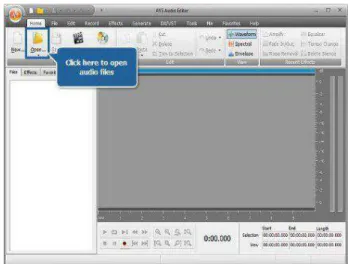
Download and install AVS Audio Editor: Open An Audio File:
To open an audio file that you intend to chop pop the Open button on the Home tab of the Ribbon Command Bar.
Fig. 2: To open an audio file
Select the Necessary Segments:
To select the parts of your audio file that you need to have as separate files apply markers. Start by indicating the first segment: pop the required position within the Waveform. Display with the left mouse button and compress the Add Marker button on the Edit tab. The start of the file will be the beginning of the opening chunch and the added marker indicates its end.
Fig. 3: Setting markers for the selected music
As soon as all the required markers are set click the Split File by Markers link on the Edit tab. the audio will be split into various files according to the markers set. They will be called as the input file name + the sequence number and put the Files tab of the result and Filters panel.
Save the Resulting Tracks:
To retain all the derived tracks utilize the Save All option of the File tab. If you do not need all the tracks double click the essential file at the result and Filters panel and use th
any designation, place, format which can suit your needs best.
Fig. 4: Saving the audio track.
Representing the Chords Of Songs:
To represent the chords of a song is described briefly. A good representation
and allow adaptable user interfaces and tools to be constructed. A song is a combination of different keys formed to make a tune. They are constructed by the pitch values of the notes. The occurrence of each note in the song is the duration of all notes including the chords.
Fig. 5: representation of chords in a song
Similarity Relations of Chords:
The notes on the keyboard are given by comparing them to the notes of the alphabets. The keyboard notes can be named as c-d-e-f-g-a-b. Each note differs with each other in sound. The seven notes of keyboard repeat themselves again and again. That the notes sound the same but the pitch differs. For example if c note is played and moved to the right until it finds the next c,
standard semiprofessional music keyboard has forty eight keys. One of these twelve set of notes is technically called an octave. Western music is based on frequencies of the keys. An octave is
intervals such that the frequency ratio of two neighboring intervals is the same. This interval is called a semi tone. There are twelve mutually exclusive half notes in the system. In western music middle c octave that is also called the middle c scale etc. starts from the first white key set to 240 Hz. Once the octave is figured out, it is easy to identify the first key of this octave9set to 240 Hz. The below table give the frequencies of each scale.
Recognizing Chords:
The basic of western music is the recognition of chords. If a tune stays in one key, then the basic chords are formed by the combination of different notes on the scale. Much song uses the three chords based on the basics (i), the quarter (IV) and the fifth (V). Sometimes a fourth note is added which is a third above the highest note of the triad. This gives a seventh chord. When a minor third is used it can result in the use of a note which is not actually part of the indegineousl scale. For sample, the C cons
G is Bb which is not part of the C major scale.
As soon as all the required markers are set click the Split File by Markers link on the Edit tab. the audio will be split into various files according to the markers set. They will be called as the input file name + the sequence
iles tab of the result and Filters panel.
To retain all the derived tracks utilize the Save All option of the File tab. If you do not need all the tracks double click the essential file at the result and Filters panel and use the Save as option to save this follow with any designation, place, format which can suit your needs best.
:
To represent the chords of a song is described briefly. A good representation will make the search efficient and allow adaptable user interfaces and tools to be constructed. A song is a combination of different keys formed to make a tune. They are constructed by the pitch values of the notes. The occurrence of each note in the
is the duration of all notes including the chords.
representation of chords in a song
The notes on the keyboard are given by comparing them to the notes of the alphabets. The keyboard notes b. Each note differs with each other in sound. The seven notes of keyboard repeat themselves again and again. That the notes sound the same but the pitch differs. For example if c note is played and moved to the right until it finds the next c, both notes sounds the same but one is higher than the other. A standard semiprofessional music keyboard has forty eight keys. One of these twelve set of notes is technically called an octave. Western music is based on frequencies of the keys. An octave is dividing into twelve equal intervals such that the frequency ratio of two neighboring intervals is the same. This interval is called a semi tone. There are twelve mutually exclusive half notes in the system. In western music middle c octave that is also alled the middle c scale etc. starts from the first white key set to 240 Hz. Once the octave is figured out, it is easy to identify the first key of this octave9set to 240 Hz. The below table give the frequencies of each scale.
basic of western music is the recognition of chords. If a tune stays in one key, then the basic chords are formed by the combination of different notes on the scale. Much song uses the three chords based on the basics ). Sometimes a fourth note is added which is a third above the highest note of the triad. This gives a seventh chord. When a minor third is used it can result in the use of a note which is not actually part of the indegineousl scale. For sample, the C considerable triad is CEG and a small third above the G is Bb which is not part of the C major scale.
As soon as all the required markers are set click the Split File by Markers link on the Edit tab. the audio will be split into various files according to the markers set. They will be called as the input file name + the sequence
To retain all the derived tracks utilize the Save All option of the File tab. If you do not need all the tracks e Save as option to save this follow with
will make the search efficient and allow adaptable user interfaces and tools to be constructed. A song is a combination of different keys formed to make a tune. They are constructed by the pitch values of the notes. The occurrence of each note in the
The notes on the keyboard are given by comparing them to the notes of the alphabets. The keyboard notes b. Each note differs with each other in sound. The seven notes of keyboard repeat themselves again and again. That the notes sound the same but the pitch differs. For example if c note is played both notes sounds the same but one is higher than the other. A standard semiprofessional music keyboard has forty eight keys. One of these twelve set of notes is technically dividing into twelve equal intervals such that the frequency ratio of two neighboring intervals is the same. This interval is called a semi tone. There are twelve mutually exclusive half notes in the system. In western music middle c octave that is also alled the middle c scale etc. starts from the first white key set to 240 Hz. Once the octave is figured out, it is easy to identify the first key of this octave9set to 240 Hz. The below table give the frequencies of each scale.
281 R.L. Jasmine et al., 2016
Australian Journal of Basic and Applied Sciences, 10(2) Special 2016, Pages: 277-282 Table 1: List of frequencies for notes
A 440.00 HZ
A# \ Bb 466.16 HZ
B 493.88 HZ
C 523.25 HZ
C# \ Db 554.37 HZ
D 587.33 HZ
D# \ Eb 622.25 HZ
E 659.25 HZ
F 698.46 HZ
F# \ Gb 739.99 HZ
G 783.99 HZ
G#\ Ab 830.61 HZ
A 880.00 HZ
The problem of finding the key piece of chord is called key finding. The method behind the key finding is that the frequencies of each key are compared. When a song matches a particular key the frequencies distance between the chords and the tone of the key are relatively small. The formula is given by:
S =αr(I) + r(IV) + r(V) + (β if the irst chord matched the key
β if the irst chord matched the key
Here r denotes the scale of the key. A denotes the frequency of the other key in the scale; B supports the first and last key of the chord.
Fig. 6: Tree structure of chord sequence
Conclusion:
A chord in an Indian music is a very complex structure. The sequence of notes used to play the songs is based on the chords. The proposed architecture aims to build the database so that it includes a large number of examples in each chord. The proposed system analyzes the sequence of scales for the chord identified. Here, it not only identifies the chords, but it also tags them according to their scales. The scope of the model can also be extended to mood based audio retrieval. The combination of audio and lyrical content is a crucial factor for future mood classification system.
REFERENCES
Bradley, M.M and P.J. Lang, 1991. Affective norms for English words (ANEW): stimuli, instruction manual and affective ratings, The Center for Research in Psychophysiology, University of Florida.
Garcia-Silva A. et al, 2012.Review of the state the art: Discovering and associating semantics to tags in folksonomies, The Knowledge Engineering Review, 27(1): 57-85.
Ghias, A et al, 1995.Query by Humming – Musical Information Retrieval in an Audio Database, In Proceedings of ACM Multimedia, pp: 231-236.
Golder, S.A and B.A. Huberman, 2006, Usage patterns of collaborative tagging systems, Journal of Information and Science, 32(2): 198-208.
Hu, X and J.S. Downie, 2010. When lyrics outperform audio for music mood classification: a feature analysis, In the Proceedings of ISMIR, pp: 1-6.
Hu, X et al., 2009, Lyric text mining in music mood classification, In Proceedings of the 10th ISMIR Conference, pp: 411-416.
Hu, X., 2007. creating a simplified music mood classification ground truth set, In Proceedings of ISMIR, pp: 309-310.
Juslin, P.N and Sloboda J.Am, 2009. Handbook of Music and Emotion: Theory, Research, Applications,
Cmin f7=c7
f7=cf
fmin=cmi n
f7=c7
cmin
f=c
dmin=cmi n
emin=cmi n
c a7=c7
gmin=cmi n
Oxford, MS, USA: Oxford University Press.
Mitchell, T.M., 2010, predicting human brain activity associated with the meanings of nouns, Human Brain Mapping, 32(30): 1191-1195.
Petersen, M.K et al, 2010. Latent semantics as cognitive component, In Proceedings of 2nd International Workshop on Cognitive Information Processing CIP.
Possner, J., 2008. The neurophysiological bases of emotion: an fMRI study of the affective circumflex using emotion-denoting words, Human Brain Mapping, 30(3): 883-895.
Schacht, A and W. Sommer, 2009. Emotions in word and face processing – early and late cortical responses, Brain and Cognition, 20(2): 538-55.
Song, Y et al. 2011, Automatic tag recommendation algorithms for social recommender systems, ACM Transactions on the Web, 5(1): 4.