Page | 53 This paper is licensed under a Creative Commons Attribution 3.0 License.
The Effect of Task Complexity on Fluency and Lexical
Complexity of EFL Learners' Argumentative Writing
Karim Sadeghi (corresponding author)English Language Department, Urmia University Urmia 165, Iran
Tel: + 989143483849 E-mail: [email protected]
Zahra Mosalli Urmia University, Iran
Tel: + 989143553117 E-mail: [email protected]
Received: 12-06- 2012 Accepted: 11-07- 2012 Published: 01-09- 2012 doi:10.7575/ijalel.v.1n.4p.53 URL: http://dx.doi.org/10.7575/ijalel.v.1n.4p.53
Abstract
Based on Robinson’s (2003) Cognition Hypothesis and Skehan’s (1998) Limited Attentional Capacity Model, this study explored the effect of task complexity on the fluency and lexical complexity of 60 university EFL students’ argumentative writing. Task complexity was manipulated through applying resource-dispersing factors. All participants were randomly assigned to the one of the three groups: (1) topic, (2) topic + idea, (3) topic + idea + discourse marker group. One-way ANOVA was utilized to detect significant differences among the groups. Results showed that increasing task complexity (1) produced significantly less fluency, and (2) did not lead to differences in lexical complexity (measured by the ratio of lexical words to function words and lexical density), but it did lead to significant differences when mean segmental type-token ratio was used to measure lexical complexity. Further findings and implications are discussed in the paper.
Keywords: Fluency, Lexical complexity, Lexical density, Task complexity, EFL learners, argumentative writing
1. Introduction
Task-based learning is an area which has caught a lot of attention recently and research on the way information is processed in completing tasks is a burgeoning area. “In information processing research on tasks, tasks are manipulated along their inherent complexity, their perceived difficulty, or the conditions under which they are completed in order for researchers to measure their effects on learners’ comprehension, production, or development” (Khomeijani Farahani & Meraji, 2011, p. 445).
Taking task complexity as the criterion, in his Triadic Componential Framework, Robinson (2001, 2005) distinguishes between intrinsic task complexity, task difficulty, and task conditions. Recent Second Language Acquisition (SLA) research has demonstrated a need for classroom activities that promote both communicative interaction and attention to form in second language (L2) classrooms. One way of promoting such opportunities is through pedagogical tasks that encourage negotiation of meaning, while at the same time providing opportunities for feedback and attention to form (Nassaji & Tian, 2010).
Page | 54 This paper is licensed under a Creative Commons Attribution 3.0 License. The former dimensions are those in which the demands on language use made by increases in task complexity, and the increased conceptual demands they implicate, can be met by specific aspects of the linguistic system. Increasing task complexity along these dimensions therefore has the potential to direct learners’ attention and memory resources to the way the L2 structures and codes concepts, so leading to interlanguage development. In contrast, increasing task complexity along the resource-dispersing dimensions does not direct learners to any particular aspects of language code which can be used to meet the additional task demands. (Robinson, 2005, p. 5)
According to Robinson (2005), if an oral or written task is manipulated using resource-directing factors, learners’ performance will be more grammatically accurate and more lexically and syntactically complex. He reasons that in the most complex task, learners tend to focus extensively on the content and message conveyance which result in more accurate and complex written or oral production. On the other hand, learners’ language performance on a task in which cognitive task complexity is manipulated via resource-dispersing factors will be less accurate and less complex. This is because of attention and memory resources dispersion. It means that in these tasks, learners cannot focus their attention on one special area (such as code of language, content, and message conveyance) and it is devoted to all of these areas in an unfocused way.
The assumptions behind Skehan’ model can be summarized as follows:
§Human’s attentional capacity is limited and selective;
§Focusing on one area of language production may take attentional resources away from others (one area in expense of the other); and
§Increasing task complexity will direct learners’ attention to only one area (mostly to the meaning) and disregard other areas (forms and codes of writing).
Robinson’s (2005) and Skehan’s (1998, 2001) models differ from each other regarding two points: (1) the results of increasing cognitive task complexity along resource-directing factors; and (2) the justification of the same observed results in learners’ performance. Skehan (1998) claims that increasing cognitive task complexity through resource-directing factors makes learners produce less accurate, less complex, and less fluent language; on the contrary, Robinson (2005) explains that since the memory and attentional resources are not limited in humans’ mind, they produce more complex and more accurate language, but less fluency. But, they converge with each other about predictions on the effect of increasing task complexity through resource-dispersing dimensions. In the present study, the researchers manipulated cognitive task complexity through resource-dispersing factors in order to detect its possible effect(s) on EFL learners’ argumentative writing quality as far as fluency and lexical complexity are concerned.
More specially, the key aim of the present study was to see if manipulation of cognitive task complexity through different amounts of writing assistance (i.e. topic, idea, and discourse marker) had any significant effect on fluency and lexical complexity of EFL learners’ argumentative writing along the following research questions:
· Does task complexity (topic only vs. topic + idea vs. topic + idea + discourse marker) affect fluency of EFL learners’ argumentative writing?
· Does task complexity (topic only vs. topic + idea vs. topic + idea + discourse marker) affect lexical complexity of EFL Learners’ argumentative writing?
2. Literature Review
2.1 Task-based Research
From 1980s onwards, tasks and consequently task-based language teaching and learning have took an important position in SLA and language pedagogy research (Kuiken & Vedder, 2008). Tasks have been regarded important as classroom language learning as primary instructional tools (Kim, 2009). According to Winne and Marx (1989), “tasks can be used as logical models that elicit what students are doing in classrooms. For this reason, over the past decades, SLA researchers have paid increasing attention to the use of tasks for both research and pedagogical purposes” (Kim, 2009, p. 254).
2.2 Written Task-based Research
Page | 55 This paper is licensed under a Creative Commons Attribution 3.0 License. investigation of task complexity on oral language production outnumbered the studies which have investigated the same in learners’ written production in EFL settings (see Ishikawa, 2006; Kuiken & Vedder, 2008; Ong & Zhang, 2010).
Writing tasks, especially those which require learners to take a special position and support it with relevant ideas are the cornerstone of much of Second Language (L2) classroom activities. Accordingly, writing tasks have caught the attention of several studies and research activities recently. Similarly, genre-based writing tasks have attracted many researchers’ attention toward the effect of different genres of writing on the EFL learners’ language performance. Khomeijani Farahani and Meraji (2011) investigated the effects of two task characteristics on the learners’ narrative writings. They found that the inclusion of There-and-Then condition with pre-task planning resulted in more syntactically complex texts, but not lexically complex ones.
In the same vein, Kormos (2011) attempted to detect whether providing the plot of the story (story-line) for the task completers has any effect on the improvement of their written productions in terms of linguistic and discourse features. Focused on the narrative genre, he found that ± plot of story task condition only distinguished lexically sophisticated and varied writings from those which were not so.
2.3 Cognitive Task Complexity
Reviewing previous writing models like Bereiter and Scardamalia’s (1987) model, it is crystal clear that these models were not good indicators of the possible effects of cognitive task complexity on the learners’ written output (Ong & Zhang, 2010). These models were not sensitive to the processes which took place during task completion in the learners’ mind. To address this shortcoming, some task-based writing models are needed. Robinson, Ting, and Urwin, (1995) argued that task-based models have potential capacity for illuminating the effect of cognitive task complexity through different factors on learners’ written output.
Different scholars have introduced various models of task complexity (Anderson & Lynch, 1988; Long, 1985; Robinson 2005, 2007). Different dimensions of task complexity are code complexity, cognitive complexity, and communicative stress (Weir, O’Sullivan, & Horai, 2006). Code complexity refers to linguistics complexity and vocabulary loading. Cognitive complexity refers to inherent cognitive demands such as information load, degree of information embeddedness, and degree of familiarity with text type and topic. And communicative stress includes conditions of implementing the task such as time and word limit. “Robinson’s Cognition Hypothesis, also known as the Triadic Componential Framework, collapses task design features into three categories of task complexity, task conditions, and task difficulty. Task complexity is taken as a host of cognitive factors which is the result of attentional, memory, reasoning, and other information processing demands imposed by the structure of the task on the language learner” (Khomeijani Farahani & Meraji, 2011, p. 445). Robinson (2005) attributes the complexity of the task into three factors including the features of the task which deals with the characteristics of linguistic and non-linguistic input, the task conditions, the information processing during task completion, and the target performance that is desirable. The complexity of a task is a valid criterion to be taken into account in designing a task and a syllabus. The design of a syllabus should be in such a way that facilitates language learning by taking the task and learners’ factors into account (Ellis, 2008; Skehan, 2003; Robinson, 2005, 2007). The number of studies which have focused on increasing task complexity by resource-directing factors (e.g., Kuiken & Vedder, 2006, 2008) is much more than those which have dealt with resource-dispersing factors. Using Skehan and Foster’s (2001) Limited Attentional Capacity Model and Robinson’s (2005) Cognition Hypothesis, Kuiken and Vedder (2008) conducted a study in which they reported the effects of task complexity on syntactic complexity, grammatical accuracy, and lexical complexity. Their findings were supportive to above-mentioned models, showing more accurate language production in more cognitively complex task. Ishikawa (2006) investigated the effects of increasing task complexity along with displacement of time and place of task prompt on learners’ writing quality and found that the non-complex task (Here-and-Now) leads to increased accuracy, complexity, and fluency.
Page | 56 This paper is licensed under a Creative Commons Attribution 3.0 License. different amounts of writing assistance, the complex task condition resulted in more lexically complex and fluent language production. Other finding of their study was that increasing task complexity, through draft availability, did not lead to significant differences in two mentioned writing qualities.
In a similar vein, Kellogg (1988) reported that ± outlining as a way for manipulating task had no significant effect on fluency of learners’ writing. In his follow-up study, Kellogg (1990) was more comprehensive in defining three planning conditions with three sub-planning conditions in L1 students’ writing. Unlike Ong and Zhang (2010), Kellog (1990) measured fluency of writing through total writing time which was more in the task with planning time. In a similar attempt, Ojima (2006) investigated the effect of “concept planning” (Ong & Zhang, 2010, p. 221) on three ESL Japanese students’ written performance and found that the writing task which enjoyed pre-task planning outperformed as far as fluency and complexity were concerned.
2.4 Fluency in Writing Tasks
Although many of the studies that have employed fluency, accuracy, and complexity measures focused on L1 and L2 oral output, there are studies which concern about these measures in writing tasks (see Suzuki, 2006; Wolfe-Quintero, Inagaki, & Kim, 1998). One of the measures of writing quality is fluency in written production. Wolfe-Quintero et al. (1998) defined fluency as "rapid production of language” (Chandler, 2003, p. 273) and as the ratio of dependent clauses to all observed clauses. Most of research in previous decades defined fluency of writing as total number of written words in a task within required time limit. However, in a study by Chandler (2003), a different measure of this writing quality came to exist: the total amount of time consumed during writing task. He adopted this measure because of length stipulation in writing task.
Wigglesworth and Storch (2009) manipulated task complexity through ± collaboration (individual vs. pairs’ works) in completing the task. Fluency of writing in their study referred to total number of Terminable Unit (T-unit) and dependent clauses. “A T-unit is defined as an independent clause and all its attached or embedded dependent clauses” (Wigglesworth & Storch, 2009, p. 464). Results showed that collaboration did only improved accuracy, but did not have any effect on fluency and complexity.
2.5 Lexical Complexity in Written Tasks
There are different ways to address the lexical complexity of writing in different studies. One of them is lexical diversity. It can be defined as the number and variety of vocabulary items which appeared in oral and written discourses (McCarthy & Jarvis 2007). The other factor to compute lexical complexity is lexical density (LD). Lexical density was originally used as a way of quantifying differences between different registers, particularly speech and writing and is commonly used in second language research. Lexical density can be obtained through the following formula (Carter, 1987):
Lexical Density =
100
(%)
text
in the
words
of
number
total
words
lexical
of
number
´
Ong and Zhang (2010) in an attempt to explore the impacts of cognitive task complexity on the lexical complexity in writing established lexical complexity through two measures: type-token ratio which does not consider the length of text and an improved type-token ratio in which the number of word types per square root of two times divided by the total number of word tokens was calculated (Wolfe-Quintero et al., 1998).
Similarly, in a study by Khomeijani Farahani and Meraji (2011), lexical complexity was measured by two different codes: “the percentage of lexical to function words (L/F)” and “mean segmental type-token ratio (MSTTR)” (Khomeijani Farahani & Meraji, 2011, p. 450). It was observed by several studies during previous times that the raw TTR is completely sensitive to text size (Wolfe-Quintero et al., 1998). Thus, MSTTR as an improved measure of lexical complexity which was independent of text size has applied in much research, recently.
Page | 57 This paper is licensed under a Creative Commons Attribution 3.0 License. found to be a more reliable indicator of lexical complexity than the raw frequency of content words” (Kormos, 2011, p. 154).
3. Method
3.1 Participants
Sixty upper-intermediate level EFL learners (within the age range of 19-25) recruited from two research sites, Ardebil and Urmia universities in Iran, took part in this research. They were selected from a total number of 90 Iranian EFL learners. The writing section of Test of English as Foreign Language (TOEFL) was used in order to homogenize the learners. The outliers were those who scored one standard deviation (SD) below and above the mean (M = 86, SD = 9). Thus, the score which were below the 77 and above the 95 were outliers.
3.2 Materials
The topic of the writing tasks was chosen from TOEFL writing topics. This writing task was used to determine the writing ability level of the participants. At this stage, the participants were required to write a persuasive essay evaluating advantages and disadvantages of human activities on the earth. Three writing tasks with different amounts of writing assistance were delivered to the learners who randomly assigned to each of these writing tasks. In the most complex writing task, the participants were invited to write an argumentative composition considering advantages and disadvantages of television on the relationships among family members and friends. In this group only the topic of the writing task was given to the participants. In the medium-level complex task, the participants were invited to write the argumentative writing with the same topic as that of the first group. Some ideas were provided for this group. The ideas contained two opposite points of view regarding the topic of argumentative essay. The third writing task was the least complex task. The topic of writing was the same as that of the previous two groups. In addition to topic and idea, some contrastive discourse markers were given to this group. This type of discourse markers is utilized dominantly in argumentative writing. The word limit for all writing tasks in all three groups was within the range of 250-300 words. It was done so that the produced text would be a good indicator of the desired writing qualities. Furthermore, there was a 90-minute time limit for writers in each group. This time limit was observed in much EFL classes when writing task was concerned.
3.3 Procedure
Before the main writing task, participants were given a writing section of TOEFL in order to homogenize them. The researcher rated the writings based on the scoring rubrics offered by Jacobs, Zinkgraf, Wormuth, Hartfiel, and Haughey (1981). Inter-rater reliability, computed using Spearman rho, was very high between raters (.96). The homogenized participants were randomly assigned to each of the three main tasks in the three different groups. To operationalize cognitive task complexity and to define these three groups for task performance, Ong and Zhang’s (2010) procedure was followed. The three groups were: 1. topic group 2. topic and idea group 3. topic, idea, and discourse marker group. Participants’ writings were coded in terms of fluency and lexical complexity. Fluency was measured following the recommendations by Wigglesworth and Storch (2009). It coded by: (1) total number of words (fluency I), (2) total number of T-units (fluency II), and (3) total number of clauses in each text (fluency III).
In the same vein, lexical complexity was measured through different procedures, including the proportion of lexical words to function words (L/F), lexical density (LD), and mean segmental type-token ratio (MSTTR) following Khomeijani Farahani and Meraji’s (2011) procedures. The criteria for classification of lexical and function words was introduced by Fontanini, Weissheimer, Bergsleithner, Perucci, and D’Ely (2005). In their definition, the function words are modals, auxiliaries, determiners, pronouns, interrogative adverbs, negative adverbs, contraction of pronouns, prepositions, conjunctions, discourse markers, sequencers, particles, lexicalized clauses, quantifier phrases, lexical filled pauses, interjections, and reactive tokens. Lexical words are nouns, adjectives, verbs, adverbs of time, place, and manner, multiword verbs, idioms and contraction of pronouns, and main verbs.
The second code of lexical complexity was lexical density (LD), which was calculated by the formula by Carter (1987):
Lexical Density =
100
(%)
text
in the
words
of
number
total
words
(lexical)
separate
of
number
Page | 58 This paper is licensed under a Creative Commons Attribution 3.0 License. The last measure of lexical complexity was MSTTR, recommended by Johnson (1994). It has been used in many other research studies including the one by Ellis and Yuan (2004). MSTTR divides texts into sections of equal size and discards any remaining data. The type-token ratio (TTR) for each section is then recorded, and the mean of each section forms the final score. Section sizes are decided by the length of the smallest available text. To find the MSTTR in present study, the students’ writings were truncated into parts of 117 words (the smallest text in all three groups), the TTR of each segment was calculated, and their average was calculated. To calculate the TTR, “the total number of different words (types) was divided by the total number of words (tokens)” (Khomeijani Farahani and Meraji, 2011, p. 450). A higher TTR is thought to indicate a greater lexical complexity. Finally, in order to detect possible statistically significant effects of manipulating task complexity on fluency and lexical complexity and to analyze the obtained data, a series of one-way ANOVA were used. The analysis was conducted using Statistical Package for Social Sciences (SPSS), version 18.
4. Results
Our first research question asked: Does task complexity (topic only vs. topic + idea vs. topic + idea + discourse marker) affect fluency (I, II, and III) of EFL learners’ argumentative writing? Table 1 shows the means and standard deviations for fluency in all three groups.
Table 1. Descriptive statistics of fluency
N M SD
fluency I TG 20 261.90 49.73
TIG 20 233.85 66.51
TID 20 289.25 66.25
fluency II TG 20 20.35 4.19
TIG 20 17.15 4.95
TID 20 21.70 6.88
Average 60 19.73 5.70
fluency III TG 20 30.10 5.58
TIG 20 27.60 8.41
TID 20 35.45 9.25
Average 60 31.05 8.44
*TG: topic group, TIG: topic + idea group, TID: topic + idea + discourse marker group
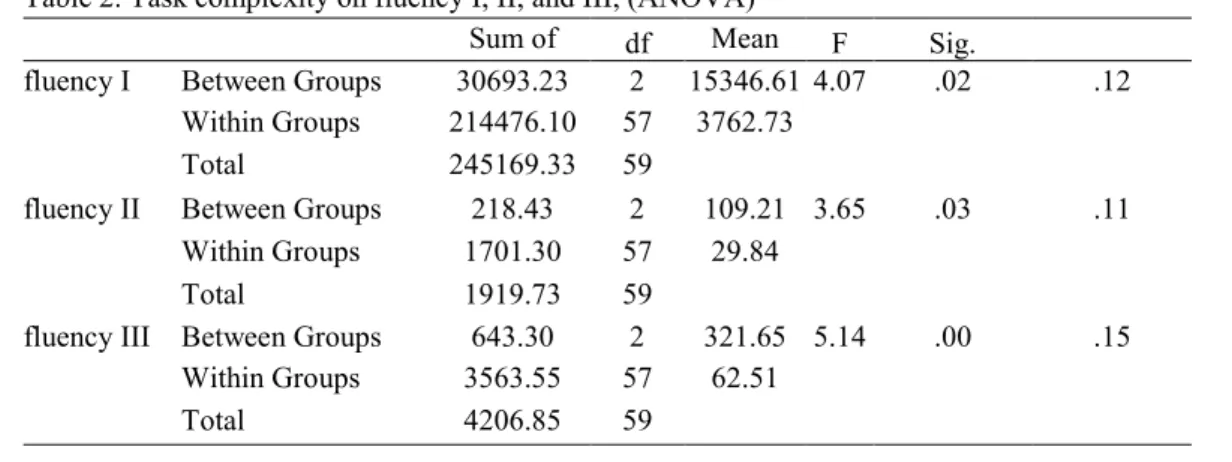
All measures of fluency revealed that the third group was more fluent (fluency I: M = 289.25, SD = 66.25; fluency II: M = 21.70, SD = 6.88; fluency III: M = 35.45, SD = 9.25) than the second group (fluency I: M = 233.85, SD =66.51; fluency II: M = 17.15, SD = 4.95; fluency III: 27.60, SD = 8.41) and the first group (fluency I: M = 261.9, SD = 40.73; fluency II: M = 20.35, SD = 4.19; fluency III: M = 30.10, SD = 5.58). Table 2 indicates whether the observed differences for the three groups were significant. Test of homogeneity of variances showed that the homogeneity of variances of scores for the three measures of fluency was not violated. P values were 0.16, 0.32, and 0.14 for fluency I, II, and III, respectively.
Table 2. Task complexity on fluency I, II, and III, (ANOVA) Sum of
Squares df
Mean
Square F Sig. η²
fluency I Between Groups 30693.23 2 15346.61 4.07 .02 .12
Within Groups 214476.10 57 3762.73
Total 245169.33 59
fluency II Between Groups 218.43 2 109.21 3.65 .03 .11
Within Groups 1701.30 57 29.84
Total 1919.73 59
fluency III Between Groups 643.30 2 321.65 5.14 .00 .15
Within Groups 3563.55 57 62.51
Page | 59 This paper is licensed under a Creative Commons Attribution 3.0 License. There were significant differences among the three groups: F (2, 57) = 4.07, p = .02 (topic group), F (2, 57) = 3.65, p = .03 (topic + idea group), and F (2, 57) = 5.14, p = .00 (topic + idea + discourse marker group). The p values for all three groups were less than .05. Thus, the differences among them were significant. Eta squired showed that the magnitudes of the significant differences among the three groups were too large (Dörnyei, 2007).
Table 3. Task complexity on the fluency I, II, and III (Post Hoc Tukey HSD) Dependent
Variable (I) (J) Mean Difference (I-J) Std. Error Sig.
fluency I TG TIG 28.05 19.39 .32
TID -27.35 19.39 .34
TIG TG
TID
-28.05
-55.40* 19.39 19.39 .32 .01
TID TG 27.35 19.39 .34
TIG 55.40* 19.39 .016
fluency II TG TIG 3.20 1.72 .16
TID -1.35 1.72 .71
TIG TG -3.20 1.72 .16
TID -4.55* 1.72 .02
TID TG 1.35 1.72 .71
TIG 4.55* 1.72 .02
fluency III TG TIG 2.50 2.50 .58
TID -5.35 2.50 .09
TIG TG -2.50 2.50 .58
TID -7.85* 2.50 .00
TID TG 5.35 2.50 .09
TIG 7.85* 2.50 .007
Note. The mean difference is significant at the 0.05 level. * p <.05
Post hoc comparisons using the Tukey HSD test indicated that, as far as fluency I was concerned, the mean score for topic + idea group was significantly different from topic + idea + discourse marker group. Topic group did not differ significantly from topic + idea and topic + idea + discourse marker groups. The Post hoc comparisons for fluency II and III led to the same results as fluency I indicated. For fluency II the topic + idea group was significantly differed from topic + idea + discourse marker group and finally for the fluency III the second group was significantly differed from the third group. In all measures of fluency the third group which received the highest amounts of writing assistance (topic + idea + discourse marker) outperformed the first group (the topic group) and the second group (the topic + idea group).
Page | 60 This paper is licensed under a Creative Commons Attribution 3.0 License. Table 4. Descriptive statistics of the lexical complexity
N M SD
L/F
TG 20 .90 .14
\
TIG 20 .88 .14
TID 20 .93 .13
Average 60 .90 .14
LD
TG 20 46.92 8.46
TIG 20 45.17 4.57
TID 20 46.90 3.58
Average 60 46.33 5.88
MSTTR
TG 20 66.06 4.00
TIG 20 60.66 4.57
TID 20 68.81 4.85
Average 60 65.18 5.58
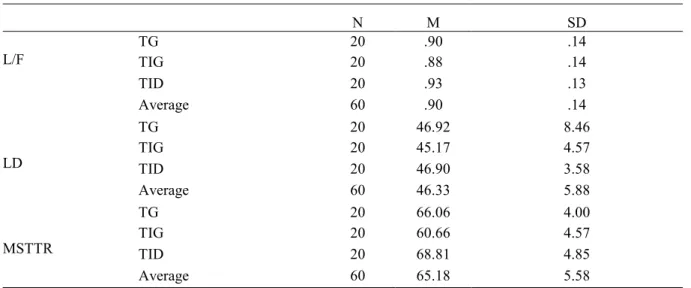
Table 4 shows the descriptive statistics for the topic group, topic + idea group, and topic + idea + discourse marker group. Test of homogeneity of variances showed that the homogeneity of variances of scores for the three measures of lexical complexity was not violated. P values were .93, .26, and .80 (above .05) for L/F, LD, and MSTTR, respectively. The following table (table 5) presents whether the observed differences among the three groups were significant or not.
Table 5. Task complexity on three lexical complexity measures, (ANOVA)
Sum of Squares
df Mean
Square
F Sig. η²
L/F Between Groups .02 2 .01 .57 .56
Within Groups 1.19 57 .02
Total 1.21 59
LD Between Groups 40.24 2 20.12 .57 .56
Within Groups 2003.27 57 35.14
Total 2043.51 59
MSTTR Between Groups 688.77 2 344.39 17.06 .00 .37
Within Groups 1150.32 57 20.18
Total 1839.10 59
Similar to measures of fluency, there was a significant difference when lexical complexity measured by MSTTR [F (2, 57 = 17.06), p = .00 (less than .05)]. The other two measures of lexical complexity, that is L/F [F (2, 57 = .57), p = .56 (greater than .05)] and LD [F (2, 57 = .57), p = .56 (greater than .05)], did not lead to significant differences. The effect size for MSTTR (η² = .37) implied large effect size (Dörnyei, 2007).
Table 6. Task complexity on MSTTR, (Post hoc Tukey HSD)
Dependent variable (I) (J) Mean Difference Std. Error Sig.
(I-J)
MSTTR TG TIG 5.39* 1.42 .00
TID -2.75 1.42 .13
Page | 61 This paper is licensed under a Creative Commons Attribution 3.0 License.
TID -8.15* 1.42 .00
TID TG 2.75 1.42 .13
TIG 8.15* 1.42 .00
Note. The mean difference is significant at the 0.05 level. * p <.05
The results of Tukey HSD test indicated that the mean score for topic group (M = 66.06, SD = 4) was significantly different from topic + idea group (M =60.66, SD = 4.57), p = .00. Furthermore, the mean score for topic + idea group was significantly different from both topic group and topic + idea + discourse marker group (M = 68.81, SD = 4.58), p = .00. The results led to conclusion that the topic + idea + discourse marker group outperformed the other two groups.
5. Discussion
The main purpose of the present study was to detect and analyze the possible effects of manipulating cognitive task complexity through the resource-dispersing factors on fluency and lexical complexity of argumentative essays. Based on Robinson’s (2005, 2007) Cognition Hypothesis, when cognitive task complexity decreased continuously from topic group to topic + idea group and to topic + idea + discourse marker group, fluency and lexical complexity of language production should be increased accordingly. It was found that the different amounts of writing assistance devoted to learners in different groups had a meaningful impact on fluency of writing. With respect to all fluency measures, the least complex task outperformed the other two groups. Regarding fluency, the results of this study were in contrast with that of Ong and Zhang (2010) in that increasing task complexity by omitting the planning time led to greater fluency of writing. The results of present study were also diverged from those of Ong and Zhang (2010) in that the least complex task with minimum level of writing assistance did not enhance fluency I (total number of words produced in every minute of writing). They also reported that the group which enjoyed availability of their drafts during task completion did not differ meaningfully from the other group which did not have access to their draft. This observation was in contrast with the findings of this study.
However, our study was in line with Kellogg’s (1988, 1990) in that the participants in the least complex task (with planning time) outperformed the most complex task (no planning time) as far as fluency I (measured by writing time) was concerned. In the same vein, the results of this study converged with those of Khomeijani Farahani and Meraji’s (2011) study in that learners in the least complex task along with + planning time and + Here-and-Now factors produced more fluent written language. Furthermore, this study was in line with the study by Ahmadian and Tavakoli (2011) in that the opportunity to engage simultaneously in careful online planning and task repetition enhances fluency significantly.
There are at least two reasons as to why the topic + idea + discourse marker group (the least complex task) produced more fluent writing. The first one may be that the learners in this group have been involved in more purposeful and meticulous planning in the time of writing tasks, that is, they had an overall planning in their minds to write the essays. This helped them write fluently whatever came to their minds. “It has been argued that planning helps to reduce cognitive demands placed on the learners during writing task execution” (Ong & Zhang, 2010, p. 227). Secondly, providing the necessary linguistics clues such as idea and discourse markers is a great assistance for fluent writing. To answer to why the difference between the topic and topic + idea group was not significant, it may be that the discourse markers are of more significant importance than relevant ideas in fluent writing, especially in argumentative writing.
Page | 62 This paper is licensed under a Creative Commons Attribution 3.0 License. finding of MSTTR in this study gave support to both above-mentioned models as the comparison was between the second and the third group. However, MSTTR findings contrasted with those hypotheses as the first and the third group compared with each other.
In their study, Ong and Zhang (2010) reported that the most complex task (with the minimum level of writing assistance) enjoyed higher lexical complexity as it measured by revised type-taken ratio. They found that increasing task complexity through resource-dispersing factors resulted in lexical complexity. In this regard, the findings of the present study was different from those of Ong and Zhang (2010), as the group with maximum amounts of writing assistance produced greater lexical complexity as measured by MSTTR, and no differences among tasks were reported as far as L/F and LD were codes of lexical complexity.
Furthermore, there was higher lexical complexity (using MSTTR) in the least complex task than in the most complex one. This result was in contrast with Kuiken and Vedder (2006, 2007), who showed that manipulating cognitive task complexity along with resource-directing dimensions, improved lexical variation as a measures of lexical complexity. However, present findings (L/F and LD) corroborated those of Kuiken, Maria, and Vedder (2005), and Kuiken and Vedder (2008) in finding no significant results regarding lexical complexity.
The lexical complexity findings of this study corroborated the results of the study by Kormos (2011). His findings were similar to this study, as the least complex task produced high number of abstract and sophisticated words (as a different measure of lexical complexity). In addition, there was not any significant differences between complex and non-complex tasks when their writings coded by “D-value, which is the variable that can be regarded as similar to the type-token ratio” (Kormos, 2011, p. 157).
There are at least two possible explanations as to why topic + idea + discourse marker condition resulted in higher lexical complexity (measured by the MSTTR) compared to topic and topic + idea group. The first explanation may be that MSTTR enhanced increasingly in tandem with the supplying higher amounts of writing assistance, as it was observed in the third group. The second explanation for the enhanced lexical complexity might lie in the fact that least complex tasks disposed extra burden of information processing to the learners' mental capacities and led them to use more abstract, sophisticated, and different vocabulary items. This lack of predetermined framework in the first and in the second groups during writing tasks might decrease the lexical complexity (via MSTTR) in those groups.
But, why topic + idea group produced less lexically complex writing compared with the topic group? Maybe, providing the idea for the second group was not great help to them, and it might distract their attention from more complex lexical items they had in their minds. It means that providing some predetermined ideas for the second group prevented learners to use more complex and sophisticated lexical items which might come from brainstorming (as it may be the case in free writing essays). The other reason might be that the topic was so straightforward that it did not stimulate the learners’ minds to use more complex language.
6. Conclusion and Recommendation
This study attempted to investigate the effects of cognitive task complexity on two writing qualities: fluency and lexical complexity in EFL learners’ argumentative writings. Having acknowledged less task-based research in written discourse, this study attempted to make answer to this need by investigating the cognitive task complexity on learners’ writing performance. This was done on two different but somehow related writing qualities: fluency and lexical complexity in the three groups (with different amounts of writing assistance). For fluency of writing, the findings proved that decreasing task complexity enhanced the fluency (measured by fluency I, II, and III) of writing with large effect sizes for all measures of fluency (η2 = .12 [fluency I], .11 [fluency II], and .15 [fluency III]). This finding gave support to both Robinson’s (2005, 2007) Cognition Hypothesis and Skehan’s (2001, 2003) Limited Attentional Capacity Model. However, as far as lexical complexity (using L/F and LD) was concerned, the results showed that significant differences were not found among the groups. However, mean segmental type-token ratio (MSTTR) as the other measure of lexical complexity produced significant differences among the three groups.
Page | 63 This paper is licensed under a Creative Commons Attribution 3.0 License. teaching classrooms. The major problem in TBLT and syllabus designing is to determine a valid criterion for grading and sequencing tasks. Task complexity can be considered as a valid criterion for grading pedagogical tasks in terms of their cognitive complexity (Robinson, 2007). Therefore, the findings of this study can be regarded as empirical basis for selecting, grading, and sequencing tasks. Moreover, the findings of the current study suggested that teachers should take into account the cognitive capabilities of the learners as well as the cognitive load of the structure of the task that was imposed to the learner while teaching.
Task complexity can be manipulated for the purpose of matching with learners' developmental sequence and their proficiency level. In this study, there were different and somehow novel means for operationalizing cognitive complexity of tasks through the providing different amounts of writing assistance. Considering writing performance, the findings suggested that in fluency (I, II, and III) and lexical complexity assessment (using MSTTR) these factors were promising in making difference among various levels of argumentative writing competence. The measures embodied in this study “might not only be used in high-stakes testing contexts but also for self-assessment, which gives learners diagnostic information with regard to their strengths and weaknesses and can foster learner autonomy in the acquisition of FL writing skills” (Kormos, 2011, p. 159). Furthermore, all measures of fluency and lexical complexity used in this study may not be bounded in writing assessments. It also contributes to oral production assessment and analysis.
Our study has also shown that major differences among these groups could be found with relation to fluency I, II, and III and MSTTR measures. Therefore, our research provided further evidence that FL writing classes should focus on task-based writing skills, by focusing on fluent and lexically complex language production. That is, it will be promising to inspire FL writers to put in a handful of different and more sophisticated lexical items in their writing.
In sum, our results did support the predictions made by Robinson’s (2005, 2007) Cognition Hypothesis and Skehan and Foster’s (2001) Limited Attentional Capacity. Like these models, this study proved that increasing cognitive task complexity along with resource-dispersing factors reduced fluency and lexical complexity (measured by MSTTR). Finally, some trade-off effects (Skehan & Foster, 2001) were reported where lexical complexity decreases at the cost of increasing cognitive demands of task. That is, according to Skehan and Foster (2001), more cognitively demanding tasks diverted “learners’ attention to the development of the content of the task instead of focusing their attention on the lexical complexity” (Ong & Zhang, 2010, p. 219). However, these trade-off effects were not shown between fluency and lexical complexity. That is, the task which led to more fluent writing also resulted in more lexical complexity.
In spite of some above-mentioned positive findings which lead to more enlightening task-based writing assessment, some limitations need to be acknowledged. Caution must be taken in generalizing the results of this study and bringing the findings down to the real world of EFL classroom usual procedure. One of the limitations may be that, this study did not uncover extensive effects of cognitive task complexity on written outputs because only 20 participants were recruited for each writing tasks. In addition, task complexity was manipulated through only resource-dispersing factors (according to Robinsons’ Triadic Componential Framework), and the other factors, that is resource-directing factors, were not considered. To fully detect the effects of task complexity on writing performance, it would be useful to manipulate task complexity by both types of factors.
Another limitation of the present study is that it paid no heed to learner factors including learning style and strategies, intrinsic motivation, and their inclination and tendency toward completing task. Insertion of these factors can be instructive in investigation the effects of task complexity in relation to fluency and especially lexical complexity, fully. In this regard, the inclusion of introspective interviews in the design of the research can help to develop a better understanding into what language learners actually do when they are completing a task. So, there is a need for further research here.
Page | 64 This paper is licensed under a Creative Commons Attribution 3.0 License. versus pair (or group) writing tasks and with planning time task versus without planning time task. In summary, the other measures for fluency and lexical complexity will lead to generalize results extensively. Thirdly, it will also be important toinvestigate the learners’ level of proficiency, age, and gender to extrapolate the findings to other proficiency levels (elementary or advanced), other age groups (adolescents or children), or other contexts and language settings such as ESL (English as a second language) settings or English language institutes. Last but not least, further research needs to include both quantitative and qualitative measures regarding different writing qualities.
References
Ahmadian, M. J., & Tavakoli, M. (2011). The effects of simultaneous use of careful online planning and task repetition on accuracy, complexity, and fluency in EFL learners’ oral production. Language Teaching Research, 15(1), 35-59.
Anderson, A., & Lynch, T. (1988). Listening. Oxford: Oxford University Press.
Arslanyilmaz, A., & Pedersen, S. (2010). Improving language production using subtitled similar task videos. Language Teaching Research, 14(4), 377-395.
Bereiter, C., & Scardamalia, M. (1987). The psychology of written composition. Hillsdale, NJ: Erlbaum. Carter, R. (1987). Vocabulary: Applied linguistic perspectives. London: Routledge.
Chandler, J. (2003). The efficacy of various kinds of error feedback for improvement in the accuracy and fluency of L2 student writing. Journal of Second Language Writing, 12, 267–96.
Dörnyei, Z. (2007). Research methods in applied linguistics. New York: Oxford University Press. Ellis, R. (2008). The study of second language acquisition. Oxford: Oxford University Press.
Ellis, R. (2009). The differential effects of three types of task planning on the fluency, complexity and accuracy in L2 oral production. Applied Linguistics, 30, 474–509.
Ellis, R., & Yuan, F. (2004). The effects of planning on fluency, complexity, and accuracy in second language narrative writing. Studies in Second Language Acquisition, 26, 59–84.
Fontanini, I., Weissheimer, J., Bergsleithner, J. M., Perucci, M., & D’Ely, R. (2005). Memória de trabalho e desempenho em tarefas de L2. Revista Brasileira de Lingüística Aplicada, 5 (2), 189-230.
Haberlandt, K. F., & Graesser, A. C. (1985). Component processes in text comprehension and some of their interactions. Journal of Experimental Psychology: General, 114, 357–374.
Ishikawa, T. (2006). The effect of manipulating task complexity along the (- Here - and - Now) dimension on L2 written narrative discourse. In C. M. Garcı´a-Mayo (Ed.), Investigating tasks in formal language learning (pp. 136–156). Clevedon, UK: Multilingual Matters.
Jacobs, H., Zinkgraf, S., Wormuth, D., Hartfiel, V. & Hughey, J. (1981). Testing ESL compositions: A Practical approach. Rowley, MA: Newbury House.
Kellogg, R. T. (1988). Attentional overload and writing performance: Effects of rough draft and outline strategies. Journal of Experimental Psychology: Learning, Memory, and Cognition, 14, 355–365.
Kellogg, R. T. (1990). Effectiveness of prewriting strategies as a function of task demands. American Journal of Psychology, 103, 327–342.
Kellogg, R. T. (1996). A model of working memory in writing. In C. M. Levy & S. Ransdell (Eds.), The science of writing: Theories, methods, individual differences and applications (pp. 57–72). Mahwah, NJ: Erlbaum. Khomeijanifarahani, A. A., & Meraji, S. R. (2011). Cognitive task complexity and L2 narrative writing performance. Journal of Language Teaching and Research, 2(2), 445-456.
Kim, Y. (2009). The effects of task complexity on learner-learner interaction. System 37, 254-268.
Kormos, J. (2011). Task complexity and linguistic and discourse features of narrative writing performance. Journal of Second Language Writing, 20, 148-161.
Page | 65 This paper is licensed under a Creative Commons Attribution 3.0 License. Kuiken, F., & Vedder, I. (2008). Cognitive task complexity and written output in Italian and French as a foreign language. Journal of Second Language Writing, 17, 48-60.
Kuiken, F., Maria, M., & Vedder, I. (2005). Cognitive task complexity and second language writing
performance. In S. H. Foster-Cohen, M. Garcı´a- Mayo, & J. Cenoz (Eds.), Eurosla yearbook (pp.195–222). Amsterdam: Benjamins.
Long, M. (1985). A role for instruction in second language acquisition: task-based language teaching. In K. Hyltenstam, & M. Pienemann (Eds.). Modelling and assessing second language acquisition (pp.77-99). Clevedon: Multilingual Matters.
McCarthy, P. M., & Jarvis, S. A. (2007). Vocd: A theoretical and empirical evaluation. Language Testing, 24, 459–488.
Nassaji, H., & Tian, J. (2010). Collaborative and individual output tasks and their effects on learning English phrasal verbs. Language Teaching Research, 14(4), 397-419.
Ojima, M. (2006). Concept mapping as pre-task planning: A case study of three Japanese ESL writers. System, 34, 566–585.
Ong, J., & Zhang, L., J. (2010). Effects of task complexity on fluency and lexical complexity in EFL students’ argumentative writing. Journal of Second Language Writing, 19, 218-233.
Robinson, P. (2005). Cognitive complexity and task sequencing: A review of studies in a Componential Framework for second language task design. International Review of Applied Linguistics, 43, 1–33.
Robinson, P. (2007). Task complexity, theory of mind, and intentional reasoning: Effects on L2 speech production, interaction, uptake and perceptions of task difficulty. International Review of Applied Linguistics, 45, 193–213.
Robinson, P., Chi-chien Ting, S., & Urwin, J. (1995). Investigating second language task complexity. RELC 26, 62-78.
Samuda, V., & Bygate, M. (2008). Tasks in second language learning. Basingstoke: Palgrave. Skehan, P. (1998). A cognitive approach to language learning. Oxford: Oxford University Press.
Skehan, P. (2001). Tasks and language performance assessment. In M. Bygate, P. Skehan, & M. Swain (Eds.), Researching pedagogic tasks: Second language learning, teaching and testing (pp. 167–185). Harlow: Pearson Education Longman.
Skehan, P. (2003). Task-based instruction. Language Teaching, 36, 1–14.
Skehan, P., & Foster, P. (2001). Cognition and tasks. In P. Robinson (Ed.), Cognition and second language instruction (pp. 183–205). New York: Cambridge University Press.
Suzuki, M. (2006). Negotiation processes and text changes in Japanese learners’ self revisions and peer revisions of their written compositions in English. Unpublished doctoral dissertation, University of Toronto, Canada. Weir, C., O’Sullivan, B., & Horai, T. (2006). Exploring difficulty in speaking task: An intra-task perspective. IELTS Research Reports 6.
Wigglesworth, G., & Storch, N. (2009). Pair versus individual writing: Effects on fluency, complexity and accuracy. Language Testing, 26(3), 445-466.