Address for correspondence Dr. Samreen Rafi
Department of Dermatology,
Postgraduate Medical Institute, Ameer Uddin Medical College/Lahore General Hospital, Lahore
Email: [email protected]
Original Article
Comparison of efficacy and safety of topical
hydroquinone 2% and oral tranexamic acid 500 mg
in patients of melasma
Introduction
Melasma is a common, acquired hypermelanosis that occurs in sun-exposed areas, mostly on the face, occasionally on the neck, and rarely on the forearms.1,2
It is most prevalent in Southeast Asia, in 40 % in females and 20% in males. In Asia, 50% of aesthetic consultations are of melasma. Occurs in 50-70% of pregnant women in USA3 and in 50 to 80 % of Latina women.4 Although 41% females developed melasma after pregnancy, only 8% showed spontaneous remission.5
Prevalence is higher in females with a female to male ratio of approximately 4:1. Women with multiple pregnancies have higher incidence Samreen Rafi, Usma Iftikhar*, Zahida Rani**, Ijaz Hussain*
Department of Dermatology, Postgraduate Medical Institute, Ameer Uddin Medical College/Lahore General Hospital, Lahore
* Department of Dermatology, Unit-1, King Edward Medical University/Mayo Hospital, Lahore ** Department of Dermatology, Khawaja Safdar Medical College/Lahore General Hospital, Lahore
Abstract
Objective To compare the efficacy of topical hydroquinone 2% and oral tranexamic acid 500mgdaily in patients of melasma.
Methods A total of 140 patients (70 patients in each group) were enrolled, who were randomly divided into 2 groups. Group A was treated with topical hydroquinone 2% and group B was given oral tranexamic acid 500mg daily. Follow-up was carried out at the end of 2nd, 4th and 8th week to compare reduction in MASI score at last follow-up.
Results The mean age of patients was 29.67 ± 6.38 years with an age range of 15 to 45 years. There were 28 (20%) male and 112 (80%) female patients. Majority i.e. 120 (85.7%) cases were married and 20 (14.3%) were unmarried. The age of onset was 15-25 years in 67 (47.9%) patients, 26-35 years in 52 (37.14%) and 36-45 years in 21(15%) patients. Both groups showed a decline in MASI score; however, the results were significantly greater in group B (oral tranexamic acid). At final follow-up, the mean percentage reduction was higher in group B (77.97±8.37) as compared to group A (67.02±8.42), p < 0.001. Adverse effects like erythema, burning, allergic contact dermatitis and pigmentation were noticed in the first group. One (1.4%) patient developed nausea and vomiting and diarrhea with oral tranexamic acid.
Conclusion Oral tranexamic acid 500 mg had a better response when compared with topical hydroquinone 2% cream and better safety profile. It might be considered as a future treatment option.
Key words
(51%) compared with single women (25%) or with no pregnancy (24%).6
Hydroquinone (HQ), a phenolic compound,
blocks the conversion of
3,4-dihydroxyphenylalanine (DOPA) to melanin through inhibiting tyrosinase7 and reduces
dyschromia through melanocyte
downregulation, prevention of melanosome production, and reduction of melanin transfer to keratinocytes. It is commonly is prescribed in a 4% concentration but is available in 10% and 2% concentration. Constant use is associated with exogenous ochronosis.8 Reductions in lesion size, darkness, and severity occurred as early as 4 weeks after treatment and remain significantly reduced throughout the study.9 It is effective in twice daily applications and should be applied to the entire face because bull’s-eye areas of discoloration can develop from localized application.10
Tranexamic acid
(Trans-4-aminomethylcyclohexanecarboxylic acid) [TNA], is a plasmin inhibitor used to prevent abnormal fibrinolysis to reduce blood loss.11 It is a synthetic lysine derivative and blocks lysine binding sites on plasminogen molecules, preventing conversion of plasminogen to plasmin. As plasminogen exists in human epidermal cells and cultured keratinocytes, it is thought to affect keratinocyte function and interaction.11 It decreases arachidonic acid induced pigmentation.12 and inhibits UV induced plasmin activity in keratinocytes, subsequently reducing melanogenesis.13 When prescribed at a dose of 250 mg twice a day for three months, the (MASI) score decreased from (11.08±2.91) to (7.84±2.44) at 12 weeks with a p-value of <0.05.14 Thromboembolism, pulmonary embolism and myocardial infarction have rarely been reported.15
Both TNA and HQ 2% have their individual efficacy and some side effects. However, their comparative efficacy has not been studied and no published data are available in this regard. Hence, our study aims to compare the efficacy of topical HQ 2% and oral TNA 500mg in patients of melisma.
Methods
It was a randomized control trial carried out in the Outpatient Department of Dermatology,
Lahore General Hospital, Lahore. The study was
carried out from September 2014 to January
2016. One hundred and forty patients with
melasma (70 patients in each group) anticipating number of drop-outs were taken. Patients were divided randomly in 2 groups using random number tables. Sample size was calculated using expected frequency of efficacy of tranexamic
acid16 and topical hydroquinone 2%.9
Patients of melasma, between 15-45 years, not on any medication in the preceding two months were enrolled. Patients suffering from any inflammatory facial dermatosis e.g. discoid
lupus erythematosus, lichen planus etc.,
pregnant and lactating females, those suffering from any systemic disease e.g., chronic liver disease, chronic renal failure, patients on oral contraceptives or hormone replacement therapy were not included. Patients with a history of thrombosis or an abnormal bleeding profile or receiving treatments in the last two months e.g., microdermabrasion, chemical peeling or laser
were excluded. Patients with acquired
disturbance of colour vision before or during the course of treatment, were dropped. Patients with history of hypersensitivity to tranexamic acid or irregular menstrual bleeding were not included.
were diagnosed clinically and Wood’s lamp examination was performed. For each patient, the area involved was plotted on a diagram. A complete blood count and fibrin degradation product (FDP) levels at the start and at each follow-up was done in all patients. Eye examination was performed for colour vision at the start of treatment and at each follow-up. Group A patients was treated with topical hydroquinone 2% cream applied at night on the affected area and group B was treated with oral tranexamic acid (250mg bid) for 8 weeks. Both groups were advised to use sunscreen with SPF
30 during the daytime. Follow-up was carried
out at the end of 2nd, 4th and 8th week to determine the improvement (reduction in MASI scoring) and side effects (both subjective and objective). Patients were assessed by a blind observer unaware of the treatment offered.
Melasma area and severity index (MASI) was calculated as follows. Face was divided into four regions i.e. the forehead was equivalent to 30%, right malar 30%, left malar region 30% and chin 10%. A numerical value was assigned for this percentage with 0 denoting no involvement, 1 = < 10%, 2 = 10-29%, 3 = 30-49% involvement, 4
= 50-69% involvement. 5 = 70-89%
involvement and 6 = 90-100% involvement
The darkness of the melasma (D) compared to
normal skin and the homogeneity of
hyperpigmentation (H) between 0-4, with 0 meaning normal skin colour and 4 showing severe hyperpigmentation.
For MASI, the sum of darkness (D) and homogeneity (H) was multiplied by the numerical value of the area (A) and percentages involved. Values was summated to obtain total MASI; Forehead 0.3 (D+H)A + Right malar 0.3 (D+H)A + Left malar 0.3 (D+H)A + Chin 0.1 (D+H)A. It can vary from 0 to a maximum of 48. The improvement was graded as reduction
in MASI at week 8 as very good when >75% improvement, good 51-75% improvement, moderate 25-50% improvement, mild <25% improvement and no change when there was 0 improvement.
Data were entered and analyzed using SPSS version 20. Quantitative variables i.e. age were presented as mean ± SD. The qualitative variables i.e. lightening in pre-existing lesions were presented as percentages. % MASI reduction (reduction in MASI) score. Qualitative data were compared using Chi-square test at each follow-up. Independent sample t-test / Mann-Whitney U test was used for the comparison of quantitative data in both groups at
each follow-up. A p value of ≤0.05 was
considered statistically significant.
Results
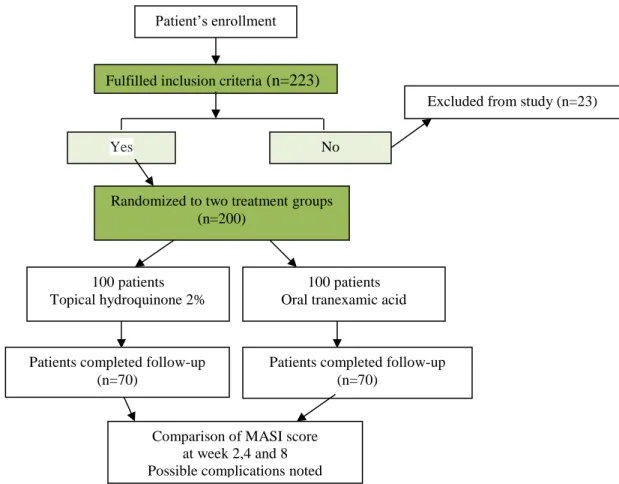
Figure 1 shows the flow of study participants. In total, 223 patients were screened for the study. Out of these 23 were excluded according to the study criteria. 200 patients were randomized into group A (topical HQ) and group B (oral TNA). At the start of study there were 100 patients in each group, but 70 patients in each group completed the study. 30 patients in each group were considered drop-outs. The reasons for drop out were mostly poor compliance and inability to come for follow-up. The mean age of patients was 29.67 ± 6.38 years with a range of 15 to 45 years. The mean age in group A and in group B was 28.66± 6.54 and 30.69 ± 6.10 years, respectively (p-value > 0.05. There were 28 (20%) male and 112 (80%) female patients with male to female ratio of 1:4.
Figure 1 Flow of participants in different phases of the study.
Figure 2 Comparison of reduction in the mean MASI score in two treatment groups, group A (topical HQ), group B (oral tranexamic acid).
40.42
22.29
14.47
13.33 41.22
20.73
11.33 9.08
0 5 10 15 20 25 30 35 40 45
Baseline 2 weeks 4 weeks 8 weeks
M
A
SI
sco
re
Weeks
Group A Group B Patient’s enrollment
Fulfilled inclusion criteria (n=223)
100 patients Topical hydroquinone 2%
Yes No
100 patients Oral tranexamic acid
Patients completed follow-up (n=70)
Excluded from study (n=23)
Comparison of MASI score at week 2,4 and 8 Possible complications noted Randomized to two treatment groups
(n=200)
Table 1 Grades of improvement in two groups of melasma treated with 2% hydroquinone (group A) and oral tranexamic acid 500mg (group B).
Grades of improvement Group A
(n=70)
Group B (n=70)
P value
No response (no change in MASI) 3 (4.3%) 2 (2.9%) 0.6468*
Mild (<25% improvement) 7 (10%) 5 (7.2%) 0.548**
Moderate (25-50% improvement) 23 (32.8%) 8 (11.4%) 0.002**
Good (51-75% improvement) 27 (38.6%) 40 (57.1%) 0.027**
Very good (>75% improvement) 10 (14.3%) 15 (21.4%) 0.2694**
* Fisher exact test, ** chi square test, p< 0.05 consideredsignificant Table 2 Adverse effects observed in group A with
topical 2% hydroquinone cream (n=70).
Adverse event N (%)
Erythema 19 (27.1)
Hyperpigmentation 7 (10)
Burning 6 (8.6)
Allergic contact dermatitis 5 (7.1)
Itching 2 (2.9)
patients, onset of disease was related to their pregnancy. Majority of patients, 76 (54.3%) had centrofacial melasma and 64 (45.7%) had malar areas involved. One twenty-three (87.9%) who had persistent disease, while 10 (7.1%) had
recurrence of disease.
Figure 2 compares the efficacy of two
treatments in melasma. At 0 week mean MASI
score was almost same in both study groups i.e. 40.42±4.74 in group A (treated with 2% hydroquinone cream) and 41.22±4.16 in group B (treated with oral tranexamic acid), p > 0.05. The mean MASI score at week 2, declined in both groups; however, it was significantly lower in group B (20.73±3.76) as compared to group A (22.29±3.57), p = 0.002. This trend continued and the mean MASI score at 4th week in group B was 11.33±4.48) and was lower than that in group A (14.47±3.11), p < 0.001. Similarly, at 8 weeks of treatment, the mean MASI score in group A and B was 13.33±3.29 and 9.08±3.39, respectively; mean MASI score was significantly lower in group B, p<0001. At final follow-up, the mean percentage reduction was higher in group B (77.97±8.37) when compared to group A (67.02±9.511), p<0.001.
Regarding the grades of improvement (Table 1), higher number of patients in group B than in group A i.e. 15 (21.4%) vs. 10 (14.3%) showed >75% improvement graded as very good; however, this difference was statistically insignificant (p=0.269). 51-75% improvement scored as good was seen in 40 (57.1%) patients in group B and 27 (38.6%) in group A, (p=0.027). As a whole 37 (52.8%) patients in group A and 45 (64.3%) patients in group B demonstrated >50% clinical improvement in disease severity (p=0.001). In group A, 33 (47.1%) patients and in group B, 25 (35.7%) patients showed <50% improvement.
Adverse effects noticed in group A patients are
depicted in Table 2. In the group B, 1 (1.4%)
patient each complained of nausea. vomiting and diarrhea; however, these were mild and did not warrant discontinuation of treatment. No ocular or thromboembolic complications were seen.
Discussion
effective treatment for melasma.
Nonetheless, the comparison between two groups showed that mean reduction in the MASI score was significantly lower in the group B by the second week of treatment and this significant difference was maintained by the end of study period i.e. week 8. The respective mean baseline MASI scores in group A and B reduced from 40.42±4.74 and 41.22±4.16 to 13.33±3.29 and 9.08±3.39 (p<0.000), with a reduction of 67.02±9.511% and 77.97±8.42%, respectively (p<0.001). This applies that TNA proved to be a significantly better treatment for melasma in our study population.
In terms of grades of improvement, 45 (64.3%) patients in group B, treated with TNA showed >50% improvement in melasma; very good (>75% improvement) in 15 (21.4%) and good (51-75% improvement) in 40 (57.1%) patients. In contrast, in group A, treated with topical HQ, 37 (52.8%) patients demonstrated >50% improvement; very good (>75% improvement) in 10 (14.3%) and good (51-75% improvement) in 27 (38.6%) patients. There was statistically significant difference between two group (52.8% [group A] vs. 64.3% [group B], p=0.001; this implied that TNA achieved significantly better results than HQ treatment.
The search of literature did not reveal any study comparing the efficacy of TNA with an established anti-melasma treatment.
A recent study by Padhi and Pradhan (2015),17 triple combination formula (HQ 2%, fluocinolone acetonide 0.01%, tretinoin 0.05%) was tested against oral TNA 250mg (bid) for 8 weeks. The MASI scores at baseline, 4 weeks and 8 weeks in group A were 15.425±1.09, 11.075±9.167 and 6.995±6.056, respectively and in group B 18.243±1.05, 6.135±4.94 and 2.19±3.38, respectively. The researchers
observed more rapid improvement in pigmentation in TNA as opposed to triple combination formula (p< 0.05) and efficacy was sustained throughout follow-up period of six months.17 This study endorses the results of our study that TNA treatment acts faster than the traditional topical therapies, as mean MASI scores in our study at week 2, 4 and 8 were lower in TNA group than that of HQ group. The underlying mechanisms of this faster effect with TNM are not fully known. Kim et al.18 in their in
vitro study observed that TNA-treated
melanocytes showed less tyrosinase activity and melanin synthesis. TNA also decreased levels of tyrosinase, TRP-1, and TRP-2. This inhibitory effect on melanogenesis involved the extracellular signal-regulated kinase signaling pathways and MITF degradation.
Results of our study are also in conformity with many previous studies, which showed the efficacy of HQ and TNA in melasma.
HQ has been used successfully in melasma as alone or as combination formula for decades. One study showed good to excellent improvement in melasma among 55% of studied patients using 4% hydroquinone cream, with a 29% of side effect.19 Another study compared efficacy of topical 4% hydroquinone vs 0.75% kojic acid in 60 patients of melasma. After 4 weeks of treatment, early improvement was noticed with HQ than with kojic acid. In 4% HQ group, there was a significant decrease in MASI from week 0 to week 4, week 8 and to week 12 (p≤0.001).20 Yet another study investigated the efficacy of combination of HQ 2%, KA 1% and GA 2% in the treatment of melasma. After 12 weeks of treatment, the mean MASI score decreased by 24%.21
treated 12 patients of melasma with oral TNA 1.5g/day along with vitamin for five months. They noticed significant improvement in 11/12 patients. Clinical results became evident within 4 weeks. Hajime et al.23 used TNA in a dose of 1-1.5g/day for 10 week; 33/40 patients showed reduced severity of melasma. Similar encouraging results were reported by Higashi,24 as well. He also used 0.75-1.5g/d TNA. All of patients improved in a few months without any major adverse event. However, relapse occurred in a few months after stopping treatment.
Zhu et al.25 treated 120 patients with TNA
0.75g/day along with vitamin E and C where as 30 controls were given only vitamin E and C for 6-8 weeks. 20% patients showed >95% reduction in the severity of disease, 30% >60% decrease and another 33% had 20-60% improvement. They concluded that it is better to increase the duration of treatment or the number of courses than to increase the dose of TNA. Regarding safety, there was no change in the coagulation laboratory tests and only a few cases of GI upset were reported. 25 Liu et al.26 using a similar treatment protocol compared 176 patients with 70 controls. The treatment group demonstrated greater improvement than the control group in terms of area reduction and pigment reduction. Around 5% patients, both in treatment and control group presented with mild tolerable GI symptoms. Coagulation parameters were checked in 61 patients of treatment group and no significant abnormality was detected.26
Wu et al.27 treated 256 patients of melasma with
250 mg twice a day oral TNA as the only modality. One-third patients showed clinical improvement in the first month, and another 33% improved after the 2nd month. After 6 months, 10.5% patients showed 90% pigmentation reduction, 19% showed 60% improvement, and 52% had 30% reduction. During treatment, 4% of patients showed GI
upset and 3% had hypomenorrhea. Coagulation profile was essentially normal.27
Mafune et al.28 tested 750 mg oral TNA for 8 weeks with a placebo. 76.8% of the TNA group showed improvement, whereas only 27% had effect in the placebo group (p<0.001). In the TNA, one case of transient chest discomfort was observed.
A relatively lower dose of TNA i.e. 500mg/day was used in the subsequent studies.
In 2011, Cho et al.29 used 500 mg/day of TNA as an additional therapy to 24 patients treated with IPL or Nd:YAG laser for melasma compared to 27 patients who were treated with only laser/IPL. The modified MASI score was lower in the TNA group (p<0.005). TNA treatment up to 6 months did not show any severe systemic side effect.
Wu et al.16 (2012) in their study investigated the
role of TNA in melasma. After 6 months of treatment, the effects were graded as excellent (10.8%), good (54%), fair (31.1%,), and poor (4.1%). Gastrointestinal discomfort (5.4%) and hypomenorrhea (8.1%) were observed, but no severe complications were found. The recurrence of melasma was occurred in 9.5%.
In a regional study from Nepal, Karn et al.14 compared the efficacy of oral TNA with routine topical therapies for the treatment of melasma. A decrease in the severity index of disease was observed by 8 and 12 week of TNA treatment (11.08±2.91 vs 8.95±2.08 at week 8 and vs. 7.84±2.44 at week 12; p<0.05). The authors concluded that addition of oral TNA provides rapid and progressive improvement in the treatment of melasma.14
in our population.30 Results of the study showed that 41 patients had good, 15 had excellent and 8 patients had fair improvement. None of the patients had serious systemic side effects, only few had oligomenorrhea, palpitation and gastric upset. Patients’ satisfaction was similarly noted.30
Tan et al.31 treated 25 patients with oral TNA
250mg bid. daily along with combination topical therapy for six months. Mean MASI scores decreased from 8.8±4.2 to 2.7±1.6, (p<0.01) with 69% reduction.
Lee et al.32 retrospectively analyzed the data of
561 patients treated with 500mg TNA (250mg bid) for mean duration of 4 months. 89.7% patients improved. Response was better in those who did not have family history of melasma (90.6% vs. 60.0%, p=0.01). Clinical improvement started within 8 weeks of start of treatment and relapse rate was 27.2%.
Regarding the safety profile of TNA treatment, in our study no serious adverse effects were seen. Only two patients presented with drug-related side effects (one each with nausea and vomiting and diarrhea), which were self-limiting and did not required discontinuation of treatment. This observation is also in agreement with above-mentioned studies. Gastrointestinal upset had been the most frequent side effect (reported frequency ~5%) followed by hypomenorrhea (reported frequency ~3.5%).11 In study by Wu et al. (2012), 8.1% of the subjects reported hypomenorrhea, which disappeared after stopping TNA.Clotting profile tested in patients did not show any abnormality.
Lee et al.32 (2016) reported adverse events in
40/561 (7.1%) patients. Only one of their patients developed deep vein thrombosis and this turned out to be a case of familial protein S deficiency.
The plethora of studies (from 1979 to 2016) support the efficacy of TNA in melasma in low doses (500mg/day), as well as, high doses (075-1.5g/day); duration of study ranging from 8 weeks to six months; used alone or in combination with other therapies. However, certain issues need to be resolved. What is the optimum dose of TNA in melasma? TNA is primarily used in patients with menorrhagia and other bleeding diatheses. The recommended dose of TNA in these indications is higher in range of 1.5 to 2.0 g/day. So use of such a higher dose in melasma patients may lead to hypomenorrhea and thromboembolic phenomenon. In order to avoid these adverse events, a lower dose of TNA i.e. 250 mg twice times daily, much lower than the usual dose to reduce excessive bleeding, is recommended. At least 1 month is required to see clinical improvement.11
Limitations of our our study are shorter duration of follow-up. Studies with extended follow-up are likely to show the time period required to achieve the maximum reduction in disease severity, after which treatment should be stopped or tapered. It shall also be interesting to note the long-term adverse effects of TNA. It will be worthwhile to study the adjuvant role of TNA along with ither treatment like HQ, triple/double combination formula, chemical peeling or lasers/IPL in the treatment of resistant melasma.
References
1. Damevska K. New Aspects of Melasma. Serbian J Dermatol Venereol. 2014;6:5-18. 2. Lee A-Y. An updated review of melasma
pathogenesis. Dermatologica Sinica. 2014;32:233-9.
4. Pawaskar MD, Parikh P, Markowski T, Mcmichael AJ, Feldman SR, Balkrishnan R. Melasma and its impact on health‐ related quality of life in Hispanic women. J Dermatolog Treat. 2007;18:5-9.
5. Ortonne JP, Arellano I, Berneburg M, Cestari T, Chan H, Grimes P et al. A global survey of the role of ultraviolet radiation and hormonal influences in the development of melasma. J Eur Acad Dermatol Venereol. 2009;23:1254.
6. Rao DS, Shankar K, Somani VK, Kohli M, Sharad J, Ganjoo A et al. A cross-sectional, multicentric clinico-epidemiological study of melasma in India. Dermatol Ther. 2014;4:71-81.
7. Grimes PE. Management of
hyperpigmentation in darker racial ethnic groups. Semin Cutan Med Surg. 2009;28 :77-85.
8. Levin CY, Maibach H. Exogenous ochronosis. Am J Clin Dermatol. 2001;2:213-7.
9. Cook-Bolden FE, Hamilton SF. An open-label study of the efficacy and tolerability of microencapsulated hydroquinone 4% and retinol 0.15% with antioxidants for the treatment of hyperpigmentation. Cutis. 2008;81:365-7.
10. Bandyopadhyay D. Topical treatment of melasma. Indian J Dermatol. 2009;54:303. 11. Tse TW, Hui E. Tranexamic acid: an
important adjuvant in the treatment of melasma. J Cosmet Dermatol. 2013;12 :57-66.
12. Maeda K, Naganuma M. Topical trans-4-aminomethylcyclohexanecarboxylic acid prevents ultraviolet radiation-induced pigmentation. J Photochem Photobiol B. 1998;47:136-41.
13. Hashimoto K, Prystowsky JH, Baird J, Lazarus GS, Jensen PJ. Keratinocyte urokinase-type plasminogen activator is secreted as a single chain precursor. J Invest Dermatol. 1988;90:823-8.
14. Karn D, KC S, Amatya A, Razouria E, Timalsina M. Oral tranexamic acid for the treatment of melasma. Kathmandu Univ Med J. 2012;10:40-3.
15. Cho HH, Choi M, Cho S, Lee JH. Role of oral tranexamic acid in melasma patients treated with IPL and low fluence QS Nd: YAG laser. J Dermatolog Treat. 2013;24:292-6.
16. Wu S, Shi H, Wu H, Yan S, Guo J, Sun Y, Pan L. Treatment of melasma with oral
administration of tranexamic acid. Aesth Plast Surg. 2012;36:964-70.
17. Padhi T, Pradhan S. Oral tranexamic acid with fluocinolone-based triple combination cream versus fluocinolone-based triple combination cream alone in melasma: an open labeled randomized comparative trial. Indian J Dermatol. 2015;60:520.
18. Kim MS, Bang SH, Kim J-H, Shin H-J, Choi H, Chang SE. Tranexamic acid diminishes laser-induced melanogenesis. Ann Dermatol. 2015;27:250-6.
19. Navarrete-Solís J, Castanedo-Cázares JP, Torres-Álvarez B, Oros-Ovalle C, Fuentes-Ahumada C, González FJ et al. A double-blind, randomized clinical trial of niacinamide 4% versus hydroquinone 4% in the treatment of melasma. Dermatol Res Prac. 2011;21;2011.
20. Monteiro RC, Kishore BN, Bhat RM, Sukumar D, Martis J, Ganesh HK. A comparative study of the efficacy of 4% hydroquinone vs 0.75% Kojic acid cream in the treatment of facial melasma. Indian J Dermatol. 2013;58:157.
21. Chowdhury WK, Wahab MA, Khondker L, Khan MS, Shirajul IK. Efficacy and safety of hydroquinone, kojic acid and glycolic acid combination in the treatment of melasma. Bangladesh J Med Sci. 2012;11:191.
22. Sadako N. Treatment of melasma with tranexamic acid. Clin Represent. 1979;13:3129-31.
23. Hajime, M., Mineo, T., Yoshio T. Oral administration therapy with tranexamic acid for melasma. Nishinihon J Dermatol. 1985;47:1101-14. (Japanese).
24. Higashi N. Treatment of melasma with oral tranexamic acid. Skin Res. 1988;30:676-80. (Japanese).
25. Zhu HJ, Yang XH. The clinical study of acidum tranexamicum on melasma. Pharmacol Prog. 2001;3:178-81.
26. Liu H, Kou CC, Yeung CW. Effectiveness of tranexamic acid in treating melasma and observation of its safety. Chin J Med Aesth Cosmet. 2005;11:361-3).
27. Wu SF, Shi HY, Chen Y, Yan Sh CD, Guo J. Treatment of melasma with oral administration of tranexamic acid. Chinese J Aesth Plast Surg. 2008;2:10.
29. Cho HH, Choi M, Cho S, Lee JH. (2013) Role of oral tranexamic acid in melasma patients treated with IPL and low fluence QS Nd: YAG laser. Journal of Dermatological Treatment. 24. p. 292-296. 30. Aamir S, Naseem R. Oral tranexamic acid in
treatment of melasma in Pakistani population: a pilot study. Journal of Pakistan Association of Dermatology. 2016 Dec 2;24(3):198-203.)
31. Tan AW, Sen P, Chua SH, Goh BK. Oral tranexamic acid lightens refractory melasma. Australas J Dermatol. 2017;58:e105-e108.