LIMPOPO PROVINCIAL
GOVERNMENT
Performance Management
System (PMS)
Information Manual
For
Employees signing the
Memorandum of Understanding
On Performance
April 2004 (2
nd
Edition)
Compiled: by Simeka Management Consulting through the support of the Integrated Provincial Support Programme (IPSP)
(i) Table
of
Contents
Page
I Table of Contents 2
II List of Tables 4
III List of Diagrams 5
IV Declaration 6
V Foreword 7
VI Acknowledgements 8
PART A: THE PERFORMANCE MANAGEMENT FRAMEWORK
Chapter 1: The design and implementation of a Performance Management System of the Limpopo Province: An Overview
1.1 Phases of PMS design and implementation process 10
Chapter 2: Introduction to Performance Management
2.1 What is Performance Management? 11
2.2 Why is Performance Management system necessary? 11
2.3 What does Performance Management system do? 12
2.4 What are the main objectives of a Performance Management System? 12
2.5 What are the underlying Principals of a PMS? 13
2.6 What does the legislation say about PMS in the Public Sector? 13
PART B: THE PERFORMANCE MANAGEMENT SYSTEM Chapter 3: What is the balanced scorecard (BSC)?
3.1 What constitutes the Provincial PMS? 16
3.2 The advantages of the BSC approach 17
3.3 Alignment of Departmental Plans to the balanced scorecard 17
PART C: IMPLEMENTATION OF PERFORMANCE MANAGEMENT SYSTEM (PMS)
Chapter 4: A Step-By-Step Guide: Developing the Organizational PM Framework in line with BSC
4.1 Introduction 20
4.2 Developing the strategic level framework 21
4.3 Developing the operational level framework 26
4.4 Performance management cycle 28
4.5 What are PM measures? 34
4.6 Criteria of a good measures (standards, indicators, baselines, & targets 37
Chapter 5: Performance Planning and Contracting
5.1 Introduction to Performance Planning and Contracting 38
5.2 The different types of performance instruments 40
5.3 Who uses which type of performance instrument? 40
5.4 The parts of a complete performance instrument (PI) 41
5.5 About competences 42
5.6 The development of workplan type of memorandum of understanding on performance
43
5.7 The development of standards framework type of memorandum of understanding on performance
51
Chapter 6: Monitoring Performance
6.1 Introduction to monitoring progress 55
6.2 Conducting Progress Reviews 58
6.3 Some useful notes in preparing and conducting progress review discussions
60
6.4 Conducting the actual PRD 63
6.5 What skills and attitudes are required to engage in an effective PRD? 64
Chapter 7: Performance Evaluation
7.1 Introduction to performance evaluation 71
7.2 Conducting individual or team evaluations 72
7.3 Performance rating 73
7.4 Step by step performance evaluation / Rating process 75
7.5 Evaluating departmental / directorate performance 77
Chapter 8: Managing Performance Outcomes
8.1 Role of communication in minimizing conflict 87
8.2 What guiding principles should manage performance outcomes? 87
8.3 What do the Public Service Regulations say about under-performance? 88
8.4 How to support employees who under-perform or whose performance is unacceptable
88
8.5 Managing disagreement at the initial stage of drawing up a performance agreement or memorandum of understanding on performance?
90
8.6 What are the consequences of collective agreements? 90
8.7 Performance improvement plan outline for managing under-performance
91
Chapter 9: Oversight, Institutional Arrangements and Structures, Stakeholder Roles and Responsibilities
9.1 Performance management oversight 95
9.2 Lines of accountability 97
9.3 Dispute Resolution 99
9.4 Institutional arrangements, structures, roles and responsibilities 99
9.5 Enabling Conditions: PM Culture and Associated Leadership Behaviours that support an effective PMS Implementation
103
9.6 Step-by-step development of a PMS roll-out 104
Annexure:
1. Full Performance Agreement Example 105 2. Some Criteria for Assessing Generic Core Competencies 122
(ii) Lists of Tables
Table 1 Confirmation of the departmental vision Pg 22
Table 3 Developing a departmental strategic focus Pg 23
Table 4 Translating strategic objectives into four perspectives
Pg 24
Table 5 Identifying measures of success for each
strategic objective
Pg 25
Table 6 Developing the operational level framework Pg 26
Table 7 Description of P.M. Cycle: Phase 1 Pg 30
Table 8 Description of P.M. Cycle: Phase 2 Pg 31
Table 9 Description of P.M. Cycle: Phase 3 Pg 33
Table 10 Preparing for the self / managerial reviews (PRD) Pg 60
Table 11 Step-by-step guide to prepare for progress
review
Pg 61
Table 12 Step-by-step guide to conduct managerial & peer reviews
Pg 62
Table 13 Rating scale Pg 74
Table 14 Points scale Pg 74
Table 15 Step-by-step guide to conduct department & directorate evaluations
Pg 78
Table 16 Routes to follow in the event of disagreement when drawing up a P.A.
Pg 90
Table 17 Step-by-step guide for managing
under-/unacceptable performance
Pg 91
(iii) List of Diagrams
Diagram 1 The four perspectives of the BSC Pg 18
Diagram 2 Confirmation of the departmental vision Pg 22
Diagram 3 Performance Management Cycle Pg 29
Diagram 4 Description of elements of performance
measures
Pg 35
Diagram 5 Example of performance measures Pg 36
Diagram 6 Phase 1: (Planning and Contracting) Pg 39
Diagram 7 Phase 2: (Monitoring Progress) Pg 57
Diagram 8 Phase 3: (Performance Evaluation) Pg 72
Diagram 9 Performance rating components Pg 73
Diagram 10 Managing Performance Pg 94
Diagram 11 P.M.S. institutional arrangements Pg 96
Diagram 12 Performance management hierarchy Pg 98
(iv) Declaration
DECLARATION OF COMMITMENT BY THE PREMIER OF THE LIMPOPO PROVINCE ON BEHALF OF ALL MEMBERS OF THE EXECUTING
COUNCIL (MECS): 23TH OCTOBER 2002
“I, Ngwako Ramathlodi, Premier of the Limpopo Province, in my capacity as Head of the Executive Council, hereby commit myself and all members of the Executive Council to lead and support the full implementation of the Performance Management System (PMS) adopted and developed in this Province. We undertake to champion this system in each department in the full belief that an effective PMS, well managed and efficiently implemented will inevitably lead to improved service delivery, to the benefit of all our citizens in our Province.”
Signature:
Date: 23/10/2002___
(v) Foreword
Since 1997, there has been a major shift in the focus of the South African Public Service towards transformation. A number of pieces of legislation, white papers as well as collective agreements have been passed to ensure this focus is not lost in the daily bustle and hustle commonly associated with large bureaucracies like government departments. Most notable of these legislative frameworks affecting organizational and individual performance is;
The White Papers on Public Service Transformation, Service Delivery Affirmative Action and Human Resources Management
The Public Service Act on Labour Relations (LRA), New Public Service, SAQA, Employment Equity and Skills Development
The Public Service Regulations (as amended) And PSCBC and other relevant resolutions
The shift in focus has meant that all levels or tiers of government have had to direct their energies in developing policies, systems and practices that seek to put delivery of service to the customer first, following Batho-Pele principles. The establishment of appropriate internal and external mechanisms for monitoring and evaluation will be central to the process of administrative transformation. Performance auditing and appraisal will be an integral part of this process (The White Paper on Public Service Transformation).
To ensure that all departments find effective and efficient ways of turning around the focus of each individual in the public service, the Limpopo Provincial Administration agreed to have a uniform PMS based on an adapted balanced scorecard approach for all its ten[10] departments. The system has the following characteristics:
Focuses on results or outputs rather than activities and processes; Administratively non-burdensome;
Developmental rather than punitive; and
Able to differentiate between employees who perform well and those who do not perform, in either case suggesting ways of rewarding or addressing performance gaps respectively
The PMS manual was developed and used to train all employees on the system. This portable manual is the latest version of a series of continuously updated editions, which guides all the employees on how to use the system. This portable edition explains concepts and other issues relating to the implementation of the system in simple and understandable terms.
DG, Limpopo Province.
(vi) Acknowledgments
A sincere word of gratitude goes to Simeka Management Consulting (SMC), which rendered technical assistance in developing and implementing the system. The Provincial Administration is also indebted to the Integrated Provincial Support Programme (IPSP) for their financial assistance in developing and implementing the system.
The Limpopo Provincial Government also thanks members of the staff for their comments and suggestions that continue to help sharpen many of the issues addressed in this manual.
PART A
THE PERFORMANCE MANAGEMENT
FRAMEWORK
1
The design and implementation of a
Performance Management System of the
Limpopo Province: An Overview
This section provides an account of the phases undergone in developing the provincial performance management system.
1.1 Phases of PMS design and implementation process
In realising the Public Service transformation imperatives, Simeka was, appointed in October 2000, through the Integrated Provincial Support Programme (IPSP), to design and implement a performance management system for the Limpopo Provincial Government.
SMC used a phased approach to design and implement the PMS as follows: Phase 1: entailed a project start-up and communication;
Phase 2: involved a system design and piloting in three Departments;
Phase 3: was about system refinement and production of first edition of PMS manual;
Phase 4: culminated in the province-wide PMS Implementation and
advisory roles; and
Phase 5: involved the project team handing over the project to line managers (in case of internal consultants like champions and PM committees) or to departments (in the case of SMC as an external consultancy);
Phase 6: re assessing the performance culture change following the full implementation of the system, revising the manual (2nd edition), evaluating PMS Communication Strategy And adjusting the Business Plans to Balanced Score Card format to enhance strategic alignment.
2
Introduction to Performance Management
This section covers the following questions:
• What is performance management?
• Why is a performance management system necessary? • What does a performance management system do?
• What are the main objectives of a performance management system? • What are the underlying principles of a performance management?
2.1 What is performance management (PM)?
Performance management is a process of harnessing all available resources within an organisation and ensuring that these perform to the maximum, in order to achieve the desired results. Performance management involves building processes, systems, culture and relationships that facilitate the achievement of organisational objectives.
2.2 Why is PMS necessary?
The Limpopo Province has a wide range of challenges to which it must respond. These include:
• Meeting the statutory and constitutional requirements in respect of service delivery;
• Addressing backlogs in a largely rural and under-developed province;
• Implementing its Provincial Growth and Development Strategy;
• Transforming an amalgamated public service from a rule-driven set of organisations into a developmental and transformative institution that promotes integration and co-operation at departmental and inter-governmental levels; and
• Re-engineering the public service to address changing needs and to ensure that government and the administration of service delivery are accessible to the people of the province.
The implementation of an effective performance management system would ensure that limited resources are utilised optimally in order to efficiently address budgetary limitations and inadequate inter-governmental transfers. Effective performance management systems are built on the existence of a clear vision, mission and strategic goals indicating what the province and its departments need to achieve. The provincial’ performance management system is a systemic process of:
• Planning work , setting expectations and standards;
• Developing a highly skilled base of staff members who know what they should contribute and how they should go about making this contribution;
• Nurturing an organisational culture that strives towards excellent performance and service delivery;
• Continually monitoring performance; and
• Rewarding excellent performance.
2.3 What does PMS do?
Performance management provides the system and processes to plan work, set performance expectations and standards. The system ensures that each staff member is clear about the important role s/he plays in the organization and the achievement of organizational objectives.
At an individual staff member level, a performance management system allows for the following:
• Agreement to be reached on individual, team and departmental responsibilities and the linking of these with the overall goals of the department.
• The clear definition of areas of responsibility and determination of indicators against which performance can be measured
• Providing and receiving feedback on performance
• Recognition and understanding of levels of performance. For each department, team and the province as a whole:
• The drawing of clear links between what the department, teams and individuals do and the goals of the province as a whole
• Recognition of good performance
• Improvement of poor performance.
2.4 What is the main objective of a PMS?
The main objective of the system is to clarify and align broader organisational, departmental, team and individual efforts and expectations, thereby ensuring that energies are directed at achieving the Provincial strategic goals. This will ensure that excellent performance is recognised, rewarded and non-performance is addressed.
2.5 What are the underlying principles of a PMS?
The performance management system is developmental rather than punitive. It provides a clear and detailed framework for:
9 Agreement on performance contracts 9 Clear measures of agreed upon standards
9 A balance between organisational needs and employee rights
The system allows for joint responsibility and accountability based on mutual trust and respect and is cost-effective and practical as it enhances improvements in quality of services.
2.6 What does the legislation say about performance
management system in the Public Sector?
The new Public Service Management Framework that includes amongst other legislation, the Public Service Act, 1994, as amended, as well as the new Public Service Regulations, came into operation on 1 July 1999.
The following points are integral to the policy and framework:
• The Public Service Commission developed and implemented a framework to evaluate Heads of Departments (HoDs) only, and they are required to sign a performance contract.
• The new approach to performance management for employees below management level is embodied in the amended Public Service Act and the PS Regulations of 2001 aim at employee development and empowerment, and not punishment.
The performance management procedures may differ, but the same principles should apply to all departments:
• An orientation towards results
• Focusing on training and development
• Rewarding good performance
• Managing poor performance and
• Adherence to openness, fairness and objectivity.
In the context of the new regulations, three salient points of the new approach to performance management are that:
• Each department will select its own system or model within the framework of the purpose and principles in the regulations, to fit its unique needs and requirements
• It embodies a shift from personnel appraisal, to a process-approach to performance management, encompassing the organisation, teams and individuals and
• The approach will allow for the development of under-performing individuals rather than take a punitive approach to under-achievers.
The policy framework, designed to transform the public service, is focused on improving service and is informed by the following mandates:
• Legislation such as the Constitution, the Public Service Act, 1994, as amended, Labour Relations Act, SAQA Act, Skills Development Act and the Employment Equity Act
• The various White Papers such as Transformation of the Public Service; Transforming Public Service Delivery; (Batho Pele); Human Resource Management; Affirmative Action; and Training and Education
• The new Public Service Regulations
• Relevant collective agreements.
• Resolution 2/1999
The Public Service Co-ordinating Bargaining Council (PSCBC) has adopted various collective agreements that inform aspects of performance management, and these include:
• Resolution 13/1998 on Performance Agreements for Senior Management from level 13 upwards and
• Resolution 3/1999 on Benefits and Allowances.
All of the requirements are included in the performance management system designed for the Limpopo Province.
PART B
THE PERFORMANCE MANAGEMENT
SYSTEM
3
What is the Balanced Scorecard (BSC)?
This section explains:
The context under which the balanced score card (BSC) is used,
♦ What constitutes the performance management system? What is a PM framework?
What is a PM model?
♦ The perspectives of the BSC and
♦ The advantages of the BSC.
3.1 What constitutes the Provincial PMS?
Limpopo Provincial Government’s PMS comprises of a performance management framework and a model. Limpopo has adopted the balanced scorecard approach as a model that captures performance dimensions that will be measured.
The Performance Management framework links directly the departmental
vision and its strategic focus as described in the strategic plan, to the strategic goals of the province on the one hand; on the other hand, it also links the foregoing to individual performance or achievement. This it does by clearly showing what information has to be collected, how to collect it and when it should be collected.
The Performance model on the other hand is a tool that helps an
organisation to identify key performance dimensions which it wants to measure. This helps to align the focus of a department towards its vision. Within this Balanced scorecard model, this refers to the four perspectives and the KRAs within each perspective.
The use of the balanced scorecard approach in the development of performance instruments is currently restricted to levels 13 and above. However, some lower level managers heading institutions and districts / regions may consider using the balance scorecard methodology to organise their key results areas (KRAs)2.
3.2 The advantages of the BSC approach
The advantages of BSC are that it brings together on a single management report many of the disparate elements of an organisation’s strategic agenda. It also forces managers to consider all the important operational measures together, thus letting them see whether improvement in one area was achieved at the expense of another.
3.3 Alignment of departmental management plans to the
balanced scorecard
• To facilitate ease of strategic alignment, all Management Plans have been formatted along the balanced scorecard lines
• The management plans are not included in this manual but should be referred to during all PM cycle phase
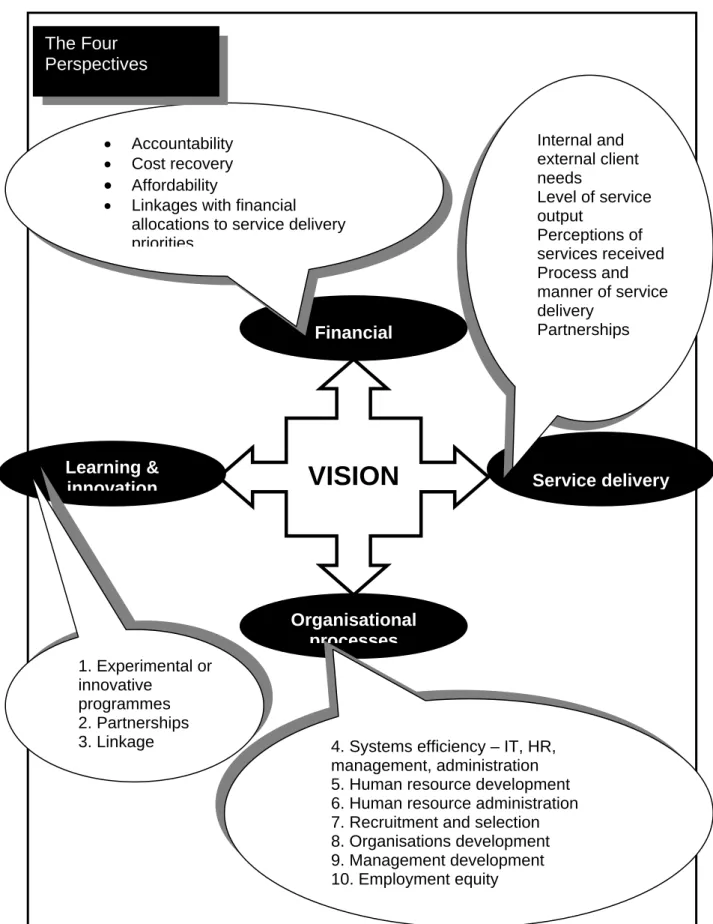
Diagram 1 below presents a graphical description of the four perspectives.
18
VISION
Financial Organisational processes Learning &innovation Service delivery
The Four Perspectives
Diagram 1: The four perspectives of the BSC
Internal and external client needs Level of service output Perceptions of services received Process and manner of service delivery Partnerships • Accountability • Cost recovery • Affordability
• Linkages with financial allocations to service delivery priorities
1. Experimental or innovative
programmes 2. Partnerships
3. Linkage 4. Systems efficiency – IT, HR,
management, administration 5. Human resource development 6. Human resource administration 7. Recruitment and selection 8. Organisations development 9. Management development 10. Employment equity
PART C
IMPLEMENTATION OF THE
PERFORMANCE MANAGEMENT
SYSTEM
4
A Step-By-Step Guide: Developing the
Organisational PM Framework in line with BSC
This section explains how to:
• Develop a departmental strategic focus from the departmental vision.
• Translate strategic objectives into the four perspectives.
• Identify measures of success for each strategic objective
• Develop the departmental business plan
• Develop directorate business plans
• Develop team delivery plans
4.1 Introduction
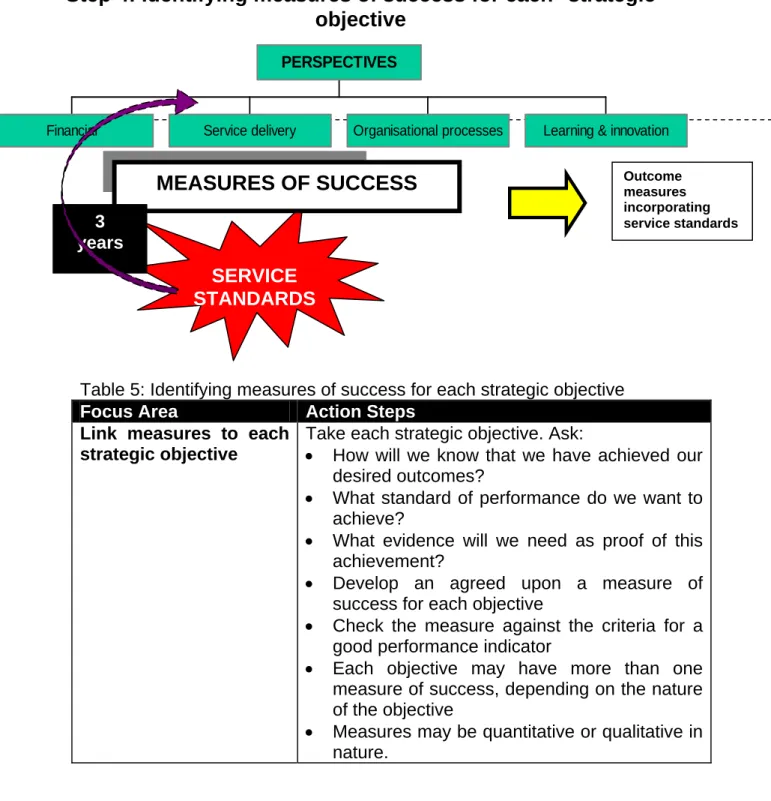
The development of a performance management system that requires the adaptation and alignment to the BSC follows a number of strategic steps that are interlinked and aligned. The starting point in developing a BSC approach to performance management is embracing a futurism stance. This implies the development and/or confirmation of the organisation’s desired future (vision) underpinned by the strategic level which has a 3-5 years focus. The departmental strategic focus is followed by the translation of strategic objectives into the four perspectives of the BSC as explained in chapter 4. The final step is identification of success measures for each strategic objective.
The organisational PM framework consists of two levels (the strategic level; and the organisational level):
• The strategic level is about ensuring that there is a clear vision, mission and focus areas guiding all long term to medium term direction of the department; and
• The operational level directs the short-term efforts of the department, its directorates, teams and individuals in the directions already set and agreed in the strategic framework.
The strategic level diagram shows how the balanced scorecard system allows for a clear relationship to be drawn between the vision and strategic focus or mission of the organisation, and strategic objectives which allow for certain outcomes to be achieved. The vision and mission of the particular department are translated into strategic objectives via the four perspective areas .
At the operational level, the diagram distinguishes between organisational and individual levels and breaks these down into different levels of organisation (department, directorate, team) and levels of employee (ranging from senior management to support staff).
4.2 Developing the strategic level framework
At a strategic level framework, the BSC methodology, as with most performance management methodologies, requires the creation of a vision, mission statement, and strategy for the organisation. This ensures that the performance measures developed in each perspective support accomplishment of the organisation’s strategic objectives. It also helps employees visualize and understand the links between the performance measures and successful accomplishment of strategic goals.
The key, as pointed out by the BSC methodology, is to first identify where the organisation wants to be in the near future. Set or confirm the departmental vision. Secondly, craft a strategy to realize the vision, and thirdly, develop measures that would indicate progress towards reaching the desired destination.
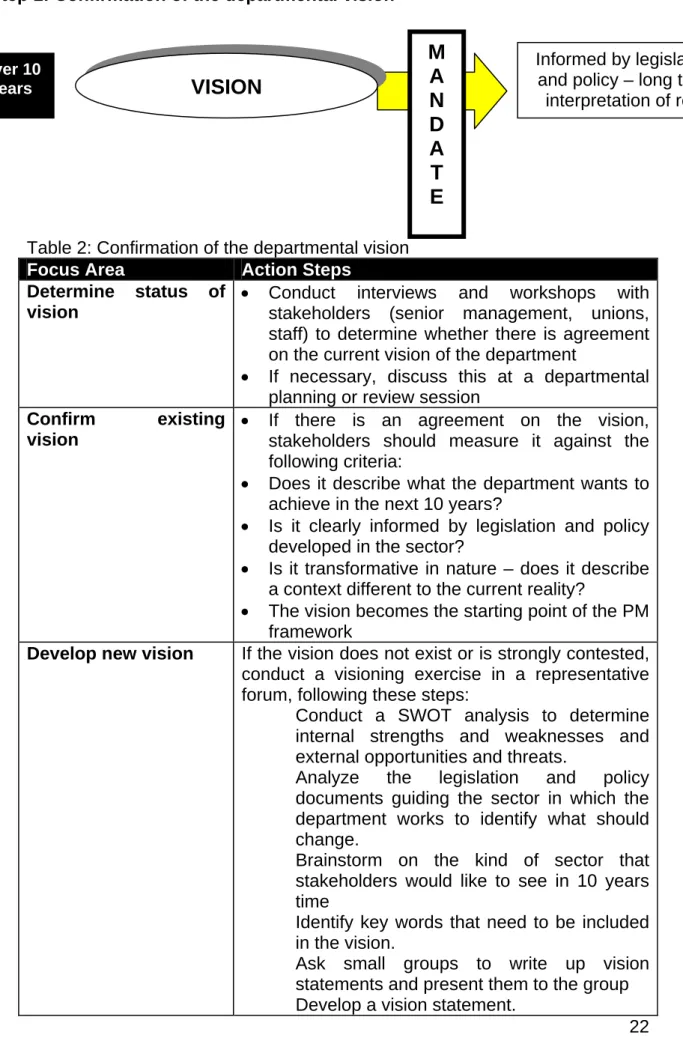
The following diagrams explain this process.
Table 2: Confirmation of the departmental vision
Focus Area Action Steps Determine status of
vision
• Conduct interviews and workshops with stakeholders (senior management, unions, staff) to determine whether there is agreement on the current vision of the department
• If necessary, discuss this at a departmental planning or review session
Confirm existing vision
• If there is an agreement on the vision, stakeholders should measure it against the following criteria:
• Does it describe what the department wants to achieve in the next 10 years?
• Is it clearly informed by legislation and policy developed in the sector?
• Is it transformative in nature – does it describe a context different to the current reality?
• The vision becomes the starting point of the PM framework
Develop new vision If the vision does not exist or is strongly contested, conduct a visioning exercise in a representative forum, following these steps:
Conduct a SWOT analysis to determine internal strengths and weaknesses and external opportunities and threats.
Analyze the legislation and policy documents guiding the sector in which the department works to identify what should change.
Brainstorm on the kind of sector that stakeholders would like to see in 10 years time
Identify key words that need to be included in the vision.
Ask small groups to write up vision statements and present them to the group Develop a vision statement.
22
VISION
Informed by legislation and policy – long term interpretation of role
M
A
N
D
A
T
E
Over 10 yearsStep 1: Confirmation of the departmental vision
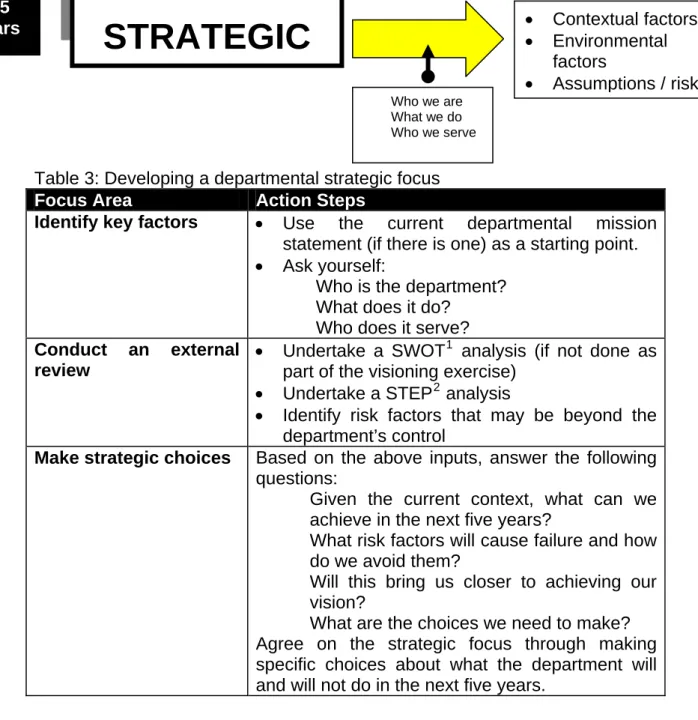
Step 2: Developing a departmental strategic focus
3-5 years Who we are What we do Who we serve • Contextual factors • Environmental factors • Assumptions / risksSTRATEGIC
Table 3: Developing a departmental strategic focus
Focus Area Action Steps
Identify key factors • Use the current departmental mission
statement (if there is one) as a starting point.
• Ask yourself:
Who is the department? What does it do?
Who does it serve?
Conduct an external review
• Undertake a SWOT1 analysis (if not done as part of the visioning exercise)
• Undertake a STEP2 analysis
• Identify risk factors that may be beyond the department’s control
Make strategic choices Based on the above inputs, answer the following questions:
Given the current context, what can we achieve in the next five years?
What risk factors will cause failure and how do we avoid them?
Will this bring us closer to achieving our vision?
What are the choices we need to make? Agree on the strategic focus through making specific choices about what the department will and will not do in the next five years.
1
A SWOT analysis examines the internal Strengths and Weaknesses of an organisation and the Opportunities and Threats it faces in the external environment
2
A STEP analysis identifies the Social, Technological, Economic and Political factors that may impact on an organisation’s success
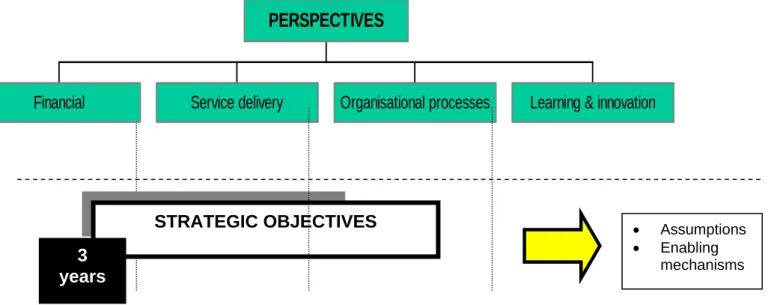
Step 3: Translating strategic objectives into the four perspectives
Financial Service delivery Organisational processes Learning & innovation
PERSPECTIVES
Table 4: Translating strategic objectives into four perspectives
Focus Area Action Steps Link existing
strategic objectives to the four perspectives
• Clarify the meaning of each perspective, in the context of the department
• List all strategic objectives that have already been identified by the department (list all objectives even if they have been grouped under focus areas)
• Organize the objectives under the four perspectives. Ask yourselves, “Is this action primarily of a financial, service delivery, organizational process or learning & innovation nature?”
• In cases where the strategic objectives are linked to more than one perspective, list them under all relevant perspectives
Regroup objectives
• Take each perspective one by one – group the objectives that seem similar together
• Discard any statements that are shorter term objectives, activities or tasks
• Develop one strategic objective out of a group of similar objectives
• Identify no more than 3 strategic objectives under each perspective
Identify gaps • In relation to each perspective, ask:
• Have we identified all the critical strategic objectives within this perspective to enable us to achieve our strategic focus?
• What other objectives will be required to ensure that we are successful in the next 5 years?
• Identify any additional objectives
• Streamline the new objectives with the existing objectives to ensure that there are no more than 3 strategic objectives under each perspective
24
STRATEGIC OBJECTIVES • Assumptions
• Enabling
mechanisms 3
Check for balance
Read through all of the strategic objectives. Ask:
1. If we achieve each of these objectives will we achieve our strategic focus?
2. Is there sufficient focus on each perspective to ensure that there is a balanced picture of the department?
Step 4: Identifying measures of success for each strategic
objective
Table 5: Identifying measures of success for each strategic objective
Focus Area Action Steps Link measures to each
strategic objective
Take each strategic objective. Ask:
• How will we know that we have achieved our desired outcomes?
• What standard of performance do we want to achieve?
• What evidence will we need as proof of this achievement?
• Develop an agreed upon a measure of success for each objective
• Check the measure against the criteria for a good performance indicator
• Each objective may have more than one measure of success, depending on the nature of the objective
• Measures may be quantitative or qualitative in nature. 25
MEASURES OF SUCCESS
3 years Outcome measures incorporating service standards SERVICE STANDARDSFinancial Service delivery Organisational processes Learning & innovation
4.3 Developing the operational level framework 1 year Departmental Business Plan / Scorecard Overall Outputs Fin Ser Del Org Proc
L&I Overall Outputs
Fin Ser
Del
Org Proc
L&I
Team Delivery Plan / Scorecard Overall Outputs Fin Ser Del Org Proc L&I Directorate Business Plan / scorecard
Table 6: Developing the operational level framework
Step Focus Area Action Steps
FOR EACH PERSPECTIVE Step1: Departmental Business Plan Identify overall outcomes within a one year framework
• In relation to each strategic objective within the perspective, identify the specific outcomes that can be achieved within the one year framework;
• Identify performance measures for each outcome. Ask:
• How will we know that we have achieved our desired outcomes?
• What standard of performance do we want to achieve?
• What evidence will we need as proof of this achievement?
• Test the measures against the criteria for good indicators
Identify
outputs within a one year framework
Define actions that will contribute to the achievement of each objective
For each action identify a performance measure, according to the process outlined above
Set clear time-frames
Identify enabling actions that may need to be taken to ensure success, or partners that should be brought on board
Outline all resource requirements –financial, human and physical
Obtain approval for plan
Ensure that senior management endorse the business plan and reflect commitments on the budget
Allocate strategic objectives
Based on strategic objectives identified and organizational structure, allocate objectives across all chief directorates and directorates Ensure that all objectives are equally allocated and that there are none left unallocated
Step2: Directorate Business Plan
Develop plan Develop a business plan according to the steps outlined above
Check that there is no duplication across the strategic plans
Identify teams Identify natural work teams, or project teams, that require individual plans. These may be teams within the department or across other departments
Get agreement on which teams require specific plans and identify which strategic objectives they will contribute to.
Step 3: Team
Delivery Plan/ Divisional Plan
Develop plans Develop team delivery plans according to the workplan format
Identify key performance areas that the team will be required to deliver on – these are overall areas of performance
List specific actions or outputs required to achieve each key performance area
Set performance measures, according to the criteria listed above, for each output
Set clear time-frames
Identify enabling actions and partners
Identify any resources required by the team to enable successful performance.
4.4 Performance management cycle
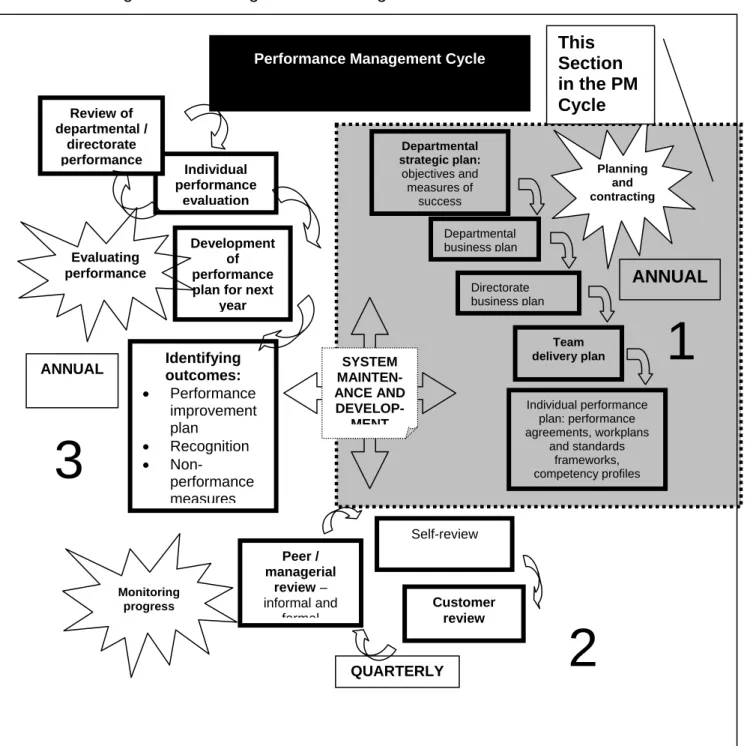
The performance management cycle describes the various phases that the system moves through over the course of one year.
There are three main phases of the performance management cycle:
• Planning and contracting
• Monitoring progress; and
• Evaluating performance.
In addition, the PM cycle incorporates system maintenance and development. The cycle is shown in the diagram 3 below and tables 9-11 on the other hand provide a detailed explanation of each phase.
Diagram 3: Performance management cycle
Performance Management Cycle
Performance Management Cycle
Performance Management Cycle
29
Performance Management Cycle
Departmental strategic plan:
Objectives and measures of success Departmental Management plan Directorate Management plan Team Delivery plan
Individual performance plan: Performance agreements, work plans and standards frameworks,
competency profiles Planning and contracting ANNUAL
1
SYSTEM MAINTENANCE AND DEVELOPMENT Self review Peer / managerial review– informal and formal
Customer review – where possible QUARTERLY
2
Monitoring progress Individual performance evaluation Development of performance planfor next year
Identifying outcomes: • Performance improvement plan • Recognition • Non-performance measures Review of departmental / directorate performance Evaluating performance ANNUAL
3
Table 7: Description of Performance Management Cycle: Phase 1
PHASE Component Description
• Departmental Strategic Plan
• The strategic level performance management framework describes the specific strategic choices made by a department, in order for it to be an effective service provider, as well as an effective, efficient and transformed organization.
• The strategic plan consists of a vision statement, strategic focus statement and strategic objectives, and measures of success, in line with each of the four perspectives.
• Departmental Business Plan
• The operational level performance management framework describes how the department aims to achieve its strategic objectives through specific actions. It gives guidance to the work of the department for the year under review.
• Directorate Business Plan
• Business plans need to be in place for each directorate. These outline the areas of performance of each directorate, and which strategic objectives they will contribute towards. They describe the specific actions to be undertaken for the period under review.
Planning and Contracting
• Project Teams Plan
• Project teams
These teams are temporary and only exist for the duration of a project. It is crucial that project teams also monitor their own performance and those of individual members. Participation in project teams implies added tasks and these should always be reflected on the individual’s performance agreements / work plans. Existence of project teams also allows for formal peer reviews.
• Individual Performance Plans
• Each individual within the department, from the level of HOD downwards, will have a performance plan. This may take a number of forms, depending on the role that the person plays within the department. The various performance-planning tools are the performance agreement, the work plan and the standards framework.
• Each performance plan is accompanied by a competency profile, used largely
• for skills development
Table 8: Description of Performance Management Cycle Phase 2
PHASE Component Description
Monitoring progress
Self review Before the progress reviews and the performance evaluation take place, employees should review their own performance before meeting with their supervisors or team leaders. The self-review process will assist employees in jointly taking responsibility for their development. In addition, employees should begin to develop a reflective framework in which they evaluate their own performance on an ongoing basis.
Peer / managerial progress review
• Progress reviews ensure that feedback on performance is continuously shared between supervisors/team leaders and employees. These reviews may be provided formally or informally.
Informal progress reviews:
Informal reviews will enable supervisors / team leaders and employees to provide each other with performance feedback on a daily basis. Feedback will be provided on an ad hoc basis after work activities have been undertaken.
Formal progress reviews:
These progress reviews should be held at least twice and preferably four times a year.
Comments made during these reviews and feedback received from internal and external stakeholders will be documented. If there are changes to the general tasks or competencies, exerted by either the internal or external environment, the individual’s performance agreement / work-plan can be re-negotiated at this stage.
• For practice purposes only and as a guide to performance trends, the use of rating scales is encouraged. However, there should be no aggregation of the quarterly scores to contribute to the end of year score as the KRA do not necessarily carry proportionate weightings every quarter. Any scoring results can only be formative at this stage.
Customer review • If possible, feedback from customers should be incorporated into the performance review process. This may be easier to obtain from internal clients, or in relation to a section or directorate, rather than an individual. Where possible it should be used to provide a more holistic picture of performance.
Table 9: Description of Performance Management Cycle: Phase 3
PHASE Component Description
Evaluating Performance & Managing Outcomes Identifying outcomes Performance Improvements Recognition Corrective Action
There should be consequences or outcomes linked to the completion of each round of performance evaluation. These outcomes can be in the form of:
• Performance improvements
• Rewards
• Corrective action
• Performance Improvements
Performance improvements may be suggested where employees are performing well but require further training and development in some aspects of the job. This may be technical training linked to job activities or training focusing on behavioural patterns. Performance improvements will generally link with the department’s training and development policy.
• Recognition
Outcomes in the form of recognition may be linked to the Province’s Remuneration policy, but may also incorporate non-financial rewards.
• Corrective action may be necessary due to two main outcomes:
• Employees consistently perform poorly. After several warnings and suggested performance improvement mechanisms, consistent poor performance on the part of an employee may be referred to Industrial Relations for disciplinary actions as stipulated by the Labour Relations Act.
• Immediate supervisor’s consistent negative behavioural patterns during performance evaluation meetings. Where employees complain of the immediate supervisor’s negative behavioural patters during performance evaluation meetings, the employees may refer the grievance to the appropriate directorate for attention.
PHASE Component Description Evaluating performance & Managing Outcomes • System Maintenance and Development
• The HRM section in the Office of the Premier plays a critical role in monitoring the implementation of the system, collecting data on the outcomes of performance evaluations and ensuring that consistency and equity apply in all cases.
• Once the system is computerised it will be far easier to store data and track performance trends.
4.5 What are PM Measures?
A critical component of any performance management system is the measures that are used to describe satisfactory performance. Many different words are used to describe measures – indicators, targets, standards, results, etc.
It is important to clarify exactly what we mean when we refer to ‘performance measures’.
The performance management system is making use of the following approach (see diagram 4 and 5 below):
35 Target Performance measures describe what is expected in terms of satisfactory
performance. They set the required level of
Objectives are a statement of intent by an organization or an individual. They identify what outcomes or outputs are expected within a particular time frame Standards describe the requirements for effective performance. Standards consider both process and outcome
requirements of effective
performance Indicators provide
evidence that the standard has been achieved. They identify particular aspects of
performance that reflect success
The target sets a specific quality or quantity of performance within a specific timeframe.
Key results areas describe focus areas of performance. A group of KPAs (usually 3-5) describe the overall function of an employee
PERFORMANCE
MEASURES
Standards
Indicators
Diagram 4: Description of elements of performance measures
Diagram 5: Example of performance measures
EXAMPLE
PERFORMANCE
MEASURES
36 Target Comprehensive science and technology curriculum framework developed in line with outcomes based requirements Curriculum framework covers all aspects of science and technology education required for Grade 10; developed in consultation with stakeholders and easy to understandStandards
Indicators
Objectives and Key Performance Areas
• Framework finalized by 31 October 2000 • Identified stakeholders sign off on framework document • Curriculum presented in simple guide-book format, in four languages Curriculum Development
4.6 Criteria for a good performance measures (standards, indicators, baseline and targets)
When identifying performance measures indicators, it is firstly important to identify WHAT we want to measure, and then to consider the criteria of a GOOD measure.
When selecting an indicator, first ask yourself: ‘what do I want to measure?’:
• Economy: how do actual costs compare with planned costs?
• Cost and Efficiency: what is the ratio of outputs to resource inputs?
• Awareness: are the intended beneficiaries aware of the service?
• Service volume / outputs: is the service available to the intended beneficiaries?
• Service take-up: are the intended beneficiaries actually receiving the service?
• Targets/milestones: what must be achieved by the end of a specified quarter
• Capacity utilization: how effectively and efficiently will the resources and infrastructure be used in the attainment of targets in a specified quarter?
• Quality: are we achieving quality standards and 'customer satisfaction'?
• Effectiveness: do actual outputs and outcomes achieve our intended objectives?
• Impact: what net improvement have we made to the quality of life of the local community
• Equity/Fair Access: is the distribution of outputs, outcomes, benefits and impacts equitable?
Once you have selected your measure, ask yourself if it meets the criteria for a ‘good’ measure. Is it “smart?”
o S - simple o M - measurable o A - attainable o R - realistic o T - time-bound 37
5
Performance Planning and Contracting
This section includes:
• An introduction to Performance Planning and Contracting
• The different types of performance instruments (PIs)
• Criteria on who uses which type of performance instrument
• Different parts of a complete performance instrument (PI)
• A step-by-step guide for developing an Individual or Team Workplans or Standards Framework.
• How to complete the forms for planning and agreements in the memorandum of understanding on performance-workplan and standard framework
5.1 Introduction
The development of Individual/team performance plans is a critical step in phase 1 of the performance management cycle. This phase of the PM cycle is shown by the shaded area in diagram 6 below. The planning and contracting phase in the PM cycle must always be informed by and drawn from departmental and directorate business plans or score cards. Individual/team performance plans are the sole basis upon which an employee’s performance will be measured in each and every department.
Diagram 6: Planning and contracting
Performance Management Cycle
Planning and contracting SYSTEM MAINTEN-ANCE AND DEVELOP-MENT This Section in the PM Cycle 39 Departmental strategic plan: objectives and measures of success Individual performance evaluation
1
Peer / managerial review – informal and formal Customer review QUARTERLY Monitoring progress2
Self-review Evaluating performance Development of performance plan for nextyear Identifying outcomes: • Performance improvement plan • Recognition • Non-performance measures Review of departmental / directorate ANNUAL performance Departmental business plan
3
ANNUAL Directorate business plan Team delivery plan Individual performance plan: performance agreements, workplans and standards frameworks, competency profiles5.2 The different types of performance instruments
There are three types of performance instruments (PIs) that will be used for different levels of employees in each of the provincial departments. The three different types of performance instruments are:
I. Full Performance Agreements for sms members and other managers in charge of institutions and regions/district
II Workplan type of memorandum of understanding on performance; and III Standard framework type of memorandum of understanding of
performance
5.3 Who uses which type of performance instrument?
As was described earlier, levels 13-16 require a full performance agreement in terms of the Public Service Regulations (as contained in the latest amendments).
Informed by the relevant Public Service Regulations (PSR), 1998, 2001 and any later amendments as well as other best practice criteria, the following guidelines directing who should use which form of Performance Instrument have been given;
• Senior management service (sms) (13-16) and other lower level managers (mostly middle managers) in charge of institutions like hospitals, colleges etc, regional and district offices conclude a full performance agreement. These employees must reflect all four perspectives in their PIs as they are responsible for the holistic well being of their institution, district, region, directorate, branch or department as the case may be.
• Most middle managers and other staff members whose jobs are not repetitive or routine or do not put them in charge of a lot other staff and resources should use the workplan. Project managers and other staff whose tasks have a specific start and end point must use these workplan types of memorandum of understanding on performance.
• Staff whose tasks are repetitive and those whose performance are governed by pre-determined professional standards, must use the standards framework type of memorandum of understanding on performance. These standards may be pre-set by professional bodies, equipment manufacturers or for that matter, between employee and the supervisor during the conclusion of the planning and contracting phase. Such staff could either be high level professionals or lower level employees. The key issue here is that they perform work that is task oriented and repeats itself over time, always seeking to keep to very clear performance standards all the time, and not based on a start-end basis.
5.4 The Parts of a Complete Performance Instrument (PI)
Each of these three performance instruments are made up of 4 parts, namely;
Part A: Generic Performance Agreement.
This generic performance agreement sums up the employee’s identity, the context and spirit of performance expectations, roles, limitations, commitment, modalities and outcomes for the whole PI. An example of this part of the performance instruments is shown as annexure 1. This part of the performance instrument applies to all employees irrespective of their level or job specialisation. As such it will be found at the start of each PI, regardless of type.
Part B: The Performance Plan.
The performance plan details in tabular form all the employee’s performance outcomes, performance dimensions (KRAs), outputs, targets and resource requirements. The performance plan constitutes 80% of the priority or weight of the whole performance instrument. This % may vary from year to year but it must be determined and communicated centrally at the start of the year. See attached format 1. The performance plan is the first part of the performance instruments that must be measured in the performance management cycle.
Part C: Competency Profile.
A competency profile describes the employee’s current competences and seeks to relate them to the employee’s job competency profile. In this regard, an employee’s competence must be identified first, and the level of each of the employee’s competences presented on a scale of 1-3, where 1 is the lowest and 3 the highest. The competence level indicated by the employee is compared with the level of competence required by the employee’s job (if that competence is a requirement on the job). Where the competence listed by the employee is applicable for the job, the difference in levels determines whether that competence should be developed further or left alone as adequate. Where the competence level profiled by the individual is lower than that required by the job that competence must be listed in Part D below as a development during the current performance cycle. It must be emphasised that the competence profile does not get measured during the performance measurement process but rather it sets a baseline form which planning and measurement of the acquisition of future competences must take place.
Part D: Competence-based Individual Development Plan.
The competence-based individual development plan seeks to address identified competency gaps from the competency profiling exercise. A competency based individual plan is the second part of the performance instruments that would be measured during the cycle of the performance management cycle. The competency based individual development plan constitutes a pre-determined weight as well e.g. 20%.
5.5 About Competences
Competences to be profiled have been divided into three parts. They have been split in this way in this edition to minimise the practise where most employees have been listing the same competences as if they all came from one directorate and did the same type of jobs and had the same career destination. The three sections are;
I. Generic competences II. Job specific competences and III. Other competences as shown.
It may be useful although it is not compulsory to prioritise these competence sections in %. For example, generic competences may constitute 40%, job specific competences 45% while others may constitute 15%. This prioritisation may differ between levels in the organisation, from time to time within the organisation’s cycle as well as strategic focus of the organisation.
The three different types of competences are briefly explained below as:
• Generic competences are those that any one employee, either by virtue of being an employee and / or occupying a particular level of the organisation, must possess. Generic competences are thus common to a number of employees at that level, for example, financial management for all sms managers (as required by PFMA), programme and project management for most management levels up to first line managers, honesty and trustworthiness for all employees. These competences usually form the foundation for any one employee to effectively and smoothly carry out their job and contribute to the progress of the whole organisation regardless of the job details.
• Job specification competences are unique to the job being performed by the employee. These competences distinguish say, an office administrator or clerk from a groundsman, a project manager from a spokesperson, a financial manager from a labour relations manager, an HR practitioner from an engineering or legal officer etc. These competences are usually what any prospective employee would particularly want to sell during a job interview.
• Other competences refer to competences that an employee has or wishes to have which have been gained in previous jobs, training, prior learning which are not required directly in the current job but whose possession helps to understand and make one’s job more effective. For example, having good numeric competence helps a lot of employee’s interpret PMS weights and ratings and thus quickly complete their PIs than those not so numerate; or an HR practitioner who has had legal background will find it easy to clarify, advise and deal with labour related queries; or a groundsman who has worked in his previous life as a garage hand will find it easy to fix lawn mowers etc while working with these implements in doing what is her / his core function of cutting grass.
• On the other hand, other competences may be what an employee needs to gain in order to be more effective in other future job roles in or out of the organisation. These would then be isolated for future career or succession planning.
All the planning formats that need to be completed for each of these types of the three performance instruments are shown below in forms 6.1 (a-c). The formats referred to constitute Part B (performance plan), Part C (competency profile) and Part D (competence-based individual development plan).
Diagram 6 outlines the planning and contracting phase as a critical step in the development of performance instruments. It is the first step in the performance management cycle discussed in chapter 5, diagram 3. This phase informs the process of signing a performance agreement or a memorandum of agreement as the case may be.
5.6 The development of workplan type of memorandum of
understanding on performance
The workplan type of memorandum of understanding on performance is developed for middle managers, supervisors and other staff members whose job is not driven by professional pre-determined standards. The process for developing a workplan is similar to that of SMS members except for steps relating to the selection of balanced score card perspectives because there is no need to identify any Balanced Score Card perspectives.
As shown in the attached formats, the development of the Competency Profile (Part C) and Competence-based Individual Development Plan (Part D) is exactly the same for each employee regardless of rank or job type. These are described below.
5.6.1 Completing the Performance Plan (Part B of PI)
Step 1: Review all the strategic planning and business plans used in the department and directorate. From these should emerge some key outcomes of the employee’s contribution to their directorate
and department.
Step 2: Take Form 6.1 (a) and list 2-3 key outcomes for each
perspective. They should clearly demonstrate how the equality of life of customers will be impacted or affected by
services to be delivered.
Step 3: Set performance targets for the 2-3 key outcomes listed.
Step 4: Identify and document between 3-5 key result areas (KRAs) per grid that will lead to the effective achievement of the listed key outcomes. An example of a KRA could be ‘budget control,
corporate planning, performance management etc’
Step 5: Indicate from which strategic goal / objective The KRA listed derives from. This indication will be made by showing the number of that strategic objective / goal in the appropriate column.
Step 6: Weight the KRA. In other words, prioritise the KRAs in order of contribution and impact in achieving the listed key outcomes. The weighting must be in percentages, which must add up to weighting allocated in step 2.
Step 7: Develop key result indicators that will indicate progress in achieving the KRAs. The KPIs would indicate type of quantity or quality of inputs to be used and outputs to be delivered.
Step 8: Determine the current quantity or quality of inputs or outputs in relation to the KPI chosen in step 6 at the start of the financial year.
Step 9: Set targets against the determined baseline indicator. The target must state the quantity or quality or both of inputs and / or
outputs to be achieved at the end of a specified period. Ideally an annual target must be set and broken into 4 quarters. A target must focus on a combination of inputs to be used and outputs to be delivered. An example, 2 bridges built and R10 million of budget used. Targets must be set after due
consideration of present and future resource allocation realities.
Step 10: Identify the means of evidence that will be produced to show that the target has been reached and indicate where the
evidence is located.
Step 11: Allocate resources within established financial management regulations and practices [medium term expenditure framework (MTEF)] physical infrastructure, current and future establishment (organogram).
Step 12: Tidy up all totals as appropriate.
Step 13: Discuss the whole performance plan draft with your supervisor and sign-off after agreement on all aspects has been reached.
5.6.2 Completing the Competency Profile (Part C of PI)
The following steps must be implemented by completing form 6.1 (b) below.
Step 1: Identify all the competences that you currently have. These are the competences that you would put down in your CV or resume when applying for a job for instance. List them down on a piece
of paper.
Step 2: Using from 6.1 (b) break the list from step 1 above into the three competence divisions discussed above, namely; generic, job
specific and others. Document each competence into each category as appropriately shown in the format below.
Step 3: For each of the competences that you have listed competence division or category, list and indicate those competences that are required for your present job or role (left hand side of the format).
Step 4: For each competence in each category, indicate the current level of competence that you possess as well as the level of competence required by the job (only where the competence is a job requirement). The competence levels apply in the same way as described above. The assessment of competence levels possessed by each individual for a competence is done in one or more ways;
o Self assessment, based on previous experience
o Against specified SAQA unit standards where these are available
o Feedback from previous PRD feedback as well as previous cycle evaluations
o Clearly agreed means of verification or performance outputs for each competence
5.6.3 Completing the Competence-based Individual Development Plan
This should be read in conjunction with Format 6.1 (c) below.
Step 1: Write down the weighting for Part D of the Performance Instrument. This is the difference between what has been
allocated for the Performance Plan (Part B) from 100%. In the illustration above, it will be 100-80=20%.
Step 2: Go to the competency profile, and identify all competences required for the job where own current level of competence is lower than that required by the job.
Step 3: Tabulate each of these competences in the appropriate categories or divisions (generic, job specific and other competences)
Step 4: Indicate why a particular competence is required, i.e. for each key results area (KRA). If it is required for a crucial KRA, or a high priority one, it must be assigned a higher weighting in the
next column.
Step 5: Prioritize each of the competences required and assign weights in % in the appropriate column.
Step 6: Indicate current level for each competence listed. This should be taken from the competency profile listing in Part C above.
Step 7: Indicate the targeted level of performance to be attained by the end of each quarter.
Step 8: Think of and document all activities that will be needed to gain the required competences to the level listed in step 7 above.
Step 9: List the resources that will be needed to ensure that these
competences are attained within the specified time to the level desired.
Step 10: Tidy up all totals
Step 11: Both the employee and the manager now sign-off all the spaces with their names and signatures during the contracting
discussion with your superior or manager.
Step 12: The manager / supervisor now passes a copy of the entire PI document with its four parts duly completed and signed by
contracting parties to the overseer (manager-one-level up) for oversight and endorsement. This means if a senior manager is concluding a PI with one of her / his managers, a signed copy should be sent to the GM who will also counter-sign to signify approval of the PI (focusing on format and strategic direction and not content details). The GM need not be part of the
planning discussion. The document duly signed by all 3 parties will be the one treated as final.
Step 13: The manager hands a copy to the system designers and
administrators (usually HR unit) and keep a copy for her / his own reference while the employee keeps a copy to guide her / his daily performance focus.