Quality Outcomes for Students with a
Disability
Research Project
Executive Summary
Transition Practices and Post School
Outcomes in Queensland Schools
Project Director
Dr Denis Meadows
Research Team
Mr Ian Alcorn
Dr Wendi Beamish
Dr Michael Davies
Dr Gordon Elias
Dr Peter Grimbeek
Dr Renee Punch
School of Cognition, Language and Special Education
TABLE OF CONTENTS
EXECUTIVE SUMMARY ... 2
Background ... 2
Context of the research... 2
Aims ... 3
The research process ... 4
Literature review... 4
Parent survey ... 5
Teacher survey ... 5
Focus groups ... 6
Overall findings ... 6
Issues for commendation and consideration... 7
Student-focused planning and development... 7
Family involvement ... 8
Program structure ... 9
Interagency collaboration ... 9
Post-school outcomes and experiences ... 10
EXECUTIVE SUMMARY
Background
In March 2002, the Ministerial Task Force on Inclusive Education was established to provide advice to the Queensland Government on how to make the schooling system more inclusive for students at educational risk because of a disability or a learning difficulty. In its report to the Minister for Education and the Arts in June 2004, the Task Force made the following recommendation:
That the Minister establish a rigorous research program in all schooling sectors in Queensland along the lines of the Queensland School Reform Longitudinal Study, which examines the link between pedagogic practices in classrooms for students with disabilities and the outcomes achieved by these students.
To this end, the Queensland Department of Education and the Arts engaged a research team from Griffith University to examine the relationship between transition practices and post-school outcomes for students with disabilities. This research project, entitled Quality Outcomes for
Students with a Disability, also acknowledges the reforms proposed for middle and senior
schooling in the Queensland Government’s Education and Training Reforms for the Future – a
White Paper (Queensland Government, 2002).
Context of the research
The process by which students with disabilities prepare for their lives after school is commonly known as the school to post-school transition process. Typically it begins in early adolescence. Kohler and Field (2003) refer to this process as transition-focused education, a process that is not in addition to, or an adaptation of, regular school activities but is a fundamental basis upon which the final years of schooling are built. By definition, transition-focused education is:
directed toward adult outcomes and consists of academic, career, and extracurricular instruction and activities, delivered through a variety of instructional and transition approaches and services, depending on the local context and students’ learning and support needs [and]…represents a shift from disability-focused, deficit-driven programs to an education and service-delivery approach based on abilities, options, and self-determination. (Kohler & Field, 2003, p. 176)
In terms of adult outcomes, transition education is built on three basic propositions. First, upon leaving school young adults with disabilities should be engaged in some form of employment or meaningful daytime activity occupying an amount of time equivalent to a full working day or week. Second, upon leaving school young adults with disabilities will live in a community setting and participate in community activities in a manner similar to persons of the same age who do not have disabilities. Third, it is expected that these young adults will have social networks with family and friends (Halpern, 1985). Further, Halpern (1993) views the above propositions as parameters of
quality of life for school-leavers and suggests that they form the basis for evaluating transition outcomes. That is, a school-leaver with disabilities who has an activity-filled day and participates regularly in community life with family and friends could be viewed as experiencing a successful transition to post-school life.
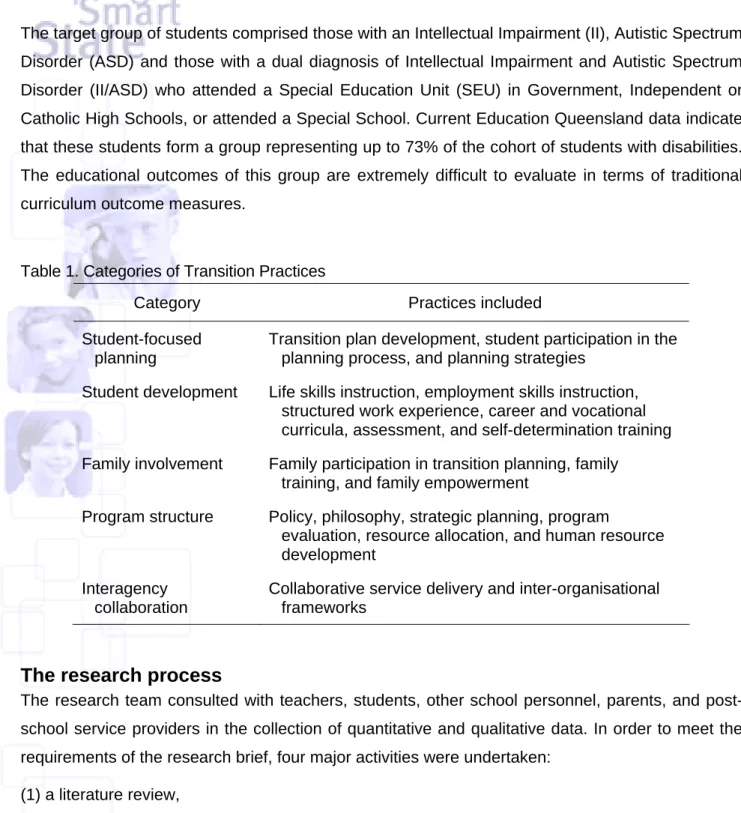
In terms of transition-focused education, the educational process should concentrate on the acquisition of the skills that will assist in achieving this quality of life. Research indicates that a curriculum firmly based in teaching these skills in the context of the student’s community is effective in promoting positive post-school outcomes (Falvey, 1989). Research also confirms that factors other than those related to the development of student skills lead to an improved quality of life after school. For example, the degree to which students are involved in planning for their life after leaving school is highly associated with the achievement of those goals (Deci & Ryan, 1991). Moreover, vocational education and work experience are also associated with improved student outcomes (Hasazi, Gordon, & Roe, 1985). Furthermore, the degree to which the students’ families are involved in the transition process and the relationships schools have with organizations providing post-school services for persons with disabilities are important predictors of positive outcomes (Devlieger & Trach, 1999). In this regard, it was these factors that were used as an organising framework for the current investigation. Each of the research activities was structured according to five key areas of transition practice identified by Kohler and her colleagues (e.g., Kohler, 1993; Kohler & Chapman, 1999; Kohler & Field, 2003). The key areas were Student-focused Planning, Student Development, Family Involvement, Program Structure, and Interagency Collaboration. These areas provided an organisational framework for the examination of individual school to post-school transition practices, as described in Table 1.
Aims
The aims of the project were:
• To undertake a review of both national and international literature to identify recommended educational practices that are indicative of positive post-school outcomes for the target group of students.
• To investigate the relationship of student outcomes to these recommended practices.
• To provide an analysis of the use of these recommended practices by Queensland teachers, and report on benchmarks concerning their use.
• Based on the above analysis, to identify issues for consideration that could more strongly align the current delivery of education services with currently recommended practice.
The target group of students comprised those with an Intellectual Impairment (II), Autistic Spectrum Disorder (ASD) and those with a dual diagnosis of Intellectual Impairment and Autistic Spectrum Disorder (II/ASD) who attended a Special Education Unit (SEU) in Government, Independent or Catholic High Schools, or attended a Special School. Current Education Queensland data indicate that these students form a group representing up to 73% of the cohort of students with disabilities. The educational outcomes of this group are extremely difficult to evaluate in terms of traditional curriculum outcome measures.
Table 1. Categories of Transition Practices
Category Practices included Student-focused
planning
Transition plan development, student participation in the planning process, and planning strategies
Student development Life skills instruction, employment skills instruction, structured work experience, career and vocational curricula, assessment, and self-determination training Family involvement Family participation in transition planning, family
training, and family empowerment
Program structure Policy, philosophy, strategic planning, program
evaluation, resource allocation, and human resource development
Interagency collaboration
Collaborative service delivery and inter-organisational frameworks
The research process
The research team consulted with teachers, students, other school personnel, parents, and post-school service providers in the collection of quantitative and qualitative data. In order to meet the requirements of the research brief, four major activities were undertaken:
(1) a literature review, (2) a survey of parents, (3) a survey of teachers, and
(4) focus groups with parents, students, teachers, and post-school providers.
Literature review
A review of current national and international literature was conducted in order to ascertain those currently recommended transition practices that are associated with positive post-school outcomes. During the 1990s, an extensive series of analyses and reviews of empirical and evaluation studies of transition practices was carried out by Kohler and her colleagues (Kohler,
1993; Kohler & Chapman, 1999; Kohler, DeStefano, Wermuth, Grayson, & McGinty, 1994; Kohler & Rusch, 1995; Rusch, Kohler, & Hughes, 1992) at the Transition Research Institute at the University of Illinois. While these North American reviews provided a strong theoretical and practical basis for the current research, the present study’s literature review augmented them by investigating more recent international and Australian transition-based research. A thorough search of the literature revealed 44 studies conducted between 1998 and 2005 that reported on transition programs and practices and the extent to which they were associated empirically with valued post-school outcomes. The literature review was structured according to the five key areas of transition practice identified by Kohler: Student-focused Planning, Student Development, Family Involvement, Program Structure, and Interagency Collaboration. This structure was also used in the design of the surveys and focus group questions in the further research activities, providing an organisational framework for the examination of individual school to post-school transition practices. Because of the close interconnections among practices in the categories of Student-focused Planning and Student Development, these two categories were combined in the focus group activity and in reporting the project’s overall findings.
Parent survey
Data on student outcomes were collected via a survey of parents whose young adult children had completed their senior schooling during the previous five years. Major findings from these data indicate that:
• The majority of parents reported high levels of involvement in the transition planning process, but many of the young adults had been only minimally involved in goal-setting for their own transition.
• Although parents generally were positive about the preparation for post-school life given by schools to their young adults, many of the young adults had not been afforded any work experience.
• There were not sufficient post-school options in the community to engage the young adults.
Teacher survey
A survey based on the recommended practices identified in the literature review was constructed and teachers involved in the transition process were invited to indicate their levels of commitment to and implementation of these practices. Major findings from these data indicate that:
• The majority of teachers agreed that most of the recommended transition practices were indicators of program quality.
• Teachers were of the view that the school program should begin to focus on transition activities when students are between the ages of 11 and 14 years.
• Recommended practices in the Program Structure area, such as staff professional development, identified transition personnel, post-school follow-up, and documented program policies, procedures, and philosophy, were insufficiently implemented.
• Recommended practices in the Interagency Collaboration area, such as regular meetings with post-school providers and cross-departmental arrangements, were insufficiently implemented.
Focus groups
Focus groups were conducted with two groups: (a) teachers and post-school service providers, and (b) parents and students. The focus groups collected data that extended and elaborated on the information gained from the parent and teacher surveys. Major findings from the focus group data indicate that:
• While work experience was valued by teachers and parents, many factors, including lack of staff resources to supervise students, transport, and unavailability of suitable placements, impeded the provision of meaningful work experiences to students.
• Little formal training in self-determination or self-advocacy was provided to students.
• Teachers and parents believed that students and their families need to be prepared for transition earlier than generally occurs.
• Funding package requirements and timing hindered transition planning by schools and families.
• There was an extreme sense of loss by students and parents at the abrupt cut-off of the supportive school environment and the lack of suitable engagement for the young adults after leaving school.
Overall findings
In all, 532 individuals from regions throughout Queensland were involved over the four research activities. This number was comprised of 275 parents, 192 school personnel, 46 service providers, and 19 students.
Findings of the research project have highlighted the extent to which transition practices in Queensland schools are aligned with quality practices identified in the literature as being associated with positive post-school outcomes. An overall analysis of data collected across the project indicated that:
• Current practices in schools are most closely aligned with recommended practices in the key areas of Student-focused Planning, Student Development, and Family Involvement.
• Current practices in the key areas of Program Structure and Interagency Collaboration appear to align less closely with recommended practice and require considerable attention in order to improve outcomes for all students and their families.
• For many students, the core transition outcomes of employment, community access, and social networks are not realised.
Issues for commendation and consideration
Specific issues for commendation of the current use of recommended practices and issues for consideration for a stronger alignment with recommended practices for each of the key areas are presented below. Issues for consideration for an additional area pertaining to post-school outcomes and experiences are also presented.
Student-focused planning and development
For commendation:
• Parents and teachers valued a wide range of work experience options for students.
• Many teachers were proactive in locating work experience sites.
• Teachers, parents, and service providers believed in the early involvement of students in their transition planning.
• Many students were involved to some extent in their transition planning meetings.
• When structured programs in student self-advocacy and self-determination were delivered, the results were considered to be very positive.
• Schools were effectively preparing many young adults for participation in community and daily activities.
• The skills, knowledge, and dedication of teachers were valued by parents.
For consideration:
• All students, regardless of degree of disability, should be afforded the opportunity to participate in relevant work experiences. However, the provision of meaningful work experiences was impeded by a lack of staff resources to supervise work experience placements, the limited availability of suitable placements, Workplace Health and Safety (WHS) laws, and the significant needs of some students. Limitations increased in rural and remote areas.
• Transport to and from work experiences presented difficulties and was often provided by teachers. Travel training should be prioritised in the curriculum.
• The active involvement of students in their transition planning process should be further encouraged. Consideration needs to be given to the implementation of strategies that teach students to advocate on their own behalf during the transition planning process, including the use of adaptations that will assist students to participate in this process.
• Life skills instruction should be located within the context of each student’s environment.
• Successful transition outcomes were particularly difficult to achieve for students with more significant disabilities and other groups of students who “fall through the gaps.”
Family involvement
For commendation:
• Schools involved parents substantially in the transition planning process, and particularly in goal-setting.
• Teachers were sensitive to the considerable difficulties families experience in coping with their children’s exit from school.
• Teachers understood the importance of good personal relationships with their students’ families.
• Schools played a major role in providing parents with information about post-school services.
• Parents particularly valued the information and assistance provided by School Transition Officers (STOs).
• Parents appreciated their involvement in key planning meetings, valued the provision of clear, concise information on post-school options at regular intervals, and liked having parental responsibilities clearly defined.
For consideration:
• The involvement of families in the transition process needs to start earlier.
• Information on post-school services provided to families needs to (a) be more user-friendly, (b) be delivered earlier in the transition process, and (c) accurately reflect post-school offerings.
Program structure
For commendation:
• The transition process was enhanced in locations where staff members were specifically assigned to transition education at the school and regional level.
• Seventy-two percent of the recommended practice items were supported by more than 80% of the teachers responding to the survey.
• Eighty percent of the recommended practice items were implemented by more than 50% of the teachers responding to the survey.
• Forty percent of the recommended practice items were implemented by more than 80% of the teachers responding to the survey.
For consideration:
• A policy document on school to post-school transition for students with disabilities could be prepared that clearly articulates the Department of Education’s support for transition activities and describes how the process should proceed.
• Although seen as valuable by teachers and parents, clearly articulated and available transition-related (a) philosophy, (b) policies and procedures, and (c) program structure were frequently lacking.
• Few schools conducted formal follow-up of their students after they have left school.
• Although the role of STOs in the transition process was highly valued by all stakeholders, there are very few full-time STOs in the school system. Consideration could be given to increasing the number of STOs, whose major role would be to support the implementation of the Department’s policy on transition education.
• Inadequate transition preparation may have occurred because of insufficient training of teachers. Professional development for staff involved in the transition process could be implemented at a variety of levels (e.g., in-service and conference activities, on-line learning, and formal university study).
Interagency collaboration
For commendation:
• Many teachers were proactive in building relationships with post-school providers.
For consideration:
• Teachers and service providers often experienced difficulties with establishing and maintaining strong interagency networks.
• Many post-school providers were unable to offer transition-related experiences to students while they were still at school because of funding issues.
• Parents should be encouraged to access and convey relevant educational information to post-school providers.
• Formal interagency agreements were restricted to work experience placements for individual students.
• The timing of the awarding of post-school funding packages hindered transition planning by schools and families and caused families to experience frustration and stress.
• Better communication and coordination between government departments, schools, and post-school agencies are necessary.
• Other government departments that are associated with the provision of post-school services for persons with disabilities could be canvassed with a view to establishing an inter-departmental strategy designed to follow up school leavers and assist them with adjustment to post-school life.
• The systemic influences of the pension, combined with low levels of pay for work, appeared to discourage full time engagement in work by young adults. A majority of individuals (most from special schools) received the full Disability Support pension from the Australian Government as their major income source, and earned little from other sources. A review of this pension-work interface and its effect on the lifestyle of these young adults and their families needs to be considered.
Post-school outcomes and experiences
For commendation:
• Over 80% of the young adults who had left school during the past five years participated in some time of out of home activity during the day (open employment, supported employment, or day program).
For consideration:
• An extreme sense of loss was experienced by students and parents on the students’ exit from school and the often abrupt cut-off of the supportive environment of the school.
• Structured, ongoing educational opportunities after leaving school were seen as necessary by some parents. There were fewer options available to students on leaving school than many parents had believed. The number of current work and lifestyle options was limited, and in some communities options were non-existent. Parents were experiencing significant family adjustments because of the increased time they needed to perform a caring role when their young adults had left school. Additional funding is required so that young adults are meaningfully engaged in work (open and supported), day programs, education, and supervised community activities.
Summary statement
The report from which this Executive Summary is drawn contains an extensive Literature Review (Section 2) and detailed results and findings from the Parent Survey (Section 3), Teacher Survey (Section 4) and Focus Groups (Section 5). The report concludes with a tabular summary of major findings and a listing of issues for commendation and consideration (Section 6).