ALCATEL-LUCENT
7210 SERVICE ACCESS SWITCH
RELEASE 4.0
The Alcatel-Lucent 7210 SAS family of compact, Ethernet-edge, demarcation and aggregation
devices enables cost-effective Carrier Ethernet services delivery to the customer edge and
extends the reach of MPLS-enabled Carrier Ethernet aggregation networks into smaller central
offices and distributed hub sites.
As a member of the industry-leading Service Router (SR) product portfolio, the MEF 9 and MEF 14 certified Alcatel-Lucent 7210 SAS leverages the powerful Service Router Operating System (SR OS) and the Alcatel-Lucent 5620 Service Aware Manager (SAM) to provide seamless integration into Carrier Ethernet and IP/MPLS solutions from Alcatel-Lucent. With platform capabilities that include IP, Multiprotocol Label Switching (MPLS), hierarchical quality of service (H-QoS), advanced operation, administration and maintenance (OAM) tools, leading resiliency and synchronization capabilities, and 10GigE interface support, the Alcatel-Lucent 7210 SAS is an integral component, delivering value-added MPLS-enabled Carrier Ethernet services including Virtual Private Line Service (VPLS) and Virtual Leased Line (VLL) services. With Release 4.0, the 7210 SAS now offers IP VPN and provider backbone bridging (PBB) service capabilities.
Available in seven compact form factor options, the 7210 SAS has the flexibility to enable fixed and wireless service providers and multiservice operators (MSOs), as well as industry and enterprise customers to build-out cost-optimized Carrier Ethernet and IP/MPLS infrastruc-ture for business, residential and mobile services delivery.
FEATURES
A family of platform variants
The Alcatel-Lucent 7210 SAS family provides deployment flexibility with a broad range of platform variants.
The 7210 SAS-D is an intelligent Ethernet-edge demarcation device that extends retail and wholesale SLA-based VPLS and VLL services to the customer edge. For service demarcation applications in 3G and LTE wholesale mobile backhaul service delivery networks, it is also available in a variant that supports ITU-T Synchronous Ethernet (Sync-E) and extended temperature ranges (ETR). The 7210 SAS-E is an Ethernet-edge access device with twelve 10/100/1000BASE-TX copper ports and twelve 100/1000BASE (SFP) fiber ports, and is designed for VPLS and VLL services delivery in multi-tenant offices.
The 7210 SAS-M is an MPLS-enabled Ethernet-edge and aggregation device. It supports IP, MPLS, Ethernet, PBB, 10GigE ports and is available in an ETR variant. As a customer edge device, it provides a common platform to enable VPLS, VLL and IP VPN services. It also supports the configuration of VPLS and VLL services using PBB. As an aggregation device, it extends the reach of the MPLS-enabled Carrier Ethernet network into smaller offices and distributed hub sites and supports provider edge (PE) functionality to aggregate customer edge (CE) routers in IP VPN service delivery. For added flexibility, the 7210 SAS-M offers optional service expansion modules to support circuit emulation services (CES) over T1/E1 interfaces and two 10GigE ports for higher speed uplinks, larger 10GigE mesh configurations and support for 10GigE CPE.
7210 SAS-D
7210 SAS-E
7210 SAS-M
7210 SAS-M (10GigE)
2
ALCATEL-LUCENT 7210 SAS | RELEASE 4.0
ALCATEL-LUCENT DATA SHEET
The 7210 SAS-X is a high performance MPLS-enabled aggregation device. Designed for more service-intensive smaller network location applications, its powerful CPU is suitable where higher scale switching and routing capabilities are essential. In addition to supporting all the IP, MPLS and Ethernet capabilities of the Alcatel-Lucent 7210 SAS-M, the 7210 SAS-X supports a larger number of service queues, packet buffers, label switched paths (LSPs), counters, MAC addresses, routing table entries and ACLs for increased service scale.
Advanced H-QoS
Today’s enterprise is looking to consolidate video, data, voice and Internet services over a single uplink. The advanced quality of service (QoS) capabilities of the Alcatel-Lucent 7210 SAS-D, Alcatel-Lucent 7210 SAS-E and Alcatel-Lucent 7210 SAS-M apply differen-tiated treatment to each service (i.e., class of traffic) in accordance with performance profiles to converge multiple services over a single uplink. Performance parameters include committed and peak information rates (CIR/PIR) along with delay, jitter and packet loss. For further service differentiation, the H-QoS capabilities on the 7210 SAS-D and 7210 SAS-M allow individual services to burst up to line rate when aggregate bandwidth is available, while ensuring the performance param-eters of each individual service is met. The Alcatel-Lucent7210 SAS-X supports advanced H-QoS with ingress and egress queuing and shaping. The 7210 SAS-X also supports dynamic buffer allocation, allowing buffers to be allocated on a per-service basis for added SLA flexibility.
Extensive OAM tools with
performance measurement
To support differentiated services managed to the customer edge, the Alcatel-Lucent 7210 SAS provides a suite of per-service OAM tools. These tools include ITU-T Y.1731 with Synthetic Loss Measurement (SLM), IEEE 802.1ag, IEEE 802.3ah, VPLS OAM and local service mirroring. The 7210 SAS hardware-based implementation of ITU-T Y.1731 enables accurate measurements of key performance parameters such as jitter, latency and packet loss. In addition, these tools are also integrated into the 5620 SAM for accelerated service activation and rapid troubleshooting. The 7210 SAS also integrates the OAM toolkit into the
5620 SAM’s Service Assurance Agent (SAA) to proactively monitor and measure SLA parameters end-to-end and quickly identify problems before they become service affecting.
The auto-configuration feature gives the Alcatel-Lucent 7210 SAS plug-and-play capabilities. After the end user powers up the system and connects the uplink, the 7210 SAS uses the network to automate service activation. To test end-to-end VPLS and VLL service configuration and diagnose problems using a hand-held Ethernet test device, the 7210 SAS sup-ports port loopback with MAC swap. The extensive SR OS accounting framework of the 7210 SAS tracks detailed customer usage on a port, service or per-application basis to support tiered service offerings and flexible billing models.
Innovative SLAs to the
customer edge
As a customer edge device, the Alcatel-Lucent 7210 SAS has the service richness to enable differentiated SLA-based Carrier Ethernet and IP VPN retail and wholesale services. With support for H-QoS and an extensive OAM toolkit, the Alcatel-Lucent 7210 SAS-D extends SLAs of more enhanced VPLS and VLL services to the customer premise. Innovative SLA attributes include dynamic bandwidth allocation, guaranteed QoS per applica-tion, the ability to monitor and measure key SLA performance parameters and resilient uplinks using multi-chassis ITU-T G.8032v2 and IEEE 802.3.ad. In addition, service assurance and management are simplified by the 5620 SAM.
With support for all the service capabili-ties of the Alcatel-Lucent 7210 SAS-D, the Alcatel-Lucent 7210 SAS-M adds IP VPN services, VPLS and VLL services config-ured with MPLS and PBB, MPLS resiliency mechanisms, 10GigE access and uplink ports and CES to the service mix — all on a single variant.
Comprehensive networking
and resiliency
With their compact footprint, 10GigE (XFP) uplinks and leading MPLS, Ethernet and PBB capabilities, the Alcatel-Lucent 7210 SAS-X and Alcatel-Lucent 7210 SAS-M are ideally suited to aggregating business, mobile and residential services in smaller network locations. For more service-intensive environments, including those supporting services with burst
requirements over the 10GigE uplinks, the 7210 SAS-X provides increased service scale.
The Alcatel-Lucent 7210 SAS-X and 7210 SAS-M support IP, MPLS, Ethernet and PBB across all ports. The IP/MPLS features include border gateway protocol (BGP)-based MPLS VPNs, VPLS, VLLs, resource reservation protocol – traffic engineering (RSVP-TE), label distribution protocol (LDP) and targeted LDP (T-LDP). For PBB implementations, Backbone Edge Bridge (BEB) and Backbone Core Bridge (BCB) functionality as defined in IEEE 802.1ah are supported for PBB-based services. The 7210 SAS-X and 7210 SAS-M also support ITU-T Sync-E for the distribution of accurate timing and synchronization over Carrier Ethernet infrastructures.
MPLS resiliency mechanisms include fast reroute (FRR) with facility and detour LSPs, primary and secondary LSPs, active-standby pseudo wire redundancy for VPLS and VLL services, and MPLS-TE graceful shutdown. For Ethernet resiliency, the 7210 SAS-X and 7210 SAS-M support multi-chassis ITU-T G.8032v2 to intercon-nect rings and multi-chassis IEEE 802.3.ad (link aggregation control protocol [LACP]) to support link aggregation across multiple chassis in dual-homing configurations.
Simplified management end-to-end
The Alcatel-Lucent 5620 SAM simplifies the management of Carrier Ethernet and IP VPN services with end-to-end reach, an integrated SR OS OAM toolkit, a comprehensive fault management system, per-service provisioning using GUI-based templates, and customized service portal capabilities. The 5620 SAM’s service test manager uses the SR OS OAM toolkit, accounting framework and threshold crossing alerts to continuously monitor SLA compliance and measure SLA performance.
Full integration of MPLS-enabled 7210 SAS variants with the Alcatel-Lucent 5650 Control Plane Assurance Manager (CPAM) provides IP/MPLS control plane visualiza-tion, surveillance and path computation. The Operations Support System (OSS) Connected Partner program offers certi-fied integration with industry-leading OSS applications, including service assurance, provisioning and traffic engineering.
BENEFITS
Increase revenues with
differentiated services
As business services commoditize, service differentiation becomes the key to unlock-ing new revenue streams and establishunlock-ing protection against price erosion. As part of an end-to-end solution, the Alcatel-Lucent 7210 SAS and Alcatel-Lucent 5620 SAM enable SLA-based Carrier Ethernet and/or IP VPN services with compelling service attributes for retail and wholesale ser-vices. Enterprise customers that operate their own networks can also use stringent SLAs to ensure application availability for their internal users.
Data, video and voice services can be converged under one uplink supporting multiple services under one SLA with per-service QoS, bandwidth guarantees, and the ability for each service to burst up to line rate. Tiered service models with flexible billing options allow the service provider to tailor service packages based on the performance and availability requirements of the enterprise. Extensive service assurance capabilities with proac-tive SLA enforcement give the service provider the ability to continuously monitor and measure traffic end-to-end.
Self-service customer portals with custom-ized on-demand management capabilities add an intangible service dimension to improve the overall quality of experience. These capabilities include the ability to make service changes, monitor service quality, view real-time reports, and change application treatment and diagnostics. Cost-optimize Carrier Ethernet build-outs With seven compact variant options, the Alcatel-Lucent 7210 SAS cost-effectively scales the Carrier Ethernet infrastructure and simplifies the service access network with one platform to support deploy-ments from the customer edge to smaller network locations. The MPLS-enabled variants help reduce costs by consolidat-ing next-generation business, residential, business and mobile services over the same device.
As part of an end-to-end SR solution, the cohesive integration of SR OS and the Alcatel-Lucent 5620 SAM helps reduce the cost of service delivery. Collectively contributing to significant operational savings are the following factors: coherent QoS and OAM service reach over metro, national and international geographies, seamless integration with the IP/MPLS
service edge, streamlined network upgrades along with reduced training, testing cycle and OSS integration costs.
Maximize operational efficiency
and service assurance
The tight integration of Alcatel-Lucent 5620 SAM and Alcatel-Lucent 5650 CPAM with SR OS provides the operational intel-ligence to maximize operational efficiency and improve service assurance, thereby reducing operational expenditures. The 5620 SAM enables rapid provisioning that expedites time to market while minimizing the chance of operator error. It also provides proactive troubleshoot-ing to identify problems before they affect customers, resulting in improved customer satisfaction. The 5620 SAM’s SAA and the SR OS accounting framework enable continuous SLA management for increased value to end users with SLA monitoring, performance measurement of service metrics, predicting SLA threshold violations, accurate billing and storing test results. The plug-and-play capabilities of the Alcatel-Lucent 7210 SAS along with the 5620 SAM deliver unmatched service velocity and service turn-up without a truck roll.
TECHNICAL SPECIFICATIONS
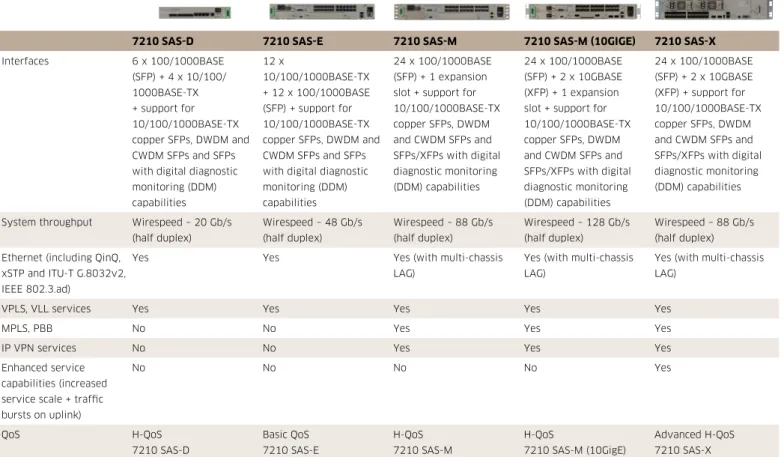
Table 1. Alcatel-Lucent 7210 SAS platform variants
7210 SAS-D 7210 SAS-E 7210 SAS-M 7210 SAS-M (10GIGE) 7210 SAS-X
Interfaces 6 x 100/1000BASE
(SFP) + 4 x 10/100/ 1000BASE-TX + support for 10/100/1000BASE-TX copper SFPs, DWDM and CWDM SFPs and SFPs with digital diagnostic monitoring (DDM) capabilities
12 x
10/100/1000BASE-TX + 12 x 100/1000BASE (SFP) + support for 10/100/1000BASE-TX copper SFPs, DWDM and CWDM SFPs and SFPs with digital diagnostic monitoring (DDM) capabilities
24 x 100/1000BASE (SFP) + 1 expansion slot + support for 10/100/1000BASE-TX copper SFPs, DWDM and CWDM SFPs and SFPs/XFPs with digital diagnostic monitoring (DDM) capabilities
24 x 100/1000BASE (SFP) + 2 x 10GBASE (XFP) + 1 expansion slot + support for 10/100/1000BASE-TX copper SFPs, DWDM and CWDM SFPs and SFPs/XFPs with digital diagnostic monitoring (DDM) capabilities
24 x 100/1000BASE (SFP) + 2 x 10GBASE (XFP) + support for 10/100/1000BASE-TX copper SFPs, DWDM and CWDM SFPs and SFPs/XFPs with digital diagnostic monitoring (DDM) capabilities System throughput Wirespeed – 20 Gb/s
(half duplex)
Wirespeed – 48 Gb/s (half duplex)
Wirespeed – 88 Gb/s (half duplex)
Wirespeed – 128 Gb/s (half duplex)
Wirespeed – 88 Gb/s (half duplex) Ethernet (including QinQ,
xSTP and ITU-T G.8032v2, IEEE 802.3.ad)
Yes Yes Yes (with multi-chassis
LAG)
Yes (with multi-chassis LAG)
Yes (with multi-chassis LAG)
VPLS, VLL services Yes Yes Yes Yes Yes
MPLS, PBB No No Yes Yes Yes
IP VPN services No No Yes Yes Yes
Enhanced service capabilities (increased service scale + traffic bursts on uplink)
No No No No Yes
4
ALCATEL-LUCENT 7210 SAS | RELEASE 4.0
ALCATEL-LUCENT DATA SHEET
7210 SAS-D 7210 SAS-E 7210 SAS-M 7210 SAS-M (10GIGE) 7210 SAS-X
OAM • ITU-T Y.1731 with
Synthetic Loss Measurement (SLM) • IEEE 802.1ag • IEEE 802.3ah
• ITU-T Y.1731 with Synthetic Loss Measurement (SLM) • IEEE 802.1ag • IEEE 802.3ah • Out-of-band
man-agement over IPv6
• ITU-T Y.1731 with Synthetic Loss Measurement (SLM) • IEEE 802.1ag • IEEE 802.3ah • Out-of-band
man-agement over IPv6
• ITU-T Y.1731 with Synthetic Loss Measurement (SLM) • IEEE 802.1ag • IEEE 802.3ah • Out-of-band
man-agement over IPv6
• ITU-T Y.1731 with Synthetic Loss Measurement (SLM) • IEEE 802.1ag • IEEE 802.3ah • Out-of-band
man-agement over IPv6 Timing and
synchronization
ETR system: ITU-T Sync-E with stratum-3 (TXCO) system clock
N/A ITU-T Sync-E with
stratum-3 (TXCO) system clock
ITU-T Sync-E with stratum-3 (TXCO) system clock
ITU-T Sync-E with stratum-3E (OXCO) system clock
ETR system available Yes No No Yes No
Temperature operating range
• Standard system: 0°C to 40°C (32°F to 104°F) • ETR system:
-40°C to +65°C (-40°F to +149°F) using the 7210 SAS-D (ETR)
Standard system: 0°C to 50°C (32°F to 122°F)
Standard system: 0°C to 50°C (32°F to 122°F)
• Standard system: 0°C to 50°C (32°F to 122°F) • ETR system:
-40°C to +65°C (-40°F to +149°F) using the 7210 SAS-M (10GigE – ETR)
Standard system: 0°C to 50°C (32°F to 122°F)
Hot-swappable modules N/A Power supplies, fan tray Service expansion
modules, power supplies, fan tray
Service expansion modules, power supplies, fan tray
Power supplies, fan tray
Power supply redundancy
The 7210 SAS-D has a single integrated power supply. The 7210 SAS-D (ETR) has a single integrated power supply and supports redundancy using an external power supply.
Integrated redundant power supplies Integrated redundant power supplies Integrated redundant power supplies Integrated redundant power supplies
Power requirements • AC input: 100 V to 240 V, 50 Hz to 60 Hz; output: +12 V DC non-redundant • DC input: -36 V DC
to -72 V DC; output: +12 V DC non-redundant • DC input: +24 V DC;
output: +12 V DC non-redundant [ETR variant only]
• AC input: 100 V to 240 V, 50 Hz to 60 Hz; output: +12 V DC
• DC input: -36 V DC to -72 V DC; output: +12 V DC
• Supports concurrent use of AC and DC power supplies
• AC input: 100 V to 240 V, 50 Hz to 60 Hz; output: +12 V DC • DC input: -36 V DC
to -72 V DC; output: +12 V DC
• DC input: +24 V DC; DC output: +12 V DC
• Supports con current use of AC and DC power supplies
• AC input: 100 V to 240 V, 50 Hz to 60 Hz; output: +12 V DC [ETR and non-ETR rated variants available] • DC input: -36 V DC
to -72 V DC; output: +12 V DC [ETR and non-ETR rated variants available] • DC input: +24 V DC;
output: +12 V DC [ETR rated] • Supports con current
use of AC and DC power supplies
• AC input: 100 V to 240 V, 50 Hz to 60 Hz; output: +12 V DC • DC input: -36 VDC
to -72 V DC; output: +12 V DC
• Supports con current use of AC and DC power supplies
Dry contacts (input/output)
N/A 4 (opto-isolated) /
2 (dry relay)
4 (opto-isolated) / 2 (dry relay)
4 (opto-isolated) / 2 (dry relay)
3 (opto-isolated) / 3 (dry relay)
Dimensions • Height: 4.28 cm
(1.69 in.) • Width: 26.5 cm
(10.43 in.) • Depth: 17.5 cm
(6.89 in.)
• Height: 6.7 cm (2.64 in.) • Width: 43.6 cm
(17.17 in.) • Depth: 25.3 cm
(9.96 in.)
• Height: 6.7 cm (2.64 in.) • Width: 43.6 cm
(17.17 in.) • Depth: 25.3 cm
(9.96 in.)
• Height: 6.7 cm (2.64 in.) • Width: 43.6 cm
(17.17 in.) • Depth: 25.3 cm
(9.96 in.)
• Height: 8.8 cm (3.47 in.) • Width: 43.9 cm
(17.3 in.) • Depth: 27.9 cm
(11 in.)
Table 2. Alcatel-Lucent 7210 SAS-M service expansion modules SERVICE EXPANSION
MODULE TYPE PORTS CONNECTOR TYPE DESCRIPTION
T1/E1 CES 4 RJ-45 4-port T1/E1 CES service expansion module supports extended temperature ranges, RJ-45 connectors, and a stratum-3 TXCO clock 10GigE 2 XFP Optics 2-port 10GigE service expansion module supports extended
temperature ranges and XFP optical connectors
SAFETY STANDARDS AND
COMPLIANCE AGENCY
REGULATIONS
Environmental specifications
• ETSI - EN 300 019 • EN 300 753
Safety
• CSA/NRTL (UL 60950-1 2nd Edition, CSA 22.2 No. 60950-1 2nd Edition) • CB Report with all national deviations
Electronic magnetic compatibility
• CE Mark • EN 300 386 • FCC Class A • VCCI Class A
Power utility substations • IEEE 1613 (fan required)
• IEC 61850-3 (Hazardous substances exception; e.g. sea salt mist, oil) Railway
• EN 50121-4 • IEC 62236-4
Certifications
• NEBS Level 3 certified
¬ 7210 SAS-E, 7210 SAS-M, 7210 SAS-M (10GigE), 7210 SAS-M (10GigE – ETR) • NEBS Level 3-compliant
¬ 7210 SAS-X, 7210 SAS-D, 7210 SAS-D (ETR)
• MEF 9 and MEF 14 certified • Telcordia GR-1089-CORE • Telcordia GR-63-CORE • ATT-TP-76200 • CE