1
Introduction
Electrical systems installed in domes-tic premises in France vary consid-erably from those used in the UK. Whilst all appliances would work sat-isfactorily in either country, few of the materials and equipment used in the construction of UK electrical systems are acceptable in France.
Despite these differences, under-standing and installing a French system is well within the capacity of anyone who is competent in the installation of UK systems.
This guide starts with the electricity supply from EDF and continues step by step through the requirements of a typical installation. The materials and equipment required are described in detail with photographs and illustra-tions showing their use.
Where appropriate, the guide pro-vides an insight into the differences between the UK and French systems and highlights the reasons behind these differences. Common misun-derstandings are clarified and prac-tices that are unacceptable in France
but acceptable in the UK, and vice versa, are explained.
There is always a tendency to think that what we are used to is better, but the French standards are in fact very high and the approach should be one of understanding and meeting the French requirements.
Common equipment
standards
Fortunately, thanks to the European Union there are some common equipment standards, such as cables and equipment carrying the CE mark. The CE mark is a construction stand-ard for equipment.
The French national standard for equipment and installations, which also includes equipment perform-ance, is the NF classification. This has a function equivalent to that of the BS Kitemark in the UK. In particular, the regulations relating to domestic elec-trical installations in France are known
Electricity in your french house
8
as NF C 15-100. The Norme, as it is
known, has broadly the same function and legal standing in France as do the IEE 17 regulations in the UK.
Codes of practice
To complement the regulations in the UK, various codes of practice are
pub-lished relating to specific aspects of installations. The same thing happens in France, where the source of similar
information is the UTE (Union
Tech-nique de l’Electricité). One UTE publication in particular is referred to in the following pages. This is UTE C90-483, which deals with IT net-works in domestic properties.
Suppliers, tariffs
and charges
2
If you want electricity supplied to a new installation, you will need to request your electricity company to provide the connection. EDF manages over 95% of the electricity network in France and will provide a connection to a property upon request.
You can choose to purchase your electricity from EDF or from one of the various alternative suppliers who offer a range of competitive schemes.
(
NoteThe French state controls the tariffs of EDF and keeps them somewhat below market level. The European Union has noted this and is insisting that they be deregulated during the course of 2010.
•
The normal way to select (or change) a supplier is to visit a comparison
website by searching under
change-ment de fournisseur d’électricité
and to choose from those listed. At the time of writing, all such sites are in French, but useful information can be
found on: www.french-property.com/
guides/france/utilities/electricity/.
Having selected your supplier, fill in the on-line form to start the contract process.
Alternatively, if you wish to change supplier, enter your electricity con-sumption and post code details into the form. This will trigger the various suppliers’ offers for you to compare. Changing your supplier should be relatively seamless with the new supplier managing the changeover arrangements with the original com-pany. Subject to contractual require-ments, there are no restrictions on how many times or how often you change supplier, but there might be some restrictions regarding reverting to your original supplier (for exam-ple, you need a period of six months before going back to EDF).
The different suppliers also list the percentage of “green” electricity included in their offers.
If you prefer a turnkey solution, it is possible to start off by choosing an electricity supplier and then to request them to make contact with EDF for the connection. The chosen
Electricity in your french house
10
supplier liaises with EDF for the work and manages the whole process. Tables 1 and 2 provide the current EDF tariffs (August 2009) for a sin-gle-phase base rate (tarif bleu) or off-peak rate (tarif bleu option heures creuses) at various power capacities.
Table 1 EDF Base rate
Power in Kva Rating of Main Switch (amps) Annual Standing Charge (Euros) CostEuros/ Kwh 6 30 77 .08 0 .1081 9 45 96 .78 0 .1125 12 60 168 .13 0 .1125 15 75 204 .76 0 .1125 Table 2 EDF Off-peak rate
Power in Kva Rating of Main Switch (amps) Annual Standing Charge (euros) High Rate (heures pleines) Off-peak Rate (heures creuses) 6 30 102 .15 0 .1154 0 .734 9 45 154 .5 0 .1154 0 .734 12 60 232 .32 0 .1154 0 .734 15 75 292 .35 0 .1154 0 .734
The above tariffs include tax (TTC). Several taxes are levied on electricity bills apart from TVA, including
munic-ipal tax, departmental tax, CTA
(con-tribution tarifaire d’acheminement)
and CSPE (contribution au service
public d’électricité) – all at various
rates which can be found detailed on the relevant EDF bill.
Another tariff offered by EDF is Tempo. The Tempo tariff divides each day into one of three colours: red, white and blue.
The blue tariff is available for 300 days of the year; these days are the least expensive. The white tariff is applied for 43 days of the year and the red tariff for the 22 remaining days. The red tariff is the most expensive and is always applied from the November 1st till March 31st, but never on
week-ends and bank holidays.
Within each day, irrespective of col-our, are off-peak and base rate peri-ods, thus giving a total of six tariff periods. The daily base rate and off-peak periods vary according to the region. Typically, base rate can be from 6 a.m. to 10 p.m. with off-peak from 10 p.m. to 6 a.m..
EDF decide which colour will be applied to the following day by send-ing a signal along the electricity net-work around 8 p.m. each day. This signal is picked up by the metering and energy management computer installed by EDF in your home. The computer illuminates the appropriate LED which indicates the colour for the next day.
This information is also available on internet, and you can arrange to be notified by e-mail or text message. This arrangement allows the con-sumer to manage their
consump-tion by deferring the use of washing machines and electric heating etc. EDF will provide the Tempo tar-iff upon request and install free of charge the management computer and the metering equipment in your home. The system is not available for consumers with less than 9 Kva sup-ply capacity.
You will find more information on the EDF website.
EDF website
The EDF website has a section in English that offers, amongst other useful infor-mation and services, English-speaking telephone helplines, depending on your region . A list of these numbers is given in the Appendix . To access the English section, go to http://www.edf-bleuciel. fr/accueil/pages-transverses/foreign-resi-dents-141412.html.
Three-phase systems
It is not uncommon to find three-phase systems in rural properties in France . This is most often an indication of their original use, perhaps as farm complexes . A three-phase supply could well have been installed originally to power farm machin-ery . Although the property may no longer be a working farm, the three-phase elec-tricity supply may still be in place . EDF will be happy to leave the three-phase supply, but it should be emphasised that unless you are qualified and compe-tent in the complexities of a three-phase supply, it is best to seek professional advice .
The risks of shock and fire are consider-ably greater than in the case of a single-phase supply .
If such a property is the subject of a renovation project, then unless there is a specific need for a three-phase supply, it is strongly recommended that it be removed and replaced by a single-phase supply .
3
EDF metering and
main switchgear
This chapter describes what EDF provide as their part of an installation, where your responsibility starts and what you need to get from that point to the consumer unit.
EDF equipment
The supply cabling to the property will arrive at the EDF main fuse box (coffret de coupe circuit), which pro-vides mains short-circuit protection for the property. The fuses will be connected to the meter in the normal way and from there will be connected
to the EDF RCD (disjoncteur de
branchement). This will most likely be a double-pole RCD Type S with overcurrent release and a continuous load capacity of 45, 60 or 90 amp. It is adjustable within this range by EDF. The tripping sensitivity for earth faults is always 500 milliamp. The Type S has an approximately 40 millisecond delay in operation for earth faults, in order to allow the consumer unit RCDs to operate first in this event. The incoming terminals will be sealed, but
the outgoing ones will not be, as they are the point of common coupling, i.e. where the consumer’s responsibility takes over from that of EDF.
Other equipment that may be found in this area includes the timers and relays required for off-peak supplies. The entire EDF installation can range from a glass-fibre box, mounted some-where outside the property and con-taining little more than a set of main fuses, a rotating disc digital meter and an RCD, to a modern GTL (see chapter 11) comprising the latest in remotely read meters and modular con-struction with an aesthetically pleasing match to the consumer’s equipment.
Main cabling
The size of the cabling from the EDF equipment to the consumer unit is a function of both the load capacity and the maximum voltage drop allowed. To establish the load capacity (if not known), locate the small window on the EDF RCD. Here you will find a number indicating the current at
Figure 1
Typical arrangement of EDF equipment
EDF main fuses
To consumer unit EDF RCD type ‘S’ EDF supply to building
Electricity in your french house
14
which the overcurrent release is set, e.g. a 45 amp RCD might have an overcurrent setting (as seen through the viewing window) of 30 amp. This would equate to a supply capacity of 6 Kva (see table 1).
The voltage drop is the loss of voltage in a cable caused by both the magni-tude of the current flowing through it and the length of the cable. It is expressed as a percentage of the volt-age as measured at the EDF equip-ment. The maximum voltage drop allowed is 3%. This is defined as calcu-lated from the EDF RCD to the furthest lighting point or socket outlet in the property. Normally, 1% is allowed for the voltage drop inside the house and this equates to a maximum of 50 m of lighting or power-socket cable. The assumption is that the supply cabling from the EDF RCD will cause no more than a 2% voltage drop before arriving at the consumer unit.
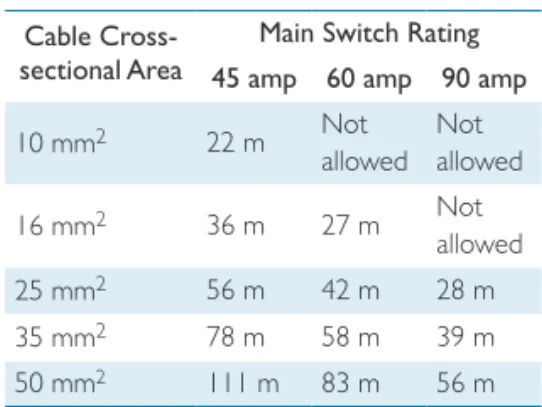
Table 3 gives cable lengths for a maximum voltage drop of 2% as a function of different load capacities. The minimum size of cable under any
circumstance is 10 mm2.
The earth connection from the test link to the consumer unit should always be the same size as the cabling between the EDF RCD and the consumer unit. EDF will be happy to provide a street pillar at the property limit or other agreed position. This will contain all the EDF equipment, i.e. fuses, meter, RCD and off-peak relays and timers. The
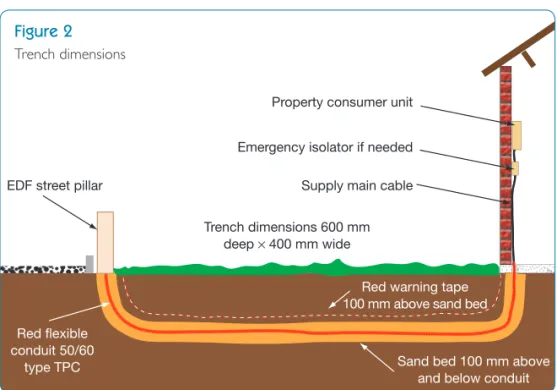
point of common coupling is still the outgoing terminals of the EDF RCD. The next question to consider is what type of cable to use, given that the cable route from the street pillar to the house will almost certainly be under-ground. The guidelines for cross-sec-tional area of cable shown in table 3 apply equally to underground cables but the cable types are different. In this situation it is necessary to install either:
• a U1000 R2V or FRN 05 VV-U
in red flexible conduit type TPC of 50/60 mm diameter, or
• an armoured cable type U1000
RGPFV or a lead-sheathed armoured cable type U1000 RVFV directly into the ground.
In either case, a red warning tape should be placed directly above the cable.
Generally, the only conduit allowed in this trench will be the EDF power supply to the house. Trenches
car-Table 3
Cable lengths for maximum voltage drop of 2%
Cable Cross-sectional Area
Main Switch Rating 45 amp 60 amp 90 amp
10 mm2 22 m Not allowed Not allowed 16 mm2 36 m 27 m Not allowed 25 mm2 56 m 42 m 28 m 35 mm2 78 m 58 m 39 m 50 mm2 111 m 83 m 56 m
rying other services must be kept at least 200 mm away from the EDF trench. However, off-peak control equipment from EDF can, with their express agreement, be included in the same conduit as the supply.
In all cases, however, any digging of trenches or installation of conduits and cables should only be carried out following consultation with EDF and their agreement as to where the street pillar might be placed.
Emergency isolation
There is a requirement in the Norme
to provide an emergency isolator ( cou-pure d’urgence) which, when oper-ated, cuts off the supply of electricity
to the property’s consumer unit. This function is normally provided by the EDF main RCD when this is along-side the property’s consumer unit. However, if the EDF main RCD is not in the same place as the property’s consumer unit (as might be the case in figure 2, where it could be located in the street pillar), then the responsi-bility to provide the main isolator falls to the owner of the property.
This isolator must be double-pole and have at least the same current rating as the EDF RCD.
Although not strictly required to be, the isolator can be an RCD similar to the EDF main RCD. It must be installed adjacent to, and control the supply to, the main consumer unit.
Figure 2 Trench dimensions
Sand bed 100 mm above and below conduit
EDF street pillar
Red flexible conduit 50/60
type TPC
Trench dimensions 600 mm deep × 400 mm wide
Property consumer unit Emergency isolator if needed Supply main cable
Red warning tape 100 mm above sand bed