SiamPay
Copyright Information
AsiaPay Limited
121/49 R.S.Tower Level 11, Ratchadapisek Road, Dindeang, Bangkok Thailand 10400
Telephone :(662) 642 3272 auto Fax: (662) 642 3279
Web site: http://www.asiapay.co.th/
This document and the software described by this document are copyright 2010 by AsiaPay Limited. All rights reserved. Use of the software described herein may only be done in accordance with the License Agreement provided with the software. This document may not be reproduced in full or partial form except for the purpose of using the software described herein in accordance with the License Agreement provided with the software. Information in this document is subject to change without notice. Companies, names and data used in the examples herein are fictitious unless otherwise noted.
All trademarks are the property of their respective owners. This document is developed and produced in Hong Kong, SAR.
Confidentiality and Usage
The information contained in this document (and any attachments) is confidential information provided by AsiaPay Limited. This document is intended only for use by merchants, customers, partners and other parties approved by AsiaPay Limited. Any copying, distribution or dissemination of this document by any other parties is prohibited.
Revision History
Revision Date Revision Description
1.0 Mar 10, 2003 First issue
2.0 Dec 12, 2004 New functions & order status and documentation list update
2.1 Sep 20, 2005 Revised password policies
TABLE OF CONTENTS
OVERVIEW... 6
INTRODUCTION... 6
GETTING STARTED ... 7
STEP 1–APPLY FOR A MERCHANT ACCOUNT...ERROR!BOOKMARK NOT DEFINED.
STEP 2–INTEGRATE PAYDOLLAR PAYMENT SERVICES...ERROR!BOOKMARK NOT DEFINED.
STEP 3–APPLICATION TEST...ERROR!BOOKMARK NOT DEFINED.
STEP 4–OFFICIAL LAUNCH...ERROR!BOOKMARK NOT DEFINED.
HOW DOES SIAMPAY PAYMENT SERVICES WORK? ...ERROR!BOOKMARK NOT DEFINED.
ADMINISTRATION TOOLS ...ERROR! BOOKMARK NOT DEFINED.
SIAMPAY MERCHANT ADMINISTRATION LOGIN...ERROR!BOOKMARK NOT DEFINED.
Merchant MTD Transaction Summary... 10
Merchant’s Bulletin Board... 10
Hot Tips ... 11
Online Help... 11
MERCHANT’S PROFILE... 12
GENERAL INFORMATION... 13
BANKING INFORMATION... 15
PAYMENT INFORMATION... 16
PAYMENT OPTIONS... 17
OPERATIONS & REPORTS... 19
TRANSACTION DETAIL... 20
CAPTURE of Authorized Transactions ... 26
Full Amount Refund (for standard plan merchants) ... 26
Partial Amount Refund (for standard plan merchants)... 26
Void, Refund, Reverse and Capture Transaction ... 27
Additional Information on Rejected and Pending Transactions ... 29
Resend Datafeed ... 32
Screening Function ... 33
ESTATEMENT (FOR STANDARD PLAN MERCHANTS) ... 35
1) Settlement History ... 35
2) Settlement Schedule ... 38
SALES REPORT... 39
REFUND REPORT (FOR STANDARD PLAN MERCHANTS) ... 40
CHARGEBACK REPORT (FOR STANDARD PLAN MERCHANTS) ... 41
TRANSACTION SUMMARY REPORT... 42
BANK SETTLEMENT REPORT (FOR PREMIER MERCHANTS) ... 43
RISK CONTROL... 45
PAYALERT REPORT... 46
PayAlert Level ... 47
HIGH RISK COUNTRY REJECTION... 48
SCREENING MANAGEMENT –CREDIT CARD SCREENING,IPADDRESS SCREENING... 49
PAYMENT LIMIT... 50
OTHER SECURITY CONTROLS... 51
CONTROL REFERENCE... 52
SIAMPAY ANALYZER ... 53
PEAK HOURS TRAFFIC ANALYSIS... 54
WEEKDAY VS WEEKEND DISTRIBUTION ANALYSIS... 55
SEASONAL ANALYSIS... 56
PAYER COUNTRY DISTRIBUTION... 57
BUSINESS TREND ANALYSIS... 59
SALES PERFORMANCE ANALYSIS... 60
REJECT REASON DISTRIBUTION... 62
SERVICES CENTRE ... 63
CHANGE PASSWORD... 64
USER ACCESS CONTROL... 65
User Group Maintenance ... 66
Add User Group ... 67
User Maintenance ... 69
Update User ... 70
Add User ... 71
DIRECT PAYMENT LINK... 72
Create Direct Payment Link... 73
View Existing Direct Payment Link ... 74
SUPPORT CENTRE ... 75
Overview
Introduction
SiamPay is a powerful web-based online payment services platform, which provides secure, multi-channel, multi-lingual and multi-currency payment services. It is used by many renowned companies and organizations in the region.
This document will help you get the most from the SiamPay payment services. With this document, SiamPay merchants will be able to understand the various features of SiamPay services. It is suggested that you read this document prior to using SiamPay services. It contains valuable information that helps you to learn faster and enhance your experience.
Getting Started
There are several steps that must be completed prior to accept payments through SiamPay payment services.
Step 1 – Apply for a Merchant Account
Before any integration is being carried out, it is presumed that the merchant has already applied a merchant account with AsiaPay (Thailand) Limited. If you do not have a merchant account, please contact us for application.
Step 2 – Integrate SiamPay payment services
This step should be completed after reading our Integration Guide. SiamPay payment service supports different types of channels’ integration. Make sure that you have the right version of Integration Guide for your application.
Step 3 – Application Test
When steps 1 and 2 are completed, you may apply a testing account with us to test your application before the official launch of your online business. In the testing environment, only testing credit cards and account numbers work. During testing process, please enter some transactions and check to see that those transactions are authorized. Check the details of each transaction, such as Merchant name, currency, amount and etc. are correct. To check the details, you have to login your merchant admin tools which at SiamPay testing environment provides detail information for transaction of your account. If your testing does not give you the expected result, please contact us for assistance.
Step 4 – Official Launch
At the moment after satisfactory testing result, it is ready for your web application launch. Make sure necessary modifications are made for production environment. If everything is ready, you can start enjoying the benefits of real-time payment process with SiamPay.
How does SiamPay Payment Services work?
Merchants using SiamPayPayment Services can automatically authorize and settle credit card payments either on their web site or on standard payment interface on SiamPay.com with 128-bits SSL encryption. Transactions history is recorded in our database and merchants can access the information by logging into merchant administration tools at www.siampay.com.
Usually, a transaction starts when a consumer makes a purchase at a merchant’s website. The required purchase information is sent securely to SiamPay Payment Services platform. Upon the transaction reaches SiamPay, our database records the information and requests the acquiring bank to authorize the transaction. The result is returned through our payment platform to client browser within seconds.
With SiamPay Administration Tools, the merchant can query the transactions’ status via their web browser. They can also perform actions like void, request refund, download report and etc. In the following sections, there contains detailed information on the features of SiamPay Administration Tools.
Administration Tools
SiamPay Merchant Administration Login
Merchant can access the Administration Tools, the user must set the correct URL or use the shortcut link at www.siampay.com homepage by selecting “Merchant Login” or
(https://www.siampay.com/b2c2/eng/merchant or https://www.siampay.com/b2c2/tha/merchant) and
then enters Merchant ID, Login name and Password in the form as shown below. Click the “Submit” button to submit the form. All fields are case sensitive. i.e. ‘ABC’ is not the same as ‘abc’.
Figure 1: Merchant Admin Login Screen
In the production environment, the data transmitted via browser will be encrypted. Please make sure there is lock-liked icon shown at the lower-right corner of your browser. This means the browser is protected and server connected is authenticated. To authenticate the identity of the server ID certificate, double click the icon to read the details. Contact SiamPay or the certificate issuer if there is any doubt.
The user will be temporarily locked when the system records more than 6 consecutive login failures due to incorrect password. Users are required to change password periodically. When a user’s password is expired, the system will prompt the user to change the password automatically.
After a successful login, the first page presented is the Merchant Admin Homepage as shown below.
Figure 2: Merchant admin home page
At the top of this home page, it contains account information, including:
- Merchant ID
- Merchant Name
- Last Logon, it shows the date and time last time you logon for security purpose.
Merchant MTD Transaction Summary
The Merchant MTD (Month to date) Transaction Summary shows transactions of the account in the current month by payment method.
Merchant’s Bulletin Board
Just below the Merchant MTD Transaction Summary, there is a Bulletin Board which covers the update news and benefits for merchants. You are recommended to view the contents regularly.
Hot Tips
“Your business is our business”. SiamPay always aims at providing comprehensive information to help our business partners and merchants like you to develop a profitable and healthy e-commerce business. This Hot Tips area contains useful information and business tips for e-business such as reference on fraud prevention and chargeback prevention.
Online Help
Simply click the ‘Help’ button on the right upper corner, you can get more information or explanation of items on the merchant admin tools usage.
In order to protect the user account, the login session will be expired automatically when the browser is idle for too long. You are highly recommended to logout the account when you are using a public terminal computer or leaving your seat.
At the left-hand-side of the screen are tags to other section: 1) Profile; 2) Operations; 3) Risk Control; 4) Analysis; 5) Services; 6) Support and these will be discussed in more detail.
Merchant’s Profile
When the Profile tag is selected, the menu of Merchant’s Profile section is shown as below.
Figure 3: Menu of Merchant’s Profile
This Merchant’s Profile section is divided into 2 parts:
i) Profile’s Information – records the Merchant Information: -
General information
Banking information
Payment information
ii) Profile Setting – shows existing payment options: -
General Information
Figure 4: General Information Screen
Merchants have the responsibility to ensure the company information is up-to-date and accurate. The descriptions of the form as follow:
General Information
Field name Description
Merchant ID Unique ID number of the merchant account
Company Name Merchant’s registered company name
Merchant Class The plan applied for the merchant
Merchant Type Business type of merchant
Payment Type Type of payment to be accepted with this merchant account. Sale means the amount is debit from the credit card account, while Authorize only holds the request amount from the account without debit at instant.
Short Name Company name in short
URL Registered URL for online business
Mailing Address Corresponding address of the merchant
Business Address Registered address of the merchant’s company
Country / Region Country / Region of business registration
Country Domicile Country domicile of the registered company
Fax Number Corresponding fax number
Enquiry Hotline Telephone number for general enquiry about the merchant’s business. (e.g. Customer Service Hotline)
Contact Information (Name, Telephone No. & Email)
Field name Description
Project Contact Person who is in charge of the SiamPay merchant account set-up
Operations Contact Person who is in charge of the daily operations of the online transactions
Technical Contact Person who is in charge of the technical issue related to this account
SiamPay will send email to your operation contact email address(es) for the followings: 1) real-time email notification of successful/unsuccessful transactions
2) chargeback and retrieval request notification 3) accounts related issue e.g. refund, payment invoice
To update the company profile information (e.g. business and mailing address, contact number, website URL), please submit the ‘Merchant Account Maintenance Form’. You can download this form at the Support session.
For merchants who are using our SiamPay standard payment page, you may now enjoy personalized payment page. After the simple setup, your Company logo can be shown on every page throughout the payment process, so as to provide a more company-specific image to your customers. To register, please fill in the ‘Merchant Account Maintenance Form’ and prepare your company logo in .jpg, .png or .gif format (The suggested file size is: 150 x 60 pixels). Please kindly submit the form and logo by email to our Service Department.
Banking Information
Figure 5: Banking Information Screen
Banking Information
Field name Description
Bank Name of settlement bank
Bank Account Title Registered name for the account
Bank Account Number Registered account number
Bank Account Currency Currency of settlement for the account
For merchant accounts, you may register with our auto settlement service. For details, please contact our Account Department.
Payment Information
Figure 6: Payment Information Screen Payment Information
Field name Description
Currency Currency setting for the merchant account.
Return Value Link (Data Feed)
This is the location where merchant’s application accepts the return value of the payment transaction.
Secure Hash This function is to enhance the transaction message communication security between merchant site and SiamPay. By employing this technology, the integrity of the information and the identity of the signatory can be authenticated with industry standard.
To enable the Secure Hash function, please submit the ‘Merchant Account Maintenance Form’. You can download this form at the Support session. For the details of integration, please refer to the “SiamPay PayGate Integration Guide” which can be downloaded at the Support session.
Each Secure Hash Secret key is valid for two years, please contact our Service department to renew the Secure Hash Secret key before it is expired
Payment Options
Figure 7: Payment Options Screen
For each payment option, you can enable or disable at anytime by simply selecting the options and click the button UPDATE to confirm the changes.
Option Description
Return Value Link (Datafeed) This is the location where merchant’s application accepts the return value of the payment transaction (Warning: Please consult with your development/IT team before update as it may seriously affects the location of return value)
Datafeed failure alert email to contact email
When there is problem in returning you with the registered datafeed, we will send an email notification to your technical contact email (for merchants who registered the datafeed function)
Payment method selection in payment page
SiamPay provides two different payment pages: Payment method selection by logo [Default value] and Payment method selection by Text. Merchant may choose the payment page according to the own preference (for merchants who are using “Client Post Through Browser” connection method, please consult with your development/IT team for more information)
Two SiamPay payment page interfaces as below:
Operations & Reports
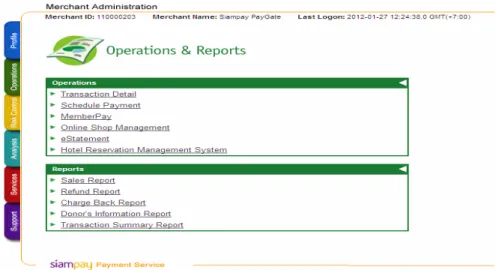
When the Operations tag is selected, the menu of Operations & Reports section is shown as below.
Figure 8: Menu of Operations & Reports
What administrator can do in this section is mainly checking the transaction details and generating reports. The menu is divided into 2 parts: i) Operations; and ii) Reports.
Sub-menu Contents
Operations -Transaction Details
-eStatement (for standard merchants) -MemberPay
-Online Shop Management -eStatement
-Hotel Reservation management System
Reports -Sales Report
-Refund Report (for standard merchants) -ChargeBack Report (for standard merchants) -Transaction Summary Report
-Bank Settlement Report (for premier merchants)
To streamline your daily operation flow, you can now perform i) Sales, ii) Authorize, iii) Capture and iv) Refund in a batch request. Just simply prepare a text file consisting all the required transactions details, and then upload to our system. You may also set the target processing date at your convenience. Please contact our Sales Department for further details of this function.
Transaction Detail
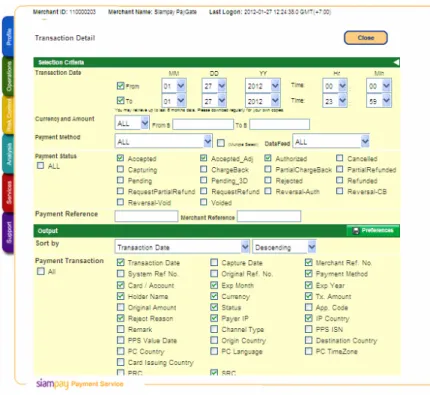
Figure 9: Transaction Detail screen
This function provides SiamPay merchants a powerful and flexible transaction searching and reporting based on the specified selection and sorting criteria. And, the selected details can also be downloaded to CSV format for recording and other processing reference. The first page of the Transactions Detail is to define selection criteria and output. Steps for transactions retrieval:
Steps Description
Step 1 – Define Searching Criteria
There are a number of selection criteria for searching. The logic of search is ‘AND’, i.e. Combination of all the fields. Leaving the field blank and selection to ALL will return all records. By default, only today’s transaction will be shown.
Step 2 – Output Sorting and fields to display
Output can be sorted by any of the criteria, ascending order or descending order. By default, the returned records are sorted by the field selected, such as Transaction Date, in descending order.
Step 3 – Submit Search Click View button to start searching and view online. Click Download button to download the extracted data.
Please note that the searching date range is set at 7 days and you may retrieve up to previous 6 months data. You are recommended to download the reports monthly for your own reference.
In order to provide a detail picture to Transaction Detail, there are descriptions of each selection criterion and output field in the following tables.
Selection Criteria of Transaction Detail
Field name Parameter / Type Description
Transaction Date From Date and To Date
(MM: Month; DD: Day; YY: Year; Hr: Hour; Min: Minutes)
Default value is today. Check From only to define the start date of search and Check To only to define the end date of search. Uncheck both From and To returns all transactions.
Currency and Amount Currency (Selection) and range of amount (Float)
Currency of transaction and amount or range of amount
Payment Method List of payment method Payment Method (e.g. Visa and MasterCard)
Datafeed Datafeed Indicator Available for merchants who have registered the
datafeed link All: all statuses
T: Successfully get response from merchant’s
defined datafeed page
F: Fail to get response from merchant’s defined
datafeed page or error occurs
R: Datafeed retry succeeds U: Datafeed retry fails
(R & U: only available for merchants who have registered the datafeed retry service)
Order Status Check box:
-Accepted -Accepted_Adj -Authorized -Cancelled -Capturing -Chargeback -PartialChargeback -PartialRefunded -Pending -Pending_3D -Rejected -Refunded -RequestPartialRefunded -RequestRefund -Reversal-Auth
Accepted: Successful sale transaction
Accepted_Adj: Transaction is accepted but there is
a partial chargeback or partial refund involved
Authorized: Hold request transaction limit only;
awaiting for capture
Cancelled: Payment cancelled by customer Capturing: Transaction waiting for the completion
of a capture process
Chargeback: Cardholder raises a dispute to the
card issuer (full amount)
PartialChargeack: Cardholder raises a dispute to
the card issuer (partial amount)
PartialRefunded: Requisition of partial amount
refund is processed by SiamPay
Pending: Incomplete transaction
-Reversal-CB -Voided -Reversal-Void
3D authentication process
Rejected: Unsuccessful sale transaction Refunded: Requisition of full amount refund is
processed by SiamPay
RequestPartialRefunded: Requisition of partial
amount refund by merchant is submitted
RequestlRefunded: Requisition of full amount
refund by merchant is submitted
Reversal-Auth: Cancellation of successful
authorized transaction by merchant
Reversal-CB: Chargeback transaction is
successfully appealed by merchant
Voided: Cancellation of successful transaction
before daily bank settlement by merchant
Reversal-Void: Withdraw the cancel request by
merchant
Payment Reference No. Number Payment Reference No. is a unique number
generated by SiamPay platform. Separate by “,” (comma) for more than one entry.
Searching Output of Transaction Detail – Payment Transaction
Field name Description
Transaction Date Date of transaction
Capture Date Date of Capture process (for authorized transaction only)
Merchant Ref. No. Reference No. submitted by merchant
System Ref. No. SiamPay generated unique number for each payment transaction
Original Ref. No. A System Ref. No. of the original parent transaction of a transaction
Payment Method Method of payment, e.g. VISA or MasterCard
Card/Account Credit Card account number
Exp Month Expiry month of the card
Exp Year Expiry year of the card
Holder Name Credit Card’s Holder name
Currency Currency of transaction
Tx. Amount Amount of transaction
Original Amount Original amount of transaction when there is a modification during capture process
Status Payment status (e.g. Accepted and Rejected)
App. Code The return value code sent by bank or card company for successful payment
Reject Reason Reason for unsuccessful transaction
Payer IP IP address of transaction
IP Country Country origination of the transaction (Country code will be shown)
Remark Remark submitted by merchant
Channel Type The source channel of payment Transaction. Refer to ‘Online Help’ for details.
PPS ISN Payment reference number for PPS
PPS Value Date Payment date for PPS
Origin Country Country of Physical Address (Information provided from the merchant)
Destination Country Country of Delivery address (Information provided from the merchant)
PC Country Payer’s computer setting on PC country
PC Language Payer’s computer setting on PC Language
PC TimeZone Payer’s computer setting on PC Time Zone
Card Issuing Country Country of the card issuing bank (Information provided from acquiring bank; for reference only)
Searching Output of Transaction Detail - Security
Field name Description
ECI Electronic Commerce Indicator (ECI) is a value that is returned from the Directory Server (Visa, MasterCard, and JCB) to indicate the authentication results of your customer's credit card payment on 3D Secure. Refer to ‘Online Help’ for details.
CVV Check CVV2/CVC2 checking is an indicator to explain if the cardholder enters the verification number at the time of payment.
Y - CVV2/CVC2 is entered by cardholder during payment N - CVV2/CVC2 is NOT entered by cardholder during payment
(Applicable for merchants who have enabled CVV2/CVC2 checking function only)
Enabled Screening Merchant can selectively block a particular IP address or card number
Payer Auth. Ref 3D Payer Authentication Reference Data
Payer Auth Status 3D Payer Authentication Status
Y – Card is 3D-secure enrolled and authentication succeeds N – Card is 3D-secure enrolled but authentication fails P – 3D secure check is pending
A – Card is not 3D-secure enrolled yet U – 3D-sercure check is not processed
Payer Response Code Response code of authentication process
Payer Response Detail Response code ‘s description
Searching Output of Transaction Detail – System/Operations
Field name Description
DataFeed Result of Datafeed process:
T – Successfully get response from merchant’s defined datafeed page F – Fail to get response from merchant’s defined datafeed page or error occurs R – Resend successfully
U – Resend unsuccessfully
(R & U: only available for merchants who have registered the datafeed retry service)
DataFeed Return Acknowledged print out received from the merchant’s defined datafeed page
SiamPay provides a special function called the ‘unique merchant reference number checking’. You may enable/disable this function according to your business needs. For more details, please contact our Service Department.
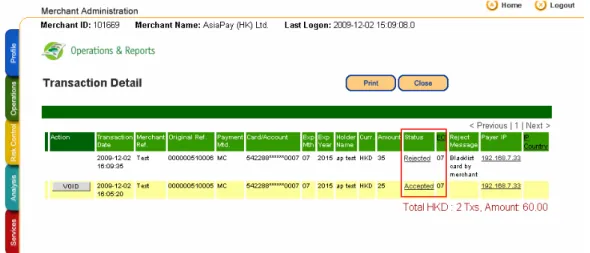
When the searching is finished, the result will be generated as the screen below.
Figure 10: Transaction Detail searching result
There is an Action column at the leftmost of the page which MAY contain any of these 5 buttons: i) Void, ii) Refund, iii) Capture, iv) Reverse and v) Resend Datafeed. The Void and Refund actions are cancellation of success sales payment while Reverse action is cancellation of successfully authorized payment. And Capture action is confirmation of the payment and the amount will be debit from the credit card account once the Capture action is taken.
Hints: To achieve quicker results. For authorized transactions, if you wish to cancel the order at real time, you are suggested to first capture the transaction and void it, instead of doing reversal.
Action Type Description
Success Payment WITH DEBIT (Accepted)
Void Void is available before daily bank settlement.
Refund Refund is available within 14 days from the transaction
Successfully Authorized Payment WITHOUT DEBIT (Authorized)
Capture Capture is available within 14 from the transaction. (exceptions subjected to payment bank) Reverse Reverse is available within 14 from the transaction. (exceptions subjected to payment bank)
Datefeed Retry
CAPTURE of Authorized Transactions
SiamPay recommends our Merchants to perform the CAPTURE action as soon as the transaction is confirmed as valid. Once captured, the customer’s credit card will be debited and merchants can receive the payment as per the scheduled pay date. If the merchant does not capture/reverse the authorized transaction over 14 days, the credit limit will be released to the cardholder after a time period which is subjected to card issuing bank.
Full Amount Refund (for standard plan merchants)
Full Refund is available both online and offline. If the transaction has occurred within the 14 days after-sale period, merchants can perform online refund, by visiting the Transaction Detail Report, and clicking the REFUND Action button. If the transaction has occurred for more than 14 days, merchants can download a Merchant Refund Request form, from the Account Service in the Support Centre.
Partial Amount Refund (for standard plan merchants)
Partial refund is only available through offline application. Merchant can download the same form as mentioned above. Simply fill in the necessary details and send it back to AsiaPay for manual processing.
After receiving a refund request, AsiaPay will gather all the necessary information and send them to the bank for processing. The refund request will then be processed by the bank, and will take up to 4 to 6 weeks to credit into the customer’s credit card account.
Please note that different payment method has its own refund processing period. You have to send us the refund request latest as follows:
Payment Method Max. refund period
Visa / MasterCard / JCB / PPS/Amex
180 Days
AliPay 90 Days
China UnionPay 30 Days
99Bill 180 Days
The merchant should directly settle the refund request with the customer after the above said period.
For Premier merchants and AE merchants, you have to contact the bank or card company directly to process refund.
Void, Refund, Reverse and Capture Transaction
Figure 11: Void/Refund/Reverse Transaction
The above screen is opened when the Void, Refund or Reverse button is clicked. In this page, the detail transaction information is shown. To confirm the action, click the Confirm button to continue. If decided not to proceed, click the Cancel button.
To capture a transaction, the below screen is opened when the Capture button is clicked. You may choose to capture the original authorized amount or a smaller amount.
To learn more about the action log of a particular payment status for the transactions, simply click on the Status for that transaction; an Action History window will pop up, to show you more information. Action History lists all the actions performed for a particular transaction.
Figure 13: Payment Status
The Action History provides information on when a specific action is performed. The Action Date shows the date and time that lead to the present payment status. You can also find out the operator that is in charge of such action from the Operator column.
Additional Information on Rejected and Pending Transactions
A. Rejected Transactions
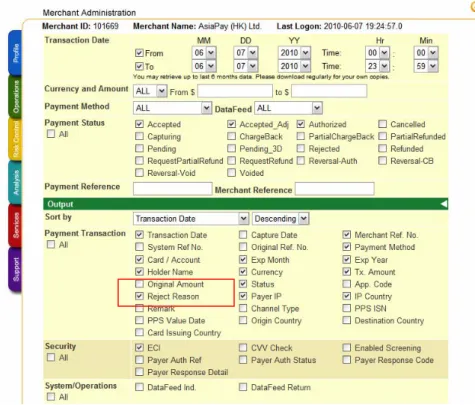
To learn more about why a transaction is being rejected, before viewing the Transaction Detail Report, please select the Reject Reason in the Output section, this will enable the Reject Reason to be displayed on the report as Reject Message.
Figure 15: Transaction Detail Report Options
The most common rejected reasons are:
1) Do not honour / Bank Decline: When the card under some account conditions that card issuers disapprove the transactions. Reasons behind includes marginally credit record, abnormal purchase amount or frequency, credit card not allowed for online payment, etc. Please invite your customers to contact the card issuing bank for the account status.
2) Payer Authentication Fail: Transaction authentication is very important in online payment process; authentication process can ensure the identity of the customers, and again to a large extent can lower the chance of chargeback cases. The 3D-secure check is enforced and the customer fails to confirm his/her identity. If the cardholder fails to pay with their VISA/MasterCard, please kindly invite the cardholder to contact the card issuing bank and register the Verified by VISA (VBV) / MasterCard SecureCode (MSC). If he has already registered the password, there may be input error during the payment, please check with the bank and try to process the transaction once again.
3) High Risk Country: A list of countries with a high reported incident of suspected fraud. By default, transactions originated from these countries will be blocked by system (Please go to Profile > Payment Options to change the checking status if necessary). Once you have disabled the checking, you are suggested to perform order confirmation with the customers whenever there is suspicion.
4) Expired Card: The cardholder inputs the expiry date wrongly, the transaction will be rejected with the reason of 'Expired Card'. Please invite your customers to contact the card issuing bank for the account status.
5) Invalid card number: The transaction may be rejected due to the customer entered the wrong card number. Please kindly invite your customers to perform the payment again and ensure that they are entering the correct card numbers.
6) Lost card: The card is reported as a lost card (by the cardholder) at the bank.
7) Stolen card, pickup card: The card is reported as a stolen card / being picked up by a third party.
8) Not sufficient funds: The credit limit of the card is not enough to process a transaction. Please invite your customers to contact the card issuing bank for the account status.
9) Blacklisted IP and card by merchant/system: After the merchant has applied a screening management, to block the IP address or credit card number of a particular transaction. That transaction will be rejected due to this blacklisted record.
10) Others: Please contact us for further details.
B. Pending Transactions
This may due to either the transaction is under processing or the Banking System does not respond to the transaction request. Please contact our Service Department for details.
Resend Datafeed
Datafeed Retry Function
(Applicable for merchants who have registered the datafeed link and retry function)
Sometimes, you may not be able to receive the datafeed response due to reasons like internet connection issue, incorrect datafeed URL being used, etc.
a) After enabling the “Auto retry failed data feed”, Datafeed will be resent:
(1) Immediately after the original attempt is failed, and (2) 15 minutes after if (1) is also failed
b) After enabling the “Receive data feed alert email”
an email notification (Retry unsuccessful) will be sent to the technical contact email address if retry (2) fails.
(To receive email notification for (1), please enable the function at Payment Options > Datafeed failure alert email to contact email)
At Transaction Detail Page, you can resend datafeed manually by pressing the ‘resend datafeed’ button on the action column within 14 days after the transaction (for transactions with the datafeed indicator of “F” and “U”).
To register the datafeed retry function (a and b), please submit the ‘Merchant Account Maintenance Form’. You can download this form at the Support session.
Screening Function
If the “Screening Function” box is checked as one of the Searching Output field in the report, a Screening column is added to the 2nd leftmost column of the page and a Screen button will be shown as below.
Figure 17: Transaction Detail Report with Screening Function
Once the Screen button is clicked, the above page is opened to facilitate the screening function. It allows the following screening effects:
Item Description
Screen the Credit Card Number Further transaction with that credit card number will be blocked
Screen the IP Address Further transaction from that IP address will be blocked
Both of the above items Further transaction either with that credit card number or from that IP address will be blocked
To confirm the action, click the Confirm button to continue. If decided not to proceed, click the Cancel button.
A Screening Management function is available under the Risk Control tag to review or delete the current screening rules. Details of this function will be described in the later Risk Control section.
eStatement (for standard plan merchants)
(For premier merchants, please contact your acquiring bank for the settlement issue.)
This is an online statement which shows the settlement detail in either by group of payment method or one-by-one transaction listing. In addition, merchant can view their coming settlement schedule and current transaction fee settings.
Three functions are available in the eStatement’s menu:
Figure 19: eStatement Menu Screen
1) Settlement History
In this function, merchants are allowed to search the past settlement records by settlement number, paid date or settlement balance.
After clicking the SUBMIT button, available records will be shown as below:
Figure 21: Searching Result Screen
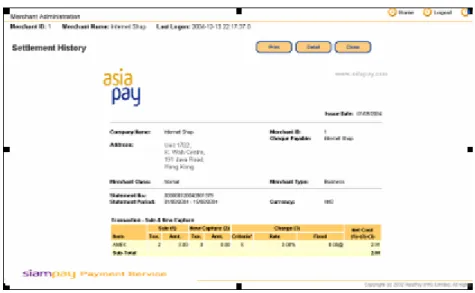
In the above screen, there is an action column with a “View” hyperlink provided for every record. Once it is pressed, the settlement detail will be shown in statement format. Below is one of the statement samples.
For every statement, it is divided into 5 sections:
Section Description
Statement Information Includes merchant information and the statement no. and period
Sale & New Capture Transaction
Net balance of Sale transaction and New Capture transaction
* Net balance = Total Sale/New Capture transaction amount - transaction fee
Refund Transaction Net balance of Refund Transaction
* Net balance = Total Refund amount + Return charge
(Return charge means the transaction fee charged in the past/current statement)
Chargeback Transaction Net balance of Chargeback transaction
* Net balance = Total Chargeback amount + Return charge – Handling fee (Return charge means the transaction fee charged in the past/current statement)
Adjustment Adjustment details
Merchant can use the DETAIL button to view all the transactions that are included in the corresponding statement. Below is the sample layout:
2) Settlement Schedule
Merchant can view their coming settlement schedule by selecting their desired period. Any change on the settlement schedule will also be reflected in this function.
Figure 24: Settlement Schedule Screen
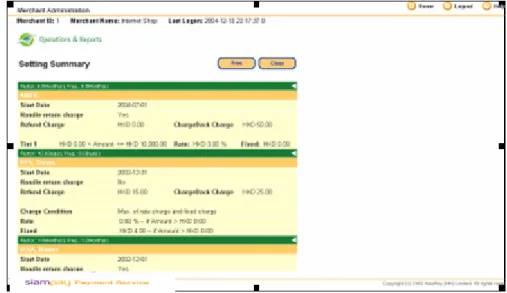
3) Setting Summary
It shows the current transaction fee setting for each payment method.
Sales Report
This online report provides a powerful reporting of Sales transactions based on the specified selection criteria including day range and currency. SiamPay merchant can choose to view, print or download (in CSV format) the report.
By default, the total sales within past 2 days will be shown.
Figure 26: Sales Report
Refund Report (for standard plan merchants)
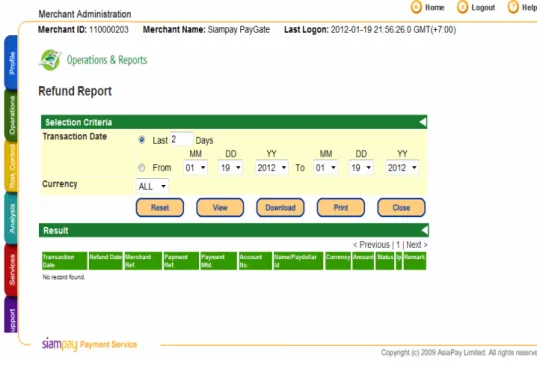
Refund report, is similar to Sales report, which provides reporting of Refund transactions based on the specified selection criteria including day range and currency. SiamPay merchant can choose to view, print or download (in CSV format) the report.
By default, the total refund within past 2 days will be shown.
Figure 27: Refund Report
Chargeback Report (for standard plan merchants)
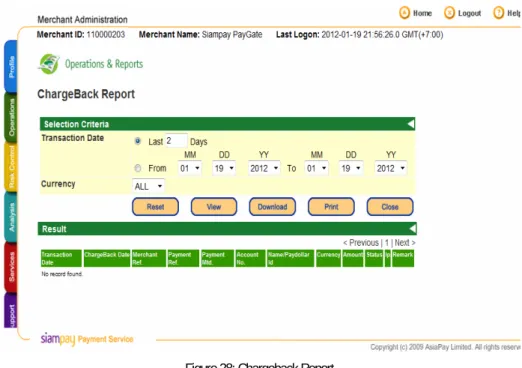
Chargeback report is an online report that provides a reporting of Chargeback transactions based on the specified selection criteria including day range and currency. SiamPay merchant can choose to view, print or download (in CSV format) the report.
By default, the total chargeback transaction within past 2 days will be shown.
Figure 28: Chargeback Report
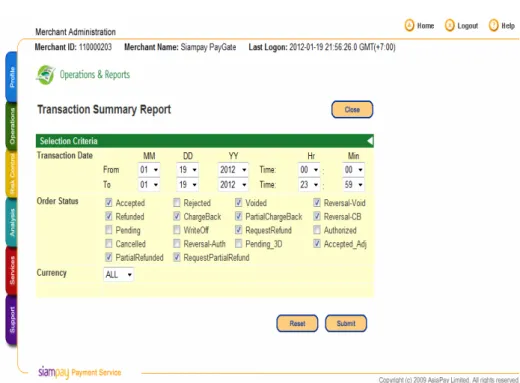
Transaction Summary Report
Figure 29: Transaction Summary Report main screen
Transaction summary report is a concise report that provides a summary of total amount and number of transactions within the specified date range. Total amounts of all transactions breakdown by payment method are available. The following is a sample result page of the summary report.
Bank Settlement Report (for premier merchants)
After daily settlement, premier merchants can work on accounts reconciliation based on the bank settlement report and payment advice received from bank.
You can view the settlement by payment bank and settlement date.
Figure 31: Bank Settlement Report – Payment Bank and Settlement Date searching
You can choose to view or download the settlement report (in csv or txt format) for your own record.
Risk Control
When the Risk Control tag is selected, the menu of Risk Control section is shown as below.
Figure 34: Menu of Risk Control
This menu is divided into 3 parts: i) Control Report ii) Control Parameter; and iii) Control Reference.
Sub-menu Contents
Control Report -PayAlert
Control Parameter -High Risk Country Rejection -Card Screening
-IP Screening -Payment Limit Setting -Other Security Controls
Control Reference -Fraud Sign
-Fraud Control -High Risk Country List -Dispute Resolution (Visa) -Charge Back Prevention -Chargeback Cycle (Visa)
-Verified by Visa Transaction Process
PayAlert Report
PayAlert is a power fraud management tool designed by SiamPay to assist merchants closely monitoring the transactions. It displays a PayAlert alert symbol to indicate the merchants if there is suspicious transaction.
Figure 35a: PayAlert Report
The 3 different levels of PayAlert are High, Medium and Low, and each is represented with a different alert symbol:
- High PayAlert Level - Medium PayAlert Level - Low PayAlert Level.
PayAlert Level
The table below shows the description and suggested actions to be taken for each PayAlert level. SiamPay recommends merchants when identifying suspicious transactions, to: 1). VOID or 2). REFUND the transactions, and even apply the screening management rule whenever necessary.
PayAlert Level Description Suggested Actions
High High PayAlert Level signifies a high level of doubt
and uncertainty about the transaction being checked. They are potentially caused by:
- Using stolen credit cards - Shoppers from high risk countries
- Unusual shopping patterns, such as repeated
orders, or transaction attempts using invalid information
- Credit card with a series of chargeback records
SiamPay highly recommends you to take active actions to ensure the buyer and the transaction are legitimate, to prevent fraudulent transactions. For example:
- Send email or call up to ensure the
shopper is valid and knows about the transaction
- Check shopper’s shipping address, billing
address, IP address and card issuer to see if it is suspicious
- Look through transactions carried out by
this particular shopper to study his/her spending history
Medium Medium PayAlert Level signifies inconsistencies in
the transaction being processed. It is less risky compared to High PayAlert Level, and potentially caused by:
- Unusual shopping patterns, such as repeated
orders, or transaction attempts using invalid information
- Credit card with chargeback records
You may wish to carry out further checks before fulfilling the order. Refer to the above actions listed for High PayAlert.
Low Low PayAlert Level indicates there is a slight
chance of fraud in the transaction. Potentially caused by:
- Repeated purchase within a short period of time
- Credit cards with a chargeback record
You may closely monitor the customer to early detect any undesirable or fraudulent behaviour.
High Risk Country Rejection
This checking is enabled by default, i.e. all transactions originated from high risk countries will be blocked. You can unclick a particular country on the list to accept payment. Once click ‘Enable’, the high risk country list will be shown.
Screening Management – Credit Card Screening, IP Address Screening
Screening Management covers TWO main areas:
Credit Card Screening
IP Address Screening
This function shows all the currently filtered card number and IP addresses and allows deletion on specific record.
Figure 37a: Screening Management in Risk Control
Payment Limit
Figure 38: Payment Limit Information
Payment Information
Field name Description
Transaction Limit Maximum limit for each single transaction
Daily Limit Maximum total transaction amount per day
Monthly Limit Maximum total transaction amount per month
To request for a payment limit upgrade, please submit the ‘Merchant Account Maintenance Form’. You can download this form at the Support session. You have to provide supporting documents such as the new pricing plan, sales receipts and invoice for the bank’s approval. The application process will take around 7-10 working days.
To closely monitor the sales performance on daily and monthly basis and to prevent payment limits to be exceeded which affects your online business, we will notify you by email (notification will be sent to your registered operation contact email) once the daily and monthly payment limits have reached 80% of the pre-set limits. As such, you will have an adequate preparation time to request for a payment limit upgrade when necessary.
Other Security Controls
Figure 39: Other Security Controls Screen
For each option, you can enable or disable at anytime by simply selecting the options and click the button UPDATE to confirm the changes.
Option Description
CVV2/CVC2 Checking Card Verification Number is a 3-digit code imprinted on the back of the card. By
enabling this function, your customer will be required to enter the credit card number, expiry date and together with the Card Verification Number printed on the card before starting the online payment process. It is an add-on security function to avoid business loss due to the fraudulent use of card. For more details, please refer to the brief description about “What is CVC2/CVV2?” next to this function.
Cardholder name checking This checking is subject to the card issuing bank
Decline transaction from the same IP
If you set the no. of transactions originated from the same IP to be N. Transaction N+1 onwards will be blocked by the system.
Domain or IP address checking
The domain and/or IP address of the page will be checked while the transaction is posting to SiamPay’s site
Control Reference
In this section, merchant can find useful information on the risk management, such as description on charge back process, guidelines to risk and fraud management, etc.
SiamPay Analyzer
When the Analysis tag is selected, the menu of SiamPay Analyzer section is shown as below.
Figure 41: Menu of SiamPay Analyzer
Advanced chart and analysis tool suite helps the merchant to better managing the sales performance and payment transaction trend in visualizations.
Sub-menu Contents
SiamPay Analyzer
(*All the information showed in this section is for reference only)
-Peak Hours Traffic Analysis
-Weekday vs Weekend Distribution Analysis -Seasonal Analysis
-Payer Country Distribution -Business Trend Analysis -Sales Performance Analysis -Reject Distribution Analysis
Peak Hours Traffic Analysis
It is useful for merchants to compare the peak and non-peak hours of the business. It will count the transactions with ALL status.
Figure 42a: Peak Hours Traffic Analysis
Figure 42b: Peak Hours Traffic Analysis – Chart and Statistic
According to the number of transaction within the chosen period, it will use ‘H’ to indicate the Peak hour and ‘L’ to indicate the Non-Peak hour.
H: Peak Hour
Weekday vs Weekend Distribution Analysis
It is useful for merchant to show the transaction distribution between weekday (Mon to Fri) and weekend (Sat and Sun). It will count the transactions with status including: Accepted, Accepted_Adj, Rejected and Cancelled.
Figure 43a: Weekday vs Weekend Distribution Analysis
Seasonal Analysis
It is useful for merchants to analyze the transactions on quarterly basis in a year and provide an insight of seasonal effect. It will count the transactions with status including: Accepted, Accepted_Adj.
Figure 44a: Seasonal Analysis
Payer Country Distribution
It is useful for merchants to show which country the customers are originated from. Merchant can select the specific date range and the payment method to display the result. Three are three options for choosing payment method:
i) All – Including all payment methods
ii) Credit Payment – Including Visa, MasterCard, JCB, AMEX, Diners
iii) Debit Payment – Including ChinaPay, CUPS, PPS, AliPay, 99Bill, PayPal
Figure 45a: Payer Country Distribution
And, there are six report types for merchant to choose: i) Successful Payment Only
ii) Rejected Payment Only
iii) Both Successful and Rejected Payment
iv) Success Ratio
v) Reject Ratio
Payer IP information is obtained from the third party - MaxMind, Inc., in which the result is based on the browser your customer used when processing the payment. It is for reference only.
An example of searching result:
Business Trend Analysis
It is useful for merchants to show the business trend according to the no of transaction and the transaction volume. It will count the transactions with status including: Accepted, Accepted_Adj.
Figure 46a: Business Trend Analysis
Sales Performance Analysis
It is useful for merchants to calculate their transaction success rate and chargeback rate. Merchant can select the specific date range and the payment method to display the result. Three are three options for choosing payment method:
i) All – Including all payment methods
ii) Credit Payment – Including Visa, MasterCard, JCB, AMEX, Diners
iii) Debit Payment – Including ChinaPay, CUPS, PPS, AliPay, 99Bill, PayPal
Figure 47a: Sales Performance Analysis
There are four report types for merchant to choose:
i) Success Ratio
ii) Chargeback Ratio (Chargeback case reported from acquiring bank; Not available for Premier merchants)
iii) Refund Ratio
An example of searching result:
Reject Reason Distribution
It is useful for merchants to have an overview of rejected payments. As such, merchant can gain a better understanding of the rejected payments classification over a specific period of time.
Figure 48a: Reject Reason Distribution
An example of searching result:
Services Centre
When the Service tag is selected, the menu of Service Centre section is shown as below.
Figure 49: Services Centre main screen
This section provides a collection of functions for account configuration, user control and value-added services. Choose from the submenu, Account Configuration or Services, the merchant can select one of the following options:
Function Description
Account Configuration
Change Password To change admin login password of super admin
User Access Control To control / amend user and group access rights Services
Change Password
Figure 50: Change Password screen
To change password, simply enter the old password, then the new password twice to confirm. Press the Submit button to change the password of your given login ID.
It is recommended to use a highly secure password with 7-15 characters. A good password should contain alphanumeric, and should be meaningless to most of the people and CANNOT be found dictionary. The new password chosen could not be the same as the previous 4 password being used before.
User Access Control
Figure 51: User Account Maintenance main screen
SiamPay Merchant Administration Tools allows different users to access the system. Super Admin may grant different access rights to different users or groups. This is useful, for instance that you may want a user or a group of users to have limited range of control over some aspects, while granting others on some other aspects.
Sub-menu Functions
User Group Maintenance -Define new group
-Group’s access right control -Edit access right
User Maintenance -Add new user
-User search -Group assignment -User’s status control -Change password
User Group Maintenance
Figure 52: User Group Maintenance screen
In SiamPay system, a user must be assigned to a group in order to gain access rights. In the diagram at the right-hand-side, it illustrates the procedure of creating groups and assigning users. Since the ‘rights’ are assigned to a group level, instead of user level, a user must be grouped into a right group to gain the rights.
The screen above is the User Group Maintenance section in which list of groups will be shown. To view / update a group, click on the group name to open the group detail screen. To add a new group,
click to open the Add User Group form as shown below.
Operations Group System Admin Ops Account System Service Group Step 1
-Define new group and grant rights to the group
Step 2
-Create user and assign the user to a group
Assignment Assignment
Add User Group
Figure 53: Add User Group screen
Create a new user group by completing the information, then selecting the access rights. Access right are divided in 3 levels:
- None means no access right
- Read only restricts user to edit / update any information
- Full means user is allowed to read and update information
Types and Functions are corresponding to the tag-menu (at the left-hand-side) and submenu of each section. When the access right of a function to a user is set as None, that menu item will not be seen by that user.
The following is the group detail screen of a sample user group. Update the group information and access right, then Confirm to complete and submit updated information.
User Maintenance
Figure 55: User Maintenance screen
User Maintenance is the second function of User Account Maintenance, in which administrator can add new user by clicking button. To search for a user, enter search criteria, such as Login ID, Name, Group and/or Status. Click Submit button to start searching. By default, i.e. click the Submit button without entering any criteria, all active user will be listed as the result screen shown below.
Update User
Figure 57: User Update screen
To update an existing user, click the Update link of that user under Action column of User Searching screen. It will present an Update User screen as above. When finish, click Submit button to complete the update process.
Add User
Figure 58: Add User screen
To add a user, click the button to open the add user form as shown above. Complete
Direct Payment Link
Figure 59: Direct Payment Link main screen
Direct payment link function helps merchants to create hyperlink with necessary payment parameters and manage the existing payment link.
Sub-menu Functions
Create Direct Payment Link -Ad a new direct payment link
View Existing Direct Payment Link
Create Direct Payment Link
Create Direct Payment Link is a function that helps merchants to create hyperlink with necessary payment parameters. Merchant can set the valid date up to one year. Within the valid period, customer can make payment via the hyperlink until it’s expired.
For example, after you have received an order by e-mail, you can input the necessary information on the page below, then send the hyperlink to the customer for payment.
View Existing Direct Payment Link
Merchant can keep a history of the direct payment links (up to one year) created at an earlier stage for operational control and review.
Figure 61a: View Existing Direct Payment Link screen
Support Centre
When the Support tag is selected, the menu of Support Centre section is shown as below.
Figure 62: Support Centre
In Support Centre, merchant can find useful information, such as vendor’s contact information, merchant account maintenance form, refund request form, merchant user guide and the Developer Corner etc.
Figure 63: Support Centre – Guide lines of Use of Standard Logos, Multi-Card Logos and 3 D Secure Cards
Under “Support” section, there is a “Guidelines of Use of Standard Logos, Multi- Card Logos and 3 D- Secure Cards” which helps the merchant to use logo on merchant website, please contact our IT Department.
Contact Information
AsiaPay (Thailand) Limited. 121/49 RS Tower, Level 11, Ratchadapisek Road, Dindeang, Bangkok Thailand 10400
Opening Hours
Mon. - Fri. 9:00a.m - 6:00p.m
(except public holidays)
Service and Operation Hotline Tel: (662) 642 3272 Fax: (662) 642 3272 Email: [email protected] Accounts Hotline Tel: (662) 642 3272 # 21 Fax: (662) 642 3272 Email: [email protected]
Technical Support Hotline Tel: (662) 642 3272 # 27 Fax: (662) 642 3272
Email: [email protected]