Peter R. Pietzuch
Stateful Distributed Dataflow Graphs:
Imperative Big Data Programming
for the Masses
Peter Pietzuch
Large-Scale Distributed Systems Group
Department of Computing, Imperial College London
http://lsds.doc.ic.ac.uk [email protected]
Growth of Big Data Analytics
• Big Data Analytics: gaining value from data
– Web analytics, fraud detection, system
management, networking monitoring, business dashboard, …
Programming Models For Big Data?
• Distributed dataflow frameworks tend to favour functional,
declarative programming models
– MapReduce, SQL, PIG, DryadLINQ, Spark, …
– Facilitates consistency and fault tolerance issues
• Domain experts tend to write imperative programs
Distributed dataflow graph
Example: Recommender Systems
Rating: 3 User A Item: “iPhone” Rating: 5 User A Recommend: “Apple Watch” Customer activity on website Up-to-date recommendations
• Recommendations based on past user behaviour through
collaborative filtering (cf. Netflix, Amazon, …):
(eg MapReduce, Hadoop, Spark, Dryad, Naiad, …) Exploits data-parallelism on cluster of machines
Collaborative Filtering in Java
Matrix userItem = new Matrix(); Matrix coOcc = new Matrix();
void addRating(int user, int item, int rating) {
userItem.setElement(user, item, rating); updateCoOccurrence(coOcc, userItem); }
Vector getRec(int user) {
Vector userRow = userItem.getRow(user); Vector userRec = coOcc.multiply(userRow); return userRec; } Item-A Item-B User-A 4 5 User-B 0 5 Item-A Item-B Item-A 1 1 Item-B 1 2 User-Item matrix (UI) Co-Occurrence matrix (CO) Update with new ratings Multiply for recommendation User-B 1 2 x
Collaborative Filtering in Spark (Java)
// Build the recommendation model usingALS int rank = 10;
int numIterations = 20;
MatrixFactorizationModel model = ALS.train(JavaRDD.toRDD(ratings), rank, numIterations, 0.01); // Evaluate the model on rating data
JavaRDD<Tuple2<Object, Object>> userProducts = ratings.map( new Function<Rating, Tuple2<Object, Object>>() {
public Tuple2<Object, Object> call(Rating r) {
return new Tuple2<Object, Object>(r.user(), r.product()); }
} );
JavaPairRDD<Tuple2<Integer, Integer>, Double> predictions = JavaPairRDD.fromJavaRDD( model.predict(JavaRDD.toRDD(userProducts)).toJavaRDD().map(
new Function<Rating, Tuple2<Tuple2<Integer, Integer>, Double>>() { public Tuple2<Tuple2<Integer, Integer>, Double> call(Rating r){ return new Tuple2<Tuple2<Integer, Integer>, Double>(
new Tuple2<Integer, Integer>(r.user(), r.product()), r.rating()); }
} ));
JavaRDD<Tuple2<Double, Double>> ratesAndPreds = JavaPairRDD.fromJavaRDD(ratings.map(
new Function<Rating, Tuple2<Tuple2<Integer, Integer>, Double>>() { public Tuple2<Tuple2<Integer, Integer>, Double> call(Rating r){ return new Tuple2<Tuple2<Integer, Integer>, Double>(
new Tuple2<Integer, Integer>(r.user(), r.product()), r.rating()); }
Collaborative Filtering in Spark (Scala)
// Build the recommendation model using ALS
val rank = 10
val numIterations = 20
val model = ALS.train(ratings, rank, numIterations, 0.01)
// Evaluate the model on rating data
val usersProducts = ratings.map {
case Rating(user, product, rate) => (user, product) }
val predictions =
model.predict(usersProducts).map {
case Rating(user, product, rate) => ((user, product), rate) }
val ratesAndPreds = ratings.map {
case Rating(user, product, rate) => ((user, product), rate) }.join(predictions)
• All data immutable
Stateless MapReduce Model
• Data model: (key, value) pairs •
• Two processing functions:
map(k1,v1) à list(k2,v2)
reduce(k2, list(v2)) à list (v3) •
• Benefits:
– Simple programming model
– Transparent parallelisation – Fault-tolerant processing map reduce shuffle partitioned data on M M M R R R
Big Data Programming for the Masses
• Our goals:
• Imperative Java programming model for big data apps
• High throughput through data-parallel execution on cluster
• Fault tolerance against node failures
System Mutable
State Large State Latency Low Iteration
MapReduce No n/a No No
Spark No n/a No Yes
Storm No n/a Yes No
Naiad Yes No Yes Yes
Stateful Dataflow Graphs (SDGs)
Program.java Cluster
Annotated Java program
(@Partitioned, @Partial, @Global, …)
Static program analysis
SEEP distributed dataflow framework
Dynamic scale out & checkpoint-based fault tolerance
1
2 3
4
Experimental evaluation results
Data-parallel
Stateful
Dataflow Graph (SDG)
State as First Class Citizen
User A Item 2 User B Item 1 2 4 1 5Tasks process data
State Elements (SEs) represent state Dataflows represent data
• Tasks have access to arbitrary state
• State elements (SEs) represent in-memory data structures
– SEs are mutable
– Tasks have local access to SEs
Challenges with Large State
• Mutable state leads to concise algorithms but complicates scaling and fault tolerance
• State will not fit into single node
• Challenge: Handling of distributed state?
Big Data problem: Matrices become large
Matrix userItem = new Matrix(); Matrix coOcc = new Matrix();
Distributed Mutable State
• State Elements support two abstractions for distributed
mutable state:
• Partitioned SEs:
Tasks access partitioned state by key
• Partial SEs:
(I) Partitioned State Elements
• Partitioned SE split into disjoint partitions
Dataflow routed according to
hash function Item-A Item-B User-A 4 5 User-B 0 5 Access by key
State partitioned according to partitioning key
User-Item matrix (UI)
hash(msg.id) Key space: [0-N]
[0-k]
(II) Partial State Elements
• Partial SEs are replicated (when partitioning is impossible)
– Tasks have local access
• Access to partial SEs either local or global
Local access: Data sent to one
Global access: Data sent to all
State Synchronisation with Partial SEs
• Reading all partial SE instances results in set of partial values
• Requires application-specific merge logic
– Merge task reconciles state and updates partial SEs
Merge
State Synchronisation with Partial SEs
• Reading all partial SE instances results in set of partial values
Multiple partial values
Merge
State Synchronisation with Partial SEs
• Reading all partial SE instances results in set of partial values
• Barrier collects partial state
Multiple partial values Collect partial values Merge logic
SDG for Collaborative Filtering
be scheduled for execution or materialised in a pipeline, each with different performance implications. Some frameworks follow a hybrid approach in which tasks on the same node are pipelined but not between nodes.
Since tasks in stateless dataflows are scheduled to pro-cess coarse-grained batches of data, such systems can exploit the full parallelism of a cluster but they can-not achieve low processing latency. For lower latency,
batched dataflows divide data into small batches for pro-cessing and use efficient, yet complex, task schedulers to resolve data dependencies. They have a fundamental trade-off between the lower latency of smaller batches and the higher throughput of larger ones—typically they burden developers with making this trade-off [39].
Continuous dataflow adopts a streaming model with a pipeline of tasks. It does not materialise intermedi-ate data between nodes and thus has lower lintermedi-atency with-out a scheduling overhead: as we show in §6, batched dataflows cannot achieve the same low latencies. Due to our focus on online processing with low latency, SDGs are fully pipelined (see §3.1).
To improve the performance of iterative computation
in dataflows, early frameworks such as HaLoop [5] cache the results of one iteration as input to the next. Recent frameworks [15, 38, 25, 9] generalise this concept by permitting iteration over arbitrary parts of the dataflow graph, executing tasks repeatedly as part of loops. Simi-larly SDGs support iteration explicitly by permitting cy-cles in the dataflow graph.
Failure recovery. To recover from failure, frameworks
either recompute state based on previous data or check-point state to restore it. For recomputation, Spark rep-resents dataflows as RDDs [38], which can be recom-puted deterministically based on their lineage. Contin-uous dataflow frameworks use techniques such as up-stream backup [14] to reprocess buffered data after fail-ure. Without checkpointing, recomputation can lead to long recovery times.
Checkpointing periodically saves state to disk or the memory of other nodes. With large state, this becomes resource-intensive. SEEP recovers state from memory, thus doubling the memory requirement of a cluster [10].
A challenge is how to take consistent checkpoints while processing data. Synchronous global checkpoin-ting stops processing on all nodes to obtain consistent snapshots, thus reducing performance. For example, Na-iad’s “stop-the-world” approach exhibits low throughput with large state sizes [26]. Asynchronous global check-pointing, as used by Piccolo [30], permits nodes to take consistent checkpoints at different times.
Both techniques include all global state in a check-point and thus require all nodes to restore state after fail-ure. Instead, SDGs use an asynchronous checkpointing mechanism with log-based recovery. As described in §5,
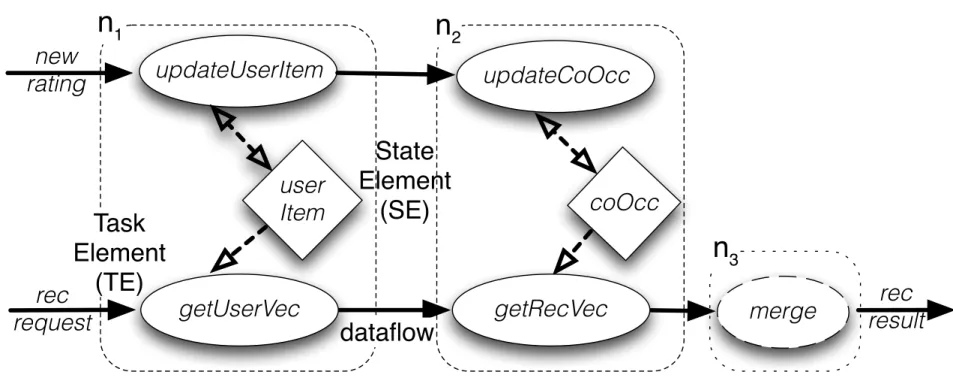
updateUserItem new rating rec request merge coOcc rec result n1 n2 n3 State Element (SE) dataflow Task Element (TE) getUserVec updateCoOcc user Item getRecVec
Figure 1: Stateful dataflow graph for CF algorithm
it does not require global coordination between nodes during recovery, and it uses dirty state to minimise the disruption to processing during local checkpointing.
3 Stateful Dataflow Graphs
The goal of stateful dataflow graphs (SDGs) is to make it easy to translate imperative programs with mutable state to a dataflow representation that performs paral-lel, iterative computation with low latency. Next we de-scribe their model (§3.1), how they support distributed state (§3.2) and how they are executed (§3.3).
3.1 Model
We explain the main features of SDGs using the CF
al-gorithm from §2.1 as an example. As shown in Fig. 1, an SDG has two types of vertices: task elements, t 2 T , transform input to output dataflows; and state elements,
s 2 S, represent the state in the SDG.
Access edges, a = (t,s) 2 A, connect task elements to
the state elements that they read or update. To facilitate the allocation of task and state elements to nodes, each task element can only access a single state element, i.e. A
is a partial function: (ti,sj) 2 A,(ti,sk) 2 A )sj = sk.
Dataflows are edges between task elements, d = (ti,tj) 2
D, and contain data items.
Task elements (TEs) are not scheduled for execution but
the entire SDG is materialised, i.e. each TE is assigned to one or more physical nodes. Since TEs are pipelined, it is unnecessary to generate the complete output dataflow of a TE before it is processed by the next TE. Data items are therefore processed with low latency, even across a se-quence of TEs, without scheduling overhead, and fewer data items are handled during failure recovery (see §5).
The SDG in Fig. 1 has five TEs assigned to three nodes: the updateUserItem, updateCoOcc TEs realise the
addRating function from Alg. 1; and the getUserVec,
getRecVec and merge TEs implement the getRec function.
We explain the translation process in §4.2.
State elements (SEs) encapsulate the state of the
compu-tation. They are implemented using efficient data struc-tures, such as hash tables or indexed sparse matrices. In the next section, we describe the abstractions for dis-tributed SEs, which span multiple nodes.
Fig. 1 shows the two SEs of the CF algorithm: the
userItem and the coOcc matrices. The access edges
spec-4
SDG for Logistic Regression
merge train classify weights items item resultStateful Dataflow Graphs (SDGs)
Program.java Cluster
Annotated Java program
(@Partitioned, @Partial, @Global, …)
Static program analysis
SEEP distributed dataflow framework
Dynamic scale out & checkpoint-based fault tolerance 2 Data-parallel Stateful Dataflow Graph (SDG)
Partitioned State Annotation
@Partitioned Matrix userItem = new Matrix();
Matrix coOcc = new Matrix();
void addRating(int user, int item, int rating) {
userItem.setElement(user, item, rating);
updateCoOccurrence(coOcc, userItem); }
Vector getRec(int user) {
Vector userRow = userItem.getRow(user); Vector userRec = coOcc.multiply(userRow); return userRec;
}
@Partition field annotation indicates partitioned state
Partial State and Global Annotations
@Partitioned Matrix userItem = new Matrix(); @Partial Matrix coOcc = new Matrix();
void addRating(int user, int item, int rating) { userItem.setElement(user, item, rating);
updateCoOccurrence(@Global coOcc, userItem); }
@Global annotates variable to indicate access to all partial instances
Partial and Collection Annotation
@Partitioned Matrix userItem = new Matrix(); @Partial Matrix coOcc = new Matrix();
Vector getRec(int user) {
Vector userRow = userItem.getRow(user);
@Partial Vector puRec = @Global coOcc.multiply(userRow);
Vector userRec = merge(puRec);
return userRec; }
Vector merge(@Collection Vector[] v){
/*…*/ }
Program.java
Java2SDG: Translation Process
Extract TEs, SEs and accesses Live variable analysis TE and SE access code assembly SEEP runnable SOOT Framework Javassist
Extract state and state access patterns through static code analysis
Generation of runnable code using TE and SE connections
Annotated Program.java
Stateful Dataflow Graphs (SDGs)
Program.java Cluster
Annotated Java program
(@Partitioned, @Partial, @Global, …)
Static program analysis
SEEP distributed dataflow framework
Dynamic scale out & checkpoint-based fault tolerance 3 Data-parallel Stateful Dataflow Graph (SDG)
Scale Out and Fault Tolerance for SDGs
• High/bursty input rates è Exploit data-parallelism
• Large scale deployment è Handle node failures
0% 50% 100% Partitioning of state Loss of state after node failure
Dataflow Framework Managing State
• Framework has state management primitives to:
– Backup and recover state elements
– Partition state elements
• Integrated mechanism for scale out and failure recovery
– Node recovery and scale out with state support
E Expose state as external entity to be managed by the distributed
What is State?
A
C B
Processing state Buffer state
Data ts1 Data ts2 Data ts3 Data ts4 User A Item 2 User B Item 1 2 4 1 5
State Management Primitives
ts - Makes state available to framework
- Attaches last processed data timestamp
Restore ts Backup A A1 Checkpoint Partition
- Moves copy of state from one node to another
- Splits state to scale out tasks
State Primitive: Checkpointing
• Challenge: Efficient checkpointing of large state in Java?
– No updates allowed while state is being checkpointed
– Checkpointing state should not impact data processing path
Dirty state
• Asynchronous, lock-free
checkpointing
1. Freeze mutable state for checkpointing
2. Dirty state supports updates concurrently
State Primitives: Backup and Restore
B Restore Checkpoint A Datat4 Data t3 Data t2 Data t1
Data t1 Data t2 Data t1 Data t2 t2 Backup t2
State Primitives: Partition
Processing state modeled as (key, value) dictionary
State partitioned according to key k
– Same key used to partition streams
0-x x-n userId 0-n userId 0-x userId x-n A1 A2 userId 0-n 0-n
Failure Recovery and Scale Out
A
Two cases:
- Node B fails è Recover
- Node B becomes bottleneck è Scale out
Recovering Failed Nodes
36 B B B New node B BState restored and unprocessed data replayed from buffer
Use backed up state to recover quickly
E Restore
Periodically, stateful tasks checkpoint and back up state to designated upstream backup node
B B
B E Checkpoint
Scaling Out Tasks
B A B
For scale out, backup node already has state elements to be parallelised B1 New node B B1 B B1 E Partition E Restore
Finally, upstream node replays unprocessed data to update checkpointed state
Distributed M-to-N Backup/Recovery
• Challenge: Fast recovery?
– Backups large and cannot be stored in memory
– Large writes to disk through network have high cost
38
• M to N distributed backup and parallel recovery
– Partition state and backup to
multiple nodes
Stateful Dataflow Graphs (SDGs)
Program.java Cluster
Annotated Java program
(@Partitioned, @Partial, @Global, …)
Static program analysis
SEEP distributed dataflow framework
Dynamic scale out & checkpoint-based fault tolerance
4
Experimental evaluation results
Data-parallel
Stateful
Dataflow Graph (SDG)
Throughput: Logistic Regression
0 10 20 30 40 50 60 25 50 75 100 Throughput (GB/s) Number of nodes SDG Spark100 GB training dataset for classification
Deployed on Amazon EC2 (“m1.xlarge” VMs with 4 vCPUs and 16 GB RAM)
SDG
Spark
Mutable State Access: Collaborative Filtering
Collaborative filtering, while changing read/write ratio (add/getRating) Private cluster (4-core 3.4 GHz Intel Xeon servers with 8 GB RAM )
0 5 10 15 20 1:5 1:2 1:1 2:1 5:1 100 1000 Throughput (10 00 requests/s) Latency (ms)
Workload (state read/write ratio) Throughput
0 1 2 3 4 5 6 7 0 500 1000 1500 2000 0 5 10 15 20 25 30 35 40 45 50 55 60 Tup les/ s (x100 K ) Numb e r o f VM s Time (seconds) Throughput (tuples/s) Input rate (tuples/s) Num. of VMs
Elasticity: Linear Road Benchmark
Scales to L=350
with 60 VMs L=512 highest reported result in literature [VLDB’12]
• Linear Road Benchmark [VLDB’04]
– Network of toll roads of size L
– Input rate increases over time
– SLA: results < 5 secs
• Deployed on Amazon EC2 (c1 & m1 xlarge instances)
Large State Size: Key/Value Store
Increase state size in distributed key/value store
0 0.5 1 1.5 2 50 100 150 200 1 10 100 1000
Throughput (million requests/s)
Latency (ms)
Aggregated memory (GB) Throughput
Summary
44
• Programming models for Big Data matter
– Logic increasingly pushed into bespoke APIs
– Existing models do not support fine-grained mutable state
• Stateful Dataflow Graphs support mutable state
– Automatic translation of annotated Java programs to SDGs
– SDGs introduce new challenges in terms of parallelism and failure recovery
– Automatic state partitioning and checkpoint-based recovery
• SEEP available on GitHub: https://github.com/lsds/Seep/
Peter Pietzuch
<[email protected]> http://lsds.doc.ic.ac.uk
Thank you! Any Questions?
Raul Castro Fernandez, Matteo Migliavacca, Evangelia Kalyvianaki, and Peter Pietzuch, "Integrating Scale Out and Fault Tolerance in Stream Processing using Operator State Management”, SIGMOD’13
Raul Castro Fernandez, Matteo Migliavacca, Evangelia Kalyvianaki, and Peter Pietzuch, ”Making State Explicit for Imperative Big Data Processing”, USENIX ATC’14