v"
SYNTHESIS OF C2 SYMMETRIC CYCLOBUTANES AND γ-BUTYROLACTONES VIA PHOTOINDUCED ELECTRON TRANSFER
Michelle Riener
A dissertation submitted to the faculty of the University of North Carolina at Chapel Hill in partial fulfillment of the requirements for the degree of Doctor of Philosophy in the Department of
Chemistry.
Chapel Hill 2014
Approved by: David A. Nicewicz Jeff S. Johnson Wei You
" iii"
ABSTRACT
Michelle Riener: Synthesis of C2 Symmetric Cyclobutanes and γ−Butyrolactones via Photoinduced Electron Transfer
(Under the direction of David A. Nicewicz)
I. Organic Photoredox Catalysis
An overview of the principles concerning photoredox catalysis, alkene oxidation, organic and inorganic photooxidants applied in organic chemistry is discussed.
II. [2+2] Cycloaddition Reactions of Alkenes via Single Electron Transfer Catalysis
A novel method for the diastereoselective synthesis of lignan cyclobutanes via dimerization of simple olefins is presented. Emphasis is on a unique strategy for controlling detrimental cycloreversion and polymerization processes via the use of appropriately tuned electron relays. This method is applied to the direct synthesis of two naturally produced cyclobutane compounds; magnosalin, and pellucidin A, as well as a third natural product, endiandrin A via derivatization.
III. Synthesis of γ-Butyrolactones via Polar Radical Crossover Cyclization Reactions of Unsaturated Acids And Alkenes
" iv"
ACKNOWLEDGEMENTS
First and foremost, I would like to thank my parents for their continuous support and encouragement throughout my graduate career. I would also like to thank my sisters, Romina and Nicole Riener, for their frequent phone calls and texts to check in and keep me sane. I am also very grateful for the support and direction I received from my PI, Dave Nicewicz. From the beginning, Dave knew I had an interest in pursuing a career in industry. I realize this mentality of acceptance is not always present in a PI, so I am genuinely grateful for his open mindedness and help. I would also like to acknowledge Dave Hamilton, Andrew Perkowski, Jean-Marc Granjean, and Tien Nguyen, who with me make up the five 5th years graduating this semester. We started off with no older graduate students to look up to, and had to guide each other from the beginning. I think we have learned a lot about ourselves, and of each other. I am very proud of how far we have come.
v"
T
ABLE OFC
ONTENTSLIST OF TABLES ... vii
LIST OF FIGURES ... viii
LIST OF ABBREVIATIONS AND SYMBOLS ... xii
CHAPTER ONE: PHOTOINDUCEDELECTRONTRANSFER ... 1
1.1 Introduction ... 1
1.2 Background ... 1
1.2.1 Organic Photosensitizers ... 5
1.2.2 Alkene Oxidation ... 8
1.2.3 Co-Catalysts in Photoredox Catalysis ... 10
1.2.4 Chemical Oxidation ... 12
1.3 Conclusion ... 12
1.4 References ... 13
CHAPTER TWO: [2+2] CYCLOADDITION REACTIONS OF ALKENES VIA SINGLE ELECTRON TRANSFER CATALYSIS 2.1 Introduction ... 15
2.2 2+2 Cycloadditions ... 15
2.2.1 Application to Lignan Natural Products ... 15
2.2.2 Direct Ultraviolet [2+2] Cycloadditions ... 19
2.2.3 Radical Anionic Cycloadditions ... 22
2.2.4 [2+2] via Energy Transfer ... 25
2.2.5 Electrochemical Cycloadditions ... 27
2.2.6 Radical Cationic Cycloadditions ... 31
" vi"
2.4 Conclusion ... 53
2.5 Experimental ... 55
2.6 References ... 82
CHAPTER THREE: SYNTHESIS OF γ-BUTYROLACONES via POLAR RADICAL CROSSOVER CYCLOADDITION REACTIONS OF UNSATURATED ACIDS AND ALKENES 3.1 Introduction ... 86
3.2 Natural Products: Isolation and Bioactivity ... 87
3.2.1 Previous Syntheses of Methylenolactocin and Protolichesterinic Acid ... 88
3.3 Synthesis of γ-Butyrolactones ... 92
3.3.1 Methods For The Synthesis of Disubstituted γ-Butyrolactones ... 92
3.3.2 Methods For The Synthesis of Trisubstituted γ-Butyrolactones ... 98
3.3.3 Synthesis α−Methylene-γ-Butyrolactones ... 104
3.4 Synthesis of γ-Butyrolactones via Polar Radical Crossover Cyclization ... 108
3.5 Results for the Synthesis of Substituted γ-Butyrolactones ... 116
3.5.1 Synthesis of Methylenolactocin and Protolichesterinic Acid ... 124
3.6 Conclusion and Outlook ... 126
3.7 Experimental ... 128
" vii"
L
IST OFT
ABLESTable 2-1 Effect of Electron Relays as an Additive in the [2 + 2] Dimerization of
Anethole ... 44 Table 2-2 Scope of [2 + 2] Dimerization of Aromatic Alkenes via Photoinduced
Electron Transfer (part 1) ... 46 Table 2-3 Scope of [2 + 2] Dimerization of Aromatic Alkenes via Photoinduced
Electron Transfer (part 2) ... 48 Table 2-4 [2 + 2] Dimerization of Terminal Aromatic Alkenes via Photoinduced
Electron Transfer ... 50 Table 3-1 Optimization of Reaction Conditions For Synthesis of γ-Butyrolactones ... 118 Table 3-2 Reaction Scope For γ-Butyrolactones From β-Methylstyrene and
α,β−Unsaturated Acids ... 119 Table 3-3 Reaction Scope For γ-Butyrolactones From Oxidizable Alkenes and
" viii"
L
IST OFF
IGURESFigure 1-1 Jablonski Diagram Depicting Fluorescene and Phosphorescence ... 3
Figure 1-2 Single Electron Transfer via Light Excitation ... 4
Figure 1-3 Typical Organic Electron Acceptors ... 5
Figure 1-4 Synthesis of TPT and Derivatives ... 6
Figure 1-5 Stability of subsequent radical anions for pOMe-TPT and pF-TPT ... 7
Figure 1-6 Oxidation Potentials of Various Alkenes ... 8
Figure 1-7 Trend in Oxidation Potential of Styrene Derivatives ... 9
Figure 1-8 Photoinduced Nucleophilic Addition of Ammonia and Isopropylamine ... 10
Figure 1-9 Mechanism for Regeneration of Photooxidant with the Aid of Diazonium 1 ... 11
Figure 1-10 Common Reductive and Oxidative Co-Catalysts ... 11
Figure 1-11 Diels Alder Reaction Promoted by Chemical Single Electron Oxidation ... 12
Figure 2-1 Skeletal Structure of Lignan vs Neolignan ... 16
Figure 2-2 Lignans Possessing Anti-Inflammatory Properties ... 17
Figure 2-3 Direct Cyclobutane Lignan Synthesis via Photolytic Dimerization ... 18
Figure 2-4 Direct Cyclobutane Lignan Synthesis via Photoinduced Electron Transfer ... 19
Figure 2-5 UV-Promoted Dimerization of N-Substituted Indoles ... 20
Figure 2-6 Key Transformation for the Enantioselective Synthesis of Punctaporonin ... 20
Figure 2-7 Chiral Hydrogen Template Used to Impart Enantioinduction ... 21
Figure 2-8 Lewis Acid Catalysis for the Enantioselective [2+2] Photocycloaddition ... 22
Figure 2-9 Cathodic Reduction Generating Radical Anions for Cyclization of Bis(enone) ... 23
Figure 2-10 Chemically-Induced Radical Anion Cyclization of Bis(enone) ... 23
Figure 2-11 Ruthenium Catalyzed Radical Anion Photocyclization of Bis(enones) ... 24
Figure 2-12 Crossed Intermolecular Cycloaddition of Acrylic Enones ... 25
Figure 2-13 Intermolecular Cycloaddition via Energy Transfer ... 26
Figure 2-14 Comparison of Radical Cation vs Energy Transfer Products ... 26
Figure 2-15 Electrocatalytic [2+2] Cycloaddition with Enol Ethers And Alkenes ... 28
" ix"
And Alkenes ... 30
Figure 2-18 Cycloreversion Of Cyclobutanes Via Anodic Oxidation ... 30
Figure 2-19 Cross Metathesis Reactions Of Enol Ethers And Terminal Alkenes ... 31
Figure 2-20 Proposed Radical Cation Chain Mechanism ... 33
Figure 2-21 Dimerization and Cycloreversion of trans-Anethole ... 34
Figure 2-22 Dimerization of trans -Anethole in the Presence of 9-Cyanoanthracene ... 34
Figure 2-23 Dimerization of p-Methoxystyrene in the Presence of Chloranil ... 35
Figure 2-24 Dimerization of Phenyl Vinyl Ether in the Presence of Photooxidants ... 35
Figure 2-25 Redox Photosensitization for the Dimerization of Indene ... 36
Figure 2-26 Redox Photosensitization Mechanism Proposed by Sakurai ... 36
Figure 2-27 Tuning Redox Properties of Ruthenium Complexes ... 37
Figure 2-28 Optimization of Conditions for Homodimerization of trans-Anethole ... 38
Figure 2-29 Scope for the Heterodimerization of Alkenes with trans-Anethole ... 39
Figure 2-30 Scope for the Heterodimerization of Alkenes with 4-Methoxystyrene ... 41
Figure 2-31 Synthesis of C2 Symmetric Cyclobutanes via Photoinduced Electron Transfer ... 42
Figure 2-32 Net Stabilization Elucidates Reactivity Pattern of Electron Rich Substituted Styrenes ... 47
Figure 2-33 X-Ray Crystal Structure of Pellucidin A ... 51
Figure 2-34 Direct [2+2] Synthesis of Magnosalin as a Single Diastereomer ... 51
Figure 2-35 Elaboration of Anethole Dimer to Furnish Endiandrin A ... 52
Figure 2-36 Effect of Electron Relay on Cycloreversion ... 52
Figure 2-37 Proposed Mechanism For Photoinduced Dimerization ... 53
Figure 3-1 Numbering Scheme And Skeletal Structure of γ-Butyrolactones ... 86
Figure 3-2 Biologically Relevant Paraconic Acids ... 88
Figure 3-3 Linear Synthesis For Protolichesterinic Acid ... 89
Figure 3-4 Direct Synthesis of γ-Butyrolactone Core: Application to Protolichesterinic Acid ... 90
Figure 3-5 Five Step Synthesis For Methylenolactocin ... 91
Figure 3-6 Synthesis For Methylenolactocin Arising from Tulipalin ... 92
" x"
Figure 3-8 3,4 Disubstituted γ-Butyrolactones via Aldol Cyclization ... 93
Figure 3-9 3,4 Disubstituted γ-Butyrolactones via NHC Catalysis ... 94
Figure 3-10 2,3,4 Trisubstituted γ-Butyrolactones via NHC Catalysis ... 95
Figure 3-11 3,4 Disubstituted γ-Butyrolactone via (-) Menthol-Derived NHC Catalysis ... 96
Figure 3-12 Menthol Derived-Chiral Butenolides ... 97
Figure 3-13 Conjugate Addition of Enantiopure Butenolides ... 98
Figure 3-14 cis-3,4-Substituted γ-Lactones With Geminal Dimethyl Substitution ... 99
Figure 3-15 γ-Lactones From Unsymmetrical Ketones and Activated Cyclopropanes ... 100
Figure 3-16 γ-Lactones From Symmetrical Ketones and Activated Cyclopropanes ... 101
Figure 3-17 2,3,4-Trisubstituted γ-Lactones From Aldehydes and Activated Cyclopropanes .... 102
Figure 3-18 Synthesis of (-) Dihydropertusaric Acid ... 103
Figure 3-19 Dreiding-Schmidt Reaction Of α-(Bromomethyl)acrylic Esters With Carbonyls .... 104
Figure 3-20 Synthesis Of α-Methylene-γ-Butyrolactones From 2-(Hydroxymethyl)acrylates .... 106
Figure 3-21 Synthesis Of α-Methylene-γ-Butyrolactones From Allylboronates ... 107
Figure 3-22 Comparison Between Standard Substrate Reactivity And Polarity Reversal Reactivity ... 108
Figure 3-23 Catalytic anti-Markovnikov Alkene Hydroacetoxylation ... 109
Figure 3-24 Catalytic Polar Radical Crossover Cycloadditions of Alkenes and Alkenols ... 110
Figure 3-25 Partial Substrate Scope Tetrahydrofuran via PRCC ... 111
Figure 3-26 Proposed Beckwith Transition State Resulting in cis-trans Selectivity ... 112
Figure 3-27 Synthesis And Proposed Mechanism For Ring Closure of β-Phenylseleno- Crotonates ... 112
Figure 3-28 Scope For Ring Closure of β-Phenylseleno-Crotonates and Acyrolates ... 113
Figure 3-29 Iridium Catalyzed Photoredox Catalysis ... 114
Figure 3-30 Proposed Mechanism for Iridium Catalyzed Photoredox Catalysis ... 115
Figure 3-31 Comparison of Product Regioselectivity Between Iridium Catalyzed Method and Desired Method For Further Derivatization To Paraconic Acids ... 116
Figure 3-32 Epimerization of γ-Butyrolactone ... 122
" xi"
Figure 3-34 Retrosynthesis Analysis of Protolichesterinic Acid ... 124
Figure 3-35 Synthesis of Protolichesterinic Acid ... 125
Figure 3-36 Epimerization of Protolichesterinic Acid Intermediate ... 126
Figure 3-37 Synthesis of Methylenolactocin ... 126
" xii"
L
IST OFA
BBREVIATIONS ANDS
YMBOLS2D-NMR
two-dimensional nuclear magnetic resonance
2Me-THF
2-methyl tetrahydrofuran
Å
ångström
Ac
acetate
AIBN
azobisisobutyronitile
Ar
aryl
aq
aqueous
atm
atmospheres
BET
back electron transfer
Bn
benzyl
br
broad
br s
broad singlet
n
Bu
normal-butyl
t
Bu
tert-butyl
bpm
bipyrimidine
bpy
bipyridine
bpz
bipyrazine
Bz
benzoyl
C#
carbon #
13
C NMR
carbon nuclear magnetic resonance spectroscopy
cat
catalytic amount or catalyst
conv
conversion
" xiii"
Cy
cyclohexyl
C–C
carbon-carbon bond
d
doublet or days
DABCO
1,4-diazabicyclo[2.2.2]octane
DBU
1,8-diazabicyclo[5.4.0]undec-7-ene
DCE
1,2-dichloroethane
DCM
dichloromethane
dd
doublet of doublet
ddt
doublet of doublet of triplets
DIBAL
diisobutylaluminum hydride
DMAP
4-N,N-dimethylaminopyridine
DMF
N,N-dimethylformamide
DMI
1,3-dimethylimidazolidinone
DMSO
dimethyl sulfoxide
dq
doublet of quartet
dr
diastereomeric ratio
dt
doublet of triplet
E
+or El
electrophile
ent
enantiomeric
eq
equation
equiv.
equivalents
er
enantiomeric ratio
Et
ethyl
" xiv"
Et3N
triethylamine
Et2O
diethyl ether
EtOAc
ethyl acetate
EWG
electron withdrawing group
F
Faraday
fac
facial
γ
gamma
h
hour
hv
light
1
H NMR
proton nuclear magnetic resonance spectroscopy
HCO2H
formic acid
HOAc
acetic acid
HMDS
1,1,1,3,3,3-hexamethyldisilazane
HRMS
high resolution mass spectroscopy
Hz
hertz
I
intermediate
IR
infrared spectroscopy
J
coupling constant
k
reaction rate
kcal
kilocalorie
λ
wavelength
L
liter
LA
Lewis acid
" xv"
LUMO
lowest unoccupied molecular orbital
M
metal or molarity
m
multiplet
m
meta
mCPBA
m-chloroperoxybenzoic acid
Me
methyl
MeCN
acetonitrile
MeOH
methanol
mg
milligram
MHz
megahertz
min
minutes
mL
milliliter
mmol
millimole
MS
molecular sieves
MTBE
methyl tert-butyl ether
n
number of atoms or counterions
nm
nanometer
NMA
N-mesityl acridinium tetrafluoroborate
nOe
nuclear overhauser enhancement
NOESY
nuclear overhauser enhancement spectroscopy
NR
no reaction
Nu
nucleophile
o
ortho
" xvi"
P
product
PET
photoinduced electron transfer
PG
protecting group
Ph
phenyl
Phth
phthalimidyl
PMP
para-methoxyphenyl
PMN
phenylmalononitrile
ppm
parts per million
ppy
2-phenylpyridine
PPTS
pyridinium p-toluenesulfonate
PTSA
p-toluenesulfonic acid
i
Pr
iso-propyl
q
quartet
Rf
retention factor
rac
racemic
RCHO
aldehyde
Red
reduction
rt
room temperature
s
singlet
S
starting material
SCE
saturated calomel electrode
SN1
unimolecular nucleophilic substitution
SN2
bimolecular nucleophilic substitution
" xvii"
t
triplet
TBAF
tetrabutylammonium fluoride
Tf
trifluoromethanesulfonyl
TFA
trifluoroacetic acid
THF
tetrahydrofuran
TLC
thin-layer chromatography
TMS
trimethylsilyl
Tf/triflate
trifluoromethanesulfonate
Ts
para-toluenesulfonyl
TS
transition state
UV
ultraviolet
X
anionic ligand, halide, substituent, or number
δ
chemical shift or partial charge
ΔG
change in free energy
λ
wavelength
µL
microliter
CHAPTER ONE: ORGANIC PHOTOREDOX CATALYSIS
1.1 1ntroduction
Implementing visible light to catalyze reactions has previously been viewed as ideal yet unrealistic, as many reagents are inert to such long wavelengths. To effect productive chemistry, small molecules require a specific wavelength of light, while irradiation at smaller or larger wavelengths result in compound degradation or no reaction. Yet, there is great reward in creating a class of transformation where light is employed as the energy source. As photocatalyzed reactions proceed via a different reaction mechanism, distinct regio- and stereoselectivities are obtained. This allows for the formation of complex molecules that might not be easily accessible otherwise. If appropriately tuned, organophotoredox catalysis could eliminate the need for high temperatures, pressures, or the use of toxic, expensive, or precious metals. Addressing this problem is the focus of this thesis, whereby the combination of easily synthesized organic catalysts with specific photophysical and redox properties are employed. This development has produced transformations exhibiting exquisite regioselectivity and diastereoselectivity, arising from cheap and commercially available material.
1.2 Background
susceptible to fast recombination. Difficulty in controlling photolytic reactions is attributed to the high energy of ultraviolet light, which commonly results in low yields and formation of numerous side products with varying regio- and diastereoselectivity. As opposed to photolytic conditions, photoinduced electron transfer mechanisms are operable with visible light; this controlled process is successful when in the presence of appropriately matched electron donor and acceptor molecules. An electron donor reagent is distinguished by possessing electron-rich groups and is capable of stabilizing a radical cationic charge. Conversely, an electron acceptor molecule possesses electron-deficient groups and is best suited for carrying a radical anionic charge. Due to preferential ionic stability, this produces reactive single-electron species with umpolung character, as an electron donor molecule is transposed to exhibit radical cationic character. This method is appealing, as it affords products not directly accessible via thermal mechanisms.
Figure 1-1: Jablonski Diagram Depicting Fluorescene and Phosphorescence
We were interested in utilizing electron transfer to afford radical cations, by employing visible light-sensitive acceptor molecules and light-insensitive donor molecules. Though this process has been understood for decades, the lack of appropriate light-sensitive acceptors capable of catalyzing useful transformations has hindered its development. Only with the recent discovery of visible light-sensitive reagents has this mechanism been exercised and exploited. The excited state energy of an acceptor molecule is correlated to the energy of the photon, and may be quenched in the presence of a donor molecule (D). Though the donor molecule is not directly excitable with visible light, it could undergo electron transfer if it exhibits specific redox properties. As depicted in Figure 1-2, the donor molecule (D) typically possesses a highest occupied molecular orbital (HOMO) that is lower in energy than the lowest unoccupied molecular orbital (LUMO) of the acceptor molecule (A). Therefore in its ground state, the donor molecule (D) is not susceptible to electron transfer, as the process is endergonic and not thermodynamically favorable. When the acceptor molecule (A) is sensitized in the presence of light, a change in electronic configuration occurs; this is depicted by promotion of one electron residing in the HOMO to its lowest lying LUMO. Excitation of the acceptor molecule produces an electron hole in the previously noted HOMO of (A), which lies below the HOMO of (D). Thermodynamics now allow for the exergonic process to occur, where one electron from the donor molecule is transferred to the acceptor molecule. This produces an electron deficient species (D•+) and a single electron rich species (A•−). This single electron transfer is labeled as the desired process, however if certain parameters of (A) and (D) are not met, back electron transfer (BET) may be observed. This undesired process occurs if the charged species (D•+) and (A•−) are in close proximity, or if one of the species is severely destabilized.1
S0 S1 Absorption
Fluorescence Intersystem
crossing
T1
Figure 1-2: Single Electron Transfer via Light Excitation
Photoinduced electron transfer may occur from either the single or triplet state of the sensitizer; yet these variants are distinguishable. Electron exchange occurring from the triplet state typically exhibits higher efficiency, and is attributed to a slower rate of back electron transfer (BET). Additionally, the longer-lived triplet state also allows for higher likelihood of reactivity. Though shorter lived, singlet states have higher oxidation capabilities, but are more likely to participate in back electron transfer due to their higher reactivity and resulting instability.2 For this reason, the choice of sensitizer is extremely important, and can be detrimental to the reaction system if improperly considered.
The likelihood of a reaction partaking in electron transfer can be predicted by considering the simplified Weller equation (equation 1), where the half wave oxidation potential of D (!!/!!"! ! ) and
the half wave reduction potential of (A) (!!/!!"#! ! ) are included. The excitation energy of (A)
(∆!!"#$%) may be combined with the half wave reduction potential of (A) if the excited state reduction potential of the acceptor molecule (!!"#∗ ! ! ) is known. The coulomb interaction energy ∆!
!"#$ is a calculated variable, and is commonly disregarded when predicting electron transfer (Equation 2). 3 In order to be thermodynamically favorable, Gibbs free energy ∆! must be equal to or below zero. This may be achieved if the excited state reduction potential of an acceptor molecule (!!"#∗ ! ! ) is large, and if the half wave oxidation potential of the donor molecule (!!/!!"! ! ) is small.
∆! =!!/!!"! ! −!!!/!!"#! ! −!∆!!"#$%(!)+!∆!!"#$ ∆!=!!/!!"! ! −!!
!"#∗ ! !
Solvent polarity is an important variable that can drastically affect the rate and likelihood of A
D
hv
A* D
A
D HOMO
LUMO SET
A
D BET
Desired Undesired
electron transfer. This variable plays a role in stabilization and separation of the resulting charged species. Depending on the solvent polarity, various species are proposed to form. In a nonpolar solvent, it is predicted that only an exciplex and contact ion pair are formed (Equation 3). However, if a more polar solvent is used, solvent separated ion pairs and free radical ions are also presumed to form.3 For these reasons, polar solvents minimize back electron transfer, and induces electron transfer to afford free radical ions.
!+!= !!!!!! ↔ !∙!!∙! ↔(!
! ∙!!
!∙!)↔!!∙!+!!!∙!
1.2.1 Organic Photosensitizers
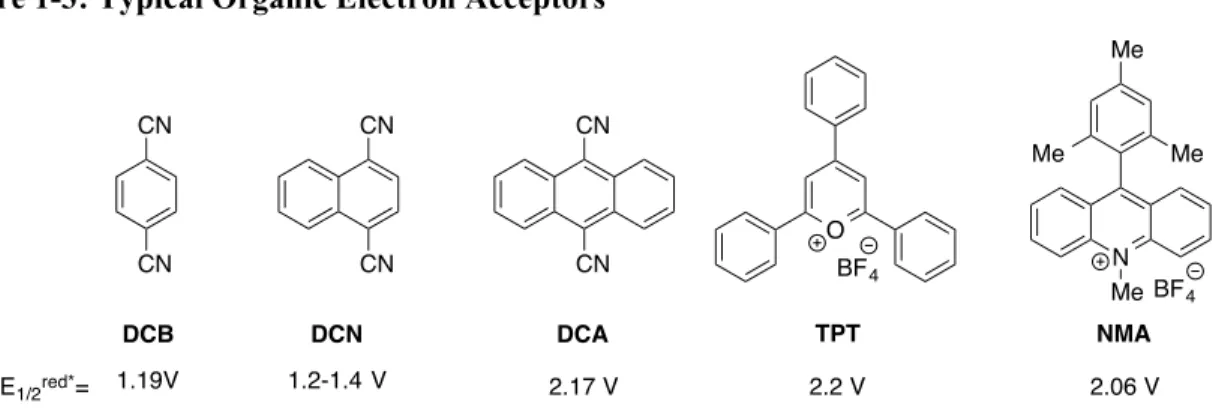
Various electron accepting sensitizers including dicyanobenzene (DCB), dicyanonaphthalene (DCN), and dicyanoanthracene (DCA) are depicted in Figure 1-3. These three sensitizers require ultraviolet or near UV for excitation, and are suspected to react solely from their singlet energy state. Regardless of their high oxidizability, these cyanoarenes are not ideal sensitizers for photoinduced electron transfer. This stems from their inability to suppress back electron transfer (BET); which is extremely fast and undesirable (Figure 1-3).
Figure 1-3: Typical Organic Electron Acceptors4,5
For this reason, great advances in this field transpired when photooxidizing salts were revealed as successful and superior sensitizers. For instance, the use of 2,4,6-triphenylpyrylium tetrafluoroborate (TPT) salt is an excellent sensitizer as it absorbs visible light, and therefore requires less energetic light than other photooxidants. This improvement may aid in decreased formation of byproducts, as only the compound of interest may be sensitized at the long wavelength. Another ideal
CN
CN
CN
CN
CN
CN
DCB DCN DCA
O
N Me
Me Me
Me
BF4
BF4
TPT NMA
E1/2red*= 1.19V 1.2-1.4 V 2.17 V 2.2 V 2.06 V
feature is the subsequent dissociation between the BF4- counterion that occurs once the photooxidant
and substrate undergo single electron transfer. Net charge separated pairs do not form between the
radical anionic acceptor and radical cationic donor species, which results in the minimization of back
electron transfer. This in turn enhances free-radical formation.6 Moreover, photophysical experiments
suggest TPT primarily reacts through its triplet state, which correlates to a longer-lived triplet
sensitizer.
Figure 1-4: Synthesis of TPT and Derivatives7
When dissolved in dichloromethane, TPT exhibits two absorption bands at 417 nm and 369
nm. It is suggested that the shorter wavelength absorption is associated to the 4-arylpyrylium moiety,
while the longer wavelength is ascribed to the 2,6-diarylpyrylium moiety.6 From a practical
perspective, TPT is an ideal organophotooxidant for its ease in synthesis and derivatization. Not only
is TPT commercially available, but the brightly colored photooxidant can be quickly made with two
equivalents of acetophenone to one equivalent of benzaldehyde in the presence of BF3.OEt2. Ease in
synthesis allows for rapid and direct derivatization to form sensitizers with various functionality
around the aromatic ring. Derivatization produces sensitizers with different absorbance and emission
wavelengths, as changing the electron-donating or releasing properties of the aromatic groups has a
direct impact on its redox properties (Figure 1-4). If electron rich methoxy groups are appended to the
three aromatic rings, the excited state reduction potential of a 2,4,6-trimethoxypyrylium is decreased
to +1.98 V. In theory, employing a photooxidant with electron rich substitution may result in faster
catalytic turnover since the resulting reduced species possesses electron-donating substituents and
cannot fully stabilize the intermediate (Figure 1-5). If an electron withdrawing fluorine atom is tS = 2.9 ns tT = 10 ms fF = 0.52 (465 nm) fISC = 0.48 Me
O
R
H O
R 2 equiv 1 equiv
BF3•OEt2 60oC, PhMe
O R
R R
+
R E*
red (vs SCE) OMe 1.98 V
H 2.2 V
F 2.5 V
Me 2.7 V BF4
TPT
appended, the excited state reduction potential is increased to +2.5 V. Theoretically, this photooxidant
is capable of reacting with a wider range of substrates; however, a stable radical species is produced
following single electron transfer. This radical species may exhibit a rate decrease in subsequent
single electron reduction to regenerate the neutral species. This decrease in rate is attributed to
increased stability of the intermediate.
Figure 1-5: Stability of subsequent radical anions for pOMe-TPT and pF-TPT
Recently, the Fukuzumi group published a report on a new photooxidant with excellent
oxidizing power. 9-Mesityl-10-methylacridinium tetrafluoroborate (NMA) is a robust reagent with a
calculated excited state reduction potential of +2.16 V in its locally excited singlet and +1.43 V in its
triplet state, respectively.8 This acridinium is presumed to primarily react via its singlet state, and
possesses two absorption bands at 480 nm and 520 nm wavelengths, where the mesityl radical cation
moiety is suggested to form with 480 nm light.9 Similarly to the TPT salts, this mesityl acridinium
salt can be simply made in 4 steps from commercially available material. More importantly, NMA is
an excellent photooxidant due to its long-lived charge separated state.10 This extended lifetime is
attributed to minimal loss in charge reorganization energy, which was calculated to be +0.79 V. In
their ground state, both 9-mesityl-10-methylacridinium tetrafluoroborate and the
2,4,6-trimethoxyoxypyrylium tetrafluoroborate have half wave reduction potentials of −0.36 V and −0.56
V, respectively, and are not capable of alkene oxidation. On the contrary, both are efficient oxidants
when in their excited states, (!!"#∗=+1.97!!) and (!!"#∗=+2.06!!), respectively. O
OMe
MeO OMe
O F
F F
More stable radical anion Less stable radical anion
<
1.2.2 Alkene Oxidation
Alkenes are a versatile functional group in organic synthesis, and their utility is proven by the
numerous methods for further functionalization and derivatization in the literature. They are ideal
starting points in a chemical transformation as alkenes are easily synthesized; additionally, many are
naturally abundant, commercially available, and cheap. Frequently, oxidation of alkenes refers to
dihydroxylation, or diamination, where the number of carbon-oxygen or carbon-nitrogen bonds is
increased. In the context of photoinduced electron transfer, alkene oxidation refers to the removal of
electrons, which typically originate from a π-orbital. The simplest way to predict alkene oxidation is
to consider its oxidation potential.
Figure 1-6: Oxidation Potentials of Various Alkenes
Terminal aliphatic alkenes such as 1-octene have oxidation potentials slightly above +2.8 V,
and therefore are difficult substrates to oxidize. However as substitution is increased and conjugation
is incorporated, the oxidation potential is decreased. For instance, styrene has a reported half wave
oxidation potential of +2.05 V,11 while 2-methy-l-butene exhibits a half wave oxidation potential of
+2.26 V.12 1,2-disubstituted conjugated alkenes and those with pendent electron donating groups
drastically decrease the oxidation potential, which is due to increased stability of the subsequent
radical cation. This is observed by comparing styrene, β-methylstyrene (!!/!!" =+1.68!!), and
4-methoxy-β-methylstyrene (trans-anethole) (!!!"/!=+1.28!!). The +0.4 V difference in stability
between β-methylstyrene and t-anethole suggests that substitution around the aromatic ring has a
greater impact at decreasing the oxidation potential than substitution of the alkene. In agreement with
+ 3.0 V 2.0 V
1.0 V 0 V
N O
n-Bu Me
Et Me
Me
MeO
Oxidation Potential (vs SCE) Me
OMe
MeO OMe
1.28 V
1.68 V 2.05 V
2.26 V 1.82 V
this trend, 2,4,5-trimethoxy-β-methylstyrene possesses an oxidation potential below 1.0 V. Enol ether
and eneamine substrates are less positive than the alkenes, rendering them extremely susceptible to
oxidation, which commonly leads to uncontrolled additions, loss in stereo- and regioselectivity, and
polymerization. It is surmised that if an electron-rich aromatic ring is present in the substrate, single
electron oxidation occurs from the aromatic system. Via resonance, the radical cation may also reside
on the alkene moiety. Reactivity is observed through the alkene portion preferentially, as breaking
aromaticity is thermodynamically unfavorable.
Surprisingly, the location of functionality on the aromatic ring has a significant impact on the
oxidation potentials of similar substrates (Figure 1-7). This unique tend is observed when ortho-
meta- and para-anethole are compared. It was found that increased stability was observed when the
electron rich substituent is in the para position, as para-anethole possesses a half wave oxidation
potential of +1.28 V. Para-anethole is significantly easier to oxidize than meta-anethole, as the
oxidation potential is less positive by +0.38 V. The methoxy group at the ortho- position is more
stabilizing than at the meta, however only by < +0.1 V. The same trend is observed when ortho-,
meta- and para-methyl-β-methylstyrene are compared. Para-methyl-β-methylstyrene exhibits a half
wave oxidation potential of +1.62 V, and is the most oxidizable substrate by over +1.0 V.
Ortho-methyl-β-methylstyrene has a half wave oxidation potential more positive than the para- derivative,
yet is less positive than the meta isomer by +0.04 V.13 Though a similar trend is observed for
nucleophilic addition reactions, this observation is unanticipated when solely accounting for the
potential required to remove one electron.
Figure 1-7: Unique Trend in Oxidation Potential of Styrene Derivatives
This trend may correlate to a difference in localization of charge-spin density. In 1991, Me
MeO
Me Me
OMe OMe
Me
Me
Me Me
Me Me
1.28 V 1.54 V 1.66 V 1.62 V 1.75 V 1.79 V
E1/2ox= E
Yamashita and coworkers reported the photoinduced nucleophilic addition of ammonia to electron
rich styrene derivatives. Typical addition at the alkene moiety was observed when styrenes possessing
electron rich substituents at the ortho and para positions were subjected to standard conditions;
however, when 3,5-dimethoxy-β-methylstyrene was considered, nucleophilic addition occurred at the
ortho position on the aromatic core. This discrepancy in reactivity was attributed to radical cation
localization residing within the aromatic ring. Stabilization ortho and para to the methoxy
substituents is higher in 3,5 dimethoxy-β-methylstyrene than in 3,4 dimethoxy-β-methylstyrene, due
to stability overlap. This is presumed to be the longest lived intermediate prior to amine addition for
the former case, and results in addition on the aromatic ring (Figure 1-8). 14
Figure 1-8: Photoinduced Nucleophilic Addition of Ammonia and Isopropylamine
1.2.3 Co-Catalysts in Photoredox Catalysis
When rendering a transformation catalytic, it is important to consider the mechanism for
photocatalyst regeneration. If a reaction is redox neutral, the photooxidant must undergo single
electron reduction with a product intermediate. However, it is also common to include an additive that
assists in the regeneration of the photooxidant. The inclusion of an additive or co-catalyst is typical
for the regeneration of inorganic photoixdants such as rutheniumIII tris(bipyridine) [Ru(bpy)
3]2+. This
ruthenium complex is a reactive photosensitizer that can serve as a single electron oxidant when
excited with visible light. However, early work accomplished by Deronzier demonstrated the
necessity of aryldiazonium salts as oxidative quenchers for [Ru(bpy)3]2+.15 This was showcased for
the oxidation of benzylic alcohols to corresponding aldehydes. Deronzier discovered that
stoichiometric amounts of diazonium 1 would oxidatively quench the excited state of the ruthenium
complex, resulting in the generation of [Ru(bpy)3]3+. Following the loss of nitrogen gas, the Me
OMe MeO
Me
OMe MeO
NHiPr Me
OMe MeO
Me
OMe
MeO NH2
hv, 20 h, 29% 1 equiv. DCB NH3, MeCN-H2O
1 equiv. DCB iPrNH2, MeCN-H2O
diazonium is suspected to undergo hydrogen abstraction, or radical cyclization, affording byproducts
1a and 1b. Two equivalents of the reduced ruthenium complex are proposed to undergo a second
electron transfer oxidation with the benzylic alcohol, resulting in a two electron transfer. With the
assistance of 2,4,6-trimethylpyridine, neutral benzaldehyde is obtained. Single electron reduction
resulting in the evolution of nitrogen gas reduced the likelihood of back electron transfer, which is
correlated with high efficiency for the regeneration of [Ru(bpy)3]3+.
Figure 1-9: Mechanism for Regeneration of Photooxidant with the Aid of Diazonium 1
This seminal discovery led to the evaluation of co-catalysts for the reductive or oxidative
regeneration of various metal-based photooxidants. Triethylamine and xanthate esters are two
common co-catalysts for the single electron reduction of ruthenium (II) (Figure 1-10). Additionally,
oxygen, nitroarenes, and methylviologen have been found fruitful in the oxidative regeneration of
ruthenium (II) and iridium (II) complexes.16 These quenchers have been instrumental in catalyst
regeneration, resulting in methods with high yields and high efficiency.
Figure 1-10: Common Reductive and Oxidative Co-Catalysts
Ru2+ N N N N N N [Ru(bpy)3]2+ Ru(bpy)32+ Ru(bpy)32+*
Ru(bpy)33+ hv OH 1/2 equiv. + H Me Me Me N Me Me Me N H O + O N2 O O O 1a 1b ET ET 1 1/2 equiv. Reductive Co-catalysts
Triethylamine ascorbate anion Methyl viologen
N NMe Me Cl Cl RO S OR O O OH O HO OH
OH Oxidative Co-catalysts
1.2.4 Chemical Oxidation
Many electron transfer reactions can also be accomplished with single electron oxidants via
chemical oxidation. The most applicable single electron oxidants within this context are
triarylaminium hexachloroantimonate complexes (Ar3N•SbCl6-). Notable work with single electron
transfer with this oxidant was accomplished by Nathan Bauld, where oxidizable substrates were
subjected to catalytic amounts of tris(p-bromopheny1)aminium hexachlorostibnate at 0 °C in
dichloromethane. When cyclohexadiene was chosen as the oxidizable substrate, the Diels-Alder
adduct was obtained in 70% yield (Figure 1-11). If the aminium oxidant was excluded, the same
cycloadduct could be obtained in 30% yield; however high temperatures and long reaction times are
required. 17 Cyclohexadiene exhibits a half wave oxidation potential of +1.8 V, while
tris(p-bromophenyl)aminium hexachlorostibnate has a reported reversible half wave reduction potential of
+1.3 V.18 Surprisingly, this electron transfer occurs while the transformation is +11 kcal/mol
endergonic.
Figure 1-11: Diels Alder Reaction Promoted by Chemical Single Electron Oxidation
1.3 Conclusion
Although the field of photoinduced electron transfer was first developed decades ago, the field
is relatively unmapped. Additionally, this unique approach is not commonly utilized for the synthesis
of chemically useful substrates, nor typically applied to the synthesis of natural products. Exploration
and further development within the field of photoredox catalysis is anticipated, as transformations
requiring milder conditions with higher efficiencies are continuously sought after. N
Br Br
Br
Ered = 1.3 V
SbCl6 (pBrPh)3N SbCl6 (pBrPh)3N SbCl6
CH2Cl2, 0 oC, 15 min
H
H
H H
(5:1)
REFERENCES
(1) Ledwith, A. Cation Radicals in Electron Transfer Reactions. Accounts of Chemical Research 1972, 5, 133–139.
(2) Miranda, M. A.; Izquierdo, M. A.; Pérez-Ruiz, R. Direct Photophysical Evidence for Quenching of the Triplet Excited State of 2,4,6-Triphenyl(Thia)Pyrylium Salts by 2,3-Diaryloxetanes. J. Phys. Chem. A 2003, 107, 2478–2482.
(3) Mattay, J. Photoinduced Electron Transfer in Organic Synthesis. Synthesis 1989, 1989, 233– 252.
(4) H. F. Davis, S. K Chattopadhyay, P. K. Das, J. Phys, Chem. 1984, 2798-2803.
(5) Blanc, S.; Pigot, T.; Cugnet, C.; Brown, R.; Lacombe, S. A New Cyanoaromatic Photosensitizer vs. 9,10-Dicyanoanthracene: Systematic Comparison of the Photophysical Properties. Phys. Chem. Chem. Phys. 2010, 12, 11280.
(6) Miranda, M. A.; Garcia, H. 2, 4, 6-Triphenylpyrylium Tetrafluoroborate as an Electron-Transfer Photosensitizer. Chem. Rev. 1994, 94, 1063–1089.
(7) G, Haucke, P. Czerney, F. Cebulla Ber. Bunsen-Ges. Phys. Chem. 1992, 96, 880.
(8) Benniston, A. C.; Harriman, A.; Li, P.; Rostron, J. P.; van Ramesdonk, H. J.; Groeneveld, M. M.; Zhang, H.; Verhoeven, J. W. Charge Shift and Triplet State Formation in the 9-Mesityl-10-Methylacridinium Cation. J. Am. Chem. Soc. 2005, 127, 16054–16064.
(9) Fukuzumi, S.; Kotani, H.; Ohkubo, K.; Ogo, S.; Tkachenko, N. V.; Lemmetyinen, H. Electron-Transfer State of 9-Mesityl-10-Methylacridinium Ion with a Much Longer Lifetime and Higher Energy Than That of the Natural Photosynthetic Reaction Center. J. Am. Chem. Soc. 2004, 126, 1600–1601.
(10) Ohkubo, K.; Mizushima, K.; Iwata, R.; Souma, K.; Suzuki, N.; Fukuzumi, S. Simultaneous Production of Tolualdehyde and Hydrogen Peroxide in Photocatalytic Oxygenation of P-Xylene and Reduction of Oxygen with 9-Mesityl-10-Methylacridinium Ion Derivatives. Chem. Commun. 2010, 46, 601.
(11) Schepp, N. P.; Johnston, L. J. Reactivity of Radical Cations. Effect of Radical Cation and Alkene Structure on the Absolute Rate Constants of Radical Cation Mediated Cycloaddition Reactions1. J. Am. Chem. Soc. 1996, 118, 2872–2881.
(12) Neikam, W. C.; Dimeler, G. R.; Desmond, M. M. A Correlation of Electrochemical Oxidation Potential of Organic Compounds with Photoionization Potential. Journal of the Electrochemical Society 1964, 111, 1190–1192.
(13) Oxidation potentials collected in house by Jean-Marc GranJean.
(15) Cano-Yelo, H.; Deronzier, A. Photo-Oxidation of Some Carbinols by the Ru (II) Polypyridyl Complex-Aryl Diazonium Salt System. Tetrahedron Letters 1984, 25, 5517–5520.
(16) Narayanam, J. M. R.; Stephenson, C. R. J. Visible Light Photoredox Catalysis: Applications in Organic Synthesis. Chem Soc Rev 2011, 40, 102–113.
(17) Bellville, D. J.; Wirth, D. W.; Bauld, N. L. Cation-Radical Catalyzed Diels-Alder Reaction. J. Am. Chem. Soc. 1981, 103, 718–720.
1CHAPTER TWO: [2+2] CYCLOADDITION REACTIONS OF ALKENES VIA SINGLE
ELECTRON TRANSFER CATALYSIS*
2.1 Introduction
The development of a mild, efficient, and ‘green’ synthetic method has appealed to chemists
for some time. Therefore, designing an alternative procedure where the energy of visible light is
exploited is a promising approach. Creating a method that reacts by a unique mechanism provides
new means for accessing complex structures from architecturally simple material. Visible light is
abundant, low energy, and cheap; however, creating a practical method is challenging since most
organic small molecules do not absorb visible light. For this reason, the application of light sensitive
organic reagents as photoredox catalysts has been instrumental to the progress of this field.
This approach has been applied to the synthesis of cyclobutane lignans; this chemically
diverse lignan family features over two-dozen cyclobutane-containing members. Despite the
biological importance of this class of compounds, there have been few efforts devoted to the
stereoselective synthesis of cyclobutane lignans and lignan analogs. In 2013, we reported a method
for the stereoselective synthesis of C2-symmetric cyclobutane alkene dimers that has been applied to
the total syntheses of the lignans magnosalin, endiandrin A, and the lignan-like cyclobutane,
pellucidin A, of which we propose a revised structure.
2.2 [2+2] Cycloadditions
Application to Lignan Natural Products 2.2.1
Cyclobutane rings are a basic and prominent structural motif present in numerous natural
products including terpenes, fatty acids, lignan and neolignan compounds.1 The rich family of lignans
*A portion of this chapter previously appeared as an article in Chemical Science. The original citation
and neolignans exhibit inhibitory activity against an array of viruses and bacteria, and also display
anti-platelet aggregation, and cytotoxicity.2 Additionally, numerous cyclobutane-containing lignans
display useful anti-inflammatory properties via glucocorticoid receptor binding, and inhibition of
nitric oxide synthesize.
Glucocorticoids play a key role in stabilizing stress-related hormones, and also exhibit
anti-inflammatory and immunosuppressive properties.3 Numerous synthetic glucocorticoids have been
explored to treat inflammatory conditions such as dermatitis and rheumatoid arthritis. Because they
possess non-selective reactivity and resulting in long-term side affects, current glucocorticoids are not
ideal for drug therapy. For this reason, the discovery and synthesis of selective glucocorticoids
receptor binders may provide an improvement over current treatments. Conversely, overproduction of
nitric oxide by inducible-nitric oxide synthase (i-NOS) is responsible for inflammation and for
vasodilation and hypotension associated with septic shock.4 Therefore, an NOS inhibition assay
assists in elucidating new selective inhibitors to i-NOS, which may be utilized in drug therapy to
prevent these symptoms.
Figure 2-1: Skeletal Structure of Lignan vs Neolignan
Lignans are so termed for possessing a di-aromatic di-propane subunit, with a bond
connecting their β-carbon. Neolignans possess the same skeletal core, but are connected by a bond
between the aromatic rings (Figure 2-1). In 2001, Quinn and coworkers discovered a class of lignans
isolated from the Australian plant Endiandra anthropophagorum that display potent glucocorticoid
receptor binding activity (Figure 2-2).24 Endiandrin A was found as most potent, possessing a
concentration of inhibition at 50% (IC50) of 0.9 µM. The dimethylated variant of endiandrin A was
subjected to the same assay and was also reported to possess binding activity; however, reactivity was
significantly diminished when compared to the parent lignan. Nectandrin B was isolated in the same
Me Me Me Me
extract and had similar functionality around the aromatic rings, yet possessed a tetrahydrofuran core.
Nectandrin B exhibited a glucocorticoid receptor binding IC50 of 27 µM, which indicates that this
lignan is also less effective than endiandrin A. Due to these results, the authors suggest that the
cyclobutane core coupled with the free phenol may be instrumental in glucocorticoid receptor binding
activity.
Figure 2-2: Lignans Possessing Anti-Inflammatory Properties
In 2002, Rhu and coworkers isolated lignans magnosalin and andamanicin from the leaves of
Perilla frutescens. 5 Both cyclobutane lignans possess the same functional groups, head-to-head
configuration, and C2 symmetry. Conversely, andamanicin exhibits a cis-trans-cis junction around the
cyclobutane core, whereas magnosalin displays an all-trans connectivity. This subtle difference in
stereochemistry has a significant impact on IC50 values when each lignan was subjected to a nitric
oxide synthase (NOS) inhibition assay. Magnosalin was found to possess an IC50 of 5.9 µM; this
value is almost ten-fold more potent than andamanicin, which hints that potency arises from the
all-trans junction.
In 1987, Badheka and coworkers reported the isolation of magnosalin and andamanicin from
piper cubeba.6 A third compound, 2,4,5-trimethoxybenzaldehyde was isolated in the same extract,
which is proposed to arise from the oxidative cleavage of trans-2,4,5-trimethoxy-β-methylstyrene
(E-Me Me OH MeO OMe HO Me Me OMe MeO OMe MeO
endiandrin A di-O-methylendiandrin A GR binding IC50 = 0.9 µM GR binding IC50 =13 µM
OH OMe MeO HO Me Me nectandrin B O
GR binding IC50 =27 µM
Me Me MeO OMe OMe MeO OMe MeO Me Me MeO OMe OMe MeO OMe MeO andamanicin magnosalin
NOS inhibition IC50 = 53.5 µM
asarone). Though this alkene was not isolated, observation of the benzaldehyde byproduct gives
reason to believe formation of this lignan originates from E-asarone.
Though simple in structure, lignan cyclobutanes are not trivial to make as single
diastereomers. Many propose that these lignan cyclobutanes are naturally produced via a single
electron transfer or photolytic [2+2] mechanism. In an isolation report published in 1982, Yamamura
and coworkers found evidence to support the latter mechanism; the authors subjected monomer
E-asarone to direct photolysis in order to elucidate the structure of the isolated compound. 7 Irradiation
of E-asarone with UV-light and a pyrex filter produced a dimer in 15% yield. Characterization of the
synthesized cyclobutane matched with the data for the isolated compound, which verified the
structure of Heterotropan. Yamamura also recovered a mixture of E- and Z- asarones, which suggests
that UV-light might be too intense to affect the cyclization in good yields (Figure 2-3).
Figure 2-3: Direct Cyclobutane Lignan Synthesis via Photolytic Dimerization
It is important to emphasize the difficulty in elucidating the relative stereochemistry of
cyclobutane stereoisomers, as cyclobutanes with various levels of symmetry exhibit similar
characterization data. This difficulty is validated, as magnosalin was initially mis-characterized to
possess a cis-trans-cis junction.8 Dhar and coworkers did not publish the correct relative
stereochemistry of magnosalin and andamanicin until 1993, which was almost a decade after the
isolation report.9 This poses a challenge in identifying the true first syntheses of a particular natural
lignan cyclobutane. For instance, in 1987 Kikuchi and coworkers reported the direct synthesis of
magnosalin by irradiation of the monomer, E-asarone, in the presence of 2 equivalents of pyromellitic
acid (Figure 2-4). In this article, the authors report that the cyclobutane was observed in a 6% yield,
with a 14% yield of the [4+2] dehydro-adduct, magnoshinin. The mass balance and yields of the
Me Me
MeO OMe
OMe MeO
OMe MeO
hexanes, hv Me
OMe OMe
MeO
E-asarone
cycloadducts are extremely low; less than 10% of the starting monomer was recovered resulting in
approximately 70% of material decomposition. The identities of the cycloadducts were proven
accurate by matching the spectra of the authentic samples to their acquired characterization.
Unfortunately Dhar’s report confirms the cyclobutane adduct synthesized by Kikuchi in 1987 is not
magnosalin, but instead andamanicin.10
Figure 2-4: Direct Cyclobutane Lignan Synthesis via Photoinduced Electron Transfer
Direct Ultraviolet [2+2] Cycloadditions 2.2.2
The field of photochemistry began with the implementation of ultraviolet light (UV light) to
mediate transformations. Success of these methods is attributed to high-energy photons, producing
3.1 V to 3.9 V for UV-A (400 nm-315 nm) and 3.9 V – 4.4 V for UV-B (315 nm-280 nm). This
immense amount of energy is capable of directly exciting conjugated and aromatic substrates and
resulting in alkene isomerization, radical formation, hydrogen abstractions, bond cleavages, and
photolytic cyclizations.11 The development of [2+2] photolytic cyclizations was an important
advance, as these cycloadducts could be accessed via thermally promoted [2+2] mechanisms.12
Unfortunately, even under a UV light-mediated electron transfer mechanism, there is difficultly in
controlling the regio- and stereoselectivity. This is demonstrated by Zhang and coworkers, who
reported the UV light-promoted [2+2] dimerization of N-acylindoles (Figure 2-5). Zhang observed
that dimerization results were enhanced in the presence of acetophenone- a UV light sensitizer. The
head-to-head dimer is observed as the major product, however yields are modest and conditions also
produce the head-to-tail dimer. Unfortunately, it is unclear if only one diastereomer is formed, or if a
Me Me
MeO OMe
OMe MeO
OMe MeO
Pyromellitic acid hv, MeCN
CO2H CO2H
CO2H HO2C
Pyromellitic Acid λ = 292 nm Me
OMe OMe
MeO
E-asarone
Andamanicin
OMe
MeO
OMe OMe
OMe MeO
Me Me
6% 14%
total of four compounds are generated.
Figure 2-5: UV-Promoted Dimerization of N-Substituted Indoles
Professor Thorsten Bach has been a pioneer in the recent advancement of UV light-promoted
cycloadditions resulting in the formation of 4-membered rings. Bach and coworkers have showcased
their method in the synthesis of Punctaporonin C by affecting a regio- and stereoselective UV
light-promoted [2+2] reaction (Figure 2-6). Cyclobutane formation was proposed to occur when the key
intermediate 3 was subjected to ultraviolet light (245 nm). Bach and coworkers discovered that
solvent and temperature could be manipulated to provide select dimerization of one alkene over the
other, affording desired adduct 3a in an 89% yield when the reaction was carried out at -75 oC in
ethanol.13
Figure 2-6: Key Transformation for the Enantioselective Synthesis of Punctaporonin
To extend this field, Bach has demonstrated successful intermolecular [2+2] cycloadditions
of isoquinolines with good enantiocontrol. 14 This is a tremendous accomplishment, as
enantioselective photochemical reactions remain a generally unresolved challenge. The difficulty
resides in affecting enantioselectivity purely though non-covalent interactions. Additionally, affecting
a regioselective intermolecular cycloaddition is equally difficult while in the presence of such high-N
R O
hv
acetophenone N N
O R O R N O R N O R
R = OCH2CH3 59% 29%
56% 12% OPh 18% Me + 2a 2b O Me Me O O HO O HO H HO Me (+) Punctaporonin C
O OH H O O HO O O O 3 3a
HO hv, -75 HO
oC EtOH
energy light. Bach achieved this by creating chiral hydrogen “template” 4, which is suggested to
coordinate with the lactam moiety (Figure 2-7). This template imparts chirality by blocking reactivity
from the bottom face, and affects regioselectivity by the choice of solvent and temperature. Polar
solvents such as acetonitrile and methanol were most stabilizing of the radical intermediates, which
resulted in highest yields for the transformation. However, to minimize formation of fully solvated
radical intermediates and selectively impart stereocontrol through the chiral reagent, the reaction must
occur in a nonpolar solvent. By reacting isoquinolone 4a with vinyl phosphonate, vinyl acetate, and
tert-butyl acrylate in toluene, cyclobutanes 4b, 4b, and 4d, are obtained in greater than 90% yield
with good diastereoselectivity and high enantioselectivity for the major isomer. In general, this report
showed the first examples of a highly successful enantioselective intermolecular [2+2] reaction
between isoquinolone and a range of electron deficient alkenes.
Figure 2-7: Chiral Hydrogen Template Used to Impart Enantioinduction
Recently, Bach reported an enantioselective [2+2] photocycloaddition via Lewis acid
catalysis. This report focused on the intramolecular dimerization of a unique class of enones,
5,6-dihydro-4-pyridines. Though direct irradiation with λ = 266 nm could affect the intramolecular
dimerization, no enantioselectivity would be observed. Bach noted that when Lewis acid 5 was
complexed with dihydropyridone substrate 6, a >50 nm bathochromic shift was observed. This
O N Me N O Me Me H O N Me N O Me
Me H O
N H O N H NH O
alkene (10 equiv.) +4 (2.5 equiv)
hv (λ= 300nm) 4
PhMe, 2-3 h, -75 oC NH O R
NH O (MeO)2P
O NH O O Me NH O
4b 4c 4d
observation led to the creation of an enantioselective intramolecular [2+2] cycloaddition, which
required irradiation at 366 nm, and provided cycloadduct 7 in 84% yield with 88% enantioselectivity
(Figure 2-8).15 This is an excellent example of a UV light-mediated transformation that led to a
controlled [2+2] dimerization with remarkable selectivity; excitation at a wavelength ideal for
sensitization of the complex resulted in formation of enantio-enriched material, while reaction of the
free enone 6 was inhibited.
Figure 2-8: Lewis Acid Catalysis for the Enantioselective [2+2] Photocycloaddition
Radical Anionic Cycloadditions 2.2.3
Single electron transfer has also proven successful in the regioselective [2+2] cyclization of
various alkenes. Contrary to radical cationic methods, very few radical anionic transformations have
been reported. In 2002, Krische and Bauld reported the intramolecular anionic cyclodimerization of
bis(enones) via electrochemical methods. Krische reported the half wave reduction potential of
bis(enone) 8 (!!/!!"#!=!−0.9!!). When the substrate is subjected to a potential of −0.9 V in a LiClO
4
electrolyte solution in acetonitrile, intramolecular [2+2] cycloaddition was observed in a 36% yield as
a mixture of diastereomers 9a and 9b. A radical chain mechanism was proposed, wherein collapse of
the distonic radical anion intermediate determines cis:trans ratio (Figure 2-9). 16
Figure 2-9: Cathodic Reduction Generating Radical Anions for Cyclization of Bis(enone)
N O
O
5 (0.5 equiv) -70oC DCM, hv, (λ= 366nm)
84% N O O H H H 6 7 88% ee N B O CF3 Me Me Me Me
Br3Al
5
O
Ph O Ph
-0.9 V MeCN, LiClO4
36% H H
O Ph O Ph H H O Ph O Ph
8 9a 9b
+
Inspired by the possibility of chemically inducing the same anionic radical cyclization, Krische
then considered the inclusion of a pre-formed anion radical to affect intramolecular cyclobutane
formation. Krische proposed chrysene anion radical could reduce the bis(enone) 10 to 10a, resulting
in σ-bond formation, producing distonic radical anion species 10b (Figure 2-10). This intermediate
was proposed to undergo a second σ-bond forming step and single electron oxidation, generating
desired bicyclic adduct 11c.17 The strong cis diastereoselectivity was believed to arise from an
electrostatic interaction between the carbonyl oxygens and the sodium ion during the transition state.
The authors admit that though substoichiometric amounts of crystene are employed (70 mol%), the
mechanism of this transformation was not a catalytic radical chain process. It was presumed that
tight-ion pairing between the sodium ion with the product ion 10c caused reaction retardation.
Figure 2-10: Chemically-Induced Radical Anion Cyclization of Bis(enone)
In 2008, Yoon and coworkers broadened the possibilities of radical anion [2+2]
cycloadditions by employing visible light-absorbing Ruthenium bypyridyl complexes as
photocatalysts. This development prompted the discovery and creation of transformations requiring
visible light as the abundant, and nonpolluting energy source. Ruthenium tris-bipyridine (Ru(bpy)32+)
has been used extensively as a photocatalyst, and its photophysical properties are well-documented.18
When excited, these complexes are capable of reacting via energy transfer, and as an excellent single
electron oxidant and as a single electron reductant. Ru(bpy)32+ absorbs λ = 452 nm, and has a O
Ph O Ph
H H O Ph O Ph 10 11a H H 11b OH O Ph H H O Ph O Ph 11c Na
THF, -78oC
60% 14% 4%
O
Ph O Ph
-relatively long lifetime in its excited state (~600ns). 19,20 Oxidative quenching of the sensitized
ruthenium complex generates Ru(bpy)33+, a powerful oxidant with a half wave reduction potential of
+1.29 V. Respectively, reductive quenching of the same complex provides a strong reductant
Ru(bpy)3+, with a half wave oxidation potential of −1.33 V.21
Yoon elected to study [2+2] cycloaddition of bis(enones) with Ru(bpy)32+ as the
photoreductant. When bis(enone) 8 was subjected to visible light irradiation in the presence of 5
mol% of Ru(bpy)32+, 89% of the cycloadduct was isolated. Optimal conditions included
stoichiometric amounts of Hünig's base and LiBF4 to reductively quench and generate Ru(bpy)3+, and
coordinate with the enone as a Lewis acid, respectively.8 Yoon also reported the cycloaddition of
tethered unsymmetrical bis(enones), which revealed that one aromatic enone must be present to
observe reactivity (Figure 2-11). Similar to Krische’s report, diastereoselectivities showed preference
towards cis substitution at the cyclobutane junction. Though a similar effect with coordination of the
lithium ion may be at play, the authors do not offer an explanation for this stereoselectivity.
Figure 2-11: Ruthenium Catalyzed Radical Anion Photocyclization of Bis(enones)
Yoon’s extension to this report was the intermolecular [2+2] photocycloaddition of enones
with methyl vinyl ketone (Figure 2-12). 22 Aryl enone 13 was proposed to undergo single electron
reduction to form the radical anion, which was proposed to react with methyl vinyl ketone via
Michael addition. In order to afford good yields and minimize homocoupling, the highly reactive
Michael acceptor 13a was required in excess. Under similar conditions to their previous report, Yoon
Ru N N N N N N 2+ E*
ox = -1.33 V [Ru(bpy)3]2+
O
Ph O Ph
H H O Ph O Ph
9a, 89% >10:1 dr 5 mol% [Ru(bpy)3]Cl2
2 equiv. iPr2NEt 2 equiv. LiBF4
MeCN visible light 30-90 min 8 H H O Ph O Ph Me H H O NEt2 O Ph H H O Me O Ph 12a, 85%
and coworkers obtained the desired cycloadduct with excellent regioselectivity and modest to good
diastereoselectivity.
Figure 2-12: Crossed Intermolecular Cycloaddition of Acrylic Enones
[2+2] via Energy Transfer 2.2.4
Research interests concerning visible light photocatalysis have been extended to consider the
energy transfer pathway of photosensitized reagents. As previously mentioned, ruthenium and iridium
complexes may react via an energy transfer mechanism to form carbon-carbon bonds. The likelihood
of energy transfer occurring is best understood by considering the triplet energy of the complex and
substrate. In order for energy transfer to be thermodynamically favorable, the triplet energy of the
complex must be higher than that of the substrate. This exergonic process was tested by employing
[Ir(dF(CF3)ppy)2(dtbbpy)](PF6), a complex initially discovered by Bernhard in 2005. Bernhard and
coworkers observed absorption bands at 310 nm (4.5V) and 380 nm (3.8V) with an emission band at
470 nm. 23 It was also calculated that in its excited state, this iridium complex has an excited state
reduction potential of +0.89 V, and an excited state oxidation potential of −1.21 V.
Figure 2-13: Intermolecular Cycloaddition via Energy Transfer
Ph O
Me
+ Me
O 5 mol% 2 equiv. iPr2NEt[Ru(bpy)3]Cl2 4 equiv. LiBF4
MeCN, 4h visible light Me Me O O Ph
13 14a 84%
>10:1 Et Me O O Ph Me Me O O O 14b, 74%
>10:1 14c, 70% > 6:1 2.5 equiv.13a
Ir N
N N +
E*red = +0.89 V E*ox = -1.33 V 15 [Ir(dF(CF3)ppy)2(dtbbpy)]+
F F F tBu tBu CF3 F O
Me Me 1 mol% 15, DMSOvisible light, 12-15h
O H H Me Me 16e 83% 16 N Ts H H Me 16a 83% Ph Me O H H Ph O H H Ph Ph Ph O H Ph 16b 78%
7:1 dr 16c 80%7:1 dr 16c 90% 16d 76%5:1 dr



![Figure 2-16: Scope For Electrocatalytic [2+2] of Cyclic Enol Ethers And Alkenes](https://thumb-us.123doks.com/thumbv2/123dok_us/8227174.2180854/46.918.238.710.304.465/figure-scope-electrocatalytic-cyclic-enol-ethers-alkenes.webp)
![Figure 2-17: Proposed Mechanism For Electrocatalytic [2+2] of Cyclic Enol Ethers And Alkenes](https://thumb-us.123doks.com/thumbv2/123dok_us/8227174.2180854/47.918.283.665.158.412/figure-proposed-mechanism-electrocatalytic-cyclic-enol-ethers-alkenes.webp)