Revision
•Lecture 1 – evolution of HRM •Lecture 2 – overview of HRM
•Lecture 3 – Human resource planning •Lecture 4 – Job analysis
•Lecture 5 – Recruitment •Lecture 6 - Selection
•Lecture 7 – Training and development •Lecture 8 - Career Development
•Lecture 9 – Performance Appraisal •Lecture 10 – Employee motivation
•Lecture 11 – Employee right and discipline
PERFORMANCE
APPRAISAL
The Concept of Performance
•Performance can be defined as ‘the value attributed to
particular behaviours by an organization that leads to attainment of important organizational goals’.
• Behaviour in the context of a job, position or role
imbued (filled) with value because of what it leads to (achieving organisational goals) (Campbell 1991).
• Is performance the act itself (behaviour) or the output
The Concept Of Performance
(Cont)
•Complying with organisational values and policies •Applying extra effort to the job
•Staying with the organization during hard times and •Representing the organization favourably to
outsiders
•The concept of POB is similar to OCB but includes
What is Performance Appraisal
(PA)?
A formal organizational procedure for assessing
employee proficiency.
A systematic process designed to assess the extent
to which employees are performing their jobs effectively.
It is about measuring job performance.
NB: performance appraisal (PA) and performance
management are used synonymously.
Both involve measuring employee performance
Purposes For Performance
Appraisal
Two main purposes:
Human Resource Management / Administrative
uses.
Human Resource Management/
Administrative uses of PA
The administration of wages and salaries /
compensation/determining salary increases.
Making promotion decisions Decisions on Transfers
Making dismissals/termination decisions
Identification of training needs for organization Provision of criteria for evaluating selection
procedures; - used to validate predictors for selection. (Provides accurate & reliable measure of job
Human Resources Management/
Administrative uses of PA (Cont.)
•Basis for evaluating the productive efficiency of theorganization as a whole and the units within it
•Basis for evaluating the usefulness/effectiveness of
training programmes
•Manpower / Staff planning decisions
•Documentation;- provides the means for
Developmental
Purposes of PA
•PA information provides means of improving
employee performance by providing feedback to the appraisee.
•PA identifies employee weaknesses which can be
Development Purposes of PA
(Cont.)
•Well conducted developmental appraisal is
performed in a facilitative manner inviting self appraisal of personal strengths and limitations.
•Appraisal and development are now often
inter-linked particularly in the application of Multi-Source - Multi-Rater / MSMR / 360 –degree feedback
MSMR Feedback System
The MSMR feedback technique is a process by
which performance evaluations of an employee, e.g. a manager, are collected from more than one source;
Supervisors (downward appraisal) peers (horizontal appraisal,
subordinates (upward appraisal) sometimes customers.
self assessment, /self rating / self-evaluation on
MSMR Feedback System
(Cont.)
•The ratings are compiled into a feedback report with
the aim that the report can help the target person (e.g. manager) to identify his strengths and
weaknesses in performance.
•Enables manager to know whether his / her
MSMR Feedback System (Cont.)
The main objective:- the manager can use it to
facilitate the development of his or her skills for performance improvement
The MSMR is, therefore, mainly used for
management development particularly
interpersonal relationships, leadership and team building and some other technical competences.
MSMR: used for employee development and
Appraisal Techniques/
Performance Ratings
Performance measures can be
• Subjective (for example, rating scales)
•Objective: - the use of formalized performance
Major Categories of
Performance Appraisal
Techniques
•Performance evaluation techniques can be grouped
into four categories.
•Rating: employees are evaluated on a number of
separate characteristics
•Ranking: employees are compared to each other •Critical incidents: statements that describe a range
of actual job behaviours are logged and evaluated as to whether they constitute effective or
ineffective behaviours.
•Other methods in which the criteria for evaluation
Performance
Measurement
Types
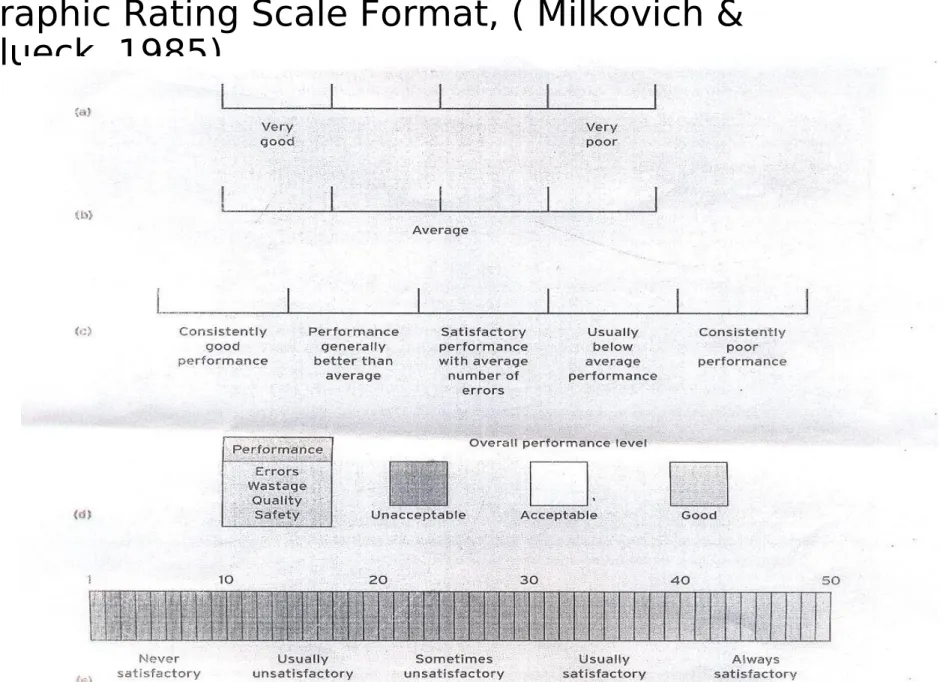
•Graphic Rating Scale (GRS)
• One of the oldest and the most widely used
performance evaluation technique
•The evaluator is presented with a graph and is asked
Performance Measurement
Types – GRS (Cont.)
•Employees are rated from low to high, or from
unsatisfactory to outstanding along a set of one dimensional scales depicting various performance characteristics, e.g.,1 to 5; 1 to 7 where anchors may or may not be explicitly labeled (for example, low or high).
•Some scales include verbal designations for the
midpoints of the continuum (e.g., very poor, poor, average, good, very good).
•Numerical weights are assigned to rating scale
Performance
Measurement
Types – GRS (Cont.)
•Total scores can then be computed. •Greater weights may be assigned to moreimportant/critical job behaviours, or evaluators may be asked to explain each rating with a
sentence or two.
Performance Measurements
Types (Cont.)
Behavioural Observation Scales (BOS)
•BOS rely on ‘critical behaviours’.
•BOS evaluate the statements generated according
to their frequency of occurrence in employee behavior.
•Response categories can be defined;
Performance
Measurement
Types (Cont.)
•
Checklist Methods
:
•The checklist is a set of adjectives or descriptive
statements of work behaviours.
•If the rater believes that the employee
demonstrates/ possesses a characteristic listed, the rater checks the item; if not, the rater leaves it
blank.
•A rating score from the check list equals the number
Performance
Measurements
Types (Cont.)
Critical Incidents• Use descriptions of actual observed behavior as
scale anchors.
•Operating managers and employees prepare lists /
statements of very effective and very ineffective behavior in a job.
•The evaluator prepares a log for each employee.
Performance Measurements
Types (Cont.) -Critical
Incidents
•Evaluator records examples of critical(outstandingly good or bad) behaviours, and the log is used to evaluate the employee at the end of the period.
• Very useful for the evaluation/post appraisal
Performance Measurements
Types (Cont.) – Comparison
Formats
Ranking
:
•This involves rank ordering employees from highest
to lowest on specific performance dimensions.
•Ranking is seldom a recommended approach. •The criteria on which employees are ranked are
Performance Measurements
Types (Cont.) – Comparison
Formats
•Paired Comparison
•Involves comparing each employee with every other
employee, on overall performance.
•The number of comparisons may be large, and
Performance Measurements
Types (Cont.) – Comparison
Formats
•
Forced Distribution
•similar to grades on normal distribution curve.
•Evaluator is required to rate employees in some fixed
distribution among performance levels. (E.g., top 5%, (outstanding) next 20% (good), next 50%
(average/satisfactory), next 20%, (unsatisfactory) last 5% (poor performers).
•Forced distributions are most suitable where there are
Performance Measurements
Types (Cont.) – unspecified
Criterion
Essay Evaluation
•Evaluator is asked to describe the strong and weak
aspects of the employee’s behavior.
•The essay can be open ended but in most cases there
Performance Measurements
Types (Cont.) – unspecified
Criterion
Management by Objectives
•The supervisor and employee to be evaluated jointly
set objectives in advance for the employee to try to achieve during a specified period.
•The evaluation consists of a joint review of the
degree of achievement of the objectives.
•It enjoys a higher probability of being regarded as
Common Performance
Appraisal Rating Errors
•Illusory halo / halo effect; tendency to rate an
employee either high or low on many factors as the rater believes the employee is high or low on a
single factor.
•This may be triggered by characteristics on which
an individual is deemed ‘conspicuously good or especially bad or by a general good or bad
impression (Drenth 1998). Positive halo; -high, high, etc. Negative halo;- low, low, etc.
•The halo effect is more likely when the
Common Performance
Appraisal Rating Errors
(Cont.)
•Restriction of range errors: Overly severe (severity
error), overly lenient (leniency error) or average rating (play safe) tendencies give rise to ratings in a restricted range across the distribution (for example ‘ceiling and ‘floor’ effects).
•These errors are directed at a total group rather
than a single individual.
•Leniency is the most common range error. By being
Post-Appraisal Interview:
Communicating Evaluating
Results
•
Some suggestions for effective
communication in evaluation
interviews
•
Be prepared to discuss performance weighed
against objectives for the period.
•
Allow time for the employee to discuss the
evaluation, and future behaviour, and to
express his or her feelings.
•
Open with specific positive results; sandwich
the criticisms between two positive comments
Some suggestions for effective
communication in evaluation
interviews
•Negative feedback should be oriented to
performance comments, not personal comments.
•Emphasize that the purpose of discussing negative
Some suggestions for
effective communication
in evaluation interviews
•The final aspect of the interview should focus on
future objectives and how the superior can help the employee achieve organizational and personal goals.
•Possible training and development activities that