Perfect Competition in the
Short Run & the Long Run
UnitA FIRM’S PROFIT-MAXIMIZING CHOICES
Price Taker
– A price taker is a firm that cannot influence the price of the good or service that it produces. – The firm in perfect competition is a price taker. Section
A FIRM’S PROFIT-MAXIMIZING CHOICES
Revenue Concepts
– In perfect competition, market demand and market supply determine price.
– A firm’s total revenue equals the market price multiplied by the quantity sold.
– A firm’s marginal revenue is the change in total revenue that results from a one-unit increase in the quantity sold.
A FIRM’S PROFIT-MAXIMIZING CHOICES
A FIRM’S PROFIT-MAXIMIZING CHOICES
A FIRM’S PROFIT-MAXIMIZING CHOICES
A FIRM’S PROFIT-MAXIMIZING CHOICES
Dave’s total revenue curve is TR.
A FIRM’S PROFIT-MAXIMIZING CHOICES
Profit-Maximizing Output
– As output increases, total revenue increases. – But total cost also increases.
– Because of decreasing marginal returns, total cost eventually increases faster than total revenue.
– There is one output level that maximizes
A FIRM’S PROFIT-MAXIMIZING CHOICES
– One way to find the profit-maximizing output is to use a firm’s total revenue and total cost curves. – Profit is maximized at the output level at which
total revenue exceeds total cost by the largest amount.
A FIRM’S PROFIT-MAXIMIZING CHOICES
Total revenue increasesas the quantity
increases —shown by the TR curve.
Total cost increases as the quantity
increases—shown by the TC curve.
As the quantity
increases, economic profit (TR – TC)
A FIRM’S PROFIT-MAXIMIZING CHOICES
At low output levels, the firm incurs an economic loss.
When total revenue exceeds total cost, the firm earns an economic profit.
Profit is maximized when the gap
between total
revenue and total
A FIRM’S PROFIT-MAXIMIZING CHOICES
Marginal Analysis and the Supply Decision
– Marginal analysis compares marginal revenue,MR, with marginal cost, MC.
– As output increases, marginal revenue remains constant but marginal cost increases.
– If marginal revenue exceeds marginal cost (if MR > MC), the extra revenue from selling one more unit exceeds the extra cost incurred to produce it.
A FIRM’S PROFIT-MAXIMIZING CHOICES
– If marginal revenue is less than marginal cost (if MR < MC), the extra revenue from selling one more unit is less than the extra cost incurred to produce it.
– Economic profit increases if output decreases. – If marginal revenue equals marginal cost (if MR =
MC), the extra revenue from selling one more unit is equal to the extra cost incurred to produce it. – Economic profit decreases if output increases or
Figure 15.3 shows the profit-maximizing output.
Marginal revenue is a constant $8 per can.
Marginal cost decreases at low outputs but then increases.
1. Profit is maximized when marginal revenue equals marginal cost at 10 cans a day.
2. If output increases from 9 to 10 cans a day, arginal cost ($7) is below marginal revenue ($8), so profit increases.
3. If output increases from 10 to 11 cans a day,
marginal cost ($9) exceeds marginal revenue ($8), so profit decreases.
The Perfectly Competitive Firm
1. How is the price established at which the firm sells?
The Perfectly Competitive Firm
3. Why do we say a perfect competitor is a price taker?
The Perfectly Competitive Firm
2. How much control does the firm have over this price?
The Perfectly Competitive Firm
4. Why does a perfect competitor maximize profits where Price = MC?
The Perfectly Competitive Firm
5. Is this perfect competitor making a profit? Why or why not?
A FIRM’S PROFIT-MAXIMIZING CHOICES
Temporary Shutdown Decisions
– If a firm is incurring an economic loss that it
believes is temporary, it will remain in the market, and it might produce some output or temporarily shut down.
Section
A FIRM’S PROFIT-MAXIMIZING CHOICES
– If the firm shuts down temporarily, it incurs an economic loss equal to total fixed cost.
– If the firm produces some output, it incurs an economic loss equal to total fixed cost plus total variable cost minus total revenue.
– If total revenue exceeds total variable cost, the
A FIRM’S PROFIT-MAXIMIZING CHOICES
– If total revenue were less than total variable cost, the firm’s economic loss would exceed total fixed cost. So the firm would shut down temporarily. – Total fixed cost is the largest economic loss that
the firm will incur.
– The firm’s economic loss equals total fixed cost when price equals average variable cost.
A FIRM’S PROFIT-MAXIMIZING CHOICES
– The firm’s shutdown point is the output and price
at which price equals minimum average variable cost.
A FIRM’S PROFIT-MAXIMIZING CHOICES
Marginal revenue curve is
MR.
A FIRM’S PROFIT-MAXIMIZING CHOICES
1. With a market price (and MR) of $3 a can, the firm
A FIRM’S PROFIT-MAXIMIZING CHOICES
A FIRM’S PROFIT-MAXIMIZING CHOICES
The Firm’s Short-Run Supply Curve
– A perfectly competitive firm’s short-run supply curve shows how the firm’s profit-maximizing output varies as the price varies, other things remaining the same.
– Figure 15.5 on the next slide illustrates a firm’s
FIRM’S … CHOICES
The firm’s marginal cost curve is MC. Its average variable costcurve is AVC, and its marginal revenue curve is MR0.
Point T is one point on the firm’s supply curve.
With a market price (and MR0) of $3 a can, the firm
FIRM’S … CHOICES
If the market price rises to $8 a can, the marginal revenue curve shifts upward to MR1.
Profit-maximizing output
increases to 10 cans per day.
FIRM’S … CHOICES
If the price rises to $12 a can, the marginal revenue curve shifts upward to MR2.
Profit-maximizing output
increases to 11 cans per day.
The new black dot in part (b) is another point of the firm’s
supply curve.
The blue curve is the firm’s supply curve.
At prices below $3 a can, the firm shuts down and output is zero.
At prices above $3 a can, the firm produces along its
MC curve.
The supply curve is the
same as the MC curve at
prices above the minimum point of AVC.
OUTPUT, PRICE, PROFIT IN THE
SHORT RUN
Market Supply in the Short Run
– The market supply curve in the short run shows the quantity supplied at each price by a fixed number of firms.
– The quantity supplied at a given price is the sum of the quantities supplied by all firms at that price.
Figure 15.6 on the next slide shows the market
At the shutdown price of $3, each firm produces either 0 or 7 cans a day.
OUTPUT, PRICE, PROFIT IN THE SHORT RUN
At prices above the shutdown price, firms produce
along their MC curve.
OUTPUT, PRICE, PROFIT IN THE SHORT RUN
The market supply curve:
Below the shutdown price, it runs along the y-axis. At the shutdown price, it is perfectly elastic.
In part (a), with market supply curve, S, and market
demand curve, D1, the market price is $5 a can.
OUTPUT, PRICE, PROFIT IN THE
SHORT RUN
Short-Run Equilibrium in Normal Times
– Market demand and market supply determine the market price and quantity bought and sold.
In part (a), with market supply curve, S, and market
demand curve, D1, the market price is $5 a can.
In part (b), marginal revenue is $5 a can.
Dave produces 9 cans a day, where marginal cost equals marginal revenue.
At this quantity, price equals average total cost, so Dave makes zero economic profit.
OUTPUT, PRICE, PROFIT IN THE
SHORT RUN
Short-Run Equilibrium in Good Times
– In the short-run equilibrium that we’ve just examined, Dave made zero economic profit.
– Although such an outcome is normal, economic profit can be positive or negative in the short run. – Figure 15.8 on the next slide illustrates short-run
In part (a), with market demand curve D2 and
market supply curve S, the market price is $8 a
can.
In part (b), Dave’s marginal revenue is $8 a can. Dave produces 10 cans a day, where marginal cost equals marginal revenue.
At this quantity, price ($8 a can) exceeds average total cost ($5.10 a can).
Dave makes an economic profit shown by the blue rectangle.
OUTPUT, PRICE, PROFIT IN THE
SHORT RUN
Short-Run Equilibrium in Bad Times
– In the short-run equilibrium that we’ve just
examined, Dave is enjoying an economic profit. – But such an outcome is not inevitable.
In part (a), with the market supply curve, S, and the
market market demand curve, D3, the market price
is $3 a can.
In part (b), Dave’s marginal revenue is $3 a can.
Dave produces 7 cans a day, where marginal cost equals marginal revenue and not less than average variable cost.
At this quantity, price ($3 a can) is less than average total cost ($5.14 a can).
Dave incurs an economic loss shown by the red rectangle.
Profit, Loss and Shutdown for a
Perfectly Competitive Firm
1. At what output will the firm
operate at price P₄, Q₄?
Profit, Loss and Shutdown for a
Perfectly Competitive Firm
2. At price P₃, will the firm make a profit, break
even, or have an economic loss?
Break even
What does it mean to break even?
Profit, Loss and Shutdown for a
Perfectly Competitive Firm
3. At price P₂, will the firm make a profit, break even, or have an economic loss?
Economic loss
Will it continue to produce? Why or why not?
Profit, Loss and Shutdown for a
Perfectly Competitive Firm
4. At price P₁, will the firm make a profit, break
even, or have an economic loss?
Profit, Loss and Shutdown for a
Perfectly Competitive Firm
Will it continue to produce? Why or why not?
Indifferent. If firm produces, revenue covers variable
The Perfectly
Competitive
Firm in Long-Run
Equilibrium
The market price is determined by supply and
Once the price
is established,
every firm
must sell at
that price or
not sell at all.
There is no
reason for a
firm to lower
its price since it
can already sell
as much as it
wants.
If firms are
making
economic
profits, more
firms will enter
the industry –
an event that
reduces and
makes profits
disappear.
If firms have
economic
losses, firms
will exit the
market – an
event that will
cause the price
to rise.
A perfectly
competitive firm is long-run
equilibrium is good for society because there is productive and allocative
efficiency when the firm is at the lowest point on its average total cost curve.
OUTPUT, PRICE, PROFIT IN THE
LONG RUN
– Neither good times nor bad times last forever in perfect competition.
– In the long run, a firm in perfect competition makes zero profit.
– Figure 15.10 on the next slide illustrates equilibrium in the long run.
Section
Part (a) illustrates the firm in long-run equilibrium. The market price is $5 a can and Dave produces 9 cans a day.
In part (a), minimum ATC is $5 a can.
In the long run, Dave produces at minimum ATC.
If supply decreases, the price rises above $5 a can and Dave will make a positive economic profit.
Entry increases supply to S and the price falls to $5 a
can.
If supply increases, the price falls below $5 a can and Dave incurs an economic loss.
Exit decreases supply to S and the price rises to $5 a
can.
In the long-run, the price is pulled to $5 a can and Dave makes zero economic profit.
OUTPUT, PRICE, PROFIT IN THE
LONG RUN
Entry and Exit
– In the long run, firms respond to economic profit and economic loss by either entering or exiting a market.
– New firms enter a market in which the existing firms are making positive economic profits.
– Existing firms exit the market in which firms are incurring economic losses.
OUTPUT, PRICE, PROFIT IN THE
LONG RUN
– The immediate effect of the decision to enter or exit is to shift the market supply curve.
– If more firms enter a market, supply increases and the market supply curve shifts rightward.
OUTPUT, PRICE, PROFIT IN THE
LONG RUN
– The Effects of Entry
OUTPUT, PRICE, PROFIT IN THE LONG RUN
Figure 15.11 shows the effects of entry.
Starting in long-run equilibrium,
1. If demand increases
from D0 to D1, the price rises from $5 to $8 a can.
OUTPUT, PRICE, PROFIT IN THE LONG RUN
2. As firms enter the market, the supply curve shifts
rightward, from S0 to S1.
Economic profit brings entry.
The equilibrium price
falls from $8 to $5 a can, and the quantity
OUTPUT, PRICE, PROFIT IN THE
LONG RUN
The Effects of Exit
OUTPUT, PRICE, PROFIT IN THE LONG RUN
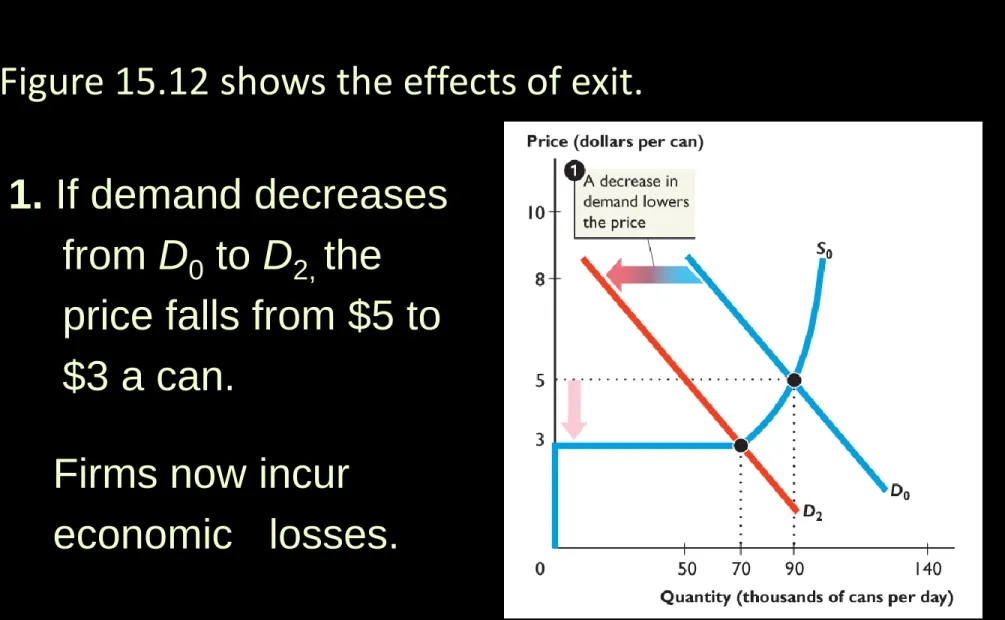
Figure 15.12 shows the effects of exit.
Starting in long-run equilibrium, 1. If demand decreases
from D0 to D2, the
price falls from $5 to $3 a can.
OUTPUT, PRICE, PROFIT IN THE LONG RUN
2. As firms exit the market, the supply curve shifts leftward, from S0 to S2.
Economic loss brings exit.
The equilibrium price rises from $3 to $5 a can, and the quantity produced
OUTPUT, PRICE, PROFIT IN THE LONG RUN
Change in Demand
– The difference between the initial long-run
equilibrium and the final long-run equilibrium is the number of firms in the market.
– An increase in demand increases the number of firms. Each firm produces the same output in the new long-run equilibrium as initially and makes zero economic profit.
– In the process of moving from the initial
OUTPUT, PRICE, PROFIT IN THE
LONG RUN
– A decrease in demand triggers a similar response, except in the opposite direction.
– The decrease in demand brings a lower price, economic loss, and some firms exit.
OUTPUT, PRICE, PROFIT IN THE
LONG RUN
Technological Change
– New technology allows firms to produce at a lower cost. As a result, as firms adopt a new technology, their cost curves shift downward. – Market supply increases, and the market supply
curve shifts rightward.
OUTPUT, PRICE, PROFIT IN THE
LONG RUN
Two forces are at work in a market undergoing technological change.
1. Firms that adopt the new technology make an economic profit.
– So new-technology firms have an incentive to enter.
2. Firms that stick with the old technology incur economic losses.
OUTPUT, PRICE, PROFIT IN THE LONG RUN
Is Perfect Competition Efficient?
– Resources are used efficiently when it is not
possible to get more of one good without giving up something that is valued more highly.
– To achieve this outcome, marginal benefit must equal marginal cost. That is what perfect
competition achieves.
– The market supply curve is the marginal cost curve. It is the sum of the firms’ marginal cost
OUTPUT, PRICE, PROFIT IN THE
LONG RUN
– The market supply curve is the marginal cost curve.
– The market demand curve is the marginal benefit curve.
– Because the market supply and market demand curves intersect at the equilibrium price, that price equals both marginal cost and marginal benefit.
OUTPUT, PRICE, PROFIT IN THE LONG RUN
1. Market equilibrium
occurs at a price of $5 a can and a quantity of 90,000 cans a day.
2. Supply curve is also the marginal cost
curve.
3. Demand curve is also
OUTPUT, PRICE, PROFIT IN THE LONG RUN
Because marginal benefit equals marginal cost
4. Efficient quantity is produced.
OUTPUT, PRICE, PROFIT IN THE
LONG RUN
Is Perfect Competition Fair?
– Perfect competition places no restrictions on
anyone’s actions—everyone is free to try to make an economic profit.
– The process of competition eliminates economic profit and brings maximum attainable benefit to consumers.
– Fairness as equality of opportunity and fairness as equality of outcomes are achieved in long-run
OUTPUT, PRICE, PROFIT IN THE
LONG RUN
– But in the short run, economic profit and economic loss can arise.
How an Increase in Demand Changes Long-Run
Equilibrium for the Firm and Industry
How a Decrease in Demand Changes Long-Run
Equilibrium for the Firm and Industry
Why Did GM Fail?
In 2008, the average price at which old GM could sell a vehicle was $18,000.
To maximize profit (minimize loss), GM sold 8 million
vehicles.
Average total cost of 8 million vehicles was $22,000, so the economic loss was $4,000 per vehicle.
Why Did GM Fail?
The firm’s “restructuring” has plans for cost savings and
investment in new green technology vehicles.
Why Did GM Fail?
Cutting fixed cost is the only way that the new GM can have a major impact on its profitability.
The minimum that the new GM must do is cut fixed cost to shift its ATC curve down from ATCO to ATCN.
GM can then maximize profit at the same quantity, 8