235
PHYTOEXTRACTION IN AN ARTIFICIAL SOIL POLLUTED WITH LEAD.
THIRD EXPERIMENTAL CYCLE
GEORGIANA PLOPEANU1, GAMENŢ EUGENIA1, MIHAIL DUMITRU1, MARIANA MARINESCU1
National Research Institute for Soil Science, Agrochemistry and Environmental Protection, Bucharest, Romania
Key words: phytoextraction, soil pollution, Pb, EDTA
ABSTRACT
This study concerns the research relating lead mobilization from artificially polluted soil by using EDTA ligand (ethylene diamine tetra acetic acid).
Experimental research in Green House were designed to check the reproducibility of analysed parameters on the selected plant (maize) and the conclusions of the preliminary test laboratory experiments.
The checking consisted in two experiments achievement with 2 degrees ofartificial loading soil with Pb: 1000 mg Pb/kg soil and concentration of EDTA in ratio Ligand/Lead between 0 and 0.5 and 2000 mg Pb / kg soil and ratio Ligand/Lead between 0 and 0.4 and three growing cycles (Cycle 1, Cycle 2 - residual effect, Cycle 3 - residual effect).
The paper will present experimental results obtained in Cycle 3, remanent effect.
INTRODUCTION
Generally, phytoremediation can be define as the process to use the plants to improve environment quality. The principle of method is the extraction of heavy metals from soil by plants (Garbisu et all., 2001). As a new approach, phytoremediation using phytoextraction, as a new technology to remediate the polluted soils, will be accepted if this processes can be more efficient than classic technologies.
Blaylock et all., showed that EDTA (acid etilen diaminotetraacetic) is the optimal optimal extractant for lead phytoextraction in phytoextarction process (Blaylock et al., 1997).
To increase the maximum Pb accumulation in plants and to reduce its solubilization risk, the application speed of mobilization agents must be chosen that maximize the lead concentration in the complexes obtained using chelating agent chosen (Epstein et all, 1993).
MATERIALS AND METHODS
This study consisted in achieving an experiment in Green House to check the remanent effect of soil treatments with EDTA on lead translocation degree in plants, identifying in the same time the moment needed to add a new EDTA treatment to improve lead translocation in maize plants.
236
Third experimental year. Remanent effect (Cycle 3)
Table 1 and Figure 1 present the influence of different EDTA treatments on biomass weighted at harvest, the maize plant height and lead content in leaf on the soil initially polluted with 1000 mg Pb/kg soil, and shows the following:
- The weight of maize leaf increases with applied EDTA doses; maize leaves are doubled in experimental variants the ratio ligand/lead was 0.3 and increased with EDTA dose;
- Plant height increased according to the leaves weight;
- Significant increases in the lead contents in maize leaves were obtained in all experimental variants where the EDTA dose (ratio ligand/lead) increased above 0.3 and continued in all treatments.
- The highest leaves weight, plant height and lead concentration in leaves was obtained in experimental variants treated with EDTA at Ligand/Lead ratio by 0.5, which allows us to recommend this concentration for the treatment of soils polluted with 1000 mg Pb/kg soil;
- Even if the lead concentration in maize leaves increased by 32 times compared to untreated and unpolluted control and 8 times compared to polluted control with lead by 1000 mg/kg, after applying EDTA at a ratio ligand/lead by 0.5, it can be estimated that the removal rate of lead in soil is reduced if EDTA is not applicable every year, the concentration of 52.2 mg/kg of lead in maize leaves is still insufficient to have any chance of soil cleaning;
- It must be stimulate the increasing of biomass and lead concentration in plants, it must be choosen a hiperacumulator or EDTA treatment at least once in 2 years.
Figure 1 Cycle3, Experiment–maize.Polluted soil with 1000 mg Pb/kg and some EDTA contents (molar ratio EDTA:Lead=0 (pot 4466); EDTA:Lead=0,1 (pot 4426); EDTA:Lead=0,2 (pot 4447); EDTA:
237
Table 1. Biomass, height and Pb content of maize on a polluted soil with 1000 mg Pb/kg and some EDTA contents - Cycle 3 (Series 3)
remanent effect
Treatment Biomass (g) Heigh (cm)
Pb (mg/kg d.w.)
Pb extracted with harvest (mg/kg sol)
V1 – control (Chernozem Fundulea) 85,3 51 1,62 0,02
V2 : Soil (+ 1000 mgPb/Kg)* + EDTA (Ligand/Lead=0) 78,6 50 14,0 0,14
V3 : Soil (+ 1000 mgPb/Kg)* +EDTA (Ligand/Lead=0,1) 112,6 55 13,2 0,18
V4 : Soil (+ 1000 mgPb/Kg)* + EDTA (Ligand/Lead=0,2) 131,3 59 19,2 0,31
V5 : Soil (+ 1000 mgPb/Kg)* + EDTA (Ligand/Lead=0,3) 165,3 64 36,8 0,76
V6 : Soil (+ 1000 mgPb/Kg)* + EDTA (Ligand/Lead=0,4) 196,3 67 38,0 0,93
V7 : Soil (+ 1000 mgPb/Kg)* + EDTA (Ligand/Lead=0,5) 216,0 75 52,2 1,40
DL 5% (Test Tukey) 29,6 7 12,9
Test Fisher ** ** **
238
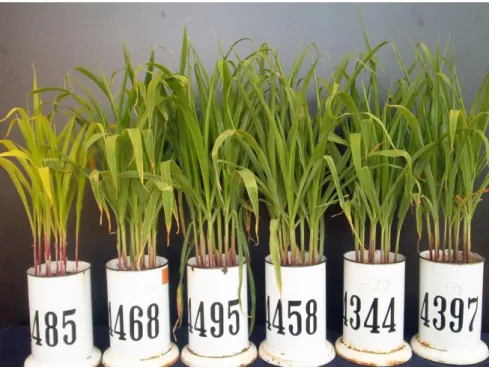
concentrations of EDTA treatment of soil initially polluted with 2000 mg Pb/kg soil on corn leaf weight, plant height and leaf content in lead (cycle 3), and shows the following:
- The leaves weight increased with EDTA dose, from 85.3 g in untreated and unpolluted variant to 205.3 g in experimental variant polluted with 2000 mg Pb / kg soil and 246 g in the variant treated with EDTA at a ratio ligand/lead equal to 0.4, the increase of leaves biomass in polluted experimental variants due to nitrogen added from lead nitrate;
- Plant height was significantly higher in the experimental variants treated with EDTA;
- The lead concentration in maize leaves increased more than 20 times in plants grown on soil polluted with 2000 mg Pb/kg soil compared to unpolluted soil and 69 times in plants grown in the soil polluted with 2000 mg Pb/kg soil and treated with EDTA at a ratio Ligand/Lead equal to 0.4, the lead concentration in plants increased with the EDTA dose, but the values are still lower than hiperaccumulators plants, it is necessary to treat every year or once at 2 years with EDTA and fertilization to increase the plants biomass and to ensure an efficient extraction system of lead from soil.
Fig. 2. Cycle 3, Experiment – maize.
Polluted soil with 2000 mg Pb/kgand some EDTA contents (molar ratio EDTA:Lead=0 (pot 4468); EDTA:Lead=0,1 (pot 4495); EDTA:Lead=0,2 (pot 4458); EDTA:Lead=0,3 (pot 4344); EDTA:Lead=0,4(pot
239
Table 2. Biomass, height and Pb content of maize on a polluted soil with 2000 mg Pb/Kg and some EDTA contents – Cycle 3 (Series 3)
remanent effect
Treatment Biomass
(g)
Heigh (cm)
Pb (mg/kg d.w.)
Pb extracted with harvest (mg/kg sol)
V1 – control (Chernozem Fundulea) 85,3 51 1,62 0,02
V8 : Soil (+ 2000 mgPb/kg)* + EDTA (Ligand/Lead)=0 205,3 68,6 33,8 0,21
V9 : Soil (+ 2000 mgPb/kg)* + EDTA
(Ligand/Lead)=0,1 203,3 70,0
49,9
1,26
V10 : Soil (+ 2000 mgPb/kg)* + EDTA
(Ligand/Lead)=0,2 227,0 73,0
80,1
2,27
V11 : Soil (+ 2000 mgPb/kg)* + EDTA
(Ligand/Lead)=0,3 220,6 74,0
102,0
2,81
V12 : Soil (+ 2000 mgPb/kg)* +EDTA
(Ligand/Lead)=0,4 246,0 75,6
111,8
3,34
DL 5% (Tukey Test) 18,8 5,9 10,0
Fisher Test ** ** **
240
1. Following the evolution of leaves weight, plant height and the lead concentration in maize leaves in both experiments (1000 mg Pb/kg soil and 2000 mg Pb/kg) and third vegetation cycle presents significant differences according to the applied treatment.
2. The lead concentration in leaves plant increased with EDTA concentration increasing at the same pollution degree with lead (1000 mg Pb / kg soil and 2000 mg Pb / kg soil). This explains the ability of chelating agent to increase the lead solubility in soil and facilitate phytoextraction process.
3. EDTA treatment on a chernozem polluted with 1000 mg Pb / kg soil (Experiment 1) DID NOT AFFECT plant growth and soil reaction at a molar ratio EDTA / Pb between 0.2 and 0.3. Lower concentrations of EDTA are not typical for phytoextraction and higher concentrations produce negative effects on plants. After the third cycle in experiment 1 did not appeared changes in soil reaction.
REFERENCES
Garbisu, C., Itziar Alkota, 2001, Phytoextraction: A cost-effective plant-based technology
for the removal of metals from the environment, Bioresource Technology, vol. 77, Issue 3,
pg. 229–236.
Blaylock M.J., Davide. Salt, Slavik Dusenkov, Olga Zakharova, Christopher Gussman, Yoram Kapulnik, Burt D. Ensley, Ilya Raskin, 1997, Enhanced accumulation of Pb in Indian mustard by soil – applied chelating agents. In Env. Sci. Technol., 31, 860–865,.
Epstein A.L., Gussman C.D., Blayloc M.J., Yemiyahu U., Huang J.W., Kapulnik Y., Orser C.S., 1993, EDTA and Pb – EDTA accumulation in Brassica juncea grown in Pb –
amended soil. In plant Soil, 208, 87–94.
***, 1981, Metodologie de analiză agrochimică a solurilor în vederea stabilirii necesarului
de amendamente şi îngrăşăminte, Metode de Analiză Chimică a Solurilor, ICPA,