343
PRELIMINARY RESEARCHES CONCERNING FOREST VEGETATION ON
THE CIUDANOVITA MINING AREA, CARAS SEVERIN COUNTY
HERNEA CORNELIA1, LAZAR M.2
1 Banat’s University of Agricultural Sciences an Veterinary Medicine of Timisoara, Calea Aradului , No. 119, Timisoara, e-mail: [email protected]
2Oravita Forest District, Ferdinand Street, No.8, Oravita
Keywords: forest vegetation, mining area, pioneer species, stand structure
ABSTRACT
Ciudanovita mining area from Caras-Severin county is located in South - West of Anina Mountains, near the town Ciudanovita. It is surrounded by forests from “IV Lisava” Production Unit. Analysis of forest vegetation on dumps, vegetation installed without anthropogenic intervention revealed the presence of numerous species, mainly pioneer. It is easy species with small seeds coming probably from neighboring stands. The most common species is black locust. This fact determined us to do a comparative analysis of this "stand" with a same age stand of black locust from forest area neighboring. Stand structure was analyzed in relation to diameter and height.
INTRODUCTION
Post mining sites are a consequence of the mining industry all over the world (Walker, 1992; Tropek et al., 2012). After mines closure there are two approaches: first one is about technical reclamation, typically comprising of covering the sites with fertile topsoil, sowing grass-herb mixture and planting trees and the second one is about spontaneous succession without any human intervention (Tropek et al., 2012).
Ciudanovita mining area from Caras-Severin County is located in South - West of Anina Mountains, near the town Ciudanovita. Uranium mining dumps have been made in order to deposit all the sterile resulted by mining activities from the South Banat mining area. Uranium mining dumps are located on the eastern slope, in a hilly region, surrounded by hills Prisaca, Golgota on the west and Janos on the south. The main uranium waste dump is along the valley between 360 and 420 m altitude. Slopes are between 180 and 400
Opened in 1950, Ciudanovita mines have been the first uranium mines closed, in 1990. This program has never been followed by a technical reclamation. Surrounded by forests, the mining area has been occupied by forest vegetation, step by step. Thanks to its perennial character, the forest vegetation plays an important role against soil erosion as well as in reduction of the water infiltration (Sahin and Hall, 1996).
The aim of this research is to analyzed forest vegetation from a uranium waste dump compared with its surrounding forest vegetation.
MATERIAL AND METHODS
Two experimental areas with rectangular shape (700 m2), situated to a relative small distance from each other, at the distance of about 800m apart, areas with the same facing slope and altitude have been chosen.
Analele Universităţii din Craiova, seria Agricultură – Montanologie – Cadastru (Annals of the University of Craiova - Agriculture, Montanology, Cadastre Series)Vol. XLIII 2013
344
improvement cutting or either negative activities like illegal felling, forest fire etc. It is important to mention that there has been no topsoil cover on the waste dump. The experimental area is 700 mp (70m x 10m); the experimental area shape is according with the dump area.
The second experimental area has been installed in Management Unit IV Lisava, compartment 18B. The area is about 700 mp (20m x 35m).
For each tree inventoried in the mentioned areas there has been notice: the position of the tree (x and y coordinates), breast height diameter, height, prune height, crown diameter measured in two perpendicular directions. The program ProArb 2 was used to study the culture architectonics (Popa, 1999). Statistical analyses were made.
To highlight the differences between bioaccumulation in diameter, height and volume, longitudinal section of representative trees from the experimental area was analyzed (Leahu, 1994, Hernea et all, 2010).
RESULTS AND DISCUSSIONS
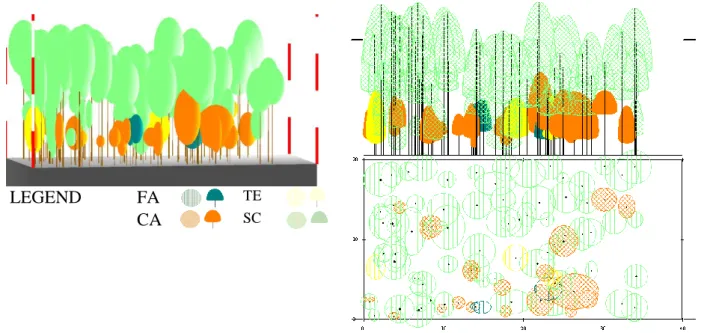
Most of the existing species on the uranium waste dump are pioneer species with light seeds coming from neighboring stands. Seed dispersal by wind is probably the most common way for species dissemination. An inventory of all trees from experimental surface has been made and 62 trees have been found (21 black locust, 10 black pine, 1 Scots pine, 1 eastern white pine, 2 common hornbeam, 1 elm, 16 silver birch, 5 European aspen, and 5 common willows). Graphical representation of the position of trees (Figure 1) show that horizontal distribution is not uniform, the trees are found in small clusters (2 -5 trees together). Due to the small number of trees and the small tree height, the stand present understock density. Crowns project covers a small part of the ground, most of them being full of weeds. Vertical distribution shows two stages of trees, black locusts are found in the superior stage while the others species are found in the inferior one. Analyzing these characteristics we can conclude that, the trees natural installed on the uranium waste dump is a stand where there are an alternance between trees, weeds and rocks. Trees are poorly developed; there is no pruning or a small height pruning.
345
Legend PI PIS UL SAC PLT
PIN SC CA ME
Figure 1 Graphical representation of three-dimensional and vertical and horizontal profile of forest installed on waste dump Ciudanovita
LEGEND FA TE
CA SC
Figure 2 Graphical representation of three-dimensional and vertical and horizontal profile of forest installed on compartment 18B, U.P.IV Lisava
Analele Universităţii din Craiova, seria Agricultură – Montanologie – Cadastru (Annals of the University of Craiova - Agriculture, Montanology, Cadastre Series)Vol. XLIII 2013
346
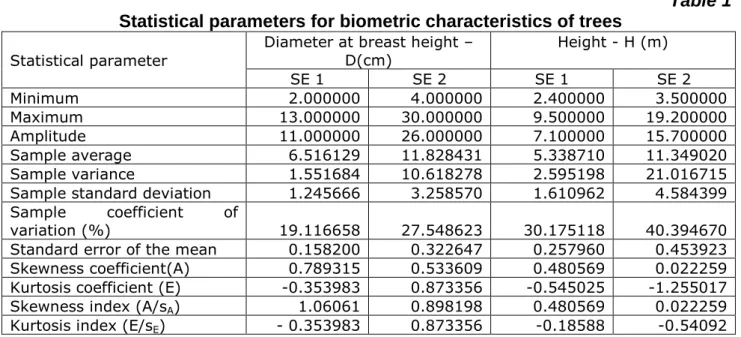
Table 1 Statistical parameters for biometric characteristics of trees
Statistical parameter Diameter at breast height – D(cm) Height - H (m)
SE 1 SE 2 SE 1 SE 2
Minimum 2.000000 4.000000 2.400000 3.500000
Maximum 13.000000 30.000000 9.500000 19.200000
Amplitude 11.000000 26.000000 7.100000 15.700000
Sample average 6.516129 11.828431 5.338710 11.349020
Sample variance 1.551684 10.618278 2.595198 21.016715
Sample standard deviation 1.245666 3.258570 1.610962 4.584399
Sample coefficient of
variation (%) 19.116658 27.548623 30.175118 40.394670
Standard error of the mean 0.158200 0.322647 0.257960 0.453923
Skewness coefficient(A) 0.789315 0.533609 0.480569 0.022259
Kurtosis coefficient (E) -0.353983 0.873356 -0.545025 -1.255017
Skewness index (A/sA) 1.06061 0.898198 0.480569 0.022259
Kurtosis index (E/sE) - 0.353983 0.873356 -0.18588 -0.54092
The stand structure in relation to the trees diameter
The arithmetic average diameter at breast height of threes from experimental area from uranium waste dump (SE 1) is 6.92 cm and the coefficient of variation recorded is 19.12% that means a small variability of this biometric characteristic. Arithmetic average diameter of trees by species are: 8.24 cm for black locust, 5.3 cm for black pine, 13.0 cm for Scots pine, 9.0 cm la eastern white pine, 3,0 cm for common hornbeam, 4,0 cm for elm, 5,31 cm for silver birch, 6.6 cm for European aspen and 5.6 cm for common willow.
The arithmetic average diameter at breast height of threes from experimental area from compartment 18 B is 11.83 cm and the coefficient of variation recorded is 27.6%. This indicates a higher important variability for biometric characteristic analyzed compare with data from the first experimental area. Arithmetic average diameters of trees by species are: 13.45 cm lfor black locust, 7.71 cm for common hornbeam, 7.0 cm for beech and 8.0 cm for lime.
Skewness coefficient of diameter at breast height (ASE 1 = 0.533609 and ASE 2=
0.789315) indicate a positive skewness (skewed to the right) characteristic for even stands. Skewness index calculeted for a 95% confident level are not significant
Kurtosis coefficient of diameter at breast height is positive for experimental area 1 (0.873356) and negative for experimental area 2 (-0.353983). Kurtosis index are not significant.
The stand structure in relation to the trees height.
The arithmetic average height of trees from experimental area uranium waste dump (SE 1) is 5.34 m. By species, the average height are: 6.27 m for black locust, 3.58 m for pine, 7.5 m for Scots pine, 5.5 m for Eastern white pine, 3.6 m for common hornbeam, 5.1 m for elm, 5.44 m for silver birch, 5.76 m for European aspen and 4.48 m for common willow.
347
Table 2 Comparative analyses of biometric characteristic of trees
Age (years)
Black locust from experimental area 2 Black locust from experimental area 1 Differences (SE 1 - SE 2)
d1.3
(cm) h (m)
ba (cm2)
v (m3)
f d1.3
(cm) h (m)
ba (cm2)
v (m3)
f d1.3 (cm) h (m) ba (cm2) v (m3) f
+ - + - + - + - + -
2 1,10 2,4 2 0,001 1,411 - - - - - -
-4 3,33 5,6 9 0,003 0,577 1,93 3,6 3 0,001 0,575 1,40 2,0 7,07 0,002 0,002
6 5,38 8,7 23 0,010 0,491 3,65 5,7 10 0,003 0,437 1,73 3,0 19,35 0,007 0,054
8 7,83 11,6 48 0,025 0,449 5,38 8,0 23 0,008 0,425 2,45 3,6 42,62 0,017 0,024
10 8,85 13,7 61 0,039 0,465 7,05 8,3 39 0,016 0,492 1,80 5,4 53,95 0,023 0,027
12 9,68 14,3 73 0,050 0,483 8,08 8,7 51 0,022 0,501 1,60 5,6 64,92 0,028 0,018
14 10,63 14,5 89 0,064 0,499
Analele Universităţii din Craiova, seria Agricultură – Montanologie – Cadastru (Annals of the University of Craiova - Agriculture, Montanology, Cadastre Series)Vol. XLIII 2013
348
Skewness coefficient of height (ASE 1 = 0.022259 şi ASE 2 = 0.480569) indicate a
positive skewness that is unusual for tree height distribution. It can be see a more pronounced skewed for experimental area 2 probably because the even aged stand structure. Skewness index calculated for a 95% confident level are not significant.
Kurtosis coefficients of tree height are negative for both experimental areas with height value for experimental area 1. Kurtosis index like skewness index are not significant.
Auxological characteristic of trees
Auxological researches made by us in the experimental areas showed the different capacity of bioaccumulation for trees. Analysis of longitudinal section of the trunk of two black locusts, one of them installed on the mining dump allow us to know the bioaccumulation in diameter, height, basal area and volume (Table 2)
It can be observed positive differences for all analyzed characteristics. If the differences between diameters at breast height are ascending until the age of eight years old and descending after that, the differences between height, basal area and volume are all ascending. These observations show us that differences regarding bioaccumulation are increasing with age.
CONCLUSIONS
In the waste dump specific conditions some woody species have installed naturally. We are talking about black locust, silver birch, Eastern aspen, common willow and pines. These species have an important contribution in determining land surface and reduce erosion but the protective functions of the forest are not quite well fulfilled. Beside these ecological losses there are economic losses too. These issues were highlighted by comparative analysis of the two experimental areas. There has been highlighted differences regarding bioaccumulation between trees from different sites.
BIBLIOGRAPHY
Hernea Cornelia, Netoiu, C., Corneanu Mihaela, Dragomir, P.I., 2010, Auxological
research concerning Robinia pseudoacacia L. From the sterile dump Cocoreni (Rovinari Basin), Journal of Horticulture, Forestry and Biotechnology, vol 15(4). Ed. Agroprint Timisoara, pag. 106-109.
Leahu, I., 1994, Dendrometrie, Editura Didactica si Pedagogica Bucuresti, 374p.
Popa, O., Popa I., 1999: Aplicatii informatice utile in cercetarea silvica. Programul CAROTA si programul PROARB. Revista Padurilor, nr.1.
Sahin, V., Hall, M.J., 1996, The effects of afforestation and deforestation on water yields. Journal of Hydrology 178 (14), 293-309
Tropek, R., Kadlec, T., Hejda M., Kocarek P., Skuhrovec, J., Malenovsky, I., Vodka, S., Spitzer, L., Banar, P., Konvicka, M., 2012, Technical reclamations are wasting the conservation potential of postmining sites. A case study of black coal spoil dumps, Ecological Engineering 43, 13-18.
Walker, L.R. (Ed.), 1992, Ecosystems of disturbed Ground. Ecosystems of the World