54
EVOLUTION OF THICKNESS OF MIXED HUNGARIAN (
QUERCUS
FRAINETTO
) AND TURKEY OAK (
QUERCUS CERRIS
) TREES
FOLLOWING THE WOODLAND STAGE
IULIAN BERCEA, NICULESCU MARIANA
Faculty of Agriculture and Horticulture, University of Craiova, [email protected]
Key words: Hungarian oak, Turkey oak, young wood,natural elimination
ABSTRACT
The ecosystem processes follow the woodland stage in the mixed Hungarian and Turkey oak wood, as a result of the inter- and intra-specific competition, depending on the thickness variable and competition for resources. The forestry-related interventions in the thicket stage will take place according to the goal of the management of the mixed Hungarian and Turkey oak young trees.
INTRODUCTION
The physiological decline of the Hungarian oak highlighted by recent research (Bercea, 2009, 2013) and the monitoring of the health of national forests (Badea, 2003) have shown that interventions are necessary by forestry works in mixed seedlings of Hungarian and Turkey oak trees in order to keep the proportion of species existing before the obvious climate changes in recent decades. The rational management of these woodlands underpins economic objectives, both by the amount of wood produced and by the economic value determined by the use value of this wood. If the Turkey oak accumulates large amounts of wood compared to the Hungarian oak trees in forests located in the same woodland, the use value of the Hungarian oak is higher than the use value of the Turkey oak. The Hungarian oak wood is used in the furniture industry for the same purposes as the English and Sessile oak trees. The Turkey oak has limited uses , more often than not, being used as firewood. To keep the proportion of mixed Hungarian and Turkey oak trees existing before the climate changes in the past decades and to ensure the same high economic value, forestry interventions are required. Our research aims at the evolution of these seedlings upon the completion of the natural regeneration process following the thicket stage, so as to determine the intervention mode that will lead to the improved composition of the seedlings and to keep the proportion of the Hungarian oak at the level of the regeneration stand, as well as to enhance positive medium- and long-term economic consequences (at the exploitability age).
MATERIALS AND RESEARCH METHODS
The research was carried out in sample areas located in phytoclimatic average conditions for Hungarian and Turkey oak trees in the widespread forests in the western part of the Getic Plateau, in Simian, Strehaia, Filiaşi, Melinesti, Drăgăşani (Bercea , 2007). In the forest of Macrea, the sample unit 82 M (ua) of the R&D Unit II Argetoaia (U.P.), Filiaşi Woodland, Hungarian and Turkey oak trees are mixed in equal proportion stands. The location of the sample areas was chosen after a long period of observation of the wilting of the Hungarian and Turkey oak trees since 1989, and permanent monitoring of the wilting phenomenon has been carried out in these sample areas. The wiltering rate of the Hungarian oak trees is 15% higher than in the case of the Turkey oak trees. The gaps due to the the removal of the wilted or wilting trees were filled with already existing seedlings of the 1994 low fructification of Hungarian and Turkey oak trees, contributing to the establishment of young stands following the regeneration cuts of the last two decades.
55
main characteristic features of young stands: number of specimens, natural elimination, origin of specimens (seeds, seedlings) per species and total number.
Measurements and observations were performed in the former regeneration cuts when applying progressive cutting on two sample areas of two-meter width, one to the south and the other to the east-west. The results of the measurements and observations were shown in tables for each species and for the whole stand. Tables were processed using Excel and plotted using the same software.
RESEARCH FINDINGS AND INTERPRETATION
The gradual planting of the seedling is highlighted by the different development stage of the specimens in the sample areas. The outer areas of the group cuts are in the thicket stage, whereas the central areas are exposed to light and are in the stage of saplings and poles, with a tendency for sticks in the case of specimens growing from seedlings.
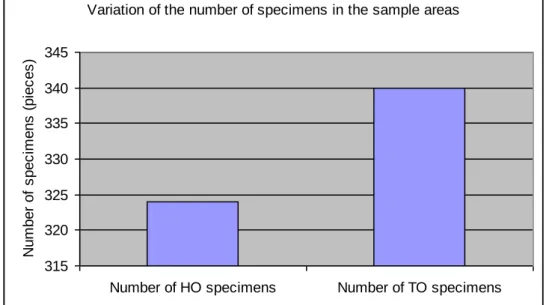
The investigations carried out showed that the number of the Turkey oak trees is high even after the natural elimination during the regeneration process, as highlighted by previous research (Bercea, 2007, 2009, 2012) (Fig. 1).
Variation of the number of specimens in the sample areas
315 320 325 330 335 340 345
Number of HO specimens Number of TO specimens
N
u
m
b
e
r
o
f
s
p
e
c
im
e
n
s
(
p
ie
c
e
s
)
Fig. 1 Proportion of Hungarian and oak trees – number of specimens
Figure 1 indicates a larger number of Turkey oak specimens throughout the whole of the former regeneration stand.
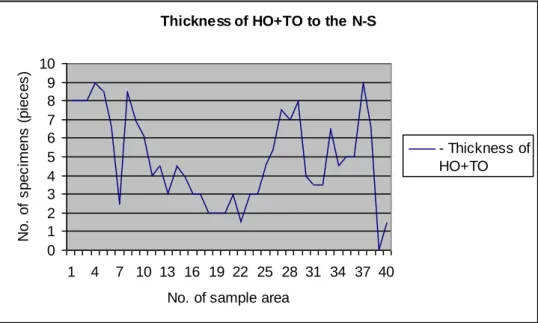
The thickness determinations of the Hungarian and Turkey oak trees in the two sample areas, to the north-south and east-west, show a larger number of Hungarian oak specimens in the central and outer northern part of the former regeneration cut, whereas the number of Turkey oak trees is larger in the outer southern and outer northern parts of the former regeneration cut (Fig. 2). The distribution is similar to that of the regeneration period ending in 2006 and examined in previous research (Bercea, 2007).
56
Variation of thickness of Hungarian and Turkey oak trees to the N-S
0 2 4 6 8 10 12 14 16
1 4 7 10 13 16 19 22 25 28 31 34 37 40
Number square metres to the N-S
N
u
m
b
e
r
o
f
s
p
e
c
im
e
n
s
(p
ie
c
e
s
) Desimea
exemplarelor de GÂ Desimea
exemplarelor de CE
Fig. 2 Thickness of Hungarian and Turkey oak trees to the north-south
Thickness of HO+TO to the N-S
0 1 2 3 4 5 6 7 8 9 10
1 4 7 10 13 16 19 22 25 28 31 34 37 40
No. of sample area
N
o
.
o
f
s
p
e
c
im
e
n
s
(
p
ie
c
e
s
)
- Thickness of HO+TO
Fig. 3 Thickness of total number of Hungarian and Turkey oak trees to the north-south
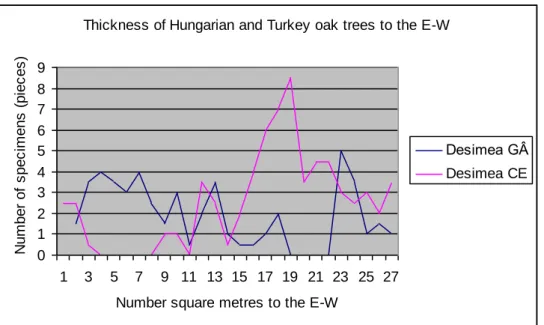
In the eastern-western sample area, the number of Hungarian oak trees is larger in the outer western and outer eastern part of the former regeneration stand, whereas the larger number of of Turkey oak trees is located in the middle and outer eastern part, keeping the distribution at the moment of regeneration (Fig. 4).
57
Thickness of Hungarian and Turkey oak trees to the E-W
0 1 2 3 4 5 6 7 8 9
1 3 5 7 9 11 13 15 17 19 21 23 25 27
Number square metres to the E-W
N
u
m
b
e
r
o
f
s
p
e
c
im
e
n
s
(
p
ie
c
e
s
)
Desimea GÂ Desimea CE
Fig. 4 Thickness of Hungarian and Turkey oak trees to the east-west
Thickness of Hungarian and Turkey oak trees to the E-W
0 1 2 3 4 5 6 7 8 9 10
1 3 5 7 9 11 13 15 17 19 21 23 25 27
Number square metres to the E-W
N
u
m
b
e
r
o
f
s
p
e
c
im
e
n
s
(
p
ie
c
e
s
)
- Thickness of HO+TO
Fig. 5 Thickness of Hungarian and Turkey oak trees to the east-west
The empty areas of the stand during 1988-1994, as a result of removal of wilted trees, most of them belonging to the Hungarian oak species, Hungarian oak trees coming from low fructification and shoots from wilting trees were planted. These planted seedlings and shoots represented pre-existing stock which are present in the current young stand and impact negatively on the specimens planted later from seeds of high competitive value. Literature indicates that specimens deriving from shoots are not enduring and accumulate wood in lower volume and quality at the age of exploitability compared to specimens from seed that accumulates high quality wood.
58
Number of HO and TO specimens to the N-S
0 1 2 3 4 5 6 7
1 4 7 10 13 16 19 22 25 28 31 34 37 40
Number of sample area
N
u
m
b
e
r
o
f
s
p
e
c
im
e
n
s
(
p
ie
c
e
s
)
- Number of specimens of HO - Number of specimens of TO
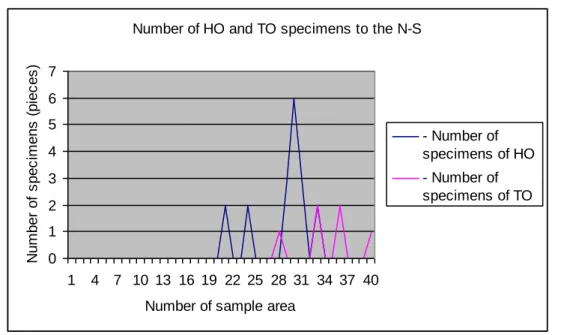
Fig. 6 Number of Hungarian and Turkey oak trees in the north-south sample area
Figure 6 shows that the largest number of Hungarian oak specimens from shoots are in the southern part and in the middle of the former regeneration stand, whereas the largest number of Turkey oak trees is located in the southern part.
Number of HO and TO specimens to the E-W
0 0,5 1 1,5 2 2,5
1 3 5 7 9 11 13 15 17 19 21 23 25 27
Number of sample area
N
u
m
b
e
r
o
f
s
p
e
c
im
e
n
s
f
ro
m
s
h
o
o
ts
- Number of specimens from shoots - HO
- Number of specimens from shoots - TO
Fig. 7 Number of Hungarian and Turkey oak trees in the east-west sample area
Figure 7 shows that in the east-west sample area, The Hungarian oak specimens from shoots are located only in the central part of the former regeneration stand.
The specimens from shoots represented pre-existing seeds, around which the regeneration stands were planted.
59
Number of wilted specimens (eliminated) to the N-S
0 0,5 1 1,5 2 2,5 3 3,5
1 4 7 10 13 16 19 22 25 28 31 34 37 40
Number of sample area
N
u
m
b
e
r
o
f
w
ilt
e
d
s
p
e
c
im
e
n
s
- Number of wilted specimens - HO - Number of wilted specimens - TO
Fig. 8 Wilted or wilting Hungarian and Turkey oak specimens to the north-south
Figure 8 shows that to the north-south, the largest number of wilted specimens belong to the Hungarian oak and are located in the central and northern part, whereas the largest number of the wilted or wilting Turkey oak are encountered in the southern part.
Number of wilted specimens (eliminated) to the E-W
0 0,5 1 1,5 2 2,5 3 3,5
1 3 5 7 9 11 13 15 17 19 21 23 25 27
Number of sample area
N
u
m
b
e
r
o
f
w
ilt
e
d
s
p
e
c
im
e
n
s
(p
ie
c
e
s
) - Number of wilted
specimens - HO - Number of wilted specimens - TO
Fig. 9 Wilted or wilting Hungarian and Turkey oak specimens to the east-west
To the east-west of the former regeneration stand, the largest number of wilted specimens belong to the Turkey oak in the central part of the sample area
The ecosystem process that prevails in the young stands is natural elimination due to interspecific and intraspecific competition. In the development of the thicket, saplings-poles, natural elimination is achieved due to the thickness of the young trees.
CONCLUSIONS
The research findings are reflected in the following conclusions:
- the composition of the mixed stand of Hungarian and Turkey oak trees, following the woodland stage, is maintained to the proportion of the regeneration composition;
60
- former marginal areas and outer mesh regeneration are thicket stage ;
- the outer and peripheral areas of the former regeneration stands are in the thicket stage;
- in the outer and peripheral areas of the former regeneration stands, natural elimination does not occur although the thickness of specimens is the largest; - - the young trees is in the state of saplings - poles in the central and, partly, in the
peripheral area;
- - natural elimination occurs in the central and peripheral parts, being higher with Hungarian oak specimens ;
- - most wilted Hungarian oak specimens show a curve at the base of the trunk and come from bushy specimens prior to regeneration cuts;
- - the wilted Turkey oak specimens are in the vicinity of Hungarian oak specimens from shoots;
To ensure the adequate proportion of the Hungarian oak trees in mixed stands and, hence, the goal of forest management, the following works are required:
- - removal of trees in the central and peripheral areas of the former regeneration cuts, shortly following the woodland stage;
- - medium-rate removal of specimens from shoots if they hinder the development of seed specimens ;
- - removal should be gradual, in accordance with enlargement and brightening cuts through progressive cutting during regeneration.
BIBLIOGRAPHY
1. Badea, O., 2003. Starea de sănătate a pădurilor din România în intervalul
1986-2000 (Romania’s Forests Health Status between 1986-2000), Bucuresti: Regia
Naţională a Pădurilor, pp. 889-897.
2. Bercea, I., 2007. Cercetări privind regenerarea arboretelor de gârniţă şi cer din
partea vestică a Podişului Getic (Research on the Regeneration of the Hungarian
and Turkey Oak Seedlings in the Western Part of the Getic Plateau). Doctoral
Thesis. “Transilvania” University of Braşov.