434 | P a g e
INTERNET USAGE IN RELATION TO THE SOCIAL
COMPETENCE OF SECONDARY SCHOOL
STUDENTS
Ms. Shaloo Saini,
Education, Lovely Professional University Phagwara, India
Dr. Parminder Kaur,
Principal, Lyallpur Khalsa College of Education for Women,Jalandhar, India
ABSTRACT
Internet usage is prominent in every aspect of life in this 21st century. The contributions of internet in the field of education are also remarkable. Internet is favoured for education but excessive non essential use of internet is a cause of concern for the students, parents, school and community.Many researchersfound excessive non essentialuse of internet to be related to various psychological disorders, adverse health effects, deteriorating educational achievements and poorer social skills. A person needs to be possessing social skills or competencies which could help him to be a better adjusted person in the society. This will help him to be mentally healthy, peaceful and successful in his life. The present paper deals with studying the Internet usage of the secondary school students in relation to the social competence. The sample for the study is 1000 randomly selected secondary school students from the rural and urban areas of Jalandhar district in equal proportion. The tools of data collection were researchers self constructed and standardised scale- ‘Internet Usage Scale by Saini S. and Kaur P. (2017) and the Social Competence Scale by Sharma and Shukla (1992) The results revealed that the internet usage of males is significantly more than the females and the internet usage of urban students is significantly more than the rural students. Further the findings reveal that there is significant difference between the Social competence scores of secondary school students having low high and average internet usage levels. But there is no significant difference between the social competence scores of students from the different subgroups formed with the interaction effect of Internet usage levels,gender and locale. With regard to the relationship between internet usage and the social competence; a significant negative relationship was found between the two variables.
Key Words: Internet Usage, Social Competence, Secondary School Students
I. INTRODUCTION
435 | P a g e
internet smart phones to be the new age baby sitter and the internet also contributes to reduce the loneliness of the old age people. Although there are lot of benefits of internet but excessive dependence on internet is a cause of concern for the human society. Internet is favored for school education whereas negative effects are also recorded . Excessive Internet use has been associated with problems with maintaining daily routines, school performance, and family relationships [1].Through internet we are connected to the people at faraway places but are unaware with the feeling sand emotions of the person sitting besides us. It is good to be technology competence in the present modern technology oriented world but it is much more important to possess social competence because man is a social animal and he cannot live in isolation. Social Competence Social competence is usually defined as the ability to act effectively and appropriately in different social situations. Social competence is a complex, multidimensional concept consisting of social, emotional, cognitive and behavioural skills, needed for successful social adaptation. [1].The life can be lead only with the support of each other so it is very important for a person to possess social competencies which can help him to be adjusted in the society and contribute to the development of the society. Adolescents are at the crucial stage of their development. They needs to be acquainted with the social norms, social values, social skills and social responsibilities expected from them because the future of the nation vests in the hands of these adolescents. And if our adolescents will be trapped by addictions of any kind be it drugs or technology; then the future of our nation will be endangered.So it is important to sensitise the adolescents, parents, teachers and society about the adverse effects of the excessive non essential use of the internet. Therefore the present paper deals with studying the Internet usage in relation to the social competence of the secondary school students.
1.1 Literature Review
Anita [2]conducted a study to analyze the perceived influence of Internet use on Social Competence, Emotional Maturity and General Wellbeing of adolescents belonging to different Residential Background, Gender, Academic Stream and Frequency of Internet Access. The data was raised from randomly selected 496 internet user adolescents. The findings of the study indicated that the Metropolitan and Non-metropolitan Internet user adolescents were in general the same on Social Competence; mean score of Male Internet user adolescents did not significantly different from the mean score of Female Internet user adolescents on Social Competence indicating that Male and Female Internet user adolescents were in general the same on Social Competence and the regular, moderate and infrequent Internet user adolescents were in general the same on Social Competence. It shows that there was no significant influence of frequency of internet access on Social Competence of internet user adolescents.
436 | P a g e
devices such as smart phones, T V‟s and tablets are destroying the face to face social skills and making the kids
emotionally dull.
Zad&Mami[4] conducted a research on to “Investigate the Relationship between Internet Addiction and Social Skills& High School Students' Achievements”. The study was conducted on the 320 students, comprising of 150
girls and 170 boys from the two districts of Kermanshah City selected through cluster sampling. The data was collected using Internet Addiction Test (IAT), and The Inventory of Social Skills (TISS) .The findings of the research showed that Internet addiction significantly predict social skills and educational achievement, that is, the higher the scores for internet addiction, the lower the social skills and educational achievement. Therefore, the results imply that unlimited use of internet has a devastating 14 negative influence on both social skills and communications and educational achievements. Another result of this research was that there is not a significant difference in addiction to internet between girls and boys, that is, the level of addiction to internet is equal in both genders.
Gapsiso and Wilson [5] studied the Impact of Internet on teenager‟s face to face communication on a sample of 132 secondary school students. The study found out that the use of internet have some impact on face-to –face communication between teenager‟s and their friends and also appears to weaken the ties that bind them with
family and friends. Internet use by the teenagers has reduced the time they spend engaging in face-to-face communication with their friends and family members. Moreover Internet usage has substantially reduced the desire of teenagers for face to face communication with their family members and friends. The teenagers reported that they prefer the Internet communication because it brings them much closer to their friends, helps them to make new friends and gives them limitless access to the world while maintaining their privacy.
Saini S. And Kaur P. [6]studied the relationship between Internet Usage and Family Environment of the secondary school students. The sample for the study was 200 students 100 male and 100 females selected from the class X of secondary schools of Jalandhar district. The results revealed that the Internet usage of males was significantly more than the females. No significant difference was found between the male and female students perception about their family environment. The researcher further found Internet Usage and Family Environment to have a negative relationship amongst them. The better the family environment the lesser will be the internet usage and the vise versa.
1.2 Significance of the Study
437 | P a g e
social life of our adolescents. And how important it is to protect our adolescents who are the future of our nation from the trap of any type of addiction or dependence may it be on drugs or technology.
2.METHODS AND PROCEDURES
2.1 Operational Definition
Internet Usage: Internet Usage refers to the sum total of the scores attained on the Internet Usage Scale by Saini S. and Kaur P.(2017)[7]
Social Competence: Social competence refers to the sum total of the scores attained on the Social Competence scale by Sharma and Shukla(1992)[8]
2.2Objectives
1. To study and compare the Internet Usage of secondary school students on the basis of Gender and Locale.
2. To study and compare the Social Competence of secondary school students on the basis of Gender and Locale.
3. To study the Interaction effect of Internet Usage levels, Gender and Locale on the Social Competence of the secondary school students.
4. To study the relationship between Internet Usage and Social Competence of the secondary school students.
2.3 Hypotheses
H1: There exists no significant difference in the Internet Usage scores of scores of secondary school students on the basis of Gender, Locale and their various interactions.
H2: There exists no significant difference in the Social Competence scores of secondary school students on the basis of Gender, Locale and their various interactions.
H3: There exists no significant Interaction effect of Internet Usage levels, Gender and Locale on the Social Competence scores of the secondary school students
H4: There exists no significant relationship between Internet Usage and Social Competence scores of secondary school students.
2.4Methodology
The present study is a Descriptive co relational research study which has been conducted on the secondary school students(class IX and X only) of rural and urban areas of Jalandhar District.1000 students(500 male and 500 female) were selected through stratified random sampling technique in equal proportions from the rural and urban based secondary schools of Jalandhar District. The tools used for the data collection are Internet Usage Scale by Saini S. and Kaur P. (2017) and the Social Competence Scale bySharma and Shukla (1992). [7&8] 2.5 Description of the Tools
438 | P a g e
Social Competence Scale by Sharma and Shukla (1992) The scale measures the social competence of the respondents through five factors. The test retest reliability of the scale is 0.56 and the predictive validity index is 0.72.
2.5Research Design
2x2 Factorial research design is employed for objective 1and 2
3x2 Factorial research design is employed for objective 3
Co relational research design is employed for objective 4
2.6 Delimitation
The study is delimited to senior secondary school students of rural and urban based secondary school
of Jalandhar District only.
3. RESEARCH FINDINGS:
T
he findings of the research have been presented below in two subsections:3.1 Descriptive Statistics
Table:I
Descriptive statistics related to Internet Usage and Social Competence
Variable N Mean Std Dev
Internet Usage 1000 60.52 9.95
Social Competence 1000 157.86 25.98
The above table depicts that the mean internet usage scores of 1000 secondary school students is 60.52 with standard deviation of 9.95.And the mean social competence scores of 1000 students is 157.86 with a standard deviation of 25.98.
3.2Inferential Statistics
Objective 1: To study and compare the Internet Usage of secondary school students on the basis of Gender and Locale.
In order to study and compare the Internet Usage of the secondary school students on the basis of gender and locale 2×2 ANOVA has been employed on the scores of Internet Usage in relation to gender (Male & Female) and Locale (Rural & Urban).The means and SD‟s of the sub-groups of 2×2 analysis of variance on the internet
439 | P a g e
Table: IIMeans and Sd’s Of Different Subgroups of 2x2 Analysis of Variance of The Scores of Internet Usage in
Respect of Two Categories of Gender And Two Categories of Locale
Variables Gender
Locale
Rural Urban Total
Male MMR=60.96, SD=9.05, N=250
MMU=63.33, SD=9.27, N= 250
MM=62.15, SD=9.23, N= 500
Female MFR=57.20, SD=10.54, N=250
MFU=60.60, SD=9.94, N= 250
MF=58.90, SD=10.38N= 500
Total MR=59.08, SD=9.99, N=500 MU=61.97, SD=9.70, N= 500
MT=60.52, SD=9.95, N= 1000
Table: III
Summary of ANOVAon The Internet Usage Scores of Secondary School Students in Relation to Gender
and Locale
Sr. No.
Sources Of Variance
SS DF MSS F VALUE
P VALUE
Result
1 Gender(A) 2637.376 1 2637.376 27.920 .000 Sig
2 Locale(B) 2085.136 1 2085.136 22.074 .000 Sig
3 Interaction(AxB) 66.564 1
66.564 .705 .401
Not Sig
4 Within 94084.440 996 94.462
MAIN EFFECTS
Internet Usage (Gender)
The mean internet usage scores of male students (N-500) is 62.15 with SD 9.23 and the mean internet usage scores of female students (N-500) is 58.90 with SD 10.38.The F value as depicted in the table II is 27.920 and the „p‟ value is .000.Since the „p‟ value is less than .05 it can be concluded that the difference between the mean
scores of male and female students is significant. It means that there does exist a significant difference in the internet usage of secondary school students on the basis of gender. The mean internet usage score of males is significantly higher than the mean internet usage score of females. It indicates that the internet usage of male students is more than that of the females.
440 | P a g e
The mean internet usage scores of rural students (N-500) is 59.08 with SD 9.99 and the mean internet usage scores of urban students (N-500) is 61.97 with SD 9.70.The F value as depicted in the table II is 22.074 and the „p‟ value is .000.Since the „p‟ value is less than .05 it can be concluded that the difference between the mean
scores of rural and urban students is significant. It means that there does exist a significant difference in the internet usage of secondary school students on the basis of locale. The mean internet usage score of urban students is significantly higher than the mean internet usage score of rural students. It indicates that the internet usage of urban students is more than that of the rural students.
INTERACTION EFFECT
Internet Usage (Gender X Locale)
The Table II depicts that the F value of the interaction effect of the gender and locale on the internet usage scores of secondary school students is 0.705 and the „p‟ value is 0.401.Since the „p‟ value is more than .05 the it
can be concluded that the interaction effect of gender and and locale on the internet usage scores of secondary school students is not significant. It means that the subgroups created through the interaction of gender and locale does not differ significantly from each other in their internet usage.
Interpretation:
1. The internet usage of males is significantly higher than the internet usage of the females.
2. The internet usage of urban students is significantly higher than the internet usage of the rural students.
3. The subgroups formed through the interaction of gender and locale does not differ significantly from each other in their internet usage.
From the above findings it can be concluded that the Hypothesis I stands rejected because there does exist a significant difference in the internet usage of the secondary school students on the basis of gender and also on the basis of locale however the subgroupsformed through the interaction of gender and locale does not differ significantly from each other in their internet usage.Similar findings have been reported by Sharma et al [9]Male adolescents are more addicted to internet than females and significantly more males than females feared about life becoming dull and boring without internet. Saini S.and Kaur P. [6] Internet usage of males is significantly more than the females.
Objective 2: To study and compare the Social Competence of secondary school students on the basis of Gender and Locale.
In order to study and compare the Social Competence of secondary school students on the basis of Gender and Locale 2×2 ANOVA has been employed on the scores of Social Competence in relation to gender (Male & Female) and Locale (Rural & Urban).The means and SD‟s of the sub-groups of 2×2 analysis of variance on the
441 | P a g e
Table IVMeans and SDof Different Subgroups of 2x2 Analysis of Variance of The Scores of Social Competence in
Respect of The Two Categories of Gender And The Two Categories of Locale
Variables Gender
Locale
Rural Urban Total
Male M=155.44SD=23.47N= 250 M=143.86SD=24.26N= 250 M=149.65SD=24.54N= 500
Female M=171.11SD=24.31N=250 M=161.02SD=24.24N= 250 M=166.06SD=24.24N= 500
Total M=163.27SD=25.13N=500 M=152.44SD=25.70N= 500 M=157.80SD=25.98N= 1000
Table: V
Summary of ANOVAon The Social Competence Scores of The Secondary School Students In Relation To
The Gender and Locale
Sr. No.
Sources Of Variance
SS DF MSS F
VALUE P VALUE
Result
1 Gender(A) 67371.264 1 66389.904 116.237 .000 Sig
2 Locale(B) 29354.724 1 28708.164 50.646 .000 Sig
3 Interaction(Axb) 139.876 1
139.876 .241 .623 Not Sig
4 Within 577283.400 996 579.602
MAIN EFFECTS
Social Competence (Gender)
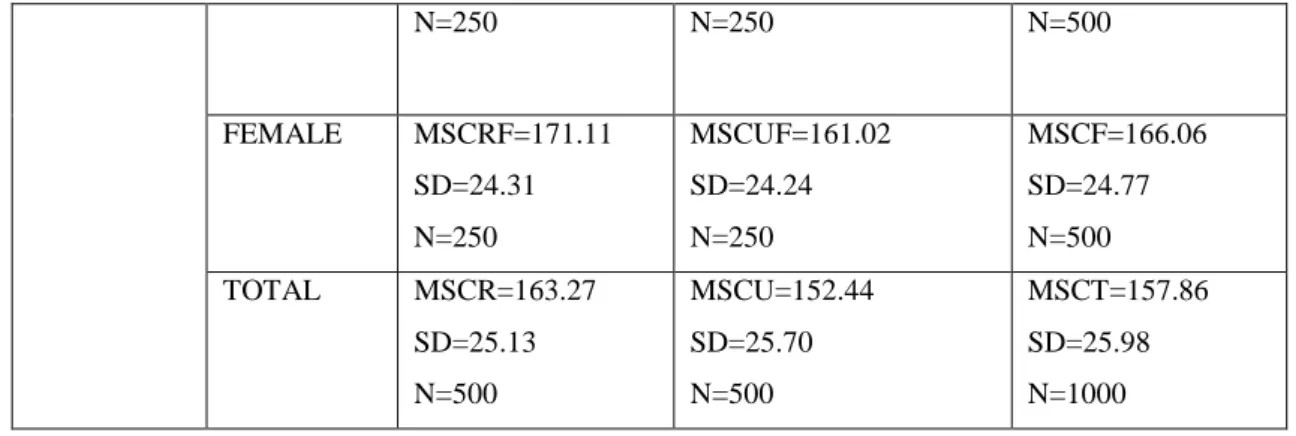
The mean social competence scores of male students (N-500) is 149.65 with SD 24.54 and the mean social competence scores of female students (N-500) is 166.06 with SD 24.82.The F value as depicted in the table IV is 116.237 and the „p‟ value is .000.Since the „p‟ value is less than .05 it can be concluded that the difference between the mean scores of male and female students is significant.It means that there does exist a significant difference in the social competence of secondary school students on the basis of gender. The mean social competence score of females is significantly higher than the mean social competence score of males. It indicates that the social competence of female students is more than that of the male students.
Social Competence (Locale)
442 | P a g e
between the mean scores of rural and urban students is significant. .It means that there does exist a significant difference in the social competence of secondary school students on the basis of locale. The mean social competence score of rural students is significantly higher than the mean social competence score of urban students. It indicates that the social competence of rural students is more than that of the urban students.
INTERACTION EFFECT
Social Competence (Gender X Locale)
The Table IV depicts that the F value of the interaction effect of the gender and locale on the social competence scores of secondary school students is 0.241 and the „p‟ value is 0.569.Since the „p‟ value is more than .05 the it can be concluded that the interaction effect of gender and locale on the social competence scores of secondary school students is not significant. It means that the subgroups created through the interaction of gender and locale does not differ significantly from each other in their social competence.
Interpretation:
1. The social competence of females is significantly higher than the social competence of the males.
2. The social competence of rural students is significantly higher than the social competence of the urban students.
3. The subgroups formed through the interaction of gender and locale does not differ significantly from each other in their social competence.
From the above findings it can be concluded that the Hypothesis II stands rejected because there does exist a significant difference in the Social Competence of the secondary school students on the basis of gender and also on the basis of locale however the subgroups formed through the interaction of gender and locale does not differ significantly from each other in their Social Competence.Similar studies have been reported in the studies undertaken by Nayak[11] where she found females at higher level in social competence than males.However Anita[2] found males and females to be similar at their social competence level and the students from metropolitan and non metropolitan areas were also found to be similar at social competence level. [12] Gender age of the mother, and type of family have no influence on the social competence.
Objective 3: To study the Interaction effect of Internet Usage levels, Gender and Locale on the Social Competence of the secondary school students.
443 | P a g e
Table: VIMeans Ans Sd’s Of Different Subgroups Of 3x2x2 Analysis of Variance of The Scores of Social
Competence In Respect of The Three Levels of Internet Usage Two Categories of Gender And The Two
Categories of Locale
Levels Of Internet Usage
Gender Locale
RURAL Urban Total
High Internet Usage
Male M1=127.85 SD=11.41 N=68 M2=117.17 SD=13.59 N=87 MSCHIUM=121.86 SD=13.71 N=155
FEMALE M3=137.39 SD=13.45 N=44 M4=134.69 SD=14.68 N=75 MSCHIUF=135.69 SD=14.23 N=119 TOTAL MSCHIUR=131.60
SD=13.06 N=112 MSCHIUU=125.28 SD=16.57 N=162 MSCHIU=127.86 SD=15.52 N=274 Average Internet Usage
Male M5=156.59 SD=10.50 N=128 M6=151.48 SD=9.77 N=115 MSCAIUM=154.17 SD=10.46 N=243
FEMALE M7=163.02 SD=9.20 N=97 M8=162.33 SD=10.99 N=116 MSCAIUF=162.64 SD=10.20 N=213 TOTAL MSCAIUR=159.36
SD=10.44 N=225 MSCAIUU=156.93 SD=11.72 N=231 MSCAIU=158.13 SD=11.16 N=456
Low Internet Usage
Male M9=187.44 SD=11.69 N=54 M10=173.96 SD=12.78 N=48 MSCLIUM=181.10 SD=13.91 N=102 FEMALE M11=191.92
SD=16.02 N=109 M12=191.92 SD=11.70 N=59 MSCLIUF=191.92 SD=14.61 N=168
TOTAL MSCLIUR=190.44 SD=14.84 N=163 MSCLIUU=183.86 SD=15.09 N=107 MSCLIU=187.83 SD=15.26 N=270
Total Male MSCRM=155.44 SD=23.47
MSCUM=143.86 SD=24.26
444 | P a g e
N=250 N=250 N=500
FEMALE MSCRF=171.11 SD=24.31 N=250
MSCUF=161.02 SD=24.24 N=250
MSCF=166.06 SD=24.77 N=500
TOTAL MSCR=163.27 SD=25.13 N=500
MSCU=152.44 SD=25.70 N=500
MSCT=157.86 SD=25.98 N=1000
Table: VII
Summary Of ANOVA On The Scores Of Social Competence Of Secondary School Students In Relation
To Three Levels Of Internet Usage,Two Categories Of Gender And Two Categories Of Locale
Sr. No.
Sources of Variance
SS DF MSS F
Value
P Value
Result
1 Levels of Internet Usage 407819.
154 2 203909.577 1381.277 .000
Sig
2 Interaction(Levels of Internet X
Gender)
1007.96
5 2 503.982 3.414 .033
Sig
3 Interaction(Levels of Internet X
Locale)
862.425 2 431.212 2.921 .054
Not Sig
4 Interaction(Levels of Internet X GenderX Locale)
815.391 2 407.695 2.762 .064
Not Sig
5 Within 145852.
486 988 147.624
MAIN EFFECTS
Social Competence (Internet Usage Levels)
Table VI depicts the ANOVA result findings. The F value of difference between the Social Competence scores of three groups of Internet Usage level is 1381.277 and the „p‟ value is.000.Since the „p‟ value is less than .05, it
445 | P a g e
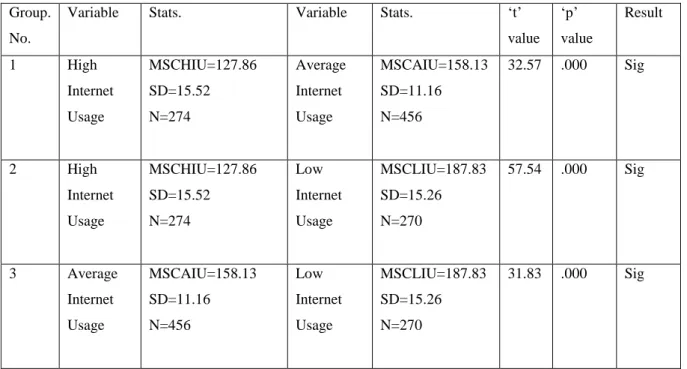
students having high average and low internet usage level is calculated and compared with each other. The findings of the „t‟ test are depicted in the Table VII below:
Table: VIII
Summary Of ‘T’ Values For The Subgroups In Respect To Social Competence Scores For The Difference
Between Three Subgroups Of Internet Usage Levels
Group. No.
Variable Stats. Variable Stats. „t‟ value
„p‟
value
Result
1 High Internet Usage
MSCHIU=127.86 SD=15.52 N=274
Average Internet Usage
MSCAIU=158.13 SD=11.16 N=456
32.57 .000 Sig
2 High Internet Usage
MSCHIU=127.86 SD=15.52 N=274
Low Internet Usage
MSCLIU=187.83 SD=15.26 N=270
57.54 .000 Sig
3 Average Internet Usage
MSCAIU=158.13 SD=11.16 N=456
Low Internet Usage
MSCLIU=187.83 SD=15.26 N=270
31.83 .000 Sig
The „t‟ test analysis depict that the „p‟ value of the „t‟ test for each pair of groups is .000.Which indicated significant difference between the mean social competence scores of students having high, average and low internet usage levels. The highest Social competence is reported by the students having low level internet usage with mean scores of 187.83. followed by average level internet usage with mean scores 158.13. and the mean social competence scores of high level internet usage is 127.86 which is the lowest in the three sub groups. It indicated that the more the internet usage of the students the lesser will be their social competence.
INTERACTION EFFECT (TWO ORDER)
Social Competence (Internet Usage Levels X Gender)
Table VI depicts the ANOVA result findings. The F value of difference between the social competence scores of three groups of Internet Usage level is 3.414 and the „p‟ value is.033.Since the „p‟ value is less than .05, it can
446 | P a g e
Table: IXSummary of ‘T’ Values For The Subgroups in Respect to Social Competence Scores for The Interaction
Between Three Subgroups Of Internet Usage Levels And Gender
Group. No.
Variable Stats. Variable Stats. „t‟ value
„p‟
value
Result
1. HIUM MSCHIUM=121.86 SD=13.71
N=155
HIUF MSCHIUF=135.69 SD=14.23
N=119
8.12 .000 Sig
2. HIUM MSCHIUM=121.86 SD=13.71
N=155
AIUM MSCAIUM=154.17 SD=10.46
N=243
25.56 .000 Sig
3. HIUM MSCHIUM=121.86 SD=13.71
N=155
AIUF MSCAIUF=162.64 SD=10.20
N=213
32.70 .000 Sig
4. HIUM MSCHIUM=121.86 SD=13.71
N=155
LIUM MSCLIUM=181.10 SD=13.91
N=102
33.69 .000 Sig
5. HIUM MSCHIUM=121.86 SD=13.71
N=155
LIUF MSCLIUF=191.92 SD=14.61
N=168
44.34 .000 Sig
6. HIUF MSCHIUF=135.69 SD=14.23
N=119
AIUM MSCAIUM=154.17 SD=10.46
N=243
13.96 .000 Sig
7. HIUF MSCHIUF=135.69 SD=14.23
N=119
AIUF MSCAIUF=162.64 SD=10.20
N=213
19.59 .000 Sig
8. HIUF MSCHIUF=135.69 SD=14.23
N=119
LIUM MSCLIUM=181.10 SD=13.91
N=102
23.89 .000 Sig
9. HIUF MSCHIUF=135.69 SD=14.23
N=119
LIUF MSCLIUF=191.92 SD=14.61
N=168
32.46 .000 Sig
10. AIUM MSCAIUM=154.17 SD=10.46
N=243
AIUF MSCAIUF=162.64 SD=10.20
N=213
447 | P a g e
11. AIUM MSCAIUM=154.17 SD=10.46
N=243
LIUM MSCLIUM=181.10 SD=13.91
N=102
19.72 .000 Sig
12. AIUM MSCAIUM=154.17 SD=10.46
N=243
LIUF MSCLIUF=191.92 SD=14.61
N=168
30.52 .000 Sig
13. AIUF MSCAIUF=162.64 SD=10.20
N=213
LIUM MSCLIUM=181.10 SD=13.91
N=102
13.29 .000 Sig
14. AIUF MSCAIUF=162.64 SD=10.20
N=213
LIUF MSCLIUF=191.92 SD=14.61
N=168
22.99 .000 Sig
15. LIUM MSCLIUM=181.10 SD=13.91
N=102
LIUF MSCLIUF=191.92 SD=14.61
N=168
6.00 .000 Sig
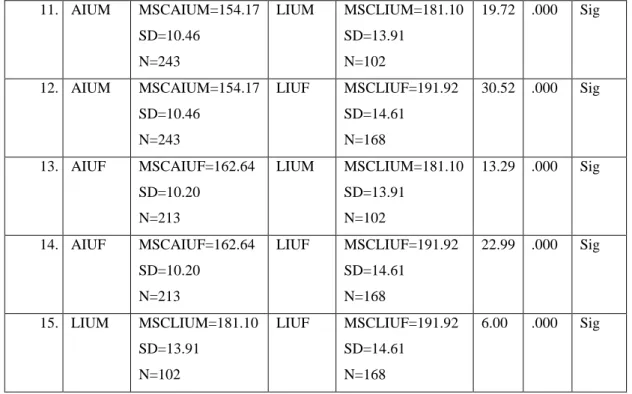
From the Table VIII it can be observed that the mean social competence of each subgroup significantly differs from the other. The highest mean social competence scores (191.92) are of the females having low level of internet usage and the lowest social competence mean scores(121.86) are of the males with high internet usage levels. It indicates that internet usage levels and the gender do influence the social competence.
Social Competence (Internet Usage Levels X Locale)
Table VII depicts that the F value of the interaction effect of three levels of internet usage and the locale is 2.921 the „p‟ value is.054.Since the „p‟ value is more than .05, it can be concluded that the F value is not significant. It
indicated that the social competence scores of the students from the different subgroups created with the interaction effect of Internet usage levels and the locale are at similar levels and does not differ from each other significantly.
INTERACTION EFFECT (THREE ORDERS)
Social Competence (Internet Usage Levels X Gender X Locale)
Table VII depicts that the F value of the interaction effect of three levels of internet usage, gender and the locale is 2.921 the „p‟ value is.064.Since the „p‟ value is more than .05, it can be concluded that the F value is not
significant. It indicated that the social competence scores of the students from the different subgroups created with the interaction effect of Internet usage levels, gender and the locale are at similar levels and does not differ from each other significantly.
Interpretation
448 | P a g e
competence of students having low internet usage is highest and the students with high internet usage level report the lowest level of social competence.
2. There is significant interaction effect of internet usage levels and gender on the social competence scores of secondary school students.
3. There is no significant interaction effect of internet usage levels and locale on the social competence scores of secondary school students.
4. There is no significant interaction effect of Internet usage levels, gender and locale on the social competence scores of the secondary school students.
The Hypotheses III states that there exists no significant Interaction effect of Internet Usage levels, Gender and Locale on the Social Competence scores of the secondary school students.But from the ANOVA test it is found that there difference in the social competence scores on the basis of different levels of internet usage is significant among the three groups of students. But the second order interaction and the third order interactions are not significant it indicates that the social competence scores of the subgroups formed due to the interaction of internet usage levels, gender and locale do not differ significantly from each other. Anita[2] also reported in her study that the male and female internet users and the metropolitan and non metropolitan internet users were reported to be having same level of social competence.[4] also found that the male and fermale students and the students from government and private schools are at same level of social competence.
Objective 4: To study the relationship between Internet Usage and Social Competence of the secondary school students.
Table: X
Table Showing The Correlation Between The Internet Usage And The Social Competence
Variable N Mean SD „r‟ value „p‟ value Result
Internet Usage 1000 60.52 9.95 -0.94 .000 Sig
(at 0.05level) Social Competence 1000 157.86 25.97
Table IX depicts the correlation results of internet usage scores with the social competence scores of the secondary school students. The mean Internet Usage scores of 1000 sample size is 62.52 with the SD 9.95. The mean social competence scores of the 1000 sample size is 157.86 with SD 25.97.The „r‟ value is -0.94 and the „p‟ value is .000.Since the „p‟ value is less than .05 the H4 stating that there exists no significant relationship
449 | P a g e
in their research that the digital devices such as smart phones TV and tablets are destroying the face to face social skills and are making the kids emotionally dull.
4
CONCLUSION
The present study was conducted to find out the internet usage in relation to social competence of the secondary school students. The findings revealed that there exists a significant difference between the internet usage of the secondary school students on the basis of gender and locale. The males reported to be significantly higher in the internet usage level than the females and the secondary school students from urban locale reported to have significantly higher internet usage level then the students from rural local. However no significant interaction effect of Gender and local was found on the Internet used scores of the secondary school students. With regards to the social competence of secondary school students it was found that females have significantly higher social competence then the mail and the social competence of rural students was found to be significantly higher than the social competence of the urban students however no significant interaction effect of Gender and local was found on the social competence scores of the secondary school students. Further a significant difference was found between social competence scores of students having different internet usage levels. The social competence of students having low internet usage was found to be highest amongst the three groups. Significant interaction effect of internet usage levels and gender was found on the social competence scores of the secondary school students. Females having low level of internet usage were reported to have highest social competence the males having high internet usage levels were found to have lowest social competence scores. No significant interaction effect of internet usage levels and locale was found on the social competence scores of the students and no significant interaction effect of internet usage levels gender and local was found on the social competence scores of the secondary school students. Further it was found that there exists a strong negative correlation between the internet usage and the social competence which indicates that the students having high internet usage were found to be processing less social competence.
450 | P a g e
REFERENCES
[1] Chen, X., Liu, M., Li, D., Li, Z., & Li, B. (2000). Sociable and prosocial dimensions of social competence in Chinese children: Common and unique contributions to social, academic, and psychological adjustment. Developmental Psychology, 36(3), 302-314
[2] Anita. (2013). A study of perceived influence of internet use on social competence, emotional maturity andgeneral well-being of adolescents (Doctoral dissertation, Maharishi Dayanand University, Rohtak, India). Retrieved from http://hdl.handle.net/10603/7814
[3] Yalda U. (2014, September).Smart phones can make kids emotionally dull. Edutracks.14(1), p.46 [4] ZadH.&Mami S. (2014,June).Investigating the effect of Internet Addiction on Social Skills and in High
School Students' Achievement. International J. Soc. Sci. & Education. 4(6),p.56-61
[5] Gapsiso, N. D., & Wilson, J. (2015). The impact of internet on the teenager‟s face to face communication. Journal of Studies in Social Sciences, 13(2), 202-220
[6] Saini, S., & Kaur, P. (2017). Internet usage in relation to the family environment of the secondary school students. In 3rd International Multi-track Conference on Sciences, Engineering and Technical Innovations (pp. 1-2). Jalandhar, India: CT Group of Institutions ISBN: 978-81-929077-7-2
[7] Saini S. and Kaur P.(2017) Internet Usage Scale, Agra National Psychological Corporation.
[8] SharmaV.P.,ShuklaP.and Shukla K.(1992) Social Competence Scale, Agra National Psychological Corporation.
[11] Nayak, M. (2014). Influence of culture linked gender and age on the social competence of higher secondary school adolescents. International Journal of Humanities and Social Science Inventions, 3(10), 31-39.
[10] Kaur, H. (2018). Social competence among adolescents in relation to their emotional maturity.
International Journal of Advanced Scientific Research and Management, 3(2), 1-9.
[9] Sharma A, Sahu R, Kasar PK, Sharma R.(2014) Internet addiction among professional courses students: A study from Central India. International Journal of Medical Science and Public Health vol.3:1069-1073. [12] VijayantiS.(2014)Gender differences in the prevalence and features of internet addiction among Indian
college students MedicaInnovatica. Vol 3(2) 49-53.