www.ijtes.net
The Use of Collaborative Assignment in
Online Learning Environments: The
Case of Higher Education
George Demosthenous, Areti Panaoura, Nikleia Eteokleous
Frederick University, Cyprus
To cite this article:
Demosthenous, G., Panaoura, A., & Eteokleous N. (2020). The use of collaborative
assignment in online learning environments: The case of higher education.
International
Journal of Technology in Education and Science (IJTES), 4(2), 108-117.
International Journal of Technology in Education and Science
Volume 4, Issue 2, Spring 2020
ISSN: 2651-5369
The Use of Collaborative Assignment in Online Learning Environments:
The Case of Higher Education
George Demosthenous, Areti Panaoura, Nikleia Eteokleous
Article Info
Abstract
Article History
Received: 14 July 2019
Many studies investigated the use of collaboration at conventional teaching environment in different educational levels. The present study examines students’ behavior during a collaborative assignment in an online learning environment in higher education. Data were collected by graduate students who were attending a course at a distance learning master degree program in Special Education. The developed group dynamics and students’ beliefs about their role during the activity were “revealed” by their reactions to the discussion forum, their private e-mails to the instructor, their activity at the platform and their contribution on the assignment, for which the wiki tool was used. Results indicated that although students were at the same time in-service or pre-service teachers at primary and secondary education and they were expected to implement group work at their teaching, they had low self-efficacy beliefs in using it as students in online learning environment. Their major difficulties were related with their fear about possible negative consequences concerning their marks due to other members’ behavior and the lack of experiences. Suggestions on how the group work and the collaborative assignment can be integrated more effectively in an online learning environment in higher education courses are discussed.
Accepted: 30 September 2019
Keywords
Online learning Collaborative assignment Wiki
Introduction
The mature graduate students today, born and grew up in the Information Age are characterized as digital natives (Prensky, 2001) and digital learners (Murugesan, 2009; Oliver & Carr, 2009; Richardson, 2009). Mainly today, they use technology in many aspects of their everyday activities, as they visit social networking websites, use email, search for information, communicate through chat rooms, participate in blogs and discussion forums, develop their own websites, become net-writers through wikis, etc. (Burnett et al., 2003; Hargadon, 2009; Murugesan, 2009). The education has to keep it in mind and develop the appropriate mechanisms to adapt innovative teaching approaches in order to be consistent with the changing landscape of the society and the economy (Dias & Victor, 2017). A part of the changing world nowadays is the impact of social media on how information and knowledge are developed, delivered and processed.
Universities throughout the world are steadily increasing the use of online courses as there are focused on improving the design of online learning environments for adult learners who need to continue their professional development by obtaining further qualifications. Undoubtedly the advances in information and communication technology provide powerful affordances to support collaborative learning in online environment (Alavi & Dufner, 2005). It seems that a collaborative learning environment contributes on students’ active and effective learning (Burke, 2011), while in many cases the importance of developing group work strategies are associated with future employment (Goold, Craig, & Coldwell, 2008) and the relative skills which have to be developed. Collaboration is an important life skill. It is widely recognized that the majority of innovations come about as a result of collaboration between groups (Elgort, Smith, & Toland, 2008), and employers want graduates to have developed teamwork skills, as they are more prepared for the commercial world (Bentley & Warwick, 2013). New learning management systems create new opportunities for interaction among all stakeholders involved in the teaching and learning processes (LaBeouf, Griffin, & Roberts, 2016). The Wiki is a web communication tool that can be used to engage students in learning within a collaborative environment (Parker & Chao, 2007). It provides participants with the opportunity of podcasting, deleting and editing. Gokcearslam and Ozcan (2011) suggest its use for brainstorming, group projects, meeting support and creating group portfolios.
(Anderson et al., 2001, Palloff & Pratt,2001) in learning and to study students’ engagement in online courses, as the growth of online courses will continue to rise dramatically, thus becoming a necessity for higher education institutions to develop, examine and offer effective online learning environments (Dixson, 2010). The research has drawn attention to the responsibilities and the role of the instructor in establishing appropriate teaching strategies and facilitating group work online (Goold et al., 2008). There are challenges which are encountered by both students and instructors and different types of support are needed for the design and the implementation of collaborative processes. For example, in the case of the group assignment, the instructor has to decide what is being evaluated, the final product and the process or both of them. Additionally the instructor has to assist the group in creating ways on how to handle unproductive members. A part of the activities in the case of online learning is the use of forums for group discussion and the use of technological tools in order to take part in group work as part of the assignment. At the same time “students’ roles expand from being isolated authors to being peer editors and readers” (Rott & Weber, 2013, p. 179).
In respect to the group work, there is a distinction between cooperation and collaboration. In the first case participants split the assignment into roughly equal pieces to be completed by the individuals and then stitched together to finish the assignment (Zach & Agosto, 2009). On the other hand collaboration involves working together. Participants have to discuss all the parts of the assignment and the final product is truly a collaborative - group product in which it is difficult to identify individual member’s contributions (Ingram & Hathon, 2004). Gayton and McEwen (2007) believe that an interactive and cohesive environment that includes group work, regular assignments and solid feedback is a presupposition for success. There are numerous studies about the pedagogical benefits of using the collaborative learning: the increased satisfaction (Brandon & Hollingshead, 1999), the higher order thinking processes (McConnell, 2005), the understanding of the content better and retaining longer (Zach & Agosto, 2009). However collaborative learning is still quite complex and ambiguous phenomenon. Hansen (2006) found that students evaluate the group experience as positive if certain conditions are met (Eunjung, 2011, Martin et al., 2019). Fujita, Doney and Wegerif (2019) indicated in the specific case of collaboration in mathematics that students’ decision-making was influenced by their inability to see their peers’ points of view dialogically.
LaBeouf et al. (2016) examined faculty and students’ comments of a university to determine perceptions of group work. The major issue noted by both groups was the allocation of grades. As Goold et al. (2008) argue it is important for teachers to recognize that students often do not want to be assessed as a group, as they feel penalized when the group does not perform satisfactorily. Additionally among most noted disadvantages are the opinions that group work is more time consuming and difficult to assess the levels of individual contribution (Quinn & Hughes, 2007). In many cases there is an increased difficulty in ensuring participation of all members (Piezon & Ferre, 2008). There is a necessity to provide clear guidelines of the assessment task, how it will be assessed and how the contribution of each group member will be assessed (Murray, 2003). The major factor for the success of group working is the effective communication and many instructors underline that communication is much more difficult when students cannot meet each other in face to face situation (Ekblaw, 2016; Conceição, 2006). For this reason Barkley, Cross and Major (2005) recommend that the instructor should foster communication skills which have to be used during the collaborative work or assignment in order to facilitate the development of the appropriate skills.
As Burke (2011) claims many people cringe and groan when they are told to work in group. She calls this phenomenon as “group hate” and she proposes the formation of realistic expectations of group work, as a possible way to overcome it. We have always to keep in mind that in any case there are advantages and disadvantages to work in a group. The major advantages are: (i) the variety of backgrounds and experiences among the students, (ii) people gain a more accurate picture of how others see them and (iii) feedback helps the students to evaluate their interpersonal behavior. The major disadvantages (Beede & Masterson, 2003) are: (i) the individual may agree to a bad solution in order to avoid conflict, (ii) an individual may dominate the discussion, (iii) some members may rely too heavily on others to do the work and (iv) it takes more time to work in a group than to work alone.
110 Demosthenous, Panaoura & Eteokleous
videoconferencing tools. There are difficulties for working adults with families, and other responsibilities to follow a program with many synchronous meetings. Additionally, the participants’ knowledge to handle any technical problems may arise and there is a necessity for immediate feedback or technical support.
The use of online tools, such as wiki, permits nowadays the use of asynchronous processes in the case of projects and collaborative activities (Cole, 2008), which are extremely useful in the case of adults who attend online courses. Wiki is one of the most widely used tools of Web 2.0 technology. It is a flexible collaborative content-management system enabling each user to create and edit web pages easily in a very short time (Bauer, 2011; Mejias, 2006), without much difficulty or expertise (Bauer, 2011; West &West, 2009). As we have already highlighted, the wiki collaborative environment allows users to post and edit simultaneously text, pictures, audio, video, graphs, and animated pictures (West & West, 2009). Wiki facilitates online collaboration of multiple people working on a common project, thus it is described as open editing website (Bauer, 2011; Ferris & Wilder, 2006). Elgort et al. (2008) examined students’ and lecturers’ perceptions of using wiki as a platform for conducting assessed group projects. They found that in most cases the use of wiki encouraged student’s participation and group involvement as nobody judges the others’ contribution. However they highlighted that the use of wiki is not enough in order to improve students’ attitudes to group work.
There is always the need to keep in mind that the teaching and learning processes have to be based on constructivism and each asynchronous or synchronous method needs to respect the inter-individual differences in respect to the different cognitive styles and learning styles. Collaborative work and assignment has to offer time and tools according to those differences in order to enable each one work productively. Technology-based approaches to learning provide many opportunities for constructivist teaching (Oliver, 2001), as they offer a highly interactive medium of learning that can be customized to meet the students’ individual needs (Heirdsfield, Walker, Tambyah, & Beutel, 2011).
Many times students encounter difficulties during a collaborative online assignment or activity due to their lack of experiences during their earlier school years or studies. Trespalacios (2017) based on his experiences to design small group discussions, offers several recommendations: a) implementing a small group discussion of a specific case study prior to the whole-class discussion can be an effective instructional strategy in online environments, b) using leaders in the case of whole-class online discussion forums and leaders in the case of group work. However, it is difficult to accept that in the case of adults the instructor has to structure the participants’ role during the collaborative work.
The aim of the present study was twofold: (i) to examine the group dynamics in terms of the online collaborative work as part of an assignment and (ii) to examine students’ beliefs about their role and the online instructor’s role during the specific activity, as there were “expressed” or “revealed” through their behavior. The contribution of the study would be on enhancing the quality of current online pedagogy in the case of higher education. Based on original data, it is suggested how to effectively integrate collaborative assignment in an online learning environment at graduate level. Additionally, taking into consideration that the population of the current study was consisted of pre-service and in-service teachers at primary, secondary and special education, it is discussed how their experiences can be used in the future aiming to collaborate with other teachers and/or in order to schedule collaborative activities for their students.
Methodology
The present study was conducted during the fall semester in 2017-2018. The participants were the 81 students who attended a course on “Research Methods” as part of their online Master Degree program in Special Education at a private University in Cyprus. Almost all of them (75) were working on domains related to education (pre-primary, primary and secondary education, special education schools or they offered private individual lessons). Participants were students from Greece and Cyprus (with the respective nationality), two countries with similarities at the Curriculum of primary and secondary education, and consequently similar educational experiences for the participants. 57 of the participants were women and 24 were men, their mean age was 29.4 years. The instructor was one of the authors of the paper.
individual feedback through the platform for the first two weeks’ content of the course. Then the students were requested to participate to a group activity, as part of a collaborative assignment. Students were randomly assigned to one of the 8 groups during the 7th week of the course (7 groups with 10 participants and a group with 11 participants). Each group was required to critically analyze a paper (a different paper was uploaded for each group) where a qualitative or a quantitative study was presented. In respect to the guidelines they had to collaborate in order to critically analyze the paper on the following parameters: (i) the presentation of the aim and the research questions, (ii) the presentation of the rationality of the study, (iii) the research method (sampling, research tools, validity and reliability). Their critical analysis was expected to focus on the content which was analyzed and discussed during the previous weeks. Synchronous and asynchronous tools were used for content presentation and understanding. Each week there was a lecture on the main topic (with a written presentation and a narration with explanations), bibliography with relevant references, examples which could be downloaded from webpages and forums for discussions. Participants had eight days to work on the assignment by using the wiki environment in order to collaborate and present their final group product. After the instructor uploaded the assignment guidelines, an online meeting was conducted (by using the Adobe connect teleconferencing tool) in order to address any students’ questions.
We assumed that it was important to ask them to work collaboratively on the task and during the online meeting; it was highlighted to them that they were jointly responsible for the strategies employed in achieving the final product. It was clear to them that they would be assigned as a group, with a common grade for all the members. The only limitation posed to them was that participants without any contribution (at least one time at the wiki’s platform) would be eliminated. The assignment was evaluated as 20% of the final grade. The mean grade for the specific assignment was 73 /100 for the 76 participants who took part at the activity. The meeting has been recorded, transcribed and then analyzed. The data collection was intended to be as natural as possible, in order to identify participants’ concerns.
In order to examine the posed research questions of the present study we analyzed: (a) students’ e-mails to the instructor where issues about the group activity and the collaboration were posed, (b) students’ queries and concerns which were expresses during the two synchronous online meetings (c) students’ behavior on wiki’s platform during their participation at the activity and (d) data from semi-structured interviews which were conducted by two participants, after the experience of the collaborative activity at the end of the semester. The first one was very active at his group and the second one sent many messages to the instructor expressing her concerns about the evaluation of the group assignment. The nicknames Costas and Maria are used for the presentation of the results.
Results
The presentation of the results is constructed based on the two main research questions. A narration and description of facts are presented in order to reveal students’ perceptions, their behavior and their concerns about the use of collaborative assignment in online learning environment.
Students’ Participation and the Respective Group Dynamics
The day the guidelines for the collaborative assignment were uploaded at the course’s platform, three students sent a personal message (through e-mail) to the instructor asking her not to participate at the group work and to work individually. Their major arguments were that they did not have personal relations with the other students; they posed the lack of time for “meetings” due to occupational responsibilities and the age gap with the other participants. Additionally, four other students sent e-mails and asked to participate at a different group in order to be with someone they already knew (i.e. husband, wife, sister and friend). During the first online meeting the instructor explained them the benefits of the collaboration with randomly constructed groups. Additionally, she explained the major characteristics of the collaborative online activities according to which participant do not have to meet each other face to face. She presented the asynchronous online tool which they have to use, the wiki. After the meeting only a student insisted to work individually and the instructor did not give her the respective permission.
112 Demosthenous, Panaoura & Eteokleous
have any member of her group at the same geographical region and she was not able to “travel” for just an assignment. They did not have any knowledge about the use of more recent asynchronous ways of collaboration. They expressed their belief that the collaboration implies face to face meetings or discussions through teleconferencing or telephone. The instructor, during the online meeting ensured them that they were not asked to have any synchronous meetings; they would only use the tools that the wiki offered to them in order to share their ideas and they would be able to construct in collaboration the final product for the assignment. Immediately after the online meeting, the instructor uploaded a file with instructions on how to use the wiki (by giving detailed guidelines and presenting examples with images of the computer screen) and how participants could use each one of the presented sheets.
The most difficult issue which was posed by the students was their denial to accept that the grade would be the same for all the members of the group. “You need to take into consideration the contribution of each member”, “It is not fair enough”, and “What if we disagree with the final product?” were few of their reactions during the meeting or as there were posed as comments at the discussion forum. The instructor emphasized the role of a new experience and the role of self-reflection based on colleagues’ feedback.
Additionally, the instructor discussed with them the benefits of using the collaborative work with their students, as teachers at different educational levels and the different roles they had to give to their students in order to work productively. She explained them that as adults they were able to decide and share roles without the instructor’s contribution, something that they may need to do with children. It was impressive that in order to help them overcome their concerns she needed to propose them different ways on how to organize the collaboration. The two main suggestions which discussed with them where: (i) the necessity to decide a procedure on how to use the different ideas, comments, suggestions in order to construct the final product and (ii) the importance of justifying their opinions, present arguments and examples in order to convince the other members of the group and in order to react productively to their colleagues’ arguments.
Their major concern was that in the case of face to face learning they would be able to evaluate each member’s contribution and mainly they would be able to provide the necessary feedback in order to enforce students’ motivation and the quality of their work. A participant insisted to underline her belief that in the case of disagreement they should have the opportunity to upload their different suggestions individually. Her major concern was on the grade of the assignment and how it would be possible to be evaluated for a product which they might disagree.
Based on the abovementioned discussion, in order to examine their beliefs about collaborative assignment and their previous teaching and learning relevant experiences, the instructor asked them through a discussion forum, few days after the meeting, to claim whether they used collaborative activities with their students (they had to present an indicative example of activity) and whether they ever belonged to any group of teachers who shared ideas and collaborated for a project or something else. Almost all of them claimed that they organized collaborative activities many times in the past, where they asked their students to collaborate in the classroom in order to investigate a concept in mathematics or physics. Few of them claimed that they asked their students to develop a project in history or geography, where they had to make a presentation with relevant information. “In most cases for the development of the project students have to collaborate during the course at the classroom or sometimes they have meetings at their home. They like to do that as they have the opportunity to play with their friends after the end of their work”. However they discriminate their work and the specific activity during the online course, due to lack of time for the discussions and the difficulty to convince adults with strong beliefs and conceptions.
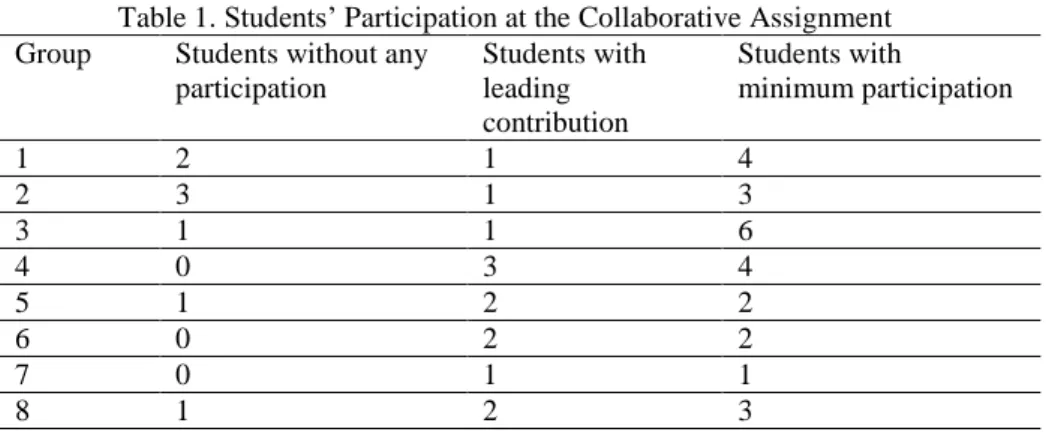
participation contributed only once to the development of the final product of the assignment. Actually in most cases, those 25 students uploaded at the place for the comments the whole text, as they would have to present an individual course work (see Table 1). They did not try to have any interaction with the other members and they did not collaborate at all. A student sent a personal e-mail to the instructor asking for feedback on her contribution, in order to “know the right answers for the final exams”. The specific comment indicated that he did not understand even the aims of the course and the expected learning outcomes.
Table 1. Students’ Participation at the Collaborative Assignment Group Students without any
participation
Students with leading contribution
Students with
minimum participation
1 2 1 4
2 3 1 3
3 1 1 6
4 0 3 4
5 1 2 2
6 0 2 2
7 0 1 1
8 1 2 3
It seems that in the case of all the groups, there was at least one student who had decided to be the leader. In almost all cases (6 out of 8) the leader wrote a comment immediately after the online meeting in order to express his / her willingness to present at the platform the initial ideas and to be responsible in order to edit the final product after the other members’ contribution. In the other two cases (group 4 and group 6), there were “independent” presentation of ideas and at the end there were participants who decided to edit them without mentioning anything about their role. Only Costas at the seventh group behaved as a leader during all the stages of the activity. He posed himself as leader and he asked the other members of the group to upload their first thoughts, he expressed his agreement and disagreement many times in respect to many ideas, he gave twice examples in order to justify his opinions and he presented many arguments. As he mentioned during the interview “I like to be sure about the final product, I need to be satisfied with it and if I like to work on something I express my initiative to act as coordinator, otherwise I do not feel that I can control the whole situation”.
There were three groups (those with only one leader) where the leader interacted with the other members by giving examples, asking for more explanations, expressing ideas on how to construct the final product by a more comprehensive way. In two cases the leading person, worked independently without indicating any flexibility to change things on the sheet where the final product was developed. They seemed to be strong-willed and they tried to justify and explain to the other members the correctness of their opinions.
Students’ Beliefs about the Participants’ Role
114 Demosthenous, Panaoura & Eteokleous
assignment.” They mentioned that they further had to use the forum which was available at the platform for discussions every week rather than posing only questions to the instructor.
Concerning the instructor’s in regards to feedback, we had to underline that during the online meeting, students asked for information about the procedure of the feedback. The instructor explained to them that the feedback would be uploaded to them few days after the deadline of the assignment. However they would be able to pose questions at a forum in order to have the instructor’s and participants’ reaction, contribution and feedback. Three different students insisted that they might have specific questions about the paper for which their group was responsible to criticize and not general questions and they felt insecurity to count only on their colleagues’ contribution. Before the deadline of the activity, one of the groups asked the instructor whether they could send her their analysis in order to give them feedback. They expressed their anxiety about the grade of the project. They seemed to relate the feedback to an assignment with the evaluation of the assignment. Two weeks after the experience with the collaborative assignment, during an online meeting (for explanations about an individual assignment) a few students complained about the time limitations and many students suggested an increase of the teaching assistant’s contribution during the collaboration in order to “feel more safety”.
Discussion and Conclusions
Universities throughout the world are steadily increasing the use of online courses as a part of lifelong learning. Clearly this is a trend that will continue. Establishing group work assignment is a teaching method to develop group work skills (Beccaria et al., 2014). The development of new e-learning processes has revealed opportunities for innovation in assessment practices in higher education. There are two main issues concerning the collaborative assignment: (i) how to support the collaborative learning by creating dynamic online environment and (ii) how to facilitate high quality feedback between instructors and students (Change, 2019; Russell, Elton, Swinglehurst & Greenhalgh, 2006). The present study concentrated mainly on the first issue, and recognized the significance of the second issue for a future study.
Although group work has many benefits for enhancing collaborative learning, it seems that it causes anxiety and a feeling of injustice. In order to change students’ perceptions about collaborative assignment and increase their motivation in order to persevere to overcome obstacles we have to facilitate them to reduce dysfunctional behavior (Hannaford, 2017). By this way we may reduce their negative experiences. Probably it would be easier for them to participate in a collaborative activity without having in their mind the marks, although in this case they may not be motivated to participate. Otherwise it seems that many of them prefer the individual work or at least the cooperative work which minimizes the necessity to collaborate, in respect to the definitions proposed by Zach and Agosto (2009).
It is suggested that collaborative activities are necessary component to effective online instruction. The present study confirms the results of LaBeouf et al. (2016) that students’ complaints are focused on time and logistical barriers and it indicates that lack of previous experiences on collaborative activities even in conventional teaching environment. Adult learners have greater need and desire for active learning because they tend to be older, non-traditional students who expect to have more agencies in their own learning (Riggs & Linder, 2016). One of the advantages of using wiki technology as a platform is that it reveals each group member’s contribution, since a record is kept of every contribution. This could counteract problems such as the attempt by some students to dominate group work and the attempt of others to get away with the least possible work. It is recommended that active learning opportunities within online asynchronous environments highly contribute on students’ learning engagement and learning experiences reflection (Chang, 2019; Riggs & Linder, 2016). However it seems that a presupposition of using collaborative assignment is the development previously the students’ awareness of group processes and group dynamics. Working with others requires the ability to resolve conflicts, use effective communication strategies, manage time and tasks (Beccaria et al., 2014). Fujita, Doney and Wegerif (2019) recently indicated in a specific case of mathematics that students’ decision-making was influenced by their inability to see their peers’ points of view dialogically.
convince their students about the benefits of collaboration without having strong beliefs by themselves as learners, based on positive experiences.
In the case of pre-service and in-service teachers the use of online collaborative assignment provides them with useful experiences that can be used for the development of communication, collaboration and knowledge in using effective communication tools which they can use further during their work. By this way they are more able to realize that the instructor’s role changes from being a provider of knowledge to a facilitator, he /she needs to be more accessible to students and facilitate group work by presenting hints about participants’ role during collaborative work. Particular attention has to be given to support them during the activity and to assess the individual contribution of each one. It seems that the instructor has to assist the group in creating ways in which to handle the unproductive members and foster the communication skills by using asynchronous methods. It could be useful to ask students present an additional piece of written work in which they analyze how their group worked and evaluate their own and others’ contributions to the group effort.
Although the graduates of pedagogical departments, departments of psychology and social sciences are expected to use collaborative teaching processes, it seems that they do not have adequate experiences as students in order to be convinced about the value of those processes or they do not feel sufficiently prepared with the relevant skills (Wilson, Ho, & Brookes, 2018). The recent Scotland’s (2016) study with undergraduate students in Qatar indicated that their perceptions changed in a statistically significant way after the submission of the first piece of formally assessed group work. The present study indicated that many adult students resist even in having an experience of collaborative assignment. We believe that a possible way to encounter the negative beliefs about the collaborative assignment is to provide them appropriate direct feedback given by the instructor or the other members of the group, after having the opportunity to express thoughts, feelings, and concerns. If the students know how to express their feelings and concerns, the group becomes more cohesive due to honesty among the members (Galajda, 2012). Sridharan and Boud (2019) indicated that peer feedback leads to enhanced teamwork behavior and self-assessment ability. Finally a future study could relate participants’ self-efficacy beliefs on developing a project individually with their contribution on the collaborative work, on their peer feedback interventions and on their metacognitive awareness in relation to group work.
Limitations of the Study
- We were not able to examine participants’ beliefs about the use of collaborative assignment directly as we tried to avoid the expression of the expected “right” answers in respect to the pedagogy. However we have to keep in mind that the expressed behaviour does not necessarily reveal the participants’ beliefs or perceptions.
- The group were divided randomly and for practical reasons the groups had too many participants. A future study can examine the impact of the number of participants and the differences concerning other participants’ characteristics.
References
Alavi, M., & Dufner, D. (2005). Technology-mediated collaborative learning: A research perspective. In S. R. Hiltz & R. Goldman (Eds.), Learning together online: Research on asynchronous learning networks (pp. 191-213). Mahwah, NJ: Lawrence Erlbaum Associates.
Anderson, T, Rourke, L., Garrison, D. R., & Archer, W. (2001). Assessing teaching presence in a computer conferencing context. Journal of Asynchronous Learning Networks, 5(2), 1-17.
Barkley, E.F., Cross, K.P., & Major, C.H. (2005). Collaborative Learning Techniques: A Handbook for College Faculty. San Francisco: Jossey-Bass.
Bauer, P. (2011). Weblogs and wikis: Potentials for seminars at university. In Proceedings of World Conference on Educational Multimedia, Hypermedia and Telecommunications.
Beccaria, L., Kek, M., Huijser, H., Rose, J., & Kimmins, L. (2014). The interrelations between student approaches to learning and group work. Nurse Education Today, 34, 1094-1103.
Becker, K. (2003). Just tell me what to do: Group Dynamic in a virtual environment. In Proceedings Women in Research Conference, Rockampton, Australia.
Beebe, S. A., & Masterson, J. T. (2003). Communicating in small groups. Pearson Education Inc. Boston: Massachusetts.
116 Demosthenous, Panaoura & Eteokleous
Brandon, D.P. & Hollingshead, A.B. (1999). Collaborative Learning and Computer-Supported Groups. Communication Education, 48(2), 109-126.
Burke, A. (2011). Group work: How to use groups effectively. The Journal of Effective Teaching, 11 (2), 87-95.
Burnett, et al. (2003). From Recreation to Reflection: Digital Conversations In Educational Contexts. Educational Studies in Language and Literature, Kluwer Academic Publishers, Netherland, V 3: 149– 167, 2003.
Chang, B. (2019). Reflection in learning. Online Learning, 23 (1), 95-110.
Cole, M. (2008). Using wiki technology to support student engagement: Lessons from the trenches. Computers & Education,52, 141–146.
Conceição, C.O.S. (2006). Faculty Lived Experiences in the Online Environment. Adult Education Quarterly, 57 (1), 26-45
Dias, L. & Victor, A. (2017). Teaching and learning with mobile devices in the 2017 century digital world: benefits and challenges. European Journal of Multidisciplinary Studies, 2 (5), 339-344.
Dixson, M. (2010). Creating effective student engagement in online courses: What do students find engaging? Journal of the Scholarship of Teaching and Learning, 10 (2), 1-13.
Ekblaw, R. (2016). Effective use of group projects in online learning. Contemporary issues in education research – Third Quarter, 9 (3), 121-128.
Elgort, I., Smith, A. G., & Toland, J. (2008). Is wiki an effective platform for group course work? Australasian Journal of Educational Technology, 24(2), 195-210.
Ferris, S. P., & Wilder, H. (2006). Uses and potentials of wikis in the classroom. Innovate, 2 (5). Available online at http://www.innovateonline.info/index.php?view=article&id=258
Eunjung, O. (2011). Collaborative group work in an online learning environment: A design research study. Upublished PhD Dissertation, University of Georgia.
Fujita, T., Doney, J. & Wegerif, R. (2019). Students’ collaborative decision-making processes in defining and classifying quadrilaterals: a semiotic dialogic approach. Educational Studies in Mathematics, 101, 341-356.
Galajda, D. (2012). Teacher’s action zone in facilitating group dynamics. Lingvarvm arena, 3, 89-101.
Gaytan, J., & McEwen, B. C. (2007). Effective online instructional and assessment strategies. American Journal of Distance Education, 21(3), 117-132.
Gokcearslan, S. & Ozcan, S. (2011). Place of wikis in learning and teaching process. Procedia – Social and Behavioral Sciences, 28, 481-485.
Goold, A., Craig, A., Coldwell, J., Goold, A., Craig, A. & Coldwell, J. (2008). The student experience of working in teams online. In Proceedings of ASCILITE - Australian Society for Computers in Learning in
Tertiary Education Annual Conference 2008 (pp. 343-352). Australasian Society for Computers in
Learning in Tertiary Education.
Hannaford, L. (2017). Motivation in group assessment: a phenomenological approach to post graduate group assessment. Assessment and Evaluation in Higher Education, 42 (5), 823-836.
Hansen, R. (2006). Benefits and problems with student teams: Suggestions for improving team projects. The Journal of Education for Business 82(1), 11–19.
Hargadon, S. (2009). White Paper on Educational Networking: The important role Web 2.0 will play in education. Retrieved from the www.elluminate.com on October 15th 2009
Heirdsfield, A., Walker, S., Tambyah, M. & Beutel, D. (2011). Blackboard as an online learning environment: What do teacher education students and staff think? Australian Journal of Teacher Education, 36 (7), 1-16.
Ingram, A.L. & Hathorn, L.G. (2004). Methods for analyzing collaboration in online communications. In T. Roberts (Ed.). Online collaborative learning: Theory and practice (pp. 215-241). Hershey, PA: Information Science Publishing.
LaBeouf, J. Griffin, J. & Roberts, D. (2016). Faculty and student with group work: What is problematic with college group assignments and why? Journal of Education and Human Development, 5 (1), 13-23. Martin, F., Budhrani, K., Kumar, S., & Ritzhaupt, A. (2019). Award-winning faculty online teaching practices:
Roles and competencies. Online Learning, 23(1), 184-205.
McConnell, J. (2005). Active and cooperative learning: tips and tricks (Part I). SIGCSE Bull 37(2), 27–30. Mejias, U. (2006). Teaching Social Software with Social Software: Innovate. Journal of Online Education 2
(5). Available online at
http://www.innovateonline.info/pdf/vol2_issue5/Teaching_Social_Software_with_Social_Software.pdf Murray, J. (2003). New Teacher Educators’ Needs: Perspectives from Research and Practice. London: Teacher
Murugesan, S. (2009). Social Issues and Web 2.0: A Closer Look at Culture in E-Learning. Handbook of Research on Web 2.0, 3.0, and X.0: Technologies, Business, and Social Applications. Publisher: IGI Global.
Oliver, R. (2001). Developing e-learning environments that support knowledge construction in higher education. In S. Stoney & J. Burn (Eds). Working for excellence in the economy (pp. 407-416). Churchlands: Australia Web Centre.
Oliver, M & Carr, D. (2009). Learning in virtual worlds: Using communities of practice to explain how people learn from play, British Journal of Educational Technology, 40 (3), pp444–457.
Palloff, R. M., & Pratt, K. (2001). Lessons from the cyberspace classroom: The realities of online teaching. San Francisco: Jossey-Bass.
Parker, K. & Chao, J. (2007). Wiki as a teaching tool. Interdisciplinary Journal of Knowledge and Learning Objects, 3, 57-72.
Prensky, M. (2001). Digital Natives Digital Immigrants. On the Horizon, MCB University Press, 9 (5), October 2001
Piezon, S., & Ferree, W. (2008). Perceptions of social loafing in online learning groups: A study of Public University and U.S. Naval War College students. The International Review of Research in Open and Distance Learning, 9(2). Retrieved from http://www.irrodl.org/index.php/irrodl/article/view/484/1034 Quinn, M. and Hughes, J. (2007) Quinn’s Principles and Practice of Nurse Education. 5th Edition, Nelson
Thornes.
Richardson, W. (2009). Becoming Internet Wise: Schools can do a far better job of preparing students for their connected futures online, Educational Leadershsip, pp 26-31.
Riggs, S. & Linder, K. (2016). Actively engaging students in asynchronous online classes. Idea, 64, 1-10. Rott, S. & Weber, E.D. (2013). Preparing students to use wiki software as a collaborative learning tool.
CALICO Journal, 30 (2), 179-203.
Russell, J., Elton, L., Swinglehurst, D. & Greenhalgh, T. (2006). Using the online environment in assessment for learning: a case-study of a web-based course in primary care. Assessment and Evaluation in Higher Education, 31 (4), 465-478.
Scotland, J. (2016). How the experience of assessed collaborative writing impacts on undergraduate students’ perceptions of assessed group work. Assessment and Evaluation in Higher Education, 41 (1), 1-20. Sridharan, B. & Boud, D. (2019). The effects of peer judgements on teamwork and self-assessment ability in
collaborative group work. Assessment and Evaluation in Higher Education. DOI: 10.1080/02602938.2018.1545898.
Trespalacios, J. (2017). Exploring small group analysis of instructional design cases in online learning environments. Online Learning, 21 (1), 189-200.
West, J. A., & West, M. L. (2009). Using wikis for online collaboration: The power of the read–write web. San Francisco: Jossey-Bass.
Wilson, L., Ho, S., & Brookes, R. (2018). Student perceptions of teamwork within assessment tasks in undergraduate science degrees. Assessment and Evaluation in Higher Education, 43 (5), 789-799. Zach, L. & Agosto, D. (2009). Using the online learning environment to develop real-life collaboration and
knowledge-sharing skills: A theoretical discussion and framework for online course design. Journal of Online Learning and Teaching, 5 (4), 590-599.
Author Information
George Demosthenous
Professor, Department of Mechanical Engineering Frederick University
Cyprus
Areti Panaoura
Associate Professor in Mathematics Education Frederick University
Cyprus
Contact e-mail: [email protected]
Nikleia Eteokleous
Assistant Professor in Educational Technology Frederick University