THE ASSOCIATION BETWEEN CLINICAL MEASURES OF MOVEMENT QUALITY WITH FUNCTIONAL PERFORMANCE MEASURES
Alicia K Yamamoto
A thesis submitted to the faculty of the University of North Carolina at Chapel Hill in partial fulfillment for the requirements of the degree of Master of Arts in the Department of Exercise
and Sport Science (Athletic Training).
Chapel Hill 2015
Approved by:
Darin Padua
William Prentice
Alain Aguilar
ABSTRACT
Alicia Yamamoto: The Association between Clinical Measures of Movement Quality with Functional Performance Measures
(Under the direction of Darin Padua)
The purpose of this study was to examine the association between clinical measures of
movement quality as it pertains to injury risk with functional performance measures. This study
examined the associated of movement quality screenings with performance variables of speed,
agility, lower body power, and core power tested through a 40-yard sprint, modified t-test,
single-leg triple hop, and seated rotational medicine ball throw, respectively. This study used a
correlational design.
Movement quality was assessed using both dynamic (jump-landing) and slow-controlled
(double and single leg squats) tasks. Movement errors were assessed during both the
jump-landing and squat tasks using a standardized scoring rubric. Higher scores indicated more
movement errors, hence worse movement quality. The participants were then asked to complete
a 40-yard sprint, modified t-test, single-leg triple hop, and seated rotational medicine ball in a
randomized order. Spearman’s order-rank correlations were used to determine the association
between movement quality during the jump-landing and squat tasks with each of the functional
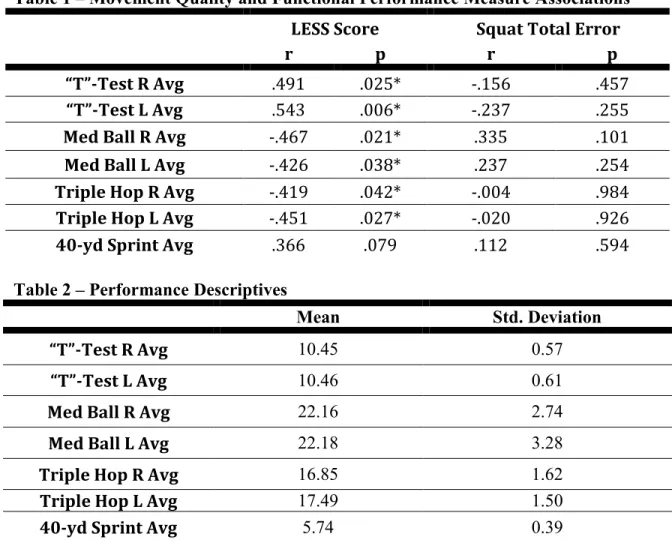
Dynamic movement quality, assessed using the LESS, was significantly associated with
agility (modified t-test), lower body power (single-leg triple hop), and core power (seated
rotational medicine ball throw). However, no such relationship was observed between movement
quality assessed during the slow, more controlled squat tasks with functional performance
measures. Movement quality during a more dynamic, max effort test is strongly associated with
functional measures of performance. While movement quality during a more slow-controlled
task is important for assessing neuromuscular characteristics associated with high injury risk
movement patterns, these measures are not associated with functional measures of performance.
Therefore, there is a need to assess movement quality across a continuum of tasks ranging from
slow-controlled global body movements to high-energy, max effort specific tasks when
TABLE OF CONTENTS
Abstract ... iv
LIST OF ABBREVIATIONS ... viii
Chapter I ...1
Introduction ...1
Independent & Dependent Variables ...5
Research Questions ...6
Research Hypotheses ...7
Delimitations / Limitations / Assumptions ...9
Chapter II ...10
Introduction ...10
Epidemiology ...10
Movement Assessment Screens ...12
Functional Movement Screen (FMS)...12
Landing Error Scoring System (LESS)...13
Fusionetics ...14
Conclusion ...17
Chapter III ...18
Experimental Design ...18
Subjects ...18
Procedure ...19
LESS ...19
Fusionetics ...20
2-Leg Squat ...20
2-Leg Squat with Heel Lift ...20
1-Leg Squat ...21
Push-Up...21
Shoulder Movement ...22
Trunk / Lumbar Movement ...22
Cervical Movement ...22
Modified T-Test ...23
Single-Leg Triple Hop ...23
Seated Rotational Medicine Ball Throw ...24
40-yard Sprint ...24
Data Reduction...25
Statistical Analysis ...44
Chapter IV ...47
Introduction ...47
Methods...48
Landing Error Scoring System...52
Results ...54
Discussion ...56
LIST OF ABBREVIATIONS
MKSI – Musculoskeletal Injury
LESS – Landing Error Scoring System
Fusionetics - FUSX
FMS – Functional Movement System
SEBT – Star Excursion Balance Test
CHAPTER 1
INTRODUCTION
Lower extremity injuries account for approximately two-thirds of all injuries seen
in collegiate athletics.1 It has been shown that these injuries can result in emotional distress,2 long-term disabilities,3 can ultimately contribute to significant US health care costs,4 and decrease individual and team performance.5 The cost for initially managing these injuries and their residual effects has become astronomical. For example, health
care costs of anterior cruciate ligament (ACL) reconstructions are estimated at $1 billion
per year6. Similar trends can be seen with other common lower extremity injuries.5 Preventing lower extremity injuries is important for lowering overall cost, as well as
limiting the amount of emotional distress,2 long-term disabilities,3 and both individual and team performance decrements that result from injury.5
In an attempt to reduce injury rates and its negative effects, several movement
assessment tools have been proposed to clinicians. These tools can be utilized to predict
the risk of lower extremity injuries to the hip, knee, hamstring, groin, and ankle,4 as well as global movement quality of the body.7 In addition, these screening tools can be utilized as a basis for implementation of corrective exercises based on the identified risk factors
such as muscle imbalances or neuromuscular dysfunction. Furthermore, these programs
attained. In the current literature, research has primarily focused on how an acute
assessment is related to injury risk factors.8 For example, the LESS (Landing Error Scoring System) is a jump-landing task that found poor movement patterns (increased
medial knee displacement, decreased hip and knee flexion, etc) are associated with
anterior cruciate ligament (ACL) injuries and patella femoral pain syndrome (PFPS).9 In addition, higher composite scores, signifying poorer biomechanics, are associated with
higher-risk biomechanics for sustaining a lower extremity injury.9 The jump-landing task, however, is only specific to identifying individuals with increased risk of lower extremity
injuries such as ACL injury and PFPS. Other research has focused on the Functional
Movement Screen (FMS), a more global movement quality screen and incorporates upper
extremity motion as well to include the whole kinetic chain.7,10-12 The FMS utilizes seven different tasks to assess fundamental movement patterns: an active straight leg raise,
shoulder mobility, trunk stability push-up, rotary stability quadruped, deep squat, hurdle
step, and in-line lunge.7,10-12 With regards to injury risk, Kiesel et al found that a FMS score less than or equal to 14, out of a possible 21, was associated with a significantly
greater risk of injury during a competitive season in NFL players.12 The composite score of the FMS, however, has been found to have a sensitivity of only 0.12 for serious
musculoskeletal (MSKI) injuries.7
Although there are no studies that associate an acute movement screening with
athletic performance ability, there is some evidence that IPP’s, based on acute movement
screening results, may improve performance. One study implementing an ACL IPP based
on the LESS test on females found increases in performance variables such as speed,
focusing on correcting high-risk kinematic and kinetic risk factors, has been shown to
reduce the risk of lower extremity injuries by 65-85%.14
A novel-screening tool, which is becoming popular in professional sports
organizations, is called Fusionetics. Similar to all other movement assessments, this tool
looks at global movement quality to identify injury risk and theoretically athletic
performance ability. Although no research currently exists on Fusionetics as an entire test
battery, it does use two tests supported by research, and observes for unilateral
difference.15,16 Similar to the FMS, Fusionetics utilizes seven various tasks including a 2-leg squat, 2-leg squat with a heel lift, 1-leg squat, push-up, shoulder movement,
trunk/lumbar spine movement, and cervical spine movements. The composite score of
Fusionetics, out of 100, is theorized to be more sensitive than the FMS in predicting
injury risk and athletic performance, because it is graded on a larger scale, and may
identify asymmetries between limbs. One feature that sets this program apart from others
is that an IPP is automatically generated per individual testing results. This can reduce
time and make delivery of an IPP more efficient. The creation of an IPP to mitigate high-
risk kinematic and kinetic risk factors is a major objective of any screening tool.
In an attempt to reduce injury risk and gauge athletic performance, several
movement screening tools have been proposed. The evidence produced, thus far, seems
promising for its ability to associate an acute screening assessment with injury risk; and
for its ability to generate IPP’s to reduce injury risk and improve performance. However,
to our knowledge, no data exists that correlates screening tools with athletic performance,
which is one of their main boasts. Furthermore, because Fusionetics is a novel screening
Therefore, the purpose of this study is to determine if there is an association
between global movement quality and athletic performance ability using both the LESS
Independent Variables:
1. LESS Composite score (out of 22)
2. Fusionetics Sectional Total Error Scores
a. Movement Efficiency (ME) Total Error Score (out of 60)
b. Squat Total Error Score (out of 40)
c. Upper Quarter Total Error Score (out of 20)
Dependent Variables:
1. Modified T-Test time (seconds)
2. 40-yard sprint time (seconds)
3. Seated rotational medicine ball throw distance (feet)
Research Questions:
1. What is the association between total LESS score and performance?
a. What is the association between the total LESS score and agility?
b. What is the association between the total LESS score and lower extremity
power?
c. What is the association between the total LESS score and core power?
d. What is the association between the total LESS score and speed?
2. What is the association between Fusionetics sectional total error scores and
performance?
a. Squat Total Error Score
i. What is the association between the squat total error score and
agility?
ii. What is the association between the squat total error score and
lower extremity power?
iii. What is the association between the squat total error score and core
power?
iv. What is the association between the squat total error score and
Research Hypotheses:
1. LESS Score
a. We hypothesize that there is a linear relationship between total LESS
scores and T-test agility times.
b. We hypothesize that there is an inverse relationship between total LESS
scores and single-leg triple hop distance.
c. We hypothesize that there is an inverse relationship between total LESS
scores and seated rotational medicine ball throw distance.
d. We hypothesize that there is a linear relationship between total LESS
scores and 40-yard sprint times.
2. Fusionetics Sectional Total Error Scores
a. ME Total Error Score
i. We hypothesize that there is an inverse relationship between ME
total error score and T-test agility times.
ii. We hypothesize that there is a linear relationship between ME total
error score and single-leg triple hop distance.
iii. We hypothesize that there is a linear relationship between ME total
error score and seated rotational medicine ball throw distance.
iv. We hypothesize that there is an inverse relationship between ME
total error score and 40-yard sprint times.
i. We hypothesize that there is an inverse relationship between squat
total error score and T-test agility times.
ii. We hypothesize that there is a linear relationship between squat
total error score and single-leg triple hop distance.
iii. We hypothesize that there is a linear relationship between squat
total error score and seated rotational medicine ball throw distance.
iv. We hypothesize that there is an inverse relationship between squat
total error score and 40-yard sprint times.
c. Upper Quarter Total Error Score
i. We hypothesize that there is an inverse relationship between upper
quarter total error score and T-test agility times.
ii. We hypothesize that there is a linear relationship between upper
quarter total error score and single-leg triple hop distance.
iii. We hypothesize that there is a linear relationship between upper
quarter total error score and seated rotational medicine ball throw
distance.
iv. We hypothesize that there is an inverse relationship between upper
Delimitations:
1. The subjects were women between the ages of 18 and 25 participating on the
varsity soccer, volleyball, field hockey, tennis, lacrosse, and basketball teams at
the collegiate level.
2. Exclusion criteria for subjects will limit subjects to have no lower extremity
injuries in the last 6 months that has kept them out of sport participation for 4
days consistently, no lower extremity surgeries in the last year, and are not
currently injured or experiencing pain greater than general muscle soreness.
3. The same investigator performed all measurements.
Limitations:
1. Measurements only apply to collegiate varsity athletes. Findings may only be
applied to this population.
2. Activity levels of the athletes may differ due to the nature of the teams.
Assumptions:
1. All measurements are reliable and valid.
2. All subjects will be capable of and put their best effort in completing the LESS
test, Fusionetics test, modified t-test, single-leg triple hop, seated rotational
medicine ball throw, and 40-yard sprint.
CHAPTER 2
REVIEW OF LITERATURE
INTRODUCTION
The majority of injuries seen in sport are sustained in the lower extremities.1 Injury prevention programs (IPPs) have been developed to help reduce the occurrence of
these injuries and have been created based off kinematic and kinetic risk factors shown to
pre-dispose an individual to lower extremity injuries, such as the ACL.14 Several
movement assessment screens have been utilized to help identify individuals who display
movement patterns associated with a higher risk of injury.4,9,12,17-20 The purpose of this review is to give background information on lower extremity and global movement
assessment screens commonly used to identify at-risk movement quality addressed in
IPPs. Additionally, this review will provide information on what the focus of IPPs
currently is, and where the focus of IPPs is heading.
EPIDEMIOLOGY
Lower extremity musculoskeletal injuries are prevalent in collegiate athletics, as
well as recreational sport, military, and general population.21-24 Over a 16-year period, the National Collegiate Athletic Association (NCAA) tracked injury and exposure rates of 15
recorded.1 Approximately two-thirds of these injuries were sustained to the lower
extremity, including the low-back and trunk.1 Over 50% of these lower extremity injuries in athletic participation recorded were sustained from a non-contact mechanism of
injury.25 Similarly, in recreational sport activities and exercise participation the National Center for Injury Prevention and Control estimated that 10,000 Americans per day seek
medical treatment and 50-80% of these injuries are to the lower extremity.21-23 In addition, in a military setting 40% of all noncombat musculoskeletal injuries (MSKI)
were attributed to the lower extremity.24 In total, it has been found that approximately 66% of athletic injuries are to the lower extremity, and 75-80% of these injuries are a
result of a non-contact mechanism of injury.21,22,26-29
Initial costs for managing these injuries are becoming astronomical at every level
of athletic participation. In a 5-year span at the professional level the National Basketball
Association (NBA) spent $400 million dollars in medical costs, Major League Baseball
(MLB) spent $320 million dollars, and the National Football League (NFL) spent the
most at $705 million dollars in medical costs. In the same amount of time the NCAA
spent $675 million dollars in medical costs. In just one year MSKI in the Military
accounted for 2.4 million medical visits to military medical treatment facilities resulting
in $548 million dollars spent on medical costs. With these injuries are associated costs for
not only the initial management of the injury, but the cost of managing any residual
long-term disabilities as well.2,3,21 One such injury frequently associated with long-term disabilities is an acute rupture of the ACL.4 Osteoarthritis following acute traumatic knee injuries is one of the long-term disabilities that have extensively studied.21,30
long-term disability among the U.S. Military and other populations of varying levels of
physical activity.21,31 PTOA resulting from hip, knee, and ankle injuries was estimated to result in a financial burden of $3.06 billion dollars annually.32 In a span of 8 years the cost of osteoarthritis has risen from $184.3 billion dollars to $281.5 billion dollars. The
prevalence of lower extremity injuries sustained in non-contact sport activity, as well as
the associated costs and long-term disabilities, suggest an obvious need to implement a
program designed to help prevent lower extremity injuries.1 Movement quality graded through movement assessment screens has been the primary focus of research and has
provided the foundational information for IPPs.
MOVEMENT ASSESSMENT SCREENS
Functional Movement Screen (FMS)
The FMS was developed to qualitatively screen athletes for intrinsic injury-risk
factors by having the subjects perform seven movements and documenting if each
movement is completed with or without compensation.17 The seven different tasks to assess fundamental movement patterns include an active straight leg raise, shoulder
mobility, trunk stability push-up, rotary stability quadruped, deep squat, hurdle step, and
in-line lunge.7,10-12 Once the screen is completed a score is tallied and utilized to help predict an individual’s risk of injury.12 The score is determined using a 4-point ordinal scale to obtain a possible total score of 21. With this screen, the higher an individual’s
total score is the lower his or her risk of injury.12 For each individual test a score of 1 corresponds to an inability to perform the movement asked, a score of 2 corresponds to
corresponds to the ability to correctly complete the movement without compensations.17 Kiesel et al found that a FMS score less than or equal to 14 was associated with a
significantly greater risk of injury during a competitive season in NFL players.12 O’Connor et al found the same findings in Marine Officer Candidates, however their
study only identified a sensitivity of 0.45 for overuse injuries and a sensitivity of 0.12 and
for more severe injuries.7 Furthermore, it has been found the FMS is not a useful tool for determining possible athletic capabilities making the FMS less enticing to athletes and
coaches.33,34
Landing Error Scoring System (LESS) Test
Comparatively, the LESS has been proven to have both intra-rater and inter-rater
reliability and biomechanical validity for identifying high-risk movement patterns in
individuals specifically at risk for anterior cruciate ligament (ACL) injury and patella
femoral pain syndrome (PFPS).9,35 The LESS test is a jump-landing task where the subject is asked to stand on a 30-cm high box and instructed to jump a distance of 50% of
their height in front of them and immediately jump as high as they can upon landing.9 This test includes a checklist of movement impairments to be assessed during a
jump-landing task; these impairments include assessing knee / hip / trunk flexion, lateral trunk
flexion, medial knee displacement (MKD), ankle plantarflexion, stance width, and toe in
or out.9 With this screen 17 jump-landing characteristics are evaluated and scored through video analysis. The higher the total number out of 17 the more at-risk the
LESS-RT the clinician only has to observe 10 jump-landing characteristics.35 A study done on the reliability of the LESS-RT found good inter-rater reliability that compares
favorably to the LESS making this a clinically useful movement assessment screen.35 However, no research to our knowledge has been done associating the LESS with athletic
performance outcomes.
Fusionetics
Fusionetics is a novel movement assessment screen that analyzes global
movement quality. It utilizes seven different tasks to assess fundamental movement
patterns including a 2-leg squat, 2-leg squat with a heel lift, 1-leg squat, push-up,
shoulder movement, trunk/lumbar spine movement, and cervical spine movements. Each
individual task score accounts for specific compensations seen while performing the task
and if those compensations occur asymmetrically. The individual scores are then added to
generate an overall composite score out of 100. Based on the compensations and
asymmetries displayed during the tasks a list of corrective exercises is generated for the
individual. Coinciding with the corrective exercises are suggested sets, repetitions, and
times per week the individual should complete each exercise. The corrective exercises are
also prioritized based on higher-risk movement patterns that were identified. This makes
the program useful clinically. The composite score of Fusionetics is theorized to be more
sensitive than the FMS because it identifies asymmetries between limbs and is graded on
a larger scale. However, Fusionetics is a novel screening tool used to assess global
movement quality and no research to our knowledge has been done on its’ reliability or
INJURY PREVENTION PROGRAMS and COMPLIANCE
Several IPPs have been developed focusing on correcting poor movement quality
identified through movement assessment screen.4,25,40,41 While the duration and volume of IPPs implemented on athletic populations for research vary, many programs
consistently utilize exercises within the same categories including: stretching, lower
extremity and core strengthening, plyometrics, and balance.13,42-44 Several of the IPPs researched utilizing this structure have had positive results by decreasing an individuals’
risk of injury.13,25,42,43,45 Mandelbaum et al developed a 20 minute warm-up formatted injury prevention and performance enhancement program.42 Subjects were instructed to complete the program 3 times per week while in pre-season and 1 time per week while
in-season.42 The program consisted of 3 basic jogging warm-up activities, 5 stretching techniques for the lower extremity and trunk, 3 lower extremity strengthening exercises,
5 plyometric exercises, and 3 agility activities.42 The results of a one-year follow-up to the study indicated an 88% reduction of injury.42 Similarly, Olsen et al developed a warm-up that took approximately 15-20 minutes to complete and was to be performed
before every practice for the first 15 sessions and then once per week for the duration of
the season.25 The program consisted of 8 basic running warm-up activities, 2 agility activities, 5 balance exercises, and 5 strength and power exercises.25 The results of the study found a relative injury risk reduction of 81% in individuals that participated in the
intervention program.25 Similar stretching, strengthening, and balance methods were utilized by Bell et al in a program they developed utilizing basic principles in the
Although poor movement quality has been found to place an individual at a
biomechanical disadvantage for lower extremity injuries, and IPPs have been developed
to address muscle groups associated with poor movement quality, coaches and athletes
are still not compliant with IPPs.46 Compliance consequences result from both lack of implementation46 as well as adherence to IPPs.44 However, it has been suggested that the key to success of an IPP is proper implementation and adherence to the training
program.47 A study done on soccer players in various club levels found that the risk of injuries was 68-72% lower in athletes that completed at least 70% or more of the IPP as
compared to those with lower adherence.44 Low compliance through both implementation and adherence of IPPs by coaches and athletes is theorized to be due to the additional
time completing an IPP would require.13 Because coaches have a limited amount of training time with their athletes, the focus of their training time needs to be on enhancing
performance.13 Nonetheless, a study done on professional soccer players found
significant associations between low season injury rates and increased performance.5 In this study, the team that decreased the frequency and severity of injuries had a
statistically better chance of improving team performance.5
Recent research has found increases in performance variables after
implementation of IPPs for the ACL.5,13,48 DiStefano et al. found that after a 9-week intervention period of implementing an ACL IPP addressing static flexibility, balance,
strengthening, agility, and plyometric exercise on both limbs, individuals were able to
improve balance ability and power assessed through vertical jump height.13 Similarly, Noyes et al. found that after a 6-week intervention period of implementing an ACL IPP
individuals displayed increases in speed, agility, and VO2 max.48 These studies, however, did not utilize subjects that specifically display movement quality errors that indicate a
need for an IPP.13,48
CONCLUSION
The prevalence of non-contact, lower extremity injuries sustained in sport
activity, as well as the associated cost and long-term disabilities with injury, indicate a
need to implement an injury prevention program.1,3,4,49-51 Injury prevention programs implemented for lower extremity injuries, such as for the ACL, have been shown to be
approximately 65-85% effective.14 However, coaches and athletes are not complaint with IPPs.13,46 In Utah, it was found that only approximately 19% of soccer coaches have implemented IPPs.46 It has been suggested that if the focus of IPP research is redirected toward their effectiveness in performance gains, coaches and athletes would be more
compliant with implementation of these programs.13,46,48 ACL IPPs that focus on
flexibility, balance, strengthening, agility, and plyometric exercise have found increases
in performance measures, although none of these studies have utilized subjects that
specifically display “poor” movement quality.13,46,48 It is suggested that individuals that display poor movement quality identified through movement assessment screens would
benefit from these programs.48 However, to our knowledge no study has been done directly linking “poor” movement quality during a screening assessment to performance.
Therefore, the purpose of this study is to determine the association between individuals’
CHAPTER 3
METHODS
EXPERIMENTAL DESIGN
We used simple correlation analyses to evaluate 1) relationships between total
LESS scores and performance on the t-test, single-leg triple hop, seated rotational
medicine ball throw, and 40-yard sprint and 2) relationships between total and sectional
error scores of FUSX tests and performance on the t-test, single-leg triple hop, seated
rotational medicine ball throw, and 40-yard sprint. Specifically the predictor variables of
the LESS composite score and FUSX total error scores and the criterion variables of time
(seconds) for the t-test and 40-yard sprint and distance (feet) for single-leg triple hop and
seated rotational medicine ball throw were used to evaluate these relationships.
SUBJECTS
Twenty-five female subjects from the university setting volunteered for this study.
The subjects’ ages ranged from 18-25 years of age. Subjects were included in the study if
they reported participating in physical activity for at least thirty minutes per day, three
days per week. Subjects also had to be a current varsity sport athlete participating on the
soccer, volleyball, field hockey, lacrosse, tennis, and basketball teams. Subjects were
that kept her out of sport participation for 4+ days consistently 2) had undergone a lower
extremity surgery in the past year or 3) was currently injured or currently experiencing
pain more than general muscle soreness as perceived by the individual.
PROCEDURE
All subjects were required to attend a single testing session lasting approximately
1 hour and 45 minutes. Prior to data collection, subjects read and signed an informed
consent from approved by the Institutional Review Board at the University of North
Carolina Chapel Hill. Subjects were also required to complete a health and activity
questionnaire to ensure compliance with the study’s inclusion criteria, injury history, and
to obtain height and weight. Subjects were required to wear athletic shoes, shirts, and
shorts that allowed the patella to be completely visible. After ensuring all required forms
were completed and inclusion criteria was met, the subjects were asked to perform the
LESS and Fusionetics screening tools in a randomized order to obtain a movement
quality score for both tests.
Landing Error Scoring System (LESS) Test
Subjects were instructed on and performed a jump-landing task. Subjects were
asked to stand on a 30-cm high jumping box that was placed 50% of their height away
from a landing target marked with athletic tape. Subjects were instructed to jump off of
the jumping block onto the landing target and to jump as high as they could once they
landed from the box. Specific emphasis was placed on both subjects’ feet leaving the box
landed from the box. Subjects were not provided any feedback on landing technique
unless they were performing the task incorrectly. Subjects were given a maximum of 5
practice trials prior to data collection. Each subject performed 5 jump-landing tasks and
were given a one minute rest period between trials to avoid fatigue.
Fusionetics (Global Movement Efficiency) Assessment
2-Leg Squat
Subjects were instructed on and performed a 2-legged squat. Subjects were
instructed to stand with feet shoulder-width apart and pointed straight forward with arms
fully extended directly over their head. The subjects were instructed to squat down as if
they were trying to sit in a chair. The subject was asked to complete a total of 15 squats
as the researcher observed 5 squats from the front, side, and rear view. An expert rater
and a beginner rater researcher then recorded compensations that occurred. From the
front view, compensations included if the feet turned out or flattened and if the knees
moved into valgus or varus. From the side view, compensations included an excessive
forward lean, if the low back arched or rounded, and if the arms fell forward. From the
rear view, compensations included heel lifts or an asymmetrical weight shift occurred.
2-Leg Squat with Heel Lift
Subjects were instructed to perform a 2-legged squat with a 2-inch wood block
placed directly underneath their heels. As with previous task, subjects were instructed to
stand with feet shoulder-width apart and pointed straight forward with arms fully
were trying to sit in a chair. The subject was asked to complete a total of 15 squats as the
researcher observed 5 squats from the front, side, and rear view. The researcher then
recorded compensations that occurred. From the front view, compensations included if
the feet turned out or flattened and if the knees moved into valgus or varus. From the side
view, compensations included an excessive forward lean, if the low back arched or
rounded, and if the arms fell forward. From the rear view, compensations included heel
lifts or an asymmetrical weight shift occurred.
1-Leg Squat
Subjects were instructed on and performed a 1-legged squat. Subjects were
instructed to stand on one foot with their hands placed on their hips. The subjects were
instructed to squat down as if they were trying to sit in a chair. The subject was asked to
complete a total of 5 squats per leg as the researcher observed from the front. The
researcher then recorded compensations that occurred. Possible compensations included
if the feet flattened, the knees moved into valgus or varus, or if they displayed an
uncontrolled trunk including trunk flexion, rotation, and/or hip shift, or a loss of balance
occurred.
Push-Up
Subjects were instructed to assume a push-up position with feet, hips, shoulders,
and hands properly aligned at chest level and approximately shoulder-width apart. The
subjects were instructed to lower themselves toward the ground with their chest
subject was asked to complete 10 push-ups while the researcher observed for
compensations from the side. Possible compensations included the head moving forward,
scapular winging, low back arching, stomach protruding, or knees bending.
Shoulder Movement
The subjects were instructed to stand with posterior side flat against a wall. The
subjects were instructed to complete shoulder flexion, internal rotation, external rotation,
and horizontal abduction with both arms independently. From the side the researcher
observed for compensations during the movements including an inability to bring their
hand to the wall during flexion, external rotation, and horizontal abduction, and an
inability to bring their hand to the mid-line of their trunk during internal rotation.
Trunk / Lumbar Spine Movements
The subjects were instructed to stand upright in a neutral position. The subjects
were instructed to complete trunk lateral flexion and rotation. From the front the
researcher observed for compensations during the movements including an inability to
reach the lateral joint line of the knee during lateral flexion and an inability to rotate their
shoulder to the midline of their trunk during rotation.
Cervical Spine Movement
The subjects were instructed to stand with their posterior side flat against the wall.
The subjects were instructed to complete lateral flexion and rotation. The researcher
distance to the shoulder during lateral flexion and an inability to rotate their chin to their
shoulder during rotation.
After completing the movement quality screenings, subjects were asked to
complete a 10-minute jog around the indoor track at a self-selected pace.
Subjects were then taken through the performance tests. Performance tests were
completed in a randomized order.
Performance Assessments
T-Test
Four cones were laid out in a T pattern. A base set of timing gates was utilized for
timing of the t-test. The leg of the T was 10 yards in length from the timing gates. The
crosspiece of the T was 10 yards in length. The subject was instructed to begin at the
base. The subject was instructed to sprint to the cone in the middle of the crosspiece,
side-shuffle to the left cone, side-shuffle to the far right cone, side-shuffle back to the
middle cone, and then backpedal to the base cone and to begin the test on the verbal
instruction of “go”. Each subject performed the T-test 3 times shuffling to the left and
right alternating between sides. The subject was given a minute rest period between trials
to avoid fatigue.
Single-Leg Triple Hop
For the single-leg triple hop, the subject was instructed to jump on one leg three
times consistently as far forward as possible. The distance was recorded from the edge of
performed the test 3 times on the right and left limb alternating between each side and
was given a 30 second rest period between trials to avoid fatigue.
Seated Rotational Medicine Ball Throw
For the seated rotational medicine ball throw, subjects were given a 2.7-kg
medicine ball. Subjects were seated on a plyometric box with their feet flat on the floor
and facing perpendicular to the direction they threw the medicine ball. Subjects were
instructed to forward flex at their hips and abdomen while rotating to either the left or
right side.52 Subjects were instructed to rotate and throw the medicine ball as far as they can. Each subject performed the test 3 times to the right and left alternating between each
side and were given a 30 second rest period between trials to avoid fatigue.
40-yard Sprint
For this test, two sets of timing gates were laid out 40-yards apart. The subject
was instructed to sprint the 40-yards as fast as possible all the way through the second set
of timing gates. Timing began on the first movement and stopped after the subject hit the
40-yard mark. Each subject performed the test 3 times and was given a minute rest period
DATA REDUCTION
LESS Scoring Criteria
1. Knee flexion angle at initial contact:
a. If the knee flexed to an angle greater than 30 degrees, the subject was
marked YES.
b. If the knee was not flexed to an angle greater than 30 degrees, the subject
was marked NO.
2. Hip flexion angle at initial contact:
a. If the thigh was flexed on the trunk, the subject was marked YES.
b. If the thigh was in line with the trunk and the hips were not flexed the
subject was marked NO.
3. Trunk flexion angle at initial contact:
a. If the trunk was flexed on the thigh, the subject was marked YES.
b. If the trunk was vertical or extended on the hips, the subject was marked
NO.
4. Ankle Plantarflexion at initial contact:
a. If the foot landed toe to heel, the subject was marked with YES.
b. If the foot landed heel to toe or flat, the subject was marked with NO.
5. Knee valgus angle at initial contact:
a. If the patella moved medially past the great toe, the subject was marked
YES.
b. If the patella did not move medially past the great toe, the subject was
6. Lateral trunk flexion angle at initial contact:
a. If the midline of the trunk was flexed to the left or right of the body, the
subject was marked YES.
b. If the midline of the trunk was not flexed to the left or right of the body,
the subject was marked NO.
7. Stance width – Wide:
a. If the foot landed wider than shoulder width, the subject was marked YES.
b. If the foot did not land wider than shoulder width, the subject was marked
NO.
See Appendix 1 for LESS scoring criteria.
Movement Efficiency Scoring Criteria 1. 2-Leg Squat
a. Foot Turn-Out
i. If a foot deviated laterally so that the medial borders were no
longer parallel, the foot that deviated was marked.
ii. If neither foot deviated laterally so that the medial borders
remained parallel, the subject was not identified as having the
compensation.
b. Foot Flattens
i. If a foot displayed the medial longitudinal arch moving toward the
ground and / or touching the ground, the foot that moved was
ii. If neither foot moved so that the medial longitudinal arch remained
in place, the subject was not identified as having the compensation.
c. Knee Valgus
i. If the patella of a knee deviated medially past the great toe, the
knee that deviated was marked.
ii. If the patella of either knee did not deviate medially past the great
toe, the subject was not identified as having the compensation.
d. Knee Varus
i. If the patella of a knee deviated laterally past the third toe, the knee
that deviated was marked.
ii. If the patella of either knee did not deviate laterally past the third
toe, the subject was not marked as having the compensation.
e. Forward Lean
i. If the torso flexed forward so that it was no longer parallel with the
lower leg, the subject was marked YES for having the
compensation.
ii. If the torso remained parallel with the lower leg, the subject was
not marked as having the compensation.
f. Low Back Arch
i. If the lumbar spine moved into excessive extension out of neutral
alignment, the subject was marked YES for having the
ii. If the lumbar spine remained in neutral alignment, the subject was
not marked for having the compensation.
g. Low Back Round
i. If the lumbar spine moved into excessive flexion out of neutral
alignment, the subject was marked YES for having the
compensation.
ii. If the lumbar spine remained in neutral alignment, the subject was
not marked for having the compensation.
h. Arms Fall Forward
i. If the arms fell forward past the ears or the elbows flexed, the
subject was marked YES for having the compensation.
ii. If the arms remained in line and the elbows did not flex, the subject
was not marked for having the compensation.
i. Heel of Foot Lifts
i. If a heel lifted up and no longer made contact with the ground, the
heel that lifted was marked.
ii. If both heels remained in contact with the ground, the subject was
not marked for having the compensation.
j. Asymmetrical Weight Shift
i. If the hips and pelvis laterally deviated from the midline of the
body, the side it deviated to was marked.
ii. If the hips and pelvis remained in line, the subject was not marked
2. 2-Leg Squat with Heel Lift
a. Foot Turn-Out
i. If a foot deviated laterally so that the medial borders were no
longer parallel, the foot that deviated was marked.
ii. If neither foot deviated laterally so that the medial borders
remained parallel, the subject was not identified as having the
compensation.
b. Foot Flattens
i. If a foot displayed the medial longitudinal arch moving toward the
ground and / or touching the ground, the foot that moved was
marked.
ii. If neither foot moved so that the medial longitudinal arch remained
in place, the subject was not identified as having the compensation.
c. Knee Valgus
i. If the patella of a knee deviated medially past the great toe, the
knee that deviated was marked.
ii. If the patella of either knee did not deviate medially past the great
toe, the subject was not identified as having the compensation.
d. Knee Varus
i. If the patella of a knee deviated laterally past the third toe, the knee
that deviated was marked.
ii. If the patella of either knee did not deviate laterally past the third
e. Forward Lean
i. If the torso flexed forward so that it was no longer parallel with the
lower leg, the subject was marked YES for having the
compensation.
ii. If the torso remained parallel with the lower leg, the subject was
not marked as having the compensation.
f. Low Back Arch
i. If the lumbar spine moved into excessive extension out of neutral
alignment, the subject was marked YES for having the
compensation.
ii. If the lumbar spine remained in neutral alignment, the subject was
not marked for having the compensation.
g. Low Back Round
i. If the lumbar spine moved into excessive flexion out of neutral
alignment, the subject was marked YES for having the
compensation.
ii. If the lumbar spine remained in neutral alignment, the subject was
not marked for having the compensation.
h. Arms Fall Forward
i. If the arms fell forward past the ears or the elbows flexed, the
subject was marked YES for having the compensation.
ii. If the arms remained in line and the elbows did not flex, the subject
i. Asymmetrical Weight Shift
i. If the hips and pelvis laterally deviated from the midline of the
body, the side it deviated to was marked.
ii. If the hips and pelvis remained in line, the subject was not marked
for having the compensation.
3. 1-Leg Squat
a. Foot Flattens
i. If a foot displayed the medial longitudinal arch moving toward the
ground and / or touching the ground, the foot that moved was
marked.
ii. If neither foot moved so that the medial longitudinal arch remained
in place, the subject was not identified as having the compensation.
b. Knee Valgus
i. If the patella of a knee deviated medially past the great toe, the
knee that deviated was marked.
ii. If the patella of either knee did not deviate medially past the great
toe, the subject was not identified as having the compensation.
c. Knee Varus
i. If the patella of a knee deviated laterally past the third toe, the knee
that deviated was marked.
ii. If the patella of either knee did not deviate laterally past the third
toe, the subject was not marked as having the compensation.
i. If pelvis hiking / dropping on stance leg, lateral flexion, or rotation
occurred, the side that caused the compensation was marked.
ii. If none of the aforementioned compensations occurred with either
side, the subject was not marked for having the compensations.
e. Loss of Balance
i. If the hands come off the hips or the non-stance leg touches the
ground, the side that caused the compensations was marked.
ii. If none of the aforementioned compensations occurred with either
side, the subject was not marked for having the compensations.
4. Push Up
a. Head Moves Forward
i. If the head moved toward the ground out of alignment, the subject
was marked YES for having the compensation.
ii. If the head remained in alignment, the subject was not marked for
having the compensation.
b. Winging Scapula
i. If the shoulder blades excessively moved up toward the ceiling or
head, the subject was marked YES for having the compensation.
ii. If the shoulder blades did not move excessively up toward the
ceiling or head, the subject was not marked for having the
compensation.
i. If the lumbar spine moved into excessive extension out of neutral
alignment and the stomach moved toward the ground, the subject
was marked YES for having the compensation.
ii. If the lumbar spine and stomach remained in line, the subject was
not marked for having the compensation.
d. Knees Bend
i. If the knees were unable to maintain alignment with the body, the
subject was marked for having the compensation.
ii. If the knees were able to maintain alignment with the body, the
subject was not marked for having the compensation.
5. Shoulder Movement
a. Flexion
i. If cervical spine protraction, shoulder elevation, lumbar spine
excessive extension out of neutral alignment, elbow flexion, or
back / glut lost contact with the wall, the side that caused the
compensation was marked.
ii. If none of the aforementioned compensations occurred with either
side, the subject was not marked for having the compensation.
b. Internal Rotation
i. If shoulder elevation, shoulder blade protraction or anterior tilting
occurred away from the wall, or the hand / forearm did not reach
an optimal position, the side that caused the compensation was
ii. If none of the aforementioned compensations occurred with either
side, the subject was not marked for having the compensation.
c. External Rotation
i. If cervical protraction, shoulder elevation, lumbar spine excessive
extension out of neutral alignment, back / glut lost contact with the
wall, or the hands did not get within an ideal distance from the
wall, the side that caused the compensation was marked.
ii. If none of the aforementioned compensations occurred with either
side, the subject was not marked for having the compensations.
d. Horizontal Abduction
i. If cervical protraction, shoulder elevation, shoulder blade
protraction or anterior tilting away from the wall, elbow flexion,
lumbar spine excessive extension out of alignment, back / glut lost
contact with the wall, or the hands did not get within an ideal
distance from the wall, the side that caused the compensation was
marked.
ii. If none of the aforementioned compensations occurred with either
side, the subject was not marked for having the compensations.
6. Trunk / Lumbar Spine Movement
a. Lateral Flexion
i. If shoulder elevation, cervical spine hyperextension / flexion /
rotation, lumbar spine excessive extension out of neutral
longitudinal arches touched ground, or heels lifted off the floor, the
direction of the flexion that caused the compensation was marked.
ii. If none of the aforementioned compensations occurred with either
side, the subject was not marked for having the compensations.
b. Rotation
i. If shoulder elevation, head laterally flexed / rotated / forward
movement, lateral flexion of trunk, thoracic spine flexion, lumbar
spine excessive extension out of neutral alignment, pelvis shifting /
rotation, knee flexion / valgus, medial longitudinal arches touched
ground, or heels lifted off the floor, the direction of the rotation
that caused the compensations was marked.
ii. If none of the aforementioned compensations occurred with either
side, the subject was not marked for having the compensations.
7. Cervical Spine Movement
a. Lateral Flexion
i. If shoulder elevation, head movement away from wall,
hyperextension, or cervical flexion / rotation, the direction of
flexion that caused the compensation was marked.
ii. If none of the aforementioned compensations occurred with either
side, the subject was not marked for having the compensations.
b. Rotation
i. If shoulder elevation, shoulder / head movement away from wall,
occurred, the direction of the rotation that caused the compensation
was marked.
ii. If none of the aforementioned compensations occurred with either
side, the subject was not marked for having the compensations.
See Appendix 2 for Movement Efficiency Scoring Criteria.
For each subject, the times for each trial of the t-test for both the right and left
sides and 40-yard sprint were averaged independently. Averages were also taken for both
the right and left sides of the seated rotational medicine ball throws and single-leg triple
APPENDIX 1
Item
# LESS item Operational definition
Camera View
1 Knee flexion angle at initial contact
At the time point of initial contact, if a knee is flexed less than 30 degrees, score Asymmetrical Heel-Toe/Toe-Heel , score ERROR. If
both knees are flexed more than 30 degrees, score NO ERROR.
Sagittal plane
2 Hip flexion angle at initial contact
At the time point of initial contact, if a thigh is in line with the trunk then a hip is not flexed and score ERROR If both thighs are flexed
on the trunk, score NO ERROR.
Sagittal plane
3 Trunk flexion angle at initial contact
At the time point of initial contact, if the trunk is vertical or extended on the hips, score ERROR. If the trunk is flexed on the hips, score
NO ERROR.
Sagittal plane
4 Ankle plantar-flexion angle at initial contact
At the time point of initial contact, if a foot lands heel to toe or flat foot, score ERROR. If both feet land toe to heel, score NO ERROR.
Sagittal plane
5 Asymmetrical foot contact
If one foot lands before the other or if one foot lands heel to toe or foot flat and the other lands differently (i.e. toe to heel), score
ERROR. If the feet land symmetrically, score NO ERROR.
Sagittal plane and
Frontal plane
6 Asymmetrical TIMING
If one foot lands before the other, score ERROR. If the feet land at the same time,
score NO ERROR.
Sagittal plane and
frontal plane
7 Asymmetrical Heel-Toe/Toe-Heel
If one foot lands heel to toe or foot flat and the other lands toe to heel, score ERROR. If the feet land symmetrically, score NO
ERROR.
Sagittal plane and
frontal plane
8 Lateral trunk flexion angle at initial contact
At the time point of initial contact, if the midline of the trunk is flexed to the left or the right side of the body, score ERROR. If the
trunk is not flexed to the left or right side of the body, score NO ERROR.
Frontal plane
9 Medial knee position at initial contact
At the time point of initial contact, draw a line straight down from
10-11 Stance width
Once the entire foot is in contact with the ground, draw a line down from the tip of each shoulder. If a line falls inside a foot, score ERROR for greater than shoulder width. If a line falls outside of a foot, score ERROR for less than shoulder width. If both lines fall on
the feet, score NO ERROR.
***If a foot is internally or externally rotated, grade the stance width based on heel placement.
Frontal plane
12-13 Foot position
At the point of maximum rotation between initial contact and maximum knee flexion, if a foot is externally or internally rotated
more than 30 degrees, then score ERROR. If the feet are not internally or externally rotated more than 30 degrees between the
time period of initial contact to max knee flexion, score NO ERROR.
Frontal plane
14 Knee flexion displacement
If a knee does not flex more than 45 degrees from initial contact to maximum knee flexion, score ERROR. If the knees do not flex
more than 45 degrees, score NO ERROR.
Sagittal plane
15 Hip flexion displacement
If a thigh does not flex more on the trunk from initial contact to maximum knee flexion angle, score ERROR. If a thigh flexes more
on the trunk from initial contact to maximum knee flexion, score NO ERROR.
Sagittal plane
16 SMALL Trunk flexion displacement
If the trunk does not flex more from the point of initial contact to maximum knee flexion, score ERROR. If the trunk does flex more from the point of initial contact to maximum knee flexion, score NO
ERROR.
Sagittal plane
17 EXCESSIVE Trunk flexion displacement
If the trunk flexes past parallel with the lower leg, score ERROR. If the trunk appears parallel with the lower leg or less, score NO
ERROR.
Sagittal plane
18 Maximum medial knee position
At the point of maximal medial knee position, draw lines straight down from the center of each patella. If a line runs through the great
toe or is medial to the great toe, score ERROR. If both lines are lateral to the great toe, score NO ERROR.
Frontal plane
19 Asymmetrical LOADING
If subject appears to have a weight-shift, or be loading one side more than the other, score ERROR. If weight seems to be loaded
evenly across both limbs, score NO ERROR.
Frontal plane
20 Wobble
Watch landing REAL-TIME. If one or both of subject’s knees appears to “wobble”, or
demonstrate quick varus/valgus motion, score ERROR. If no wobble is present, score NO ERROR.
21 Joint displacement
Watch the sagittal plane motion at the trunk, hips, and knees from initial contact to maximum knee flexion angle. If the subject goes through large displacement of the trunk, hips, and knees then score
SOFT. If the subject goes through some trunk, hip, and knee displacement but not a large amount, then score AVERAGE. If the
subject goes through very little, if any trunk, hip, and knee displacement, then score STIFF.
Sagittal plane
22 Overall impression
Score EXCELLENT if the subject displays a soft landing and no frontal plane motion at the knee. Score POOR if the subject displays a stiff landing and at least some frontal or transverse plane
lower extremity motion OR large frontal or transverse plane lower extremity motion. All other landings score AVERAGE.
Sagittal plane and
Frontal plane
APPENDIX 2
Movement
Efficiency Item View Region Compensation
Presence of
Compensation Operational Definition
Double Leg Squat
Front
Foot / Ankle
Foot Turn-Out R / L
Feet deviate laterally so medial borders are no
longer parallel
Foot Flattens R / L Medial longitudinal arch touches floor
Knee Valgus R / L
Knee deviates medially past the great toe
Varus R / L Knee deviates laterally past the third toe
Side
Low Back / Hip
Forward Lean Y / N Torso no longer parallel with lower leg
Low Back Arch Y / N
Excessive extension in reference to neutral
alignment
Low Back Round Y / N
Excessive flexion in reference to neutral
alignment
Shoulder Arms Fall Forward Y / N
Arms fall forward past the ears or elbow flexion
occurs
Back
Foot /
Ankle Heel of Foot Lifts R / L Heels no longer touch floor
Low Back / Hip
Asymmetrical
Weight Shift R / L
Hips and pelvis laterally deviate from midline of
Movement
Efficiency Item View Region Compensation
Presence of
Compensation Operational Definitions
Double Leg Squat with Heel
Lift
Front
Foot / Ankle
Foot Turn-Out R / L
Feet deviate laterally so medial borders are no
longer parallel
Foot Flattens R / L Medial longitudinal arch touches floor
Knee
Valgus R / L Knee deviates medially past the great toe
Varus R / L Knee deviates laterally past the third toe
Side
Low Back / Hip
Forward Lean Y / N Torso no longer parallel with lower leg
Low Back Arch Y / N
Excessive extension in reference to neutral
alignment
Low Back Round Y / N
Excessive flexion in reference to neutral
alignment
Shoulder Arms Fall
Forward Y / N
Arms fall forward past the ears or elbow flexion
occurs
Back Low Back / Hip
Asymmetrical
Weight Shift R / L
Hips and pelvis laterally deviate from midline of
Movement
Efficiency Item View Region Compensation
Presence of
Compensation Operational Definition
Single Leg
Squat Front
Foot /
Ankle Foot Flattens R / L
Medial longitudinal arch touches floor
Knee
Valgus R / L Knee deviates medially past the great toe
Varus R / L Knee deviates laterally past the third toe
Low Back /
Hip
Uncontrolled
Trunk R / L
Hips do not remain level or squared
STATISTICAL ANALYSIS
All data analyses were performed using SPSS version 13.0 (SPSS, Inc. Chicago,
IL). Spearman’s rank-order correlations were run to examine the relationships between
the LESS total error score and Fusionetics movement efficiency total error score (number
of errors totaled from all 7 tasks incorporated in screen), squat total error score (number
of errors totaled from the 2-leg squat, 2-leg squat with heel lift, and 1-leg squat), and
upper quarter total error score (number of errors totaled from push-ups, shoulder
movements, trunk movements, and cervical movements) independently with performance
RESEARCH DESIGN RUBRIC
Question Description Data Source Method
1a. What is the association between lower extremity movement quality and agility?
IV:
•LESS score DV:
•T-test time (seconds)
Spearman rho correlation
1b.
What is the association between lower extremity movement quality and lower
extremity power?
IV:
•LESS score DV:
•SL Triple Hop Distance (feet)
Spearman rho correlation
1c. What is the association between lower extremity movement quality and core power?
IV:
• LESS score DV:
• Med Ball Throw Distance (feet)
Spearman rho correlation
1d. What is the association between lower extremity movement quality and speed?
IV:
• LESS score DV:
• 40-yard sprint time (seconds)
Spearman rho correlation
2a. What is the association between global movement quality and agility?
IV:
• ME Total Error score
• Squat Total Error score
• UQ Total Error Score
DV:
• T-time test (sec)
Spearman rho correlation
2b.
What is the association between global movement quality and lower extremity
power?
IV:
• ME Total Error score
• Squat Total Error score
• UQ Total Error Score
DV:
• SL Triple Hop Distance (feet)
2c. What is the association between global movement quality and core power?
IV:
• ME Total Error score
• Squat Total Error score
• UQ Total Error Score
DV:
• Med Ball Throw Distance (feet)
Spearman rho correlation
2d. What is the association between global movement quality and speed?
IV:
• ME Total Error score
• Squat Total Error score
• UQ Total Error Score
DV:
• 40-yard sprint time (seconds)
CHAPTER 4
MANUSCRIPT
INTRODUCTION
Lower extremity injuries account for approximately two-thirds of all injuries seen
in collegiate athletics.1 Approximately three-fourths of these injuries are being sustained through non-contact mechanisms of injury, suggesting that there are underlying
neuromuscular dysfunctions and muscle imbalances pre-disposing these individuals to
injury.28,29,53 These factors have been identified through screening tools developed to assess an individuals’ movement quality through both slow-controlled and high-energy,
dynamic movement assessment screens.4 Furthermore, studies have shown that injury prevention programs (IPPs) addressing poor movement quality have reduced lower
extremity injuries by 65-85%.14 Unfortunately, compliance with implementing IPPs is low.46 It has been theorized that low compliance from both coaches and athletes is due to a limited amount of time available for training, and that the focus of their training time
needs to be on enhancing performance.13 Redirecting the focus of IPPs from improving movement quality and reducing injury rates to how these changes may also effect
performance enhancement may increase coaches’ and athletes’ interest and compliance of
these programs. However, there is little research examining the association between
study was to examine the association between clinical measures of movement quality
with functional performance measures.
METHODS
Subjects
25 varsity female athletes from the university setting volunteered for this study
(n= 4 soccer, n= 2 volleyball, n= 3 field hockey, n= 6 lacrosse, n= 7 tennis, n= 3
basketball). Subjects were excluded from the study if she 1) suffered a lower extremity
injury in the last six months that kept her out of sport participation for 4+ days
consistently 2) had undergone a lower extremity surgery in the past year or 3) was
currently injured or currently experiencing pain more than general muscle soreness as
perceived by the individual. Prior to data collection, subjects read and signed an informed
consent from approved by the Institutional Review Board at the University of North
Carolina Chapel Hill. Subjects were also required to complete a health and activity
questionnaire to ensure compliance with the study’s inclusion criteria, injury history, and
to obtain height and weight. Subjects were required to wear athletic shoes, shirts, and
shorts that allowed the patella to be completely visible.
Procedures
All subjects were required to attend a single testing session lasting approximately
1 hour and 45 minutes. After ensuring all required documentation were completed and
inclusion criteria were met, the subjects were asked to perform a series of dynamic
Landing Error Scoring System (LESS) was used to evaluate movement quality during the
dynamic jump-landing task. A similar scoring criteria was used to evaluate movement
quality during the double leg (DLS) and single leg squat (SLS) tasks. The specific
movement error criteria for both LESS and squat evaluations will be discussed further in
the Data Reduction/Analysis section.
Movement quality during the dynamic task was evaluated as subjects performed 5
trials of a standardized jump-landing task. Subjects jumped forward from a 30-cm high
box at a distance half of their height, marked with white athletic tape on the ground.
Subjects were instructed to jump forward with their heels landing past the tape, and then
to immediately jump as high as they could following their landing. Subjects were
instructed to leave the box and land with both feet simultaneously and were allowed a
maximum of five practice trials to ensure they were completing the task correctly.
A Microsoft Kinect v2.0TM sensor (The Microsoft Corporation, Redmond Washington, USA) was positioned 10 feet in front of the subject to record all
jump-landing trials. Unlike previous dual-view camera systems (anterior and side views) that
have been used to record jump-landing trials for LESS scoring, the Kinect-based system
requires a single video and depth sensor to evaluate LESS scores. LESS scoring
Movement quality during the slow-controlled squat tasks was evaluated as the
subject’s performed a series of DLS and SLS. First, subjects were instructed on and
performed a DLS. Subjects were instructed to stand with feet shoulder-width apart and
pointed straight forward with arms fully extended directly over their head. The subjects
were instructed to squat down as if they were trying to sit in a chair. The subject was
asked to complete a total of 15 squats as the researcher observed 5 squats from the front,
side, and rear view. The subjects were then asked to complete the DLS with their heels
lifted onto a 4-cm wood block with the same instructions as the DLS with their heels on
the ground. The final lower body task required was a SLS on each limb. Subjects were
instructed to stand on one foot with their hands placed on their hips. The subjects were
instructed to squat down as if they were trying to sit in a chair. The subject was asked to
complete a total of 5 squats per leg while being observed from the front.
Movement errors were identified in real-time by a member of the research team
(AY) as participant’s performed the double and single leg squat tasks. Double leg and
single leg squat error operational definitions have been described and can be found in