EMPLOYMENT FLUCTUATIONS AND TOBACCO: HOW CHANGING EMPLOYMENT CONDITIONS IMPACT SMOKING BEHAVIOR AND CIGARETTE
TAX POLICY
Shelley D. Golden
A dissertation submitted to the faculty of the University of North Carolina at Chapel Hill in partial fulfillment of the requirements for the degree of Doctor of Philosophy in the Department of Public Policy.
Chapel Hill 2013
Approved by:
Dr. Krista M. Perreira
Dr. Kyle Crowder
Dr. Christine Piette Durrance
Dr. Sudhanshu Handa
iii ABSTRACT
SHELLEY D. GOLDEN: Employment fluctuations and tobacco: How changing employment conditions impact smoking behavior and cigarette tax policy
(Under the direction of Krista M. Perreira)
In the last 35 years, the United States has experienced periods of extraordinary job
growth, as well as four economic recessions, one of which was the longest downturn
since the Great Depression. Although cyclical variation triggers questions about
economic and housing stability, changing labor market conditions may also impact
population health through financial and psychosocial mechanisms. This dissertation
assesses the impact of both aggregate and individual level employment conditions on
smoking, the leading preventable cause of death in this country. Understanding
relationships between employment and smoking can help policymakers and health
professionals design targeted health promotion programs, enhance tobacco control
policies, and plan for future healthcare needs.
In the first essay, I use nationally representative data to examine the influence of
state labor market conditions on smoking behaviors, finding that smoking probabilities
decline as state unemployment rates rise, but only in relatively strong economies. In the
second essay, I assess how individual employment changes impact smoking status and
intensity. Analyses of repeated observations of individuals over time suggest that people
smoke more when they are unemployed than when they are working, but smoke less
when they are out of the labor market altogether. In the third essay, I use thirty years of
iv
associated with lower smoking prevalence. My results demonstrate little support for
claims that high state unemployment rates drive higher cigarette tax rates.
As the economy continues to recover from recent downturns, the results presented
here illustrate several opportunities to enhance progress toward national smoking-related
goals. In these analyses, economic growth and employment are associated with greater
smoking risks, underscoring the need for continued workplace programs and policies that
discourage or prohibit smoking. Looking for work also appears to be a smoking risk
factor; pairing smoking prevention resources with unemployment assistance programs
could help ameliorate this risk. Finally, while economic and employment conditions are
not key predictors of cigarette excise taxes in my analyses, other political or regional
factors may create policy windows that advocates can leverage to foster tobacco control
v
To my children, Maya and Cian Bodenheimer,
and their peers around the world,
vi
ACKNOWLEDGEMENTS
This dissertation, like most research done in public policy, would not have been
possible without the willingness of members of the public to respond to government and
institutional surveys. These participants will never be known to me, but I am grateful for
the time they dedicate to building the foundations of our public knowledge.
Many individuals were instrumental in guiding my doctoral studies and
dissertation research. As my primary policy mentor and dissertation committee chair,
Krista Perreira was equal parts cheerleader and constructive critic, and she is responsible
for much of my growth as a researcher. Christine Durrance has been a steadfast supporter
and sounding board, whose willingness to discuss everything from null results to
childcare kept me afloat through some difficult moments. Other dissertation committee
members gifted me with necessary tools, including: the omitted variable bias formula
drilled into me by Ashu Handa; crash courses on the PSID and spatial regression from
Kyle Crowder; and orientation to the world of tobacco control from Kurt Ribisl. I would
also like to acknowledge the Royster Society of Fellows, for providing financial support
throughout my training and exposing me to scholars from diverse disciplines.
I was privileged to share the challenges and joys of doctoral training with Kevin
Bastian, Shanyce Campbell, Jade Marcus Jenkins and Rod Rose. Their willingness to
study, laugh and celebrate with me, despite our disciplinary differences (i.e., my limited
knowledge of education policy!), kept me from descending into the isolation that
vii
particularly grateful to Jessica Pearlman and Liana Richardson for discussing the
intersections of health and society, offering feedback, forcing me to be productive, and
answering detailed statistical questions (occasionally with the help of a cocktail napkin!).
I would not be where I am today without the students, staff and faculty of the
Health Behavior Department, who gave me a space to park my backpack, opportunities to
teach and learn, and a place to call home. Special thanks go to Jo Anne Earp, who always
made time to talk, edit, and support me, despite her own crazy schedule – I hope I can
one day mentor others with the kind of dedication she has given me.
I count myself lucky to be surrounded by women who are successfully balancing
academic careers and family life – thank you to Audrey Pettifor, Clare Barrington, Nina
Yamanis and Beth Moracco for being role models and compatriots in that endeavor. In
addition, I am indebted to a number of people for keeping me grounded in the “real world” when graduate school threatened to consume me: Chimi Boyd and Frederick
Isasi, whose commitments to social justice inspire me every day; Claire Cusick, who fed
me chocolate, and Ashley Henderson, who woke up before dawn to help me burn it off;
Susan Jackson and Debbie Grammar, who made sure I celebrated the Super Bowl,
Valentine’s Day and other “big” events; and Cindy Soloe and Heather Altman, for
embodying every possible form of social support during out 16 year friendship. Thanks
also to the staff and volunteers of the Orange County Rape Crisis Center and Frank Porter
Graham Elementary school, for their daily efforts, and for affording me opportunities to
contribute meaningfully to my community.
For my crafty, food loving, planning-obsessed “sisters” Suzanne Dolina and
co-viii
hosting dinner events, holding me accountable to my goals, or getting me out of town
(with supplies to clothe and feed my family), they went far beyond the call of friendship.
To Sylvia and Boyce Bodenheimer, I owe a debt of gratitude, not only for raising
a warm and caring son, and driving down whenever we needed help, but also for
enhancing my understanding of the rewards and stresses of hard work. My ideas on the
relationships between employment and health are more sophisticated thanks to them. I
am thankful to my own parents, Kendra and Jim Golden, for instilling in me an
appreciation for difference and a sense of responsibility to the collective, values that led
me to both public health and public policy. They are also responsible, whether through
nature or nurture, for any analytic, organizational or writing talents I may possess. Even
now, when age, education, employment, marriage and a mortgage have theoretically
conferred independence on me, they continue to selflessly offer their emotional support,
time, and sweat equity to keep my household afloat, and I cannot thank them enough.
Last, but not least, I want to thank the people who lived with me through this
process. When I was overwhelmed at work – and had no good answer to their questions
about why I spent so much time with my computer – my children responded by drawing
me robots, making up songs, chattering in Spanish, inviting me to the park, and otherwise
reminding me to smile and enjoy the moment. My husband Tom took on extra parenting
duties, bit his tongue when I agreed to new volunteer roles, lent his programming skills to
the data gathering and analysis, and proofread the final dissertation. Most importantly, he
was my unwavering champion, even when my studies interfered with his job or our
ix
TABLE OF CONTENTS
LIST OF TABLES ... xi
LIST OF FIGURES ... xiii
Chapters I. EXECUTIVE SUMMARY ... 1
Essay One... 2
Essay Two ... 3
Essay Three ... 4
II. EXAMINING AND EXPLAINING THE INFLUENCE OF EMPLOYMENT CONDITIONS ON SMOKING ... 6
Introduction ... 6
Background ... 10
Methods... 19
Results ... 27
Discussion ... 34
III. EMPLOYMENT CHANGES AND SMOKING... 52
Introduction ... 52
Background ... 54
Methods... 61
Results ... 71
Discussion ... 74
x
Introduction ... 91
Background ... 93
Methods... 101
Results ... 108
Discussion ... 112
APPENDIX: TESTS OF BIAS AND CLUSTERING IN CIGARETTE TAX MODELS ... 123
xi
LIST OF TABLES
Chapter 2
2.1: Characteristics of the BRFSS analytic sample ... 43
2.2: Association of state employment conditions with
smoking status ... 44 2.3: Impact of proposed mediators on the unemployment
rate-smoking relationship ... 45
2.4: Average marginal effects of a one percentage point increase in state level unemployment rates on smoking prevalence ... 46
2.5: Predicted effect of a one percentage point increase in the
unemployment rate on smoking prevalence by population group ... 47 2.6: Sensitivity of models to alternate estimation procedures or
employment specifications ... 48
Chapter 3
3.1: Demographic characteristics of sample participants ... 84
3.2: Wave-specific individual analytic samples ... 85
3.3: Comparison of fixed and random effects models of
employment status and smoking ... 86 3.4: Changes in smoking and key risk factors over time ... 87
3.5: Associations of employment status and job loss experience with smoking status and intensity ... 88 3.6: Gender differences in associations of employment status
with smoking ... 89
3.7: Associations of employment status with smoking behavior by income and wealth ... 90
Chapter 4
4.1: Prevalence of cigarette tax hikes and rates by state characteristics ... 118
xii
4.3: Association of tobacco taxes with tobacco control attitudes ... 120
4.4: Sensitivity of models to alternative variable specifications ... 121 Appendix
A.1: Sensitivity of models to alternative econometric specifications ... 128
xiii
LIST OF FIGURES
Chapter 2
2.1: Conceptual model of procyclical smoking and proposed
mediators ... 49
2.2: Trends in unemployment and smoking in the analytic
sample ... 50
2.3: Predicted prevalence of any and daily smoking by
unemployment rate ... 51
Chapter 4
CHAPTER 1: EXECUTIVE SUMMARY
Conventional and political wisdom suggests that poor economies marked by high
rates of unemployment are undesirable. During bad economic times, individuals are less
satisfied with their lives and experience higher stress levels (Catalano & Dooley, 1979;
Fenwick & Tausig, 1994; Hibbing & Alford, 1981). One concern for the public and
policymakers is the potential impact of economic downturns on health. Recessions are
usually associated with rising rates of unemployment, and a significant body of
individual level research suggests that losing work and being unemployed is bad for your
mental and physical health (Bartley, 1994; Catalano et al., 2011; Dooley, Fielding, &
Levi, 1996; Jahoda, 1982). In contrast, recent aggregate-level research finds that when
the economy worsens, overall population health improves. During economic downturns,
mortality rates and incidence of certain diseases decline (Laporte, 2004; Neumayer, 2004;
Ruhm, 2000; Ruhm, 2003; Ruhm, 2007; Svensson & Kruger, 2012).
Rapid modifications to health behaviors that are triggered by lost work and poor
economic climates may account for some observed changes in mortality and morbidity,
and serve as early indicators of future health needs. Smoking, a leading cause of
preventable death, increases for individuals during unemployment, but declines for
populations, on average, during recessions (Falba, Teng, Sindelar, & Gallo, 2005;
Prochaska, Shi, & Rogers, 2013; Ruhm, 2005; Weden, Astone, & Bishai, 2006). The
mechanisms through which smoking behaviors are modified, and the populations most
2
In this dissertation, I assess the impact of both aggregate and individual level
employment conditions on smoking, incorporating key financial, psychosocial,
demographic and political considerations in my analyses. In the first essay, I use
nationally representative data to examine the influence of state unemployment rates on
smoking behaviors, and investigate whether income, tobacco taxes or emotional distress
mediate those relationships. In the second essay, I assess how individual movement in
and out of work impacts smoking status and intensity. In the third essay, I use thirty years
of annual data from all 50 states to explore whether state economic conditions, as well as
key political and regional characteristics explain variation in state cigarette excise tax
levels.
As the economy continues to recover from recent downturns, the results presented
here illustrate several opportunities to enhance progress toward national smoking-related
goals. Some of the research indicates that economic growth and employment may
heighten smoking risks, underscoring the need for continued workplace health promotion
programs, and workplace policies that limit or prohibit smoking on the job. Looking for
work also appears to be a smoking risk factor; pairing smoking prevention resources with
unemployment assistance programs could help ameliorate this risk. Finally, while
economic and employment conditions are not key predictors of cigarette excise taxes in
my analyses, other political or regional factors may create policy windows that advocates
can leverage to foster effective tobacco control policy.
I. Essay One
Previous research on the impact of labor market cycles on smoking suggests that
3
the impact of a change in employment conditions on smoking is consistent, regardless of
the strength of the economy in which the change occurs. In this essay, I match state
unemployment data from 1996-2010, when the country experienced periods of both
strong growth and severe recession, with reports of smoking behavior from participants
in the Behavioral Risk Factor Surveillance System during the same period. Regression
analyses confirm previously established procyclical smoking patterns, but also indicate
that these relationships are attenuated in poor labor markets. Whereas a one percentage
point increase in a relatively low rate of unemployment is associated with a 0.12
percentage point drop in smoking prevalence, a similar labor market shift when
unemployment is already high produces only a statistically insignificant 0.03 percentage
point drop in prevalence. Further analyses suggest that this attenuation may be due to a
curvilinear relationship between unemployment rates and emotional distress, in which
unemployment rates and emotional distress are negatively correlated in strong
economies, but positively correlated in weak ones. If the economy continues to recover,
additional programs may be needed to ensure that growth does not unintentionally inhibit
progress toward national smoking goals. In particular, health officials should consider
working with new and growing industries to institute tobacco prevention measures in
workplaces.
II. Essay Two
The volatile economic conditions of the last two decades have resulted in high
rates of both job loss and hiring, with additional movement in and out of the labor market
altogether. For individuals, changing employment status could result in financial and
4
employment changes and health, however, is difficult because effective analysis must
account for the possibility that less healthy people may be more likely to be unemployed,
and the fact that most prevalent health problems generally arise following a build-up of
risk factors and behavior over an extended time period. In this essay I use individual
fixed effects methods with six waves of nationally representative data to analyze changes
in smoking, a rapidly modifiable health risk factor, following employment transitions. I
find that when individuals stop working, their smoking behaviors change; how they
change, however, depends on whether former workers leave the labor market altogether.
People are more likely to smoke when they are actively searching for work than when
they are working, but when they leave work to instead retire, go to school, or otherwise
exit the labor market, their smoking behaviors decline. Although recent experiences with
involuntary or any job loss does not appear to strengthen the impact of employment
changes on smokers, current workers who experienced such losses smoke more often
than their more continuously employed peers. My analyses indicate no differences in
smoking reactions to employment changes based on gender or household income level.
Higher levels of household wealth, however, attenuate the smoking declines that
otherwise follow labor market departure. These results suggest that smoking prevention
programs should target both the newly employed and the unemployed, by enhancing
workplace policies, community-based campaigns, and unemployment assistance
programs.
III.Essay Three
Cigarette excise taxes are considered one of the most effective strategies for
5
sometimes used to fund tobacco control programs. Little is known about what motivates
changes in state cigarette excise tax levels. Tobacco control professionals have suggested
that economic contractions may drive states to raise cigarette taxes to generate revenue,
but political scientists argue that economic characteristics are only one of several factors
that drive tobacco policy innovation. Political factors, like legislative control, election
cycles, and public opinions about potential or related policies, as well as pressures from
neighboring states, may also be important policy predictors. Using thirty years of annual
data from all 50 states, I explore the magnitude and strength of the associations between
key economic, political, and regional characteristics and state cigarette excise tax levels.
Between 1981 and 2011, average nominal rates of cigarette excise taxes increased
from $0.13 to $1.38, an increase nearly six times the rate of inflation. While taxes are
generally higher when state unemployment is high, this relationship appears confounded
by other factors. Once politics, attitudes and regional variation are considered in
multivariate regression models, any relationship between state unemployment rates and
cigarette taxes disappears. Instead, higher cigarette taxes in neighboring states and
concerns about high federal income tax rates are each correlated with higher referent state
rates, whereas a history of tobacco growing and Republican party control are negatively
associated with cigarette tax rate growth. Tobacco control advocates could consider
targeting cigarette tax initiatives in states that border others where excise taxes have
CHAPTER 2: EXAMINING AND EXPLAINING THE INFLUENCE OF EMPLOYMENT CONDITIONS ON SMOKING
I. Introduction
Between 1996 and 2010, the United States experienced periods of extraordinary
job growth, as well as two economic recessions, one of which was the longest downturn
since the Great Depression. According to data from the Bureau of Labor Statistics (BLS),
national unemployment rates during this period fluctuated from a low of 3.8% in April of
2000 to a high of 10.0% in October of 2009.1 Although cyclical variation often triggers
questions about economic and housing stability, previous research suggests that changing
labor market conditions may also impact population health. Understanding the impact of
strong and weak employment conditions on health can help policymakers plan for future
health and healthcare needs. Furthermore, identifying the mechanisms that tie labor
markets to health, and the populations most impacted by these relationships, is necessary
to better inform and target health promotion programs.
Counter to conventional wisdom, previous research finds that when labor market
conditions worsen, overall mortality rates and the prevalence of many diseases actually
decline (Laporte, 2004; Neumayer, 2004; Ruhm, 2000; Ruhm, 2003; Ruhm, 2007;
Svensson & Kruger, 2012). Such “procyclical” patterns, however, are not found for
diseases like cancer, perhaps because cancer diagnoses and deaths typically occur
following years of exposure to risk factors. It may therefore be difficult to ascertain
1 Data retrieved from online Labor Force Statistics produced by BLS from the Current Population Survey.
7
impacts from short-term employment shocks on cancer and other diseases that unfold
over time. Yet cancer is one of the leading causes of death in the United States (Hoyert &
Jiaquan, 2012), and both cancer incidence and costs are projected to increase over the
next several decades (Mariotto, Yabroff, Shao, Feuer, & Brown, 2011; B. D. Smith,
Smith, Hurria, Hortobagyi, & Buchholz, 2009).
Cancer risk factors, such as smoking, can serve as better indicators of how
economic declines may ultimately impact morbidity and mortality because they are more
rapidly modifiable in the face of changing economic conditions. In addition to cancer,
smoking is associated with heart disease, stroke, chronic pulmonary disease, and other
health problems, and is considered the leading preventable cause of mortality in the
United States (Adhikari, Kahende, Malarcher, Pechacek, & Tong, 2008; Mokdad, Marks,
Stroup, & Gerberding, 2004). Smoking-related mortality risks accumulate over time and
are correlated with total exposure (Peto et al., 2000; US Department of Health and
Human Services [HHS], 2004), suggesting that modifications to both smoking status and
amount smoked can have broad health implications. Currently, about 20% of adults
smoke in the United States, a prevalence rate that remains above the 12% goal of Healthy
People 2020 (HHS, Healthy People 2020, 2012).
Aggregate-level research has examined the impact of changing labor market
conditions specifically on smoking, finding that as the economy worsens, smoking rates,
like general mortality, decline, particularly among heavy smokers (Charles & DeCicca,
2008; Okechukwu, Bacic, Cheng, & Catalano, 2012; Ruhm, 2005). This research,
however, is limited in several ways. Most analyses assume the impact of a change to
8
economy in which a change occurs. Yet an uptick in unemployment rates during a
healthy economy could impact different parts of the labor market, or be viewed
differently by consumers, than a similar uptick in the midst of a recession. Additionally,
the data employed in previous analyses derive from surveys conducted in the 1990s and
early 2000s, and therefore fail to include the periods of particularly high unemployment
observed recently. While the 2001 recession was relatively minor, the 2007-2009 Great
Recession was characterized by the strongest increases in the unemployment rate in the
last several decades (BLS, 2010). If non-linear relationships between employment
conditions and smoking do exist, data from periods of both economic boom and severe
recession are most likely to uncover them. Since high unemployment rates are persisting
well beyond the official close of the Great Recession, determining whether previously
observed patterns apply during difficult economic times will help the healthcare system
anticipate long-term smoking trends.
Furthermore, to effectively craft smoking prevention programs, it is necessary to
understand not only the direction of the relationship between economic conditions and
smoking, but also the reasons the relationship exists. Although theories about the
mechanisms explaining the observed relationships have been offered, they have been
limited in scope, and not well-supported in empirical work. For expensive behaviors like
smoking, explanations for procyclical effects tend to focus on individual changes in
income, hypothesizing that weak economies result in depressed incomes, leaving
individuals with fewer resources to purchase tobacco products.
The ability to purchase cigarettes, however, is a function of product price as well
9
This may be a critical issue to consider currently, since taxes on tobacco products have
been levied at increasingly different rates across states in recent years, resulting in
substantial state variation in tobacco product prices (Jemel et al., 2008).
Changing economic conditions may produce stress effects in addition to financial
effects, and high stress levels are associated with increased smoking rates (Bosma, Peter,
Siegrist, & Marmot, 1998; Kubzansky et al., 1997; McEwen, 1998; McKee, Maciejewski,
Falba, & Mazure, 2003; Thoits, 1995). Economic contractions could produce higher
stress levels, if individuals fear job loss or feel income anxiety, or lower stress levels, if
stress produced by long work hours and fast working paces are alleviated (Catalano et al.,
2011). No study, however, has analyzed distress or other mental health measures in the
context of economic conditions and smoking.
Finally, efforts to ameliorate the impact of changing economic conditions on
smoking patterns can be targeted if we improve our understanding of the people whose
smoking behavior is most strongly impacted by these conditions. Certain groups,
including young adults, men, individuals with less education, and Blacks and Hispanics,
face higher risk of unemployment, especially during recessionary periods (Allegretto &
Lynch, 2010), and may therefore be particularly susceptible to income, price and stress
effects. In addition, previous research suggests that the younger adults, Blacks and
Hispanics are particularly sensitive to changes in cigarette price (Farrelly, Bray,
Pechacek, & Wollery, 2001).
The pathways linking macroeconomic conditions and health are likely complex
(Catalano et al., 2011), and could be influenced by the severity of recent downturns. In
10
between 1996-2010, and test whether the initial employment conditions from which
growth or contraction occurs modify observed relationships. In addition to extending
previous research through recent economic downturns, I consider the potential impact of
income, tobacco taxes and emotional distress in the relationship between employment
conditions and smoking, and whether the relationship varies by population group.
II. Background
A. Previous Studies
Previous research about the relationship between macroeconomic conditions and
smoking suggests that smoking is pro-cyclical, rising with employment rates. In the most
extensive national study to date, using data from the 1987-2000 waves of the Behavioral
Risk Factor Surveillance System, Ruhm (2005) found that a one percentage point drop in
state employment rates was associated with 0.13 percentage point decrease in smoking
prevalence (a 0.6% decline) among current smokers, with the strongest effect among
heavy smokers. Additional studies partially confirm these results among specific
population groups, using either employment rates, or unemployment rates, as a measure
of labor market conditions. Using cross-sectional data from men in the 1997-2001
National Health Interview Surveys, Charles and DeCicca (2008) find procyclical
relationships between local area unemployment rates and smoking for most men in their
sample. Okechukwu and colleages (2012) demonstrate procyclical impacts on the number
of cigarettes smoked, but not smoking status among construction workers who
participated in the Tobacco Use supplement to the waves of Current Population Survey
(CPS) administered between 1992 and 2007. These results, however, were limited to
11 when the industry performed better than expected.
B. Variation in Effect by Level of Unemployment
Most studies of the effect of labor market conditions on smoking either assume
the relationship is linear, such that the influence of a one percentage point change of an
unemployment rate is consistent, regardless of whether the change occurs during a period
of relatively low unemployment (e.g. from 4% to 5%) or high unemployment (e.g., from
8% to 9%), or report the marginal effect of a one percentage point change at the average
level of employment in the sample. In one exception, Okechukwu and colleagues (2012)
tested a quadratic association of labor market conditions and smoking of construction
workers, finding some evidence for this model, especially for smoking magnitude in
general, and smoking status among the employed. No previous work explicitly tests a
quadratic relationship between employment conditions and smoking in a national sample
of adults.
There are several reasons that higher levels of initial unemployment could alter
the impact of a rate change on smoking status. Many people lose work in both strong and
poor economies, but they face more barriers to returning to work during recessions.
Analyses of recent labor market conditions suggest high unemployment rates during
recessions result more from decreases in work opportunities and new hires than from
increases in involuntary job losses (deWolf & Klemmer, 2010; Falba et al., 2005). Some
evidence suggests that increases in unemployment, especially in the most recent
downturn, might produce more emotional distress than similar changes occurring under
stronger economies (Ayers et al., 2012). If the prospect of losing work is particularly dire
12
could be muted. Alternatively, smoking-related policy changes, like increases in tobacco
taxes to generate revenue, may only be triggered once labor market conditions deteriorate
to extreme levels, suggesting that if purchasing power is a key mechanism, procyclical
relationships could strengthen during periods of peak unemployment.
The relative volatility of the U.S. economy during the past two decades provides
an opportunity to explore the possibility that the role of the labor market in producing
smoking could vary based on the employment circumstances in which changes occur. In
the 15 years between 1996 and 2010, the United States experienced both its lowest and
highest levels of unemployment in nearly 30 years. Previous examinations of the
relationship between employment conditions and smoking rely of reports of behavior
prior to 2007. Therefore, they fail to include the relatively high, and sustained, rates of
unemployment during what is now called the Great Recession. Moreover, recent
economic swings may have more strongly impacted income than previous cycles.
According to data from the CPS, the drop in median household income in the year
following recession was stronger in the last two recessions (2001 & 2007-2009), than the
two preceding recessions (1981-1982 and 1990-1991) (DeNavas-Walt, Proctor, & Smith,
2011). Additionally, variation in cigarette excise taxes grew during this period as well
(Orzechowski & Walker, 2011). Any effects from changing purchasing power underlying
the relationship between employment conditions and smoking may therefore be easiest to
identify using recent data. Similarly, recessions in the last decade also occurred in the
context of declining job security and safety nets, and increasing income inequality.
Long-term unemployment, in which individuals are unable to find work for at least 27 weeks,
13
health effects of labor market conditions might therefore be more identifiable during this
period (Ayers et al., 2012).
C. Mechanisms Explaining Procyclical Smoking
Previous studies of procyclical smoking fail to explain why smoking rises as the
economy grows, and unemployment rates decline. Three potential mechanisms, in
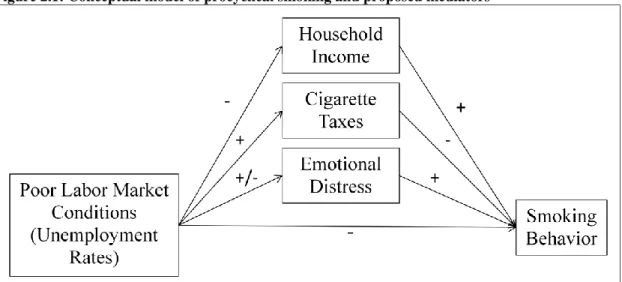
particular, deserve further attention. Hypothesized pathways linking state unemployment
conditions with smoking through 1) household income, 2) cigarette tax rates and 3)
emotional distress are illustrated in Figure 2.1. The empirical and theoretical rationales
for these relationships are described below.
Income as a Mechanism
Recessionary periods have previously been associated with lower average
household incomes (Michel, 1991). Relationships between income and smoking,
however, are likely complex. As individuals lose income or anticipate income loss,
economic theory suggests they decrease their purchase of all normal goods, including
cigarettes. Cigarette consumption, however, may be relatively income inelastic, or
relatively insensitive to changes in income. A wide variety of income elasticities for
cigarettes have been reported in the literature; a meta-analysis summarizing nearly 400
estimates suggests that a one percent loss of income is associated with only a 0.28 percent
decrease in cigarette demand in the short run, and a 0.39 percent decrease in cigarette
demand in the long run (Gallet & List, 2003). Additionally, individuals might choose to
substitute generic cigarette brands or cheaper forms of tobacco, like chewing tobacco or
snus, when faced with an income loss, in order to maintain their consumption levels.
14
2010), some research suggests that when cigarette prices increase, individuals switch to
cigarettes that are higher in tar and nicotine (Farrelly, Nimsch, Hyland, & Cummings,
2003), but do not substitute snus for cigarettes (Bask & Melkersson, 2003).
Previous research on the role of income in procyclical smoking is mixed. Ruhm
(2005) finds little evidence of an impact of income on the relationships between state
employment rates and smoking. On the other hand, Xu and colleagues (2010) use local
area level unemployment rates as instrumental variables for wages and income, and find
that wage and income declines brought about by changes in macroeconomic conditions
are associated with decreases in smoking. Their sample, however, is restricted to men
with lower levels of education.
Taken together, empirical and theoretical work suggests that poor employment
conditions result in lower incomes, which might decrease smoking prevalence, but also
may not explain changes in smoking. In Figure 2.1, income is posited as a potential
mediator, even though the support for this hypothesis is tenuous.
Tax as a Mechanism
Individual consumption decisions are also impacted by the price of a product. As
with changing income, changing cigarette prices impact purchasing power, so that when
cigarette prices rise, a consumer can purchase fewer cigarettes for the same price.
Additionally, other goods become less expensive relative to cigarettes, so consumers may
opt to substitute other goods for cigarettes, if there are comparable goods that can provide
them the same perceived benefit. Previous research suggests that a one percent increase
in the price of cigarettes is associated with a 0.4 percent decrease in cigarette demand
15
stronger among individuals of low socioeconomic status (Townsend, Roderick, &
Cooper, 1994).
One of the key components of increasing cigarette prices is government
sponsored taxes on tobacco prices. The market share weighted average price of a pack of
cigarettes increased from $3.12 in 2000 to $5.61 in 2011; the percent of that price derived
from cigarette excise taxes grew from about 24% to 44% (Orzechowski & Walker, 2011).
Tobacco tax increases have been associated with declines in smoking, both among youth
(Chaloupka & Wechsler, 1997) and the general population (Chaloupka et al., 2000;
Chaloupka, Straif, & Leon, 2011; Levy, Chaloupka, & Gitchell, 2004). Tobacco control
advocates have suggested that economic contractions may drive states to raise tobacco
taxes to generate revenue, noting spikes in the number of states passing hikes following
the national recessions of 1981, 1990 and 2001 (Campaign for Tobacco Free Kids
[CTFK], 2012b). State –based cigarette tax response to macroeconomic decline,
therefore, provides another theoretical explanation for the procyclical effects of smoking.
Although three previous studies include a measure of tobacco prices or taxes in their
analyses (Charles & DeCicca, 2008; Okechukwu et al., 2012; Xu & Kaestner, 2010), two
only include it as a control variable and report no results specific to it. The authors of the
final study urge caution in interpreting the slight positive, rather than negative,
correlation between prices and smoking they find, due to the limited time period and
price range examined (Okechukwu et al., 2012).
As illustrated in Figure 2.1, I hypothesize that periods of high unemployment
result in higher cigarette taxes, which in turn depress cigarette smoking prevalence.
16
Purchasing power may not be the only pathway linking labor market conditions
and smoking. Changing employment conditions could provoke psychosocial responses in
the people who experience them, and high stress is positively associated with smoking,
increases in smoking levels, and perceived barriers to quitting smoking (Cohen &
Lichtenstein, 1990; Morissette, Tull, Gulliver, Kamholz, & Zimering, 2007; Ng &
Jeffery, 2003). Whether high unemployment rates are positively or negatively correlated
with stress levels, however, is unclear. In addition to providing material benefits, work is
a key social institution that facilitates social contacts and provides a sense of personal
identification and meaning (Jahoda, 1982). Poor economic conditions may produce
stressors in the form of job insecurity or loss, income anxiety and strain on social
relationships (Catalano et al., 2011; Zivin, Paczkowski, & Galea, 2011), suggesting high
unemployment rates may be associated with higher stress levels. On the other hand, work
can be a source of stress, particularly if working environments require long hours and
allow little autonomy (Clougherty, Souza, & Cullen, 2010; M. J. Smith, Cohen,
Stammerjohn, & Happ, 1981). Strong economies characterized by low unemployment
rates may therefore be associated with higher stress levels than depressed economies.
Previous work has not directly examined the role of emotional distress in the
relationship between employment conditions and smoking, but several studies have
explored related ideas. Ruhm (2005) finds a one hour increase in the average number of
hours worked per week is associated with a slight (<1%) rise in smoking, and argues this
may reflect higher job-related stress during periods of high employment. On the other
hand, Barnes and Smith (2009) recently examined whether increases in an individual’s
17
smokers in 1998. Specifically, they find that a 1% increase in the probability of
unemployment is associated with a 2.4% increase in the likelihood of continued smoking;
a 1% increase in the probability of falling into poverty is associated with a 1.1% increase
in the likelihood of continued smoking; and each 10% drop in real income is associated
with more than a 17% increase in continued smoking likelihood. In addition, Charles and DeCicca (2008) found that men’s mental health generally worsened as local labor
markets deteriorated, with effects particularly pronounced among those least likely to be
employed. Although this study also considered smoking as an outcome, measures of
emotional distress and smoking were not considered in the same model.
Based on this review, I hypothesize that increased stress levels are correlated with
higher smoking prevalence, but do not specify the type of correlation between
employment conditions and stress levels (Figure 2.1). If strong economies produce high
levels of work-related stress, procyclical smoking should be attenuated when measures of
stress are included in models. On the other hand, if declining employment conditions
produce stress from job insecurity and loss, procyclical smoking should appear stronger
when stress levels are controlled in analyses.
D. Differential Impacts on Population Groups
Some groups may be more strongly impacted by changing labor market
conditions than others. Job loss produces declines in income and increases in mental
distress (Jacobson, LaLonde, & Sullivan, 1993; Paul & Moser, 2009; Ruhm, 1991),
suggesting that if procyclical smoking is mediated through these processes, smoking
among unemployed individuals could be impacted through both. Similarly, changes in
18
the least impact on individuals not in the labor force.
Certain population groups are more likely to be unemployed and lose work,
especially during recessions. In 2009, for example, the unemployment rate for individuals
without a high school degree was more than three times the rate of those who had
graduated college, and unemployment among Blacks and Hispanics was nearly twice that
among Whites or Asians. Men and younger adults also suffered relatively high rates,
compared to women or older adults, respectively (BLS, 2012). Although the tight labor
markets of the Great Recession impacted all population groups more strongly than
previous recessions, age, race and educational disparities are similar to those from
previous recessionary times (Allegretto & Lynch, 2010). With the exceptions of Blacks,
whose smoking rates are lower than those of Whites, members of each of these groups
are also more likely to smoke than their female, more educated and older peers (Agaku,
King, & Dube, 2012). The smoking behavior of each of these groups may therefore be
more strongly impacted by changing employment conditions, when compared to the
population overall.
Finally, the smoking behavior of some groups may be more sensitive to changes
in income or price than others. In particular, previous research suggests that younger
adults, men, Blacks and Hispanics are particularly sensitive to changes in cigarette price,
and smoking behaviors of younger adults may be especially sensitive to changes in
income (Farrelly et al., 2001; Gallet & List, 2003; Townsend et al., 1994).
Previous research on differential smoking responses to changing labor market
conditions, however, is inconclusive. Ruhm (2005) finds that smoking patterns do differ
19
although individuals with less education experience stronger smoking responses as
employment conditions change, women and Whites are more strongly impacted than men
and other racial groups, respectively. In addition, employed individuals experience
slightly higher effects than the full population sample. On the other hand, Charles and
DeCicca (2008) found that while men most likely to be employed smoke less during poor
economic times, those who are least likely to be employed smoke more. Using
employment propensity scores, they find that a one percentage point decrease in the
employment rate is associated with a 2.3 percent decrease in smoking for individuals in
the top decile for employment probability, but a 2.7 percent increase in smoking for
individuals in the bottom decile.
E. Contribution
In this study, I use nationally representative data covering recent periods of low
and high unemployment to examine the influence of state employment conditions on
smoking behavior. Different from previous nationally representative research (Ruhm,
2005), I explicitly test whether the relationship between state unemployment rates and
smoking is non-linear in nature. I then investigate the potential impact two unexplored
theoretical explanations for procyclical relationships, tobacco taxes and emotional
distress, in addition to household income, in those relationships. Finally, I consider
whether relationships between employment conditions and smoking vary across key
population groups.
III.Methods
A. Data and Sample
20
race, ethnicity, and marital status are drawn from the annual iterations of the Behavioral
Risk Factor Surveillance System (BRFSS) implemented between 1996-2010 (Centers for
Disease Control and Prevention [CDC], 1996-2010). The BRFSS is a state-based system
of health surveys that collects regular information about health outcomes and health
behaviors, including adult smoking behavior. During the analysis period, all 50 states and
the District of Columbia collected smoking information from a sample of their residents.
BRFSS data are merged with monthly state level indicators of employment conditions
available from the BLS. The BLS Local Area Unemployment Statistics captures key
indicators of economic conditions for different geographic areas, including states. BLS
data used in this analysis are generated from the Current Population Survey, the Current
Employment Statistics program, the State Unemployment Insurance System, and the
decennial census, and primarily consist of monthly and annual estimates of
unemployment and employment in each state.
Analytic Sample: Between 1996 and 2010, 4,134,163 individuals aged 16 or over
who resided in one of the fifty U.S. states or the District of Columbia participated in a
BRFSS survey, with annual totals ranging from 121,384 in 1996 to 444,906 in 2010. Of
the total participants, smoking information is missing for 16,876 (0.4%), and other
covariate information is missing for an additional 90,044 (2.2%). Dropping these cases
results in a final analytic sample size of 4,027,243 (97.4% of all participants).2 In some
mediation analyses, sample sizes decrease due to missing information about income
group (n=14, <0.01% of full analytic sample) or mental health days (n=125,826, 3.1% of
2 Although the loss to the analytic sample due to complete case analysis was minor, the dropped
21
full analytic sample). When sampling weights are employed, the sample is 51% female
and 73% White. The majority of sample participants were married, had attended at least
some college, and were employed at the time of survey. Detailed demographic
characteristics of the analytic sample are presented in Table 2.1.
B. Measures
Outcome variable: The primary outcome variable measures an individual’s
smoking status as a binary indicator. A BRFSS participant is considered a smoker if he or she answered “yes” to the survey question, “Have you smoked at least 100 cigarettes in
your entire life?” and answered, “every day” or “some days” to the question, “Do you
now smoke cigarettes every day, some days, or not at all?” In additional analyses, I focus
on daily smokers, coding individuals who currently smoke every day as daily smokers.
Explanatory Variables: The primary proposed measure of macroeconomic
conditions is the state civilian unemployment rate averaged across the three months3 preceding the respondent’s BRFSS survey date, including the survey month. The
unemployment rate measures the percentage of people in the labor force who are
unemployed within a specific geographic area. A person is considered unemployed if he
or she is not currently working, is available to begin working, and has actively looked for
work in the past four weeks. The labor force is made up of individuals age 16 or older
who are employed and unemployed. The unemployment rate, however, may provide an
underestimate of true demand for work, as it does not capture discouraged workers who
leave the labor market due to difficulty finding work. In sensitivity analyses, the average
3
22
employment rate, also called the employment to population ratio, for the three months
ending with the survey month is substituted for the unemployment rate. The employment
rate measures the percent of working aged individuals living in a specific area who are
employed. An individual is considered employed if he or she worked for pay or profit in
the past week (BLS, 2009a).
Mediating Variables: To consider potential explanations for any demonstrated
relationship between economic conditions and smoking, I employ three variables
measuring income, cigarette excise taxes and mental health status, respectively. The
BRFSS asks participants to indicate their household income, from all sources, using
categories of income ranges. The minimum income category is $10,000 or less, and the
maximum is $75,000 or more; in between category sizes range from $5,000 at the lower
levels (e.g., between $15,000 and $20,000) to $25,000 at higher levels (e.g., between
$50,000 and $75,000). The relationship between income and smoking is likely
bidirectional, with smokers earning less than non-smokers (Auld, 2005). Individual
income may therefore be endogenous, predicted by smoking status, rather than labor
market conditions. To address this concern, I follow Ruhm (2005) by assigning each
individual the weighted average of the incomes of all individuals living in the same state,
of the same gender, age group and education level. Through this process I track changes
in income likely brought about by labor market shifts, taking into consideration key
demographic categories. Averages are calculated using the midpoint of the income range,
adjusted for inflation, and measured in 2010 thousands of dollars.
The cigarette excise tax variable is designed to capture the tax faced by a
23
combination of the federal excise tax and the state excise tax. Excises taxes are adjusted
for inflation using the Consumer Price Index-Urban, produced by the BLS,4 and
measured in 2010 cents per pack of 20 cigarettes. Annual state and federal cigarette
excise taxes are available from the 2011 edition of The Tax Burden on Tobacco, a
publication produced by the economic consulting firm Orzechowski and Walker, with
financial support from leading cigarette manufacturers, and cooperation of the tobacco
tax administrators in all 50 states and the District of Columbia. During the analysis
period, the federal government raised taxes three times, from 0.24 cents to $1.01, and
changes in state tobacco tax rates occurred in 123 of the 765 state-year combinations.
State taxes ranged from less than three cents per pack in Virginia in 2003 and 2004 to
almost $3.50 in 2010 in Rhode Island.
The BRFSS includes two questions which capture numbers of “unhealthy days”
the respondent experienced in the past month due to poor physical health or poor mental
health. Specifically, the mental health question asks, “Now thinking about your mental
health, which includes stress, depression, and problems with emotions, for how many days during the past 30 days was your mental health not good?” and the physical health
question asks, “Now thinking about your physical health, which includes physical illness
and injury, for how many days during the past 30 days was your physical health not good?” (HHS, 2000). When used in combination, a number of studies finding that the
healthy days measure had acceptable criterion validity when compared to several other
clinical assessment tools, could distinguish groups with various health ailments, and had
good test-retest reliability among most populations (Moriarty, Zack, & Kobau, 2003).
Although the mental health question has not been individually subjected to a wide range
4
24
of validation tests, researchers often report trends in mental health using responses to
only the mental health question (Moriarty et al., 2003; Zahran et al., 2005). Furthermore,
previous research indicates that individuals report substantially different numbers of
physical and mental unhealthy days (HHS, 2000). Because the theoretical basis for the
analyses focuses on changes in emotional state brought about by changing labor market
conditions, I measure emotional distress using the single indicator of mentally unhealthy
days. As with income, however, the relationship between emotional distress and smoking
may be bidirectional, as individuals believe smoking will alleviate anxiety, and some
evidence suggests chemical components of cigarettes may alter mood states (Kassel,
Stroud, & Paronis, 2003; Morissette et al., 2007). Emotional distress indicators are also
missing for nearly 5% of the analytic sample. As with income, I therefore assign each
individual the weighted average of the mental unhealthy days of all individuals living in
the same state, of the same gender, age group and education level.
Control Variables: To account for sociodemographic factors likely correlated
with labor market participation and smoking, I include a dichotomous indicator of female
gender, continuous measures of respondent’s age (linear and quadratic), as well as binary
variables for education level (some high school, high school graduate, some college,
college graduate), and marital status categories (married, divorced, widowed, single). In
addition, I include four mutually exclusive categories capturing race/ethnicity
(Non-Hispanic White, Non-(Non-Hispanic Black, Other Non-(Non-Hispanic and all (Non-Hispanic) based on
two BRFSS questions assessing participant race and Hispanic ethnicity.
C. Analytic Approach
25
techniques to account for clustering of data. Because smoking status is measured
dichotomously, the dependent variable may be poorly predicted in linear analysis, which
allows predictions of any value. Probit models instead employ the inverse of the
cumulative distribution function associated with the standard normal distribution, which
ranges from 0 to 1, when modeling the dependent variable. Estimation is done through
maximum likelihood, in which those probit model parameters that best predict the
existing data are identified. Models include cluster-robust standard errors to account for
the possibility that observations collected within a state in a given month are not
independent. Specifically, I model smoking probability as a function of state, individual,
and time characteristics, according to the following econometric specification:
Pr(Sijmy=1) = Φ(Xijmβ + Emjy γ + αj+δm + λy+ εijmy)
where Sijm measures smoking status (any or daily) for individual i in state j during
month m in year y; Xijm is a vector of individual or family sociodemographic
characteristics; Emjy captures state employment conditions; αj,δm, and λy represent
unobserved determinants of smoking associated with state of residence j, calendar month
m, and survey year y, respectively. Labor market conditions vary by geographic area,
time of year, and across years (Allegretto & Lynch, 2010; Zolnik, 2011). Although
smoking prevalence has decreased over time, these trends include spikes and troughs, and
vary regionally (CDC, 2011a). Smoking also fluctuates seasonally, with higher rates in
the summer, and lower rates in the winter (Chandra & Chaloupka, 2003). Inclusion of the
state, month, and year dummy variables controls for some potential bias in estimates due
to correlation of both employment conditions and smoking with space and time. Most
26
Hausman test comparing the coefficients from a model employing all fixed effects with
one that employed no fixed effects was significant (χ2=5673.48, p=0.000), suggesting that
the dummy variables inclusion may be required to prevent some omitted variable bias.
To assess the shape of the relationship between employment conditions and
smoking, I included a linear and quadratic measure of state unemployment rates in initial
models, and examined the statistical significance of the coefficient on the quadratic term
with a t-test. Because probits are non-linear models, the coefficient values are not directly
interpretable as marginal effects, though the sign of the coefficient is consistent with the
direction of variable correlation. To report the impact of changing unemployment rates
under different economic conditions, I calculate the weighted average marginal effect
(AME) of a one percentage point increase in the state unemployment rate for all sample
members, using three different initial unemployment rates. Specifically, I calculate
AMEs at the mean level of unemployment (5.6%), at one standard deviation above the
mean (7.6%) and at one standard deviation below the mean (3.7%).
Following Baron & Kenny (1986), I assess the potential mediating role of
household income, cigarette excise taxes, and emotional distress using two additional
models for each mediator. First, I estimate the impact of unemployment rates on the
mediating variable using linear regression. Second, I add the mediating variable to the
original reduced-form probit equation. To account for possible non-linear associations
between mediators and smoking, I considered linear and quadratic forms of each
mediating variable, ultimately including quadratic measures of income and emotional
distress, as each are statistically significant at the 0.05 level.
27
model, as well as the fully mediated, direct effects model, which includes measures of
income, taxes and emotional distress, on various sub-groups of the participants.
Specifically, I conduct stratified analyses to examine effects within specific gender,
race/ethnicity, age, educational level, marital status and labor market participation
groups. AMEs are calculated for both low and high unemployment conditions.
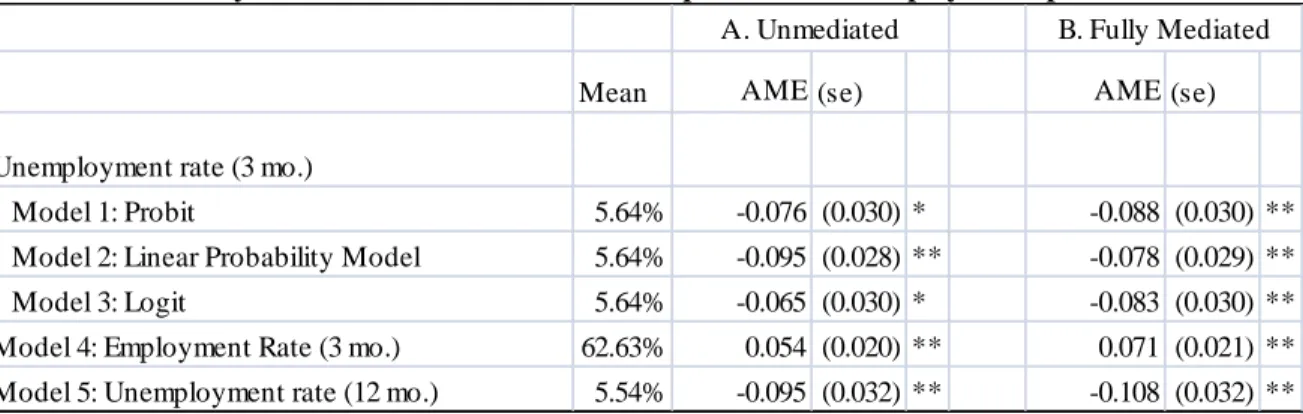
In addition to these primary analyses, I consider several other models to ensure
that results are not sensitive to the choice of employment condition measure, or the probit
estimation technique.
All analyses are conducted using regression techniques and the margins
post-estimation command in STATA 12 (Statacorp, College Station, Tex).
IV.Results
A. Trends in Unemployment and Smoking in the Analytic Sample
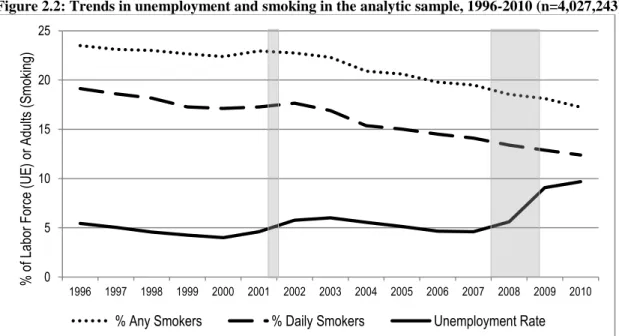
During nine of the fifteen years between 1996 and 2010, state unemployment
rates experienced by BRFSS participants are below 5.5%, but in the three years during
and following the two recessionary periods in 2001 and 2007-2009, rates are higher,
including average rates above 9% in both 2009 and 2010 (Figure 2.2). Across the entire
time period, smoking prevalence among adults in the BRFSS sample declined from
23.4% to 17.3% overall (Figure 2.2). While prevalence rates drop between most years,
annual rates of decline were not uniform over the time period, and smoking prevalence
increased by half a percent between 2000 and 2001. During and following the more
recent recessionary period, however, smoking declines somewhat consistently. Daily
smoking prevalence also declined from 19.1% to 12.4% during the same time period,
28 2007-2010.
B. Unemployment Rates and Smoking Behavior
To assess the impact of short-term unemployment rates on smoking behavior,
while accounting for other important covariates, I turn to the results of the probit
regression models. Results of these analyses indicate that smoking behaviors are
procyclical, but that these relationships attenuate as the economy worsens. The
coefficients on the linear unemployment term in both the any smoking and daily smoking
models are negative, but the coefficients on the quadratic terms are significant and
positive (Table 2.2). Calculations of AMEs indicate that a labor market change at average
levels of unemployment, from 5.6% to 6.6%, is associated with a 0.08 percentage point
decline in any smoking and a 0.09 percentage point decline in daily smoking. AMEs
calculated at one standard deviation above and below the mean unemployment rate reveal
the curvilinear nature of the relationship between employment and smoking. A one
percentage point increase in unemployment from a starting point of 3.7% is associated
with a 0.12 percentage point decline in any smoking and a 0.11 percentage point decline
in daily smoking, but a similar increase starting from 7.6% is associated with no
statistically significant change in smoking prevalence, and a 0.06 percentage point
decline in daily smoking rates (Table 2.2).
C. Income, Taxes and Emotional Distress as Mediators
Tables 2.3 and 2.4 present the unemployment rate coefficients (Table 2.3) and
AMEs (Table 2.4) from models used to test mediation of the unemployment rate-smoking
relationships by income, taxes or emotional distress. Traditional tests of variable
29
mediators, and the attenuation of the effects in the unmediated models once the mediating
variables are added. For each proposed mediator in Table 2.3, Column 1 presents the
coefficients derived from the linear regression of the mediator on unemployment rates;
Columns 2 and 4 present the coefficients from the probit models of any and daily
smoking that do not include the mediators (the models presented in Table 2.2), and
Columns 3 and 5 present the coefficients from the same probit models of any and daily
smoking, with the mediator added. Table 2.4 lists the AMEs of a one percentage point
increase in unemployment rate on smoking at low, average and high unemployment rate
starting points for the unmediated model, models that add each mediator separately, and
one model that incorporates all proposed mediators. To illustrate effects, Figure 2.3
provides a graphical depiction of the predicted prevalence of any (Panel A) and daily
(Panel B) smoking for both unmediated and mediated models.
Income: As hypothesized, the unemployment rate is negatively associated with
income (Table 2.3, Model A1). Specifically, an increase in the unemployment rate from
average levels 5.6% to 6.6% is associated with an average decline in income of $4,818.
The significant, negative value of the quadratic unemployment term suggests that at
higher levels of unemployment the negative correlation strengthens.
Also as hypothesized, income is positively associated with any (b=0.02) and daily
(b=0.02) smoking. However, the significant negative signs on the squared income terms
suggest these effects diminish at high income levels (Table 2.3, Models A3 & A5). In
calculations of AMEs for income (not shown), increases in income are positively
associated with any and daily smoking at income levels one standard deviation below the
30
standard deviation above the mean. Specifically, a $10,000 increase in household income
from an initial income of $37,000 is associated with a 0.15 percentage point increase in
any smoking and a 0.16 percentage point increase in daily smoking. The same increase
from an initial income of $59,000 is associated with a 0.02 and 0.01 percentage point
decline in any and daily smoking prevalence; from $71,000 the AMEs are -0.12 for any
smoking and -0.11 for daily smoking.5
The coefficients on unemployment remain relatively unchanged when comparing
the unmediated and income-mediated models (Model A2 vs. Model A3 for any smoking;
Model A4 vs. Model A5 for daily smoking). These results are underscored in Figure 2.3
and Table 2.4, in which the predicted probabilities of smoking and the average marginal
effects from the unmediated and smoking mediated models are very similar, although
income appears to slightly accentuate the relationship between unemployment rates and
any smoking, especially at low levels of unemployment, and slightly mediate the
relationship with daily smoking at high levels of unemployment, though primary effects
remain significant.
Cigarette Excise Taxes: Increasing unemployment rates are correlated with higher
cigarette excise taxes, such that a one percentage point increase in unemployment starting
from the mean level of 5.6% is associated with a 3.4 cent increase in tax levels (results
calculated from coefficients in Table 2.3, Model B1). Although this relationship is
curvilinear, with smaller impacts at higher unemployment levels, it remains positive even
when unemployment rates reach the highest observed rates in the sample (results not
shown), and therefore conforms to the hypothesized relationship. Also as hypothesized,
5 Reference point income levels were chosen based on the 25%, 50% and 75% levels of the income
31
both any smoking and daily smoking decline as cigarette taxes rise (Table 2.3, Models B3
& B4). Although the magnitude of the coefficients on the unemployment rate terms do
decrease when taxes are added to smoking models, the predicted probabilities of any or
daily smoking from the tax mediated models are barely distinguishable from the
unmediated models (Figure 2.3). Average marginal effects decline slightly when taxes
are added, though remain well within a standard error of the unmediated AMEs (Table
2.4, Models C & H).
Emotional distress: The results presented in Model C1 of Table 2.3 indicate that
emotional distress declines as unemployment grows at low levels of unemployment. The
significant negative sign on the coefficient on the quadratic term, however, predicts that
these anti-cyclical impacts on emotional distress would wane and eventually reverse
direction during periods of higher unemployment. Based on the coefficients in this
model, I calculate that a one percentage point increase in unemployment rates from a low
starting point of 3.7% is associated with a 0.02 day decline in the average number of
reported days in poor mental health, and a similar labor market change under average
unemployment conditions (5.6% unemployment) is associated with 0.01 fewer poor
mental health days. Under high unemployment conditions, however, a one percentage
point increase in unemployment from 7.6% to 8.6% is associated with almost a 0.01 day
increase in poor mental health days.
The complexity of the relationship between unemployment and stress is apparent
in the mediation analysis. As hypothesized, emotional distress is positively associated
with any smoking, as well as daily smoking (Table 2.3, Models C3 & C5). At lower