Mackenzie S. Zalin. Measuring the Applications of the Subject Doctorate to Academic Librarianship in North America. A Master’s Paper for the M.S. in L.S degree. March, 2019. 54 pages. Advisor: Mary Grace Flaherty
This work records and discusses the results of an anonymous web-based survey administered in January and February of 2019 to academic librarians with subject doctorates (i.e. PhDs in disciplines outside of library and information science) employed in North America. Respondents answered a mixture of quantitative and qualitative questions about the fields of their PhDs, their MLSs or equivalent degrees, their current positions in academic libraries, and the relevancy of their doctoral training to their current positions. According to the principal finding of this study, a majority of those librarians surveyed apply their doctoral training directly to their current positions in academic libraries, albeit at lower rates than those observed in the preceding decade. Statistically significant correlations were found between the relevancy of respondents’ doctoral training to their current positions, the accreditation status of their MLS or equivalent, and the year they began their current positions.
Headings:
College and university librarians – Status Academic libraries
Academic libraries & faculty Universities & colleges Surveys
MEASURING THE APPLICATIONS OF THE SUBJECT DOCTORATE TO ACADEMIC LIBRARIANSHIP IN NORTH AMERICA
by
Mackenzie S. Zalin
A Master’s paper submitted to the faculty of the School of Information and Library Science of the University of North Carolina at Chapel Hill
in partial fulfillment of the requirements for the degree of Master of Science in
Library Science.
Chapel Hill, North Carolina March 2019
Approved by
Table of Contents
Introduction ... 2
Literature Review... 3
Methodology ... 10
Limitations ... 11
Results ... 12
Discussion ... 28
Conclusions ... 36
Appendix A (Survey Instrument)... 38
Appendix B (Recruitment Letter) ... 41
Appendix C (Coding sheet for PhD fields in responses to Q1) ... 42
Introduction
Holders of subject doctorates, namely, those with PhDs in disciplines outside of library and information science (LIS), have long been a fixture in academic libraries in North America. These librarians serve at institutions of almost every conceivable size and type, where they have usually been welcomed for the breadth and rigor of their doctoral training, no matter the discipline. But while the merits of the PhD in these settings are widely touted, academic librarians with subject doctorates themselves are not well defined or understood. Though several studies have been dedicated to these professionals over the preceding half century, none have been conducted since the Great Recession. Given the seismic shifts that have taken place throughout libraries and the academy in the last decade, the little we knew about academic librarians with PhDs before the crash of 2008 needs to be reexamined.
The study discussed below therefore sets out to improve our understanding of these particular librarians by addressing the following research question:
Are academic librarians in North America with subject doctorates more likely to work in areas directly related to their subject doctorates than they are to work in areas that are indirectly related to their subject doctorates?
doctorates who may be thinking about a job in an academic library over traditional
faculty positions in the fields of their PhDs (an alternative that has been considered viable for decades) stand to benefit from knowing how transferable their skills are likely to be. Additionally, library administrators and policy makers throughout academia, who often struggle to place PhDs in “alt-ac” jobs that make use of the skills they acquired from their subject doctorates, also stand to make more informed decisions on how library jobs are designed and marketed to these professionals in light of the findings of this study.
Literature Review
Holders of PhDs in subjects outside of library and information science have had a presence in North American academic libraries since at least the early 20th century (see
e.g. Ferguson, 2016, pp. 722-725, and especially Jones (1998) for historical overviews of this topic). However, few studies dedicated to them are to be found anywhere in the literature. While there is no shortage of publications that extol (and sometimes decry) the PhD degree in libraries, especially in light of the continued controversy over the 1975 decision of the Association of College & Research Libraries to make the “master’s
degree [i.e. the master’s of library science (MLS) or equivalent]...the appropriate terminal
professional degree for academic librarians” (Association of College & Research Libraries, 2006, September 6),1 only a handful of empirical works center on the people employed by academic libraries who hold subject doctorates.
The earliest of these studies known to us is Miller (1976), who surveyed library school deans to ascertain both the number of PhDs enrolled in their MLS programs and
1
the types of positions their graduates found in libraries from 1972 to 1974, a time when the subject doctorate was becoming increasingly common in both settings following a contraction of the market for traditional tenure-track teaching jobs outside of LIS disciplines (Lindquist & Gilman, 2008, p. 38). Miller determined that the highest
proportion of academic librarians with PhDs were employed immediately after obtaining the MLS in reference services (48.4%), followed closely by subject bibliography (45.2%) and administration (29%) (Miller, 1976, p. 161). Though Miller provided invaluable insights into professional outcomes for these new librarians, the likes of which had never been observed before in the literature, he nevertheless employed indirect methods which made the graduates of these MLS programs seem remote and imperceptibly similar to other librarians, marking a trend that would be seen throughout the literature for years to come. For instance, Mayer & Terrill (2005) did not separate PhDs from MAs and other graduate certifications in their survey of academic librarians and advanced subject degrees, and so had little to say specifically about the subject doctorate in academic libraries in spite of their curiosity about the impact of the PhD (see especially p. 70, wherein the subject PhD vis-à-vis the MLS is designated as an area for future research). Similarly, Kim et al. (2007) indicated the number of librarians of color with doctorates (n = 8) in their survey of ALA librarians (n = 79) and the preferred setting for MLS students
with doctorates to be employed after graduation (i.e., academic libraries and archives; see pp. 540 and 539 respectively), but did not focus on these particular degrees.
Despite the occasional appearance of these sorts of studies which offered
were trained before they arrived,2 a proper follow-up to Miller (1976) focusing on these particular professionals would only come in the form of Lindquist & Gilman (2008) and the qualitative supplement of Gilman & Lindquist (2010) (using the same data set) more than thirty years later. These studies represented a quantum leap forward, in that they showcased an abundance of data gathered from surveys administered to more than six hundred librarians with subject doctorates (including professional doctorates like JDs) regarding their demographic and educational backgrounds, their duties in libraries, and their reasons for working there. The upshot was a picture of a highly versatile group whose contributions to libraries were as broad and varied as they were indispensable.
While these studies did more to improve our collective understanding of holders of subject doctorates in academic libraries than all others that had come before, it is noteworthy that Lindquist & Gilman made a point of suggesting to the reader in the conclusion to their 2008 work that their findings might look substantially different if the same study were conducted just a few years later:
“...in an academic library environment in which roles are constantly being redefined, it remains to be seen whether deep subject and language expertise will continue to be preferred, let alone required, and, if so, to what extent. In a world of shelf-ready books and cooperative purchasing programs, will the projected retirements of doctorate-holding librarians make a great impact? Will academic libraries continue to recruit them but mainly in the area we see the younger respondents entering—reference/information? Is it possible that certain kinds of academic libraries (for example, those with the greatest financial resources and affiliated with large graduate programs) will keep hiring them into a variety of positions that make good use of advanced subject and research skills, such as collection development/management, rare books/special collections, and archives?” (Lindquist & Gilman, 2008, pp. 48-49).
2 Cf. e.g. Cooper et al. (1987), which is essentially a narrative of the transitions of three PhDs in linguistics,
Given the piquancy of these questions, it is surprising that no one has attempted to replicate the work of Gilman & Lindquist. Even more surprising is the fact that empirical studies dedicated to librarians with subject PhDs have been all but non-existent in the intervening decade. With the exception of Brunner (2011), whose study was confined to a small-scale survey of postdoctoral fellows at the Council on Library and Information Resources (n = 22) and is now nearly as old as the Lindquist & Gilman study (2008), empirical works addressing this population have treated holders of subject doctorates incidentally, if they have at all.
Clarke & Kim (2018), for instance, do not specify the degrees held by MLS students in spite of their avowed interest in these students’ educational backgrounds (see
Clarke & Kim, 2018, p. 9). Alonso-Regalado & Van Ullen (2009) and Day & Szurek (2018) also have difficulty parsing advanced subject knowledge in terms of educational attainment, the former in a content analysis of job advertisements for Latin American and Caribbean studies librarians and the latter in a survey of subject liaisons.3 Similarly, Ferguson (2016) limits herself to examining combined MLS/MS/MA programs, even though she studies additional post-graduate certifications held by librarians and sets out previous work conducted on the subject doctorate in academic libraries in her literature review. On the other hand, Glenn & Roland (2011) and Crum & Cooper (2013) do note the number of PhDs surveyed in their respective studies of biomedical librarians, but do not subject these numbers to subsequent analysis (which the latter pair suggest might
3
have been a limitation in their study (Crum & Copper, 2013, p. 285)). Likewise, Triumph & Belle (2015) report the number of doctorates sought in academic job postings from 2011 (Triumph & Belle, 2015, p. 730), but do not identify which specific jobs sought candidates with PhDs or how these postings compared with earlier ones collated from 1996 and 1988.
The aforementioned studies thus leave many questions open about academic librarians who hold PhDs outside of information and library science in North America today. Though the conspicuous dearth of scholarship on this topic would allow for any number of research questions to be posed which could ultimately improve the state of knowledge about holders of subject doctorates in academic libraries today, the
forthcoming study will focus on answering the following research question first stated in the introduction above:
Are academic librarians in North America with subject doctorates more likely to work in areas directly related to their subject doctorates than they are to work in areas that are indirectly related to their subject doctorates?
The foundational study of Lindquist & Gilman (2008) discussed above answers this question resoundingly in the affirmative:
“When asked whether any of the duties they perform in their current position are connected directly to their subject doctorate, a significant minority of survey respondents (21.2 percent, 129) said that their current duties are not connected directly to their doctorate, but the vast majority (78.8 percent, 480) said they are” (Lindquist & Gilman, 2008, p. 46).
Gilman & Lindquist (2010) pointed out that “these librarians tend to thrive and be most valued in positions that have some connection to their disciplinary background” (Gilman
& Lindquist, 2010, p. 410) and demonstrated a strong statistical association between job satisfaction and ability to use subject knowledge on the job (χ² = 12.060, with 4 df, p = 0.017; Gilman & Lindquist, 2010, p. 409), the outcome of the forthcoming investigation stands to be of interest to many in the world of academic librarianship, for whom the well-being of holders of subject doctorates is essential to their own success.
In light of the profound changes that have occurred throughout academic libraries and higher education in general since the landmark studies of Lindquist & Gilman (2008) and Gilman & Lindquist (2010), many outside factors may explain potential differences in the numbers of academic librarians with PhDs whose jobs now require them to make use of their subject doctorates and those whose jobs do not. Chief among them is the sluggish recovery of the world economy following the Great Recession, which hit just months after Lindquist & Gilman published the first part of their study in January of 2008 and devastated hiring throughout academia. Though the year 2016 saw more PhDs
minted in the United States than any other year since records began to be kept in 1957 (see National Science Foundation, National Center for Science and Engineering Statistics, 2018, p. 3 & Table 1), the number of new PhDs with definite employment commitments after graduation continued a precipitous decline towards fifteen and twenty year lows in science and engineering fields and non-science and engineering fields respectively (see National Science Foundation, National Center for Science and
It is important to note that more PhDs with fewer career opportunities portends more competition not only for academic teaching jobs, but for academic library jobs as well. This is likely to be exacerbated in the coming years by delayed retirements, the slow growth of FTE professional staffing, and the substantial reduction in FTE non-professional staffing in libraries of the Association of Research Libraries (ARL) consortium (Wilder, 2016 ; Wilder, 2018). Combined with the fact that the market is increasingly desirous of jobs that are more technical in nature (see e.g. Marcum (2012)) and depend less on the sorts of skills that have traditionally benefited from the expertise of librarians with subject doctorates, such as language expertise (cf. Triumph & Beile, 2015, p. 727 and Lindquist & Gilman, 2008, p. 48, above), the result may be that various economic factors are compelling PhDs to compromise more often and accept library jobs that rely less on their doctoral training than they did ten years ago.
Another major outside factor that may be influencing the extent to which
(2018) corroborate this trend towards interdisciplinarity in broad strokes through citation analyses and qualitative surveys. The ubiquity of interdisciplinarity in the academy thus becomes a factor to consider seriously, along with the economic (and by extension, technical) factors described above, in addressing the aforementioned research question.
Methodology
To determine the extent to which academic librarians with PhDs in non-LIS fields apply their doctoral training directly to their current work in North America and why, data were collected through an anonymous web-based survey that was sent to subscribers of a variety of professional academic library discussion groups and listservs with national and international reach. This method was selected for the breadth of quantitative and qualitative data it stood to yield about a population that is not confined to a single disciplinary, institutional, or geographical setting in North America, and thus for its potential to maximize the generalizability of the findings. Quantitative data were gathered about the subjects’ PhDs, their MLSs or equivalent degrees, their current positions in
academic libraries, and the relevancy of their doctoral training to their current positions. Additionally, qualitative data were gathered about the subjects’ estimation of the
relevance of their doctoral training to their current positions.
from further review on November 30, 2018 (Study # 18-2937). Pilot testing of the survey was conducted individually by the author throughout December 2018 and the first week of January 2019, in consultation with the author’s supervisor. The survey went live on January 9, 2019, and was sent along with the recruitment letter to all members of the American Library Association through the ALA Connect discussion group
(https://connect.ala.org/), before being disseminated throughout the month of January to more specialized listservs dedicated to special collections and rare books ([email protected]), music ([email protected]), medicine ([email protected]), law ([email protected]), and cataloging ([email protected]). The survey closed on February 4, 2019.
Limitations
The specific credentials sought among participants representing a population whose size and extent have never even been estimated in the literature4 necessitated a non-probability sample for what is in essence a descriptive pilot study. As with all studies predicated on anonymous web-based surveys, one could fault this study for producing what might be considered low-validity data (Park, 2001, p. 275), but no better alternative methodology presented itself for addressing the aforementioned research question to such a scattered and diverse population with pronounced interests in the subject doctorate vis-à-vis academic librarianship in North America. Additionally, while the recruitment letter accompanying the survey set out the prerequisites for participation in the title of the study and while every effort was made to exclude responses which clearly did not come from
practicing academic librarians in North America with PhDs in subjects outside of LIS disciplines, the possibility exists that some responses made their way into the dataset which did not meet one or more of the criteria for the study. However, the high number of partial responses received (see below) suggests that most participants who did not meet one or more of the criteria respected the parameters of the study and so refrained from answering questions for which they lacked the prerequisite degree, employment status, etc.
Finally, it should be noted that Qualtrics logged a participant’s agreement (or lack thereof) to the terms and conditions described in the recruitment letter at the front of the survey as a question, meaning that if a participant chose not to answer any of the
questions on the survey itself, the system would still count the response as partial. So as not to mislead the reader, the response rate received for each individual question on the survey will therefore be provided in the results and the corresponding discussion below.
Results
individual responses, both complete and partial, were ultimately analyzed using Qualtrics and the statistical package JMP.
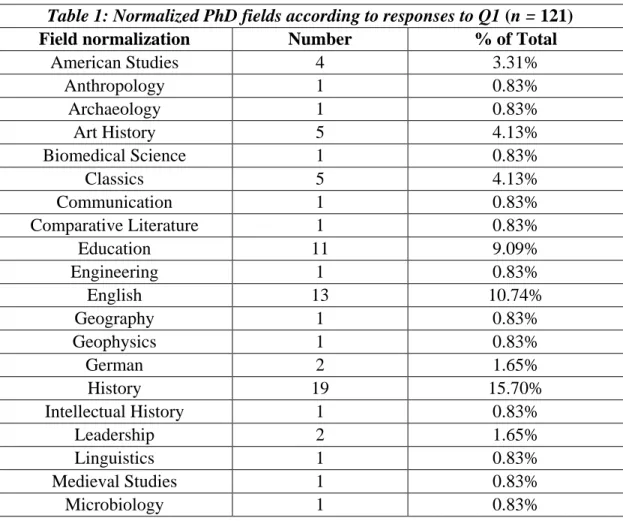
Part I of the survey asked participants about their educational backgrounds. In response to Question 1, participants specified the fields of their PhDs (n = 121). After data normalization, which saw answers like “Greek” and “Classics” or “English” and “English literature” coded together, 30 fields were determined to be represented in the
sample, which in turn were coded into overarching branches of study (see Appendix C for coding sheet and Table 1 for count and percentage of normalized PhD fields). Of these fields, 78.51% (n = 95) corresponded with arts and humanities disciplines, 17.34% (n = 21) with social science disciplines, 2.48% (n = 3) with natural science disciplines, and 1.65% (n = 2) with health science disciplines (see Figure 1).
Table 1: Normalized PhD fields according to responses to Q1 (n = 121) Field normalization Number % of Total
American Studies 4 3.31%
Anthropology 1 0.83%
Archaeology 1 0.83%
Art History 5 4.13%
Biomedical Science 1 0.83%
Classics 5 4.13%
Communication 1 0.83%
Comparative Literature 1 0.83%
Education 11 9.09%
Engineering 1 0.83%
English 13 10.74%
Geography 1 0.83%
Geophysics 1 0.83%
German 2 1.65%
History 19 15.70%
Intellectual History 1 0.83%
Leadership 2 1.65%
Linguistics 1 0.83%
Medieval Studies 1 0.83%
Music and Musicology 32 26.45%
Nursing 1 0.83%
Philosophy 1 0.83%
Political Science 1 0.83%
Public Administration 1 0.83%
Religious Studies/Theology 2 1.65%
Romance Studies 4 3.31%
Slavic Languages 1 0.83%
Sociology 2 1.65%
Theater 3 2.48%
Figure 1: PhD fields by branch of study according to responses to Q1 (n = 112)
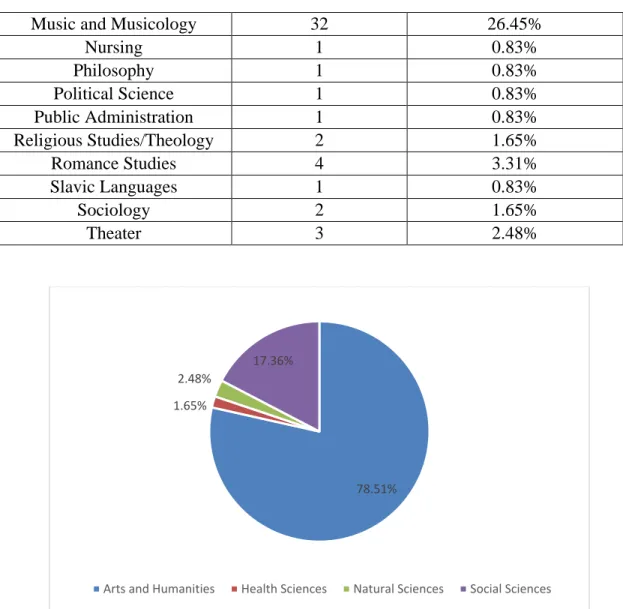
Responses to Question 2 (n = 126) showed that the median year of the receipt of the PhD was 2005 (mean = 2003; maximum = 2019; minimum = 1973; standard
deviation = 11.74; standard error = 1.04). In light of these data, it was determined that 56.3% (n = 71) of those who responded to Question 2 earned their PhDs before the onset of the Great Recession in 2008, whereas 42.1% (n = 53) earned their PhDs afterwards and 1.6% (n = 2) earned their PhDs in 2008 (see Figure 2).
78.51% 1.65%
2.48%
17.36%
Figure 2: Date of receipt of PhD according to responses to Q2 (n = 126)
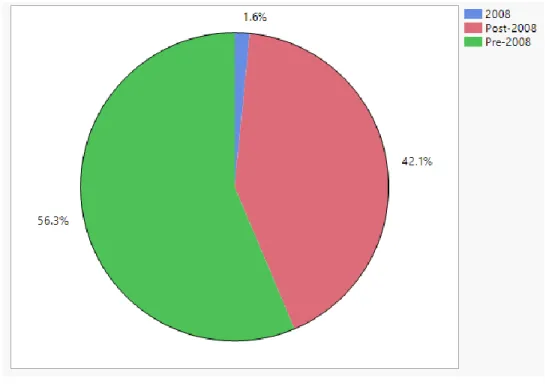
According to Question 3 (n = 129), 78.3% (n = 101) of respondents held the MLS/MLIS/MSIS or equivalent, whereas 21.7% (n = 28) did not (see Figure 3).
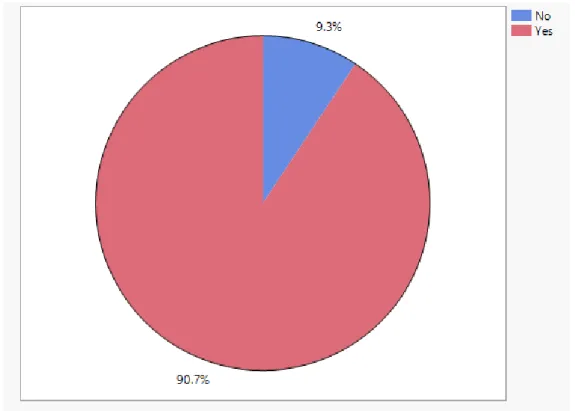
Responses to Question 4 (n = 107) showed that 90.7% (n = 97) of participants who held the MLS/MLIS/MSIS or equivalent degree indicated that these were ALA-accredited (see Figure 4).
Figure 4: Responses to Q4: “If you responded “Yes” to question 3, do you hold an ALA-accredited MLS/MLIS/MSIS or equivalent?” (n = 107)
Figure 5: Date of receipt of PhD according to responses to Q5 (n=98)
The fact that there was one more response to Q5 than there was to Q4 suggests that some participants may have misunderstood the question and indicated the year of the receipt of the MLS/MLIS/MSIS or equivalent degree even if it was not ALA accredited, something which the logic of the survey did not prohibit.
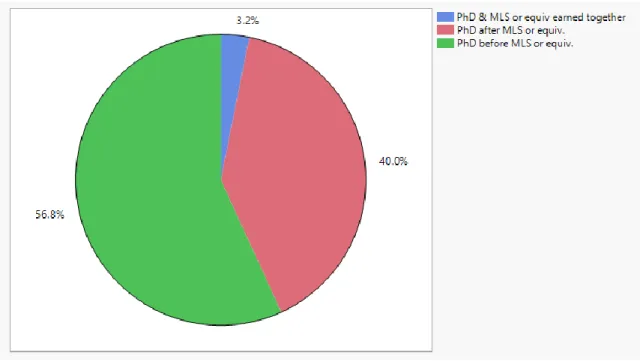
Of those participants who answered both Question 2 and Question 5 (n = 95), 56.8% (n = 54) received the PhD before the ALA-accredited MLS/MLIS/MSIS or equivalent degree, whereas 40.0% (n = 38) received the PhD after the ALA-accredited MLS/MLIS/MSIS or equivalent degree, and 3.2% (n = 3) received both degrees in the same year (see Figure 6).
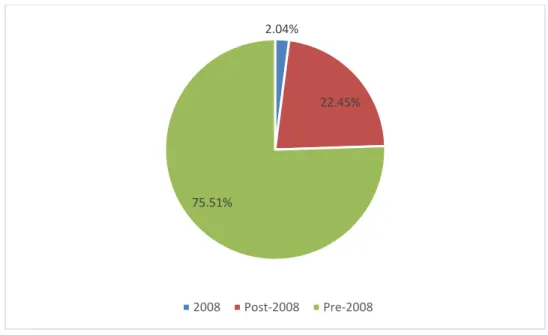
2.04%
22.45%
75.51%
Figure 6: Year of Receipt of PhD vs. Year of Receipt of ALA-accredited MLS/MLIS/MSIS or equivalent degree according to Q2 and Q5 (n = 95)
For those who received the PhD before the ALA-accredited MLS/MLIS/MSIS or equivalent degree, the median number of years elapsed between the receipt of the two degrees was 4 (mean = 5.70; maximum = 21; minimum 1; standard deviation = 4.54; standard error = .61), whereas for those who received the PhD after the ALA-accredited MLS/MLIS/MSIS or equivalent degree, the median number of years elapsed between the receipt of the two degrees was 11.5 (mean = 13.3; maximum = 39; minimum = 2;
standard deviation = 8.87; standard error = 1.44).
“Doctoral Universities: Very High Research Activity.” 9.3% (n = 10) of the total selected varieties of master’s colleges and universities, 7.5% (n = 8) selected varieties of
baccalaureate colleges, 1.9% (n = 2) selected varieties of associate’s colleges, and 3.7%
(n = 4) selected varieties of special focus four-year institutions (see Table 2 for full breakdown by Carnegie type).
Table 2: Carnegie Classification of parent institutions where respondents are employed according to Q6 (n=107)
Carnegie Classification N % of Total Associate's Colleges: High Transfer-High Nontraditional 1 0.93% Associate's Colleges: Mixed Transfer/Career & Technical-High
Traditional
1 0.93%
Baccalaureate Colleges: Arts & Sciences Focus 6 5.61%
Baccalaureate Colleges: Diverse Fields 2 1.87%
Doctoral Universities: High Research Activity 14 13.08% Doctoral Universities: Very High Research Activity 55 51.40%
Doctoral/Professional Universities 14 13.08%
Master's Colleges & Universities: Larger Programs 3 2.80% Master's Colleges & Universities: Medium Programs 3 2.80% Master's Colleges & Universities: Small Programs 4 3.74% Special Focus Four-Year: Arts, Music & Design Schools 3 2.80% Special Focus Four-Year: Medical Schools & Centers 1 0.93%
(count = 12), “associate” (count = 11), “music” (count = 11), and “special” (count = 10). All resulting terms with counts higher than 1 are indicated in Table 3.
Table 3: Term analysis of responses to Q7 Term Count Document Count
librarian 43 42
head 23 23
librari· 21 21
director 18 18
professor 15 15
curat· 14 14
collect· 13 13
services 13 13
assistant 12 11
associate 11 11
music 11 11
special 10 10
instruct· 9 9
research 7 7
reference 6 6
book· 5 5
coordinator 5 5
education 5 5
rare 5 5
catalog· 4 4
arts 4 4
dean 4 4
performing 4 4
public 4 4
senior 4 4
manag· 3 3
scienc· 3 3
archivist 3 3
information 3 3
resourc· 2 2
manuscript· 2 2
assessment 2 2
data 2 2
digital 2 2
graduate 2 2
learning 2 2
literacy 2 2
media 2 2
metadata 2 2
outreach 2 2
programs 2 2
sound 2 2
specialist 2 2
student 2 2
studies 2 2
technical 2 2
According to Question 8 (n = 112), the median year in which respondents began to serve in their current positions was 2013.5 (mean = 2010.83; maximum = 2019; minimum = 1982; standard deviation = 7.837; standard error = .74). Of these
respondents, 70.5% (n = 79) started their current positions after the onset of the Great Recession in 2008, 27.7% (n = 31) started their current positions before, and 1.8% (n = 2) started their positions in 2008 (see Figure 7).
From these same data was extrapolated the figure of 5.5 years, or the median number of years of service (mean = 8.169; maximum = 37; minimum = 0; standard deviation = 7.837; standard error = .74).
Question 9 (n = 112) revealed that 51.8% (n = 58) of the respondents held permanent but non tenure-track positions in their academic libraries, whereas 39.3% (n = 44) were tenured or tenure-track, and 8.9% (n = 10) held either temporary, fixed, or contingent positions (see Figure 8).
Figure 8: Responses to Q9: “Which category best describes your position?” (n = 112)
Figure 9: Responses to Q10: “Do you hold a dual appointment within your institution?” (n = 112)
When asked to specify the department or school within which participants held dual appointments in Question 11 (n = 23), one wrote “School of Information” and another wrote “College of Education as Full time Faculty in BLIS / Graduate School/ MLIS
Faculty”, thereby indicating that 8.7% (n = 2) of respondents had secondary affiliations in LIS-related departments. A full list of responses to Question 11, which show an array of secondary affiliations outside of LIS, can be found in Table 4:
Table 4: Raw responses to Q11: “If you responded “Yes” to question 10, in which department/school do you hold a dual appointment?” (n=23)
College of Biomedical Sciences
College of Education as Full time Faculty in BLIS / Graduate School/ MLIS Faculty College of Music
Conservatory Conservatory English History
History/School of Arts and Sciences
I do have right of return which includes tenure and rank of full professor if I step back from the dean position
I have served as director of women's studies Libraries
Modern and Classical Language Studies
81.25% 18.75%
music Music
Music Department Music History
No, but I am an associate in the Social Studies of Medicine Dept. (no teaching, no duties, no salary)
Public Health Religious Studies School of Information School of Music School of Music
The "Yes" in Q10 is inaccurate, but I also can't say No; the story is, I have had in the past (and likely will have in the future) a lecturer appointment in Music, but it is intermittent, inconsistent, and not guaranteed.
Part III asked participants to describe the work involved in their current positions in academic libraries and the relevance of those positions to their doctoral training. Question 12 (n = 379) specifically asked participants to list all the domains in which they work in their current positions (meaning that multiple values could be selected). 21.64% of the total number of responses received indicated responsibilities in the domain of reference (n = 82), 20.84% in instruction (n = 72), 15.83% in administration (n = 60), 13.72% in special collections/archives/rare books (n = 52), 13.19% in subject
Figure 10: Responses to Q12: “Does your current position require you to work in any of the following domains?” (n = 379)
When asked to specify these other domains, respondents indicated multiple areas in which they work that did not neatly correspond with any of the aforementioned domains, including acquisitions (n = 2), media and maker spaces (n = 2), interlibrary loan (n = 1), open educational resources (OER) and learning management systems (LMS) (n = 1), and scholarly communications (n = 1) (see Table 5 for full list).
Table 5: Other Duties According to Raw Responses to Q12 (n = 23)
1) circulation management; 2) my job description does not include instruction, but I do it anyway.
Acquisitions
Acquisitions/Vendor Digitization
Electronic Resources Exhibitions
I also manage student interns Interlibrary Loan
Management of a Media Center and Makerspace media
Outreach, Scholarly Communication Preservation
Programming, Committee work Project Management
Public Support Services (students, et al.) Research services
Research Support- Part of a research team and I am the statistician Subject Area Teaching
Subject specialist for collection development and management in science and technology; liaison to all science departments
supervision, training, planning Systems
Technology and programming
According to Question 13 (n = 110), 66.4% (n = 73) of respondents stated that their current positions related directly to their doctoral training, whereas 33.6% (n = 37) stated that their current positions did not relate directly to their doctoral training (see Figure 11).
Figure 11: Responses to Q13: “Does your current position relate directly to your doctoral training?” (n = 110)
4.668, p = .0307), and with Q8, which asked participants to indicate the year they started to work in their current positions (t(96.43) = -2.02, p = .0461) (see Figure 12).
Figure 12: One way analysis of position start date (Q8) by relevancy of subject doctorate to position (Q13) (t(96.43) = -2.02, p = .0461)
The relationship between Q13 and Q3, which asked whether participants held the MLS or equivalent (without specifying whether it was ALA-accredited or not), approached
significance (χ² = 3.193, p = .0739). No other variables were found to correlate significantly with Q13.
Finally, question 14 (n = 103) asked participants to elaborate on their answers to Question 13 and explain why their doctoral training did or did not relate to their current positions. Though respondents who replied in the affirmative to Question 13 and
answered Question 14 (n = 68) most commonly singled out the correspondence between the field of their PhDs and their current positions (n = 21), relevance was indicated in other ways as well. For instance, respondents also mentioned that they drew upon their doctoral training in terms of how they approached research (n = 15) and
in academic libraries and their doctoral training were observed in the realms of reference (n = 4), administration (n = 3), and writing (n = 2). Three (n = 3) mentions were made of language skills and three (n = 3) others were made of the improved credibility, respect, and collegiality that came with holding a PhD in the context of an academic library. In explaining the relationship between their doctoral training and their current position, one respondent even went so far as to say that “everything about libraries is also about education and knowledge.”
Respondents who replied in the negative to Question 13 and filled out Question 14 (n = 35) often echoed similar sentiments. Just over 57% (n = 20) made a point of mentioning that their doctoral training, though not directly relevant to their current positions, had at least some bearing on their work or was considered useful to some extent. These respondents indicated that they most frequently drew upon their doctoral training in terms of how they approached teaching/instruction (n = 5), research (n = 5), writing (n = 3), analysis (n = 2), and reference (n = 1). One respondent also mentioned that they considered the PhD “useful for advancement as a vice president or president”, an answer which, though perhaps prospective in nature, was coded under administration (n = 1).
Discussion
On the basis of the findings from the survey of academic librarians with non-LIS PhDs in North America set out above, the typical respondent:
1. Holds a PhD in an arts or humanities field
3. Holds an ALA-accredited MLS/MLIS/MSIS or equivalent degree, earned an average of just under nine years before the Great Recession of 2008
4. Earned their PhD before their ALA-accredited MLS/MLIS/MSIS or equivalent degree
5. Currently works in a doctoral or professional university as defined by the Carnegie Classification
6. Began to serve in their current position an average of just over two years after the Great Recession of 2008
7. Serves in a permanent position, but not in a tenured or tenure-track position 8. Does not hold a dual appointment
9. Works most commonly in the domains of reference and instruction 10.Works in a position that relates directly to their doctoral training
study in the study set out above (see Figure 1) and that of Lindquist & Gilman (2008) is the same.
It should nevertheless be noted that the proportions vary between the two datasets, most substantially in the case of arts and humanities disciplines. That there were nearly 20% more librarians with arts and humanities PhDs in our dataset than there were in the dataset of Lindquist & Gilman (2008) may simply speak to sampling anomalies (e.g. a potentially high response rate among subscribers to [email protected] given the percentage of librarians with PhDs in music and musicology represented, which, at 26.45%, far outstripped history, the most commonly represented field of study in Lindquist & Gilman, 2008, at 16.5% (Lindquist & Gilman, 2008, p. 41)). However, this difference may also speak to the fact that arts and humanities PhDs have historically had the lowest percentage of definite commitments for employment (including postdoctoral study) at the time of degree award of any branch of study since 2008 (see National Science Foundation, National Center for Science and Engineering Statistics, 2018, pp 8-9), a figure which reached twenty-year lows in 2016 (see Figure B of National Science Foundation, National Center for Science and Engineering Statistics, 2018, pp 9) and marked the continuation of an analogous trend noted by the National Opinion Research Center, whereby, “from 1985 to 2005, the highest percentage of doctorate holders who were still seeking employment or further study within a year of earning their doctorate were in the humanities” (Lindquist & Gilman, 2008, p. 40). As the typical respondent of
arts and humanities disciplines since the Great Recession at least in part to the dwindling number of job opportunities these librarians have tended to have relative to their peers with PhDs in other branches of study.
This may serve in turn to explain Finding 4, that most respondents earned their PhDs before the MLS or equivalent (56.8%). But as participants were not asked about their motives for pursuing one degree before the other, we can only speculate as to the reasons. In any case, it may be said that Finding 4 is consistent with an analogous finding discussed in Lindquist & Gilman, that 54% of the librarians surveyed decided to become librarians after their doctoral programs (Lindquist & Gilman, 2008, p. 36).
That a clear majority of participants in our survey were found to hold the ALA-accredited MLS/MLIS/MSIS or equivalent degree (Finding 3) is also in keeping with the findings of Lindquist & Gilman (2008), who note that 82.6% of their participants held the ALA-accredited MLS and 1.8% held the non-ALA-accredited MLS (Lindquist &
Gilman, 2008, p. 42). However, when we compare these percentages of combined ALA- and non-ALA-accredited MLS degrees (84.4%) with those observed in our dataset (78.3%, as per the results to Q3, which made no distinction between ALA- and non-ALA-accredited degrees), a decline in 6.1% may be observed. Although this decline is relatively small, the difference becomes greater once we acknowledge that our survey asked participants whether they held degrees equivalent to the MLS (e.g. MSIS) in
institutions lacked a library degree in 2015 (Wilder, 2016, p. 10), the decline observed between our data set and that of Lindquist & Gilman (2008) is consistent with a trend found in the context of a North American consortium comprised exclusively of graduate institutions, where the overwhelming majority of respondents to our survey currently work (Finding 5).
The gravitation of our respondents to institutions with graduate programs (i.e. doctoral and masters universities, which collectively constituted 86.9% of the total number of Carnegie classifications selected in Q6) is also consistent with the findings of Lindquist & Gilman (2008), who noted that 78.3% of the respondents to their survey worked in university libraries (Lindquist & Gilman, 2008, p. 45). Though our
respondents appear to be slightly more inclined to work at these types of libraries than the academic librarians with PhDs outside of LIS disciplines surveyed by Lindquist &
A rough correspondence may also be observed between the percentage of responses in our dataset and those of Lindquist and Gilman (2008) which indicated responsibilities held by librarians in the domain of reference (21.64% according to Q12 vs.18.7% according to Lindquist & Gilman, 2008, p. 44), the most common type in both studies (Finding 9), just as it was over forty years ago in the study of Miller (1976) (see the literature review above). In fact, the only major difference observed between the percentages of job responsibilities isolated in the two studies was in the realm of
instruction, which stood only at 5.6% in 2008 (see Lindquist & Gilman, 2008, p. 44), but which our data show now stands at 20.84%. This may perhaps be explained by the fact that Lindquist & Gilman were interested in measuring the main areas of work of their respondents (whereas our survey asked participants to identify all areas), though it was unclear to us whether this necessarily meant that multiple main areas of work could not be selected by participants in their study. In any case, the fact that employers in academic libraries across the board have come to esteem instruction more highly in recent years (see e.g. Hall (2013) for an illuminating case study) makes this increase neither unexpected nor unreasonable, though it would nevertheless be useful to inquire in a follow-up study if having a subject doctorate makes academic librarians more likely than other librarians to work in this particular domain.
Unfortunately, no comparative data for the percentage of respondents with dual positions appear in Lindquist & Gilman (2008) or any other study known to us that might help gauge the relative dearth of academic librarians with PhDs in these types of jobs (Finding 8), a somewhat surprising discovery in light of the trend towards
above). Additionally, while the job titles provided in Q7 speak to the high standing of numerous respondents in their respective work environments and presuppose supervisory roles in turn (which Lindquist & Gilman, 2008, p. 46 found a majority of respondents possessed in the previous decade), we cannot use these data to offer any statistics as to the managerial or administrative responsibilities of our sample population.
As with nearly all of the other findings set out above, the discovery that a majority of our respondents work in positions that relate directly to their doctoral training (Finding 9) accords with what Lindquist & Gilman found to be the case in 2008. But whereas 78.8% of respondents said that their positions were connected directly to their PhDs more than a decade ago (Lindquist & Gilman, 2008, p. 46), 66.4% of our respondents said the same was the case in 2019. At first glance, this decline is disconcerting given the strong correlation Gilman & Lindquist observed between “how much respondents enjoy being a librarian and how closely their duties conform to their area of subject knowledge (χ² = 12.060, with 4 df, p = 0.017)” (Gilman & Lindquist, 2010, p. 409). However, the fact that the two sets of respondents in our study who felt that their doctoral training did and did not relate directly to their current positions in academic libraries both singled out many of the same domains to which they applied their PhDs in some measure (i.e., research, reference, teaching/instruction, writing, and administration) speaks to the subjectivity of the relevancy of one’s doctoral training to a given position, a conclusion that is not surprising or controversial if, in fact, “everything about libraries is also about education and knowledge”, as one respondent put it. Ultimately, then, those with PhDs looking to
relevancy of the subject doctorate to academic librarianship, especially since more than half of the participants in our study who stated that their subject doctorates were not directly relevant to their current work mentioned that their doctoral training was indirectly relevant or had at least some bearing on their current positions. On the
contrary, they should be encouraged by the fact that a clear majority of respondents apply their PhDs earned in many different fields to their current positions, even though most respondents began their current positions in the doldrums of the Great Recession (Finding 6).
The statistically significant correlations found between the relevancy of the subject doctorate to one’s current position in an academic library and 1) the concurrent
possession of an MLA-accredited MLS or equivalent (χ² = 4.668, p = .0307) and 2) the year in which one began to serve in their current position (t(96.43) = -2.02, p = .0461) are striking, but, like the decline observed above in the relevancy of the subject doctorate, should be qualified. In the case of 1), it is important to note that this relationship does not entail the mere possession of the MLS or equivalent degree, which was not determined to be statistically significant (χ² = 3.193, p = .0739). Furthermore, while 2) does suggest that the subject doctorate is more likely to be directly relevant to one’s current position the earlier one started to work in this capacity (see Figure 12 above), this does not mean that the relationship between the relevancy of the subject doctorate to a given academic librarian’s current work can be correlated with a start date before or after the Great
directly to their current positions in the qualitative follow-up to Q13 may serve to corroborate this finding in turn. In the end, earning a PhD after 2008 or lacking an ALA-accredited MLS or equivalent should not be seen as deterrents to those subject doctors interested in starting a career in academic librarianship or to those librarians without PhDs considering the pursuit of subject doctorates, any more than the decline in direct relevancy of the subject doctorate to current positions in college and university libraries observed above.
Conclusions
Though our study has shown that academic librarians armed with doctorates outside of LIS disciplines look somewhat different from their colleagues of yesteryear, it is noteworthy that in many respects they look the same. That a clear majority of these librarians continue to apply their PhDs directly to their current positions across many different disciplines and job responsibilities bodes well for the future of this population. While we cannot, of course, predict the extent to which the subject doctorate will remain relevant to academic librarianship, the ability of librarians with non-LIS PhDs to continue to put their knowledge and expertise to work in a host of different positions in
universities and colleges of nearly every conceivable type despite the far-reaching changes that have been observed throughout the profession since the greatest economic crisis the world had seen in nearly a century suggests that the presence of these specific information professionals will continue to be felt throughout the academy for years to come.
This is not to say, however, that the results of the preceding survey have
academic libraries in North America today. With a bird’s eye view of the aforementioned population having now been attained, it would be useful to follow up with qualitative semi-structured interviews, not only with subject doctors, who could help to place our findings in the context of their personal experiences and nuance some of the data (e.g. the circumstances that saw them take up their current positions when they did), but also with library administrators, who might be able to provide insights into the future of the
Appendix A (Survey Instrument)
Part I:
1) What is the field of your PhD?
_______________________________________ 2) When did you earn your PhD?
2019 2018 2017 etc.
3) Do you hold the MLS/MLIS/MSIS or equivalent?
❏ Yes
❏ No
4) If you responded “Yes” to question 3, do you hold an ALA-accredited
MLS/MLIS/MSIS or equivalent?
❏ Yes
❏ No
5) If you responded “Yes” to question 4, what year did you earn the
MLS/MLIS/MSIS or equivalent? 2019
Part II:
6) To the best of your knowledge, what is the Carnegie classification of the parent institution of the academic library where you are employed?
(Selections drawn from The Carnegie Classification of Institutions of Higher Education, n.d.)
7) What is your current title in the academic library where you are employed? _______________________________________
8) What year did you begin to serve in your current position? (Dropdown menu of years will appear, allowing one to be selected)
2019 2018 2017 etc.
9) Which category best describes your position? (Select one)
❏ Tenured/tenure-track
❏ Permanent, but non tenure-track
❏ Temporary/Fixed/Contingent
10) Do you hold a dual appointment within your institution?
❏ Yes
❏ No
11) If you responded “Yes” to question 10, in which department/school do you
hold a dual appointment?
Part III:
12) Does your current position require you to work in any of the following domains? Please check all that apply:
❏ Cataloging
❏ Reference
❏ Instruction
❏ Special Collections/Archives/Rare Books
❏ Subject Bibliography
❏ Administration
❏ Other (please indicate):
_______________________________________
13) Does your current position relate directly to your doctoral training?
❏ Yes
❏ No
Appendix B (Recruitment Letter)
January 9, 2019 Dear colleague,
I write to invite you to participate in a brief survey of academic librarians with PhDs in subjects outside of information and library science. The findings of this survey will inform my research at the School of Information and Library Science at the University of North Carolina-Chapel Hill and will improve the state of knowledge on a topic that has broad ramifications to academic librarianship and higher education in general.
The Office of Human Research Ethics at the University of North Carolina-Chapel Hill determined this study (#18-2937) to be exempt from further review according to the regulatory category cited above under 45 CFR 46.101(b).
You may access the survey by clicking here:
https://unc.az1.qualtrics.com/jfe/form/SV_bqtBReUBqVjeegd
The average time to complete the survey is approximately 10 minutes.
There are no known risks of participating in this study. There are no benefits to you. Your participation is voluntary and you may withdraw from the study at any time for any reason. Your answers will be anonymous and all information obtained will be kept confidential.
If you have any questions, please do not hesitate to contact me at [email protected]. If you have any questions or concerns about your rights as a research participant, you may contact the University of North Carolina Institutional Review Board at 919-966-3113 or by email at [email protected].
Thank you for your time and consideration. Sincerely,
Mackenzie S. Zalin, Ph.D. MSLS Candidate
School of Information and Library Science University of North Carolina-Chapel Hill
Appendix C (Coding sheet for PhD fields in responses to Q1)
Raw responses to Q1 (n = 121)
Field Normalization Branch of Study
African history History Arts and Humanities
American Culture Studies American Studies Arts and Humanities
American history History Arts and Humanities
American history History Arts and Humanities
American literature American Studies Arts and Humanities American Studies American Studies Arts and Humanities American Studies American Studies Arts and Humanities
Anthropology Anthropology Social Sciences
Archaeology Archaeology Arts and Humanities
art history Art History Arts and Humanities Art History Art History Arts and Humanities Art History Art History Arts and Humanities Art history Art History Arts and Humanities Art History Art History Arts and Humanities Biomedical Science Biomedical Science Health Sciences book history / English
literature
English Arts and Humanities
Classical Studies Classics Arts and Humanities
Classics Classics Arts and Humanities
Classics Classics Arts and Humanities
Classics (Greek and Latin Language and Literature)
Classics Arts and Humanities
Communication Communication Social Sciences Community College
Leadership
Leadership Social Sciences Comparative Literature Comparative
Literature
Arts and Humanities
Education Education Social Sciences
Education Education Social Sciences
Education Education Social Sciences
Education, with a specialization in Leadership in
Higher Education
Education Social Sciences
Educational Management Education Social Sciences
engineering Engineering Natural Sciences
English English Arts and Humanities
English English Arts and Humanities
English English Arts and Humanities
English English Arts and Humanities
English and American Literature
English Arts and Humanities English LIterature English Arts and Humanities English Literature English Arts and Humanities English Literature English Arts and Humanities English literature English Arts and Humanities English literature English Arts and Humanities English Literature English Arts and Humanities
Ethnomusicology Music and
Musicology
Arts and Humanities
Ethnomusicology Music and
Musicology
Arts and Humanities
Ethnomusicology Music and
Musicology
Arts and Humanities
European History History Arts and Humanities
French/francophone literature Romance Studies Arts and Humanities
Geophysics Geophysics Natural Sciences
German literature German Arts and Humanities
Germanic linguistics and older Germanic literatures
German Arts and Humanities
Greek Classics Arts and Humanities
Higher Education Education Social Sciences
Higher Education Education Social Sciences
Higher Education Education Social Sciences
Higher Education Administration
Education Social Sciences Higher Education
Management
Education Social Sciences Historical Geography Geography Social Sciences Historical Musicology Music and
Musicology
Arts and Humanities Historical musicology Music and
Musicology
Arts and Humanities Historical Musicology Music and
Musicology
Arts and Humanities Historical Musicology Music and
Musicology
Arts and Humanities Historical Theology Religious
Studies/Theology
Arts and Humanities
history History Arts and Humanities
History History Arts and Humanities
History History Arts and Humanities
History History Arts and Humanities
History History Arts and Humanities
History History Arts and Humanities
History History Arts and Humanities
History History Arts and Humanities
History & Sociology of Science, Technology &
Medicine
History Arts and Humanities
History of Medicine History Arts and Humanities History of Medicine and
Science
History Arts and Humanities History of Science History Arts and Humanities Intellectual History Intellectual History Arts and Humanities
Leadership Leadership Social Sciences
Linguistics Linguistics Social Sciences
Literacy/reading comprehension
Education Social Sciences
Medieval history History Arts and Humanities
Medieval Studies Medieval Studies Arts and Humanities Microbiology Microbiology Natural Sciences
music Music and
Musicology
Arts and Humanities
Music Music and
Musicology
Arts and Humanities
Music Music and
Musicology
Arts and Humanities
music Music and
Musicology
Arts and Humanities
Music Music and
Musicology
Arts and Humanities Music composition Music and
Musicology
Arts and Humanities
Music theory Music and
Musicology
Arts and Humanities
Music Theory Music and
Musicology
Arts and Humanities
Musicology Music and
Musicology
Arts and Humanities
Musicology Music and
Musicology
Arts and Humanities
Musicology Music and
Musicology
Musicology Music and Musicology
Arts and Humanities
Musicology Music and
Musicology
Arts and Humanities
musicology Music and
Musicology
Arts and Humanities
Musicology Music and
Musicology
Arts and Humanities
Musicology Music and
Musicology
Arts and Humanities
musicology Music and
Musicology
Arts and Humanities
Musicology Music and
Musicology
Arts and Humanities
musicology Music and
Musicology
Arts and Humanities
musicology Music and
Musicology
Arts and Humanities
Musicology Music and
Musicology
Arts and Humanities
Musicology Music and
Musicology
Arts and Humanities
musicology Music and
Musicology
Arts and Humanities
Musicology Music and
Musicology
Arts and Humanities
Musicology Music and
Musicology
Arts and Humanities
Nursing Nursing Health Sciences
Philosophy Philosophy Arts and Humanities
Political Science Political Science Social Sciences Public Administration Public
Administration
Social Sciences
Religion Religious
Studies/Theology
Arts and Humanities Romance Languages and
Literatures
Romance Studies Arts and Humanities
Slavic Languages and Lliteratures
Slavic Languages Arts and Humanities
Sociology Sociology Social Sciences
Sociology Sociology Social Sciences
Spanish literature Romance Studies Arts and Humanities Spanish Literature Romance Studies Arts and Humanities
Theatre
History/Criticism/Text/Theory
Theater Arts and Humanities
Theatre/drama Theater Arts and Humanities
Bibliography
Alonso-Regalado, J. & M. Van Ullen. (2009). Librarian for Latin American and
Caribbean Studies in U.S. Academic and Research Libraries: A Content Analysis of Position Announcements, 1970-2007. University Libraries Faculty
Scholarship. 2.
Association of College & Research Libraries. (2006, September 6). Statement on the Terminal Professional Degree for Academic Librarians [Text]. Retrieved September 2, 2018, from http://www.ala.org/acrl/standards/statementterminal Berry, J. N. (2003). But Don’t Call ’Em Librarians. Library Journal, 128(18), 34–36.
Brunner, M. L. (2011). Ph.D. Holders in the Academic Library: The CLIR Postdoctoral Fellowship Program. In S. Walter and K. Williams, The Expert Library: Staffing, Sustaining, and Advancing the Academic Library in the 21st Century. (pp.
158-189). Chicago: ACRL.
The Carnegie Classification of Institutions of Higher Education (n.d.). About Carnegie Classification. Retrieved February 12, 2019 from
http://carnegieclassifications.iu.edu/
Clarke, R. I., & Kim, Y.-I. (2018). The More Things Change, The More They Stay the Same: Educational and Disciplinary Backgrounds of American Librarians, 1950-2015, School of Information Studies: Faculty Scholarship.178.
Cooper, J., Gertz, J., & Sandier, M. (1987). From PhD to MLS: Retraining in Librarianship. Library Journal, 112(8), 41–42.
Crowley, B. (1996). Redefining the Status of the Librarian in Higher Ed. College & Research Libraries, 57(2), 113-121.
Crum, J. A., & Cooper, I. D. (2013). Emerging roles for biomedical librarians: a survey of current practice, challenges, and changes. Journal of the Medical Library Association : JMLA, 101(4), 278–286.
Day, L., & Szurek, J. (2018). Beyond the MLS: Reflections on the role of professional and continued education for academic library liaisons. College & Undergraduate Libraries, 25(2), 131–149.
Ferguson, J. (2016). Additional Degree Required? Advanced Subject Knowledge and Academic Librarianship. Portal: Libraries and the Academy, 16(4), 721–736. Gilman, T., & Lindquist, T. (2010). Academic/Research Librarians with Subject
Doctorates: Experiences and Perceptions, 1965-2006. Portal: Libraries and the Academy, 10(4), 399-412.
Glenn, E., & Rolland, B. (2011). Librarians in biomedical research: New roles and opportunities. Journal of Information Processing and Management, 54(2), 100– 105.
Herubel, J.-P. V. M. (2006). Doctoral degrees and the academic librarian, or, "is there a doctor in the house?" Indiana Libraries 25(3), 42-44.
Huisman, R. (2011). Lifelong learning: Moving beyond the library degree. College & Research Libraries News, 72(5), 288–289.
Jaschik, S. (28 August, 2017). The Shrinking Humanities Job Market. Inside Higher Ed. Retrieved from
https://www.insidehighered.com/news/2017/08/28/more-humanities-phds-are-awarded-job-openings-are-disappearing
Jones, P. J. (1998). Academic graduate work in academic librarianship: Historicizing ACRL’s terminal degree statement. The Journal of Academic Librarianship,
24(6), 437–443.
Kim, K.-S., Chiu, M.-H., Sin, S.-C. J., & Robbins, L. (2007). Recruiting a Diverse Workforce for Academic/Research Librarianship: Career Decisions of Subject Specialists and Librarians of Color. College & Research Libraries, 68, 533–552. Lindquist, T., & Gilman, T. (2008). Academic/Research Librarians with Subject
Doctorates: Data and Trends 1965–2006. Portal: Libraries and the Academy, 8(1), 31-52.
Lopatovska, I., & Ransom, E. (2016). The state of L-Schools: Intellectual diversity and faculty composition. Journal of Librarianship and Information Science, 48(1), 18–35.
Marcum, D. B. (2012). Do librarians need PhDs? Information Outlook, 16(5), 33-35. Mayer, J., & Terrill, L. J. (2005). Academic Librarians’ Attitudes about Advanced
McKenna, Laura. (2016, April 21). Jobs Are Scarce for Ph.D.s. The Atlantic. Retrieved September 8, 2018, from
https://www.theatlantic.com/education/archive/2016/04/bad-job-market-phds/479205/
Miller, R. G. (1976). The Influx of Ph.D.s into Librarianship: Intrusion or Transfusion? College & Research Libraries, 37(2), 158-167.
Mitchell, W. B., & Morton, B. (1992). On Becoming Faculty Librarians: Acculturation Problems and Remedies. College & Research Libraries, 53(5), 379–392. National Science Foundation, National Center for Science and Engineering Statistics
(2018). Doctorate Recipients from U.S. Universities: 2016. Special Report NSF 18-304. Retrieved from www.nsf.gov/statistics/2018/nsf18304/.
Neal, J. G. (2006). Raised by Wolves: Integrating the New Generation of Feral Professionals Into the Academic Library. Library Journal, 131(3), 42–44. Park, E. (2001). Understanding “authenticity” in records and information management:
Analyzing practitioner constructs. The American Archivist, 64(2), 270-291. Petrowski, M. (2018). 2017 academic library trends and statistics : Carnegie
classifications : Associate of Arts Colleges, Baccalaureate Colleges, Masters
Colleges and Institutions, Doctorate Granting Institutions. Chicago: Association
of College and Research Libraries.
Pluzhenskaia, M. (2007). Research collaboration of library and information science (LIS) schools’ faculty members with LIS and non-LIS advanced degrees:
Interdisciplinarity and transdisciplinarity in the organization of scientific
knowledge: Actas del VIII Congreso ISKO-España, León, 18, 19 y 20 de Abril de
2007 (pp. 321-330). Servicio de Publicaciones.
Ridley, M. (2018). Academic Librarians and the PhD. Partnership: The Canadian Journal of Library and Information Practice and Research, 13(1).
Rosa, K., & Henke, K. (2017). 2017 ALA demographic survey. Retrieved from
http://www.ala.org/tools/sites/ala.org.tools/files/content/Draft%20of%20Member %20Demographics%20Survey%2001-11-2017.pdf
Thomas, S. E., & Leonard, A. E. (2014). Interdisciplinary librarians: self-reported non-LIS scholarship and creative work. Library Management, 35(8/9), 547–557. Triumph, T. F., & Beile, P. M. (2015). The Trending Academic Library Job Market: An
Analysis of Library Position Announcements from 2011 with Comparisons to 1996 and 1988. College & Research Libraries, 76(6), 716–739.
Weech, T. L., & Pluzhenskaia, M. (2005). LIS Education and Multidisciplinarity: An Exploratory Study. Journal of Education for Library and Information Science, 46(2), 154-164.
Wiggins, A., & Sawyer, S. (2012). Intellectual diversity and the faculty composition of iSchools. Journal of the American Society for Information Science and
Technology, 63(1), 8–21.
Wilder, S. (2016). Delayed Retirements, Muted Hiring, and ARL Directors: ARL Professionals in 2015. Retrieved from
http://www.arl.org/storage/documents/mm16fall_Stats-Wilder_Final.pdf