PHONOLOGICAL PRIMING EFFECTS ON ACOUSTIC DURATION
Elise C. Rosa
A thesis submitted to the faculty of the University of North Carolina at Chapel Hill in partial fulfillment of the requirements for the degree of Master of Arts in the Department of Psychology
Chapel Hill 2013
ii ABSTRACT
ELISE C. ROSA: Phonological Priming Effects on Acoustic Duration (Under the direction of Jennifer E. Arnold)
iii
ACKNOWLEDGEMENTS
iv
TABLE OF CONTENTS
LIST OF TABLES………...vi
LIST OF FIGURES………vii
Chapter I. INTRODUCTION ………….…….………1
Phonological Priming……….3
Language Production System Facilitation Effects……….6
Language Production System Inhibition Effects………....9
Communicative-emphasis effects in different contexts………10
II. CURRENT STUDY………..13
Motivation for Experiments 1 and 2………..13
General experimental design……….13
III. EXPERIMENT 1……….15
Method………...…15
Results and Discussion………...…21
IV. EXPERIMENT 2………..27
Method………27
Results and Discussion………...30
V. EXPERIMENT 3………...36
v
Method……….36
Results and Discussion……….40
VI. GENERAL DISCUSSION………44
APPENDICES……….49
vi
LIST OF TABLES
Table
vii
LIST OF FIGURES
Figure
1. Sample trial from Experiment 1………....16
2. Primes in Experiment 1……….….17
3. Experiment 1 object duration (ms)………...22
4. Sample trial in Experiment 2………..28
5. Primes in Experiment 2………...29
6. Experiment 2 object duration (ms)………..32
7. Sample trial in Experiment 3………...38
8. Primes in Experiment 3………....39
CHAPTER 1
INTRODUCTION
Imagine that you are packing for a trip. You’re talking out loud to yourself while you’re getting ready, and you say “I need to pack my watch. I wonder if the hotel has a TV where I can watch the game?” How is the pronunciation of watch (the verb) affected by the context of just having produced watch (the noun)? Many factors are known to influence the duration of words, such as whether the information is given or new, and whether it is predictable or not in the
context. These are factors that are related to the communicative goals of the speaker; they depend on the speaker’s motivation to be clearly understood by his or her audience.
In addition to these communicative pressures, there may be factors inherent to the
production process that affect the durations of words, or even shared sounds, that are repeated in a given context. Do the identical sounds, or phonological properties, of ‘watch’ and ‘watch’ cause you to emphasize or reduce ‘watch’ in this example? The focus of the current project is to determine whether there are effects of the production process itself in such a context. The set of studies presented in this paper will explore how one acoustic aspect of word production, duration, is influenced by phonological similarity between words.
2
to the language production system, and factors related to speakers’ desires to speak clearly and be understood by their listeners. Effects due to the language production system could lead to
facilitation in production, which may be reflected in reduced duration. There is evidence that phonological overlap makes language production easier (Wheeldon & Monsell, 1992; Gahl et al. 2012; Buz & Jaeger, 2012; Yao 2011). However, there are also findings that phonological overlap leads to production difficulty, which in turn may lead to emphasis in pronunciation, or longer duration (Jaeger et al. 2012; Bock, 1987; O’Seaghda & Marin, 2000).
The experiments presented here investigated whether phonological priming led to
reduction in word duration when words were primed by homophones: words that share all of their phonological information, but have different meanings (Exp. 1&3), or phonological cohorts: words that share some of their phonological information (Exp. 2). Previous phonological priming studies have focused on words produced in isolation, so it remains to be seen how these effects are realized within the context of a sentence. The current experiments used sentence completion trials, in which participants provided the last word (the prime); followed by object movement trials, in which participants described the movement of a pictured object (the target). Experiment 1 tested whether the duration of ‘bat’ (the flying mammal, ‘rotate the bat’) is more reduced after priming with ‘bat’ (the piece of sports equipment, ‘he wanted to play baseball but had forgotten his bat’) than after priming with a phonologically unrelated word. The second experiment
3 Phonological Priming
Phonological priming can be thought of as the cost or benefit of processing a target word given a preceding prime word that shares phonological (sound) information. This priming could be related to either the production system, when the speaker is producing both of the words, or the comprehension system, when a listener is hearing both of the words. Phonological priming can occur for words that have different degrees of overlap or similarity. Identity primes are the same word, such as ‘cat’, ‘cat’. These words share all of their phonological information, but all of their other forms of information as well, such as meaning. Homophone primes, such as ‘bat’(flying mammal), and ‘bat’(the piece of sports equipment), share all of their phonological information, but have different meanings. Phonological priming has also been found for phonological cohorts, or words that share some of their phonological information, but not all (‘cap’, ‘cat’).
The majority of language production models (Dell 1986, Levelt 1989, Roelofs, 1992) agree that the non-linguistic representations of an utterance are retrieved first, followed by word representations, then the sounds that make up those words. Based on these models, phonological priming may occur because phonologically similar words share activation of the same phonemes. Following a spreading-activation account of language production, phonological priming would result from lingering activation on these phoneme nodes when a similar-sounding word is produced. This lingering activation could either aid or impede production of the second word.
4
activation with those nodes associated with them, and ultimately allows units associated with a representation to become activated. This model does not assume that equal levels of activation must be spread to every connection, so some nodes may receive more activation than others from the same source. Decay of activation is specified in this model to take place exponentially until it reaches zero, and once an item is selected its activation immediately returns to zero. However, the selected node quickly regains some activation, as neighbors with whom it shares connections have received spreading activation from it, and thus some activation also spreads back to the initial node.
5
There is some debate over the way in which homophone pairs are organized and stored in the lexicon. Part of this debate concerns whether homophones share representations at the lemma level, where syntactic properties and word meaning are located, or the lexeme level, where words’ morphological and phonological properties are stored. One class of models, shared representation, argues that homophone pairs share a lexeme, but maintain separate representations at the
conceptual, lemma, and phonological level (Dell, 1990, Levelt, Roelofs, & Meyer, 1999). An opposing class (independent representation) contends that they maintain separate representations at all levels (Caramazza, 1997, Harley, 1999). In a series of picture-naming experiments,
Caramazza et al. (2001) investigated whether homophones inherit the frequency of their pair. The authors found that the naming latency of a member of a homophone pair was related to that word’s frequency, but was unrelated to the frequency of its mate.
These results are consistent with a model of word production in which homophones do not share representations (such as Caramazza, 1997). Additionally, they are inconsistent with a model in which there is strong interactivity between levels of representations (such as Dell, 1990), as high-frequency lexical items would share activation with nodes associated with them, and
therefore produce a homophone frequency effect (which Caramazza et al. 2001 did not find). Both models in which there are lemma and lexeme nodes (Dell, 1990) and models in which there are only lexemes can account for these results (Caramazza, 1997, Harley, 1999). In a model with two lexical layers (lemmas and lexemes), the frequency information could be located at either the lemma or the lexeme level.
6
decision task). These models do not make predictions about response durations, but if a
systematic relationship exists between the two (as suggested by Sternberg et al., 1978) we might expect that changes in latency would also lead to changes in duration.
Language production system facilitation effects
The process of saying a word, in and of itself, may facilitate later production of the same word. Support for facilitation inherent to the production system is provided both by a theoretical model and empirical support, which make the prediction that phonological priming should result in a reduction in word duration. The Facilitation-based Reduction Hypothesis, proposed by Kahn & Arnold (2012), hypothesizes that any activation of a representation of a word should lead to reduction in duration. Support for this theory comes from previous findings that linguistically primed words were produced with shorter durations than words that were conceptually primed (Kahn & Arnold, 2012). Linguistic givenness, which can be thought of as a kind of priming, activates the phonological level of representation, but additionally activates other levels, such as the semantic, or meaning level. This activation generated from linguistic priming is presumably greater than that generated from conceptual priming, which results in the difference in duration found between the two conditions. The first experiment will test the Facilitation-based Reduction Hypothesis at the phonological level of representation, to determine whether activation at this level alone can also lead to reduction.
7
after lags of 6-12 minutes, orthographically identical homophone pairs, i.e. homophone pairs that were also spelled the same, led to response facilitation as measured by latency to begin speaking. The authors also measured duration, but found no effects of phonological priming. However, if we assume that phonological priming is related to activation on the specific phonemes shared between prime and target, this null finding for duration is not surprising. In order for a language production system to function effectively, this activation on particular phonemes must decay fairly quickly. Given the rapid rate of spoken words, if phonological activation on phonemes didn’t decay quickly, the system would be flooded with activation from previously produced words. The proposed study examined whether phonological priming extends between sentences, given a lag of less than 5 seconds.
Studies that report a relationship between planning and word duration also provide evidence for the existence of facilitation resulting from word production. Shorter planning times for utterances, as measured by latency to begin speaking, have been associated with shorter utterance durations. Sternberg et al. (1978) report experiments in which participants were presented with lists of numbers, varying from one (two) to five (two three four five six). When planning to say a longer list of numbers participants had a longer latency to begin speaking. This longer planning time, however, didn’t translate into shorter utterances. The duration of each word also increased with the number of words in the list. Latency to begin speaking and duration of the words increased as the number of items to be produced increased, although latency followed a linear pattern, and duration followed a quadratic pattern. If phonological priming aids in
8
The number of close phonological associates a word has can also lead to reduced word durations. Words that have many similar-sounding neighbors, such as ‘cat’ (cap, can, cab, cad, etc.) are said to be stored in dense neighborhoods. Words such as ‘xylophone’, which don’t share phonological information with many other words, are considered to be from sparse
neighborhoods. Evidence from corpus studies (Gahl et al., 2012; Buz & Jaeger, 2012) indicates that, all else equal, words from dense neighborhoods are produced with shorter durations than words from sparse neighborhoods. This finding can be interpreted within a production-facilitation framework in the following way: these similar-sounding words likely contribute to the activation of the target word during production, thereby speeding its production and resulting in a shorter duration overall.
Finally, there is evidence that primes need not fully phonologically overlap with targets to produce facilitation. Prime words that shared only their onset with targets facilitated reaction times in a word-pair task (Meyer, 1991), although an even stronger facilitation effect was found for primes and targets that shared their first syllable. Primes that preceded picture-naming
9 Language production system inhibition effects
Most models of language production include some form of competition at some level (but see Mahon et al. 2007; Dell 1986) so one word can ultimately be selected and produced.
Production experiments have also found inhibitory effects resulting from phonological overlap between prime and target, presumably related to the competition inherent in production models. Intuitively, we know that production of two similar words back-to-back is difficult. Tongue-twisters are difficult to pronounce rapidly and are error-prone. O’Seaghda & Marin (2000) demonstrated this with an experiment in which participants produced word pairs that shared onsets (storage, story) or offsets (glory, story) as quickly as possible. They found that speakers took longer to produce similar pairs than pairs that didn’t share word-onset or offset phonological information (collar, story); however Sevald & Dell (1994) found that only word-onset led to inhibition. There is also evidence that these inhibitory effects of phonological priming are short-lived. Using the same methodology, Wheeldon & Smith (2003) found that the inhibitory effects went away when one word was inserted between the pair (storage, collar, story).
Using a simple recurrent network, Watson et al. (2013, unpublished manuscript) investigated whether difficulty with phonological encoding was related to word duration and errors in production. They compared words that overlapped initially to those that had word-final similarity. The authors found that the network produced more errors for those words that
10
baseline. The authors suggest that this lengthening of part of the word may reflect the difficulty related to phonological encoding.
Phonological overlap has been demonstrated to have inhibitory effects on lexical decisions as well. Jaeger et al. (2012) reported that participants produced constructions that didn’t include same-onset information “Patty handed…” versus “Patty passed…” more often than would be expected by chance, suggesting that production of the first word (Patty) inhibited the selection and production of a similar sounding word (passed) immediately following. Note, however, that these effects are similar to those reported by O’Seaghda & Marin (2000) and Sevald & Dell (1994) in that the two words occur without one in between them. It is possible that this inhibitory effect would no longer be present if the first and second word had another word intervening. However, in a sentence production task in which one word was inserted between the two related words (lost the lock), phonological overlap was associated with a higher rate of disfluency (Hilliard, Furth & Jaeger, 2011). Bock (1987) also reported that inhibition from phonological priming resulted in a change in syntactic structure during a picture-description task, such that primed words tended to be produced after unprimed words.
Communicative-emphasis effects in different contexts
The current set of studies sought to examine the effects of phonological priming while minimizing potential communicative-emphasis motivations. Participants spoke out loud but were not addressing designated addressees; lab confederates were present in the room but not in the participants’ line of vision. Although no clear communicative goals were emphasized,
11
inhibition effects related to the production system itself will have to both be considered as possible causes of that effect.
Phonological similarity has been found to lead to comprehension difficulty (Slowiaczek & Hamburger, 1992; Goldinger, Luce & Pisoni, 1989). As speakers are themselves sometimes listeners, they may be sensitive to the difficulty their listeners face in comprehending similar-sounding words. One purpose of language is to communicate clearly, so we might expect that speakers will provide more acoustic information when addressees might have trouble
comprehending their utterance. In a context in which a word is phonologically similar to another word, the speaker may emphasize the target word when producing it, perhaps to aid the listener in distinguishing it from the competitor.
Fowler (1988) found no effects of priming for homophone primes when read before their targets in a list format or embedded in paragraphs. Additionally, she found that when participants were asked to engage in a more conversational task, addressing a lab confederate on a variety of topics, reductions in duration were found for identical prime and target pairs, but not for
homophones. Communicative-emphasis demands were relatively low in this study, as participants in this task were not engaged in a conversation, and were rather directing a monologue at the lab confederate, similar to the set of studies reported in this paper. However, the set of studies in this paper utilized a more constrained set of stimuli that was comparable across participants.
12
expressions when they were repeating information to old addressees rather than directing it to new addressees.
CHAPTER 2
CURRENT STUDY Motivation for Experiments 1 and 2
Experiments 1 and 2 examined whether phonological overlap led to production facilitation. The Facilitation-based Reduction hypothesis (Kahn & Arnold 2012) predicts reduction in duration for any level of activation of a word’s representation. These two
experiments tested how much phonological overlap was required for a reduction following prime presentation- whether full overlap (Experiment 1) was required, or whether partial overlap (Experiment 2) would suffice. As target words would presumably also receive activation at the lexical level from homophone primes, Experiment 2 also provided an opportunity to more sensitively probe priming at the phonological level itself. The experiments also addressed
questions related to utterance planning- if facilitation production facilitation follows phonological priming, is this realized only in latency to begin speaking, only on the primed word, or over all regions in the utterance? Facilitation planning the target word would presumably free resources to plan the other words in the utterance, and therefore the entire utterance might be produced with reduced duration.
General experimental design
14
CHAPTER 3
EXPERIMENT 1: FURTHER TEST OF THE FACILITATION-BASED REDUCTION HYPOTHESIS
Method Participants
45 undergraduates completed the task for course credit. 5 were excluded from the analyses, 2 because of a computer malfunction, 2 because of experimenter error, and 1 for completing less than half of the target items correctly. 22 identified as female, 13 as male, and 5 did not specify their gender.
Materials and Design
16
were taken from freely available sites on the internet. The sentence completions and filler sentences are included in the appendix.
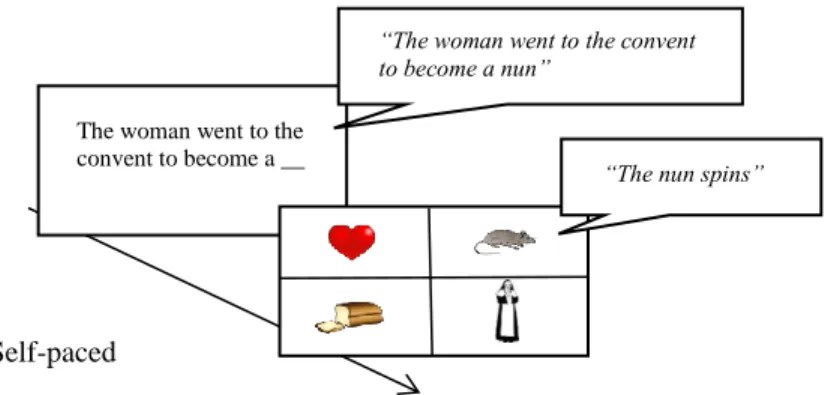
The experiment consisted of alternating sentence completion and object movement trials. During the sentence completion trials a sentence (minus the final word) appeared on the screen and the participant read the sentence aloud and provided the final word. During the object movement trials, 4 objects appeared on the screen and one of them performed an action. The location of the target that moved was counterbalanced between the four possible object locations. Participants saw four new objects on every trial, and the objects did not repeat over the course of the experiment. The participant reported out loud the object and its movement following the given form ‘the object movement’. Each participant received 24 experimental items and 24 filler items. The target in each of the experimental items was the object whose movement was described. The 24 filler items were objects whose movement was described. These items were preceded by unrelated sentence completion primes. A picture of the object that completed the sentence was always present in the filler trials but never performed the action. This experimental design was adopted so participants would not assume that any related object would be the one performing the action, and thus would be discouraged from adopting an anticipatory planning strategy. A visual representation of an identical trial in Experiment 1 is shown below.
Figure 1: Sample trial from Experiment 1 The woman went to the convent to become a __
“The woman went to the convent to become a nun”
“The nun spins”
17
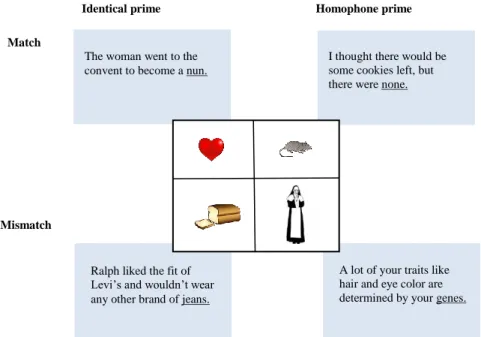
The stimuli were arranged following a Latin Square design. Each participant viewed each target item only once, preceded either by an identical prime (6 trials), a homophone prime (6 trials), or an unrelated prime (12 trials). A target object was therefore preceded by a related
sentence-completion during 12 trials total, or 25% of the time. An example of the possible primes for a single stimulus is shown below in Figure 2 (each participant saw only one of these primes for this given object). Matching primes are those that share phonological information with the target object (either identical words or homophone pairs). Mismatching primes are those that are unrelated to the object (but are homophone or identical primes for another object).
Figure 2: Primes in Experiment 1
Ralph liked the fit of Levi’s and wouldn’t wear any other brand of jeans.
Match
Mismatch
The woman went to the convent to become a nun.
I thought there would be some cookies left, but there were none.
A lot of your traits like hair and eye color are determined by your genes.
18
The experiment was a latin-square design, as each participant saw each item in one
condition, but saw all the conditions across different items. This design was adopted to discourage adoption of a predictive strategy in participants, as might occur if target objects were seen more than once. Additionally, reduction in duration of an object’s name might occur after repeated exposure to it in the experiment, as opposed to as a result of phonological priming per se. Procedure
Participants were seated in front of the computer and instructed that they were going to see alternating trials of sentence completions and object movement tasks. They were fitted with an audio recorder and were instructed to complete the sentences and describe the objects’
movements out loud. Participants performed several practice trials with the experimenter to ensure they understood the task and didn’t advance past the current slide (sentence completion or object movement) until they were done producing their utterance. The experimenter also watched the participant’s screen during the experiment to ensure they did not proceed past the current slide until they were done speaking. During the instruction period, participants were asked to describe the object’s movement using the form, “The [object] [movement]”. If the participant deviated from this form during the experimental trials, the experimenter asked the participant to resume using this form before proceeding to the next trial. Examples of the possible movements objects could have (spin, shrink, pulse, expand) were shown using non-experimental object stimuli during the practice trials at the beginning of the experiment, and participants were instructed to use these verbs to describe those particular object movements.
Once participants had been instructed which form to use to describe the objects’
19
advance to the next slide until they had completed producing the utterance that corresponded to the current slide. Each participant contributed 24 target trials that were analyzed, for a total of 960 trials over 40 participants.
Once participants had completed the task, a post-experiment questionnaire evaluated whether they were aware of the phonological similarity between some of the items. The
questionnaire began with general questions ((1)“What did you think this study was about”?) and extended to more specific questions ((2)“Did you notice anything about the sentences and objects being related?” (3)“Did you notice that sometimes the sentence completions word was the same word as the object that moved?”). This questionnaire allowed for an evaluation of whether participant awareness of any similarities affected participants’ performance (by comparing high-awareness and low-high-awareness groups). Across all experiments, participants who reported noticing a relationship between primes and targets after the first question were given an awareness score of 3 (most aware). Participants who reported a relationship after being asked the second question were given a score of 2 (less aware), and those who recognized some relationship only after the third question were given a score of 1(least aware).
Analysis
The target object movement trials were analyzed using the PRAAT software (Boersma et al. 2009). The durations of these trials were divided into latency to begin speaking, determiner length, object noun length, and movement verb length. The end of a beep produced by the computer, the beginning of which corresponded to the beginning of the object movement, was used to signal the beginning of the latency. Each object movement took half a second. The point at which a participant could recognize the action may have differed across the different
20
performed one of the four possible movements, so there were 12 items that performed each movement. Due to experimenter error, there was one more filler item that spun (7 total) and one fewer that shrunk (5 total), resulting in movements in the target trials being divided as follows: expand and pulse movements were evenly divided across the 4 experimental conditions (6 trials each), but there were 7 shrinks in each experimental condition and only 5 spins.
The latency period began after the object had started its movement, as indicated by a beep produced by the computer program and recorded in the sound file. All durations were
log-transformed to normalize their distributions. The similarity and match predictor variables were centered. Trials on which participants did not complete the sentence completion with the
predicted word (159 trials, 16.5%) or didn’t describe the object (96 trials, 10%) or its movement (90 trials, 9.4%) with the predicted word were excluded from the analysis. Note that this does not indicate that 345 trials were excluded- on 213 trials more than 1 region of interest was incorrect. Trials on which participants were 2.5 standard deviations beyond the mean for latency duration were excluded from that analysis (11 trials).
The log-transformed durations were analyzed in multilevel models, using SAS proc mixed command. Separate models were constructed for latency length, determiner length, object noun length, and movement verb length. Control models were developed first for each of these regions containing number of syllables, list identifier, order of presentation in the task, and how aware the participant was of the experimental manipulation (calculated from the post-experiment
21
predictors of prime match (mismatch or match) and similarity type (identical, homophone). Interaction terms between these predictors were also included in final models.
Participants were given scores for ‘awareness of manipulation’ according to the guidelines stipulated earlier in the paper. 19 participants received awareness scores of 3 (most aware), 18 received scores of 2 (less aware), and 3 received scores of 1 (least aware).
Results and Discussion Results
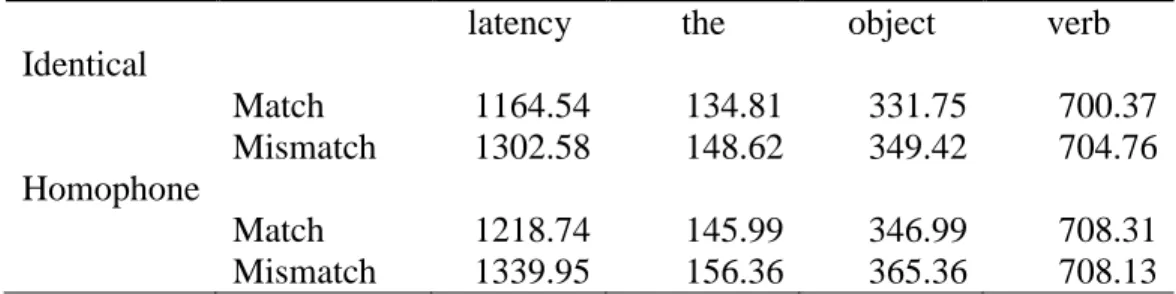
Means of the latency to begin speaking and each of the target regions are presented in Table 1 and Figure 3. Complete lists of the control variables and random effects that were included in each model are presented in Tables 2 and 3. Visual inspection of Table 1 reveals a pattern of shorter durations for match trials compared to mismatch trials, with a trend for identical match trials to be shorter than homophone match trials.
There was a main effect of match for latency to begin speaking (F(1,710)=20.70, p<.0001), but no effect of similarity (p=.1667), and no interaction between the two (p=.8395).
Identical and homophone target trial subset analyses were also performed. The main effect of match persisted when just homophone targets were analyzed (p=.0001) and when just identical targets were analyzed (p<.0001).
The analysis of ‘the’ durations revealed a main effect of match (F(1,713)=7.11, p=.0079)), but no effect of similarity (p=0.1849) and no interaction between the two (p=0.3907). When the subset of identical target trials were analyzed the effect of match persisted (p=.02), but was not found in the homophone target analysis (p=0.21).
22
homophone target trials were examined there was an effect of match (p=.0227), similarly for the identical target trials (p=.0006).
There were no main effects of match (p=0.1254), similarity (p=0.5373), or an interaction (p=0.94) for the verb duration analysis. There were no effects of match when homophone target trials were examined separately (p=0.32) or when identical target trials were examined (p=0.25).
latency the object verb
Identical
Match 1164.54 134.81 331.75 700.37
Mismatch 1302.58 148.62 349.42 704.76 Homophone
Match 1218.74 145.99 346.99 708.31
Mismatch 1339.95 156.36 365.36 708.13 Table 1: Experiment 1 target region durations (ms)
Figure 3: Experiment 1 object duration (ms) 300
320 340 360 380 400
D
urat
ion
(m
s)
Exp. 1: Object word duration
*
*
23
latency the object Verb
Itemset -1.90 --- --- ---
Item order -5.31 -1.94 -4.69 -6.34
Awareness --- --- 1.61 ---
Object syllables 1.62
Verb syllables ---
Table 2: Experiment 1 control variables in each final model. Dashes for control variables indicate that the variable was not significant in the control model and was not included in the final model. T-values indicate significant effects and the direction of the effects in the control models. Empty boxes indicate the control variables were not included in the control models.
latency the object Verb
Subject * * * *
Target item * * * *
Target verb * * *
Subject*Match * * *
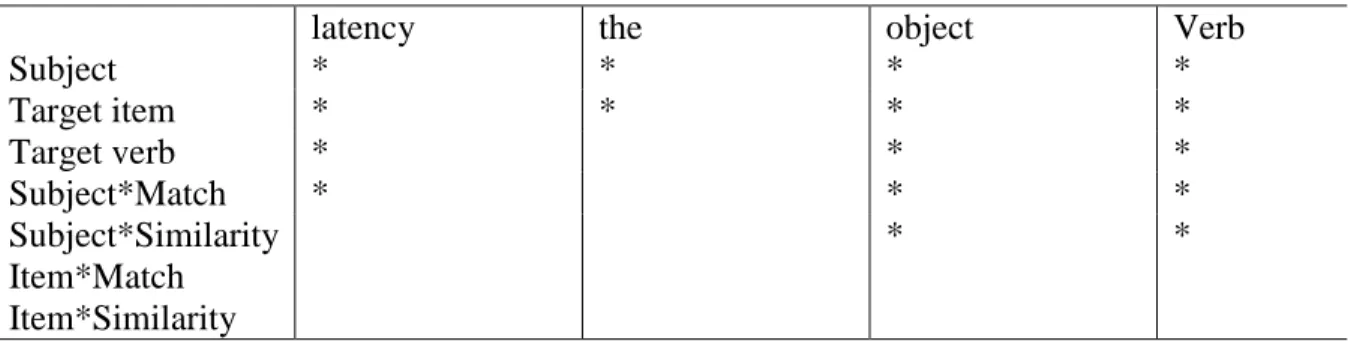
Subject*Similarity Item*Match Item*Similarity
* *
Table 3: Experiment 1 random intercepts and slopes included in each final model. Asterisks indicate that the effects were included in the models. Effects are listed in order of importance and were eliminated from the bottom up until the model converged and was positive definite.
Discussion
24
It is possible that the findings of reduction of the latency to begin speaking, article word, and object were due to the effects of phonological priming. However, there are at least two
alternative explanations for these findings. First, perhaps participants recognized that sometimes a relationship existed between the word that ended the cloze sentence and the object that performed the movement. If so, they might seek out objects in the display that were phonologically related to the word they had just spoken, and anticipate that the object would be the one performing the movement. This would allow for them to pre-plan their utterance, and thus this anticipation might account for the reductions in latency to begin speaking and word duration, rather than it being a result of phonological priming.
One avenue of addressing this alternative explanation is an examination of the latencies to begin speaking for the filler trials. The filler trials were composed of cloze sentences whose final words appeared as an object that did not perform the movement in the subsequent object
movement trial. These objects were counterbalanced across the four positions. If participants noticed the relationship between sentence and object-movement trials, they might anticipate that these objects would perform the actions, and thus have comparatively longer latencies to begin speaking than in the target trials in which the anticipated object did perform the movements. The average latency for filler trials was 1280 ms, as compared to 1321 ms for mismatch trials and 1196 ms for match trials. The average latency for identical match trials was 1169 ms and the average latency for homophone match trials was 1224.
25
not significantly slower in the filler trials, this suggests that participants were not hindered by the prime object not moving, as would be expected if they had anticipated its movement and then had to re-plan their utterances once another object moved. This comparison indicates that participants may not have adopted an anticipatory strategy. The analyses of filler trials compared to identical and homophone match trials were less informative, as we expected match trials to be faster given the effects of priming (as was also reflected in the significant effects of match in the models). An analysis of filler trial durations (anticipated object does not move) and identical match trial durations (anticipated object does move) revealed a significant effect of trial type (F(1,
1077)=8.65, p=0.0033). A comparison of filler trial durations and homophone match trial durations (homophone pair item does move) also revealed a significant effect of trial type (F(1, 1074)= 4.02, p=0.045). This suggests that participants did begin speaking faster after being primed if the primed object was in the display, but this analysis doesn’t clarify whether that was due to priming itself or to participants’ anticipation of the object.
26
Experiment 2 was conducted to test whether effects of phonological priming exist when phonological cohorts were used as primes, rather than homophones. This less-obvious overlap between primes and targets decreased the possibility of spreading activation to the lexical level of the target, as prime and target were less related, and therefore the target was likely to receive less (if any) spreading activation at the lexical level from the prime. Additionally, this manipulation had the added benefit of making the relationship between prime and target less obvious, reducing the possibility that participants would become aware of the manipulation and adopt a predictive strategy.
CHAPTER 4
EXPERIMENT 2: DOES PHONOLOGICAL PRIMING EXTEND TO PHONOLOGICAL COHORTS?
Method
Motivation for Experiment 2
Experiment 2 tested whether partial phonological overlap between prime and target words led to acoustic reduction. The prime/target pairs in Experiment 1 shared all of their phonological information, and therefore targets presumably received maximal priming on the phonological level. Experiment 2 used the same design as Experiment 1. Prime/target pairs that shared partial phonological information were used, to examine whether priming some of the phonemes was sufficient to facilitate production.
Participants
52 undergraduates participated in the experiment for course credit. 8 were excluded for computer or equipment malfunctions, 2 didn’t meet inclusion criteria (were not native English speakers), and 2 were excluded before of experimenter error. 40 participants (33 females) were used for the analyses.
Materials and Design
Identical to Experiment 1, Experiment 2 presented alternating sentence-completion and object-movement trials. Prior to the experiment the target sentences were found to have an
28
stimuli, or from freely available sites on the internet. Prime and target pairs were selected to be phonologically related at the onset of the words. Targets shared, on average, 62.10% of their phonemes with the primes. A list of the prime and target pairs is included in the appendix.
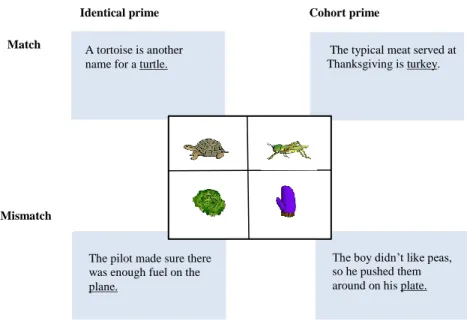
The experiment followed the same form as Experiment 1; alternating sentence completion trials and object-movement description trials were presented. The location of the target object that moved was counterbalanced across all 4 possible object locations. Experiment 2 differed from Experiment 1 only in the use of phonological cohort primes instead of homophone primes. Each participant was presented with 24 target trials, in which the target object was preceded by a phonological cohort prime (6 trials), an identical prime (6 trials), or an unrelated prime (12 trials, phonological cohort or identity primes for other target items). The same filler trials that were used in Experiment 1 (24 trials) were presented. A visual representation of a possible cohort trial is given below.
Figure 4: Sample trial in Experiment 2 Self-paced
The typical meat served at Thanksgiving is ___
“The typical meat served at Thanksgiving is turkey”
29
The stimuli were arranged following a Latin Square design. Each participant viewed each target object only once. A target object was preceded by a related sentence-completion during 12 trials total, or 25% of the time. An example of the possible primes for a single stimulus is shown below (each participant will only see one of these primes for this given object). Matching primes are those that share phonological information with the target object (either identical words or phonological cohort pairs). Mismatching primes are those that are unrelated to the object (but are cohort or identical primes for another object).
Figure 5: Primes in Experiment 2 Procedure
The same procedure as in Experiment 1 was used. Participants performed practice trials in which they learned object movements and were instructed on what form their responses should take. The experiment followed the same self-paced timing as Experiment 1, and the participants
The pilot made sure there was enough fuel on the plane.
Match
Mismatch
The typical meat served at Thanksgiving is turkey. A tortoise is another
name for a turtle.
The boy didn’t like peas, so he pushed them around on his plate.
30
were audio recorded. Participants spoke the sentence completions and object movements out loud, but did not work with a lab confederate. The phonological cohort object was never present in the display. These aspects of the experimental design were adopted to minimize the motivation for speakers to include contrastive cues in their speech, and to maximize the possibility that phonological priming would lead to reduction in duration.
A post-experiment questionnaire was presented upon completion of the experiment to determine whether participants were aware of the similarities between primes and targets. Analysis
The same analysis procedure was used as for Experiment 1. Trials on which participants did not complete the sentence completion with the predicted word (119 trials, 12.4%) or didn’t describe the object (132 trials, 13.75%) or its movement (41 trials, 4.27%) with the predicted word were excluded from the analyses. However, on 45 trials participants made a mistake on at least two of these regions, such that overall 247 trials were excluded, rather than 292.
As in Experiment 1, participants were given scores for ‘awareness of manipulation’ according to the guidelines. In Experiment 2, 10 participants received scores of 3 (most aware), 29 received scores of 2 (less aware), and 1 received a score of 1 (least aware).
Results and Discussion Results
31
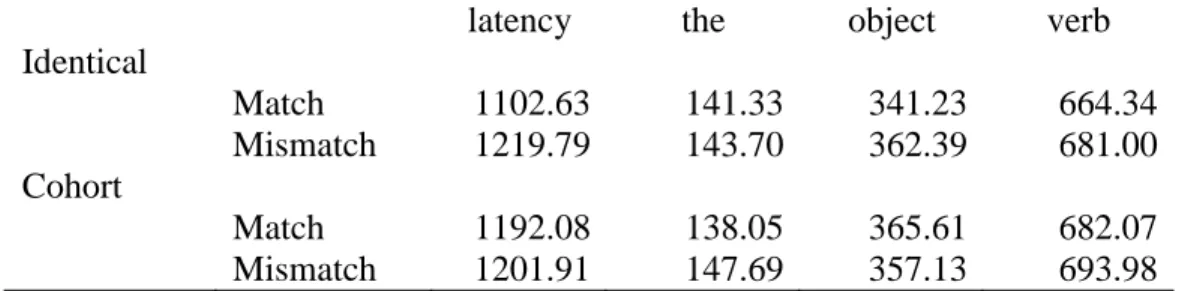
The analysis of the latency to begin speaking revealed a main effect of similarity (F(1,724)=4.55, p=.02), a main effect of match (F(1,724)=9.15, p=.0026), and an interaction between the two (F(1,724)=10.09, p=.0016. When targets preceded by identical primes were analyzed, the effect of match was significant (p<.0001), but not when those preceded by cohort primes were analyzed (p=.7625), indicating that the identical prime trials were driving these effects.
There were no main effects of similarity (p=.2723), match (p=.6194) or an interaction between the two (p=.1245) on ‘the’ duration. When identical target trials were analyzed on their own there was no effect of match (p=.59).
Analysis of the object region showed a main effect of similarity (F(1,711)=7.62, p=.0059), no main effect of match (F(1,711)= 2.62, p=.1061), and an interaction between the two
(F(1,711)=10.25, p=.0014). There was a main effect of match for targets preceded by identity primes (F(1,377)=14.97, p=.0001), but not for those preceded by cohort primes (p=.39).
There was a main effect of match for verb duration (F(1,713)=5.07, p=.0246), but no effect of similarity (p=.60) or an interaction between the two (p=.15). The effect of match was present for the targets preceded by an identity prime (p=.01), but not for those preceded by a cohort prime (p=.53).
A visual comparison of the means for identical condition target regions between
Experiments 1 and 2 suggested that latency to begin speaking was slightly longer in Experiment 1 and object word durations were longer in Experiment 2, perhaps suggesting different strategies in terms of utterance planning. However, a post-hoc between-experiment analysis found no
32
duration (F(1,764)=0.01, p=0.92), object duration (F(1,763)=1.30, p=0.25), or verb duration (F(1,763)=1.07, p=0.30).
latency the object verb
Identical
Match 1102.63 141.33 341.23 664.34
Mismatch 1219.79 143.70 362.39 681.00 Cohort
Match 1192.08 138.05 365.61 682.07
Mismatch 1201.91 147.69 357.13 693.98 Table 4: Experiment 2 target region durations (ms)
Figure 6: Experiment 2 object duration (ms) 300
320 340 360 380 400
D
urat
ion
(m
s)
Exp. 2: Object word duration
*
33
latency the object verb
Itemset --- --- --- ---
Item order -4.52 -2.82 -4.62 -5.84
Awareness --- 2.63 1.81 ---
Object syllables 3.89
Verb syllables ---
Table 5: Experiment 2 control variables in each final model. Dashes for control variables indicate that the variable was not significant in the control model and was not included in the final model. T-values indicate significant effects and the direction of the effects in the control models. Empty boxes indicate the control variables were not included in the control models.
latency the object verb
Subject * * * *
Target item * * * *
Target verb * * * *
Subject*Match *
Subject*Similarity Item*Match Item*Similarity
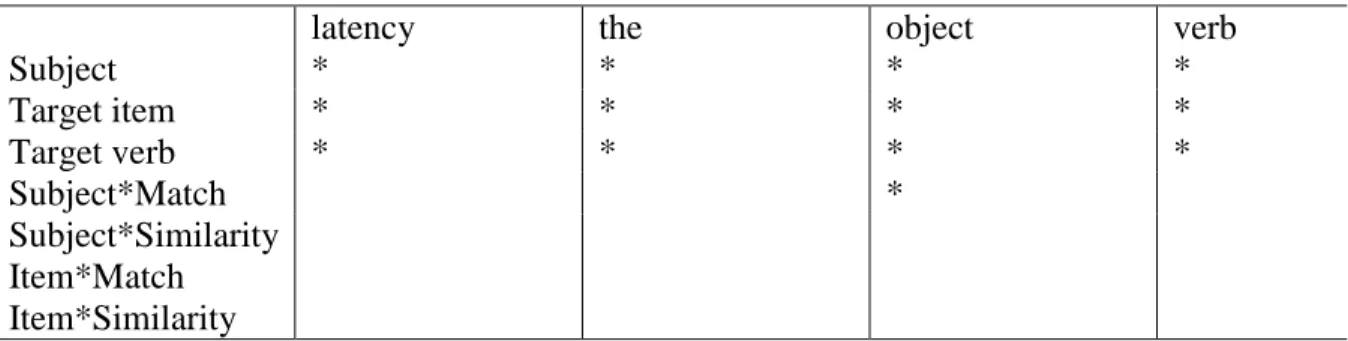
Table 6: Experiment 2 random intercepts and slopes included in each final model. Asterisks indicate that the effects were included in the models. Effects are listed in order of importance and were eliminated from the bottom up until the model converged and was positive definite. Discussion
Experiment 2 did not provide any evidence that the effects of phonological priming extended to phonological cohorts. This experiment investigated whether phonological priming could be found with phonological cohorts that shared some but not all of their phonemes. This manipulation allowed possible effects of lexical-level priming or facilitation to be ruled out. Identical prime and target pairs were included. Reductions in duration following identity primes were found in Experiment 2 on latency to begin speaking, the object word, and the movement verb.
34
in Experiment 1 had adopted a different strategy, in which they pre-planned more of their utterances before beginning to speak. However, the differences between experiments on this target region did not approach significance. Identity priming effects were also found for the verb in Experiment 2 but not in Experiment 1. The verb durations were also longer in Experiment 1 than 2 (although not significantly), suggesting that perhaps more sentence-final lengthening overall was taking place in Experiment 1. The difference between identical match and mismatch verb durations is in the right direction in Experiment 1 (700 ms (match) vs 704 ms (mismatch)), just a lesser magnitude than the difference between the two in Experiment 2 (664 ms (match), 681 ms (mismatch)).
In addition to the possibility that phonological priming does not extend to phonological cohorts, there are at least two other explanations for the lack of an effect found. The first is that the time course between prime and target presentation was too long. Priming due to partial phonological overlap is hypothesized to be due to lingering activation on the shared phonemes. Given the delay between prime and target presentation, it is possible that any lingering
phonological activation had decayed to such an extent that it did not facilitate production, especially since primes and targets did not share all their phonemes. It is possible that lingering activation on only a few shared phonemes may facilitate production given a shorter delay.
35
CHAPTER 5
EXPERIMENT 3: FURTHER TEST OF HOMOPHONE PRIMING EFFECTS ON DURATION Motivation for Experiment 3
Experiment 3 was a further test of whether phonological priming with homophones led to reduction in word duration. Specifically, it tested whether the effects of homophone priming persisted when there were less obvious relationships between primes and targets in the experiment. In Experiment 1 participants viewed target trials preceded by identity and homophone primes. In addition, the filler sentence completions were objects in the following trials, although not the objects that performed the movements. It is possible that the combination of these experimental factors drew participants’ attention to the relationships between primes and targets, and encouraged them to strategically anticipate and deploy attention to any related object in the display, thus speeding planning and utterance production. Experiment 3 included no identity primes. Additionally, no identical objects of the filler sentence completions appeared on the subsequent object movement trials. Rather, on half of the filler trials (6) the homophone pair of the sentence completion word appeared on the subsequent object movement trial but did not perform the action.
Method Participants
37
was excluded due to a computer error during the experiment. 40 were used in the analyses. Of the 40 participants, 6 did not specify their gender, 22 identified as female, and 12 as male.
Materials and Design
Identical to Experiments 1 and 2, participants in Experiment 3 were presented with alternating sentence-completion and object movement trials. Target sentences were taken from those developed for Experiment 1. Twelve sentences were selected from Experiment 1 based on largest effect size (homophone mismatch-homophone match). In Experiment 1 these sentences had an average correct sentence completion rate in the homophone match condition of 89%, and an average correct object naming rate of 95%. In Experiment 3 these sentences had an average correct completion rate of 84.8% and the objects were correctly identified at a rate of 86.25%. Filler sentences from Experiment 1 were used, and 12 additional filler sentences, composed of homophone trials from Experiment 2 (in which the homophone completion appears an object which does not move) were included. Pictures were taken from the colored versions of the
Snodgrass & Vanderwalt (1980) stimuli, or from freely available sites on the internet. A list of the prime and target pairs is included in the appendix.
38
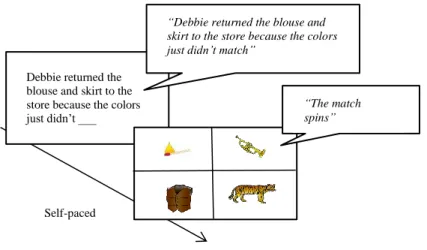
trials used in Experiments 1 and 2. The remaining 12 were composed of the other half of the target homophone prime sentences from Experiment 1. The homophone competitor object was present in half (6) of the subsequent object movement displays on these trials, but did not perform the action. A visual representation of a possible homophone trial is given below.
Figure 7: Sample trial in Experiment 3
Each participant viewed each target object only once. A target object was preceded by a related sentence-completion during 6 trials total, or 12.55% of the time. An example of the possible primes for a single stimulus is shown below (each participant saw only one of these primes for this given object). Matching primes are those that share phonological information with the target object (homophones). Mismatching primes are those that are unrelated to the object (but are homophone primes for another target).
Self-paced Debbie returned the blouse and skirt to the store because the colors just didn’t ___ ___
“Debbie returned the blouse and skirt to the store because the colors just didn’t match”
39 Figure 8: Primes in Experiment 3
Procedure
The same procedure as in Experiments 1 and 2 was used. Participants performed practice trials in which they learned object movements and were instructed on what form their responses should take. Participants self-paced through the trials, and were audio recorded. A
post-experiment questionnaire was presented upon completion of the post-experiment to determine whether participants were aware of the similarities between primes and targets.
Analysis
The same analysis procedure was used as for Experiments 1 and 2, although only one variable was manipulated in Experiment 3 (match). Trials on which participants did not complete the sentence completion with the predicted word (73 trials, 15.2%), didn’t describe the object correctly (66 trials, 13.75%), or didn’t describe the movement correctly (23 trials, 4.8%) were
A lot of your traits like hair and eye color are determined by your genes.
Match
Mismatch
Debbie returned the blouse and skirt to the store because the colors just didn’t match.
40
excluded from the analyses. As in Experiments 1 and 2, participants were given scores for ‘awareness of manipulation’, following the previously established guidelines. 7 participants received scores of 3 (most aware), 28 participants received scores of 2 (less aware), and 5 participants received scores of 1 (least aware).
Results and Discussion Results
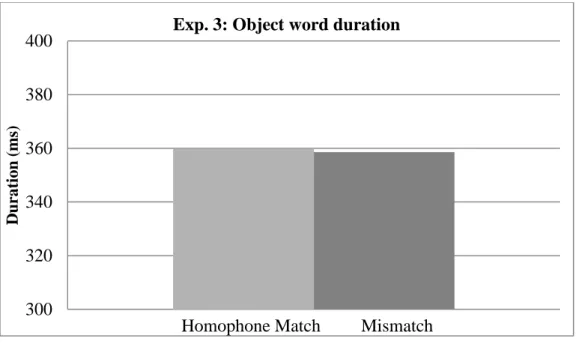
Means of the regions of interest are presented in Table 7 and Figure 9. The control variables and random effects that were included in each model are presented in Tables 8 and 9. Inspection of Table 7 reveals similar durations in all target regions across the two conditions.
There were no main effects of match on any of the target regions analyzed; latency to begin speaking (F(1,349)=0.05, p=0.83), ‘the’ duration (F(1, 347)=1.25, p=0.26), object word duration (F(1, 349)=0.81, p=0.37), or verb duration (F(1, 340)= 0.94, p=0.33).
latency the object verb
Homophone
41 Figure 9: Experiment 3 object duration (ms)
latency the object verb
Itemset --- --- --- ---
Item order -3.27 -3.09 -2.28 -3.58
Awareness --- --- --- ---
Object syllables ---
Verb syllables ---
Table 8: Experiment 3 control variables in each final model. Dashes for control variables indicate that the variable was not significant in the control model and was not included in the final model. T-values indicate significant effects and the direction of the effects in the control models. Empty boxes indicate the control variables were not included in the control models.
latency the object verb
Subject * * * *
Target item * * * *
Target verb Subject*Match Subject*Similarity Item*Match Item*Similarity
Table 9: Experiment 3 random intercepts and slopes included in each final model. Asterisks indicate that the effects were included in the models. Effects are listed in order of importance and were eliminated from the bottom up until the model converged and was positive definite.
300 320 340 360 380 400 D urat ion (m s)
Exp. 3: Object word duration
42 Discussion
Given the null effects of Experiment 2, Experiment 3 was aimed at isolating the cause of the homophone priming effects found in Experiment 1. The basic experimental design from Experiments 1 and 2 was maintained, but some changes were made to make the relationships between primes and targets less obvious. First, no identity prime target pairs were used.
Secondly, 36 fillers were used (compared to 24 in Experiments 1 and 2), and none of these fillers had identical objects in the movement trials as lures (a design feature of Experiments 1 and 2). Instead, 6 of the 36 filler trials had homophone objects as lures in the object-movement trials.
If the results of Experiment 1 were due to phonological priming effects, regardless of on what level of representation these were realized, similar reductions in duration on the object region and other analyzed regions should have been obtained in Experiment 3. However, no such reductions in duration following homophone primes were found in Experiment 3. This suggests that the effects of homophone primes found in Experiment 1 may have been due to a strategic deployment of attention to the relationships between primes and targets, leading to anticipation of a related object’ movements, despite the fact that filler trial analyses from experiment 1 did not indicate this was the case.
43
CHAPTER 6
GENERAL DISCUSSION
The three studies presented here found that reductions in duration did occur on the target phrase following presentation of identity primes, and following presentation of a homophone prime when the manipulation was fairly obvious to participants. These effects were not isolated to the primed word, but were also seen on latency to begin speaking and other regions in the target phrase. When attempts were made to make relationships between primes and targets less clear, as when phonological cohorts were used (Experiment 2) or when fewer homophone pairs were included (Experiment 3), such effects of phonological priming were no longer found.
The post-experiment questionnaires were used to analyze participants’ awareness of the experimental manipulations, and to determine whether participants were more aware of the manipulations between experiments. The questionnaires indicated that participants were more aware of the manipulation in Experiment 1, versus Experiments 2 and 3. There were more
45
This comparison raises several potential explanations for the findings. First is the possibility that the effects of homophone priming seen in Experiment 1 were due entirely to deployment of attention to primed objects in the object-movement trials. Attention to a prime-target relationship might encourage participants to adopt a strategy in which they scanned the possible objects for a match, and then began planning object-movement utterances earlier than in trials in which there were no matching objects. However, this explanation is inconsistent with other information about participants’ behavior. The filler trial analyses showed no differences in latencies to begin speaking between trials in which primed objects did not move (filler trials) and trials in which primed objects were not present (mismatch trials). Participants were not hindered by a primed object not
performing the movement, indicating that they had no begun planning an utterance which included that object. There is also no evidence that the effects of priming were contingent on participants’ awareness, as there were no interactions between awareness measures and critical predictors in the statistical models. Given the evidence to the contrary, the
potential explanation that increased attention to target objects in the object-movement trials accounted for the findings in Experiment 1 is insufficient.
46
target object. This explanation is consistent with the null findings of the filler trial analyses.
Alternatively, a related explanation is that perhaps participants’ awareness
encouraged them to adopt a strategy in which they predicted the target word, per se, rather than searching for an object that matched the target word. This would result in the priming effect seen for both homophones and identical primes (but not phonological cohorts). This explanation would perhaps also involved increased attention or activation paid to the prime word, which would aid in its later production, without implicating a predictive strategy based on available objects.
The pattern of results in this set of experiments raises the possibility that unless speakers have some motivation to maintain a word’s representation in memory, activation of that word’s representation(s) is likely fleeting. Nearly half of the participants in
Experiment 1immediately reported awareness of the relationship between primes and targets, and thus may have been attending more to the primes (than participants in Experiments 2 and 3) and maintaining representations of them in memory. A
representation of the prime word may have still been available when they were producing the target, aiding in production, as primes and targets were phonologically identical. Participants in Experiments 2 and 3 had less awareness of the relationships, overall, and thus were not deploying extra attention to prime words, which resulted in no facilitation of the targets.
47
system are possible outcomes of such studies, as well as inhibition (as expressed by target word lengthening) due to communicative motivations. Despite the fact that they were somewhat inconclusive, the findings of this set of studies suggest that any effects of phonological priming found in a similar task will be in the direction of facilitation, as opposed to inhibition.
However, these effects were not robust enough to provide reliable support to the Facilitation-based Reduction Hypothesis (Kahn & Arnold, 2012). They were also in contrast to those of Wheeldon & Monsell (1992), who found that latencies were reduced even after long lags (6-12 minutes) between prime and target presentation of
orthographically identical homophone pairs. However, the homophone pairs in this study were not uniformly orthographically identical, so a clear comparison cannot be made. No effects of phonological inhibition were found in this set of studies, perhaps not
surprisingly, as efforts were made to reduce speakers’ communicative–emphasis motivations.
48
target word. This set of studies does suggest that homophone priming is possible and, when it is present, it facilitates production, leading to target reduction. However, it may only been found in tasks in which participants have some motivation to maintain a representation of the primed word.
Future Directions
In addition to the possibility that homophone priming simply doesn’t happen, or only happens when participants are motivated to maintain a representation of the prime longer than usual, there is also the possibility that this task was not sensitive enough to detect it. Several seconds elapsed between prime and target presentation, and if the effects of homophone priming are fleeting, they may have decayed by the time participants were planning and uttering the target phrase.
A second possibility is that such effects may be easier to detect when they are both produced in one coherent utterance, or at least two related phrases. As the prime and target trials were fairly distinct from one another, and no attempt was made to encourage participants to convey information communicatively, these two trials may have been approached as separate entities. If primes and targets were planned and packaged by the language production system as a more united phrase, perhaps phonological facilitation processes would be more evidence.
49 Appendix 1:
Stimuli from Experiment 1 Target sentence pairs
In the alphabet A is the first letter He wrote his mother a long letter
Paul's two favorite teams are playing in the Super bowl She ladled soup into her bowl
The voice sounded familiar but she couldn't tell who it might be The boy was stung by a bee
She wasn't sure if she had locked the door, so she went back to check The grocery store wouldn't accept a personal check
Marilyn Monroe was a famous movie star The hopeful girl wished upon a shooting star The color of your eyes is determined by your genes
Ralph liked the fit of Levi's and wouldn't wear any other brand of jeans So the dough wouldn't stick to the counter the baker added more flour He walked over to the vase and sniffed a pretty flower
At midnight, Cinderella had to leave the ball Jose swung the bat and hit the ball
On the form he had to check off whether he was female or male The postman came and picked up the day's mail
The patient couldn't wait for his wound to heal To make the horse go, Mary dug in her heel
The children were told to say darn instead of damn
To stop yearly flooding and provide the city with power they built a dam In the old days kids called their parents ma and pa
The lion got a thorn in its paw
The pigs were confined to the pig pen He signed his name with a ballpoint pen To fly away Dracula often turns into a bat The baseball player swung the bat
When the punch was thrown at him, someone warned him to duck The child knew how to quack like a duck
He always missed the Simpsons because he didn't have a TV to watch He didn't realize that he was running late until he glanced at his watch
Debbie returned the blouse and skirt to the store because the colors just didn't match He lit the candle with just one match
The cashier refused to give change for such a large bill Donald Duck's girlfriend wears lipstick on her bill To get to the island in his car he took
50 Tinkerbell was a tiny fairy
Bill sat by the phone and waited for it to ring
The young man bought his girlfriend an engagement ring
A selfish person only cares about three people: Me, myself and I She put a contact lens in her eye
I thought there would be some cookies left, but there were none The woman went to the convent to become a nun
The boy admired Mohammed Ali, so he learned how to box The shipping store will likely have that shape and size of a box Mother Hubbard checked her cupboards, but they were bare
They always put their food in a tree when they were camping to avoid attracting a bear
Fillers
An egg is laid by a chicken
The ship stopped off the coast and dropped its anchor Granny smith is my favorite kind of apple
He needed to chop some wood so he went outside and took an axe
Susie hated loud noises, so when cleaning up the party she was sure to not pop a single balloon
Katie wanted to put her shirt in the closet but didn’t have a hanger. The chrysalis came out of its cocoon and became a butterfly Pete's shirt was so tight that he popped off the top button
Callie decided for her birthday she wanted a chocolate fudge cake
For the two year old’s birthday party the mother called the circus to get a clown The family went to the animal shelter and adopted a dog and a cat
The top shelf of the cupboard was too high for Billy so he stood on a chair
She wanted to make an omelet so she took the carton out of the fridge and got an egg The fly was buzzing around the kitchen so the chef opened the window
The coach told the players to start running when he blew the whistle The fairy godmother said that to find a prince you have to kiss a frog It started raining as soon as Susan got outside so she opened her umbrella The grandma wanted tea so her granddaughter put on the kettle
Jake wanted to play tennis but he realized he'd forgotten his racket
The woman disliked making pizza because her eyes started watering when she chopped the onion
Jane was excited for the Halloween because she loved carving her pumpkin When setting the table Kate remembered the pepper, but forgot the salt
The maid was annoyed that when she did laundry the always ended up missing a sock
51 Appendix 2:
Stimuli from Experiment 2 Phonological cohort pairs
cat cap
map mat
comb coat
boat bone
bed bell
dog doll
toad toes
cane cape
pig pin
camel camera heart harp
fish fist
candy candle pencil pentagon plate plane snail snake sandal sandwich rooster ruler bacon bagel turkey turtle picture pickle horse horn dolphin dollar mouth mouse Target sentence pairs
The tired instructor sat down on her yoga mat.
The car's GPS wasn't working, so for directions he used the map. On its head, a unicorn has a horn.
The jockey picked out a new saddle for his horse. The boxer balled up his hand into a fist.
The little boy put a worm on his hook and tried to catch a fish. For Valentine's day the little girl made cards in the shape of a heart. The angel plucked at the strings on the harp.
The little puppy grew up to be a huge dog.
The little girl wanted a pretend baby sister, so she asked her mom for a doll. The dog couldn't remember where he had buried his bone.
52
An animal like a frog but with warts on its skin is a toad. The little boy got some paper and crayons and drew a picture. A cucumber that is stored with vinegar becomes a pickle. Shoes like flip-flops are types of sandals.
Peanut-butter and jelly was the girl's favorite kind of sandwich. Before seeing the patient, the doctor put on his white coat.
The girl's hair was so snarled that it broke one of the teeth in the comb.
At the end of the school day, the students knew it was time to go when they heard the bell. The little boy pushed all his dirty clothes under his bed.
The boy wanted to be a superhero, so his mom made him a cape. The old man leaned on his cane.
To protect her hair from chlorine, the swimmer wore a cap.
They knew it was dinnertime when they heard the meowing of the cat. On their suits, presidential nominees all wear flag pins.
The farmer filled the pail with slop and went out to feed the pigs. The child loved waking up to the smell of sizzling bacon.
The customer smeared cream cheese on her bagel. The typical meat served at Thanksgiving is turkey. A tortoise is another name for a turtle.
The boy didn't like peas, so he pushed them around on his plate. The pilot made sure there was enough fuel on the plane.
To fill in the bubble sheet the student needed a sharp pencil. A shape with five sides is called a pentagon.
A male chicken that crows in the morning is called a rooster. The student needed to measure a line, so he got out his ruler. Flipper was a famous friendly dolphin.
Four quarters are the equivalent of a dollar.
A desert animal with humps on its back is called a camel.
The father wanted to take a picture, but couldn't find his camera. The children couldn't wait to eat all of their Halloween candy. The woman went into the church and lit a candle.
A slimy garden creature with a shell is called a snail. A boa constrictor is a type of snake.
The woman put out traps with cheese because she thought she saw a mouse. The little girl was afraid of the dentist and wouldn't open her mouth.
Fillers
53 Appendix 3:
Stimuli from Experiment 3 Stimuli
In the alphabet A is the first letter.
She wasn't sure if she had locked the door, so she went back to check. A lot of your traits like hair and eye color are determined by your genes. At midnight, Cinderella had to leave the ball.
The patient couldn't wait for his wound to heal. In the old days kids called their parents ma and pa. To fly away Dracula often turns into a bat.
He always missed the Simpsons because he didn't have a TV to watch.
Debbie returned the blouse and skirt to the store because the colors just didn't match. A boat that carries people and their cars over water is called a ferry.
A selfish person only cares about three people: Me, myself and I. I thought there would be some cookies left, but there were none. Fillers
Identical to Experiment 1 and 2 fillers, with the addition of 6 former stimuli: Paul's two favorite teams are playing in the Super Bowl.
The voice sounded familiar but she couldn't tell who it might be. Marilyn Monroe was a famous movie star.