Impact of Regional Systems of Care on Disparities in Care Among
Female and Black Patients Presenting With ST-Segment
–
Elevation
Myocardial Infarction
Tomoya T. Hinohara, MD; Hussein R. Al-Khalidi, PhD; Christopher B. Fordyce, MD, MHS, MSc; Xiangqiong Gu, MS; Matthew W. Sherwood, MD, MHS; Mayme L. Roettig, RN, MSN; Claire C. Corbett, MMS; Lisa Monk, RN, MSN; Jacqueline E. Tamis-Holland, MD; Peter B. Berger, MD; J. E. B. Burchenal, MD; B. Hadley Wilson, MD; James G. Jollis, MD; Christopher B. Granger, MD
Background-—The American Heart Association Mission: Lifeline STEMI (ST-segment–elevation myocardial infarction) Systems Accelerator program, conducted in 16 regions across the United States to improve key care processes, resulted in more patients being treated within national guideline goals (time from first medical contact to device: <90 minutes for direct presenters to hospitals capable of performing percutaneous coronary intervention;<120 minutes for transfers). We examined whether the effort reduced reperfusion disparities in the proportions of female versus male and black versus white patients.
Methods and Results-—In total, 23 809 patients (29.3% female, 82.3% white, and 10.7% black) presented with acute STEMI between July 2012 and March 2014. Change in the proportion of patients treated within guideline goals was compared between sex and race subgroups for patients presenting directly to hospitals capable of performing percutaneous coronary intervention (n=18 267) and patients requiring transfer (n=5542). The intervention was associated with an increase in the proportion of men treated within guideline goals that presented directly (58.7–62.1%,P=0.01) or were transferred (43.3–50.7%,P<0.01). An increase was also seen among white patients who presented directly (57.7–59.9%,P=0.02) or were transferred (43.9–48.8%,P<0.01). There was no change in the proportion of female or black patients treated within guideline goals, including both those presenting directly and transferred.
Conclusion-—The STEMI Systems Accelerator project was associated with an increase in the proportion of patients meeting guideline reperfusion targets for male and white patients but not for female or black patients. Efforts to organize systems of STEMI care should implement additional processes targeting barriers to timely reperfusion among female and black patients. (J Am Heart Assoc. 2017;6:e007122. DOI: 10.1161/JAHA.117.007122.)
Key Words: acute coronary syndrome•myocardial infarction•race•reperfusion•sex
T
he cornerstone of acute ST-segment–elevation myocar-dial infarction (STEMI) treatment is prompt coronary artery reperfusion to reduce morbidity and mortality. Nationalguidelines call for primary percutaneous coronary intervention (PCI) within 90 minutes of paramedic arrival for patients who call 9-1-1 and are transferred directly to a hospital offering PCI (PCI-capable) and within 120 minutes of first medical contact (FMC) for patients requiring interhospital transfer.1 Nevertheless, up to 50% of patients presenting with STEMI fail to meet national guideline goals for reperfusion therapy.2–5 Furthermore, disparities in both the use and the timing of reperfusion therapy may exist in vulnerable patient popula-tions, including women and minorities, particularly black patients.6–11However, little contemporary evidence exists to describe care gaps among such disparate groups, particularly on a national level.
The Regional Systems of Care Demonstration Project American Heart Association Mission: Lifeline STEMI Systems Accelerator program represented the largest effort in the United States to organize regional STEMI care. It significantly increased the proportion of patients treated within guideline goals and significantly reduced reperfusion times among hospitals implementing care processes compared with those
From the Duke University Medical Center, Durham, NC (T.T.H., H.R.A.-K., C.B.F., M.W.S., C.B.G.); Duke Clinical Research Institute, Durham, NC (T.T.H., H.R.A.-K., C.B.F., X.G., M.W.S., M.L.R., L.M., C.B.G.); New Hanover Regional Medical Center, Wilmington, NC (C.C.C.); Mount Sinai Saint Luke’s Hospital, New York, NY (J.E.T.-H.); Cardiovascular Center for Clinical Research, Danville, PA (P.B.B.); South Denver Cardiology Associates, Denver, CO (J.E.B.B.); Sanger Heart and Vascular Institute, Carolinas HealthCare System, Charlotte, NC (B.H.W.); University of North Carolina, Chapel Hill, NC (J.G.J.).
An accompanying Data S1 is available at http://jaha.ahajournals.org/conte nt/6/10/e007122/DC1/embed/inline-supplementary-material-1.pdf
Correspondence to: Christopher B. Granger, MD, Duke Clinical Research Institute, Duke University Medical Center, DUMC Box 3850, Durham, NC 27715. E-mail: [email protected]
Received July 24, 2017; accepted July 26, 2017.
that did not.12,13Recent efforts to improve STEMI reperfusion times have identified systemic barriers to care resulting from a highly fragmented healthcare system as a primary imped-iment to the delivery of rapid reperfusion.12,14–16To address system-related delays, interventions were conducted with the goal of identifying regional gaps, barriers, and inefficiencies in STEMI care and to implement proven recommendations and protocols to improve quality and consistency of care. Key study interventions included organizing and training regional leadership, identifying barriers to care unique to each region, establishing common protocols for the diagnosis and treat-ment of patients with STEMI presenting to emergency medical services (EMS) personnel or hospitals lacking PCI facilities, conducting ongoing measurement of and feedback on performance in hospitals, and having regular reviews of performance with representatives of hospitals and EMS agencies.
Despite the success of these programs, little is known about the specific impact of rapidly implementing multiple STEMI regional networks on care disparities, including among female and black patients. The objective of this study was to determine the impact of implementing regional systems of STEMI care on the proportion of patients treated within reperfusion time guideline goals for female versus male and black versus white patients and to determine whether the intervention narrowed disparities between these groups.
Methods
Study Design and Population
This study analyzed data collected over 7 calendar quarters from July 1, 2012 (2012 quarter 3), through March 31,
2014 (2014 quarter 1), as part of the STEMI Systems Accelerator project. The design and methods for this study have been published.17 In brief, the STEMI Systems Accelerator project was a nationwide effort to organize and implement STEMI reperfusion therapy in 16 regions across the United States and included 484 hospitals and 1253 EMS agencies. The enrollment criteria for each region included the following: (1) 70% of PCI-capable hospitals in the region were participating in the National Cardiovascular Data Registry’s ACTION Registry–Get With The Guidelines (AR-G) program; (2) there was defined organization of regional leadership; (3) common protocols were established for the diagnosis and treatment of patients with STEMI presenting to EMS personnel or hospitals lacking PCI facilities; (4) there was agreement to enter patients into the AR-G for 6 consecutive quarters; and (5) regional leadership participated in a 2-day national training session directed by study faculty reviewing current evidence, guidelines, and approaches to regional STEMI care. The following 16 of 21 regions that applied for participation in the project met enrollment criteria by the baseline data collection quarter and were included: Atlanta, GA; Columbus, OH; Denver, CO; Hartford, CT; Houston, TX; Kern County, CA; Louisville, KY; New York, NY; northern New Jersey; Oklahoma City, OK; Philadelphia, PA; Pittsburgh, PA; St. Louis, MO; San Antonio, TX; Tampa, FL; and Wilkes-Barre/Scranton, PA.
Regional interventions were based on Mission: Lifeline established approaches and drew on specific resources that effectively augmented regional organization in prior experi-ence (Data S1).18Each region established common protocols, including common criteria for establishing the diagnosis of STEMI, activating a catheterization laboratory with a single phone or radio call, treating the patient with simple initial regimens, and transporting the patient by preidentified mechanisms. Common protocols were implemented, and ongoing performance measurement and feedback were conducted and reflected in quarterly hospital STEMI treatment reports.
Each region identified a quarter (quarters 3 or 4 of 2012 or quarter 1 of 2013) as the baseline quarter (Q1) from which to assess subsequent temporal trends in outcomes. All patients with ongoing ischemic symptoms lasting for >10 minutes but <12 hours, with ECG-diagnosed ST-seg-ment elevation, and treated with primary PCI were included. Patients were included in the direct presenter group if they presented to a PCI-capable hospital (capable of performing PCI 24/7) either by EMS transport or self-transport. Patients were included in the transfer group if they presented to a hospital without PCI capabilities and were subsequently transferred to a PCI-capable hospital. Analysis was performed on the overall population represented by all 16 regions.
Clinical Perspective
What Is New?
• Women and black patients have longer ST-segment– elevation myocardial infarction (STEMI) treatment times compared with men and white patients.
• Establishment of regional systems of STEMI care has been shown to improve overall STEMI treatment times, but its impact on care disparities by sex and race is less clear.
What Are the Clinical Implications?
• Despite implementing regional systems of STEMI care across health systems in the United States, disparities in STEMI care persist among women and black patients. • This study highlights the need to develop regional care
efforts to implement additional processes to overcome barriers to care for women and black patients.
N
AL
RE
Study Outcome
The primary outcome of this study was the percentage of patients meeting guideline goals for FMC-to-device time. The outcome was analyzed by sex and race in each of the 7 quarters.
Statistical Analyses
Analyses were conducted to determine the change in the percentage of patients (female versus male and black versus white) meeting guideline goals for 6 quarters (after the baseline quarter). Descriptive statistics for continuous vari-ables were presented as medians (25th and 75th percentiles). The Cochran–Armitage test for trend was used to assess changes in rates over time. Categorical variables are presented as frequencies with percentages. Baseline charac-teristics were compared using the Wilcoxon rank sum test for continuous variables and the Pearsonv2or Fisher exact test, as appropriate, for categorical variables. In-hospital mortality was analyzed using the logistic regression model with generalized estimating equations to account for clustering of patients within each hospital. Mixed-effects models were used to estimate the effect of sex and race on the dependent variable of FMC-to-device time and the interaction between sex or race and intervention.
All statistical tests were conducted at the nominal 0.05 significance level. Statistical analyses were performed with SAS version 9.2 or higher (SAS Institute). The project was reviewed by the Duke University institutional review board and classified as exempt.
Results
Patient Characteristics and Presentation
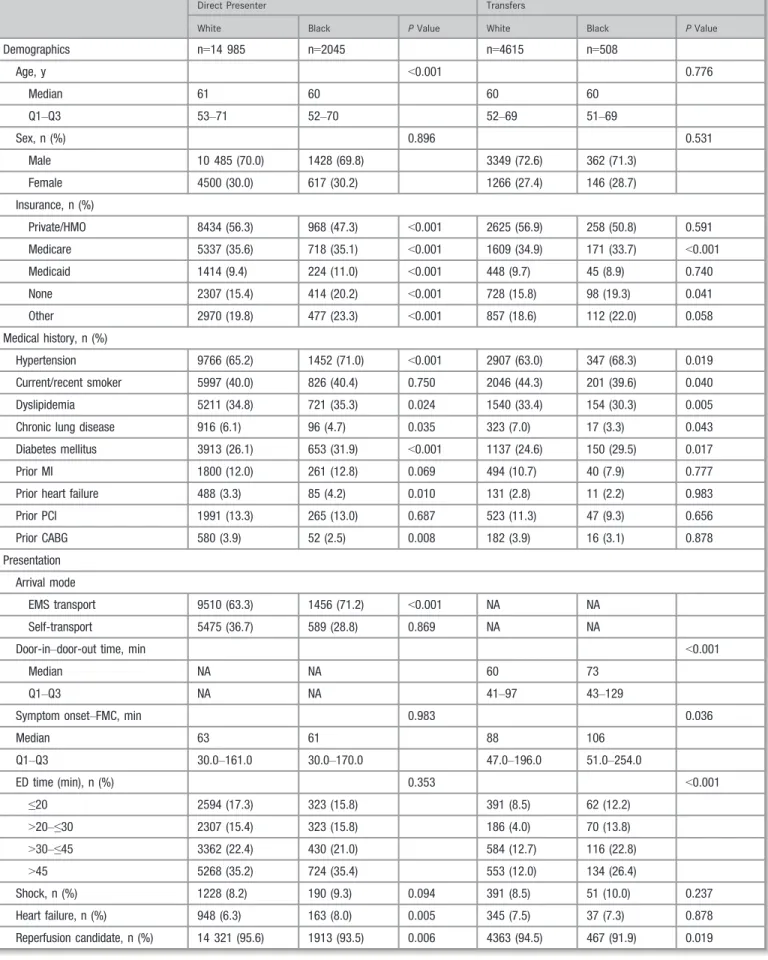
A total of 23 809 patients presented with acute STEMI from July 2012 through March 2014. The population was 70.7% male, 29.3% female, 82.3% white, and 10.7% black. Overall, 77% of patients were in the direct presenter group and 23% were in the transfer group. Of the 23 809 patients, 20 797 were treated by primary PCI within 12 hours of symptom onset and were included in the primary outcome analysis. Patient demographics, medical history, presenting clinical characteristics, and in-hospital complications are shown in Tables 1 and 2.
Women were significantly older and had significantly more comorbidities, including hypertension, chronic lung disease, diabetes mellitus, and prior heart failure, compared with men. Women were also more likely to have Medicare or Medicaid insurance. Women had a longer delay between symptom onset and FMC and were more likely to arrive by EMS transport rather than self-transport. Women who were
transferred had a significantly longer door-in to door-out time compared with men. Women also had significantly more in-hospital complications, including in-in-hospital death, congestive heart failure, and major bleeding.
Black patients had significantly higher rates of diabetes mellitus and hypertension and were more likely to be uninsured compared with white patients. Among those transferred, black patients had significantly longer door-in to door-out times. Among direct presenters, black patients had higher rates of in-hospital complications including cardiogenic shock and congestive heart failure, whereas complication rates were similar for black and white patients in the transfer group. In-hospital mortality was similar for black and white patients.
Direct Presenter Group
In each quarter, a higher proportion of men were treated within guideline goals compared with women. The proportion of women presenting directly to a PCI-capable hospital that met guideline goals for FMC-to-device time (<90 minutes) did not change (53.5% in Q1 to 54.2% in Q7,P=0.26). However, the proportion of directly presenting men treated within guideline goals increased significantly from 58.7% in Q1 to 62.1% in Q7 (P=0.01) (Figure 1). The sex and intervention interaction terms were not significant.
In each quarter, a higher proportion of white patients were treated within guideline goals compared with black patients. The proportion of black patients in the direct presenter group meeting guideline goals did not change (54.0% in Q1 to 56.0% in Q7,P=0.43). However, the proportion of white patients in the direct presenter group meeting guideline goals increased modestly but significantly from 57.7% in Q1 to 59.9% in Q7 (P=0.02) (Figure 2). The race and intervention interaction terms were not significant.
Transfer Group
Among transfers in all regions over 7 calendar quarters, the proportion of women who were transferred to a PCI-capable hospital meeting guideline goals for FMC-to-device time (<120 minutes) did not change over the course of the intervention (42.8% in Q1 to 36.5% in Q7, P=0.53). The proportion of transferred male patients meeting guideline goals significantly increased from 43.3% in Q1 to 50.7% in Q7 (P<0.01) (Figure 1). The sex and intervention interaction terms were not significant.
The proportion of black patients in the transfer group treated within guideline goals decreased, although this was not statistically significant (42.9% in Q1 to 32.3% in Q7,
P=0.54). The proportion of white patients in the transfer group meeting guideline goals significantly increased from
N
AL
RE
Table 1. Patient Characteristics by Sex
Direct Presenter Transfers
Male Female PValue Male Female PValue
Demographics n=12 813 n=5454 n=4021 n=1521
Age, y <0.001 <0.001
Median 59 66 58 64
Q1–Q3 51–67 56–78 51–66 54–75
Race, n (%) 0.114 0.651
White 10 485 (81.8) 4500 (82.5) 3349 (83.3) 1266 (83.2)
Black 1428 (11.1) 617 (11.3) 362 (9.0) 146 (9.6)
Other 900 (7.0) 337 (6.2) 310 (7.7) 109 (7.2)
Insurance, n (%)
Private/HMO 7194 (56.1) 2806 (51.4) <0.001 2254 (56.1) 855 (56.2) 0.013
Medicare 3860 (30.1) 2593 (47.5) <0.001 1223 (30.4) 690 (45.4) <0.001
Medicaid 1030 (8.0) 729 (13.4) <0.001 339 (8.4) 197 (13.0) <0.001
None 2328 (18.2) 650 (11.9) <0.001 703 (17.5) 188 (12.4) <0.001
Other 2362 (18.4) 1358 (24.9) <0.001 755 (18.8) 303 (19.9) 0.333
Medical history, n (%)
Hypertension 8139 (63.5) 3924 (71.9) <0.001 2507 (62.3) 1047 (68.8) <0.001
Current/recent smoker 5262 (41.1) 1998 (36.6) <0.001 1794 (44.6) 656 (43.1) 0.330
Dyslipidemia 4483 (35.0) 1973 (36.2) 0.114 1334 (33.2) 497 (32.7) 0.200
Chronic lung disease 605 (4.7) 470 (8.6) <0.001 234 (5.8) 127 (8.3) <0.001
Diabetes mellitus 3170 (24.7) 1746 (32.0) <0.001 921 (22.9) 491 (32.3) <0.001
Prior MI 1661 (13.0) 574 (10.5) <0.001 438 (10.9) 142 (9.3) 0.303
Prior heart failure 370 (2.9) 261 (4.8) <0.001 103 (2.6) 54 (3.6) 0.017
Prior PCI 1833 (14.3) 612 (11.2) <0.001 475 (11.8) 143 (9.4) 0.057
Prior CABG 515 (4.0) 170 (3.1) 0.003 175 (4.4) 35 (2.3) 0.001
Presentation
Arrival mode
EMS transport 8002 (62.5) 3763 (69.0) <0.001 NA NA
Self-transport 4811 (37.5) 1691 (31.0) <0.001 NA NA
Door-in to door-out time, min <0.0001
Median NA NA 60 65
Q1–Q3 NA NA 41–97 45–112
Symptom onset to FMC, min <0.001 <0.001
Median 60 70 86 100
Q1–Q3 29.0–152.0 30.0–184.0 45.0–188.0 50.5–250.0
ED time (min), n (%) <0.001 0.694
≤20 2385 (18.6) 779 (14.3) 410 (10.2) 160 (10.5)
>20 to≤30 2073 (16.2) 766 (14.0) 184 (4.6) 72 (4.7)
>30 to≤45 2904 (22.7) 1145 (21.0) 614 (15.3) 236 (15.5)
>45 4376 (34.2) 2012 (36.9) 536 (13.3) 184 (12.1)
Shock, n (%) 1026 (8.0) 502 (9.2) 0.008 307 (7.6) 158 (10.4) <0.001
Heart failure, n (%) 776 (6.1) 481 (8.8) <0.001 278 (6.9) 139 (9.1) 0.005
Continued
N
AL
RE
43.9% in Q1 to 48.8% in Q7 (P<0.01) (Figure 2). In each quarter, a higher proportion of white patients were reperfused within guideline goals compared with black patients. The race and intervention interactions term were not significant.
Discussion
Establishment of regional systems of STEMI care has been shown to improve STEMI treatment times and is a class I recommendation in the American College of Cardiology Foundation and American Heart Association STEMI manage-ment guidelines.1,19 In this study, implementing systems of STEMI care across multiple regions was associated with a significant increase in the proportion of male and white patients meeting guideline goals for FMC-to-device times among both direct presenters and transfers that was not evident for female or black patients, highlighting important contemporary care gaps that remain in the United States despite regional efforts.
Disparities in the management of STEMI by sex have been documented previously.6–9,11 A study of 2.5 million patients in the National Registry of Myocardial Infarction database demonstrated that women were significantly less likely to receive reperfusion therapy compared with men.11Although the use of primary PCI for STEMI remained imbalanced in the current study, differences between men and women have significantly narrowed, particularly following intervention (Q1: 91.1% in men versus 84% in women, P<0.01; Q6 and Q7: 91.5% in men versus 87.1% in women,P<0.01). Furthermore,
prior studies have shown that women who do receive reperfusion therapy have longer overall ischemic times and door-to-balloon times compared with men.6,7,9 This study extends these prior findings by consistently demonstrating that a higher proportion of men were reperfused within guideline goals compared with women despite a national effort to organize STEMI care across multiple STEMI networks. Despite the success of programs organizing regional systems of STEMI care, the impact of these programs on disparities in reperfusion therapy by sex is not well character-ized. To our knowledge, the only other study to examine this is the RACE (Reperfusion of Acute Myocardial Infarction in North Carolina Emergency Departments) study, a statewide systems of STEMI care project conducted in North Carolina, which demonstrated that women had significant improvement in door-to-device times although not to a greater extent than men.6The considerably larger and heterogeneous population of the STEMI Systems Accelerator project, which was implemented across multiple systems of care in the United States, allowed for more widespread characterization of the impact of organizing STEMI care in vulnerable patient populations. In contrast to the results of the RACE study, the intervention in this study benefited men but not women. The difference infindings may be explained by the use of the more contemporary FMC-to-device time (incor-porating prehospital system delays) rather than door-to-device time or by heterogeneity in both patient population and regional differences over time.
Similar to women, black patients are also less likely to receive reperfusion therapy compared with white patients,
Table 1. Continued
Direct Presenter Transfers
Male Female PValue Male Female PValue
Reperfusion candidate, n (%) 12 330 (96.2) 5098 (93.5) <0.001 3811 (94.8) 1423 (93.6) 0.075
Heart rate 0.002 0.002
Median 79 80 78 80
Q1–Q3 66–93 66–96 65–93 68–96
Systolic BP, mm Hg <0.001 0.087
Median 140 138 143 142
Q1–Q3 119–161 114–160 122–163 120–161
Complications, n (%)
In-hospital death 671 (5.2) 465 (8.5) <0.001 188 (4.7) 118 (7.8) <0.001
Stroke 78 (0.6) 57 (1.0) 0.002 35 (0.9) 16 (1.1) 0.530
Cardiogenic shock 948 (7.4) 502 (9.2) 0.625 282 (7.0) 139 (9.1) 0.008
Congestive heart failure 714 (5.6) 429 (7.9) <0.001 232 (5.8) 113 (7.4) 0.023
Major bleeding 451 (3.5) 336 (6.2) <0.001 133 (3.3) 100 (6.6) <0.001
BP indicates blood pressure; CABG, coronary artery bypass grafting; ED, emergency department; EMS, emergency medical services; FMC,first medical contact; HMO, health maintenance organization; MI, myocardial infarction; NA, not assessed; PCI, percutaneous coronary intervention; Q, quarter.
N
AL
RE
Table 2. Patient Characteristics by Race
Direct Presenter Transfers
White Black PValue White Black PValue
Demographics n=14 985 n=2045 n=4615 n=508
Age, y <0.001 0.776
Median 61 60 60 60
Q1–Q3 53–71 52–70 52–69 51–69
Sex, n (%) 0.896 0.531
Male 10 485 (70.0) 1428 (69.8) 3349 (72.6) 362 (71.3)
Female 4500 (30.0) 617 (30.2) 1266 (27.4) 146 (28.7)
Insurance, n (%)
Private/HMO 8434 (56.3) 968 (47.3) <0.001 2625 (56.9) 258 (50.8) 0.591
Medicare 5337 (35.6) 718 (35.1) <0.001 1609 (34.9) 171 (33.7) <0.001
Medicaid 1414 (9.4) 224 (11.0) <0.001 448 (9.7) 45 (8.9) 0.740
None 2307 (15.4) 414 (20.2) <0.001 728 (15.8) 98 (19.3) 0.041
Other 2970 (19.8) 477 (23.3) <0.001 857 (18.6) 112 (22.0) 0.058
Medical history, n (%)
Hypertension 9766 (65.2) 1452 (71.0) <0.001 2907 (63.0) 347 (68.3) 0.019
Current/recent smoker 5997 (40.0) 826 (40.4) 0.750 2046 (44.3) 201 (39.6) 0.040
Dyslipidemia 5211 (34.8) 721 (35.3) 0.024 1540 (33.4) 154 (30.3) 0.005
Chronic lung disease 916 (6.1) 96 (4.7) 0.035 323 (7.0) 17 (3.3) 0.043
Diabetes mellitus 3913 (26.1) 653 (31.9) <0.001 1137 (24.6) 150 (29.5) 0.017
Prior MI 1800 (12.0) 261 (12.8) 0.069 494 (10.7) 40 (7.9) 0.777
Prior heart failure 488 (3.3) 85 (4.2) 0.010 131 (2.8) 11 (2.2) 0.983
Prior PCI 1991 (13.3) 265 (13.0) 0.687 523 (11.3) 47 (9.3) 0.656
Prior CABG 580 (3.9) 52 (2.5) 0.008 182 (3.9) 16 (3.1) 0.878
Presentation
Arrival mode
EMS transport 9510 (63.3) 1456 (71.2) <0.001 NA NA
Self-transport 5475 (36.7) 589 (28.8) 0.869 NA NA
Door-in–door-out time, min <0.001
Median NA NA 60 73
Q1–Q3 NA NA 41–97 43–129
Symptom onset–FMC, min 0.983 0.036
Median 63 61 88 106
Q1–Q3 30.0–161.0 30.0–170.0 47.0–196.0 51.0–254.0
ED time (min), n (%) 0.353 <0.001
≤20 2594 (17.3) 323 (15.8) 391 (8.5) 62 (12.2)
>20–≤30 2307 (15.4) 323 (15.8) 186 (4.0) 70 (13.8)
>30–≤45 3362 (22.4) 430 (21.0) 584 (12.7) 116 (22.8)
>45 5268 (35.2) 724 (35.4) 553 (12.0) 134 (26.4)
Shock, n (%) 1228 (8.2) 190 (9.3) 0.094 391 (8.5) 51 (10.0) 0.237
Heart failure, n (%) 948 (6.3) 163 (8.0) 0.005 345 (7.5) 37 (7.3) 0.878
Reperfusion candidate, n (%) 14 321 (95.6) 1913 (93.5) 0.006 4363 (94.5) 467 (91.9) 0.019
Continued
N
AL
RE
and those who are treated by primary PCI have longer reperfusion times.10,11,20,21 Differences between black and white patients in the use of primary PCI in this study was redemonstrated in the preintervention group (89.3% in white versus 84.9% in black patients in Q1, P=0.01) but were no longer present following intervention (90.6% in white versus 88.2% in black patients in Q6 and Q7, P=0.14). Consistent with priorfindings, this study also showed that black patients had longer reperfusion times compared with white patients.10,21
Although implementing regional systems of STEMI care improves reperfusion times and the proportion of patients reperfused within guideline goals, this study demonstrates that sex and race disparities in STEMI care persist despite intervention. Consequently, the intervention did not eliminate barriers to care among female and black patients. This study highlights future opportunities to further improve the impact of implementing regional systems of STEMI care by incorpo-rating additional care processes that address treatment barriers unique to female and black patients. Reasons for sex- and race-related disparities in STEMI care have been described previously.
Women have been shown to have longer reperfusion times compared with men for numerous reasons, including atypical symptoms and lack of chest discomfort, ECG with lower magnitude of ST-segment elevation, greater likelihood of a missed prehospital diagnosis of STEMI, longer delay between ECG acquisition and activation of the catheterization team, higher incidence of presentation to a non-PCI hospital, and higher risk of interhospital transfer resulting in delay of transfer.8,9,22–26 Delay in seeking medical care is also more
frequent among women for several reasons, including less knowledge about symptoms of STEMI, advanced age, greater likelihood to contact their physician initially, and greater likelihood of living alone or being widowed.27In this study, it is plausible that symptom presentation among women contributed to a longer delay in obtaining an ECG and confounded the diagnosis, which may be reflected in longer emergency department dwell times. In addition, a longer delay between symptom onset and FMC as well as older age and more comorbidities may explain the sicker initial presentation of women, with higher rates of cardiogenic shock and heart failure on presentation. Finally, women had significantly longer door-in to door-out times. The current intervention did not include education to specifically address atypical presentation in certain populations, including women and older adults. Additional education, particularly of EMS agen-cies, on the presentation in women and training to obtain an ECG even for atypical symptoms can allow for earlier diagnosis. In addition, providers should be educated to activate the catheterization team for a diagnostic ECG despite atypical symptoms. Finally, further analysis to understand why women have longer transfer times is necessary.
Race-related disparities have been attributed predomi-nantly to differences in the care delivered at hospitals that treat a higher proportion of minorities as well as income and type of insurance.10,21,28 In this study, black patients were more likely to be uninsured, and this may have contributed to differential care compared with white patients. Future endeavors should compare outcomes of hospitals that treat a higher proportion of black patients with other hospitals within the region to examine whether there are differences in
Table 2. Continued
Direct Presenter Transfers
White Black PValue White Black PValue
Heart rate 0.002 0.027
Median 80 80 79 80
Q1–Q3 66–94 67–96 65–93 68–95
Systolic BP, mm Hg 0.990 0.749
Median 140 140 143 140
Q1–Q3 118–161 118–160 122–163 121–164
Complications, n (%)
In-hospital death 905 (6.0) 138 (6.7) 0.210 247 (5.4) 32 (6.3) 0.372
Stroke 102 (0.7) 23 (1.1) 0.028 41 (0.9) 5 (1.0) 0.803
Cardiogenic shock 1152 (7.7) 186 (9.1) 0.027 330 (7.2) 47 (9.3) 0.086
Congestive heart failure 901 (6.0) 152 (7.4) 0.013 267 (5.8) 32 (6.3) 0.644
Major bleeding 632 (4.2) 103 (5.0) 0.088 194 (4.2) 15 (3.0) 0.175
BP indicates blood pressure; CABG, coronary artery bypass grafting; ED, emergency department; EMS, emergency medical services; FMC,first medical contact; HMO, health maintenance organization; MI, myocardial infarction; NA, not assessed; PCI, percutaneous coronary intervention; Q, quarter.
N
AL
RE
0 10 20 30 40 50 60
Women
Men
42.8%
34.5%
38.0%
42.3%
44.9% 46.8%
36.5% 50.7% 49.8%
47.8% 47.9%
42.9% 45.2%
43.3%
P=0.5342 for Women, P=0.0028 for Men; Cochran-Armitage test for trend 0
10 20 30 40 50 60 70
2012Q3 2012Q4 2013Q1 2013Q2 2013Q3 2013Q 2014Q1
2012Q3 2012Q4 2013Q1 2013Q2 2013Q3 2013Q 2014Q1
% of Patients Meeting FMC-to-DeviceTime
% of Patients Meeting FMC-to-DeviceTime
Quarter (Q)
Quarter (Q)
Women
Men
53.5%
50.2% 51.0% 52.2%
54.2%
52.9% 54.2% 62.1% 62.6%
63.0% 62.8%
60.8% 60.7%
58.7%
P=0.264 for Women, P=0.012 for Men; Cochran-Armitage test for trend
A
B
Figure 1. Percentage of patients meeting guideline goals for FMC-to-device time by quarter and sex. Patients arrived directly at hospitals capable of performing percutaneous coronary intervention (A) or were transferred (B). FMC indicatesfirst medical contact.
N
AL
RE
0 10 20 30 40 50 60 70
2012Q3 2012Q4 2013Q1 2013Q2 2013Q3 2013Q4 2014Q1
2012Q3 2012Q4 2013Q1 2013Q2 2013Q3 2013Q4 2014Q1
% of Patients Meeting Guideline FMC-to-Device Time
% of Patients Meeting Guideline FMC-to-Device Time
Quarter (Q)
Black Patients
White Patients
Black Patients
White Patients
54.0%
52.6%
51.2%
56.3%
59.1%
52.5%
56.0% 59.9% 60.6%
60.8% 60.5%
58.6% 57.7%
57.7%
P = 0.4307 for black patients, P=0.0151 for white patients; Cochran-Armitage test for trend
0 10 20 30 40 50 60
Quarter (Q) 42.9%
36.4% 37.0%
45.5%
40.4%
38.6%
32.3% 48.8% 50.2%
48.6% 48.6%
42.8% 43.7%
43.9%
P=0.5421 for black patients, P=0.0032 for white patients; Cochran-Armitage test for trend
A
B
Figure 2. Percentage of patients meeting guideline goals for FMC-to-device time by quarter and race. Patients arrived directly at hospitals capable of performing percutaneous coronary intervention (A) or were transferred (B). FMC indicatesfirst medical contact.
N
AL
RE
care. Although common protocols should mitigate differences in care regardless of race, hospitals treating more black patients may face additional barriers that hinder the ability to execute these protocols. Hospitals vary substantially not only in overall door-to-balloon times but also in key hospital-level subintervals, including door-to-ECG, ECG-to-lab, and lab-to-balloon times.29Comparing these subintervals among hospi-tals treating minorities may help to more precisely identify areas in need of improvement. Furthermore, EMS agencies are funded on a local basis, and those servicing lower socioeconomic and underserved areas lack adequate resources, personnel, or training to successfully implement desired interventions, thus leading to delays in care.30 Ensuring adequate funding will be important to establish uniform application. In addition, this study showed that the greatest disparity in reperfusion times was among black patients in the transfer group: Only 32.3% of black patients met guideline goals compared with 48.8% of white patients. Furthermore, the door-in to door-out time was 13 minutes longer for black patients (P<0.001). This identifies race-related differences in interhospital transfers as a key area in need of further research and improvement. Finally, quarterly performance reports provided to each hospital could include outcomes by sex and race to provide feedback on the impact of implementing sex- and race-specific care processes.
To our knowledge, this is the only multiregion study to determine the impact of implementing regional systems of STEMI care on female and black patients. Although effectu-ating care processes improves reperfusion times of an overall population, this study demonstrates a differential impact of the intervention based on sex and race. The current study showed a significant increase in the proportion of male and white patients treated within guideline goals that was not evident for female or black patients. This highlights the persistent disparity in STEMI care among female and black patients and the importance of ongoing regional care efforts to implement additional processes to target and eliminate barriers to care delaying reperfusion times in female and black patients.
Limitations
This study has some limitations. Because of the observational nature of measurements, the relationships between the implementation of the STEMI Systems Accelerator project and treatment times and outcomes are subject to confound-ing, including cointervention. Quality-improvement efforts by participating hospitals and EMS agencies may have con-tributed to the outcomes. In addition, the willingness of enrolled hospitals to participate in the AR-G program may indicate a greater focus on quality improvements and thus may limit reproducibility at other hospitals.
Conclusion
A national STEMI regionalization program was associated with an increase in the proportions of male and white patients who are reperfused within guideline goals for FMC-to-device time that was not evident for female or black patients. These results highlight future opportunities to further narrow treatment differences among disparate populations.
Acknowledgments
We are indebted to Morgan deBlecourt for her editorial assistance and expertise.
Sources of Funding
The Regional Systems of Care Demonstration Project: Amer-ican Heart Association Mission: Lifeline STEMI Systems Accelerator program is supported by the ACTION Registry– Get With The Guidelines and education and research grants by The Medicines Company, Abiomed, Inc., Philips Healthcare, and AstraZeneca.
Disclosures
Sherwood reports honoraria from Boehringer Ingelheim; an education grant from AstraZeneca; and a project grant from Gilead Sciences. Berger reports research grants from Janssen, The Medicines Company, AstraZeneca, Lilly, and Sanofi; and consultancy for Janssen and Medicure. Wilson reports consultancy for Medical; and advisory board membership for Boston Scientific Corporation. Granger’s disclosures are available at dcri.org/about-us/conflict-of-interest. The remaining authors have nothing to disclose.
References
1. American College of Emergency Physicians; Society for Cardiovascular Angiography and Interventions, O’Gara PT, Kushner FG, Ascheim DD, Casey DE Jr, Chung MK, de Lemos JA, Ettinger SM, Fang JC, Fesmire FM, Franklin BA, Granger CB, Krumholz HM, Linderbaum JA, Morrow DA, Newby LK, Ornato JP, Ou N, Radford MJ, Tamis-Holland JE, Tommaso CL, Tracy CM, Woo YJ, Zhao DX, Anderson JL, Jacobs AK, Halperin JL, Albert NM, Brindis RG, Creager MA, DeMets D, Guyton RA, Hochman JS, Kovacs RJ, Kushner FG, Ohman EM, Stevenson WG, Yancy CW. 2013 ACCF/AHA guideline for the management of ST-elevation myocardial infarction: a report of the American College of Cardiology Foundation/American Heart Association Task Force on Practice Guidelines.J Am Coll Cardiol. 2013;61:e78–e140.
2. Dauerman HL, Bates ER, Kontos MC, Li S, Garvey JL, Henry TD, Manoukian SV, Roe MT. Nationwide analysis of patients with ST-segment-elevation myocardial infarction transferred for primary percutaneous intervention:findings from the American Heart Association Mission: Lifeline Program.Circ Cardiovasc Interv. 2015;8:e002450.
3. Bagai A, Al-Khalidi HR, Mu~noz D, Monk L, Roettig ML, Corbett CC, Garvey JL, Wilson BH, Granger CB, Jollis JG. Bypassing the emergency department and time to reperfusion in patients with prehospital ST-segment-elevation:findings from the reperfusion in acute myocardial infarction in Carolina Emergency Departments project.Circ Cardiovasc Interv. 2013;6:399–406.
4. Fosbol EL, Granger CB, Jollis JG, Monk L, Lin L, Lytle BL, Xian Y, Garvey JL, Mears G, Corbett CC, Peterson ED, Glickman SW. The impact of a statewide
N
AL
RE
pre-hospital STEMI strategy to bypass hospitals without percutaneous coronary intervention capability on treatment times. Circulation. 2013;127:604–612.
5. De Luca G, Suryapranata H, Ottervanger JP, Antman EM. Time delay to treatment and mortality in primary angioplasty for acute myocardial infarction: every minute of delay counts.Circulation. 2004;109:1223–1225.
6. Glickman SW, Granger CB, Ou FS, O’Brien S, Lytle BL, Cairns CB, Mears G, Hoekstra JW, Garvey JL, Peterson ED, Jollis JG. Impact of a statewide ST-segment-elevation myocardial infarction regionalization program on treatment times for women, minorities, and the elderly.Circ Cardiovasc Qual Outcomes. 2010;3:514–521.
7. Leurent G, Garlantezec R, Auffret V, Hacot JP, Coudert I, Filippi E, Rialan A, Moquet B, Rouault G, Gilard M, Castellant P, Druelles P, Boulanger B, Treuil J, Avez B, Bedossa M, Boulmier D, Le Guellec M, Le Breton H. Gender differences in presentation, management and inhospital outcome in patients with ST-segment elevation myocardial infarction: data from 5000 patients included in the ORBI prospective French regional registry. Arch Cardiovasc Dis. 2014;107:291–298.
8. Pancholy SB, Shantha GP, Patel T, Cheskin LJ. Sex differences in short-term and long-term all-cause mortality among patients with ST-segment elevation myocardial infarction treated by primary percutaneous intervention: a meta-analysis.JAMA Intern Med. 2014;174:1822–1830.
9. Parikh SV, Jacobi JA, Chu E, Addo TA, Warner JJ, Delaney KA, McGuire DK, deLemos JA, Cigarroa JE, Murphy SA, Keeley EC. Treatment delay in patients undergoing primary percutaneous coronary intervention for ST-elevation myocardial infarction: a key process analysis of patient and program factors.
Am Heart J. 2008;155:290–297.
10. Bradley EH, Herrin J, Wang Y, McNamara RL, Webster TR, Magid DJ, Blaney M, Peterson ED, Canto JG, Pollack CV Jr, Krumholz HM. Racial and ethnic differences in time to acute reperfusion therapy for patients hospitalized with myocardial infarction.JAMA. 2004;292:1563–1572.
11. Peterson ED, Shah BR, Parsons L, Pollack CV Jr, French WJ, Canto JG, Gibson CM, Rogers WJ. Trends in quality of care for patients with acute myocardial infarction in the National Registry of Myocardial Infarction from 1990 to 2006.
Am Heart J. 2008;156:1045–1055.
12. Jollis JG, Al-Khalidi HR, Roettig ML, Berger PB, Corbett CC, Dauerman HL, Fordyce CB, Fox K, Garvey JL, Gregory T, Henry TD, Rokos IC, Sherwood MW, Suter RE, Wilson BH, Granger CB; Mission: Lifeline STEMI Systems Accelerator Project. Regional systems of care demonstration project: American Heart Association Mission: Lifeline STEMI Systems Accelerator. Circulation. 2016;134:365–374.
13. Fordyce CB, Al-Khalidi HR, Jollis JG, Roettig ML, Gu J, Bagai A, Berger PB, Corbett CC, Dauerman HL, Fox K, Garvey JL, Henry TD, Rokos IC, Sherwood MW, Wilson BH, Granger CB; STEMI Systems Accelerator Project. Association of rapid care process implementation on reperfusion times across multiple ST-segment-elevation myocardial infarction networks. Circ Cardiovasc Interv. 2017;10:e004061.
14. Henry TD, Sharkey SW, Burke MN, Chavez IJ, Graham KJ, Henry CR, Lips DL, Madison JD, Menssen KM, Mooney MR, Newell MC, Pedersen WR, Poulose AK, Traverse JH, Unger BT, Wang YL, Larson DM. A regional system to provide timely access to percutaneous coronary intervention for ST-elevation myocardial infarction.Circulation. 2007;116:721–728.
15. Aguirre FV, Varghese JJ, Kelley MP, Lam W, Lucore CL, Gill JB, Page L, Turner L, Davis C, Mikell FL; Stat Heart Investigators. Rural interhospital transfer of ST-elevation myocardial infarction patients for percutaneous coronary revascu-larization: the Stat Heart Program.Circulation. 2008;117:1145–1152. 16. Ting HH, Rihal CS, Gersh BJ, Haro LH, Bjerke CM, Lennon RJ, Lim CC,
Bresnahan JF, Jaffe AS, Holmes DR, Bell MR. Regional systems of care to
optimize timeliness of reperfusion therapy for ST-elevation myocardial infarction: the Mayo Clinic STEMI Protocol.Circulation. 2007;116:729–736. 17. Bagai A, Al-Khalidi HR, Sherwood MW, Mu~noz D, Roettig ML, Jollis JG, Granger
CB. Regional systems of care demonstration project: Mission: Lifeline STEMI Systems Accelerator: design and methodology.Am Heart J. 2014;167:15– 21.e3.
18. Jollis JG, Mehta RH, Roettig ML, Berger PB, Babb JD, Granger CB. Reperfusion of acute myocardial infarction in North Carolina emergency departments (RACE): study design.Am Heart J. 2006;152:851.e1–11.
19. Bradley EH, Nallamothu BK, Herrin J, Ting HH, Stern AF, Nembhard IM, Yuan CT, Green JC, Kline-Rogers E, Wang Y, Curtis JP, Webster TR, Masoudi FA, Fonarow GC, Brush JE Jr, Krumholz HM. National efforts to improve door-to-balloon time results from the Door-to-Balloon Alliance.J Am Coll Cardiol. 2009;54:2423–2429.
20. Vaccarino V, Rathore SS, Wenger NK, Frederick PD, Abramson JL, Barron HV, Manhapra A, Mallik S, Krumholz HM; National Registry of Myocardial Infarction Investigators. Sex and racial differences in the management of acute myocardial infarction, 1994 through 2002.N Engl J Med. 2005;353:671–682. 21. Curtis JP, Herrin J, Bratzler DW, Bradley EH, Krumholz HM. Trends in race-based differences in door-to-balloon times.Arch Intern Med. 2010;170:992– 993.
22. Galcera-Tomas J, Melgarejo-Moreno A, Alonso-Fernandez N, Padilla-Serrano A, Martınez-Hernandez J, Gil-Sanchez FJ, Del Rey-Carrion A, de Gea JH, Rodrı guez-Garcıa P, Martınez-Ba~no D, Jimenez-Sanchez R, Murcia-Hernandez P, del Saz A. [Female sex is inversely and independently associated with marked ST-segment elevation. A study in patients with ST-ST-segment elevation acute myocardial infarction and early admission].Rev Esp Cardiol. 2009;62:23–30. 23. Dellborg M, Herlitz J, Emanuelsson H, Swedberg K. ECG changes during myocardial ischemia. Differences between men and women.J Electrocardiol. 1994;27(suppl):42–45.
24. Graham G. Acute coronary syndromes in women: recent treatment trends and outcomes.Clin Med Insights Cardiol. 2016;10:1–10.
25. Dreyer RP, Beltrame JF, Tavella R, Air T, Hoffmann B, Pati PK, Di Fiore D, Arstall M, Zeitz C. Evaluation of gender differences in Door-to-Balloon time in ST-elevation myocardial infarction.Heart Lung Circ. 2013;22:861–869. 26. Canto JG, Rogers WJ, Goldberg RJ, Peterson ED, Wenger NK, Vaccarino V, Kiefe
CI, Frederick PD, Sopko G, Zheng ZJ; NRMI Investigators. Association of age and sex with myocardial infarction symptom presentation and in-hospital mortality.JAMA. 2012;307:813–822.
27. Nguyen HL, Saczynski JS, Gore JM, Goldberg RJ. Age and sex differences in duration of prehospital delay in patients with acute myocardial infarction: a systematic review.Circ Cardiovasc Qual Outcomes. 2010;3:82–92. 28. Hannan EL, Zhong Y, Walford G, Jacobs AK, Venditti FJ, Stamato NJ, Holmes DR
Jr, Sharma S, Gesten F, King SB III. Underutilization of percutaneous coronary intervention for ST-elevation myocardial infarction in Medicaid patients relative to private insurance patients.J Interv Cardiol. 2013;26:470–481.
29. Bradley EH, Herrin J, Wang Y, McNamara RL, Radford MJ, Magid DJ, Canto JG, Blaney M, Krumholz HM. Door-to-drug and door-to-balloon times: where can we improve? Time to reperfusion therapy in patients with ST-segment elevation myocardial infarction (STEMI).Am Heart J. 2006;151:1281–1287. 30. Jollis JG, Roettig ML, Aluko AO, Anstrom KJ, Applegate RJ, Babb JD, Berger PB,
Bohle DJ, Fletcher SM, Garvey JL, Hathaway WR, Hoekstra JW, Kelly RV, Maddox WT Jr, Shiber JR, Valeri FS, Watling BA, Wilson BH, Granger CB; Reperfusion of Acute Myocardial Infarction in North Carolina Emergency Departments (RACE) Investigators. Implementation of a statewide system for coronary reperfusion for ST-segment elevation myocardial infarction.JAMA. 2007;298:2371–2380.
N
AL
RE