INVESTIGATION
Whole Genome Sequence Analysis of Mutations
Accumulated in
rad27
D
Yeast Strains with Defects
in the Processing of Okazaki Fragments Indicates
Template-Switching Events
Sumita Omer,*,†Bar Lavi,*,‡Piotr A. Mieczkowski,§Shay Covo,†,1and Einat Hazkani-Covo*,1
*Department of Natural and Life Sciences, The Open University of Israel, 4353701 Ra’anana, Israel,†Department of Plant Pathology and Microbiology, Robert H. Smith Faculty of Agriculture, Food and Environment, Hebrew University, 76100 Rehovot, Israel,‡Department of Cell Research and Immunology, George S. Wise Faculty of Life Sciences, Tel Aviv University, 69978, Israel, and§Department of Genetics, Lineberger Comprehensive Cancer Center, University of North Carolina at Chapel Hill, North Carolina 27599
ABSTRACT Okazaki fragments that are formed during lagging strand DNA synthesis include an initiating primer consisting of both RNA and DNA. The RNA fragment must be removed before the fragments are joined. InSaccharomyces cerevisiae, a key player in this process is the structure-specificflap endonuclease, Rad27p(human homolog FEN1). To obtain a genomic view of the mutational consequence of loss ofRAD27, aS. cerevisiaerad27Dstrain was subcultured for 25 generations and sequenced using Illumina paired-end sequencing. Out of the 455 changes observed in 10 colonies isolated the two most common types of events were insertions or deletions (INDELs) in simple sequence repeats (SSRs) and INDELs mediated by short direct repeats. Surprisingly, we also detected a previously neglected class of 21 template-switching events. These events were presumably generated by quasi-palindrome to palindrome correction, as well as palindrome elongation. The formation of these events is best explained by folding back of the stalled nascent strand and resumption of DNA synthesis using the same nascent strand as a template. Evidence of quasi-palindrome to palindrome correction that could be generated by template switching appears also in yeast genome evolution. Out of the 455 events, 55 events appeared in multiple isolates; further analysis indicates that these loci are mutational hotspots. SinceRad27acts on the lagging strand when the leading strand should not contain any gaps, we propose a mechanism favoring intramolecular strand switching over an intermolecular mechanism. We note that our results open new ways of understanding template switching that occurs during genome instability and evolution.
KEYWORDS template
switching RAD27 Okazaki
fragments inverted repeats FEN1
Processing Okazaki fragments during the synthesis of the lagging DNA strand is an extremely complex task. On the lagging strand, as the DNA helix is opened up, Pol a-primasefirst synthesizes an RNA fragment of between 7 and 14 nucleotides and elongates it with a short amount of DNA. Poldthen extends the primer until it reaches the synthesized downstream fragment, a length of 200 nucleotides (Kunkel and Burgers 2008; Nick McElhinny et al. 2008; Burgers 2009). The polymerase then displaces the RNA primer of the previous Okazaki fragment, resulting in a 59 single-stranded flap structure (Burgers 2009). The RNA primers must be removed from the 59end of the Okazaki fragments by a nuclease in order to ligate the nearby fragments into a continuous DNA molecule. Three pathways have been suggested to remove the RNA/DNA primer during Okazaki frag-ment maturation, and all of these pathways involve a structure-specificflap endonuclease, specifically theSaccharomyces cerevisiae
it. With successful ligation of the nick, pol dcan be recycled to continue the replication of the lagging strand.
Okazaki fragment maturation occurs as the next downstream frag-ment is already being synthesized, and this process needs to be in coordination with the progress of the replication fork. Even in a simple genome, such as that of S. cerevisiae, Okazaki fragment maturation occurs100,000 times per replication cycle (and tens of million times per replication cycle in the human genome) (Burgers 2009). Due to this complexity, Okazaki fragment maturation poses a significant challenge to genome stability. However, it is still not clear if a checkpoint mechanism transduces delays in Okazaki fragment maturation and how the cell would act upon such a signal. For these reasons, mutations in the components responsible for Okazaki fragment maturation are likely to cause severe genome instability. Deletion ofRAD27is tolerated in yeast; therefore, it is likely that an alternative but potentially less effective nuclease is capable of pro-cessing Okazaki fragments in yeast (Johnson et al.1995; Reagan et al. 1995). Furthermore, it is not clear yet how loss of RAD27 influences instability at the genomic level.
Based on genetic reporter assays that measure changes in the sequence of a single locus, it appears that loss of function ofRad27in yeast leads to a unique mutation signature. First, instability of microsatellites (small tandem repeats with units 10–60 bp in length) and mini satellites (larger repeat units) has been observed, and there is a tendency toward insertions rather than deletions (Kokoskaet al.1998). Second,rad27Dstrains also accumulate insertions of up to 100 bpflanked by nontandem direct repeats (Tishkoffet al.1997). Finally,rad27Dstrains show increased mitotic re-combination (Tishkoffet al.1997). Whether or not the mutational signa-ture ofrad27Dis consistent across the entire yeast genome is unknown.
Here, we used whole genome sequencing ofrad27Dstrains to detect the spectrum of mutations of short (,300 bp) events throughout the entire genome. We confirm that insertions are the most common events inrad27Dstrains, and events in simple repeats are as frequent as insertions mediated by direct repeats. Interestingly,rad27Dstrains undergo template-switching events, resulting in the creation of larger DNA palindromes. These template-switching events can be followed by DNA amplification, as well as the conversion of quasi-palindromic sequences into perfect palindromes. This latterfinding was not pre-viously reported, and to our knowledge this is one of thefirst examples of how whole genome sequencing of genetically modified strains can pinpoint regions that are prone to complex mutations.
MATERIALS AND METHODS
Strains
Analyses were conducted with the rad27D haploid strain RJK56 (Kokoskaet al.1998), which has the MS71 background (Strandet al.
1995). The genotype of RJK56 isMATaade5-1leu2-3trp1-239ura3-52 his7-2 LEU+rad27Dr+. A single colony was picked from the sub-culture zero plate and streaked for single colonies on YPD. This plate was designated subculture one. After7 d, the cells in the heavy growth were frozen away as subculture one for that colony. Another single colony was then picked and streaked for singles (subculture two). This process was then repeated forfive subcultures. Cells from frozen sub-culturefive were struck for single colonies on YPD. After 3 d, a single colony was picked from the plate and streaked for single colonies on YPD. This plate was designated subculture six. After3 d, another single colony was picked and streaked for singles. This process was repeated for 25 subcultures.
Generation and analysis of high-throughput sequencing data
Fourteen colonies were sequenced using Illumina paired-end reads: two independent colonies from subculture zero (RJK56-1-0/PG1016, RJK56-2-0/PG1017), two colonies from subculture five (RJK56-1-5/ PG1018, RJK56-2-5/PG1019), and 10 colonies from subculture 25 (RJK56-1-25.[1-5]/MD1020-MD1024 and RJK56-2-25.[1-5]/MD1025-MD1029). The DNA was prepared for sequencing using the protocol recommended by Illumina for the HiSeq2000. The samples were se-quenced using an Illumina HiSeq2000 machine, generating paired-end reads of 100 bp for the subculture 25 colonies and reads of 93–100 bp for the subculture zero and five colonies. For the 14 sequenced samples, coverage varied from 65- to 289-fold.
Detecting insertions and deletions (INDELs)
INDELs were detected using a combination of two methods: Burrows-Wheeler Alignment Tool (BWA, Li and Durbin 2009) was used for reference assembly and Abyss was used forde novoassembly (Simpson et al.2009). During BWA assembly, reads were assembled on a pre-viously sequenced and assembled MS71 strain (Strand et al. 1995), which was assembled with S288c as a reference. Since MS71 shows hybrid regions that resemble both S288c and YJM789, we decided not to assemble directly on the S288c sequence. However, all positions in our analysis are presented here in SGD coordinates. SAMtools was then used to extract“pileup”files out of the assembledfiles (Liet al. 2009), creatingfiles that show the number of bases supported at each position. Only positions that did not overlap repeats, as determined by RepeatMasker using theS. cerevisiaelibrary (Jurka 2000), and positions that passed the vcf-annotate script from VCF-tools (Danecek et al. 2011) were considered. During Abyss assembly, since the reference assembly can identify relatively small INDELs, we applied Abyssde novoassembly for our data. Each of the 14 strains was analyzed with multipleCparameters, and theCvalue was chosen that had resulted in the combination of the contig of maximal length and of the highest N50 (the N50 is the size of the smallest of all the large contigs covering 50% of the genome). For each strain, the Abyss Scaffoldfile was then masked with RepeatMasker (e.g., Tys and LTRs) using theS. cerevisiaelibrary and Lagan.pl (Brudnoet al.2003) was used to place each of thede novo contigs into the reference chromosomes. For each strain, MAFFT (Katohet al.2009) was then used to align the contigs to chromosomes and produce an alignment. Finally, for each of the chromosomes, all strains were aligned using MAFFT with profile mode, and INDELs were extracted using in house PERL scripts. Thefinal alignment was presented using SEAVIEW viewer (Gouyet al.2010).
We looked for events that occurred in at least one of the strains that was subcultured for 25 generations but not shared among all of the subculture 25 strains. Abyss Events are only predicted if at least one of the Copyright © 2017 Omeret al.
doi:https://doi.org/10.1534/g3.117.300262
Manuscript received August 6, 2017; accepted for publication September 14, 2017; published Early Online October 3, 2017.
This is an open-access article distributed under the terms of the Creative Commons Attribution 4.0 International License (http://creativecommons.org/ licenses/by/4.0/), which permits unrestricted use, distribution, and reproduction in any medium, provided the original work is properly cited.
Supplemental material is available online atwww.g3journal.org/lookup/suppl/ doi:10.1534/g3.117.300262/-/DC1.
1Corresponding authors: Department of Plant Pathology and Microbiology, Robert
subculture zero orfive strains were assembled in the region. INDELs in telomeric regions and INDELs that overlapped Ns were also ignored. Small (,9) Abyss events were selected if they were supported by BWA (even if they did not pass the strict classification in thefirst list). In-tegrative Genomic Viewer (IGV, Robinson et al.2011) was used to manually inspect all cases.
Each locus with an INDEL was assigned to the following classifi ca-tions: (1) INDELs in SSRs (e.g., mononucleotides, dinucleotide,etc.); (2) INDELs mediated by short direct repeats; (3) INDELs involved in palindromic expansion; (4) clusters of INDELs or clusters of INDELs and single nucleotide polymorphisms (SNPs) that can be explained by a quasi-palindrome correction; or (5) other INDELs. Each of these classes is further grouped to separate insertions, deletions, or unknown/mixed mutations.
Classification of the INDELs was performed using in house PERL scripts and a combination of the following programs: Repeatmasker, tandem repeatfinder (TDF, Benson 1999), EMBOSS palindrome (Rice et al.2000), and BLAST of a sequence against itself (Altschulet al.
1997). In the classifications of duplications/deletions mediated by a direct repeat, events are either of the typeABAtoABABA(insertion) orABABAtoABA(deletion), whereAis the direct repeat andBis a unique sequence (A,Bare regions of DNA). The program TDF was used to identify A and B regions. The length of A+B should equal the length of the INDEL. If TDF revealed multiple choices thatfit the length of the INDEL, the duplications with the highest similarity between copies was chosen. Therefore, events in nonperfect simple repeat re-gions can end up as insertion mediated by tandem repeat.
Detecting mutations
Mutations were identified by two reference assembly methods: BWA and CLC Genomics. BWA mutations were identified as described above for INDELs. CLC Genomic Workbench (currently Qiagen) was also used to identify mutations. Reads from each of the 14 strains were assembled independently to the MS71 reference genome, and variant calling was performed with a minimum variant calling of 90%. A“filter against control reads” analysis was used tofilter events shared with
Figure 2 Stacked histogram depicting the lengths of 338 INDELs that appear only once in the 10 rad27D subculture-25 strains. The different classes of events in-clude insertions (black) and deletions (gray) in SSRs, insertions (red) and deletions (orange) mediated by di-rect repeats, insertions (blue) and deletions in template-switching events, and other insertions (green). Figure 1 The experimental design of this study. The initiator strain was the RJK56rad27Dhaploid (Kokoska
subculturefive strains. IGV viewer (Robinsonet al.2011) was used to eliminate cases with SNPs that were shared by all strains by manually inspecting all events. SNPs in clusters with and without INDELs were tested by EMBOSS palindrome (Riceet al.2000) and BLAST (Altschul et al.1997) for the identification of palindromes and inverted repeats (IRs).
Detecting template switching in Saccharomyces evolution
Inverted repeats with an arm length of at leastfive nucleotides and spacer up to 70 bp were identified in S288c coding genome using the EMBOSS palindrome package (Riceet al.2000). An orthologous region for each IR was detected in the followingSaccharomycesgenomes:S. eubayanus (GCF_001298625.1), S. uvarum (GCA_000732305.1), S. arboricola (GCF_000292725.1), S. kudriavzevii(GCA_000167075.2),S. mikatae (GCA_000167055.1), and S. paradoxus (GCA_000166955.1). BLAST was used to identify orthologs (Altschul et al.1997) requiring at least one additional gene from each side of the query genes. Multiple sequence alignments (MSAs) were reconstructed using MAFFT V3.705 (Katohet al.2009). Finally, the number of perfect but different IR variants in an orthologous region was detected and compared to the number of different perfect IRs in 1000 simulated MSAs. Note, the evolu-tionary simulation was performed without a template-switching mechanism.
Data availability
Strains are available upon request. A list of all events reported is provided in Supplemental Material,File S1. The sequencing data have been de-posited in the National Center for Biotechnology Information Sequence Read Archive (accession no. SRP117788).
RESULTS
Mutations inRAD27and other strains are typically studied using a single gene for which forward mutations can be selected. The rate of changes in this one gene, as well as the spectrum of mutations, is assumed to be consistent across the entire genome. Here, we used whole genome sequencing of rad27Δ strains to directly test the mutation spectrum. A single rad27Δ haploid colony (RJK56, Kokoska et al. 1998) was picked from a subculture zero plate streaked for single col-onies on YPD that was grown for7 d. A colony from this plate was designated subculture one. Restreaking and growth on YPD was re-peated until subculturefive was obtained. Five independent colonies
were picked from the subculturefive plate, and each of these colonies was further streaked until subculture 25, growing each subculture for3 d. Using Illumina deep sequencing technology, we sequenced two separate lines, each with the following seven colonies: one from subculture zero, one from subculturefive, andfive from subculture 25, for a total of 14 strains (Figure 1). HiSeq2000 was used to analyze the data. The genomic analysis focused on the spectrum of events ranging in size from 1 to 300 bp.
We identified 455 loci with changes that occurred in at least one of the strains that was subcultured for 25 generations but were not shared among all of the subculture 25 strains (File S1). The events were classified to different mutation categories as described below. The rate of mutation for each category was calculated as rate per colony/ generation/base pair. The information is provided inFile S1. Impor-tantly, we provide a minimal estimation for the rates because some of the events can be reversal and some of them that present in multiple strains could have been created independently. The majority of events we observed were INDELs. Two types of INDELs were most common: Figure 3 (A) An example for an insertion mediated by a direct repeat. The top sequence in this pairwise alignment includes an insertion of 51 bp compared to the other strains (represented here by a single strain MD1020). The bottom sequence represents the ancestral form with the structure ofABA, and the top sequence with the insertion has the structure ofABABA(SGD position 470,500 on chrXIII). (B) Three types of changes at ChrII:392888 that were observed inrad27Dstrains. A unit of 16 bp composed of an 8-bp direct repeat (indicated asA) and an 8-bp unique sequence (indicated asB). Most strains, as well as the two zero and twofive-strains, included the ancestral form of three copies ofAB
(represented here by strain MD1021). However, two independent strains (MD1020, MD1028) included four copies ofAB, and one strain (MD1029) included two copies ofAB.S. cerevisiaestrain JAY291 has oneABunit, and YJM789 contained threeABunits in this locus.
INDELs in simple sequence repeats (SSRs, 183 loci) and INDELs me-diated by short direct repeats (177 loci). An additional class consisted of INDELs and SNPs that are presumably the result of template-switching events, a class that was not previously associated withrad27Δstrains (21 events). Other events were composed of SNPs and gene conversions between paralogous genes.
Among INDELs, insertions are more common than deletions (Figure 2). Most events were unique, i.e., they appeared in only one strain; however, 51 of the INDELs and 4 of the template-switching loci were found with events in multiple strains, indicating that these loci are prone to changes. Here we focus on INDELS mediated by short di-rected repeats (Tishkoffet al.1997) and template switching. The full list of all events depicted are available inFile S1.
rad27Δstrains have hotspots for changes
In the case of insertions mediated by a direct repeat, the nonmutated, original locus is the formABA, whereBis a unique stretch of DNA
sequenceflanked by two short direct repeats, marked asA(Figure 3A, bottom sequence). After the insertion has occurred, the mutated locus would be in the form ofABABA(Figure 3A, top sequence). In the case of deletions, the opposite scenario occurs;ABABAis transformed to ABA. For insertion events, the size of the unique regionBcan range in size between 1 and 91 bp, and the size of the repeatAcan range between 1 and 21 bp. This is a somewhat larger size range compared to the previously detected (Tishkoffet al.1997) 5–108 bp, which was medi-ated by a repeat of 3–12 bp.
One interesting example occurs around position 392,888 on chrII, between theSML4andECM33genes (Figure 3B). This locus includes three variants with two to four copies of a 16-bp AB unit. This example, verified by PCR, contains duplications of a 16-bp unit mediated by a 8-bp direct repeat (A) in two independent strains (RJK56-1-25.1/ MD1020, RJK56-2-25.4/MD1028) and a deletion of 16 bp mediated by a direct repeat in an additional strain (RJK56-2-25.5/MD1029). Moreover, BLAST analysis of additionalS. cerevisiaestrains indi-cated that variation in this locus is common and that different wild-type strains have variation in the number of repeats. For example, one single AB copy is observed in the JAY291 strain that is used in bioethanol production, and three AB copies are observed in the YJM789 strain that was derived from the lung of an AIDS patient (Weiet al.2007).
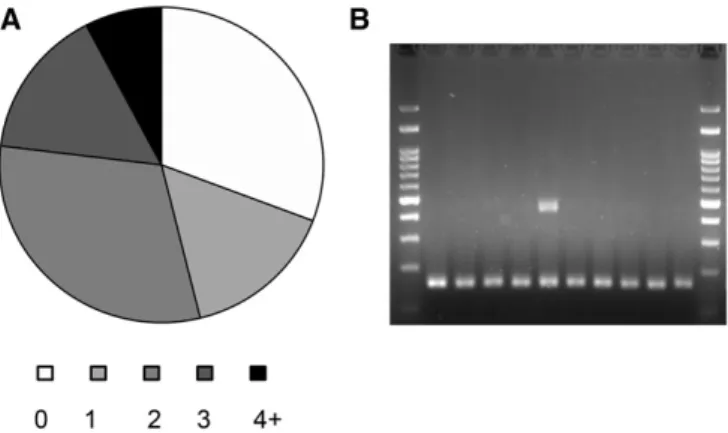
The appearance of identical events in the two independent S.cerevisiaelines is striking. The majority of events that appear in multiple strains are insertions mediated by direct repeats (29); 17 of the events are in SSR and 4 are template-switching events (see below). We analyzed 16 events that appear in multiple strains of which 13 were PCR-validated to appear in multi strains; one was identified to appear only in one strain, while another two events we analyzed were not resolved. Since events repeated in several isolates we hypothesized that the sites are prone to changes. To test this hypothesis, we streaked for singles colonies from subcultures zero andfive from both lines and randomly picked 10 colonies from each of the four, a total of 40 colonies. In 70% of the 13 cases, at least one of the picked colonies showed an alternative length of the PCR product. As can be seen in Figure 4B, we couldfind evidence for sectoring: both the original allele and an evolved one appear in a culture grown from a single colony isolate. Thus, these events are highly unstable and during subculturing they can appear and dis-appear (Figure 4). To the best of our knowledge, this is one of the first examples of how NGS data provide prediction to loci of struc-tural variability in the population.
rad27Δstrains show template-switching events
A template-switching mechanism where the replication fork pre-sumably hops between templates on two DNA strands results in the most interesting class of events. Template-switching medi-ated events were found at a total of 21 loci (File S1), of which 17 events were unique, and four events were detected in multiple strains. We verified by Sanger sequencing or PCR 15/16 unique template-switching events. The four template-switching events appearing in multiple strains were also verified as noted before. These events resulted in the following outcomes: (a) a cluster of SNPs and a combination of INDELs and SNPs that was formed by template switching between either the arms of imperfect IRs or quasi-palindromes, leading to the creation of a perfect IR or pal-indrome (10 events); (b) long insertions that were created by a combination of palindrome extensions and DNA amplification (six unique events, four events in multiple strains); and (c) palindrome Figure 5 Quasi-palindrome to palindrome correction in rad27D
expansion followed by exonuclease activity without DNA amplification (one event).
Quasi-palindrome is a palindromic or IR sequence that bears muta-tions in one of the arms. A simple example is59AGAACAxxxxTcTTCT 39 wherecshows a mismatch between arms andxrepresents a spacer base. A conversion of this quasi-palindrome to a perfect palindrome means an appearance of identical arms in inverted orientations, thus 59AGAACAxxxxTGTTCT 39. A mechanism of template switching resulting in a quasi-palindrome to perfect palindrome correction is illustrated in Figure 5. Two subculture 25rad27Δstrains are shown in Figure 5A. The top sequence is mutated and has a perfect IR with identical arms of 16 bp separated by a spacer of 1 bp. The bottom strain, which represents the original sequence, has an imperfect IR. The arms of the imperfect palindrome are different from each other in three points (one mismatch and a deletion of two bases, all of which are shown in large font in Figure 5). The most parsimonious way to explain how the top sequence originated is that the replication fork stalled and switched templates; the stalled replication fork folded back used the nascent DNA strand as a template. As shown in Figure 5B, replication starts using a template with the sequence of the bottom strain in Figure 5A. The newly synthesized strand replicates the tem-plate of the 39arm of the IR and then begins replicating the second arm but stalls. Next, the newly synthesized strand forms a secondary structure, resulting in a template switch, where the recently synthe-sized IR arm is used as the template (Figure 5C). Finally, the repli-cation fork realigns to the legitimate template (Figure 5D). At the end of this process, the bottom strand in Figure 5D would resemble the top and mutated strain in Figure 5A, but the top strand on Figure 5D would resemble the bottom and original strain in Figure 5A. At the next round of replication, two different daughter cells will be produced, one with and one without a perfect IR (as shown in Figure 5A).
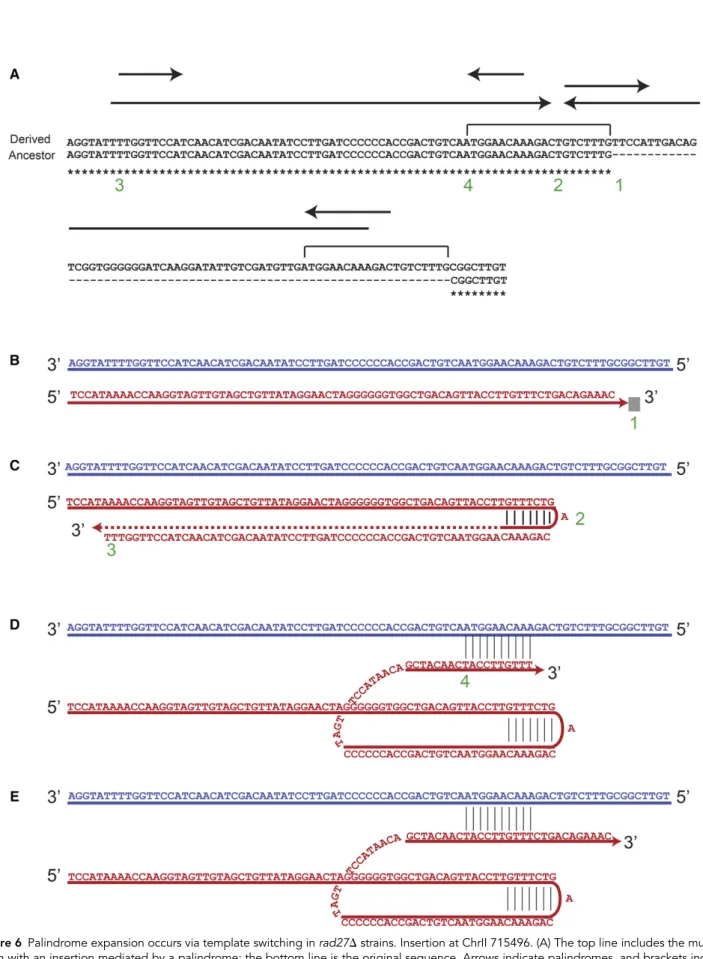
We also found template-switching events that caused DNA ampli-fication and extension of the palindrome. The ratio of the length between the palindrome or IR expansion and the amount of DNA amplification varied between the events, depending on the point where the replicated strand returned to the original template. In some examples, like in Figure 6, the palindrome expansion segment is bigger than the amount of DNA amplification, while in other events, like Figure 7, the opposite relationship was observed.
In Figure 6A, two variants of subculture 25rad27Δ strains are depicted; the top strain contained the mutated sequence, which in-cludes an insertion of 66 bp, the result of palindrome expansion. The bottom strain, which represents the original sequence, includes a pal-indrome of 15 bp with a center at point 2. The mechanism of mutation generation here is best explained by a folding-back mechanism that involves two steps of template switching. First, while replicating on a template with the sequence of the bottom strain, the replication fork is presumably blocked at point 1 (Figure 6B). The nascent strand is then folded back to the center of a small, 15-bp palindrome (point 2, Figure 6C) and synthesis occurs until point 3. After replicating a total of 55 bp, the nascent strand realigns back to the original template (Figure 6D) and replication resumes using the original template (Figure 6E). This transaction results in a 66-bp insertion and a short duplication. At the end of this process, the bottom strand in Figure 6E would resemble the top and mutated strain in Figure 6A, while the top strand on Figure 6E would resemble the bottom and original strain on Figure 6A. The next round of replication will result in two daughter cells with structures similar to the two forms in Figure 6A.
A similar event was found at theNNF2gene, nearARS727, and is shown in Figure 7. Here, a duplication makes up a larger part of the
insertion, although palindrome expansion is also involved. The top sequence in Figure 7A represents that of a mutated strain from sub-culture 25 with an insertion, and the bottom sequence in Figure 7A represents the original form prior to insertion and was found in the other subculture 25 strains. First, while replicating on a template similar to the bottom strain in Figure 7A, the replication fork stalls (Figure 7B, point 1 in Figure 7A). Next, the nascent strand folds back (Figure 7C, point 2 in Figure 7A) forming a stem loop structure due to imperfect IRs that are centered at point 2. DNA synthesis continues up to point 3 (Figure 7D). The fork realigns to the original template at point 4 (Figure 7E) and replication resumes (Figure 7F). At the end of the process, the bottom strand will resemble the top and mutated strain on Figure 7A, while the top strand on Figure 7F will resemble the bottom and original strain in Figure 7A. The next round of replica-tion will result in a daughter cell with the inserreplica-tion. We note that it is also possible that the fork does not return to the native template at point 4 but may fold back on itself a second time, using the short IRs (indicated in Figure 7A). In this case, the fork would realign to the original template strand at point 5. Both options lead to the same final sequence.
A fourth example of template switching without DNA amplification is shown in Figure 8. Two subculture 25 strains are shown in Figure 8A. The top strain represents the mutated strain including a palindromic insertion, and the bottom strain in Figure 8A represents the original sequence. Here, the original sequence includes 17 bases that are missing in the mutant strain. The most parsimonious explanation is that these 17 bases were deleted by an exonuclease during the process of palindrome expansion. Removal of these bases enables the newly synthesized strand to fold back and form a secondary structure thus switching template and replicating the same strand resulting in palin-dromic expansion. The process leads to a bottom strand similar to the mutated strain and a top strand similar to the original strain. The next round of replication will result in two daughter cells with these different genotypes.
Template-switching events through Saccharomyces evolution
DISCUSSION
rad27Δstrains have hotspots for changes
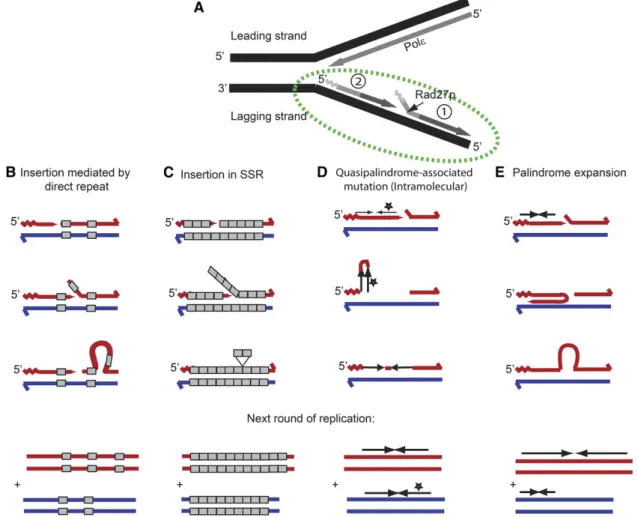
Rad27 is a key player in the assembly of Okazaki fragments on the lagging strand (Figure 10A). Insertions mediated by tandem repeats are common inrad27Δstrains (Figure 10B) (Tishkoffet al.1997). We found that there are genomic hotspots for these insertions in this
ge-notype. We note that a model of an insertion of one repeat unit in SSR is similar (Figure 10C), as the repeat can easily realign in multiple places. Figure 10B shows a model for an insertion mediated by a direct repeat, where realignment of the direct repeat in the wrong location enables the formation of a loop containing the unique sequence that forms the insertion in the next round of replication.
Figure 10 Models for the formation of the common events observed inrad27Dstrains. (A) Description of Okazaki fragment maturation. Primers produced by polymeraseaare shown in a light gray zigzag, and the extension by polymerasedis represented by a darker shade of gray. The predicted position where Rad27/FEN1 acts to remove the RNA/DNA primer in wild-type strains is indicated by the small black arrow. The junction between two adjacent Okazaki fragments is enlarged in B–E (green ellipse). (B) A model for an insertion mediated by a direct repeat, where realignment of the direct repeat in the wrong location enables the formation of a loop containing the unique sequence that forms the insertion in the next round of replication. (C) A model for an insertion of one repeat in SSR. We note that mechanisms B and C are similar, as the repeat can easily realign in multiple places. (D) An intramolecular template-switching model for the correction of a quasi-palindrome to a palindrome. The star indicates a change between the two copies of the IR. (E) A model for expansion of a palindrome through a template-switching mechanism. We suggest that the polymerase is stalled due to stabilization of theflap as a hairpin in the previously synthesized Okazaki fragment, or due to inefficient strand displacement. The polymerase continues synthesis using the nascent strand as a template. The red strand is the nascent strand and the blue strand is the original template strand.
Stalled replication forks in rad27Δstrains are resolved by template switching
The current view of Okazaki fragment maturation assumes a compe-tition between DNA polymerase and DNA ligase I on the 39OH of the nascent strand. In the absence ofRad27, the formation of ligatable nicks is severely reduced and thus the polymerase can rebind the 39OH and continue synthesis (Burgers and Kunkel 2017). Our results indicate that when the legitimate single-stranded DNA template is shrinking, the polymerase may switch to other available templates rather than continue and displace the downstream Okazaki fragment. This is in agreement with biochemical data suggesting that strand displacement by poldis minimal (Burgers and Kunkel 2017). Therefore, here we relate to the point where the template of DNA synthesis is no longer the original template as a point of stalled replication fork. It is possible that in vivo strand displacement can progress further than the point of template switching but the nascent DNA is processed by nuclease as described here in Figure 8 and by Jinet al.(2001).
The most powerful aspect of using whole genome sequencing in the study of mutagenesis is to reveal the contribution of the sequence context. Detecting that rad27Δ strains undergo template switching was only possible because of the use of whole genome sequencing. Moreover, a previous analysis of rad27null mutants was unable to detect these events (Serero et al.2014). Quasi-palindrome to palin-drome correction in one arm of an IR, which then serves as a template for the synthesis of the second arm, has been demonstrated in multiple organisms including bacteria and yeasts (Bzymek and Lovett 2001; Lisnicet al.2005). This phenomenon has been linked to both muta-tional hotspots (Roscheet al.1998; Viswanathanet al.2000) and ge-netic diseases (Bissler 1998). It was also shown that obstacles in Okazaki fragments, such as RNA residues in the DNA of DNA-RNA hybrids, can also lead to template-switching events (Kimet al.2013).
Either an intermolecular or an intramolecular template-switching model could be responsible for quasi-palindrome to palindrome correction (Ripley 1982; Lovett 2004). In the intermolecular strand switching model, the unpaired 39end of the nascent strand pairs with a single-stranded template on the opposite strand. AsRad27pis assigned to the lagging strand and acts when the leading strand should not contain any gaps, a mechanism of intermolecular strand switching is very unlikely, and we prefer a mechanism of intramolecular strand switching (Figure 10D).
A template-switching mechanism similar to that of a quasi-palindrome correction can also achieve quasi-palindrome expansion. In the absence ofRAD27, the legitimate DNA template can be blocked. Recent data strongly argue that the replication fork is dynamic and can adopt alternative templates when it is blocked to allow completion of DNA synthesis, even at the risk of a severe genome rearrangement (Leeet al. 2007; Weinertet al.2009). Here, at least two alternative templates can be proposed for strand misalignment at the border between the newly synthesized Okazaki fragment and the previous fragment. First, when RAD27is missing, theflap structure of the old Okazaki fragment can create a hairpin, preventing the strand displacement by pold(Figure 10E). Therefore, the newly synthesized Okazaki fragment will fold back and synthesize in the opposite direction. It was shown that palin-dromes can also be achieved when a double strand break occurs next to a short inverted repeat (Butleret al.1996; Rattrayet al.2005) or by origin-dependent IR amplification (Breweret al.2011). Forming longer palindromes can also be unstable (Butleret al.1996; Tanaka et al.2002; Breweret al.2011), and their formation is associated with gene amplification events that can promote or contribute to carcinogenesis (Narayananet al.2006; Tanakaet al.2007; Tanaka and Yao 2009).
In breast cancer, it was shown that palindrome formation is an early stage in gene amplification (Tanakaet al.2005; Tanaka and Yao 2009), often associated with poor prognosis (Guenthoeret al.2012). Similarly, in ourrad27Danalysis we found that palindrome expan-sion is primarily associated with DNA amplification. We note, how-ever, that gene amplification in cancer includes also events much longer than we can detect in ourrad27Dsystem. In a broader con-text, our data support a more frequent phenomenon of primer extension when the template is unavailable, presumably due to a stalled replication fork, that causes the polymerase to switch to the nascent strand and use it as the template (Leeet al.2007; Weinert et al.2009).
We also show the first evidences of perfect IR representation in orthologous regions through Saccharomyces evolution. Thisfinding suggests that a template-switching mechanism is important not only in instability conditions but also through evolution and normal organ-ism life.
Finally, our results provide a mechanistic insight. It has not been clear how the 39end of an Okazaki fragment transfers between the polymer-ase and DNA ligpolymer-ase. The fact that we observe significant template switching indicates that the absence of a natural DNA template does not serve as a signal for the polymerase to fall off and cease DNA synthesis. It is tempting to speculate that Rad27pitself may have a direct role in signaling for the switch between the polymerase and the ligase.
ACKNOWLEDGMENTS
We thank Margaret Dominska, Patricia W. Greenwell, Marina Druseikis, and Aseelnor Abedalkhal for their help with yeast subculturing. This project started at the laboratory of Thomas D. Petes at Duke University and was supported by National Institutes of Health grants GM24110 and GM52319. P.A.M. is funded by the University of North Carolina at Chapel Hill University Cancer Research Fund. S.C. is supported by the Research Career Devel-opment Award of the Israel Cancer Research Foundation. E.H.-C. was supported by the Israel Cancer Association grant 20150038 and by the Open University of Israel Research fund.
LITERATURE CITED
Altschul, S. F., T. L. Madden, A. A. Schaffer, J. Zhang, Z. Zhanget al.,
1997 Gapped BLAST and PSI-BLAST: a new generation of protein
database search programs. Nucleic Acids Res. 25: 3389–3402.
Bae, S. H., and Y. S. Seo, 2000 Characterization of the enzymatic
properties of the yeast Dna2 helicase/endonuclease suggests a new
model for Okazaki fragment processing. J. Biol. Chem. 275: 38022–
38031.
Bae, S. H., E. Choi, K. H. Lee, J. S. Park, S. H. Leeet al., 1998 Dna2 of
Saccharomyces cerevisiaepossesses a single-stranded DNA-specific en-donuclease activity that is able to act on double-stranded DNA in the
presence of ATP. J. Biol. Chem. 273: 26880–26890.
Bae, S. H., K. H. Bae, J. A. Kim, and Y. S. Seo, 2001 RPA governs
endo-nuclease switching during processing of Okazaki fragments in eukaryotes.
Nature 412: 456–461.
Bambara, R. A., R. S. Murante, and L. A. Henricksen, 1997 Enzymes and
reactions at the eukaryotic DNA replication fork. J. Biol. Chem. 272: 4647–4650.
Benson, G., 1999 Tandem repeatsfinder: a program to analyze DNA
se-quences. Nucleic Acids Res. 27: 573–580.
Bissler, J. J., 1998 DNA inverted repeats and human disease. Front. Biosci.
3: d408–d418.
Brewer, B. J., C. Payen, M. K. Raghuraman, and M. J. Dunham, 2011
Origin-dependent inverted-repeat amplification: a replication-based model for
Brudno, M., C. B. Do, G. M. Cooper, M. F. Kim, E. Davydovet al.,
2003 LAGAN and multi-LAGAN: efficient tools for large-scale
multiple alignment of genomic DNA. Genome Res. 13: 721–731.
Burgers, P. M. J., 2009 Polymerase dynamics at the eukaryotic DNA
rep-lication fork. J. Biol. Chem. 284: 4041–4045.
Burgers, P. M. J., and T. A. Kunkel, 2017 Eukaryotic DNA replication fork.
Annu. Rev. Biochem. 86: 417–438.
Butler, D. K., L. E. Yasuda, and M. C. Yao, 1996 Induction of large DNA
palindrome formation in yeast: implications for gene amplification and
genome stability in eukaryotes. Cell 87: 1115–1122.
Bzymek, M., and S. T. Lovett, 2001 Evidence for two mechanisms of
palindrome-stimulated deletion inEscherichia coli: single-strand annealing and replication slipped mispairing. Genetics 158: 527–540.
Danecek, P., A. Auton, G. Abecasis, C. A. Albers, E. Bankset al., 2011 The
variant call format and VCFtools. Bioinformatics 27: 2156–2158.
Frank, G., J. Qiu, M. Somsouk, Y. Weng, L. Somsouket al., 1998 Partial
functional deficiency of E160Dflap endonuclease-1 mutantin vitroand
in vivois due to defective cleavage of DNA substrates. J. Biol. Chem. 273:
33064–33072.
Gouy, M., S. Guindon, and O. Gascuel, 2010 SeaView version 4: a
multi-platform graphical user interface for sequence alignment and phyloge-netic tree building. Mol. Biol. Evol. 27: 221–224.
Guenthoer, J., S. J. Diede, H. Tanaka, X. Chai, L. Hsuet al., 2012 Assessment
of palindromes as platforms for DNA amplification in breast cancer.
Genome Res. 22: 232–245.
Harrington, J. J., and M. R. Lieber, 1994 Functional domains within FEN-1
and RAD2 define a family of structure-specific endonucleases:
implica-tions for nucleotide excision repair. Genes Dev. 8: 1344–1355.
Jin, Y. H., R. Obert, P. M. Burgers, T. A. Kunkel, M. A. Resnicket al.,
2001 The 39/59exonuclease of DNA polymerase delta can substitute
for the 59flap endonuclease Rad27/Fen1 in processing Okazaki fragments
and preventing genome instability. Proc. Natl. Acad. Sci. USA 98: 5122–
5127.
Johnson, R. E., G. K. Kovvali, L. Prakash, and S. Prakash, 1995 Requirement
of the yeast RTH1 59to 39exonuclease for the stability of simple
re-petitive DNA. Science 269: 238–240.
Jurka, J., 2000 Repbase update: a database and an electronic journal of
repetitive elements. Trends Genet. 16: 418–420.
Katoh, K., G. Asimenos, and H. Toh, 2009 Multiple alignment of DNA
sequences with MAFFT. Methods Mol. Biol. 537: 39–64.
Kim, N., J. E. Cho, Y. C. Li, and S. Jinks-Robertson, 2013 RNA:DNA
hybrids initiate quasi-palindrome-associated mutations in highly tran-scribed yeast DNA. PLoS Genet. 9: e1003924.
Kokoska, R. J., L. Stefanovic, H. T. Tran, M. A. Resnick, D. A. Gordeninet al.,
1998 Destabilization of yeast micro- and minisatellite DNA sequences
by mutations affecting a nuclease involved in Okazaki fragment pro-cessing (rad27) and DNA polymerased(pol3-t). Mol. Cell. Biol. 18: 2779– 2788.
Kunkel, T. A., and P. M. Burgers, 2008 Dividing the workload at a
eukaryotic replication fork. Trends Cell Biol. 18: 521–527.
Lee, J. A., C. M. Carvalho, and J. R. Lupski, 2007 A DNA replication
mechanism for generating nonrecurrent rearrangements associated with
genomic disorders. Cell 131: 1235–1247.
Li, H., and R. Durbin, 2009 Fast and accurate short read alignment with
Burrows-Wheeler transform. Bioinformatics 25: 1754–1760.
Li, H., B. Handsaker, A. Wysoker, T. Fennell, J. Ruanet al., 2009 The
sequence alignment/map format and SAMtools. Bioinformatics 25: 2078–
2079.
Lisnic, B., I. K. Svetec, H. Saric, I. Nikolic, and Z. Zgaga, 2005 Palindrome
content of the yeastSaccharomyces cerevisiaegenome. Curr. Genet. 47:
289–297.
Lovett, S. T., 2004 Encoded errors: mutations and rearrangements mediated
by misalignment at repetitive DNA sequences. Mol. Microbiol. 52: 1243–
1253.
Lynch, M., W. Sung, K. Morris, N. Coffey, C. R. Landryet al., 2008 A
genome-wide view of the spectrum of spontaneous mutations in yeast.
Proc. Natl. Acad. Sci. USA 105: 9272–9277.
Masuda-Sasa, T., O. Imamura, and J. L. Campbell, 2006 Biochemical
analysis of human Dna2. Nucleic Acids Res. 34: 1865–1875.
Narayanan, V., P. A. Mieczkowski, H. M. Kim, T. D. Petes, and K. S.
Lobachev, 2006 The pattern of gene amplification is determined by
the chromosomal location of hairpin-capped breaks. Cell 125: 1283–
1296.
Nick McElhinny, S. A., D. A. Gordenin, C. M. Stith, P. M. Burgers, and T. A.
Kunkel, 2008 Division of labor at the eukaryotic replication fork. Mol.
Cell 30: 137–144.
Nishant, K. T., W. Wei, E. Mancera, J. L. Argueso, A. Schlattlet al., 2010 The
baker’s yeast diploid genome is remarkably stable in vegetative growth
and meiosis. PLoS Genet. 6: e1001109.
Rattray, A. J., B. K. Shafer, B. Neelam, and J. N. Strathern, 2005 A
mech-anism of palindromic gene amplification inSaccharomyces cerevisiae.
Genes Dev. 19: 1390–1399.
Reagan, M. S., C. Pittenger, W. Siede, and E. C. Friedberg, 1995 Characterization of a mutant strain of Saccharomyces cerevisiae with a deletion of the RAD27 gene, a structural homolog of the RAD2 nucleotide excision repair gene. J. Bacteriol. 177: 364–371.
Rice, P., I. Longden, and A. Bleasby, 2000 EMBOSS: the European
molecular biology open software suite. Trends Genet. 16: 276–277.
Ripley, L. S., 1982 Model for the participation of quasi-palindromic DNA
sequences in frameshift mutation. Proc. Natl. Acad. Sci. USA 79: 4128–
4132.
Robinson, J. T., H. Thorvaldsdottir, W. Winckler, M. Guttman, E. S.
Landeret al., 2011 Integrative genomics viewer. Nat. Biotechnol.
29: 24–26.
Rosche, W. A., L. S. Ripley, and R. R. Sinden, 1998 Primer-template
mis-alignments during leading strand DNA synthesis account for the most frequent spontaneous mutations in a quasipalindromic region in
Escherichia coli. J. Mol. Biol. 284: 633–646.
Serero, A., C. Jubin, S. Loeillet, P. Legoix-Né, and A. G. Nicolas, 2014 Mutational
landscape of yeast mutator strains. Proc. Natl. Acad. Sci. USA 111: 1897–
1902.
Shen, B., P. Singh, R. Liu, J. Qiu, L. Zhenget al., 2005 Multiple but
dis-sectible functions of FEN-1 nucleases in nucleic acid processing, genome stability and diseases. Bioessays 27: 717–729.
Simpson, J. T., K. Wong, S. D. Jackman, J. E. Schein, S. J. Joneset al., 2009 ABySS:
a parallel assembler for short read sequence data. Genome Res. 19: 1117–
1123.
Stith, C. M., J. Sterling, M. A. Resnick, D. A. Gordenin, and P. M. Burgers,
2008 Flexibility of eukaryotic Okazaki fragment maturation through
regulated strand displacement synthesis. J. Biol. Chem. 283: 34129–
34140.
Strand, M., M. C. Earley, G. F. Crouse, and T. D. Petes, 1995 Mutations in
the MSH3 gene preferentially lead to deletions within tracts of simple repetitive DNA in Saccharomyces cerevisiae. Proc. Natl. Acad. Sci. USA
92: 10418–10421.
Tanaka, H., and M. C. Yao, 2009 Palindromic gene amplification–an
evolutionarily conserved role for DNA inverted repeats in the genome.
Nat. Rev. Cancer 9: 216–224.
Tanaka, H., S. J. Tapscott, B. J. Trask, and M. C. Yao, 2002 Short inverted
repeats initiate gene amplification through the formation of a large DNA
palindrome in mammalian cells. Proc. Natl. Acad. Sci. USA 99: 8772–
8777.
Tanaka, H., D. A. Bergstrom, M. C. Yao, and S. J. Tapscott, 2005 Widespread
and nonrandom distribution of DNA palindromes in cancer cells
pro-vides a structural platform for subsequent gene amplification. Nat. Genet.
37: 320–327.
Tanaka, H., Y. Cao, D. A. Bergstrom, C. Kooperberg, S. J. Tapscottet al.,
2007 Intrastrand annealing leads to the formation of a large DNA
palindrome and determines the boundaries of genomic amplification in
human cancer. Mol. Cell. Biol. 27: 1993–2002.
Tishkoff, D. X., N. Filosi, G. M. Gaida, and R. D. Kolodner, 1997 A novel
mutation avoidance mechanism dependent on S. cerevisiaeRAD27is
Turchi, J. J., and R. A. Bambara, 1993 Completion of mammalian lagging strand DNA replication using purified proteins. J. Biol. Chem. 268: 15136–15141.
Turchi, J. J., L. Huang, R. S. Murante, Y. Kim, and R. A. Bambara, 1994 Enzy
matic completion of mammalian lagging-strand DNA replication. Proc.
Natl. Acad. Sci. USA 91: 9803–9807.
Viswanathan, M., J. J. Lacirignola, R. L. Hurley, and S. T. Lovett, 2000 A
novel mutational hotspot in a natural quasipalindrome inEscherichia coli.
J. Mol. Biol. 302: 553–564.
Waga, S., and B. Stillman, 1994 Anatomy of a DNA replication fork
re-vealed by reconstitution of SV40 DNA replication in vitro. Nature 369: 207–212.
Wei, W., J. H. McCusker, R. W. Hyman, T. Jones, Y. Ninget al.,
2007 Genome sequencing and comparative analysis of
Saccharo-myces cerevisiaestrain YJM789. Proc. Natl. Acad. Sci. USA 104:
12825–12830.
Weinert, T., S. Kaochar, H. Jones, A. Paek, and A. J. Clark, 2009 The
replication fork’sfive degrees of freedom, their failure and genome
re-arrangements. Curr. Opin. Cell Biol. 21: 778–784.
Zheng, L., and B. Shen, 2011 Okazaki fragment maturation: nucleases take
centre stage. J. Mol. Cell Biol. 3: 23–30.