ROLE OF ONLINE TEACHING EXPERIENCE IN PEDAGOGICAL INNOVATION IN LIS EDUCATION: AN ACTIVITY-THEORETICAL ANALYSIS
Julia Khanova
A dissertation submitted to the faculty of the University of North Carolina at Chapel Hill in partial fulfillment of the requirements for the degree of Doctor of Philosophy in the
School of Information and Library Science
Chapel Hill 2013
ii
ABSTRACT
JULIA KHANOVA: Role of online teaching experience in pedagogical innovation in LIS education: An activity-theoretical analysis
(Under the direction of Dr. Gary Marchionini)
The study explored the role of online teaching experience in pedagogical innovation in the area of Library and Information Science (LIS) education. Based on the data from interviews with 25 LIS faculty who have relevant experience and from the syllabi for their courses, the study provides evidence that transitioning courses to online modality leads faculty to incorporate new teaching methods, technology tools and resources into their overall pedagogical repertoire.
The study applied Activity Theory framework in a novel way to conduct multi-level analysis of the teaching activity with attention to both activity structure and its context. Both individual and institutional cases are described in detail, using unified Activity Theory-based vocabulary. This analytical approach allowed the discussion of individual and institutional factors that drive pedagogical innovation. The study links innovation to changes in actions that comprise the teaching activity and suggests that innovative pedagogies are more likely to develop in the context of asynchronous online teaching.
iii
iv
DEDICATION
v
TABLE OF CONTENTS
CHAPTER 1 - INTRODUCTION ...1
Statement of the Problem ...1
Preliminary Studies ...4
Research Questions and Study Significance ...7
CHAPTER 2 – REVIEW OF LITERATURE ...9
Research on Online Teaching ...9
Instructor engagement in online teaching ...9
Developing and teaching online courses ...12
Theory and Practice of Instruction ...14
Theories of learning ...15
Theories of instruction ...21
Instructional design and technology ...25
Online technology and pedagogy ...27
Activity Theory ...30
Introduction to Activity Theory and its concepts ...30
Evolution of Activity Theory ...35
Applications of Activity Theory ...38
CHAPTER 3 - METHODS ...42
Study Design ...42
vi
Overview of study design ...44
Part 1 – Survey of LIS Faculty ...45
Participants ...45
Data collection ...45
Data analysis ...46
Part 2 – Case Studies ...47
Participants ...47
Recruitment ...47
Data collection ...48
Interviews ...48
Course syllabi ...49
Data analysis ...50
Case selection ...50
Individual case analysis ...52
“Meta-case” analysis ...54
Hierarchy of activity analysis ...55
Card sort ...56
Respondent validation ...58
CHAPTER 4 – RESULTS FROM PART 1 SURVEY ...59
CHAPTER 5 – FINDINGS RELATED TO RQ1 ...64
Approaches to Online Teaching...64
Classroom emulation ...64
vii
Illustrative cases ...69
Case 1 – “I wrote a book” ...69
Case 2 – Course co-evolving with online tools ...71
Case 3 – A move away from distance classroom ...72
Case 4 – Supporting learners’ exploration ...73
Summary case discussion ...75
Online Teaching approach summary ...77
Changes in Actions and Operations ...78
Operation-level changes...79
Action-level changes ...83
Institutional Context...85
Institutional “meta-cases” ...86
Institutional case 1 ...86
Institutional case 2 ...87
Institutional case 3 ...89
Institutional case 4 ...90
Institutional case 5 ...92
Institutional case 6 ...93
Discussion of institutional contexts ...94
CHAPTER 6 – FINDINGS RELATED TO RQ2 ...102
Whole Activity Changes ...103
Content and structure ...103
viii
Approaches to teaching ...105
Teaching Activity Component Changes ...106
Re-use of teaching materials ...106
Use of electronic resources ...107
Assignment changes...107
Online discussion ...109
Chapter Summary ...111
CHAPTER 7 – FINDINGS RELATED TORQ3 ...115
Pros and Cons of Online Teaching ...116
Course Fit for Online Instruction ...124
Hybrid Teaching Vision and Practice ...126
Flipped classroom model ...127
Hybrid teaching envisioned ...129
Hybrid teaching practiced ...130
CHAPTER 8 –DISCUSSION & CONCLUSIONS ...133
Current and Emergent Trends in Online Education ...133
Hybridization of teaching ...133
View of instruction as synchronous or asynchronous...136
The MOOC trend ...139
Study findings and existing online education literature ...141
Methodological Contributions: Application of Activity Theory Framework ...144
Combining Activity System and hierarchy of activity analysis...145
ix
Study Limitations ...147
Recommendations for Practice ...149
Recommendations for instructors ...149
Recommendations for academic institutions ...150
Future research ...152
Conclusions ...154
APPENDICES Appendix A – Questionnaire for Part 1 ...155
Appendix B – Interview questions for Part 2...156
Appendix C – Example of an Individual Case description ...159
Appendix D – Example of Institutional “Meta-Case” notes ...161
Appendix E – Physical Concept Map from Card Sort Analysis ...163
x
LIST OF TABLES
Table 1. Inclusion/exclusion of cases by institution ...51
Table 2. Partial survey data: Prevalence of online teaching ...60
Table 3. Variety of LIS courses taught online ...62
Table 4. Common operationalizations of teaching actions for online teaching format ....79
xi
LIST OF FIGURES
Figure 1. Basic Activity Theory diagram ...32
Figure 2. Hierarchy of Activity diagram ...34
Figure 3. Activity System diagram ...36
Figure 4. Application of Activity System diagram for the present study ...43
Figure 5. Activity System diagram for one of the cases ...54
Figure 6. Set of Activity System diagrams from one institution ...55
CHAPTER 1
INTRODUCTION
Statement of the Problem
Online education is arguably the fastest growing segment of higher education in the United States with steady annual increases in the rates of online student enrollment (Allen & Seaman, 2010). Two thirds of the national higher educational institutions offer online courses and, increasingly, fully-online degree programs (Allen & Seaman, 2007). The student demand for online education is on the rise and this trend is projected to continue into the foreseeable future (Hussar & Bailey, 2008). A more recent Horizon Report produced jointly by EDUCAUSE Learning Imitative1 and New Media Consortium2 also lists the paradigm shift towards online and hybrid learning as one of the key trends in higher
education and an important driver in the higher educational context (Johnson, Adams Becker, Cummins, Estrada, Freeman & Ludgate, 2013). Consequently, university faculty are
increasingly likely to teach online in addition to or instead of teaching in a traditional on-campus classroom, yet we have very little understanding of the impact online teaching has on pedagogical practice in higher education.
Despite the relative novelty of online education, there is a substantial and constantly growing body of research that attempts to keep up with the rapid growth in this area. As
1
www.educause.edu/eli
2
2
online education is becoming more commonplace, the research agenda shifts from proving that online education is a viable option to a more focused examination of specific dimensions of online teaching and learning. Of those, the practical reality of online teaching remains significantly underexplored.
Most of the research on online education can be categorized as research about online learning. It is student-centered, focusing on the learning process, learning outcomes and learners’ experiences in online courses. Comparing effectiveness of online learning to face-to-face learning in terms of academic achievement has been the major theme in this area with conclusive findings over the past decade that online learning outcomes are equivalent or superior to traditional classroom learning (Bernard et al., 2004; Means, Toyama, Murphy, Bakia & Jones, 2009). Student satisfaction with online learning and factors that contribute to it has been another important topic in online learning research. The main findings in this area are that students are generally satisfied with online learning, even if they rate the
experience less positively than classroom learning (Mentzer, Cryan & Teclehaimanot, 2007) with cognitive/learning style affecting perception of online course experience for some students (e.g., Liu, Magjuka, & Lee, 2008; Simpson & Du, 2004) and quality of interactions with instructors and peers being main contributors to satisfaction with online learning (e.g, Kazmer & Haythornthwaite, 2001; Drouin, 2008). Course technology has been shown to be another significant factor in online learning experience for students, particularly the usability of the course platform (e.g., Liao, 2006; Sun, Tsai, Finger, Chen & Yeh, 2008; Wu,
Tennyson & Hsia, 2010).
3
adopted for educational purposes. Studies of eLearning technologies range from detailed examination of custom-built experimental systems or interfaces to broad reviews of patterns of use of widespread eLearning tools. The latter are comprised of Course/Learning
Management Systems (CMS/LMS) (Morgan, 2003; West, Waddoups & Graham, 2006) and, increasingly, of the assorted common web technologies adapted for educational use (Conole & Alevizou, 2010; Crook et al., 2008). eLearning technologies are seen as having great potential for driving pedagogical innovation (Conole & Alavizou, 2010), but more research is needed into their impact on teaching practice.
Online teaching is probably the least explored area in online education research. Even those studies that examine specific instructional strategies and instructors’ behaviors (e.g., Anderson, Rourke, Garrison & Archer, 2001; Blingaut & Trollip, 2003; Brinkerhoff & Koroghlanian, 2007) present their findings from the students’ perspective. The faculty-centered studies more commonly address the factors affecting participation in online education (e.g., Birch & Burnett, 2008; Schifter, 2000, 2004; Shea, 2007). Most of the literature on online course development and teaching is prescriptive in nature (Xu & Morris, 2007), with a few research studies that are often framed from the administrative perspective (e.g., Covington, Petherbridge & Warren , 2005). The research on faculty experience of the process of online teaching and how it fits with their overall pedagogical practice is scarce.
Online education is driven by the interplay between technology, pedagogy,
4
functionality drive administrative and pedagogical choices. Finally, current social and technology trends drive a lot of students’ preferences and expectations as well as the definition of what learning is and should be.
As the prevalence of online education increases and new technologies emerge, the need for research in this area will continue to exist re-visiting previously examined topics and answering new questions. Examining the role of online teaching in driving pedagogical innovation is one of the questions that has not been addressed through research. This question ties together two main lines of eLearning research: online teaching and eLearning technology, with a focus on instructors as often neglected key players in educational system. Understanding online teaching from a faculty perspective and the impact it has on teaching culture and practice can be a useful contribution to both the theoretical discourse on online education and its practical implementation.
Preliminary Studies
This section provides brief summaries of the two studies that were conducted in order to explore online pedagogy from a faculty perspective and the factors that shape it. The emphasis is on the way the general research question has emerged from these studies as well as on the findings that support the overall approach to the present research.
5
collection with additional follow-up via email in some cases. The study explicated some of the specifics of the interplay between pedagogy, technology and institutional factors in shaping online course development and teaching. The findings suggest that institutional factors are the strongest drivers in selection and use of eLearning technologies, while decisions about course content, presentation format and pedagogical strategies are primarily driven by faculty with additional input by staff in various instructional support roles. That being said, most of the pedagogical and technological decisions were influenced by several interconnected factors, suggesting the need for a holistic approach to research in this area.
6
seen as an indicator of the tensions in the system that are important to the understanding the process and its outcomes.
One important theme that emerged from the interviews with faculty participants in both studies was that of substantial changes to the course objectives, content, assignments and assessments in the process of conversion to online teaching format. Most significantly, the faculty consistently talked about the ways these changes affected their pedagogical thinking and about incorporating some of the modifications to the course for online teaching into their on-campus teaching. The reported changes range from major revisions to course content that are applied across all sections of the course (online and face-to-face) to addition of new learning objectives that emerged from the online teaching experience, to replacement of the “old” assignments with the “new” ones developed for the online course, to
incorporating more web tools and resources in on-campus teaching. The latter includes replacement of classroom lecture with materials prepared for online course (in order to utilize class time for more intensive interactive teaching, an approach known as flipped classroom), inclusion of online discussion and collaboration tools to augment classroom instruction and an increase in the use of documents and media resources available on the open web (based on and expanding from those that have been used for the online version of the course).
7
one of their courses online to other courses in their pedagogical repertoire. Clearly the experience of moving and teaching a course online can have a noticeable impact on the overall pedagogical practice of participating faculty.
Research Questions and Study Significance
As demonstrated in preliminary studies described above, online teaching frequently leads faculty to incorporate new teaching methods, technology tools and resources in their overall pedagogical repertoire and to modify their approach to teaching. In other words, online teaching can act as a powerful catalyst in the process of pedagogical innovation. This process does not occur in a vacuum, but is very much embedded in the contexts of the educational institutions with different cultures, technology infrastructure and policies, which have significant impact on the pedagogical practice of the faculty members. The overarching goal of the study was to examine in the context-aware way the role of online teaching
experience in pedagogical innovation in higher education.
Specifically, the study was designed to answer the following questions:
1. What changes to the course are typically made in transitioning it from face-to-face to online teaching and how do contextual (institutional) factors influence this process?
2. Which online teaching technologies, resources and teaching methods get incorporated into face-to-face versions of the course?
8
3. Do faculty see any pedagogical advantages in handling specific aspects of teaching a course in one format vs. the other (online vs. face-to-face)?
In answering these questions the study aimed to make a meaningful contribution to our understanding of the contemporary pedagogical practice, and the place online
CHAPTER 2
REVIEW OF LITERATURE
Research on Online Teaching
As mentioned in the introduction, online teaching has received relatively little research attention to date, compared to online learning or eLearning technologies. The following sections summarize the existing research on faculty engagement in online education and faculty experience in developing and teaching online courses.
Instructor engagement in online teaching
One of the main foci of research about online teaching to date has been on the
motivating and inhibiting factors of instructor engagement in developing and teaching online courses. These studies typically rely on a combination of surveys and interviews of faculty members and college administrators and are rather consistent in their findings with little change over time. The key motivators/inhibitors identified in early studies (Rockwell, Schauer, Fritz & Marx, 1999; Schifter, 2000) are very similar to those that emerged in more recent studies (Birch & Burnett, 2008; Lloyd, Byrne & McCoy, 2012; Shea, 2007). The motivating factors can be primarily described as personal or intrinsic, while the inhibiting factors are mostly extrinsic, or having to do with the institutional policies and practices.
10
technologies, and expansion of pedagogical skills, as well as a desire for new challenges and for change in academic routine (Birch & Burnett, 2008; Rockwell, et al., 1999; Schifter, 2000, Shea, 2007). More mature faculty members are particularly motivated by the new pedagogical opportunities online teaching presents (Shea, 2007). The more pragmatic motivators include scheduling flexibility and convenience (Birch & Burnett, 2008), which was cited as the top motivator in the survey by Shea (2007), particularly for female and part-time faculty. The Institutional emphasis on online education is also emerging as a significant motivating factor (Parthasarathy & Smith, 2009).
The role of the institution becomes much more prominent in discussion of the inhibitors of engagement in online teaching. Increased workload, or more specifically, the extra time commitment required to develop and teach online courses is the most frequently cited barrier to engagement in online teaching (Birch & Burnett, 2008; Lloyd et al., 2012; Rockwell, et al., 1999; Schifter, 2000; Schifter, 2004; Shea, 2007). The time investment is of greatest concern when it comes to the development of online course for the first time offering or course redesign, a factor that intertwines with the perceived lack of recognition of this extra effort by administrators (Shea, 2007). Harasim (2000) notes that the initial
workload from new course preparation may indeed be considerable, but it reduces substantially by the second offering of the online course and becomes similar to that of teaching in a face-to-face classroom by the third offering. Yet, the need for the upfront time investment does act as deterrent for many instructors who do not want to take time away from research and other academic activities (Birch & Burnett, 2008).
11
deter many instructors from engagement in online teaching (Lloyd, 2012; Rockwell et al., 1999; Schifter, 2000). Faculty want to have sufficient technical support as well as some additional compensation in order to venture into online teaching (Marek, 2009; Schifter, 2000; Schifter, 2004; Shea, 2007). The compensation can be in the form of a course release (for new course development), overload pay, funding for special software, assignment of graduate assistants to help with the course development and teaching and financial support for relevant professional development including cost of conference participation. Inadequate financial compensation, particularly for new course development or course redesign, emerges as the topmost concern especially for younger and non-tenured faculty (Lloyd et al., 2012; Shea, 2007). In a recent study of LIS faculty engagement in online teaching, course release was cited as the most desired form of institutional support, followed by availability of formal training in the form of courses and workshops, as well as IT infrastructure and financial issues (Marek, 2009). Availability of these forms of support correlates highly with faculty confidence in ability to teach online and satisfaction with this form of teaching.
12
In summary, engagement in online teaching is determined by a number of personal and institutional factors. The list of these factors is consistent over time with some variation in significance of certain “motivators” and “inhibitors” of online teaching. Online teaching can offer instructors substantial flexibility and expansion of their pedagogical repertoires, but at the cost of significant commitment of time and effort that may not receive adequate
compensation and recognition. Institutional support of online teaching in various forms plays an increasingly important role as online education becomes more prevalent across higher education sector.
Developing and teaching online courses
From the preceding discussion of motivators and inhibitors of online teaching it is clear that the transition to online teaching from face-to-face classroom teaching involves substantial time and effort, as well as the development of new skills. It would seem logical that the nature of online course development and the teaching process should be the subject of research inquiry, but only a handful of published studies have addressed these issues. Course development has been addressed primarily in comparison of models (faculty-driven vs. project team-based) (Hawkes & Coldeway, 2002) or in more detailed analyses of
collaborative project-based course development and the faculty role in the process (Chapman & Nicolet, 2003; Hixon, 2008; Xu & Morris, 2007). The other, overlapping line of research inquiry is the analysis of the main functions and tasks of online instructors and how those compare to the more traditional instructor roles (e.g., Conceicao, 2006; Coppola, Hiltz & Rotter, 2001; Liu, Bonk, Magjuka, Lee & Su, 2005).
13
scale of the effort (e.g., single course vs. entire program), as well as institutional
administrative and technical support (Hawkes & Coldeway, 2002). Collaborative, project-based online course development is becoming more prevalent, especially for large-scale online programs, because the development process requires a variety of skills that are unlikely to all be present in one individual (Oblinger & Hawkins, 2006). The role of faculty in such efforts is often reduced to that of subject matter expert (Hixon, 2008), which may be incompatible with the tradition of academic culture. However, even with a team approach to online course development, faculty retain the role of course author (Xu & Morris, 2007).
The course designer role is just one of the many “hats” that faculty wear in online education. The 2005 study by Liu et al. examined the faculty perceptions of their key roles in online teaching using a four-dimension framework of pedagogical, managerial, social and technical roles. The respondents particularly emphasized their pedagogical roles: course designer, profession-inspirer, feedback-giver and interaction-facilitator. The course designer role was often seen in the context of “repurposing learning materials from the traditional classroom to online courses” (p. 34), and involved iterative refinement of course structure, material and assignment selection. The designer role is seen as tightly connected with both managerial (organizer and planner) and technical (media designer) roles.
The faculty experience of online teaching process is one of the least explored areas. In one of the earliest studies Coppola et al. (2001) attempted to understand the online
14
a facilitator and mentor, guiding students through learning rather than direct teaching. This is echoed in by Conceicao (2006), who examined perception of online teaching experiences by ten faculty members from different departments of a large university, as well as in more recent study of nursing faculty by Passmore (2009). The substantial shift of teaching role from presentation of information to discussion facilitation is one of the fundamental differences observed between traditional and online pedagogy (Dziuban, Shea & Arbaugh, 2005; Harasim, 2000; Passmore, 2009). Another important difference between traditional and online teaching that is typically reported in literature is a significant increase in the volume and quality of interaction with students (e.g., Conceicao, 2006; Coppola et al., 2001; Dziuban et al., 2005). Finally, as the respondents in qualitative studies (Conceicao, 2006; Coppola et al. 2001) note, online teaching comes with a greater emphasis on the need to plan and structure the course much more tightly than for face-to-face teaching, paying greater attention to organization and storage of information.
The shift from direct instruction to facilitation of learning while particularly prominent in online teaching is not unique to online pedagogy. Rather, teaching online particularly harmonizes with this general trend in pedagogical thought and catalyzes the incorporation of current pedagogical theory into teaching practice.
Theory and Practice of Instruction
15
Theories of learning
The main goal of teaching is to facilitate learning. Formal teaching has a centuries old tradition much of it rooted in explicit or implicit beliefs about how people learn that translate into general approaches to, and specific methods of, instruction. Teaching practice is inseparable from theories of human learning, from the “model of the learner” – a
generalized conceptual view of how a person learns (Bruner, 1985). Learning is commonly defined as a change in a person’s thinking or ability that persists over time and cannot be ascribed to simple maturation (Bigge & Shermis, 1992; Gagne, 1985; Tarpy, 1997). Theories of learning vary in perspectives on this change with some focusing on learning as an overt behavior and others seeing learning as the acquisition of knowledge, or more broadly, a change in the mental associations in the learner (Ormorod, 1999; Tarpy, 1997).
well-16
structured sequence (Biggie & Shermis, 1992). The early philosophy-based theories of learning continue to influence current teaching practice: contemporary instruction frequently rests on the Aristotelian notion of the experiential nature of learning or uses the Socratic method of teaching regardless of instructor agreement with its philosophical underpinnings.
The developments in psychology and formal education in the 20th century have led to the emergence of several empirically based theories of learning. The classification of these theories varies from author to author, but most draw a clear line between Behaviorism and non-behaviorist learning theories, such as Cognitivism, Social Learning and Constructivism (e.g., Bigge & Shermis, 1992; Halpern, Donaghey, Lamon, & Brewer, 2002; Kop & Hill, 2008; Ormorod, 1999). The main principles of these theories and their influence on pedagogy are summarized in the following paragraphs.
Behaviorist theories of learning originate from animal behavioral research and see human learning as a behavioral response to stimuli presentation that can be trained and conditioned. This is based on Skinnerian operant conditioning in which different stimuli, or reinforcements, are presented in response to a behavior in order to promote or reduce the likelihood of this behavior in the future (Ormorod, 1999; Winch, 1998). The learner is seen as a passive responder to stimuli with the instructor having full control over and
17
it is suitable only for certain learning scenarios (Ormrod, 1999) and overall more appropriate in training (shorter-term acquisition of specific skills and abilities) than in education, which is concerned with long-term preparation of an individual for life (Winch, 1998).
Just as the developments in behavioral psychology have produced behavioral theories of learning, the developments in cognitive psychology underpin several learning theories characterized by a focus on understanding the process of learning and its meaning to an individual. These learning theories can be collectively labeled as cognitive-interactionist (Bigge & Shermis, 1992). One of the key foundations of these theories is the view of human knowledge as a product of the assimilation of reality into the mind based on the work of Piaget (1970). This assimilation of reality occurs through active processing of information from the environment and organizing it into cognitive structures or schemas. The
18
concept of ZPD underpins several teaching methods from direct tutoring to various forms of building “scaffolding” to facilitate the learning process for students.
The notion of learning as a product of social interaction has been shaped into a formal Social Learning Theory (SLT) by Bandura (1976). The main postulates of SLT are that (a) learning is largely vicarious (based on observation); (b) information processing is based on a system of symbols and the human ability to visualize future events; (c) humans possess self-regulatory capacity (ability to control their behaviors). From these main postulates derives the idea that people serve as intentional and unintentional models of behavior. Learning occurs by observing and replicating modeled behavior. Bandura (1976) argued that
modeling is the only way to teach complex skills from language acquisition to performing a surgery. These ideas form the foundation for many specific teaching methods (Ormrod, 1999), particularly those based on the notion of interactive peer learning by working in small groups, known as collaborative learning (Slavin, 1995).
19
While there is a conceptual distinction between individual and social learning, the two interact and, over time, strengthen one another (Salmon & Perkins, 1998). Overall, contemporary discourse on learning is shifting from a focus on the formation of the
individual’s cognitive structures towards a focus on social forms of knowledge and the role of discussion in learning, converging on the unified social-constructivist view of learning (Palincsar, 1998). The interaction between the individual and social dimensions of learning is partially mediated by the students’ self-regulating capacity that makes them active
participants in setting learning goals and managing their own learning (Wolters, 2010). This is particularly true for adult learning, which is characterized by a high level of learner
independence and self-direction (Merriam, 1993).
The theoretical discourse about online learning in higher education is largely based on the assumption of a high degree of student self-direction and motivation and tends to “cluster at the collaborative, constructivist and cognitivist end of the spectrum” (Haythronthwaite, Bruce, Anrews, Kazmer, Montagure & Preston, 2007, p.5). Constructivist learning principles and social learning theory based ideas (e.g., interaction as the key to successful learning) form the main theoretical foundations for both design of online instruction and research into online learning (Chen, 2007; Hill, Song & West, 2009) as well as the growing number of published guidelines for online teaching (e.g., Swenson & Taylor, 2012).
Much of online learning can be explained from the perspectives of existing learning theories, but the special role of technology in online education has prompted calls for
20
attempt to capture the role of technology is the co-evolutionary model of technology and learning proposed by Andrews and Haythornthwaite (2007). They argue that over time the use of technology changes the ways of learning, but that at the same time pedagogy pushes new uses of technology. Another theory that focuses on the role of computer and
information technology in learning is connectivism (Siemens, 2004), which expands the socio-constructivist idea of knowledge residing not only with individuals, but with social entities and suggests that, in the digital world, knowledge can reside in non-human entities.
While useful for discussion of the role of technology in online learning, these and other theoretical models do not replace full-fledged learning theory because they cannot account for all the aspects of human learning (Kop & Hill, 2008). As Bruner (1985) observed, a learning theory or model can at best be an approximation of the reality of learning and different models can be useful under different conditions. Of existing theories and models, social constructivism is the most comprehensive theoretical base for
understanding human learning whether on- or off-line. Despite its conceptual appeal and dominance in contemporary educational literature, social constructivism is difficult to translate directly into teaching practice. The need for structure in formal education requires approaches that lie somewhere in the middle of the continuum between radical social constructivism and pure behaviorism (Jonassen, 1991). Indeed, the research into online course development and teaching suggests that pragmatic online pedagogy combines socio-constructivist elements with those rooted in the behaviorist teaching tradition (e.g.,
Bellefeuille, 2006; Puntambekar, 2006). This is consistent with observations that
21
pedagogical innovation may be accelerated in online education through the impact of
technology and the new ways of communication, distribution and construction of knowledge it affords.
Theories of instruction
If learning theories are concerned with understanding how learning occurs, theories of instructional design are concerned with how to facilitate the learning process and to achieve desired learning outcomes – the translation of learning theory into pedagogical practice. Instructional Design (ID) is a linking science connecting learning theory and the practice of instruction by prescribing methods for instructional development, implementation and evaluation (Reigeluth, 1983). Each of the ID theories and models offers a concrete set of recommendations for what should be done to achieve desired learning outcomes while describing some “instructional laws and regularities” (Landa, 1983).
22
Gagne’s work bridges the theory of learning and ID theory. He developed a set of very pragmatic principles of instruction that are primarily based on behaviorist learning theory and informed by contemporary understanding of the structure and functioning of human memory (Bigge & Shermis, 1992; Gagne, 1985; Gagne, Wager, Goals & Keller, 2005). Combined with Briggs’ work in developing instructional procedures (e.g., Briggs, 1968, Briggs & Wager, 1981), the Prescriptive Model of Instruction emerges as a broadly applicable framework for designing instructions (Aronson & Briggs, 1983).
23
The view of learning from the information processing and cognitive structure perspective underpins several ID theories that emphasize instructional design based on
utilization of the learners’ existing mental structures, meaningful organization of information, and teaching cognitive strategies (Ertmer & Newby, 1993). The Elaboration Theory of Instruction is one such theory focused on organization of instructional content at the course level by explicating the principles of selecting and sequencing content to optimize
achievement of learning goals (Reigeluth, 1983; Reigeluth 1999). Elaboration means continuous presentation of more detailed and complex version of what has been already learned. The theory calls for “specific example to general rule” sequencing for teaching skills or “general rule to specific example” sequencing for teaching domain expertise. Instruction is structured as a sequence of learning episodes that build upon each other by presenting progressively more elaborate concepts/principles/tasks and supporting content. Such structure is often seen in online courses.
Constructivist and social theories of learning in combination with developments in information technologies in the past two decades produced nothing short of a paradigm shift in instructional design theory (Reigeluth, 1999, Reigeluth & Carr-Chellman, 2009).
24
This concentric model builds around a problem/project that is to be selected from the practice domain wrapped into a supporting structure of a collection of relevant cases, access to
information resources and sets of cognitive tools. The latter include (1) knowledge representation tools, such as databases and modeling tools; (2) performance support tools, such as spreadsheet templates, that off-load repetitive tasks to free the learners to engage in higher order cognitive tasks, and (3) information gathering tools, such as search engines and intelligent information filtering agents, for support of project-related information seeking. Collaborative tools, such as email, discussion boards, and chats, support both co-located and distance work groups. The CLE model offers a unifying theoretical framework for several popular variants of problem/project-based instruction, such as Collaborative Problem Solving (Nelson, 1999) and has been used as a framework for designing online instruction (e.g., Morrison, 2003; Wang, 2009).
In the past decade, instructional theory development has compartmentalized to focus on developing theory and practice based guidelines for specific approaches to instruction (Reigeluth & Carr-Chellum, 2009), such as direct instruction (Kirschner, Sweller & Clark, 2006), discussion-based instruction (Murphy, Wilkinson & Soter, 2011) or problem-based learning (PBL) (Savery & Duffy, 1998). The utility of each approach depends on the instructional scenario, which includes the learning goals, the educational level and several other factors. Just like the theoretical views of learning have largely converged on social constructivism, instructional theory is converging on the set of general principles of instruction summarized by Merrill (2002):
25
Learning is facilitated when existing knowledge is activated as a foundation for
new knowledge.
Learning is facilitated when new knowledge is demonstrated to the learner.
Learning is facilitated when new knowledge is applied by the learner
Learning is facilitated when new knowledge is integrated into the learner's world
These principles offer a pragmatic fusion of elements of behaviorist, cognitive and constructivist instructional theories and can be applied to the design of instruction for different approaches (see Reigeluth & Carr-Chellum, 2009 for details) and for both classroom and online instruction.
Instructional design and technology
Instructional Design as a practical discipline historically precedes the instructional design theories described above, originating in World War II military training (Reiser, 2001b). Instructional design or instructional system design (ISD) was originally developed for narrow and specific skills training, but has been subsequently applied to general
26
educational setting with instructional designers playing an active role in developing online courses (e.g., Hixon, 2008; Xu & Morris, 2007).
Given its origins, it is not surprising that ID practice has been historically dominated by behaviorist instructional theories, particularly by Gagne’s work, but the past two decades have seen a shift towards a constructivist view of learning and thus instructional design practice (Dick, 1996; Gustafson & Branch, 2007; Reiser, 2001b). This shift to a
constructivist approach to ID has been accompanied by a number of other developments that significantly impact ID practice: (1) growth in the availability and use of electronic
performance support systems (information bases, expert systems, task automation tools); (2) the rapid prototyping trend as applied to the production of instructional materials; (3)
substantial increase in Internet-based learning (Reiser, 2001b).
Historically, the term instructional technology has been synonymous with
instructional media, the “physical means via which instructions are presented to learners”
(Reiser, 2007, p. 3), but the combination of rapid technological growth and development in educational sciences in the last decades of the 20th century have led to a broadening of the definition to include a full range of “technological processes and resources” that facilitate learning (Januszewski & Molenda, 2008). Instructional technology is thus an integral part of instructional design (Reiser, 2001a).
27
impact on instruction (Reiser, 2001a). Reiser notes that this pattern started to reverse in the mid 1990s due to a combination of factors: (1) rapid advances in digital technology and the emergence of the World Wide Web (WWW); (2) growing availability of these technologies for instructional purposes; (3) the interactive capabilities of new media; and (4) growing popularity of distance education via Internet in higher education. The above trends continued over the past decade with growing maturity of web-based tools, expansion in online course offerings as well as other e-learning options and corresponding expansion of IT infrastructure and its role in higher education accompanied by the emergence of new trends, such as the popularity of social networks (Brown & Green, 2010).
These technological developments have revived interest in social learning theories and the connection between media/technology and learning, coinciding with an increasingly constructivist tone of IDT discourse. From a cognitive-constructivist perspective,
educational technology is not a vehicle for instruction delivery, but a collection of tools that support knowledge construction, social aspects of learning and that facilitate reflection (Jonassen, Howland, Marra & Crismond, 2008). The connection between technology and instructional practice, the co-evolution of technology and pedagogy, is particularly salient in the realm of online education.
Online technology and pedagogy
Initially, the discussion of technology in online education was dominated by two themes: use of media for instruction and Course/Learning Management Systems
(CMS/LMS). Despite a plethora of guidelines for use of specific media for optimal
28
Means et al., 2009 for review of relevant studies). The research on CMS/LMS concentrated on adoption of these technologies by instructors and use of specific features in teaching practice, noting a dominance of preference for information delivery tools and functions (Conrad, 2004; Morgan, 2003; Dutton, Cheong & Park, 2004). Of the technologies designed for interactive and collaborative learning, threaded discussion tools were the only ones truly widely used (see Tallent-Runnels, 2006 for review), receiving corresponding research attention.
However, in recent years, evidence of a noticeable paradigm shift in the use of technology for education has emerged. Surveys of educators show growing interest in pedagogy dominated by problem-based learning and collaborative work and a declining role of lecture (information delivery) as an instructional strategy (Kim & Bonk, 2006). This is happening against the background of growing variety and ubiquity of Web 2.0 technologies that support user participation in social interaction, information aggregation and sharing, as well as collaborative knowledge creation and thus “harmonize with modern thinking about education” (Crook et al., 2008, p.4) that puts social constructivist learning as the cornerstone of pedagogical theory (Duffy & Bruns, 2006). The emerging practices of sharing, content production, communication and collaboration through blogs, wikis, social networks and media sharing sites (e.g., YouTube) as well as the abundance of online resources drive pedagogical changes (Conole & Alevizou, 2010).
At present, the discussion of the impact of Web 2.0 on pedagogy is largely
29
presenting evidence, albeit fragmented, from experimental and case studies of applications of these tools for instructional practice. These include studies of educational uses of wikis (e.g., Konieczny, 2007; Minocha & Thomas, 2007), blogs (e.g., Duffy & Bruns, 2006; Williams & Jacobs, 2004), Twitter (Ebner, Lienhard, Rohs & Meyer, 2010; Rath, 2011) and other
technologies (see Crook et al., 2008 for examples).
The affordances of current web technologies for constructivist-social learning are obvious, but the emergence of eLearning 2.0 (Downes, 2005) and the evolution of Pedagogy 2.0 (McLoughlin & Lee, 2007) are still largely theoretical. While virtual teaching
environments impose constraints on traditions (classroom lecture) modes (Jaffee, 2003), technology alone cannot create a shift from a knowledge transmission instructional model to a participatory knowledge building one (McLaughlin & Lee, 2007). As Beauchamp and Kennewell (2009) illustrate in their analysis of the use of a particular technology (electronic whiteboard) for instruction, there is a complex interplay between technological affordances and their utilization in teaching practice. While the “disjuncture between Web 2.0
technologies and current educational systems or teaching practices persists” (Conole & Alevizou, 2010, p. 43), there is general agreement in the field of education on the desirability of closure of this gap through changes in pedagogical practice.
30
Activity Theory
Introduction to Activity Theory and its concepts
The term activity theory refers to the line of theoretical and research work that originated from 1920-1930s Russian/Soviet cultural-historical psychology and was further elaborated on by a number of contemporary scholars (Engestrom & Miettinen, 1999). The theory fits within a broader socio-cultural analysis approach, which is cross-disciplinary in nature and addresses the complexities of real-world problems by explicating “the
relationships between human action, on the one hand, and the cultural, institutional and historical contexts in which this functioning occurs on the other” (Wertsch, 1998, p.24). Developed as an alternative and antithesis to Western behaviorism, activity theory has its roots in classical German philosophy, particularly Hegelian dialectics with its emphasis on the historical development of ideas, as well as in Marxist views of society and of
consciousness as products of engagement in activities (Jonassen & Rohrer-Murphy, 1999; Wilson, 2008). The main conceptual framework of activity theory was developed by
Leont’ev (1978, 1981) based on the ideas of his mentor and colleague Vygotsky. Conducting research to support the idea of a dialectic, mutually influencing relationship between
consciousness and activity Leont’ev showed the mediating role of signs, tools and
instruments used in activity (Zinchenko, 1995). As a result, Leont’ev formulated a number of principles that form a “coherent, if incomplete, framework comprising the foundations of activity theory” (Kaptelining & Nardi, 2006, p. 52).
31
functioning and interaction with the world, they differ in the main object of study. By expanding Vygotsky’s concept of mediating tools from purely psychological tools such as words, signs and symbols, to include concrete tools and objects of human activity as
mediators of the development of human consciousness, Leont’ev effectively shifted the focus from the study of consciousness to the study of activity itself (Zinchenko, 1995)
The two key concepts/terms of activity theory are activity and object. Since both words have multiple meanings in the English language depending on the context and domain of use, a terminological clarification is in order. Without clear understanding of the meaning of these terms in the context of activity theory, misapplication of the concepts or confusion with other common uses of these terms in everyday speech or in domains such as engineering and design is likely (Rogers, 2004). This can be particularly challenging since the
foundational activity theory works were written in Russian with explicit reference to German equivalent terms, which presents difficulty in translating into other languages such as English (Kaptelinin, 2005).
Leont’ev uses the term deyatelnost rather than activnost, both of which are translated into English as “activity”. The first means doing something consciously, “in order to
transform something” (Kuutti, 1996, p. 41), whereas the latter can mean any active process. Leont’ev (1978) is careful to clarify that activity is not behavior, nor is it a response to a stimulus, but rather a process through which “mutual transfers between the poles subject-object are accomplished” (p.50). He further emphasizes that this productive activity, which is specifically human, is carried on with tools and is social in nature. The tools or
32
people. As such, activity is a system with structure and internal transitions and transformations which cannot be considered in isolation from the social context.
According to Leont’ev, activity cannot be objectless, but is always directed at some object to satisfy a human need. Object in this context refers not to a material object, but is used in a broader sense of the “target or content of thought or action” (Kaptlelinin, 2005, p.6). In his writing, Leonont’ev (1981) stressed that the term was used not in the general sense of a “thing”, but in the sense of “something to which the act is directed” (p. 36). Emphasizing the dialectic, mutually-influencing relationship between the subject and the object, Leont’ev (1978) proposes a dual view of the object of activity: (1) something that exists by itself and transforms the subject and (2) product of activity of the subject.
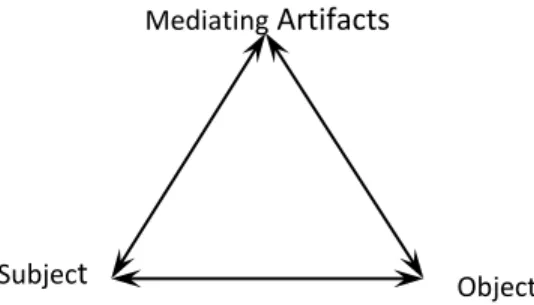
Having clarified the terminology, the basic activity theoretical framework can be depicted as a triangle connecting subject and object through mediating artifacts.
Figure 1. Basic Activity Theory diagram
This simple diagram clearly illustrates the connection between the main concepts of activity theory, which is not a predictive theory, but rather a descriptive framework for the study of human activity. This pictorial representation also emphasizes (by use of
bidirectional arrows) the mutual transformation between subject and object in the process of
Subject Object
33
activity, which is “considered the key source of development of both object and the subject” (Kaptelinin & Nardi, 2006, p. 32). Kaptelinin and Nardi also note that the relationship between subject and object is asymmetrical because, unlike objects, subjects have needs and possess agency, that is “the ability and need to act” (p. 33). The subject’s needs form the motives for activity. In fact “activity does not exist without motive” (Leont’ev, 1978, p. 62) and individual activities can be isolated for the purpose of analysis by the criterion of motives that elicit them.
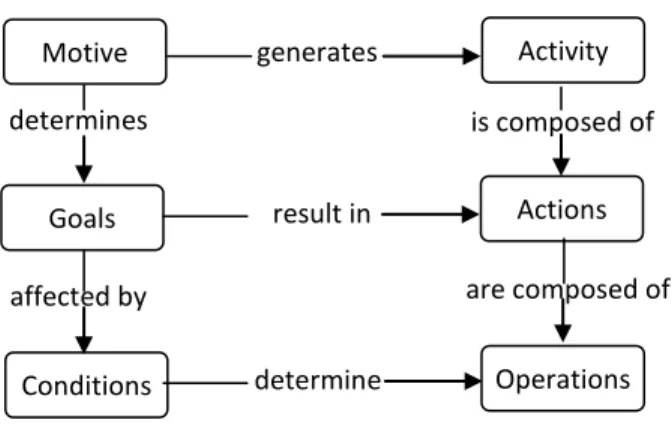
Recognizing the complexity of activity, Leont’ev (1978) proposes the systemic-structured view of activity as comprised of goal-directed actions, which are subordinate to the overall activity and its motive. The actions in turn, consist of operations, which are performed to complete the actions under existing contextual conditions for attaining the concrete goals. Leont’ev illustrates the relationship between components of activity by a simple example of a person travelling from point A to point B. This action (directed by goal of reaching point B) can be motivated by different needs (reasons for wanting to reach point B) and thus be part of different activities. Different methods of reaching point B (operations) may be employed depending on conditions. It is the motive for the overall activity,
34 Motive
Operations Goals
Activity
Actions
Conditions
generates
are composed of is composed of
affected by determines
result in
determine
Figure 2. Hierarchy of Activity diagram (based on Wilson, 2006)
This view of the structure of activity is aimed at facilitating analysis of the systemic connections within the activity as a single unit of analysis, not as a means of decomposing it into smaller elements (Leont’ev, 1978). This structural view allows dealing with the
dynamic nature of activity and its context, such as conditions changing, while the goal is fixed (Kaptelinin & Nardi, 2006).
The main conceptual principles of activity theory are summarized below (based on Kaptelinin & Nardi, 2006; Leont’ev, 1978 and Wilson, 2008):
Activity is object-oriented, that is directed at a real object and is guided by an
objective (motive).
Activity is mediated by tools, which can include both physical tools and mental
tools, such as language
Activity is hierarchical in structure as described by Leont’ev (1978) and
35
Activity is developmental, reflecting the evolutionary nature of human interaction
with the world and the importance of the cultural-historical context to understanding of human activity.
Evolution of Activity Theory
Activity theory is not a static set of postulates, but a developing framework in which some concepts get redefined and elaborated on (Kaptelinin, 2005). Engestrom (1999b) suggests that although Vygotsky’s work was primarily focused on the consciousness of an individual, his introduction of the basic subject – mediating artifact – object model can be seen as the first stage in developing activity theory. This makes Leont’ev’s work the second generation of the theory. Leont’ev (1981) regarded the view of an isolated human interacting with the objects in the world as artificial, so without changing Vygotsky’s basic model, he expanded the conceptual framework to include collective activity with emphasis on the division of labor as well as the historical evolution of an activity. In the past decades, several expansions of activity theory have been proposed, most notably, the widely adopted Activity System developed by Engestrom (1999a, 1999b), which he considers to be a third generation of activity theory and described in greater detail below.
36
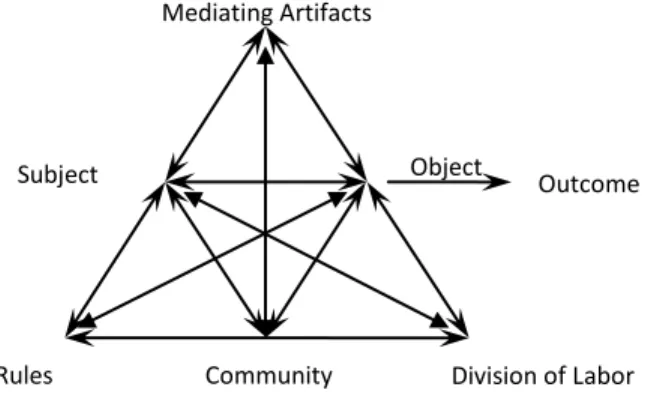
societal and collaborative nature of actions. The resultant diagram expanding the Vygotsky-Leont’ev triangle to include Rules, Community and Division of labor has become the most widely used activity-theoretical model.
Figure 3. Activity System diagram (Engestrom, 1999a,b)
It is important to note that these concepts, particularly division of labor, have been elaborated upon by Leont’ev (e.g., 1981) in his writings, so Engestrom’s expansion of the model is largely graphic rather than conceptual. Wilson (2008) clarifies that the rules can be formal or informal and set limits on activity being undertaken; community can mean immediate organizational unit or the broader society that a subject belongs to, while division of labor refers to task sharing and collaboration in performing the activity.
The more significant contribution of Engestrom (1999b) to the development of activity theory is introduction of the concept of contradictions in activity system, which he developed by going back to the Marxist foundations of activity theory. Four levels of contradictions in activity system are identified:
Subject Object
Mediating Artifacts
Rules Community Division of Labor
37
Primary contradictions, which are tensions within the components of an activity,
such as conflicting rules, incompatible instruments or other contradictions within each element of the activity system.
Secondary contradictions, which are tensions between the components of an
activity (e.g., stiff division of labor lagging behind possibilities presented by new tools).
Tertiary contradictions develop as tensions rise between the “old” activity and the
“new” activity as it evolves over time. These develop when a new, more culturally advanced object or motive is introduced in the dominant activity system, prompting changes.
Quaternary contradictions are the ones that exist between different activity
systems. This concept takes into account the existence of a network of “neighbor activates”, such as rule-producing or instrument-generating activities, connected to the main activity system under analysis.
In the educational research literature, Engestrom’s work is considered second generation activity theory, referring to Leont’ev’s work as the first generation (e.g., Roth & Lee, 2007). Kaptelinin (2005) notes differences between Leont’ev and Engestrom versions of activity theory in the definitions of Subject and Object. For Leont’ev, the subject is the individual who carries out the activity, albeit embedded in the social context, while for Engestrom the community collectively carrying out the action is the subject. The object of activity according to Leont’ev is motive or need; whereas Engestrom sees the object as production – what is being transformed into an outcome. These distinctions, while
38
illustrated in the following sections of this review showing applications of Engestrom’s activity system for both individual and collective subjects.
Applications of Activity Theory
Activity Theory is not a theory in the classical sense, but rather a descriptive tool for “interpretation of the individual, other people, and artifacts in everyday activity” (Nardi, 1996, p.8), a set of concepts for describing activity. As such, it offers a useful framework for any inquiry into practice and has been used in a number of fields of study such as
ergonomics, educational psychology, computer-supported collaborative work (CSCW), computer-mediated learning, and human-computer interaction (HCI) (Wilson, 2008). Activity theory has been applied in different ways. In the most basic application, select activity theory concepts are included among the theoretical foundations in designing
research, such as the study by Xu (2007) into interactive information retrieval or the recently published study of technology adoption by Sun (2012). The full set of activity theoretical concepts have been utilized in system development research (e.g., Collins, Shukla & Remiles, 2002; Kaptelinin, Nardi & Macaulay, 1999), including the design of instructional systems (e.g., Collis & Margaryan, 2004), although system-centered research tends to give primacy to tool mediation and related concepts. Finally, activity theory in the form of Engestrom’s Activity System has been used as an integrative framework for the analysis of complex problem settings, such as Spasser’s (2002) analysis of technology mediated
39
Considering the significance of Vygotsky’s work in both educational psychology and as a theoretical antecedent of Activity Theory as well as the fact that Engestrom’s Activity System has derived from his work in school education and workplace learning, it is not surprising that Activity Theory, particularly Activity System has become an increasingly popular framework for analysis of problems in educational settings. Many of these studies are framed as analyses of contradictions in the activity system or between systems. For example, Scanlon and Issroff (2005) use contradictions and tensions, particularly in the areas of rules and division of labor as explanations for observable behavior when analyzing several case studies evaluating the use of technology in higher education. Focusing on the view of learning (professional development) as a movement to a more culturally advanced activity through resolution of contradictions within the activity system, Forbes, Madeira,and Slotta (2010) present two studies of teachers’ development of curriculum design capacity and pedagogical content knowledge. Examination of contradictions between connected activity systems can be a powerful analytical tool as demonstrated by Meyers (2007) in the study of school libraries that examines tensions between library activity systems and teacher activity systems. The study identified a number of contradictions between the two, such as lack of a common object (“student finding information” in the library system vs. “student using information” in the teacher system) that resulted in problems in the practice setting. The study findings were used to develop interventions to resolve contradictions and to create commonality of goals between the systems.
40
community and division of labor). Grossman and colleagues (1999) were able to
demonstrate how the differences on those dimensions between the pre-service (coursework at a university) and in-service (student-teaching in a school) activity settings shape future teachers’ appropriation of pedagogical tools. The practical implication of the study is in laying foundation for interventions on the setting level. A similar approach was used in a study by Baran and Cagiltay (2010), who compared two virtual communities of practice that different sets of pre-service teachers participated in. Both systems had an object of
knowledge creation and sharing, but different community composition, division of labor and rules. Activity-theoretical analysis of these differences enabled the authors to draw
conclusions about the relative effectiveness of each system in achieving the objective of activity.
Tool mediation as a central concept in activity theory makes activity theory a
particularly suitable framework for research related to online education. For example, Berge and Fjuk (2006) analyzed the online meetings in web-based course using activity theory as a framework for distinguishing the roles of tools and rules in student activity and
41
the researchers to address questions such as how to describe the transformations that take place in educational workplace as a result of the dynamic relationships between technology and the stakeholders in an educational system.
CHAPTER 3
METHODS
Study Design
Overall research approach and scope of the study
The role of online teaching in pedagogical innovation that the study investigated is a complex and novel subject, suggesting use of an exploratory approach to research design with the goal to better understand this phenomenon. The main aims of an exploratory study are the discovery and analytical description of patterns within and around the phenomenon of interest. This calls for a structured, yet flexible research design with strong qualitative and interpretive analysis (Lincoln & Guba, 1985; Robson, 2002). Consistent with the tradition of education-related research, including eLearning, such analysis should recognize the role of context and account for contextual factors in the problem being studied (Hoadley, 2007).
43
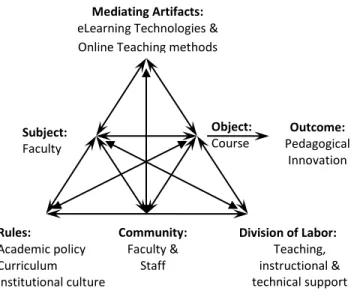
This inclusive interpretation of mediating tools is consistent with the basic tenets of activity theory (Kaptelinin & Nardi, 2006; Leont’ev, 1978) and has been used by other researchers, who include both tangible (technology) and intangible (pedagogy, instructional theory) tools in their analyses (Benson & Whitworth, 2007; Collis & Margarian, 2004; Lloyd & Irvine, 2005). All elements of the activity system for the purpose of the proposed study can be represented by the following diagram:
Figure 4. Application of Activity System diagram for the present study
Using activity theory as the study framework calls for a flexible multi-method research design and qualitative data analysis (Jonassen, 1999; Nardi, 1996). In terms of the general approach to research design, activity theory based studies are typically case studies: “empirical investigations of a particular contemporary phenomenon within its real life
context using multiple sources of evidence” (Robson, 2002, p. 178). A “case” in a case study can be an individual person or other entity, such as a group of people, an organization, a period of time and so forth (de Vaus, 2002; Robson, 2002). For the purpose of the present investigation, the boundary of an individual case was defined by a faculty member teaching a
Subject:
Faculty
Object:
Course
Mediating Artifacts:
eLearning Technologies & Online Teaching methods
Rules: Academic policy Curriculum Institutional culture Community: Faculty & Staff
Division of Labor:
44
particular course. Additionally, in order to address the contextual factors, groups of cases from the same context (academic institution) were examined together.
The study focused on cases selected from teaching in the field of Library and Information Science (LIS) in the United States. Given that the majority of LIS programs in the US offer either select courses or entire degrees in online format (Marek, 2009) this area of higher education provided a good pool of cases of interest. Moreover, the interdisciplinary nature of LIS as a field (Saracevic, 1999) translates into significant variety in courses taught and thus the study findings might be transferrable to a wider range of higher educational scenarios.
Overview of the study design
The study consisted of two parts: a survey and a series of case studies. Such a two-phase study design is not uncommon (Robson, 2002) with the survey two-phase serving to
establish some correlational patterns and provide a base for the selection of cases that display significant characteristics of the phenomena of interest (Miller & Salkind, 2002). The goal for Part 1 of the study was to capture the overall picture of involvement in online teaching by the study population and, more importantly, to provide the basis for selection of cases for detailed investigation. Part 2 of the study aimed to address the main research questions through Activity System framed case studies and additional qualitative analyses as outlined in the following sections.
45
research subjects. Any such adjustments were kept consistent with the general research plan and were guided by the desire to address the research questions in the best way possible, maximizing the use of available data.
Part 1 – Survey of LIS Faculty
Participants
Participants for the first phase of the study were solicited from the population of full-time faculty members of American Library Association (ALA)-accredited schools within the United States offering online courses/programs. The LIS schools/programs that offer any online education options (a total of 44) were identified from the most recent ALA-published directory of accredited programs (American Library Association, 2011). The full-time faculty members of these programs were identified from the program web sites. Faculty members listed on the institutional web sites as “full-time faculty” or “core faculty” were included in the list, for a total of 750 people. The email addresses published on institutional web sites were used to invite these individuals to participate in the study.
Data collection
46
was sent an individual email invitation to participate in the study with an embedded link to the questionnaire. To maximize the response rate, the survey invitation emails were timed to arrive at recipients’ mailboxes in mid to late morning mid-week during the academic session for most of the programs3. The questionnaire was left open for five weeks, with no new responses in the last 10 days the survey was open. No additional reminder emails were sent.
Data analysis
The quantitative data from the 315 questionnaires received was exported into Excel for further analysis. Of those, 20 questionnaires were incomplete and were excluded from further analysis, leaving 295 completed questionnaires. As this was exploratory research, the quantitative data from questionnaires was analyzed primarily by means of descriptive
statistics, which are reported in Chapter 4.
The questionnaire data was further analyzed for the purpose of drawing the sample of cases for Part 2 of the study. The questionnaire was designed to identify a sub-population with pedagogical experience relevant to the main research questions: those individuals who have combined experience in transitioning a course from face-to-face to online teaching and who continue to teach in both formats. The final question on the questionnaire asked individuals if they would be willing to be contacted for a follow-up interview. The 58 individuals who answered affirmatively comprised the pool of potential cases for Part 2 of the study.
3 Email invitations were sent on April 10, 2012, a Tuesday, falling about a month from the end of semester for